
Cook Local, Eat Global
Really Good Reading Material

Thanks to Kate, the Accidental Hedonist, I was guided to read the web-version of the recent issue of The Nation, a very well-written leftist political journal, which is all about food.
After checking out the link and getting caught up in reading the various articles therein, I wanted to give a little taste of it to my readers and urge them to have a look as well.
The issue opens with a few words from Alice Waters, the Berkley chef who has been at the forefront of the movement to change the way America eats for decades. In “Slow Food Nation,” she speaks eloquently about how we need to change from being a fast food nation into a people caught up in the joys of slow food, not only for our pleasure, but for the health and wellbeing of our bodies, our children, our environment and our nation.
Next up is a forum entitled, “One Thing To Do About Food,” edited by Alice Waters, that asks a disparate group of thinkers, writers, activists and farmers (Eric Schlosser, Marion Nestle, Michael Pollan, Wendell Berry, Troy Duster, Elizabeth Ransom, Winona LaDuke, Peter Singer, Dr. Vandana Shiva, Carlo Petrini, Eliot Coleman & Jim Hightower) to answer the question, “How do we fix our dysfunctional relationship with food? What one thing do you recommend we do to change the course of our diet and destiny?”
By far the best, probably most eye-opening pieces in the issue are “Hard Labor,” by Felicia Mello, which takes a long, critical look at the state of laborors on industrial organic farms and finds that their plight is often -worse- than on conventional industrial farms, and Eric Schlosser’s “Hog Hell,” which examines the mistreatment of workers in a hog slaughtering facility in North Carolina. These two hard-hitting articles open readers’ eyes to the fact that our industrialized food system, whether it is organic or not, is not only unsustainable from an ecological standpoint, and is hell on animals, but also contributes mightily to the mistreatment of human workers.That really gives us something to think about when we eat–do we care more for the environment or the comfort of animals or the health of our own children than we do about the health and well-being of the people who bring us our food?
This issue of The Nation is well worth reading and I urge everyone who reads here, lurks here, or just checks out my recipes to take a look at what these writers have to say on the issue of food. Because, as I have said from the beginning of this blog, food is more than what keeps our bodies going–it sustains our minds, souls and civilization as well. And how we think about food, and how we consume it has a larger impact on our world than most of us realize.
A Taste Of The Action in My Kitchen Today
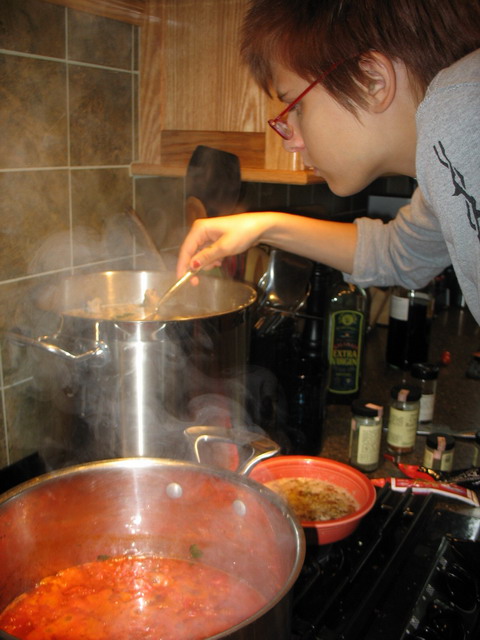
The photograph above gives a slight clue as to why there has been no post for the past two days: I have just been too darned busy.
Luckily for my readers, most of my busyness has been in the kitchen, though I have also been working on painting furniture for the nursery and working on Kat’s quilt.
And today, Morganna was a strong taskmistress in the kitchen–she got me up and motivated enough to not only make stock–which you see her skimming above, but to use our huge supply of tomatoes to make marinara for the freezer for after Kat is born, and make chicken and noodles for dinner with mashed potatoes, so that we could both feed Dan, who went to Columbus with Zak to pick up our rocker-glider for the nursery, and have leftovers for the freezer. (And we had two good meal’s worth of leftovers out of them–not to mention around twenty quarts of stock, two quarts of marinara sauce and chicken that we can use to make jambalaya for supper and for freezing later in the week.)
The Culinary Nerd gets very little rest…she is tireless in the pursuit of good food for her family. (I can only eat so much take out while recovering from childbirth, and so all of this work is very much worth it from my perspective.)
Needless to say–look for a big stock post on Tuesday. And maybe one about homemade marinara on Monday.
Tomorrow, I have some goodies from the blogosphere to share with you.
Until then, I leave you with this photograph–that also gives a look at the -other- action that happened in my kitchen today: Schmoo showing his unique way of getting a snack.

Silly Mooncat!
Greek Salad
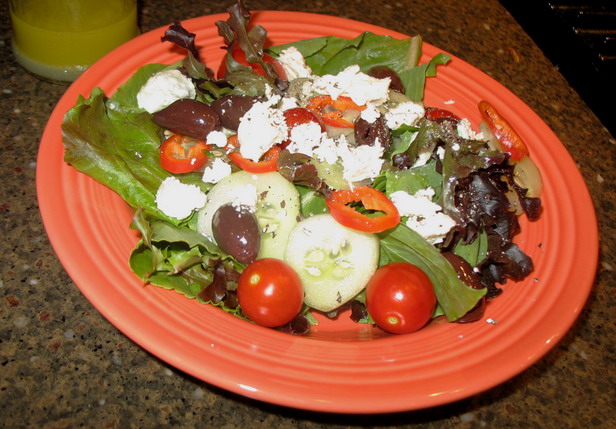
I love salads, especially in the summertime.
And they are so easy, so simple really, but I have found that often, the simplest recipes are the ones which can go the most awry if a careless cook takes “simple” to mean “I don’t need to give this any thought, and so I can just throw it together willy-nilly and it will come out okay.”
It won’t come out okay.
Salads, especially tossed green salads, require the freshest and tastiest ingredients, or else you might as well not take the time and effort to make them and eat them.
For instance, let us look at the often maligned Greek salad. Found on take out menus from gyro huts to pizza places to sub shops, the Greek salad most of us are familiar with is a very sad thing indeed, a pale ghostly imitation of what it could and should be.
Wilted iceberg lettuce freckled with flecks of brown funk mixed indifferently with bottled “Italian” or “Greek” dressing made of some sort of vegetable oil that never saw an olive in its existence, and acetic acid standing in for vinegar is garnished with a couple of tasteless California black olives, some indifferent blobs of briney American feta cheese a few slices of dried out cucumber and a wedge or two of pink, crisp, watery hothouse tomatoe sits in a slimy mess in a take-out container and is a mockery to any good self-respecting salad.
I don’t eat that crap, and I don’t suggest that anyone else should, either.
What makes a salad Greek, according to the lady who made the moussaka I ate a couple of times a week while I was pregnant with Morganna, isn’t the olives, or even the feta, though they help, but the quality of the greens, and the dressing. And she swore to me that she and everyone in her family preferred to make their dressing with nothing but olive oil, lemon juice and salt with a good cranking of black pepper. She said that the lemon was a “sweeter sour” than vinegar, which she claimed was too harsh to go on a salad that was to go with her moussaka. (Some people insist on oregano or mint in the dressing, she said, but she liked it best plain.)
Of course, she also used good greens–romaine, usually, but also butterhead lettuces, and real Kalamata olives, and wonderful feta cheese that was just salty enough, but not too salty. She also used homegrown tomatoes in the season, and crisp cukes, but would also use hothouse tomatoes in the winter. At least she grumbled about them.
So, I pattern my Greek salad after hers–and like her, I prefer my dressing to be very plain. I just use salt, good olive oil and lemon juice in it, and it dresses the mixed greens, fresh homegrown tomatoes, Hungarian hot wax peppers, Kalamatas, cukes and Mt. Vikos feta cheese perfectly.
The recipe for the dressing is so simple, I am going to give it as a formula, not even a recipe. This way, you can scale it to whatever amount you want.
Take 1 part lemon juice and 3 parts good olive oil, and put them into a sealable jar. Shake well to combine. Add salt and freshly ground black pepper to taste, and shake again. (A part can be any unit of measurement–ounces in weight or volume, or tablespoons or increments of a measuring cup. Just keep your proportions the same no matter what size measure you use so that there is three times more oil than lemon juice, and the dressing will come out beautifully.)
That is it, folks.
As for the salad itself–use a good mixture of excellent, fresh greens, garden fresh vegetables and maybe some minced fresh herbs, and use this simple, delicious salad dressing and you will make an awesome salad.
Add kalamata olives, the rich, ripe purple-black brine cured olives of Greece, and some of the very milky, lightly salty Mt. Vikos brand (or your favorite brand, for that matter) crumbled feta and sprinkle them all over the salad before tossing it, and you have a wee bit of heaven in a bowl.
Eat a large bowl of this alongside a small portion of moussaka, to balance out the saintly food with the sinful.
Besides, they taste really, really good together.
Kids and Food in the News Again

I noticed a few stories here and there about kids and food as I perused various news outlets and thought some of them were definately worth bringing to the attention of the blogosphere.
The first one is rather interesting, at least to a former and soon to be again, breastfeeding mother, though technically, it is not from a news story, but from one of the Washington Post’s blogs:
US Government Says Breastfeeding is Best for Babies, but the TSA Isn’t On Board
From Leslie Morgan Steiner’s “On Balance” a work/life blog from the Washington Post, we hear how the TSA is making travel difficult for breastfeeding mothers who bring along breastpumps and breastmilk without a baby or toddler in sight.
Okay, obviously, no one at the TSA has read the US Government’s advice that breastfeeding is the best way to feed infants. And, obviously, no one has told them how breastfeeding works, nor why a woman would travel with a breastpump and no baby. And obviously, no one at the TSA is a breastfeeding mother or is or has been married to one. Because these folks are clueless, and they are making more obstacles for breastfeeding women who are travelling sans baby.
Why would a woman travelling without a child want to carry a breastpump and her saved breastmilk in little containers kept cold with blue ice (which is also now contraband, because it melts to a liquid/gel form)? Well, if one is travelling without the baby, the breastpump comes along because the breasts only make milk so long as there is demand, so pumping keeps up the supply. Breast pumps also keep working Moms who travel without their babies from developing painfully engorged breasts which can turn into cases of blocked milk ducts and mastisis, which are painful health conditions.
Besides, why would a breastfeeding woman -with- a baby carry expressed breast milk in a cooler, when she has the perfect container for breastmilk -on her person- in the form of breasts? It doesn’t go bad in the breast, it is never past the “use by” date, it doesn’t need to be warmed up so the kid’s tummy doesn’t get a shock from cold milk and it is sterile! What more can you ask for? If she gets engorged, there is the baby right there to help her out–no need for the breast pump!
DUH!
And why would a woman want to keep the milk she pumps?
Because it is good for her baby. Duh. Because she can ship it to where her baby is to feed it while she is away. Because, for some women who have supply problems, it is not that easy to come by. Because it is just plain wasteful to dump it if you don’t have to!
TSA–ask not for whom the clue phone rings–it rings for thee. Please take your collective heads from your collective rears and pick up the reciever of the clue phone and take the call.
Because it really is silly for one branch of the government to tell women, “Breast is best!” while another branch of the government is saying, “You gotta pour that breastmilk out, it could be liquid explosives.”
Oh, and that breastpump is weird looking. It could be a bomb.
(It is comforting, however, to know that the TSA is not alone in their ignorance. For an eye-opening look at human ignorance about breastfeeding mechanics, check out the comments after the entry. Warning–there are LOTS of comments, and many of them are infuriating, on both sides of the issue–some breastfeeding advocates come across as snidely superior, while most of the detractors come across as ignorant twits. Not very many people show themselves in a good light in that discussion.)
Teens With a Drinking Problem: The Frappucino Generation
So from infants and their needs, colliding with the security ideals of the TSA, we go to teens and their eating, or rather, drinking habits. From Salon.com, a rather shrill and alarmist article about teens and Starbucks tells us that kids are flocking to Starbucks because it is a safe place to hang out without being shooed away by the staff, because it makes them feel grown up, and because they like sugar and fat laden coffee drinks.
I am tempted to say “Duh” again, however, I don’t want it to turn into a Greek chorus sort of refrain.
The main gist of the article is that Starbucks says they are not marketing towards teens, but the author says they are. The evidence given to back this up is slim–the author notes that the frappuccino and other sugary drinks appeal to teens. The problem with that theory is that they also appeal to a lot of adults, and in truth, I have seen more adults drinking them than kids.
How many adults eat Happy Meals as compared to kids? Eh? See what I mean?
The other objection to kids drinking Starbucks is that some teens apparently drink sugary, fatty coffee instead of eating breakfast or lunch.
Once again, can you hear the Greek chorus in your head?
Teens skip meals. They eat junk food. That is what they do.
Of course it is upsetting. Of course it isn’t good for them. Of course nutritionists (and parents) are going to squawk over it. But does that mean we need to get pissed at Starbucks over what teens do naturally?
But when you compare it to kids who eat tons of junk food and soda for every meal and are getting obese–yet another current media obsession, and with good reason, considering the health consequences of extreme obesity at a young age–coffee substituting for a meal or two doesn’t get my dander up that much. I don’t know why.
Making a case that Starbucks is bad for teens is just–well–not much of a case. As some commenters on Salon pointed out, teens are engaging in adult behavior by going to Starbucks where they can write poetry and people-watch, and hang out safely with friends (instead of driving around aimlessly, sneaking off to drink beer and have risky unprotected sex) , and they are being rewarded for this adult behavior. So what if they drink some coffee while they are at it? Don’t we want our teens to make adult, responsible decisions?
Or would we rather they cruise around in their cars drinking beer or something? I mean, really.
Video Games to Help Curb Childhood Obesity?
From the Fort Wayne News-Sentinel, we have a report of various ways educators are hoping to teach kids better eating and exercise habits. Some of these programs are funded by the federal grovernment as part of a U.S. Department of Agriculture program called The Expanded Food and Nutrition Education Program
Baranowski led a research group that developed a multimedia nutrition game and tested how effective it was with fourth-grade students. After playing twice a week for five weeks, the youngsters increased their daily fruit, juice and vegetable intake by an average of one serving a day more than other students.
In Baranowski’s “Squire’s Quest!” game, aspiring knights earn dragon-scale points by vanquishing slimy snake and Mog mole invaders who try to destroy the kingdom’s fruits and vegetables. With the help of a wizard mentor and a castle robot named Mad Maxie, students take on adventures that allow them to gain skills and set goals related to consuming more fruit, 100 percent juice and vegetables.
Okay, so kids eat more veggies, fruit and juice after playing these games. That’s cool.
But, I have a novel idea to help fight childhood obesity that also involves play:
How about bringing back recess, compulsory physical fitness classes and get those kids off their duffs and onto the playground?
It isn’t just what they eat and how much of it they eat–it is the fact that many of them get no exercise. And uh, video games–for as much as kids love them–burn about -3 calories per hour of play. And too many kids play too many video games already.
Whereas a good game of tag, dodgeball or a long session of double dutch rope skipping burns hundreds of calories, and–get this–is -fun-.
When schools started cutting recess and phys ed in favor of academics, educators went the wrong way, and have actively contributed to the childhood obesity problem in our country.
So, hey, great–teach kids how to cook and what to eat with hands-on classes, get them playing nutrition-based video games–but also get their heinies in gear and get them moving!
That’s it for this week’s installment of food (and kids) in the news. Look for another Greek recipe tomorrow!
Photo credit: That, my friends, is a photograph of Morganna when she was about 18 months old, peering over the back of her carseat before we put it and her in the car. Wasn’t she a cutie?
Making Moussaka
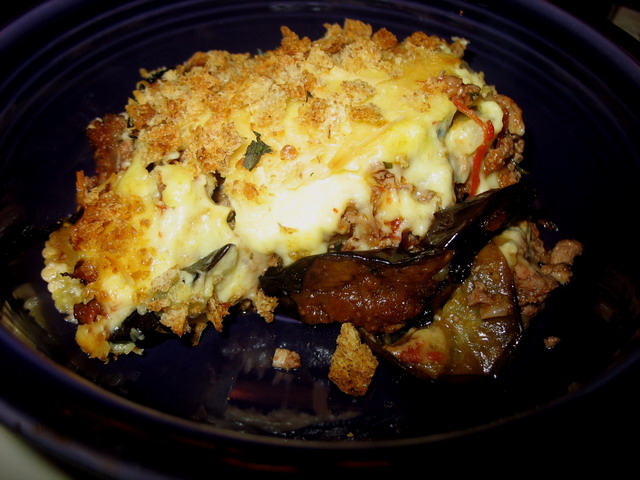
When I was pregnant with Morganna, there was one dish I craved continually, and for a while, I ate it at least twice a week.
Moussaka.
For those who have never had moussaka, it is generally considered to be a Greek dish, though, in truth, there are versions of it from Turkey, and the Balkan states as well. The Greek version is a casserole of sliced fried eggplant, layered sometimes with potatoes and maybe zucchini, a tomato and ground lamb sauce spiced with a hint of cinnamon and some garlic, and then topped with a cheese and egg-enriched bechamel sauce. (I know that I have talked bad about bechamel here in the past, and I still stand by my assertion that plain bechamel is the most boring sauce known to humankind, but the Greek version, which has all sorts of goodies added, is fantastic. Rich, but fantastic.)
When I was pregnant with Morganna, I always bought some at the local little Greek place in the mall in Charleston, and it was usually accompianied by dolmathes (rice and lamb stuffed grape leaf rolls) and spanikopita (phyllo pastries filled with spinach, mint and cheese). No matter what I ordered to drink, the owner, a lovely older lady, would give me milk (it got to be a joke between us) and usually, she threw in an extra spanikopita, or a little sweet, like a tiny piece of baklava.
She would fix me with a stern eye, and tell me, “You are carrying high–you will have a girl. That is good, all I have are a bunch of big useless boys.” This statement was usually aimed at one of several of her very large sons who worked in the kitchen, patiently layering phyllo and fillings, or pulling huge pans of moussaka and pastitsio out of the ovens. Far from useless, the young men would all laugh, and when addressed thus, would invariably stop what they were doing and give Mamma a hug and a kiss; obviously, this affectionate nature was what made them “useless,” for she would flap her apron at them, and give them a light cuff on the shoulder or hip.
“Back to work,” she’d say with a fond grin. “See what I mean–useless–they are always finding ways to get out of thier jobs.”
When I woke up yesterday with a hunger for moussaka, I was sad to know that I couldn’t just head out to the mall and buy a piece from my old friends. Not only because I would not get to see them, but because that meant I had to make it myself. Which is fine–I don’t mind, but it isn’t a simple recipe.
One must cook the eggplant, and if one uses potatoes (I always do), one must par-cook those. One must make the lamb sauce and the bechamel, and then one must put them all together, and bake it.
The results were worth it, however, and I made enough that I had some to freeze for after Kat’s birth, when I will be nursing and voraciously hungry and unwilling to take the time to make such an involved recipe.
There are a few notes I would make about moussaka, before going into the recipe:

One–if you want to lower the fat content of the dish, either grill, roast or broil the eggplant instead of frying it. Fried eggplant sucks up olive oil like a sponge. You -can- dust the eggplant with flour before frying in an attempt to forstall the soaking up of the oil, but it won’t do much. The best you can do if you fry the eggplant, is have your oil heated up all the way before putting the eggplant in the pan–this will help it start cooking right away and will cause it to soak up minimal oil.
That said–I like the way that fried eggplant tastes, so that is how I do it.
Two–traditionally, one uses the big European/Middle Eastern eggplants for this dish, but I do not. There are several reasons for this. One, is that in order to purge bitterness from the large eggplant, one must slice it and then sprinkle it liberally with salt and let it “weep” for about twenty minutes to a half an hour. Then, one blots the resulting liquid from the surface of the eggplant with paper towels, and then goes about frying it.
With the little, skinny Asian eggplants that I use, one can avoid this step completely. They are so small, sweet and not as watery, that one need not purge them. They are fine without this step.
The other reason I use them is because they are the eggplants my CSA folks grow, so I have tons of them right now.
Three–one can use canned tomatoes in the lamb and tomato sauce business, but at this time of year, when my kitchen is inundated with tomatoes, why do that? It is silly. If you want to use canned tomatoes, then use them–just make sure you use somewhere around 3-4 cups worth of them, and recognize that there will be a lot of liquid to simmer away.

What kind of tomatoes did I use? Well, I could have used big plum tomatoes–they are coming into season now, but instead, I used a pair of huge beefsteaks. All I did was peel them, and seed them, then chopped them roughly. They were full of flesh, juice and flavor, and they made the sauce delicious, especially when combined with the dry red wine and the concentrated tomato paste. To seed fresh tomatoes, just peel them by whatever method you prefer, core them, and then slice them in half horizontally–across the equator fo the tomato. This exposes the seed capsules. With your fingers, dig out the seeds and dispose of them down the sink–not too fussy, not too messy, and very quick. Then, chop the tomato up, and you are done.
Four–the enriched bechamel. Technically, this sauce is supposed to be made with Greek kefalotiri cheese–a hard, dry aged cheese that is salty and easily grated. Well, that cheese is not so easily found in the US, so most Greek-Americans I know of use good parmesan instead, and that is what I used. In fact, in all of my years of eating moussaka, which has been many, I don’t think I have ever had it with the actual cheese of choice, and have only had it with parmesan. (Some recipes add sharp cheddar to the sauce–and as much as I love sharp cheddar, I must put my foot down and say no to its involvement in moussaka. It has no place there–the flavor is too strong.) Now, my version of the sauce is pretty rich–because I added the cup of cream. That is because I didn’t have three cups of milk, but only two. If you have three cups of milk and that cream scares you, use the milk, skip the cream, and make yourself happy. However, I will also say that I reduced the number of egg yolks from four to three, so you might want to add that extra yolk if you forgo the cream, in order to make a flavored bechamel with the right amount of body, and the proper silken texture.
Five–the breadcrumbs–I made my own from some stale whole wheat Itialian bread from the bakery down the road. They were great, and really added a nice crunch to the topping. Breadcrumbs from a tin–they are not as good, and don’t really add much to the recipe, so I say, if you want crunch, make your own, if you don’t care, leave them out.
Six–the meat. Lamb is the most traditional meat, and my favored one. Beef is a distant second in my book, because it lacks the succulence of lamb. I bet veal would be good, but I haven’t tried it. A poster asked if they could use ground pork–I don’t see why not, though I have not done it myself, and it would not be traditional at all. Finally, you can use ground chicken or turkey, but I don’t suggest, because it lacks a lot of flavor. It might be able to be made good, but I am not sure how. Maybe you could mix lamb half and half with fowl and make a lower-fat option that way. (Really, this is not a low-fat dish, and trying to make it that way rather misses the point. Just eat it now and again and make it taste really good instead of monkeying about with it and making it lower in fat, but maybe not so good.) Oh, and one more thing about the meat–I add more aromatics to mine than most people do, but I like it that way. The addition of fresh herbs, Aleppo pepper, fresh Hungarian wax ripe chiles and more onion and garlic really add a lot of flavor to the meat, and pumps up the overall aroma of the dish, so I am all about my additions.
Okay, there go all the caveats, whytos and wherefores, so let’s get down to business: the recipe. I know it is long and involved, but take heart, if a pregnant lady who is tired all the time can make this (though not quickly), so can you. And it will taste really good, I promise.
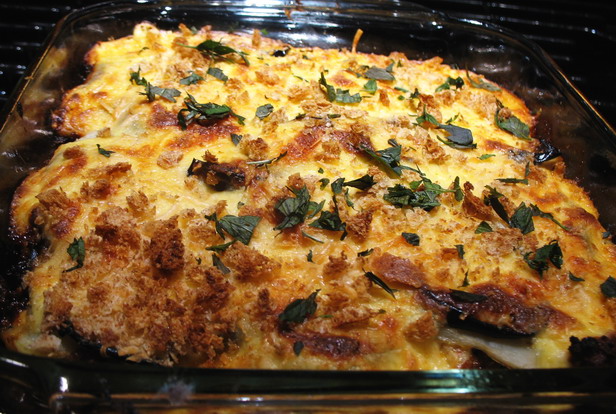
Moussaka
Ingredients:
For the Meat and Tomato Filling:
3 tablespoons olive oil
4 medium yellow onions, sliced thinly (about four cups)
1 tablespoon fresh ripe (red) Hungarian hot wax pepper, minced
1/2 tablespoon Aleppo pepper or freshly ground black pepper
1 teaspoon salt
1 tablespoon fresh rosemary, stemmed and minced
3 cloves garlic, minced (about three tablespoons)
1 tablespoon fresh oregano, minced
1/4 teaspoon ground cinnamon
1 pinch ground cloves
1 pound ground lamb
3/4-1 cup milk
2 large tomatoes, peeled, seeded and roughly chopped (about 3-4 cups chopped tomato)
1 cup dry red wine
3 tablespoons double concentrated tomato paste (the kind that comes in a tube)
2 tablespoons fresh mint, minced
2 tablespoons fresh Greek basil (mine is Greek columnar basil–or you can use 1 tablespoon regular basil) minced
1 tablespoon fresh oregano, minced

Method:
Heat olive oil in a heavy bottomed pan on medium heat. Add onions, Hungarian hot pepper, and Aleppo or black pepper. Sprinkle salt over the onions, and cook, stirring, until onions are golden. Add rosemary, garlic, oregano, cinnamon and cloves, and cook until very fragrant–about three more minutes. Add lamb, and milk, and cook, stirring, until lamb browns and falls apart, and most of the milk is cooked away.
Add tomatoes, red wine, and tomato paste, and turn down heat. Cook uncovered until the tomatoes have broken down and incorporated into the meat and most of the liquid has evaporated. Keep lightly warm. Just before using to layer the moussaka, mix in the rest of the freshly minced herbs.
For the Eggplant and Potatoes:
6-8 small Asian eggplants, well washed and dried
olive oil
2 russet potatoes, peeled
salt
Method:
Without peeling eggplants, cut them into thin rounds or ovals, about 1/4″ thick.
Heat enough olive oil in saute pan to cover bottom thinly. When it is hot, add a single layer of eggplant slices. Do not crowd pan. Beware–they will sputter and pop. (I used a splatter shield to keep the stove top and myself clean.) Allow to cook until golden on one side–about two minutes, then turn, and cook one minute more–until golden–on the other side. Remove and drain on paper towels. Repeat as necessary until all eggplant is fried, adding to olive oil in pan as necessary.
Cut potatoes in half longways, and then cut into 1/4″ thick slices.
Bring salted water to boil, and add potatoes. Cook until they are almost tender, but still a bit crisp–about eight to ten minutes. Drain carefully.
For the Bechamel:
4 tablespoons butter
4 tablespoons flour
2 cups warmed milk
pinch ground nutmeg
1 cup cream
3 egg yolks, well beaten, in a bowl bigger than you think you need
1/4 cup lemon juice
1/2 cup grated parmesan cheese
salt and either black pepper or Aleppp pepper to taste
Method:
In a medium, heavy-bottomed, saucepan, melt butter.
Add flour, and stir to combine. Cook, stirring, for about three minutes, until it forms a light tan paste (roux) that smells slightly nutty.
Add warmed milk, whisking continually. Bring to a simmer, whisking like mad. Add nutmeg, and allow to simmer to thicken.
Add cream, and whisk like mad, and allow to simmer to thicken some more. Lower heat to the lowest setting possible without going out entirely.
Take about 1/2 cup of hot bechamel, and pour into egg yolks, and whisk madly. Do not try to add naked egg yolks to the hot bechamel on the stove! This will cause the egg to cook separately, make ugly yellow lumps and all sorts of nastiness. Don’t go there. This step, which sounds silly, will temper the egg yolks, warm them up slightly and let them get used to the hot sauce.
After the egg yolks are combined with the little bit of sauce, pour this mixture into the sauce and add lemon juice and parmesan and whisk like mad over very low heat until you have a thick, pale yellow sauce with cheese and egg perfectly combined.
Season with salt and pepper. Keep lightly warm.
For Assembling the Moussaka:
olive oil or oil spray
3/4 cup breadcrumbs
1/4 cup grated parmesan cheese
freshly chopped mint for garnish
Method:
Preheat oven to 350 degrees.
Grease bottom of 13X9″ glass baking pan with olive oil or spray. Sprinkle with 1/2 the breadcrumbs.
Cover the breadcrumbs with a layer of eggplant. Cover the eggplant with a single layer of potatoes.
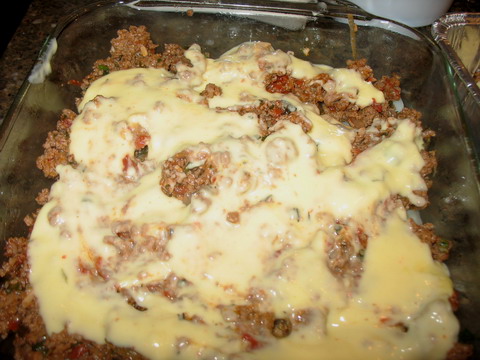
Top the vegetables with all of the meat and tomato mixture. Cover the meat with a thin layer of bechamel sauce. (The photo shows what this halfway stage of assembly looks like–just barely cover the meat with the sauce.)
Cover the bechamel with a layer of potatoes, then cover the potatoes with a layer of eggplant. Cover this with a generous layer of bechamel, and then sprinkle with all of the parmesan cheese and the remaining breadcrumbs.
Bake for 45 minutes, (25 minutes if you have a convection oven like we do) and then let sit for ten minutes before cutting.
Sprinkle generously with freshly minced mint for garnish before serving.
This is rich, so serve it with a very large, good greens-laden and vegetabliferous Greek salad. For a recipe for same, including the simplest, yet tastiest dressing in the world, come back tomorrow!

Categories:
- Admin (rss) (55)
- Blogs and Blogging (rss) (81)
- Book Reviews: Cookbooks (rss) (43)
- Book Reviews: Non-Cookbook Food Books (rss) (38)
- Cats and Cat Blogging (rss) (47)
- Chinese Cooking Lessons (rss) (32)
- Culinary School Stories (rss) (18)
- Dairy Pruducts: Cultured and Barbaric (rss) (4)
- Documentary Filmmaking (rss) (1)
- Essays, Rants and Reflections (rss) (260)
- Fighting Hunger (rss) (12)
- Food and Kids (rss) (45)
- Food in the News (rss) (126)
- Food Media (rss) (98)
- Food Preservation (rss) (18)
- Food Safety (rss) (45)
- Gardening (rss) (30)
- Herbs and Herb Blogging (rss) (20)
- Holidays (rss) (50)
- Kat Blogging (rss) (22)
- Kitchen Science (rss) (36)
- Leftover Makeover (rss) (8)
- Life, the Universe and Everything (rss) (131)
- Local and Sustainable (rss) (227)
- Local Athens Food and Foodies (rss) (42)
- Meatless Mondays (rss) (32)
- Menu For Hope (rss) (5)
- Nutrition, Diet and Health (rss) (84)
- On The Farm (rss) (8)
- Recipes: Almost Vegetarian, Vegetarian and Vegan (rss) (294)
- Recipes: American Regional (rss) (37)
- Recipes: Appalachian Hillbilly (rss) (33)
- Recipes: Bread, Pasta, Grains (rss) (95)
- Recipes: Canning and Preserving (rss) (8)
- Recipes: Chinese (rss) (123)
- Recipes: Comfort Food (rss) (120)
- Recipes: Cookies (rss) (16)
- Recipes: Desserts (rss) (48)
- Recipes: French (rss) (25)
- Recipes: Fruits and Vegetables (rss) (302)
- Recipes: Greek, North African and Middle Eastern (rss) (31)
- Recipes: Indian (rss) (137)
- Recipes: Italian (rss) (42)
- Recipes: Japanese (rss) (7)
- Recipes: Jewish (rss) (4)
- Recipes: Korean (rss) (6)
- Recipes: Meat, Poultry and Fish (rss) (220)
- Recipes: Mexican/Native American/ Latin American/Caribb (rss) (27)
- Recipes: Original (rss) (108)
- Recipes: Thai (rss) (27)
- Recipes: Tofu (rss) (17)
- Recipes: US Regional (rss) (16)
- Recipes: Vietnamese (rss) (8)
- Restaurant Stories (rss) (28)
- Sewing, Quilting, Arts and Crafts (rss) (16)
- Simple Chinese Recipes (rss) (30)
- Slow Food and Heritage Foods (rss) (10)
- Spice Blogging (rss) (44)
- The Chinese Cookbook Project (rss) (14)
- The Chinese Pantry (rss) (39)
- The Documentary (rss) (2)
- The Kitchen Saga (rss) (17)
- The Locavore's Bookshelf (rss) (15)
- The Unsung Adventures of The Culinary Nerd (rss) (6)
- Tools and Toys (rss) (35)
- Uncategorized (rss) (10)
- With a Side of Politics (rss) (48)
Archives:
- August 2012 (9)
- July 2012 (12)
- September 2011 (3)
- August 2011 (7)
- July 2011 (8)
- June 2011 (16)
- May 2011 (17)
- April 2011 (11)
- December 2010 (9)
- November 2010 (5)
- February 2010 (1)
- December 2009 (5)
- November 2009 (7)
- October 2009 (10)
- September 2009 (16)
- August 2009 (14)
- July 2009 (14)
- June 2009 (7)
- May 2009 (17)
- April 2009 (10)
- March 2009 (25)
- February 2009 (13)
- January 2009 (10)
- December 2008 (5)
- November 2008 (5)
- October 2008 (6)
- September 2008 (13)
- August 2008 (8)
- July 2008 (11)
- June 2008 (18)
- May 2008 (13)
- April 2008 (14)
- March 2008 (16)
- February 2008 (17)
- January 2008 (19)
- December 2007 (25)
- November 2007 (18)
- October 2007 (24)
- September 2007 (16)
- August 2007 (15)
- July 2007 (15)
- June 2007 (10)
- May 2007 (14)
- April 2007 (16)
- March 2007 (17)
- February 2007 (20)
- January 2007 (13)
- November 2006 (1)
- October 2006 (8)
- September 2006 (14)
- August 2006 (25)
- July 2006 (30)
- June 2006 (28)
- May 2006 (34)
- April 2006 (29)
- March 2006 (24)
- February 2006 (30)
- January 2006 (38)
- December 2005 (40)
- November 2005 (37)
- October 2005 (32)
- September 2005 (25)
- August 2005 (30)
- July 2005 (28)
- June 2005 (21)
- May 2005 (8)
- April 2005 (22)
- March 2005 (17)
- February 2005 (29)
- January 2005 (10)
Search Site:
Links:
- Lily’s Wai Sek Hong
- 101 Cookbooks
- A cat in the kitchen
- A Veggie Venture
- Accidental Hedonist
- Cha Xiu Bao
- chez pim
- Chocolate & Zucchini
- Chopstick Cinema
- Chowhound.com
- Chubby Hubby
- Cook sister!
- Cooking with Amy
- da*xiang
- Eat Local Challenge
- Eating Liberally
- Ecocentric
- Eggbeater
- Epicurious
- Farmgirl Fare
- Fatfree Vegan
- Foodgoat
- ForkandBottle.com
- Green Olive Tree
- Hooked on Heat
- Jaden’s Steamy Kitchen
- Kalyn’s Kitchen
- Lucullian delights
- Mahanandi
- Matt Bites
- MeatHenge
- mmm-yoso!!!
- New York Times – Dining & Wine
- Pizza Goon
- Rasa Malaysia
- Ruhlman
- Sailu's Kitchen
- Serious Eats
- SF Gate: Food & Dining
- Simply Recipes
- Soul Fusion Kitchen
- Tastespotting
- The Amateur Gourmet
- The Cleaner Plate Club
- The Food Section
- The Grub Report
- thecookscottage
- U.S. Food Policy
- Wandering Chopsticks
- Washington Post Food and Dining
- Wasted Food
Meta:


Powered by WordPress. Graphics by Zak Kramer.
Design update by Daniel Trout.
Entries and comments feeds.