
Cook Local, Eat Global
The Spice is Right IV: It’s Too Darned Hot Roundup, Part II
Now we come to the second part of the round-up for this month’s The Spice is Right event: “It’s Too Darned Hot!”
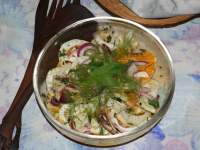
Elizabeth, my good friend in Canada who writes Blog From Our Kitchen, had a conundrum about this month’s entry. She couldn’t decide which recipe to showcase, since most everything she and her husband cook has chiles in it. But, luckily for us, she settled on this jewel-like salad, a beautiful entry filled with colors and flavors. Her Orange Fennel Salad is dressed simply with cider vinegar, honey, olive oil and dried, crushed toasted chiles, but it is the perfect foil for the fruits and vegetables within. The final kiss of perfection is the use of the clean, fresh flavor of mint leaves; I imagine that the haunting flavor of mint floats above all the stronger flavors and brings a breath of chill to the heat of the chile-kissed salad dressing. Great one, Elizabeth!
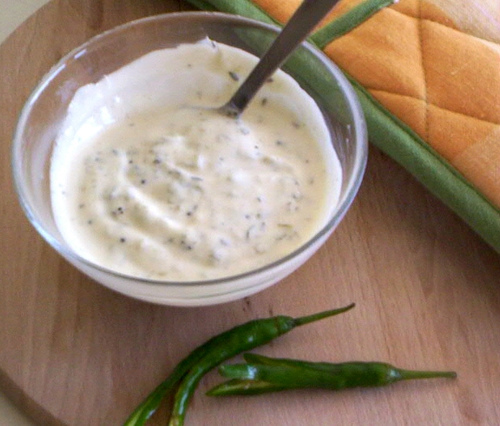
I adore learning about other cultures and foodways, and that is the best part of this event. We have so many participants from all around the world that we all get a chance to take a peek into not only each other’s kitchens, but we also get a taste of the folklore of everyone’s home region. Vaishali, the author of Happy Burp, though she lives in Dusseldorf, Germany, hails from India, and not only does she give us great recipes featuring chiles, but she tells us a bit about their more esoteric powers as well. But, magick aside, let’s talk about those chiles and how she pairs them up for this event with yogurt. Hot and cold, wed together perfectly in her Mirchicha Chatka, a dish that sounds like two of my Indian food loves: green chutney and raita, made to marry and produce an offspring that is the perfect blending of the two opposites. The next time I make Indian food, Vaishali–I am making this dish and I hope to get lots of appreciative happy burps from my family in return!
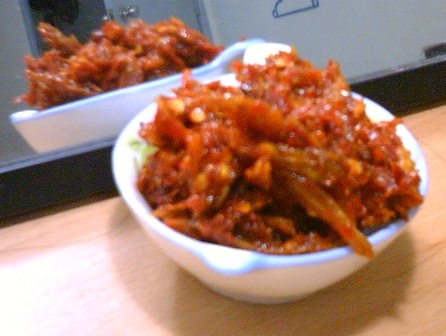
I am not surprised to hear from Rokh, the author of Tham Jiak for this event, for indeed, she does live in Malaysia, where the climate is hot and the chiles are hotter. And what does she bring us from that paradise of sun, surf and heat? Nothing less than the national condiment, the universal elixer, the pride of the Malaysian kitchen: Sambal Chilli. A scarlet, chunky paste of chiles, shallots, sugar, garlic, tamarind and lime, this condiment is used in the kitchen and at the table, and keeps for a month unrefrigerated in Malaysia. I suspect in Ohio, where we complain if it gets near 90 degrees, it lasts a little longer, that is, if it doesn’t get used up before then, which it likely would in our house. Thank you for sharing such a treasure, Rokh!
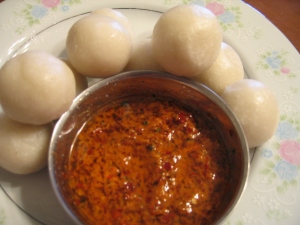
How can we Westerners fail to learn about spices now that we have so many great teachers from India, writing from their kitchens? Let me introduce Annita, who writes My Treasure…My Pleasure from her kitchen in Kerala, and who, like all of the other Indian food bloggers I have had the pleasure of reading, is generous with her recipes, instruction and writing. For her first entry into The Spice is Right, she gives us something few of us Indian food fans in the US have seen: Unda-Chammanthi. What’s that? Well, they are a healthy breakfast of steamed rice flour and coconut cakes dipped in a sauce/chutney made from the holy trinity of chile, shallots and curry leaves. Doesn’t that sound like an eye-opener in the morning? Much better than cold cereal, I think. Thank you, Annita, and I hope to see your goodies here again next month!

Indira is a woman after my own heart. Not only is she the great writer and photographer behind Mahanandi, but she is fearless in pairing chile with chocolate, and that just cannot help but futher endear her to me. Look at how pretty her Chocolate~Chilli~Pecan Mini Cakes are, and imagine the taste! Dark chocolate, pecans and chile–I am telling you, one of these days, I am going to show up at Indira’s kitchen door next to her lovely cat Kittaya, because I caught a whiff of something good on the air and followed it until I found her! I can’t wait to try this recipe out in my own kitchen, and I highly suggest y’all give it a whirl, too. Thank you, Indira, for another wonderful inspiration.

Now, y’all know I love chocolate, but what you may not know is that I also love okra. Yes, I do, but only when it is cooked in certain ways, one of which is the way Mandira, the author of Ahaar, cooks it. That is, she makes Stir-fry Okra, Chillies & Shallots, which is to say, she doesn’t boil it until it is slimy, and she gives it a great setting among all those strong flavors. Chiles make everything better, but shallots and mustard seeds improve everything even more. I think the only thing that is missing is garlic, and I don’t reckon it would hurt to throw some of that in there, too. But this is a fine entry for another first-timer, and I really hope, Mandira, that you come back with some more beautiful recipes like this one–it is a keeper!

One of the things I just love about this event is how much I get to learn about cuisines from other countries. This time around, it looks like I am lucky enough to learn a lot about traditional regional Indian specialties from bloggers who are living there, or who are from there and are now living elsewhere. Archana fits into the latter category; from India, she is now living and blogging Spicyana in the US. She drops in at the Spice is Right to tell us about a South Indian specialty called Porotta, a kind of layered flatbread that apparently takes years to master. It is a street food in India, but Archana presents an easier way for home cooks to make a similar dish, which she calls Chilly Crepes . This way, if you are far from South India and are longing for a taste of home–you need no longer pine and sigh. Try out this gorgeous recipe, and set your spirit free. (Look how pretty the picture is!) Thank you, Archana–I hope you come back with more great recipes like this one!
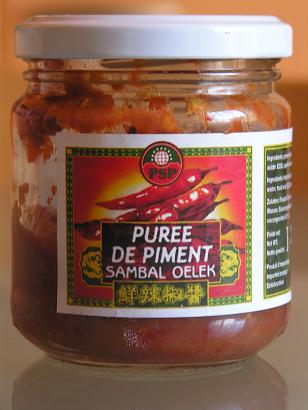
How about a recipe for green beans done Indonesian style? Isis, who blogs from France at Yambalaya, sends us a recipe for Sambal Goreng Boontjes, a dish that uses the firepower of the Indonesian condiment, sambal olek. Basically, it is green beans stir fried with onions, garlic and sambal in coconut oil. How, oh how, can that possibly be anything but tasty? I mean, really? And, as if that was not enough, Isis sends us a photograph of her pretty chile pepper plants, growing happily and healthily in her yard. Thank you so much Isis–I hope to see an entry from you for Fresh and Local! (You cannot get more local than growing your own veggies, you know!)
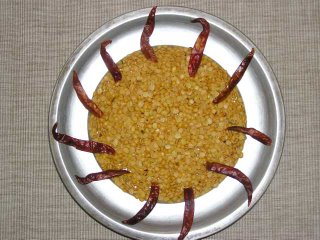
One of the best things about Indian food is how regional it is. Regional variations are to me, the spice of life. Pavani, who now lives and blogs Cook’s Hideout from New Jersey, shares with us an Andhra recipe called Kandhi Pachadi (Toor dal Chutney). It is a simple dish, filled with the goodness of toor dal, chiles, garlic and cumin, and is meant to be served with tart dishes cooked with tamarind. The fire of the chiles heats up the palate, and the cool acidity of the tamarind dishes chills the tongue, making the diner brave for more chiles a few seconds later. Thank you for bringing this sweet little dish to us, Pavani–I look forward to hearing more from you in the future!

Oooh! Fusion fun alert! Fusion fun on the horizon! Danielle, the kind and creative blogger of Habeas Brulee has presented a fusion cuisine original for our delectation this month: Roasted Red Pepper Chipotle Egg Rolls with Tzatziki Dipping Sauce. It’s crunchy. Its spicy and sweet and Mexican and Chinese. And its cooling and soft, and…Greek. Yes, Greek. And she mixes all of this together and it sounds fantabulous. Just fantastic. You have to go read her recipe and see it for yourself. So, go click the link and stop reading my blatherings and take a look at her primer on the two ways of wrapping eggrolls while you are at it! (BTW–I do it the second way. I do the same for spring rolls as well. It is easier and faster, says the woman who used to work in a Chinese restaurant and so has wrapped many a roll in her day.)
And with that, we come to the end of part two. Look for part three of the round-up sometime tomorrow, probably in the morning, posted bright and early, before we take to the road in our rented mini-van for a week of heat, humidity and good Indian food. (Akbar, here we come!)
The Spice Is Right IV: It’s Too Darned Hot Roundup, Part I
It really is too darned hot today. I know, I spent part of the early afternoon outside washing dirty, stinky dogs. After that, I retreated from the 97 degree heat and umpteen-eleven percent humidity and took a shower, and have been hiding out in the air-conditioned house since. I might only emerge to pick the tomatoes that are ripe on the eight foot vines on the deck, and after that, perhaps make a salad for dinner, and that is all.
But, what else will I put in the salad?
Chiles, of course.
Because, oddly enough, I crave really hot and spicy foods when I am miserably hot. I think it is because they make me sweat, which cools me off. So, later tonight, it will be the chiles, the fish sauce, the palm sugar and the lime juice I will reach for to make salad dressing for those lovely little gemlike tomatoes!
But, enough about me.
Let’s take a look at the first batch of entries I recieved for this event and see what folks all around the world make when they want something that is too darned hot!

First up, we have Meeta from Germany, author of the blog, What’s For Lunch Honey? She brings us, in a post about three basic pasta sauces, one of my traditional favorites of the Italian kitchen: Arabiatta Sauce. Her recipe for the sauce is simple: sundried tomatoes, garlic, basil, olive oil, and, of course, chiles. This is a sauce for inflaming the passions, which makes sense, because the root of the word, means “angry” in Italian. But, you know, this sauce never makes me angry–it always makes -me- happy. Not all fire is bad, you know–it warms the heart as well as burns. To me, arabiatta is more like a big sloppy kiss than an angry barrage. Thanks for the great entry, Meeta! (Hey, and if you don’t like arabiatta, try her aglio olio–it is nothing but garlic–and lots of it, chile and olive oil. If you don’t like that–well, I don’t think we can help you.)

Now, we head off to Santa Fe, New Mexico, where Christine of Christine Cooks Vegetarian teaches us the art of making beautiful from the local red chiles. The dried pods she shows in one photograph are gorgeous cherry-red and smooth–definately a chile to be reckoned with. The finished enchiladas look delectable, too–with a deep burndished red sauce, white cheese and brilliant green cilantro–my mouth is watering already. Combining the chiles with four other types of dried, powdered chiles, onions, garlic, tomatoes and cumin, Christine really aims to wake up the palate of omnivore and vegetarian alike with her delicious looking sauce. As if that wasn’t enough, she fills her enchiladas with a combination of black beans and baby squashes. Now, that sounds way tasty to me! Great entry Christine–I hope we see you again next time!
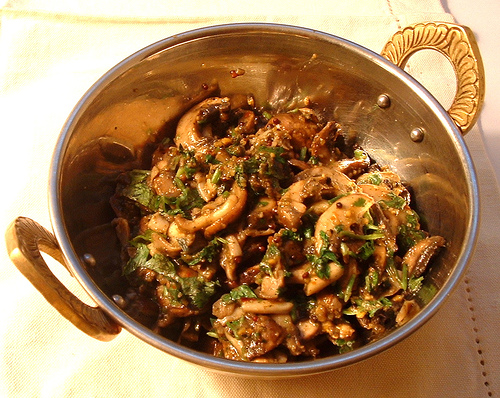
Nupur of One Hot Stove always makes my mouth water with her descriptions of the food she has eaten and cooked in and around her native India, so it is no surprise that her Mushroom Chettinad has gotten me all hot and bothered. She uses a mixture of wild mushrooms in it, with a very simple, but gorgeous-sounding spice blend of tamarind, cilantro, curry leaves, mustard seed, dal, black peppercorns and chiles to turn a vegetable which is often very plain into a sultry sexpot of a supper. And look at the beautiful photograph–I love the karahi she is serving it in! The next time I get some mushrooms in my CSA box, I have a feeling that I am pulling out this recipe–thank you, Nupur! I really appreciate anything that combines mushrooms and chiles–it is mixture that not many people think of. Keep bringing the flavors of India home to New York City!

Macky always has something interesting cooking in her kitchen in Manila at The Edible Garden, and this entry proves it, most deliciously. She makes an adapted recipe from Lex Culinaria: Spicy Onion Jam: a sweet, hot and sticky concoction red with tomatoes, sweet with onions and sugar, and spiced with red chile flakes. It is a lovely condiment that I bet would go splendidly on top of a goat cheese and basil tart with a pinenut-spiked crust. I’m looking forward to what Macky has to share with us in the future, too!

I am happy to see that Shammi from the UK/Indian food blog, Food, In The Main has come to join our game this time around, because she loves spices, chiles and garlic as much as I do! I love the sound of the dish she presents to us, where chiles join a melange of other spices and seasonings to create something that she says may not be authentic but tastes really damned good on rice! Her Garlic Kaara Kuzhambu includes shallots, garlic, chile powder, turmeric, fenugreek seeds, dal, mustard seeds, cilantro, and curry leaves. As if that wasn’t beautiful enough, she gives a recipe for her garam masala mixture that she sprinkles over the dish to add extra fragrance–and wouldn’t you know, it includes more chiles, along with black peppercorns, cumin and coriander. It sounds absolutely ravishing–too darned hot, indeed! Thank you, Shammi–I do hope you join us again next month!
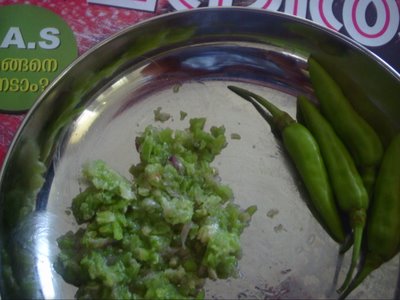
L.G. writes her blog, Ginger and Mango from her home in Kerala, India, and I love reading her descriptions of the native cuisine there. I cannot help but be excited to see her post for this event, as it is another way to make my best beloved fresh green chutney, which we just call “Green” around this house. I am even more excited, because she describes the chile (kanthaari) used in her Kanthaari Mulaku Chammanthi, haari, which she thinks may not have a name in English. Which of course, means, we can’t likely get it here, but I don’t care, because it is a mystery, and mysteries are cool. Especially culinary ones. Looking at the chile in question, it looks rather similar to a Thai bird chile, but I trust that the flavor is probably very different–chiles are highly variable in shape, color, and flavor. What is most interesting about this chutney, is that it contains only three ingredients: shallot and kanthaari chile ground in a mortar and pestle and blended with a bit of coconut oil. It sounds divine to me–and I am even more thrilled to learn that intelligent girls and women in Kerala are called “kanthaari” which means lioness or tigress, after this wee, but aparently fierce chile. Thank you for sharing with us, LG, though now you know, I will have to figure out if I can find seeds to grow your chile here in Ohio!
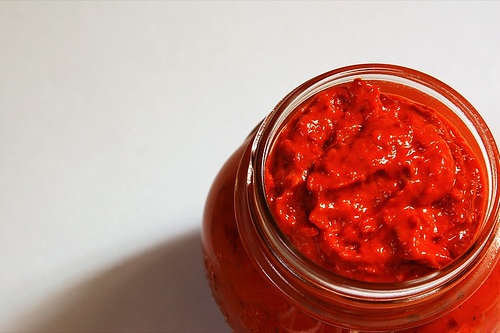
Haalo hails from Melbourne, Australia, where she writes Cook (almost) Anything At Least Once, and because of her, we are going from green to red. Yes, she presents us another fiery chile condiment, but instead of it being green and from India, it is fire-red and from North Africa: Harissa. And Harissa is really hot. I mean, like really. Look at her recipe. It requires 80 Chinese chile peppers. That is right. 80. Yeah. That isn’t a typo. It also contains a respectable amount of garlic, and some cumin and caraway, but most of what harissa is about is beautiful, scarlet chiles with temperments and temperatures to match the flaming color. It is used both as an ingredient and a condiment, though, so it isn’t like you are supposed to eat it all on its own. But, however it is supposed to be eaten, it sure is beautiful–thank you for sharing that lovely photo with us Haalo, and come back next time–I want to know what you have up your sleeve for next month!
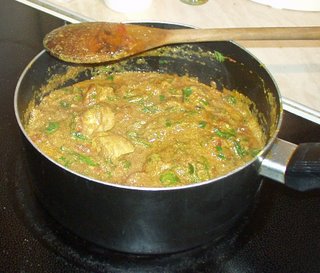
We have another new face to welcome here–Sheherazade, the author behind the UK blog Feeds Two Hungry People. I have to congratulate her on her choice of recipes; she presents a luscious version of of Karhai Chicken From Madhur Jaffrey’s Ultimate Curry Bible, a work she consults for quick, tasty curry dinners often. And no wonder–look at the lovely results she gets! Two kinds of chile go into this yogurt-based curry: dried cayenne and green fresh chiles. I don’t know about you, but I can smell the verdant aroma of the fresh cilantro from here! Thank you very much, Scheherazade, and I very much hope to see you again next month.

Nandita writes Saffron Trail in Mumbai, India, and she brings us a delicious looking new way of cooking paneer, which is homemade Indian cheese. Nandita calls it “cottage cheese” but it isn’t like what most Americans think of as cottage cheese, although the milky flavor is very similar. But it isn’t broken up into little tiny curds with whey around it. It is pressed into blocks, and then it can be cut into little bite-sized squares and used in curries and other dishes. Nandita gives a recipe for the paneer itself, and then tells us how to marinate it with both dried red chiles and fresh green chiles, and then she presents us with a milder curry sauce, and finishes the dish with a lovely handful of freshly chopped cilantro. The resulting Chilli Marinated Cottage Cheese in Gravy looks and sounds like a wonderful supper dish. Thank you so much for showing this recipe, Nandita. I hope it inspires other cooks to try their hand at making paneer at home. (It tastes much better homemade.)

Jennifer is from Baton Rouge, Louisiana, where they looooove the hot and spicy food. It is most definately one of the regions of the US where the chile pepper reigns supreme, so of course the author of The Weekly Dish had to participate in this round of The Spice is Right, and what does she bring us? Oh, only something that has this pregnant lady wanting to jump up from her keyboard and rush to the kitchen to make me up a plate of Blue Cheese and Mango Quesadillas with Mango Salsa. It has blue cheese (which, yes, I am allergic to, so even though I love it and love the sound of it in this recipe, I would have to substitute it with something else, like maybe a good sharp chevre). And mangoes. And chiles and salsa, and it sounds sooo gooood. And it is very pretty, too–just look at all the colors in that salsa: violet onions, emerald green cilantro and buttery, rich yellow mangoes. (I love colors almost as much as I love food–you should see our house–it has paint as bright as the colors of that salsa.) I am about to short out my keyboard with all of this drooling. Jennifer–I hope you come back next month, too, because I want to see what is Fresh and Local in Louisiana in August!
Allright, that is it for tonight. Look for more of the round-up tomorrow, and then on Tuesday, as I post in between doing laundry and packing for our trip. I hope you all are enjoying reading this round-up as I am having writing it–it is a priviledge to be able to look in on so many kitchens across the world and comment on what is being cooked there.
Thanks again to all the participants–without your mad cooking skills, The Spice is Right would not be half as fun and rewarding as it is.
The Spice Is Right V Theme: “Fresh and Local”
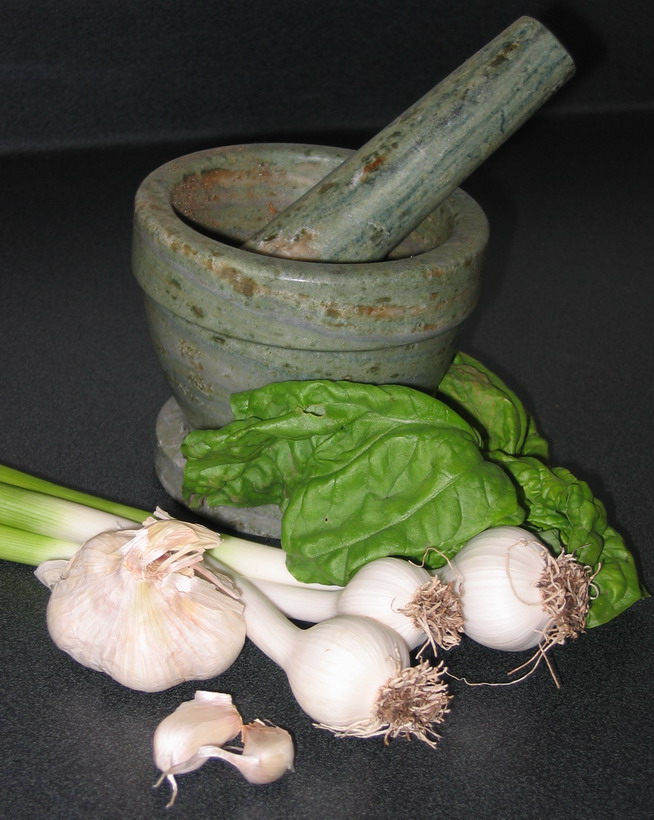
This Spice is Right challenge may be a bit difficult, but it should be fun.
In recognition that August is, at least in the Northern Hemisphere, a time of growth, plenty and harvest, and considering how many bloggers we have from around the world, it might be fun if we highlighted the local flavoring ingredients that are in season where we are.
For us North Americans, that can mean onions, garlic, chiles, nasturtium seeds, blossoms and leaves, dill seeds, fennel seeds, fennel bulbs, coriander seeds (green and dried) and any number of other goodies that we may have grown and harvested ourselves, dried ourselves or processed ourselves. Or, it could be we obtained them from the local farmer’s market.
For those who live in say, India–the field is a bit more open, isn’t it? Some folks have black pepper vines growing wild over their back garden fences. There may be a co-op of farmers down the road who grow ginger or turmeric or chiles or cardamom. They may, like we North Americans, have a pot of chiles growing on their deck or doorstep.
For folks in Europe–well, you know what grows near you! Lavender is one–caraway seeds, dill seeds, fennel–and of course, onions and garlic. The list isn’t as restrictive if one thinks about it.
And once you figure out which locally grown spice you want to highlight, I would really like it if you featured it in a recipe containing as many local ingredients as humanly possible! That includes vegetables and fruits, which will be in copious supply next month, meat, fish and dairy, eggs, legumes and grains. Work with what you can get from your local farmers.
See what happens!
Go native for a meal!
It should be fun. I look forward to seeing what folks come up with–I have a bang-up bunch of goodies to feature for “It’s Too Darned Hot!” so look for three round-up posts over the next three days.
As always, the deadline is August 15th at midnight EST. Post your recipe before that time, with a link back to this post in case your readers want to join in the fun, too, and send me an email including a link to the post, your name, where you are, and a link to your blog’s main page. I will do the rest!
And then, next week, we are going to be away in Washington, DC, with a friend who is interviewing at Georgetown University. (She’s brilliant.) But, I will still be posting from the hotel room–I have some posts and photos lined up and ready to go while we are gone so you don’t have to get lonely.
One other thing–I have the schedule for the next few months of themes for the Spice is Right. Would you like me to go ahead and post them and let y’all plan ahead? Or, do we want to continue as we have been? I will tell you that there will be no Spice is Right in October, since I will be busy giving birth to Kat that month, and there may not be one in November. The only way there will be one during that two month hiatus is if someone else wants to pick up the baton for two months and come up with themes and do round-ups. If you are interested, email me, if not, we will just take a two month break, and come back in December.
Thank you for all of your interest and support in my event!
By Special Request: Aztec Gold Brownies
Chiles are one of my favorite fruits and flavoring agents in the entire culinary universe.
As far as I am concerned, they are among the most versatile of ingredients, and can allow the cook to play with a range of flavor, color, heat and aroma that very few other ingredients can manage. As a result of this versatility and the playfulness that it evokes in me, I have come up with a few recipes where chiles appear in contexts that one does not usually expect the fire of a pepper to erupt.
One of those contexts is in a dessert.
A decadadent, rich dessert, filled to bursting with chocolate.
Yes, I know. Chiles with chocolate are becoming a bit de rigeur these days, what with the film “Chocolat” and all.
And I have to admit that I was first inspired to make these brownies after I belatedly rented and watched that movie, and was enchanted with the thought of pairing chile pepper with chocolate in a sweet context. (Mole sauces are wonderful, don’t get me wrong, but I have to admit to liking my chocolates sweet. But, not too sweet.)
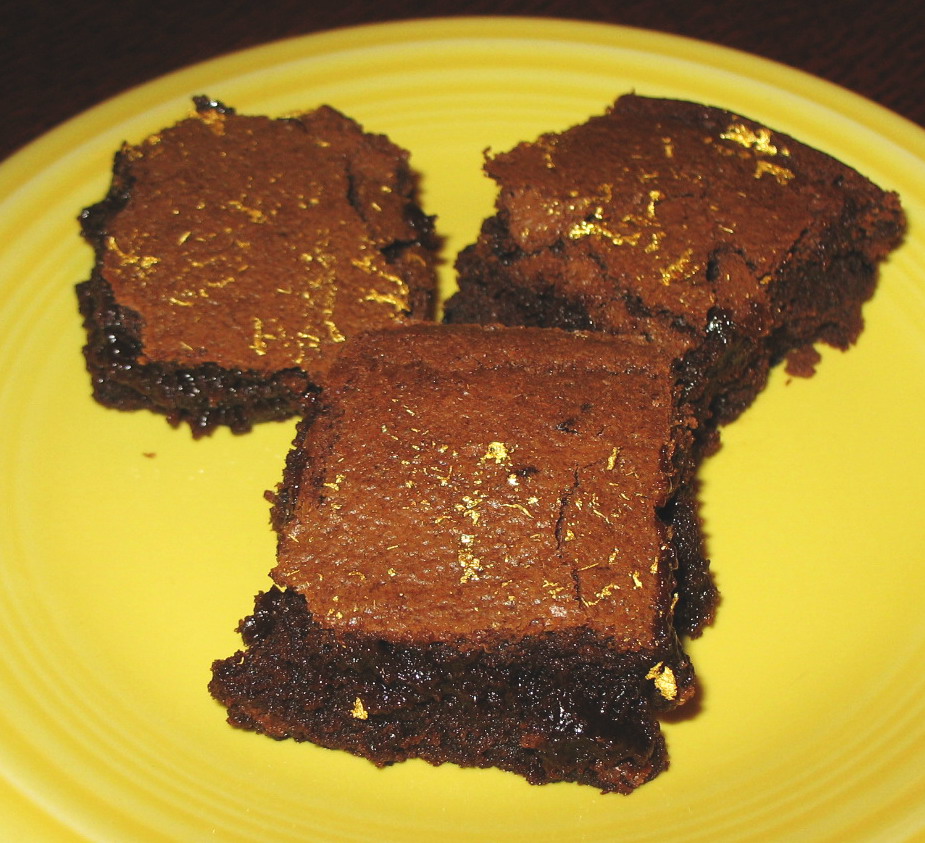
But, these brownies, which I named in honor of another film (“Pirates of the Caribbean,” if you are wondering) are not just about sweet and hot, chocolate and chile. Oh, no. I packed them full of flavors that are associated in one way or another with Mexico: vanilla, cinnamon and coffee, to be precise. And I used high quality chocolate in them, plus added Dutch process cocoa, in order to get a deep, dark chocolatey flavor, color and aroma.
And then, just for kicks, I sprinkled gold leaf on the top of them. You know–to give them that extra bit of flash, and to help them live up to their name. (Allright, I have to ‘fess up here. I did the gold for the blog. And it looks cool, and it is extremely cool to be eating gold. But for the first two years worth of making these lovelies, I have not used the gold. You don’t have to. But, if you want to–follow the instructions on the gold leaf and have fun.)
These brownies are addictive, and have become a favorite dessert around here since I made them up a couple of years ago. I have made them for weddings, for holidays, and just because. This winter, I may try glazing them with dark chocolate ganache and then sprinkling them with gold leaf and see what happens. In the summer, the ganache would just melt into puddles of goo, but in the winter–well, it may just add a little bit moreishness to them.
The flavor is complex. The first flavor to hit is a combination of the good chocolate and the smokiness of the chipotle. Then, the cinnamon kicks in, and then the espresso. Finally, the chipotle chile heat creeps up the back of your throat and warms your mouth. And then you take another bite, and a whisper of vanilla insinuates itself on your tongue, and then dances with the espresso and chocolate, and then the smokiness cuts in and the chile turns it all into big party. And you take another bite, and it all starts over again. They are, in a word, fantastic. These brownies are one of the few of my recipes I -will- brag about, like in public, even though it is not at all in my nature.
They really are that good. They are sexy hot, and I don’t say that about many of my recipes.
But these brownies–they are smokin‘.
So, there we are. My entry for The Spice is Right IV: It’s Too Darned Hot!. A bit close to late, but still within the deadline–and by popular demand. For those who loved my Aphrodite Cookies–I am giving you another recipe of a similar caliber–these brownies will make your reputation. I promise you.
Just tell folks where you found the recipe, okay?
Aztec Gold Brownies
Ingredients:
4 ounces (2 squares) semi-sweet (62%) Scharffen Berger chocolate, grated (you can use a higher percentage chocolate–like 70% here, but it will make super-rich brownies. Just so you know.)
1 stick salted butter, at room temperature, cut into cubes
1 ¼ cups sugar
1 tsp. cinnamon
1 tbsp. espresso powder
1 ½ tsp. ground dried chipotle pepper
¾ cup all purpose flour
2 tbsp. Dutch cocoa
3 large eggs
½ tsp. double strength Penzey’s vanilla extract (or 1 tsp. Penzey’s Mexican Vanilla Extract)
Method:
Preheat oven to 325 degrees F. Line 8″ square glass baking pan with foil and spray with Baker’s Joy.
In a glass bowl, melt butter and chocolate in microwave in 10 second increments. If chocolate is well-grated, this should take about 40 seconds-stir after thirty seconds.
Place sugar, cinnamon, espresso powder and chipotle pepper in a mixing bowl and stir well. Put flour and cocoa in another bowl and mix well.
Scrape chocolate into sugar mixture and beat on medium speed about 30 seconds. Scrape sides and bottom of bowl and beat another 20 seconds or so.
Add eggs, beat to incorporate, scraping as needed. Add vanilla, and stir to incorporate.
Add ½ of flour mixture, and stir on low speed until mostly mixed in. Scrape bowl and add rest of flour, mixing until incorporated. Scrape bowl. Beat on medium high speed for about 45 seconds, or until mixture lightens visibly. This is to incorporate air, which is the only leavening in the batter.
Scrape into prepared pan and bake at 325 for 30-35 minutes.
Allow to cool in pan for fifteen minutes. Lift out foil and lay on a wire rack and allow to cool -completely- before cutting. Otherwise, they will fall apart. They are very fudgy in the middle, with a bit of a crispish crust on top. If you cut too soon, they will be gooey in the middle and crackle way too much on the top and then fall apart.
They will still taste good, but they won’t look very good when you go to serve them, and they -will- be hard to eat.
The Locavore’s Bookshelf: Chew On This

Eric Schlosser’s excellent book, Fast Food Nation is one of those works that is destined to become a classic work of non-fiction; the clarity of his prose and his arguments about the state of the US’s food culture, fat intake and fast food obsession ensure that anyone who reads the book -will- sit up and take notice of these problems. It is simply one of those books that cannot help but change the engaged reader once the information in it is digested and assimilated.
Chew On This, his newest work, which is written along as similar vein as Fast Food Nation, is however, aimed at a different audience, one that is the target of fast food marketing and is often exploited by the unfair labor practices of fast food restaurants: children and teens. Many reviewers have contended that Schlosser’s prose and language are too sophisticated for young readers; I disagree. Schlosser goes out of his way, for example, to neither talk down to his audience, nor to use language that is not likely to have been encountered by the average eight-year-old to teen reader. His grammar and syntax are also simple and direct, and his prose style is very conversational and informal, as if it is a transcript of a peer giving the skinny on the topic of fast food to some friends.
One rhetorical device Schlosser and his co-author Charles Wilson use to great effect is the personalization of the issues surrounding kids and fast food by presenting the specific stories of kids from across the country and Canada. In telling these tales the authors mostly get out of the way and allow their subjects to speak in their own words, which they use to narrate their own experiences. From the life of a teen fast food worker in West Virginia, to the tale of a young activist who fought against the sale of soda in her school, Schlosser’s tactic of allowing these young people to speak to their own experiences further enhances his point that fast food targets kids via marketing, and unfair labor practices, and that such marketing and maltreatment is neither ethical nor desireable.
In addition to personalizing the issue by giving examples from the lives of real kids, I hope that Schlossers illustrative examples also have the effect of inspiring his readers to stand up and act against fast food in large and small ways. Children and teens are often very idealistic and often have very passionate, informed opinions. However, they also often feel powerless to effect change in the word due to their young ages. Schlosser’s presentation of young people who -have- stood up for a cause and, in many cases, made positive changes in their communties have the potential to give hope and courage to kids of a similar mindset who may not believe that they are influential enough to make any sort of difference in the world of fast food.
Like Fast Food Nation, readers of Chew On This are likely to be propelled to think pretty deeply about food, where it comes from, how it is made and what goes into it. And that, to me, is the greatest effect that the book can have, whether it is with readers who are young or only young at heart.I think it is very important that young people be presented with an alternative view of fast food, so that they can make up their own minds about the issues surrounding it–with as much information as they need to make a wise and informed decision.
And that goes for everyone–not just kids–which is why I say that this book is well worthy to exist on the bookshelf of all people who are niterested in food and every locavore, no matter if they are eight or eighty.

Categories:
- Admin (rss) (55)
- Blogs and Blogging (rss) (81)
- Book Reviews: Cookbooks (rss) (43)
- Book Reviews: Non-Cookbook Food Books (rss) (38)
- Cats and Cat Blogging (rss) (47)
- Chinese Cooking Lessons (rss) (32)
- Culinary School Stories (rss) (18)
- Dairy Pruducts: Cultured and Barbaric (rss) (4)
- Documentary Filmmaking (rss) (1)
- Essays, Rants and Reflections (rss) (260)
- Fighting Hunger (rss) (12)
- Food and Kids (rss) (45)
- Food in the News (rss) (126)
- Food Media (rss) (98)
- Food Preservation (rss) (18)
- Food Safety (rss) (45)
- Gardening (rss) (30)
- Herbs and Herb Blogging (rss) (20)
- Holidays (rss) (50)
- Kat Blogging (rss) (22)
- Kitchen Science (rss) (36)
- Leftover Makeover (rss) (8)
- Life, the Universe and Everything (rss) (131)
- Local and Sustainable (rss) (227)
- Local Athens Food and Foodies (rss) (42)
- Meatless Mondays (rss) (32)
- Menu For Hope (rss) (5)
- Nutrition, Diet and Health (rss) (84)
- On The Farm (rss) (8)
- Recipes: Almost Vegetarian, Vegetarian and Vegan (rss) (294)
- Recipes: American Regional (rss) (37)
- Recipes: Appalachian Hillbilly (rss) (33)
- Recipes: Bread, Pasta, Grains (rss) (95)
- Recipes: Canning and Preserving (rss) (8)
- Recipes: Chinese (rss) (123)
- Recipes: Comfort Food (rss) (120)
- Recipes: Cookies (rss) (16)
- Recipes: Desserts (rss) (48)
- Recipes: French (rss) (25)
- Recipes: Fruits and Vegetables (rss) (302)
- Recipes: Greek, North African and Middle Eastern (rss) (31)
- Recipes: Indian (rss) (137)
- Recipes: Italian (rss) (42)
- Recipes: Japanese (rss) (7)
- Recipes: Jewish (rss) (4)
- Recipes: Korean (rss) (6)
- Recipes: Meat, Poultry and Fish (rss) (220)
- Recipes: Mexican/Native American/ Latin American/Caribb (rss) (27)
- Recipes: Original (rss) (108)
- Recipes: Thai (rss) (27)
- Recipes: Tofu (rss) (17)
- Recipes: US Regional (rss) (16)
- Recipes: Vietnamese (rss) (8)
- Restaurant Stories (rss) (28)
- Sewing, Quilting, Arts and Crafts (rss) (16)
- Simple Chinese Recipes (rss) (30)
- Slow Food and Heritage Foods (rss) (10)
- Spice Blogging (rss) (44)
- The Chinese Cookbook Project (rss) (14)
- The Chinese Pantry (rss) (39)
- The Documentary (rss) (2)
- The Kitchen Saga (rss) (17)
- The Locavore's Bookshelf (rss) (15)
- The Unsung Adventures of The Culinary Nerd (rss) (6)
- Tools and Toys (rss) (35)
- Uncategorized (rss) (10)
- With a Side of Politics (rss) (48)
Archives:
- August 2012 (9)
- July 2012 (12)
- September 2011 (3)
- August 2011 (7)
- July 2011 (8)
- June 2011 (16)
- May 2011 (17)
- April 2011 (11)
- December 2010 (9)
- November 2010 (5)
- February 2010 (1)
- December 2009 (5)
- November 2009 (7)
- October 2009 (10)
- September 2009 (16)
- August 2009 (14)
- July 2009 (14)
- June 2009 (7)
- May 2009 (17)
- April 2009 (10)
- March 2009 (25)
- February 2009 (13)
- January 2009 (10)
- December 2008 (5)
- November 2008 (5)
- October 2008 (6)
- September 2008 (13)
- August 2008 (8)
- July 2008 (11)
- June 2008 (18)
- May 2008 (13)
- April 2008 (14)
- March 2008 (16)
- February 2008 (17)
- January 2008 (19)
- December 2007 (25)
- November 2007 (18)
- October 2007 (24)
- September 2007 (16)
- August 2007 (15)
- July 2007 (15)
- June 2007 (10)
- May 2007 (14)
- April 2007 (16)
- March 2007 (17)
- February 2007 (20)
- January 2007 (13)
- November 2006 (1)
- October 2006 (8)
- September 2006 (14)
- August 2006 (25)
- July 2006 (30)
- June 2006 (28)
- May 2006 (34)
- April 2006 (29)
- March 2006 (24)
- February 2006 (30)
- January 2006 (38)
- December 2005 (40)
- November 2005 (37)
- October 2005 (32)
- September 2005 (25)
- August 2005 (30)
- July 2005 (28)
- June 2005 (21)
- May 2005 (8)
- April 2005 (22)
- March 2005 (17)
- February 2005 (29)
- January 2005 (10)
Search Site:
Links:
- Lily’s Wai Sek Hong
- 101 Cookbooks
- A cat in the kitchen
- A Veggie Venture
- Accidental Hedonist
- Cha Xiu Bao
- chez pim
- Chocolate & Zucchini
- Chopstick Cinema
- Chowhound.com
- Chubby Hubby
- Cook sister!
- Cooking with Amy
- da*xiang
- Eat Local Challenge
- Eating Liberally
- Ecocentric
- Eggbeater
- Epicurious
- Farmgirl Fare
- Fatfree Vegan
- Foodgoat
- ForkandBottle.com
- Green Olive Tree
- Hooked on Heat
- Jaden’s Steamy Kitchen
- Kalyn’s Kitchen
- Lucullian delights
- Mahanandi
- Matt Bites
- MeatHenge
- mmm-yoso!!!
- New York Times – Dining & Wine
- Pizza Goon
- Rasa Malaysia
- Ruhlman
- Sailu's Kitchen
- Serious Eats
- SF Gate: Food & Dining
- Simply Recipes
- Soul Fusion Kitchen
- Tastespotting
- The Amateur Gourmet
- The Cleaner Plate Club
- The Food Section
- The Grub Report
- thecookscottage
- U.S. Food Policy
- Wandering Chopsticks
- Washington Post Food and Dining
- Wasted Food
Meta:


Powered by WordPress. Graphics by Zak Kramer.
Design update by Daniel Trout.
Entries and comments feeds.