
Cook Local, Eat Global
Considering Cravings
One of the most mythic aspects of pregnancy that nearly everyone talks about, or has a story or two about are the odd food cravings that women go through. Since it is something that is happening to me on a daily basis, I felt the need to talk about it, because, for one thing, I find it fascinating that no one is really sure what causes the intensity of the food longings that women get during pregnancy.
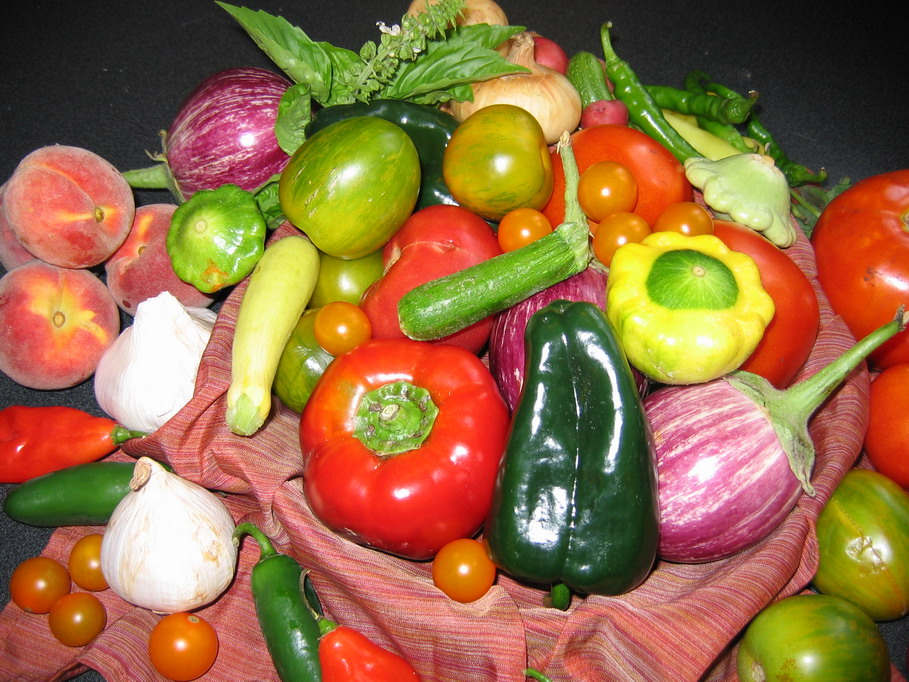
One explanation that is given is that the body lacks something as the child grows, and so the woman’s body triggers a hunger in her for a food that contains the missing nutrient(s). It is a sensible enough supposition, this explanation, and is usually the one that I myself will give for my sudden, uncontrollable desire for whatever food has taken my fancy.
There is nothing wrong with that explanation, per se, mind you, except when you take into account that some unlucky few women have intense cravings guiding them to eat dirt, powdered laundry detergent or sand. One could blithely say that these women are severely malnourished and obviously lack an essential mineral or two that can be found in the inedible item of choice, but that seems to me like cravings gone awry.
Which leads me to the other guidance system that may be at work when it comes to cravings: hormones.
Now, pregnant women get really weary of hearing about hormones, because it seems as though they are at fault for everything in the pregnant woman’s world. Have hot flashes? Hormones are the cause. Your breasts hurt? Hormones are at work. Falling prey to sudden intense fits of rage or worse, sobbing fits that come from nowhere? Hormones again.
In fact, a pregnant woman can easily come to the conclusion that hormones are the root of all the weirdness that invades her world.
And, really, it pretty much is true. So why couldn’t cravings be some byproduct of the ocean of hormones that a woman’s metabolism is steeped in during pregnancy? It seems just as logical as some sort of nutritive lack, and really, the answer may be a combination of the two–the woman lacks a nutrient and so the hormones get to work and make cravings. (They way that hormones work is a complex set of chemical reactions and interactions–and really, the amount that is known about how exactly women’s hormones work is miniscule–our body chemistry is just that complex. I know that it is complex, but sometimes, I have to admit to visualizing the hormones as these black-leather clad little molecules with whips, going about my body, shouting orders and wreaking havoc. So, I have a weird imagination. It’s probably the fault of some hormone or another….)
The other interesting thing about cravings is that they happen to most women during pregnancy, most to the point that I should probably say all, but then some woman who had a perfect pregnancy and sailed through with no side effects or complications would probably post and say, “Oh, I never had one of those.”
And they are different, not only with every woman, but in each different pregnancy.
Which leads women to making assumptions about the baby they are carrying.
For example, when I was pregnant with Morganna, I craved two things continually: cheese, and Huy’s garlic sauce. The cheese I explained away as a need for calcium, and the garlic sauce–which I always said I would eat on whatever Chef Huy felt like putting it on, including an old shoe or a dead rat–well, I never could figure why my liking for it became an obsession when I was pregnant.
Later, however, I decided that I was carrying a kid who really liked cheese and garlic.
And, sure enough, when Morganna was allowed to eat cow-milk based foods–she gravitated over to cheese immediately, and never looked back. And when she was about two, there was the incident where she grabbed a head of garlic out of a bin at a local Middle Eastern grocery store and amused the owner by nearly sticking it up her nose. She loudly inhaled, sighed and said, “Darlic! Mmmm. Darlic! Mordanna love darlic.” (She had problems with the “g” sound at the time, obviously.)
So what am I craving now?
Vegetables. Many of which are not in season yet, but my body really doesn’t much care about that. It still wants tomatoes. And eggplants. Squash, sweet potatoes, and beans. Avocados. Greens–especially kale and collards, but also gai lan, choi sum, bok choi and chard. Fermented vegetables are great, too–kim chee is fast becoming an obsession again. (That was the case for the last pregnancy, the one that ended in a miscarriage.)
Tofu and miso and edamame and other soy products are also appealing strongly to me these days, but even more so–I have been wanting beans and corn.
I guess it is because I am having aversions to meat, that I am seeking so much vegetable protein. Though, every day, I eat a little bit of meat, just nowhere nearly as much as I normally would, and I am still having issues eating beef much at all. I did eat a hot dog yesterday–a great handmade all beef frank in a natural casing that snapped under my teeth, with spicy mustard, onions, chili sauce and slaw on top. It was great, though what I loved the best was the slaw. It was not too sweet–I hate sugary slaw, but it wasn’t all mayonnaisey and slimy, either. I hate gloppy slaw. But it was lightly salty, a little sweet, kind of tart, very cabbagey with just enough mayo to hold it all together.
Go figure. I eat a hotdog and rave about the damned slaw.
I am beginning to believe that this kid that I am carrying was a Buddhist monk in his last life and just doesn’t want to give up on the veggies.
Zak thinks otherwise.
He is of the opinion that once the kid is out, and no longer breastfeeding or being spoon-fed, that it’ll become a junk-food junkie, just as a reaction against all the healthy stuff I fed it from the time it was a blastocyst.
Oh, well. If that is the case, at least I know I -tried-.
But be that as it may–I am finding these cravings to be fascinating and find myself wondering what other women crave? And what do they abhor–because the darker side of the food cravings, the shadow, are the food aversions. With me, I am finding that while I don’t reject sweets totally, I am finding it easier to ignore them than when I am not pregnant. And, of course, there is my inability to eat much in the way of meat.
But what of everyone else? What do other women crave and avoid?
And are these cravings culturally bound, or not?
Super-Quick Allergy Update
I got a call from my doctor’s office today.
It wasn’t the shrimp.
It was the black pepper.
I am allergic to black pepper. Very weird.
They didn’t give me any more information than that, so I don’t know how strong of an allergy it is.
What I do know is that I made keema sookh the other night and as usual, put about 1/2 teaspoon of black peppercorns into the Sumeet grinder along with all the other spices, and ground it up, and suffered no ill effect. I also used, in a restaurant, pre-ground pepper on my food to no ill effect.
The only thing I can think of was that the sauce at The Cheesecake Factory had so much freshly ground pepper in it, that it triggered a sensitivity. The next day, when I ground fresh pepper over a pasta salad and took a bite, a big piece of peppercorn got in my mouth and I had the same feeling of numbness begin on the back of my tongue.
But after that–no effect that I have noticed.
Very odd.
I am not sure what to do now, except mostly avoid pepper, at least, as much as I can.
Beans Out of Gas?
Thanks to my potty-humor obsessed husband, some important research has come to my attention.
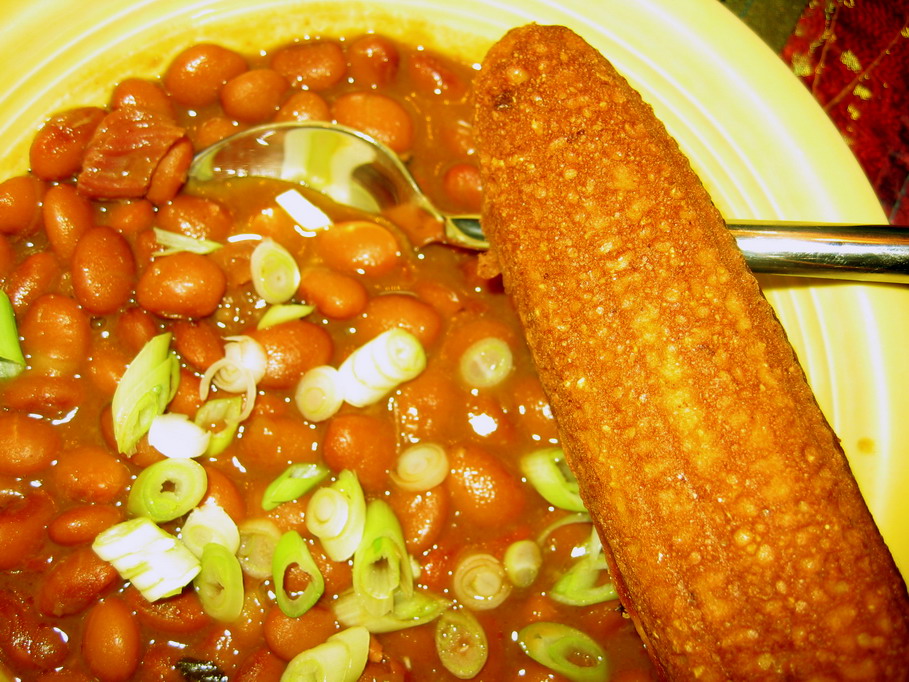
Scientists in Venezuela have discovered a natural method to reduce the gas-producing effect of beans: fermentation.
Two compounds in beans have been pinpointed for years as being the culprits for the vegetables’ near-legendary (at least in my family) capacity for creating intestinal gas: alpha-galactosidic compounds (a component of oligosaccharides in the beans) and soluble dietary fiber. These compounds are not digestible by humans, and so they pass directly to the large intestine, where they are broken down by naturally-occurring gut bacteria, such as lactobacillus. The side effect of this process is a great deal of stink-producing hydrogen and methane gas.
Fermentation by lactobacillus bacteria, however, has been found to reduce the troublesome gas-producing compounds in beans–essentially, scientists are allowing lactobacillus bacteria to pre-digest the alpha-galactosidic compounds and soluble fiber -before- they are eaten by humans. This way, fewer of these compounds reach the lactobacillus bacteria in the gut, where they would be broken down and gas would be produced.
This is great idea, which not only gets rid of the gas, but also renders the beans more nutritious to humans. More nitrogen is available to be digested in the lactobacillus-fermented beans than in those which are not fermented, and there is evidence that the proteins and starches in the beans are more readily digested in the fermented version.
What I want to know is–what do the fermented beans taste like? The Scientific American articles are noteably reticent on that point, but as far as I am concerned, if the fermented beans don’t taste good, no one is going to eat them, even if if they produce less gas and are more nutritious. Lactobacillus fermentation, (also known as lactic acid fermentation) which is the process by which yogurt, kefir, sauerkraut, kimchee, sourdough bread and some pickled foods are made, creates a distinct difference in flavor and texture between the raw materials and the resulting fermented product.
Cabbage and sauerkraut do not taste or feel the same. Cabbage is somewhat sweet, crisp-textured, and a bit biting, while saurkraut is sour (hence the name, huh?), soft and somewhat squeaky in texture. (It squeaks against the teeth when you chew it.) Yogurt is tart and thick, while milk is thin and rather basic in flavor. Sourdough bread is noticeably acidic, while regular yeast-fermented bread is not.
I don’t know if I approve of acidic beans.
Then again, since I like every other product of lactic acid fermentation I have ever tried, especially kimchee, a dish at which many Westerners turn up their noses, I may be wrong. Tangy beans may be tasty.
But, I think that -some- mention of the flavor should have been made. I mean, geez, scientists eat, too, and presumably they taste what they eat. Right? I know my brother-in-law who is studying genetics at Cal Tech certainly tastes his food–I know, because he talks about it a lot. The same goes for a certain organic chemist of my aquaintance. My point is–scientists are foodies too, so why don’t the researchers in question let us know the most important thing–how do those danged beans taste?
I may have to do my own research project to find out.
Until then, however, I will stick with my Beano, the product that allows me to eat my fill of beans, lentils and cruciferous vegetables without gassing Zak, Morganna and the cats to death. For those not in the know about Beano, it is an enzyme supplement (alpha-D-galactosidase, to be specific) produced from a mold that helps the body digest some of those awful gas-producing alpha-galactosidic compounds and soluble fiber before they get to the lactobacillus bacteria in the gut and start acting out. It is good stuff, and it works pretty well, though for lentils I have found that I have to take an awful lot of Beano to make a difference. (For a great medical explanation of how Beano works, check out this link.)
What does Zak, the originator of this post have to say about the issue?
The most important thing he has learned, apparently, is that it is okay to say “fart” on the ABC News. (Well, at least it is okay to say it on their website….)
And that’s the way it is, Thursday, April 27th, 2006. Goodnight. (Yeah, I know, Walter Cronkite was on CBS–I grew up watching him. But still, can you imagine old Walt saying “fart” on the air? I can’t either. It is such an undignified word.)
Stepping Out To Make a Home-Cooked Meal
One of the more interesting twists in the “home meal replacement” industry–which is a big growth sector in the food service business, are the rising numbers of franchise establishments that allow people to assemble a week’s worth of meals out of pre-prepped ingredients, package them, and then take them home to stow in the freezer until they are needed. Then, they are popped into the oven to create a “home-cooked” taste and aroma in a fraction of the time it would take to actually make the meal from scratch. Those who use these businesses are thrilled that they are saving time by not having to do the shopping, prepping and cleanup, while still serving meals that are quite economical at an average of about $3.00 per serving.
On paper, these “meal assembly centers” are an interesting idea: so interesting, in fact that Entrepreneur Magazine called them “one of the hottest franchise concepts of 2006.” The magazine’s website lists 6 different franchise companies ( The Dinner A’Fare, Dinner By Design, Dream Dinners, Let’s Eat, Super Suppers, and Supper Thyme USA) with a total of 241 locations between them.
This information appears to be out of date, however. Other sources, including the websites of Dream Dinners, Dinner By Design and Super Suppers, the three of the largest meal assembly companies, cite over three hundred and ninety-eight locations across the US. Another source lists 570 locations spread among 200 different companies.
The growth of this sector of the food service industry is also evident in the appearance of a trade group that offers support to those interested in opening a meal assembly business. Even though the trend is in its infancy, with most of the businesses going no further back than 2002, The Easy-Meal Prep Association (which probably offers the most accurate number of the franchises and independant meal assembly businesses in the US to date: 270 companies with 742 outlets) offers a number of products and services meant to support the franchisees and business owners who make this tremendous growth possible.
The concept has even spread to Canada.
How does it all work?
The idea is simple, and is related to the methods used by organized parents (and personal chefs, for that matter) to put home-cooked meals on the table every night of the week, even with a schedule too full to cook. Customers sign up for the service online, where they specify the number of meals they wish to assemble, and choose from the recipe/menu options listed on the website. These menu offerings change periodically, so that repeat customers do not get burned out on the same choices in meals.
They choose a date and time to come in to do their cooking. At the appointed time, they arrive at the location, put on an apron, and start “cooking,” a process which consists of going from station to station, and following recipes by measuring pre-prepped ingredients from bins into plastic ziploc bags. These are taken home and stowed in the freezer or fridge until they are thawed and cooked for a warm, cosy family meal. It offers the ease and convenience of popping a frozen entree from the grocery store into the oven, while giving the customers the feeling that they contributed to the creation of the meal (thus relieving guilt) and giving them the appearance of avoiding processed foods, with all of the attendant additives.
Many of these franchises also work hard to sell the idea of “cooking parties” to corporate groups and individuals. Many of the locations supply drinks, snacks and music, the group recieves a discount on the dinners prepared, and the host or organizer of the party often is given her dinners for free. The fun of coming together and “cooking” with friends is emphasized, however, it is obvious that the parties concept is a very well-thought out marketing ploy. By getting new clients to try their services in the fun and informal setting of a party, franchise owners hope to gain more repeat customers.
What is the food like?
Well, I cannot speak from experience, though, in truth, I am half-tempted to take a trip to Columbus to one of these places and give them a try, though I am reluctant to make their minimum of twelve meals. (Why? Because if the food sucks, I certainly don’t want to spend that much money making stuff that none of us will end up eating, that’s why.)
However, among the plethora of news stories out there on the phenominon, there are some pretty sharp critiques.
Lisa Kahn of the New Jersey Star-Ledger noted that because individual franchises had to follow the recipes from corporate headquarters, which are often based far afield, there is no ability to account for individualized local tastes. While most of the companies rely on professional chefs to revamp family favorites such as pasta, beef, chicken and pork, she points out that many New Jerseyites who are accustomed to ethnic food and fresh herbs might not “swoon” over recipes that include garlic powder and frozen pre-chopped onions as ingredients.
Jim Myers, staff writer for The Tennessean, actually went to an outlet of Super Suppers in Franklin, Tennessee and tried out the experience of meal assembly. While he praised the economy of producing the meals at $3.00-$5.00 per serving, he less than impressed with the quality of the ingredients or recipes. He acerbically notes, “Having all your ingredients prepped and ready is called mise en place in formal kitchens, which is French for having everything in its place. I’m a huge fan of mise en place, except when all the mise in the place is a parade of SYSCO products such as frozen chicken bits, garlic powder and fruit drenched in syrup.”
He elaborates that he had hoped for better, fresher ingredients, and that while some frozen foods are fine, the combination of frozen.vegetables and meats, canned chopped garlic, frozen chopped onions and wan-looking spices, gave a flavor to the dinners that did not say “home” to his palate so much as “institution.” He also noted that most of the recipes were loaded with sugar and fat and were not as healthy as Super Suppers claimed.
(On the other hand, for $3.00-$5.00 per serving, what does he expect?)
So, what do I think of all of this?
I have to admit that I think it is just a step above buying Stouffer’s frozen entrees for your family.
I recognize that people have less time to cook than they would like, and it is a struggle for most families to eat a decent dinner together without resorting to pizza or take out. And while I agree with the recently trumpeted research stating that kids are better off having a home cooked, sit-down dinner with their parents, than they are eating microwaved food between activities, I am not sure that the ingredients used in these meal-assembly franchises are going to make meals that are any healthier than the average take-out or frozen dinners. (That research, btw, seems to appear in the press releases and marketing materials for these meal assembly companies–if the number of times the statistics are cited in media stories on the companies are any way to judge. It makes me think that they are preying upon parental guilt in a big way.)
I know that as a personal chef, I tended to use the healthiest, freshest ingredients possible in the meals I made for my clients: fresh vegetables and fruits, dried beans and grains (cooked in the rice cooker and pressure cooker to save time), fresh herbs, and fresh meat, poultry and fish. I used real, unprocessed cheeses and dairy foods, and every meal I made tasted like what it was: food made by hand, with care and attention to detail. My prices were also not much higher than what these businesses are charging, and frankly, my product was a hundred times better than anything that could be assembled out of Sysco processed food products.
Personally, I think that if people want to serve truly healthy, flavorful options to their families, they will take one day a week, and cook up a week’s worth of food in an afternoon. Sure, they will have to be organized, do the shopping and the prep and the cleanup, but these chores can all be shared among the entire family. In fact, cooking together can frankly, count as quality time. Kids learn a great deal by cooking with Mom and Dad–they learn valuable life skills such as cooking and economics, safety, math, counting and task management. It can also be a great deal of fun, especially if cooking is approached not as a boring, irritating chore, but as an expression of love for food and each other.
But, I also realize that I am essentially old fashioned. It is easy for me to say these things, because I am trained as a chef, have worked as a personal chef and a prep cook and cooking is in my blood and bones. It is easy for me to take the high road and call for parents to use the freshest ingredients because that is what I grew up eating as the granddaughter of farmers.
But, really, think about it. Most of the greatest things in life are not easy. Being a parent isn’t easy, nor is being a good spouse. But everyone strives to accomplish these things–we all try to be the best people we can be.
So, why not try to be a good cook, too? Aren’t our families worthy of being fed the really good stuff?
I think so.
I just wish more folks thought so, too.
Baking Again: Rasberry Rose Crumb Bars
One of those rare baking fits has come upon me, and I have no idea why.

It isn’t that I want to eat sweets, necessarily. I am still more likely to crave beans, rice, corn tortillas and a good stir fry than sweets.
But I have the desire to bake sweet things and then feed them to other people.
Last night, while Zak was at his doctor’s appointment, after I cleaned the dinner dishes up, I asked Morganna if she would like to bake something with me.
“Sure!” she said, predictably.
So, we frolicked off to the kitchen to determine what exactly we would like to bake.
Cookies were decided upon, though cake was a close second. I just figured that we could more easily get rid of cookies, as I can just send them to school with Morganna and she can pass them out among the students and teachers. Cake is more difficult to transport and give away. Unless one makes cupcakes, which I might do at some point, but last night was a cookie night.
But again–what kind of cookies, eh? I mean, really. We’ve been through this before.
However, it is spring, and my fancy turns lightly to thoughts of fruit. That narrowed the choices.
The world outside is alight with blossoms and fresh floral scents, and the sun is as bright as it is in summer, which made me think of raspberries.
Raspberry-filled crumb bars are a classic cookie, and I posted a recipe for the usual way I make mine a long while back, but as I looked at it, and looked in my pantry, I realized that I could improve upon it.
For one thing, I had that lovely Pakistani rose petal preserve just sitting on my shelf waiting to be utilized in another creative way.
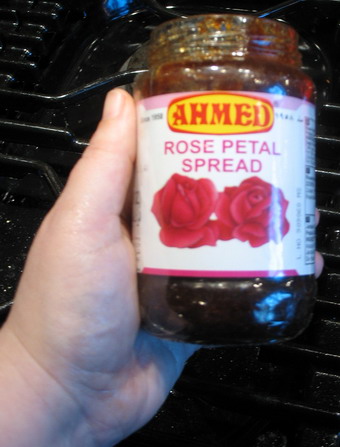
And for another thing, I was stymied in my desire to add oats to the last batch of cookies, and there, lonely on the pantry shelf were some organic rolled oats. They didn’t exactly jump up and down, waving an arm and saying, “Ooh, ooh, ooh, me, me, me!” but they got my attention anyway.
Besides, I didn’t have the usual amount of almonds to add to the dough, so I grabbed the oats and set them on the counter.
Morganna didn’t even flinch when she saw the oats. I think she only objects to them in the context of chocolate.
These little flavor-packed bars come together quickly and easily. The thing that takes the most time is preparing the pan. You can just grease and flour a glass baking pan, but I prefer lining it tightly with foil, and spraying it with Baker’s Joy. That way, you can just lift the foil out by the flaps on the outside, when the bar is done baking, and set it on a wire rack to cool. Out of the glass pan (which helps the cookies bake more evenly), the cookies cool much faster, and the cleanup is not traumatic. You can also cut the bars more cleanly into neat-edged squares if you take them out of the pan before cutting them.
The dough is simple–it is basically a pastry dough that is put together in a mixer until it resembles coarse crumbs. There is an egg in the dough, which helps hold it together when you pat it into the pan; it also adds cohesion to the cookies once they are baked. After it is mixed together, you then take two cups of the dough out, gently knead the almonds in by hand, and set it aside.
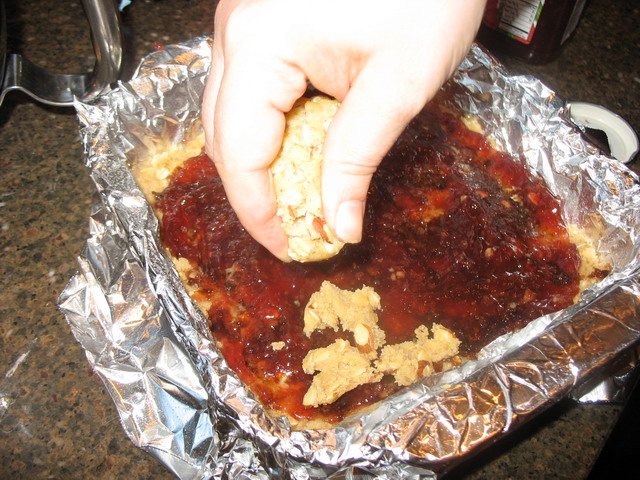
The rest is simply dumped into the prepared pan and patted down into an even layer to form the bottom crust.
Then, the rose preserves and raspberry jam are spread evenly over the crust. The rose preserve is very strongly flavored, so we opted to use it very sparingly. We found that a mere 5 1/2 teaspoons spread in a very thin smear over the bottom crust was sufficient to add aroma and a delicate floral flavor to the filling. The 3/4 cup of raspberry jam was simply spread over that.
Placing the crust on top is done in a different technique; instead of dumping it in and patting it evenly, I just take up the dough by the handful and working it with my fingers, crumble it evenly over the jam, letting most but not all of it get covered by little lumps of dough. Then, I gently pat it down to create a more even-looking, slightly more compact top crust. The sliced almonds stud the top crust and add a good amount of crunch and good looks to the final cookie, while most of the almond flavor comes from the almond extract in the dough.
They smell incredible while they bake. The first fragrance to waft into the living room where we were watching Dr. Who, was the almond-scent, kissed with butter. Then, the raspberry and rose drifted into our awareness, rich and redolent of a sun-drenched summer garden. When we took them out of the oven and pulled the foil up and out of the pan, setting the cookies onto a rack, it was hard not to dive instantly onto the cookies.
However, they really are better served to be cut after they are fully cool. If they are still warm, or even worse, hot, several things are bound to happen.
One–you -will- burn your lips and tongue on the jam and preserves. Two, the bars will fall apart. Remember, Raspberry Rose Crumb Bars are essentially a type of pastry and while the oats help give them structure, these cookies are delicate.
The flavor, however, is worth the wait. The subtle spices in the dough, along with the almond extract and almonds are a perfect frame for the richness of the raspberries mixed with damask roses. The oats really add a lot of texture to the cookies, making them slightly chewy, in addition to being crumbly and rich with butter, with the layer of sticky jam in the middle.
All in all–they turned out to be a delightfully grown-up cookie that still satisfies the kid inside.
Raspberry Rose Crumb Bars
Ingredients:
2 cups all purpose flour (or 1 1/2 cups white and ½ cup whole wheat flours)
1/2 cup rolled oats
1 cup raw sugar
1 cup softened butter
1 egg
1 tsp. almond extract
¼ tsp. ground ginger
½ tsp. ground cardamom
½ tsp. ground cinnamon
1/2 cup sliced almonds
5 1/2 teaspoons rose petal preserves
¾ cup seedless raspberry jam
Method:
Preheat oven to 350 degrees F.
Combine all ingredients except almonds and preserves in mixing bowl and beat on low speed until mixture resembles coarse crumbs.
Reserve 2 cups of crumb mixture, and gently knead sliced almonds into the crumbs.
Grease an 8 or 9 inch square baking pan (you can line with foil first to ease lifting bars from pan after baking–if so, grease foil–I use Baker’s Joy).
Press remaining crumb mixture eveningly ontop bottom of pan.
Sparingly spread rose preserves in an even layer within ½ inch of edge. Spread raspberry preserves on top of the rose jam.
Top with remaining crumbs fairly evenly, then gently pat down.
Bake for 40-50 minutes, until the top is lightly browned.
Cool completely, cut into bars.
Makes 25 small bars.

Categories:
- Admin (rss) (55)
- Blogs and Blogging (rss) (81)
- Book Reviews: Cookbooks (rss) (43)
- Book Reviews: Non-Cookbook Food Books (rss) (38)
- Cats and Cat Blogging (rss) (47)
- Chinese Cooking Lessons (rss) (32)
- Culinary School Stories (rss) (18)
- Dairy Pruducts: Cultured and Barbaric (rss) (4)
- Documentary Filmmaking (rss) (1)
- Essays, Rants and Reflections (rss) (260)
- Fighting Hunger (rss) (12)
- Food and Kids (rss) (45)
- Food in the News (rss) (126)
- Food Media (rss) (98)
- Food Preservation (rss) (18)
- Food Safety (rss) (45)
- Gardening (rss) (30)
- Herbs and Herb Blogging (rss) (20)
- Holidays (rss) (50)
- Kat Blogging (rss) (22)
- Kitchen Science (rss) (36)
- Leftover Makeover (rss) (8)
- Life, the Universe and Everything (rss) (131)
- Local and Sustainable (rss) (227)
- Local Athens Food and Foodies (rss) (42)
- Meatless Mondays (rss) (32)
- Menu For Hope (rss) (5)
- Nutrition, Diet and Health (rss) (84)
- On The Farm (rss) (8)
- Recipes: Almost Vegetarian, Vegetarian and Vegan (rss) (294)
- Recipes: American Regional (rss) (37)
- Recipes: Appalachian Hillbilly (rss) (33)
- Recipes: Bread, Pasta, Grains (rss) (95)
- Recipes: Canning and Preserving (rss) (8)
- Recipes: Chinese (rss) (123)
- Recipes: Comfort Food (rss) (120)
- Recipes: Cookies (rss) (16)
- Recipes: Desserts (rss) (48)
- Recipes: French (rss) (25)
- Recipes: Fruits and Vegetables (rss) (302)
- Recipes: Greek, North African and Middle Eastern (rss) (31)
- Recipes: Indian (rss) (137)
- Recipes: Italian (rss) (42)
- Recipes: Japanese (rss) (7)
- Recipes: Jewish (rss) (4)
- Recipes: Korean (rss) (6)
- Recipes: Meat, Poultry and Fish (rss) (220)
- Recipes: Mexican/Native American/ Latin American/Caribb (rss) (27)
- Recipes: Original (rss) (108)
- Recipes: Thai (rss) (27)
- Recipes: Tofu (rss) (17)
- Recipes: US Regional (rss) (16)
- Recipes: Vietnamese (rss) (8)
- Restaurant Stories (rss) (28)
- Sewing, Quilting, Arts and Crafts (rss) (16)
- Simple Chinese Recipes (rss) (30)
- Slow Food and Heritage Foods (rss) (10)
- Spice Blogging (rss) (44)
- The Chinese Cookbook Project (rss) (14)
- The Chinese Pantry (rss) (39)
- The Documentary (rss) (2)
- The Kitchen Saga (rss) (17)
- The Locavore's Bookshelf (rss) (15)
- The Unsung Adventures of The Culinary Nerd (rss) (6)
- Tools and Toys (rss) (35)
- Uncategorized (rss) (10)
- With a Side of Politics (rss) (48)
Archives:
- August 2012 (9)
- July 2012 (12)
- September 2011 (3)
- August 2011 (7)
- July 2011 (8)
- June 2011 (16)
- May 2011 (17)
- April 2011 (11)
- December 2010 (9)
- November 2010 (5)
- February 2010 (1)
- December 2009 (5)
- November 2009 (7)
- October 2009 (10)
- September 2009 (16)
- August 2009 (14)
- July 2009 (14)
- June 2009 (7)
- May 2009 (17)
- April 2009 (10)
- March 2009 (25)
- February 2009 (13)
- January 2009 (10)
- December 2008 (5)
- November 2008 (5)
- October 2008 (6)
- September 2008 (13)
- August 2008 (8)
- July 2008 (11)
- June 2008 (18)
- May 2008 (13)
- April 2008 (14)
- March 2008 (16)
- February 2008 (17)
- January 2008 (19)
- December 2007 (25)
- November 2007 (18)
- October 2007 (24)
- September 2007 (16)
- August 2007 (15)
- July 2007 (15)
- June 2007 (10)
- May 2007 (14)
- April 2007 (16)
- March 2007 (17)
- February 2007 (20)
- January 2007 (13)
- November 2006 (1)
- October 2006 (8)
- September 2006 (14)
- August 2006 (25)
- July 2006 (30)
- June 2006 (28)
- May 2006 (34)
- April 2006 (29)
- March 2006 (24)
- February 2006 (30)
- January 2006 (38)
- December 2005 (40)
- November 2005 (37)
- October 2005 (32)
- September 2005 (25)
- August 2005 (30)
- July 2005 (28)
- June 2005 (21)
- May 2005 (8)
- April 2005 (22)
- March 2005 (17)
- February 2005 (29)
- January 2005 (10)
Search Site:
Links:
- Lily’s Wai Sek Hong
- 101 Cookbooks
- A cat in the kitchen
- A Veggie Venture
- Accidental Hedonist
- Cha Xiu Bao
- chez pim
- Chocolate & Zucchini
- Chopstick Cinema
- Chowhound.com
- Chubby Hubby
- Cook sister!
- Cooking with Amy
- da*xiang
- Eat Local Challenge
- Eating Liberally
- Ecocentric
- Eggbeater
- Epicurious
- Farmgirl Fare
- Fatfree Vegan
- Foodgoat
- ForkandBottle.com
- Green Olive Tree
- Hooked on Heat
- Jaden’s Steamy Kitchen
- Kalyn’s Kitchen
- Lucullian delights
- Mahanandi
- Matt Bites
- MeatHenge
- mmm-yoso!!!
- New York Times – Dining & Wine
- Pizza Goon
- Rasa Malaysia
- Ruhlman
- Sailu's Kitchen
- Serious Eats
- SF Gate: Food & Dining
- Simply Recipes
- Soul Fusion Kitchen
- Tastespotting
- The Amateur Gourmet
- The Cleaner Plate Club
- The Food Section
- The Grub Report
- thecookscottage
- U.S. Food Policy
- Wandering Chopsticks
- Washington Post Food and Dining
- Wasted Food
Meta:


Powered by WordPress. Graphics by Zak Kramer.
Design update by Daniel Trout.
Entries and comments feeds.