
Cook Local, Eat Global
IMBB: Use Your Noodle–Lo Mein
Lo mein is a popular dish in Chinese-American restaurants, and sometimes it is quite good. Meaning “stirred noodles,” it is generally made by stir-frying a topping of some sort–meat, tofu, vegetables, with some sauce made from thickened broth seasoned with wine, soy sauce and sesame oil.
All too often, in restaurants it is a travesty of limp, gummy noodles drowned in sticky, pasty sauce. I don’t know why such a simple dish should be treated so roughly by restaurant cooks, but perhaps it is because many Americans like lo mein made that way.
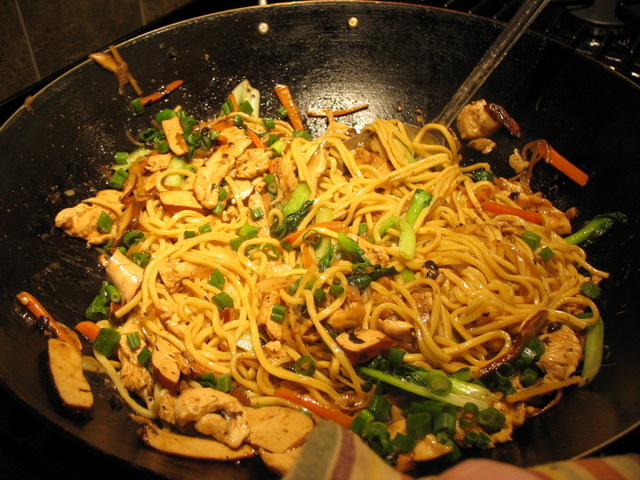
I like it best when it is made from fresh wheat noodles, which can be purchased in Asian markets either in the refrigerated section or frozen. I learned to make lo mein at the China Garden from one of the under-chefs. His name, oddly enough, was Lo, and this is the way he showed me to use fresh wheat noodles so that they didn’t get too soft or squishy.
If you buy them frozen, simply leave them on the counter for a few hours to thaw, or in the refrigerator overnight. These must not be cooked for very long–they are soft and pliable. I bring the water to a boil and then sift them through my fingers into it, and stir, then cook them for no more than two or three minutes. Any more and they will become mushy and unappetizing.
Then, drain them, and rinse them immediately in cold water, until they cool. The cold water does two things. One, it cools the noodles and keeps them from cooking under their own heat, and two, it firms the starch up so they have a more toothsome texture. Lo was very clear on this point, and I have heard it again and again from Chinese chefs. Always rinse your noodles in cold water, even if you are going to put them into hot soup right after. And they are right–it makes a difference.
Then, after the cold water shower, drain the noodles again, and pour a half teaspoon of sesame oil into your hands, and massage it through the noodles to keep them from sticking.
That is all that is necessary to get the noodles right.
As for the topping–it can be anything. I like chicken or tofu, or as I made tonight–chicken and tofu.
With mushrooms, carrots, and greens, and flavored with onions, ginger, garlic, a single red jalapeno and fermented black beans, the mixture is varied in color and texture, flavor and and fragrance. The noodles are tender-chewy, the mushrooms are tender, the carrots crisp, the greens velvety, and the chicken delicious. The tofu is chewy without being rubbery and the aromatics come together to make a very well-flavored dish without being harsh or overly seasoned.
To make the lightly thickened sauce, it is merely a matter of marinating the chicken in plenty of wine and cornstarch, then after stir frying it with all of the vegetables, adding a bit of soy sauce and more wine, and deglazing the wok. Then, in go the noodles, and about 2/3-3/4 cup of chicken broth. While you are busy stirring the noodles into the topping, the cornstarch is busy thickening the sauce into a nice glaze that clings to everything without being heavy, greasy or overly sticky and sweet.
It is a very comforting dish, very easy and quick to put together, and a very homey, simple supper for friends and family.
Altogether, lo mein is one of my favorite ways to eat noodles.
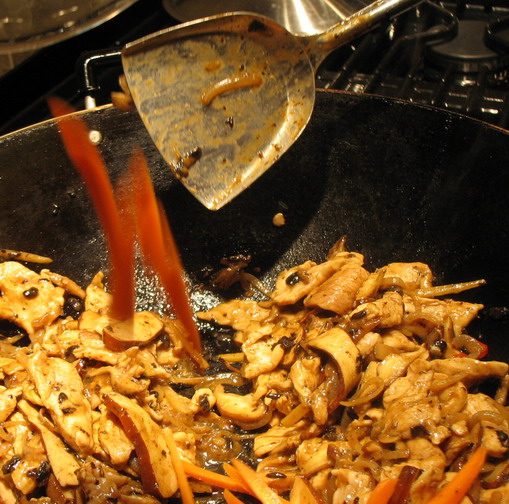
Chicken Lo Mein with Greens and Mushrooms
Ingredients:
1 pound fresh Chinese wheat noodles
1/2 teaspoon sesame oil
1 1/2 tablespoons peanut oil
1 small onion, thinly sliced
1 1/2″ cube fresh ginger, peeled and cut into thin slivers
1 ripe jalapeno, thinly sliced on the diagonal
2 cloves garlic, peeled and thinly sliced
1 1/2 tablespoons fermented black beans, lightly crushed
1 whole boneless skinless chicken breast, very thinly sliced
2 tablespoons Shao Hsing wine
1 1/2-2 tablespoons cornstarch
handful fresh shiitake mushrooms, stemmed, caps cut into thin slices
3 squares pressed spiced tofu, sliced thinly
1 tablespoon Shao Hsing wine
2 tablespoons thin soy sauce
1/2 cup jullienned carrots
1 bunch tatsoi, bottom trimmed off, leaves washed and dried
2/3-3/4 cup chicken broth
1/4-1/2 cup thinly sliced scallion tops
1/2 teaspoon sesame oil
Method:
Bring large pot of water to a rolling boil. Loosen up the bundle of fresh noodles with your hands until they are all separated and sprinkle them into the pot, then stir with a chopstick so they do not cling together once they are in the water. Keep stirring so they don’t touch the bottom, and watch over them. Do not let them boil more than two or three minutes–I tend to boil mine for about two and a half minutes. Then drain them into a colander in the sink, and rinse thoroughly with cold water tossing and separating them with your fingers so none of them even get a chance to stick together.
Then let them drain for a minute or two, and pour some sesame oil into your hands and massage it through the strands of noodles. This keeps them from getting sticky while they sit waiting to be stir fried in the wok.
And speaking of the wok, it is time to heat it up until it smokes, and then add the peanut oil. Wait until it is hot enough to shimmer, then add the onions and stir fry until they are deep golden. Then add the rest of the aromatics, and continue stir frying until the onions are browned and everything is wonderfully fragrant.
Add the chicken, pat it into a single layer in the wok and leave it to sear and brown on the bottom for about a minute and a half without distirbing it. Then, stir fry. When half of the pink is gone from the chicken flesh, add the mushrooms and tofu, then deglaze with the wine and soy sauce.
Continue stir frying, then add carrots, and stir fry for about another minute–by this time the chicken should have all of the pink gone.
Add the greens, and the noodles, and the chicken broth. Stir fry quickly, mixing everything thoroughly. Three things happen at this time–the noodles absorb sauce flavor, the sauce thickens and clings to the ingredients, and the greens wilt to a velvety texture.
When everything is well mixed and the sauce is clinging to everything, remove from heat and stir in scallions and sesame oil, then serve in bowls with chopsticks.
Note: This is a very versatile recipe. You can use any meat or seafood, and any tofu or vegetables you like in any combination. Change the seasoning, add more chiles, use chile garlic paste- or hot or sweet bean paste–whatever you like. Customize it to your own taste. That is the beauty of these simple Chinese homestyle recipes–they reflect the unique flavor of your kitchen and the more times you make them, the more they become yours.
Tagged with: IMBB # 22 + Noodle
Hillbilly Fried Rice
So we come to it.
The fusion dish to end all fusion dishes.
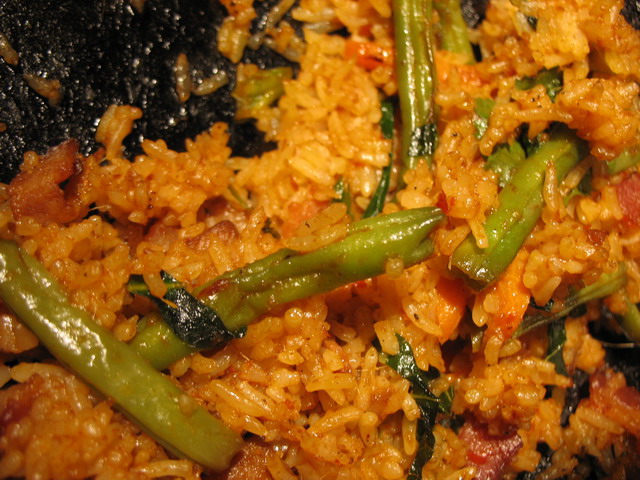
The culinary equivalent of a bastard love child between the movies “Deliverance” and “Crouching Tiger, Hidden Dragon.”
Hillbilly Fried Rice.
Oh, I hear the giggles. The laughter. The disbelief.
That is only because you haven’t tasted it, friends.
Because this here stuff is good.
Uh. Huh.
You know why?
Because it involves bacon.
Oh, yes. Bacon. Bacon makes everything better. Ummhmm. Bacon, bacon, bacon. That fine fatty goodness that comes from the belly of the sacred swine, the sweet, salty, sexy bad boy of the kitchen: bacon.
The other thing it involves is greens.
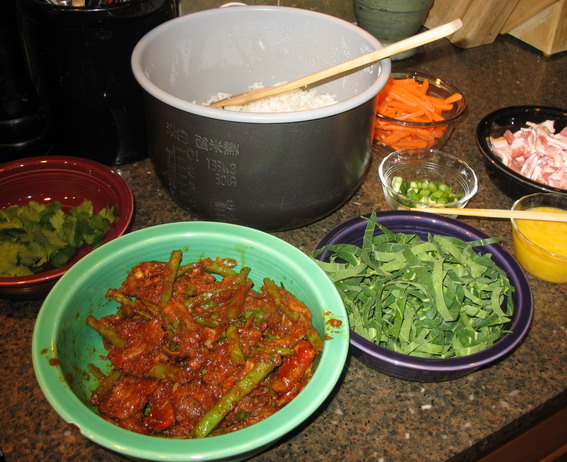
Which isn’t just an attempt to counterbalance the nutritional deep-six that the bacon provides.
Far from it. It is meant to give flavor to the dish. It is meant to further anchor the fusion between the Chinese wok and the hillbilly cast iron skillet.
You see, because the hillbillies and the Chinese both are great lovers of the pig and the greens. And, both groups being frugal by nature, there are within both culinary traditions many dishes which start out as a means of dealing with leftovers in the most tasty manner possible.
Therefore, as silly as one might think it, Hillbilly Fried Rice is something that is inevitable. It is natural. It is something that was meant to be.
It is an idea whose time has come.
How does one make it?
Well, first, one must be in the right mindset to make it. One must have several things in the kitchen. A wok, of course, is a necessity, because believe me, I don’t care what Mr. Alton Brown has to say about how impossible it is to stir fry in a wok on an American stove, if he so much as even tried to make fried rice in a prissy little saute pan, he would rue the day he had that particular doomed idea and would run home cryin’ to his mamma about it. You cannot fry rice in a saute pan, not unless you enjoy scattering little grains of cold rice all over your kitchen.
There are very few times I will say something like that, but here is one of those times. If you don’t have a wok, don’t even try to fry rice.
Secondly, you need cold, leftover steamed rice to make this dish.
I don’t care what kind of rice it started out as: jasmine, basmati, texmati, brown, short grain, long grain or saffron, it has better be cold, and a little bit dried out before you start this recipe. I am telling y’all that if you start out with nice warm, fluffy steamed rice and put it into your wok it is going to do three things in this order: it will get smooshy and mucky, it will stick to your wok no matter how much oil you pour over it, and it will burn and smell hideous.
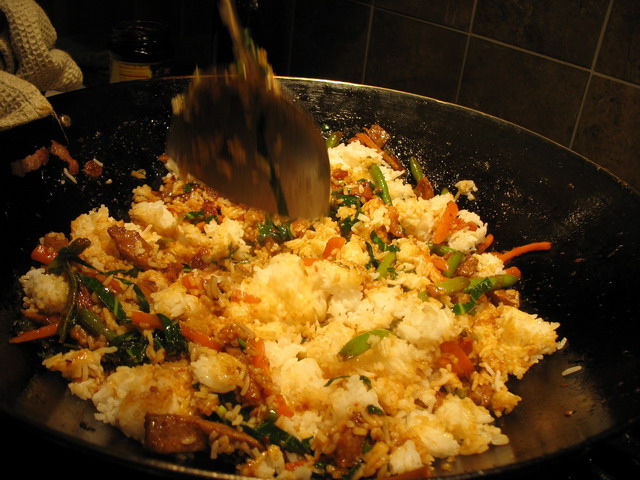
I did this at a very young age, so I know. It is a lesson I never forgot, so I pass it on to you, free of charge, so you never have to go there and experience the horror of smelly, sticky rice burned onto your once happy, innocent wok.
Another thing–before you try and stir fry the rice, break it up from its big clumps into mostly separate grains and a few small clumps. Otherwise your wrists will want to jump ship and run away from you as you struggle trying to stir fry it and turn it into a nice happy wok full of fried rice.
And at least one giant rice clump will break apart in mid-stir and go flying around the kitchen in a scatter of little grains that coat the cooktop, the floor, your hair, your cat, the rugrat in the highchair, everything. You’ll find rice three months after you tried to fry it up in the light fixture on the ceiling when you go to change lightbulbs.
So, break up the rice.
Oh, and one more thing–don’t try to do this while intoxicated. Hand-eye coordination goes right out the window, and the rice goes on the floor, and before you know it, your face is in the wok and your hair’s on fire, and someone stepped on the cat’s tail and your housemate is laughing so hard she can’t help you. (I am exaggerating just a little for comic effect, but not by much.)
The other things you need for making a proper batch of Hillbilly Fried Rice are some leftovers.
You can put near-about anything in fried rice and it will taste good. Everything from tofu, to vegetables, to meat to left-over stir fried stuff to left-over ham bits to Chinese sausage to smoked sausage to bits of Thai curry to some Mexican carne asadas. At one time or another, any or all of those have made their way into a batch of Hillbilly Fried Rice and tasted downright fine. There are just a couple of rules to keep in mind when assembling your leftovers: one, if you can’t identify it–it don’t need to go in the wok.
And two: if it has Spam in it–it is no longer Hillbilly Fried Rice and has fallen into the category of Redneck Fried Rice and you are no longer in my domain, but have ended up over in one of my cousins’ kitchens. You know, the cousins who are named Duck and Jick. (I do too have cousins named Duck and Jick–don’t y’all dare and try to contradict me.) Those guys. Once you are in their clutches, I cannot rescue you. Obi-Wan is your only hope for salvation from redneckdom.
He’ll use the Force and I’ll sit on the sidelines and watch. (Well, actually, we might could use the John Deere to pull y’all out, but the Force is a mite bit more reliable than the old Deere these days.)
Oh, and the other thing–don’t put your neighbor’s kids or pets into the fried rice because it riles them up a bit. So, no matter how annoying and loud they might be, they have to stay out of the wok. It just isn’t neighborly otherwise. Put the cleaver down, and walk away.
So, anyway, I bet at this point, you are wanting a recipe. I guess I should just write it down then, and let y’all go on about your day now that you know all about the Hillbilly Fried Rice.
Y’all come back now, y’hear?
Cue banjos.
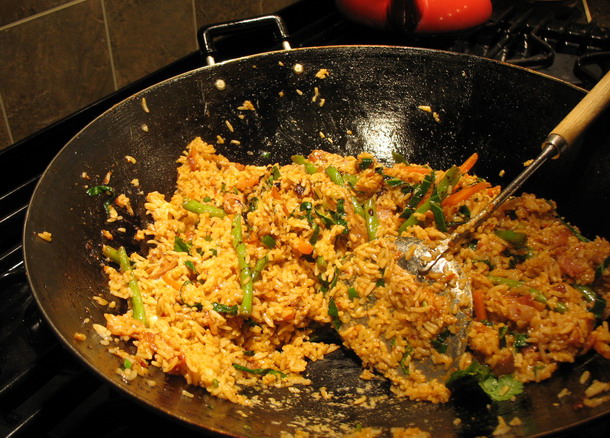
Hillbilly Fried Rice (serves as many as it needs to)
Ingredients:
1 tablespoon peanut oil
3-6 strips thick cut country style bacon cut into 1/2″ pieces (or more if you like)
1 small onion, sliced thinly –optional
2-3 cloves garlic sliced thinly–optional
1″ piece fresh ginger cut into thin slivers–optional
thinly sliced chile–optional
1-2 cups of assorted leftovers from the refrigerator, hopefully cut to the same basic shape and size as the bacon. Recut if you have to
1/2 cup of fresh vegetables like carrots, cut into julliene. You can also use mushrooms here, or water chestnuts or broccoli stems whatever you like
2 cups fresh greens cut into shreds–I like collards best
soy sauce to taste
Shao hsing wine to taste
2-4 cups cold steamed rice, broken up into individual grains again
2 eggs, lightly beaten
handful scallions, thinly sliced
handful cilantro leaves–optional
1 teaspoon thick soy sauce–optional (this is what makes restaurant style fried rice brown)
1 teaspoon toasted sesame oil
Method:
(A quick note before I begin. See all those optional aromatics I have listed there in the beginning? They are optional because I have no clue what leftovers you have in your refrigerator. If, like I had tonight, you have mu pad prik king, you don’t need any other aromatics because it is plenty aromatic on its own, and is enough to flavor all the rice. I just added three thinly sliced scallions, some carrots, the greens and some cilantro. But if you have Cantonese leftovers or something else mild, then you might need some more flavor boosters–so start slicing. In other words–it is up to you. Only you know the contents of your refrigerator.)
Heat wok until it smokes and add oil. Add bacon. Stir fry quickly, until it renders its fat and is medium done–still chewy, in other words. (If you are using the onion, cook it with the bacon. It will be golden brown when the bacon is ready.)
Add your aromatics if you are using them, and then your leftovers and stir and fry until everything is nice and warmed up. If you are using carrots or other crunchy fresh vegetables, add them at this time. Add the greens and keep stir frying until everything is quite hot and fragrant.
Add the rice. Then stir fry. This is an utter bear. The rice is heavy. Keep stirring it anyway. You have to kind of stir it and chop it with the edge of your wok shovel. Rather like chopping weeds with a hoe. It sucks. Pray to the Kitchen God to help you or something. He probably won’t but pray anyway. It might make you feel better for having tried. Keep stirring until everything is mixed together and the rice is starting to look glossy. Pour a tiny bit of the soy sauce and wine in, to deglaze anything that might be stuck on the sides of the wok. When everything is stirred in together and mixed nicely and hot, make a hole in the middle of the rice in the center of the wok.
Pour your eggs in and stir, cooking the eggs in the middle. I actually cook mine halfway and then mix it all into the rice so that it makes the rice stick together and there are no obvoius egg bits in the dish. Sneaky me. It makes everything taste good, too. But you can cook the eggs all the way in the center, and then mix it all up into the rice after. That way, you have little yellow-brown eggy bits showing in your rice, which is also good. It is your wok, your kitchen, your eggs–you do what you want.
Stir in the scallions and cilantro, and the scant teaspoon of thick soy sauce if you want your rice to be brown.
Stir in the sesame oil, and serve it forth.
You are done.
A note: the mu pad prik king made an absolutely delicious version of Hillbilly Fried Rice, so much so that Zak liked it better today than he did yesterday.
Dan approved too, but then, it did have pork in it.
Oh, and while we are talkin’ about fusions fried rice, check out what Sailu had cookin’ recently: Indo-Chinese fried rice. I bet that is something right fine and dandy. Meena has some fried rice, too, here at Hooked On Heat.
Mu Pad Prik King: A Thai Dry Curry
Some people are confused when they hear the words, “dry” and “curry” uttered together.
I am not really certain why; if one eats either Thai or Indian foods often, there are plenty of dishes that are called “curry” that are not soupy with gravy or sauce, but dry, with spices or spice pastes clinging to the main ingredients.

But there are people out there who think “curry” and instantly think “gravy,” and think of a nice soupy dish poured over some kind of rice that is spicy and warm and good, and that is all there is to it.
Except, that isn’t all there is.
In Thailand, there are lots of dry curries. And honestly, I have yet to meet one that I haven’t liked.
One that I am particularly fond of is mu pad prik king, which translates literally to “pork fried chile ginger.” Or, in plain English, stir fried pork with chile ginger paste.
The main flavorings, however, in the dry curry paste are not chile and ginger, but are chiles, galanal, garlic, shallots, lemongrass and lime zest, though of course, there are other ingredients. The ever-present shrimp paste is one, cilantro roots (or stems, as I was forced to use) are another, with white peppercorns bringing up the rear.
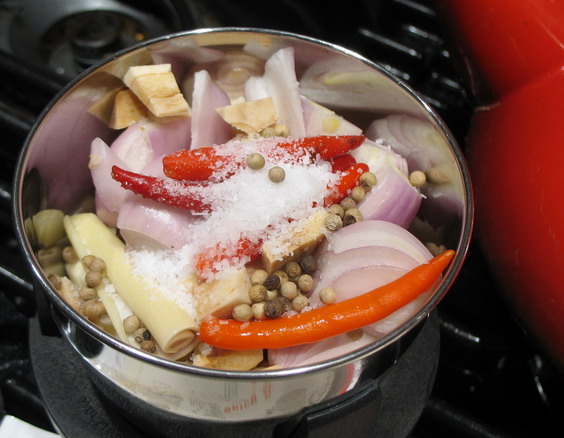
An unusual ingredient that is, according to Chef Victor Sodsook, used in the countryside is pork cracklings, which are the solid, browned leavings from rendering lard. Lacking those, I used a teaspoon of bacon grease–and was surprised to find that it really did add a great deal of flavor to the finished dish.
The making of any dry curry is simple, once the curry paste is managed. Again, I recommend the Sumeet grinder for anyone who makes large amounts of Indian, Thai or Mexican foods–any cuisine where seasoning pastes are regularly made is one that can be simplified by the use of one. I know that there are cooks who swear that using a mortar and pestle is relaxing, but I know that with my carpal tunnel as bad as it is, I would never cook Thai food from scratch if I had to crush every curry paste ingredient by hand. I just know it–and I am a patient, methodical and obsessed cook.
Which means if I wouldn’t do it–neither would most people.
Once the curry paste is made, however, the procedure is quite simple.

It involves heating up a wok, adding oil, and cooking your protein item, whether it is meat, fowl, seafood or tofu, about halfway, then removing it to a bowl.
Then the curry paste is added, and stir fried until it dries out slightly and darkens a bit. It is seasoned to taste with palm sugar and fish sauce. A few spoonsful of water are added to rehydrate it, then the protein ingredient is added again, and stir fried until done. Then, blanched or steamed vegetables are added, stir fried a bit, some lime juice is added, and the food is turned around the wok one or two more times, then scraped into a serving platter and decorated with the appropriate garnishes.
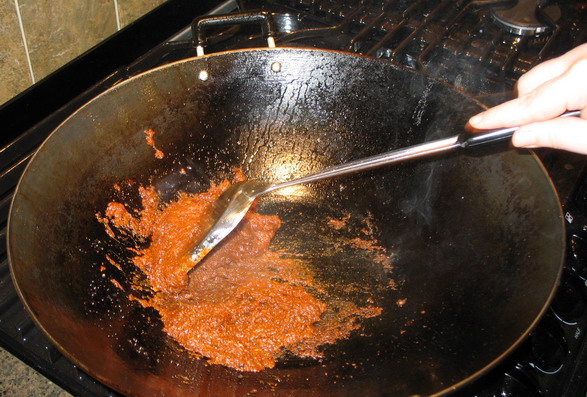
In the case of mu pad prik king, blanched string beans are added along with crushed peanuts and slivered lime leaves. Lacking lime leaves as I did–cilantro will do. It lacks the floral sweetness of lime leaves, but the fresh scintillating green of it is an excellent contrast to the sharp, very intensely flavored dry curry.
Dry curries are meant to be eaten with a large amount of rice. A spicy clear soup like tom yum goong (hot and sour shrimp soup) would go admirably with it as well.
This was the first time I had made this particular curry and both Morganna and I loved it. I added fresh shiitake mushrooms to the dish, and while I adapted the paste from Kasma Loha Unchit’s Dancing Shrimp, I also used the pork fat idea from Victor Sodsook’s True Thai. For the curry itself–I adapted it from Kasma’s version using shrimp. Instead of steaming the beans and using them as a garnish, I blanched them and threw them into the stir fry. As noted before, I had no lime leaves, so I used cilantro instead, and I added not only the pork fat to the curry paste, but also the white peppercorns, and four Thai bird chiles for heat.
We had a lot of leftovers, mainly because Zak was too tired to eat (he was arguing with our plumbing all day–he won, but I think his back is the worse for the victory), and Morganna was feeling rather blah as well. I think that the only thing I will change about the recipe next time, is that I will not use all of the curry paste as Kasma directed me to. I think it was slightly too much. It was very good, but very, very overwhelming. I think I would use only 2/3 of the recipe and use the rest for some other flavorful purpose sometime later in the week.
No matter–we all liked it and the leftovers will do admirably for supper tomorrow–I promised Morganna that I would make Hillbilly Fried Rice for us, so stay tuned, and see what happens when you set a hillbilly loose in a kitchen with a wok, some bacon, a mess of greens, a pile of rice and various Asian leftovers.
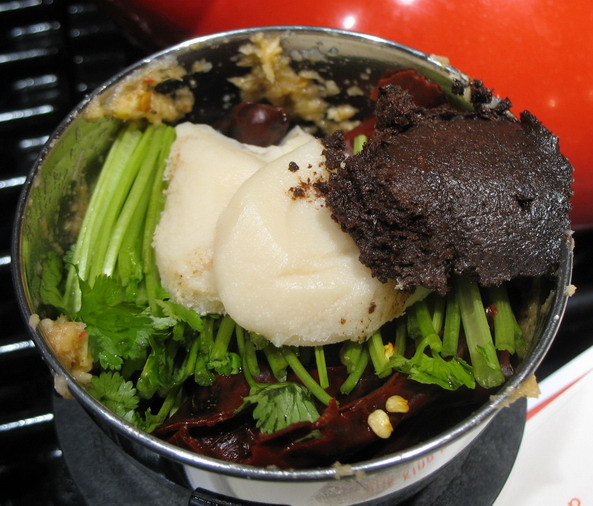
Curry Paste Ingredients:
7 large dried New Mexico red chiles, stems removed and soaked
4 Thai bird chiles, stems removed
1/2 teaspoon kosher salt
1/2 teaspoon white peppercorns
1″ section fresh galanga root, peeled and chopped
1 stalk of lemongrass, dried upper part trimmed away, the lower part cut into chunks or slices
2 tablespoons cilantro root or stems, chopped
zest 1 small lime
1 head garlic peeled and chopped
2 medium shallots, peeled and chopped
1 teaspoon shrimp paste
1 teaspoon bacon grease
Method:
If you don’t have a Sumeet, chop up your soaked chiles, then one at a time, in order, grind the ingredients into a paste using a mortar and pestle–or alternatively, grind it as far as possible with a blender, and finish with a mortar and pestle. If you have a Sumeet, grind them into a paste.
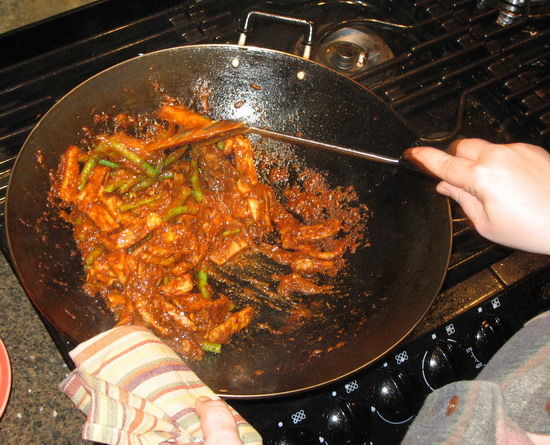
Ingredients:
2 tablespoons peanut oil
1 pound lean pork loin chops, cut into thin slices
Prik king curry paste
2-4 tablespoons water
1-3 tablespoons fish sauce
1-2 teaspoons palm sugar (if you don’t want to get palm sugar, use raw sugar, but only use 1/2-1 teaspoon of it–it is sweeter)
6 large fresh shiitake mushrooms, stems removed, caps sliced a similar thickness to the pork
2 cups blanched string beans that have been topped and tailed and snapped in half
juice of one lime
3 tablespoons coarsely crushed peanuts
1 cup cilantro leaves
Method:
Heat wok until smoking, add oil. Heat until oil shimmers and dances from the heat of the wok. Add pork, and stir fry until it is about halfway done–half of the pink will be gone. Remove from the wok, draining most of the oil back into wok. Set aside.
Add curry paste (2/3 of it, or all of it, as you see fit), and stir and fry for about three minutes, until it darkens slightly, dries out a bit and is very, very fragrant. As it dries, add about 2 tablespoons of water, and continue cooking until the three minutes is up.
Season with smaller amounts of fish sauce and palm sugar.
Add the pork back to the wok, along with the curry paste, and add the mushrooms. Stir fry, about two minutes, until the pork is really starting to firm up–test a piece between your fingers. If it still feels flaccid in the middle, it is underdone, but if the meat is springy to your touch, it is done. Add the beans and stir fry. Taste the sauce. If necessary add more fish sauce and/or more palm sugar.
Add the juice of one lime, then scrape into a serving platter and garnish with peanuts and cilantro.
Serve with generous amounts of steamed jasmine rice.
The Pantry
I may be organized in many parts of my life.
I may know where most every little widget and gadget in my kitchen lives, and I may know where I put the tax forms and where obscure bits of medical equipment live, but my pantry is a mess.
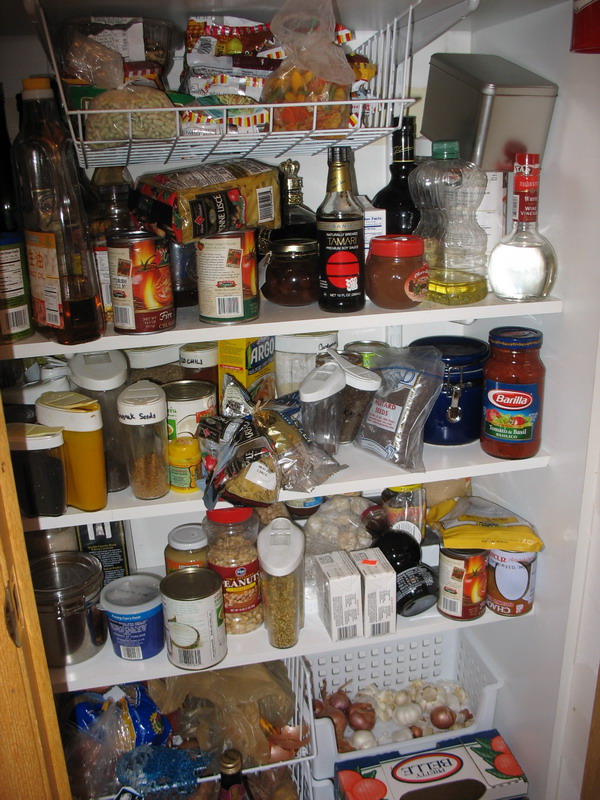
Behold the disarray, the mess, the jumble.
Chaos lives in my pantry closet.
Believe it or not, this is the improved version; when we moved into the house, the closet consisted of three shelves, nailed into the walls, unpainted and very deep. The top one was over my head, so when I put stuff on it, if it fell backwards, I would never see it again.
Now, there are shelves, baskets, racks, and all sorts of things and it is still in a state of perpetual slovenliness.
I feel like if people were to look in there, they would think me some sort of slatternly housekeeper, and would be loathe to eat at my table.
That’s why I tend to keep people out of there.
The bad thing is, this is not the only place where foodstuffs are stored in this house. There is the upstairs kitchen, and the laundry room next door. That is where the big rice barrels (yes, barrels, as in plural, as in, I keep a lot f rice in the house.) Down in the basement, there are a few boxes of dry goods–beans, dried rice noodles, wheat noodles, and a few stray canned goods.
I really am not some sort of survivalist freak, y’all, just in case you were thinking that. I’m not sure why I keep so much food in the house, except that we went through a year with my Dad unemployed and there wasn’t much food in the house. I remember too many dinners of pinto beans and cornbread in a row, with peanut butter and jelly sandwiches day after day for lunch, and only cereal for breakfast. I remember our pantry shelves being quite barren, and the worry lines the crept between Mom’s eyebrows at the grocery store.
I think that is why I keep so much food around.
I think that is also why I tend to give so much food away: if there is a food drive, I bring bags of food. If donations are collected for homeless shelters or food banks, I give money. When I can, I volunteer at soup kitchens, and make boxes of food for folks to take home.
Of course, all of this explains my tendencies to stockpile food, but it doesn’t really go into why I keep my pantry in such a mess.
That part, I cannot figure out.
In fact, now that I have revealed to the world my inability to keep a tidy pantry closet, I believe I will force myself to get up and straighten it.
Just to, you know, save face or something.
2005 Food Blog Award Winners Announced!
Kate has announced the winners in the 2005 Food Blog Awards at the Well Fed Network.
I won.
I am in shock.
I won the Reader’s Choice Award for Best Post for Meat Comes From Animals, Deal With It, or Eat Vegetables.
I am virtually speechless, mainly because I did not expect to win–the competition was tough. I was up against Pim, for goodness sake–one of the three writers who inspired me to start this blog. (The other two are Clotilde at Chocolate and Zucchini and Kate at The Accidental Hedonist.)
I very much want to thank everyone who nominated me for the awards, and those who read the post and voted for it. It means a great deal to me to be recognized for my essay–because when I wrote it, I never dreamed that it would travel as far and wide as it did. It still amazes me, that months after it was written and posted, to find that people are still emailing it around the net, and I am still getting comments on it.
It started out as a simple rant–a vent, because I had heard one too many times, “Oh, I cannot eat meat that looks like it came from an animal.”
And I guess it struck a chord with a lot of people.
Anyway, if I continue, I will blither in an inchoherent, incomprehensible fashion.
Once more, thank you to everyone who read that post, voted for it, sent it out on the net, commented on it and talked about it.
And thank you also to all of the readers of this blog who are part of the reason I keep plugging away, writing here and at the Well Fed Network. Thank you for reading, commenting, asking questions, challenging me, and forcing me to improve myself and grow. Thank you, also for being really cool people whom I am priviledged to get to know.

Categories:
- Admin (rss) (55)
- Blogs and Blogging (rss) (81)
- Book Reviews: Cookbooks (rss) (43)
- Book Reviews: Non-Cookbook Food Books (rss) (38)
- Cats and Cat Blogging (rss) (47)
- Chinese Cooking Lessons (rss) (32)
- Culinary School Stories (rss) (18)
- Dairy Pruducts: Cultured and Barbaric (rss) (4)
- Documentary Filmmaking (rss) (1)
- Essays, Rants and Reflections (rss) (260)
- Fighting Hunger (rss) (12)
- Food and Kids (rss) (45)
- Food in the News (rss) (126)
- Food Media (rss) (98)
- Food Preservation (rss) (18)
- Food Safety (rss) (45)
- Gardening (rss) (30)
- Herbs and Herb Blogging (rss) (20)
- Holidays (rss) (50)
- Kat Blogging (rss) (22)
- Kitchen Science (rss) (36)
- Leftover Makeover (rss) (8)
- Life, the Universe and Everything (rss) (131)
- Local and Sustainable (rss) (227)
- Local Athens Food and Foodies (rss) (42)
- Meatless Mondays (rss) (32)
- Menu For Hope (rss) (5)
- Nutrition, Diet and Health (rss) (84)
- On The Farm (rss) (8)
- Recipes: Almost Vegetarian, Vegetarian and Vegan (rss) (294)
- Recipes: American Regional (rss) (37)
- Recipes: Appalachian Hillbilly (rss) (33)
- Recipes: Bread, Pasta, Grains (rss) (95)
- Recipes: Canning and Preserving (rss) (8)
- Recipes: Chinese (rss) (123)
- Recipes: Comfort Food (rss) (120)
- Recipes: Cookies (rss) (16)
- Recipes: Desserts (rss) (48)
- Recipes: French (rss) (25)
- Recipes: Fruits and Vegetables (rss) (302)
- Recipes: Greek, North African and Middle Eastern (rss) (31)
- Recipes: Indian (rss) (137)
- Recipes: Italian (rss) (42)
- Recipes: Japanese (rss) (7)
- Recipes: Jewish (rss) (4)
- Recipes: Korean (rss) (6)
- Recipes: Meat, Poultry and Fish (rss) (220)
- Recipes: Mexican/Native American/ Latin American/Caribb (rss) (27)
- Recipes: Original (rss) (108)
- Recipes: Thai (rss) (27)
- Recipes: Tofu (rss) (17)
- Recipes: US Regional (rss) (16)
- Recipes: Vietnamese (rss) (8)
- Restaurant Stories (rss) (28)
- Sewing, Quilting, Arts and Crafts (rss) (16)
- Simple Chinese Recipes (rss) (30)
- Slow Food and Heritage Foods (rss) (10)
- Spice Blogging (rss) (44)
- The Chinese Cookbook Project (rss) (14)
- The Chinese Pantry (rss) (39)
- The Documentary (rss) (2)
- The Kitchen Saga (rss) (17)
- The Locavore's Bookshelf (rss) (15)
- The Unsung Adventures of The Culinary Nerd (rss) (6)
- Tools and Toys (rss) (35)
- Uncategorized (rss) (10)
- With a Side of Politics (rss) (48)
Archives:
- August 2012 (9)
- July 2012 (12)
- September 2011 (3)
- August 2011 (7)
- July 2011 (8)
- June 2011 (16)
- May 2011 (17)
- April 2011 (11)
- December 2010 (9)
- November 2010 (5)
- February 2010 (1)
- December 2009 (5)
- November 2009 (7)
- October 2009 (10)
- September 2009 (16)
- August 2009 (14)
- July 2009 (14)
- June 2009 (7)
- May 2009 (17)
- April 2009 (10)
- March 2009 (25)
- February 2009 (13)
- January 2009 (10)
- December 2008 (5)
- November 2008 (5)
- October 2008 (6)
- September 2008 (13)
- August 2008 (8)
- July 2008 (11)
- June 2008 (18)
- May 2008 (13)
- April 2008 (14)
- March 2008 (16)
- February 2008 (17)
- January 2008 (19)
- December 2007 (25)
- November 2007 (18)
- October 2007 (24)
- September 2007 (16)
- August 2007 (15)
- July 2007 (15)
- June 2007 (10)
- May 2007 (14)
- April 2007 (16)
- March 2007 (17)
- February 2007 (20)
- January 2007 (13)
- November 2006 (1)
- October 2006 (8)
- September 2006 (14)
- August 2006 (25)
- July 2006 (30)
- June 2006 (28)
- May 2006 (34)
- April 2006 (29)
- March 2006 (24)
- February 2006 (30)
- January 2006 (38)
- December 2005 (40)
- November 2005 (37)
- October 2005 (32)
- September 2005 (25)
- August 2005 (30)
- July 2005 (28)
- June 2005 (21)
- May 2005 (8)
- April 2005 (22)
- March 2005 (17)
- February 2005 (29)
- January 2005 (10)
Search Site:
Links:
- Lily’s Wai Sek Hong
- 101 Cookbooks
- A cat in the kitchen
- A Veggie Venture
- Accidental Hedonist
- Cha Xiu Bao
- chez pim
- Chocolate & Zucchini
- Chopstick Cinema
- Chowhound.com
- Chubby Hubby
- Cook sister!
- Cooking with Amy
- da*xiang
- Eat Local Challenge
- Eating Liberally
- Ecocentric
- Eggbeater
- Epicurious
- Farmgirl Fare
- Fatfree Vegan
- Foodgoat
- ForkandBottle.com
- Green Olive Tree
- Hooked on Heat
- Jaden’s Steamy Kitchen
- Kalyn’s Kitchen
- Lucullian delights
- Mahanandi
- Matt Bites
- MeatHenge
- mmm-yoso!!!
- New York Times – Dining & Wine
- Pizza Goon
- Rasa Malaysia
- Ruhlman
- Sailu's Kitchen
- Serious Eats
- SF Gate: Food & Dining
- Simply Recipes
- Soul Fusion Kitchen
- Tastespotting
- The Amateur Gourmet
- The Cleaner Plate Club
- The Food Section
- The Grub Report
- thecookscottage
- U.S. Food Policy
- Wandering Chopsticks
- Washington Post Food and Dining
- Wasted Food
Meta:


Powered by WordPress. Graphics by Zak Kramer.
Design update by Daniel Trout.
Entries and comments feeds.