
Cook Local, Eat Global
Memes, Memes, Everywhere, Memes
It got tapped for two memes this week, one by Rose of The Hungry Rose and one by Rokh of Thiam Jak. Sunday being what we used to call in the newsroom, “a slow news day,” I figured I’d write them both up and kill two memes with one bird, or a post in hand is worth two in the meme, or something like that. (I have a friend, Erika, who is infamous for messing up aphorisms. She once said, “Don’t cross your horse before the bridge,” which was pretty funny, but not as funny as “That’s the cow that broke the camel’s back.” I guess I was just channelling her there for a moment….)
First up, Rose twanged me with The Too Much Information Meme, wherein I am to give 10 random bits of information most people do not know about me.
I promise that I will be gentle.
1. I am a folklorist.
If there is a second great passion in my life besides food, it is old stories. Mythology, folklore, fairy tales, fables and tall tales are bread and butter for my imagination. History is a tertiary interest–and my favorite thing about history is a fabric of “truths” woven of threads spun from stories. I find stories endlessly fascinating, and love to listen to them, read them, tell them and write them.
Which is probably why, every time I present a recipe in this blog, there is a story attached to it.
2. I used to cowrite a reasonably well-received online comic that dealt with themes of Buddhism, UFO’s, the nature of reality, breakfast cereals, and the mythology of Coyote.
The title of the comic is Journey to the West, which yes, is taken from a famous Chinese novel of the same name. Zak did the art, and both of us did the writing. I am proud that some of the funnier one-liners are mine.
Check out the archives, and read up on the adventures of our intrepid characters, Jack Crazyquilt, Spookyfox, Max, Briar and Sifu.
Someday, we may even go back to telling their tales.
3. I have had several pieces of fiction published, but still have not finished my novels.
Novels are hard, but short stories are harder. As readers of this blog have likely figured out, I am not good at writing in a short format. Therefore, most of my short stories are longer than short. But they are pretty good, if I say so myself.
4. I am a science fiction and fantasy literature fan.
I guess that should have become obvious once readers got through the first three random facts about me that I am a great lover of science fiction. Not only that, but I am geeky about it. Not so geeky that I dress up like Mrs. Spock and look like an utter dork (at least not anymore), but I will sit and discuss the merits of this author versus that one, and how I love the writing style of one, but cannot stand his characters and find his plots to be utter drivel.
I also will geek out over SF on television–my first love was Star Trek the original series. That was supplanted a few years ago by Babylon 5, which nearly was edged out of first place by Firefly. (Yes, oh, yes, I am a Browncoat. Shiny.) The new BBC version of Doctor Who with Christopher Eccleston as the new Dr. got me back into the TARDIS (For those who don’t pirate it from bit torrent, it will be showing on the SciFi channel starting in March!), and I am mostly liking the new Battlestar Galactica, though it is ponderously depressing.
5. I used to not really like Tolkien’s Lord of the Rings.
That is a big admission for a geek girl to make. But, I have to admit–I found it to be plodding, dull, boring and with no real characterization to speak of. Sure, some of the writing was beautiful, and the poetry and songs, languages and cultures were detailed and perfectly realized, but geez–could we have a realistic, non-misogynistic female character. Don’t give me that Eowyn crap–she went off to get herself killed because she was mooning over Aragorn and he rejected her for his good little seamstress Elf woman back home.
The reason I like the books now is all Peter Jackson’s fault. Well, he, Fran Walsh and Phillipa Boyens. They made the female characters (and all of the characters, actually) realistic and worthwhile, and told the story in a way that I could care about it.
So, here I am admitting that I loved the movies, and the books–not so much.
6. I read really fast.
I can read a novel in a day, if it is a good one of average size. I can read nonfiction almost that fast, especially if it is interesting.
7. I sing.
I sing really well, and used to sing in choirs all the time. I’ve never been in a band, though I have been recorded a few times. Nothing exciting, mind you, but it was fun.) I generally am classified as a mezzo soprano, but I have a wide vocal range and can sing from first tenor to soprano. When I was pregnant with Morganna, but range widened at both ends–I could sing baritone to first soprano. It was pretty cool.
Now I just sing for myself and if other people ask me to.
I am still aiming to learn to play piano after all these years, but between writing, editing, cooking and soon, teaching, I haven’t gotten around to it.
8. I used to hate math and was convinced I was horrible at it, but when I was in culinary school, I tutored other students in algebra.
This weirdo fact is probably because I am moderately dyslexic (ah, I am sure some of my strange typos become understandable now.)and I am just not good at learning math in a vaccum. I had no trouble with math once I got into chemistry in high school and college–if it has a function that I understand, then it is easier for me to remember the steps to each operation and be able to perform them. If not–well, then I don’t remember them.
9. I like wine well enough, but I don’t really get “into” it.
I don’t get the big deal about wine. Sure, I like some of it–and I tend to have expensive tastes in it (but not always), but I don’t get all the fussiness and the gibberty jabber that goes along with it. Oh, that, and I prefer the taste of good Shao Hsing wine to good sherry.
Besides, wine makes my rosacea act up (it makes my face flush pink, which is bad–because it will then threaten to become permanent.)
10. Finally! I am running out of secrets! I used to decorate eggs.
Boy, is that random or what? I am not talking about just Easter eggs here, either. No, when I was a kid and a young adult, I used to blow the contents out of eggshells and then decorate these fragile items to look like jewels or jewel boxes or what have you. Every now and then, I will get the urge to do it again, but I haven’t succumbed to the urge. When I get that way, I usually do a painting instead. Oh, yeah–I paint, too. Not as often as I should or I would like, but I do paint. And I am learning quilting. I used to do beaded jewelry all the time.
Okay, Rokh at Tham Jiak tapped me with “The Things I Carry” meme, which is where I talk about what I take from my kitchen to other people’s kitchens when I am going to cook. Then, I am supposed to name the person whose kitchen I would most like to hijack to cook in.
I feel pretty funny answering this, because I used to be a personal chef, which meant, I carried a portable version of my kitchen with me, and I have a lot of experience cooking in other people’s houses.
At this point, I can cook anywhere, anytime, with as little or as much equipment as is available, because I have managed to stir fry while camping, in the rain, and I have cooked over open fires, in professional kitchens, and in every sort of home kitchen imaginable.
That said–when I go off to a friend or my parents’ kitchen there are things I carry:
My knives. I have the chef thing of being very attached to my knives. Besides, I love my Mom, but she keeps her knives so dull, I am terrified that I am going to cut off a finger every time I use them. (She is terrified of how sharp my knives are. And she hasn’t even seen the new Shun Elite yet. Oh well.)
A wok, with its utensils. I also am very attached to my carbon steel and cast iron woks. It is just a thing. I love them, I have to have them. I don’t like anyone else’s, but if I must, I will use them. I just won’t be overly happy with it.
Depending on what I am making, my Sumeet grinder. Yes–if I am making Indian, Mexican or Thai–the Sumeet must come with, no ifs ands or buts. Thankfully it is reasonably small and portable.
Ingredients often come with me. Chiles, spices and herbs, predominately, though sometimes soy sauces, fish sauce, and sesame oil. It depends on what I am cooking.
Wine. I don’t drink it, but I sure do cook with it. So I take some with me and leave it–that way when I come back to cook again, it is usually still there.
A good cutting board. Do you know how many people use those damnable glass cutting boards? Those things are hell on knives. They should be outlawed. So I take wood, bamboo or the soft, heavy plastic kind.
As for whose kitchen I would love to hijack–that is a hard one. I mean, if it is any kitchen ever–it would be the one in the chef’s house in “Eat, Drink, Man, Woman.” (I adore that movie.) But that is an awesome kitchen in an awesome house. Ang Lee’s eye is just perfect.
If it has to be real kitchen–I like the kitchens in both of my in-laws’ houses. They are well-appointed and designed. One is huge, one is small, but they are both great and I have cooked really amazing feasts in both of them.
I’m not tapping anyone for the memes–because I know a lot of bloggers dislike memes. So, instead–if you haven’t been tapped and are just itching to do these memes, then, consider yourself plonked by Barbara’s Magic Meme Twanger and meme away on your blog!
Doings at the Paper Palate
This is just a quick post to keep all of my readers up to date on what I am writing for the Paper Palate, and to give y’all a taste of some of the other great writing you can find on the Well Fed Network.
Inspired by a NY Times article called “Generation Pad Thai,” I expounded on kids, food, and kid food, on th 16th with “Kid Food: Little Palates And Big Appetites.”
The NY Post published a bit piece about yet another freelance writer demanding comps from a restaurant, so I explored the complex issue on the 18th.
On the 19th, careful reader Rose and I noticed that I had scooped the NY Times (sort of anyway) on the subject of umami, so of course, I wrote about that. ( I tried hard not to gloat too much.)
And finally, on the 20th, I reviewed Paula Deen’s new magazine. (Yes, Paula Deen has a new magazine. No, I don’t much like it, though she seems like a very nice lady.)
On the 17th, Christina of The Thorngrove Table presented a tasty-sounding recipe from Olive magazine–Steak with Spanish Tomato Salad.
And on the 15th, Beth ofHold the Raisins did a lovely job of testing Grace Young’s Stir Fried Garlic Lettuce from the San Francisco Chronicle before rushing off to her honeymoon! (Happy Honeymoon, Beth!) (BTW–that recipe does taste great–though when I had it, it was made with romaine lettuce.)
Finally, “The Candy Librarian” at Sugar Savvy lets us know how Hershey’s Kisses Get Their Shape. (I love The Candy Librarian. I just wanted to say that.)
Weekend Cat Blogging: Kitchen Companions
One of the best things about having many cats in a house this big is that, no matter what I am doing or where I am, I have at least one companion.
Sometimes, two.

For example, here are Springheel Jack and Tatterdemalion (Jack is the big one), sitting in my kitchen bookshelves, watching me do the dishes.
They like these bookshelves because they are not full yet, so they have lots of nooks and crannies they can take over as their own. Which is good. That way, they can sit in the kitchen, be a part of the action, yet not be underfoot and in the way.
Though, I am not certain what I will do when those shelves inevitably begin to fill with cookbooks.

As is inevitable with cats, however, their attention wanders. Apparently, it is not that interesting to watch me load the dishwasher, so their thoughts stray, and they discover new sources of fascination, much closer at hand–or paw.
Each other.
(Of course, while you watch the feline antics, you also get a gander at some of my cookbooks–particularly my baking books, some of the French books, and some general purpose cookbooks.
All of the Chinese Cookbook Project books are upstairs in the teaching kitchen–and a couple of shelves above Tatter is my collection of cookbooks from the rest of Asia–Thailand, Korea, Japan, India and Burma.
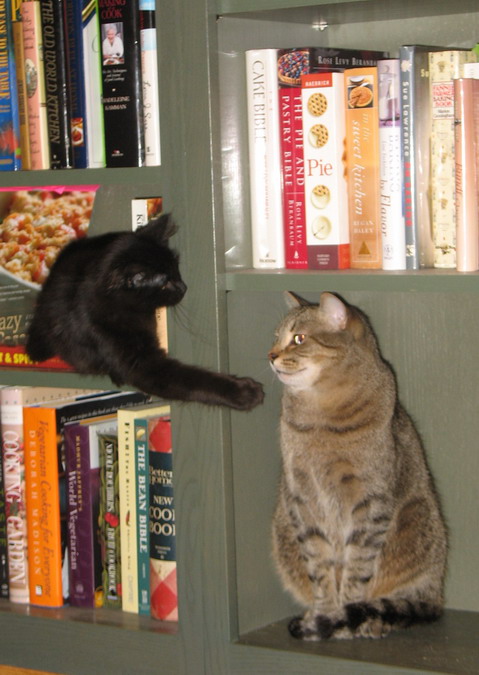
And so, Tatter reaches out to touch someone, (namely, Jack) and the games are about to begin. Seconds after this photograph was shot, she flew out of the bookshelves and raced down the hall, with Jack hot on her heels.
For such graceful creatures, cats running sound like a herd of small elephants on the hardwood.
For more Weekend Cat Blogging action, visit Claire and Kiri at Eatstuff.
From My Rasoi: Bhatura–Indian Bread For Brunch or Breakfast
I have always loved Indian breads. Naan, pooris, chapati, roti and paratha are all great favorites of mine, but I think that my best-beloved is bhatura. This is probably because the first time I had it was at Akbar in Colubia, Maryland, where we were surprised by a basket of it by one of the waiters. We were eating channa masala, one of our favorite dishes, and out of the blue, we looked up to see a basket of steaming hot bread that we had not ordered set before us.
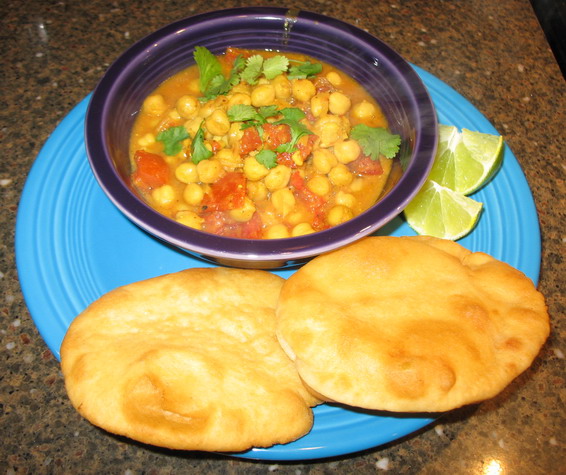
The waiter smiled broadly and said, “Surprise–compliments of the chef.” He lifted the enfolding napkin that cradled the bread, revealing golden, fragrant, puffy rounds of fried yeast dough. “Bhatura. We call them bhatura,” he said. “In the north, where our chef is from, these go with the channa masala. Everywhere, there are roadside stands, little restaurants on the corner, and vendors with carts, selling only channa masala and bhatura. Everywhere. We eat them for breakfast, for lunch, for tea–even a midnight snack.” He watched us tear open the bread, the yeast-scented steam warming our faces. “You can dip it, or you can put the channa inside–like a pocket. It is good.”
I scooped up some chickpeas with mine and took a bite. He wasn’t kidding. It was good.
Satisfied to see our eyes roll back in our heads, and to hear our appreciative noises, he nodded and went away to procure more chai, leaving us to our new obsession: bhatura.
Zak said, “You must learn to make this. It isn’t even on the menu. We may never eat it again if you don’t learn how.”
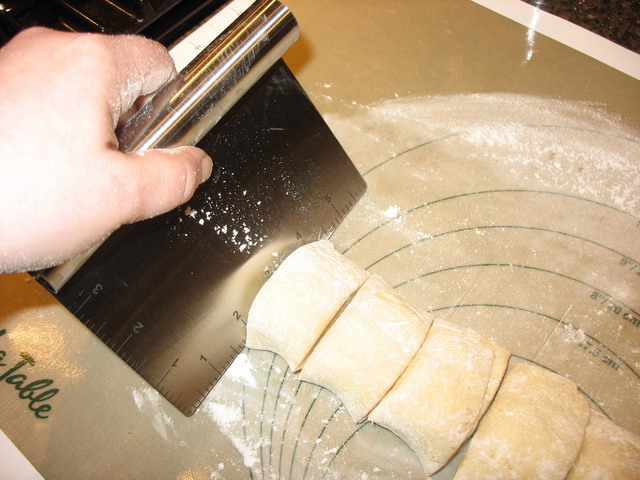
So, instead of learning something simple (and lower in fat) like chapati or roti first–I learned bhatura.
It isn’t so hard as all of that.
The dough is similar to some versions of naan. In fact, I think that the chef at Akbar used naan dough to make his. I originally used a naan recipe for the dough, until I got an actual bhatura recipe from Lord Krishna’s Cuisine by Yamuna Devi. I have, of course, changed it a bit over the years to make it more to our liking. For example, I have often started it the night before and let it rise slowly in the refrigerator instead of letting it rise quickly as Devi’s instructions specify. I have found that this develops a more complex and interesting flavor. (I have also cooked one half of a batch of bhatura, and left the rest in the refrigerator for a day or two until I am ready for another meal with fried bread. Then, I simply take the dough balls from the fridge, pat them down into thin rounds, let them warm to room temperature, heat the oil and fry them. The flavor is even better after it has been left to continue fermenting in the refrigerator for several days.)
I also ended up using kamut flour instead of semolina–I liked the flavor and the softer texture better. (Kamut is an ancient Egyptian form of wheat which has a higher percentage of protein than modern wheat and boasts a sweeter flavor.) Instead of ghee, I generally use butter, and I always use full fat yogurt, with the cream stirred in. The addition of these small amounts of fat yield a softer, tenderer dough which fries up crisp on the outside and airy and puffy on the inside.
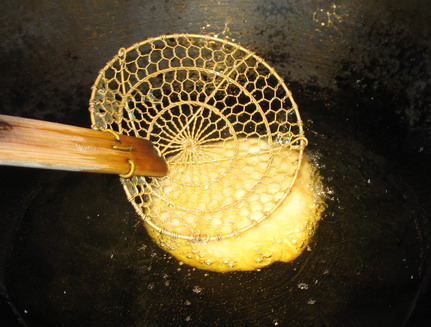
I use only peanut or canola oil to fry the bread, and I use my wok for the operation, since one can use less oil and still deep fry in a wok. I pour about 3/4″ to 1″ of oil in, and heat it up on medium high heat. It is important to get the oil perfectly hot before you fry your bhatura–otherwise the bread will soak up oil and be heavy and greasy, which is utterly uappealing. No one wants oil-sodden bread.
I also discovered that in order to inflate bhatura and have them make pockets that you can stuff with channa masala, you can tap the dough with the back of your skimmer or strainer–this will cause large bubbles to form. (This is how it works with pooris, too.) Otherwise, the bhatura themselves will only make smaller bubbles if left alone. (Which way you like them is your own personal choice. They are good both ways, but I like them inflated so I can fill them with channa masala, or as you will see later, scrambled eggs.)
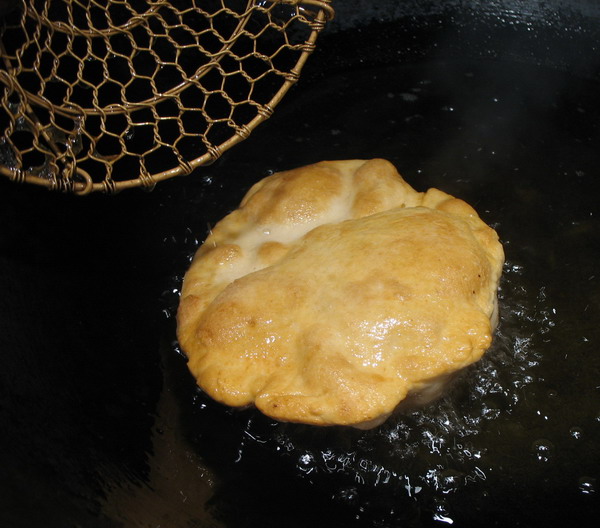
Once the bhatura is brown on both sides, you just take it from the oil, let it drain on paper towels, and if you want to keep it warm, cover them with another towel and pop them in an oven warmed to about 170 degrees. That’s it.
Now, what are they good with besides channa masala?
Well, I like them with any dal and raita, really. I discovered this week that they are good with scrambled eggs: I had four eggs in the house and a handful of discs of bhatura dough, and was hungry. So, I took the dough out to warm up, and heated up the warming oven to 170. When they were at room temperature, I flattened them out into five inch diameter discs, heated the oil and fried them, then popped them into the oven. I heated a little butter until it was foamy, tossed in some mustard seeds, beat the eggs with a tiny bit of milk and some garam masala, and waited for the mustard seeds to pop. Once they popped, I poured the eggs into the pan and cooked them, then ate them with the bhatura, and discovered that they were quite delicious.
If only I had some cilantro to toss into the eggs at the last and a bit of raita! But, I was fresh out of yogurt, so it was eggs and bread for breakfast that day. (And, since the theme of “From My Rasoi” this month is “breakfast,” I guess this is my entry. Check out Meena’s Hooked on Heat for more details.)

Bhatura
Ingredients:
½ ounce fresh yeast
1 teaspoon sugar
½ cup lukewarm water
1 ¾ cups all purpose flour
½ cup kamut
½ teaspoon salt
1 tablespoon ghee or butter
2 tablespoons plain yogurt
oil for deep frying
Method:
Mix the yeast with the sugar and water in a measuring cup and allow to proof.
Place flour, semolina and salt in large bowl, and mix together. Using hands, rub in ghee or butter.
When the yeast mixture is foamy, add to flours along with yogurt and mix to form a dough. Turn out onto a lightly floured surface and knead until smooth and elastic: about ten minutes.
Place in a lightly oiled bowl, cover with either a damp towel or lightly oiled plastic wrap and allow to rise in a warm place until doubled in bulk: about one hour.
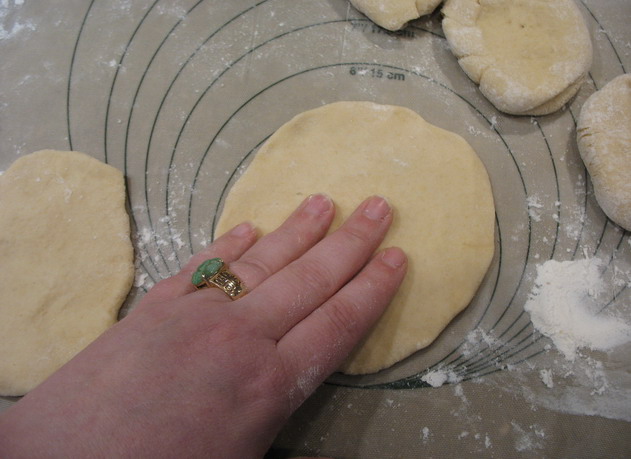
Turn out onto a lightly floured surface and punch dough down. Divide into 10 equal pieces by rolling into a rope and cutting it 9 times. Shape each piece into a ball, and flatten into discs with the palm of your hand. With a floured rolling pin, roll into 5 inch rounds. (Or, you can do as I did in the picture above and pat it into a circle with your fingertips, or between your palms.)
Pour oil to depth of about 3/4 inch in a wok or karahi. Bring to temperature: test with a bamboo chopstick. (When hot enough, lots of bubbles will form on edges of chopstick when you put it into oil.) Gently slide bread, one piece at a time, into oil, frying for about one minute: turning after thirty seconds.
Drain on paper towels and serve while warm with channa masala and raita. (Or, scrambled eggs!)
The Chinese Cookbook Project VIII: Learning to Cook Like Buddha
It has been since November that I have written about any of my adventures in seeking to expand my collection of Chinese cookbooks in English, so it was getting to be time to do another installment of “The Chinese Cookbook Project.” Just as I was gearing up to write about the books by the fantastic teacher, author and cook, Grace Zia Chu, I received an email from Scott, asking this very relevant question: “Anyway, I was just looking through the Chinese Cookbook Project section, and wondered if you have encountered any English-language cookbooks covering Chinese Buddhist vegetarian cuisine. I have been searching for a while, but haven’t had any success. Most cookbooks have discussed tofu, and a few have at least mentioned the gluten mock-meats in passing, but I would find any information about other ingredients and techniques, such as the (probably brown mushroom-based) vegetarian stocks used, very helpful.”
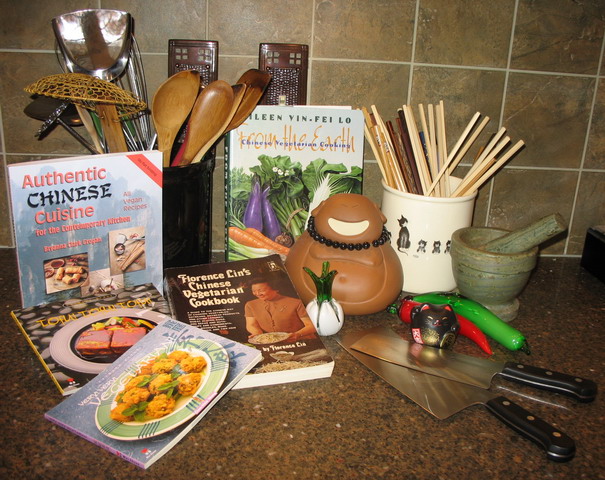
I answered Scott in email, but I thought that the answer I gave might be of interest to other readers, so I expanded upon it and present it here.
The good news is, yes, I know of and have read five vegetarian Chinese cookbooks that deal specifically with some of the Buddhist recipes that Scott asked about. The bad news is–all but one of them are out of print. However, the bad news is softened by the fact that all of them are readily available at no great cost from Amazon, Bookfinder and, most likely eBay.
First of all, I suppose I should explain what exactly we mean when we talk about Chinese Buddhist vegetarian cooking, shouldn’t I?
Many, but not all Buddhists, take the tenet of “Do no harm,” to extend to diet: thus they are vegetarians.
However, the vegetarian monks of China, did not believe that all pleasure must be sacrificed in order to do no harm to living beings, so they cleverly invented a cuisine, which is called, “zhai cai” which roughly translates to either “purification cuisine” or “disciplined cuisine.” In this highly developed and fascinating variant on Chinese cookery, meat is replaced by tofu, wheat gluten, black mushrooms, agar-agar, and other meat analogues. Wheat gluten, in particular, is used in highly creative and very flavorful ways to very closely imitate chicken, or other meats.
Every dish in the repretoire of Chinese cuisine is replicated in zhai cai, from dim sum specialties (steamed buns filled with lotus seed paste are said to have been invented by Buddhist nuns to replace char sui bai–steamed pork buns), to festival dishes to soups, red-braised dishes, noodles, soups and stir-fries.
Scott is right: most Chinese cookbooks in English do not dwell for very long on these Buddhist specialties. It is assumed that Americans are not interested in such foods, or that they would not enjoy the flavor of tofu or wheat gluten, so short shrift is given to this fascinating and very worthy cuisine.
However, as someone who has gone out of her way to order “vegetarian” sesame chicken in Chinese restaurants because I really like the flavor of deep fried wheat gluten, I can say that if Americans get a taste of Buddhist food, they’d like it. Fully vegetarian ma po tofu is really good, too, and there is nothing better than a good steamed lotus seed bun. (I like them much better than the pork buns myself, but not as well as I like my very own steamed mushroom buns.)
On to the books!
First, the one that is in print: Authentic Chinese Cuisine for the Contemporary Kitchen by Bryanna Clark Grogan. To be honest, I was wary of this book, because the author is not Chinese, and it comes from “The Healthy World Cuisine Series.” While the title promises authenticity, I wasn’t very sure about it until I got my hands on the book.
Grogan did her homework, and she presents a good selection of authentic Buddhist-style recipes that utilize wheat gluten. She gives instructions on how to make one’s own wheat gluten, and on how to make vegetable stocks which do indeed, as Scott surmised, use black mushrooms as an ingredient. She also makes good use of typical Chinese vegetarian ingredients such as fermented tofu, Sichuan preserved vegetable, and gives instructions on how to make one’s own homemade bun dough. Some of her recipes are not as authentic as others, but most of them utilize the ingredientsand techniques that I have come to expect from a cookbook which is presenting mainly Chinese recipes, as opposed to “Chinese-inspired” recipes.
However, if you don’t know much about Chinese techniques of cutting, stir-frying, steaming, braising or frying–you might not want to use this book on its own, but in conjunction with other books on basic Chinese cookery. While her historical background and discussion of ingredients is very detailed, her ability to explain the basics of the Chinese kitchen is limited.
A fine book which is sadly out of print, but should not be is Eileen Yin-Fei Lo’s From the Earth: Chinese Vegetarian Cooking. Born in Sun Tak, a suburb of Canton, Lo has been teaching Chinese cookery at the China Institute of America in New York City for thirty years and has written a number of excellent cookbooks. While Grogan is not good at explaining the basics, Lo is more than capable of taking a beginner by the hand and leading them into the mysteries of the Chinese kitchen.
Even so, the basics are covered quite briefly in this book, but the reason I picked it up was for the recipes–Lo presents such classics as “Romaine Lettuce with Black Beans,” “Braised Chinese Turnips with Vegetables,” and “Shark Fin Soup,” made with bean thread noodles and pea sprouts instead of shark’s fin. She also presents a long chapter of Buddhist tofu recipes, along with many recipes of her own invention for stir fried vegetables. Included are recipes for noodles, soups (with vegetable broths that include Chinese dates and buckthorn seeds), desserts, and a handful of seafood-based recipes, because as Lo notes, many Chinese who are mostly vegetarian will eat “the occasional fish.”
The Buddha said: “One will enjoy longevity, by not killing or harming others, one will seldom be sick, if one relieves others’ worry and grief.”
Thus opens the preface to Florence Lin’s Chinese Vegetarian Cookbook by noted teacher and author, Florence Lin. Included in her book are separate chapters on tofu and soybean products, wheat gluten, eggs, seeds and nuts, and rice, noodles and breads. Each chapter has handy charts describing the nature of each dish in the chapter; this is meant to help the cook prepare a Chinese meal balanced in flavor, texture, color and cooking style. Lin’s recipes are excellent, and there are many line drawings illustrating various techniques throughout the book.
The last two books are very slender volumes put out by Wei Chuan, which is the publishing arm of a very large, very famous Chinese cooking school in Taiwan by the same name. The Wei Chuan books are all filled with photographs illustrating the finished dish as well as some of the techniques needed to complete them, and the text is presented in both Chinese and English. Most Wei Chuan cookbooks are full-sized books, but Very! Very! Vegetarian by Chen-Hsia Wang and Tofu! Tofu! Tofu! by Mu-Tsun Lee are half-sized. Were it me, I would have combined the two into a single volume, but as I am not on the editorial board, no one asked my opinion! (I [probably would have ditched the weird, kinda westernized recipes in the vegetarian one, too–but again–I was not consulted.)
While the vegetarian book is strictly vegetarian, the tofu book does include recipes where meat or seafood are used as a seasoning, stuffing or featured ingredient with the tofu. This is a very Chinese way of presenting tofu, where the small amount of meat is used to flavor the bean curd, but it really doesn’t count as vegetarian or Buddhist. However, quite a few of the recipes -are- completely vegetarian, and the author goes out of the way to use tofu in many guises from pressed tofu to bean curd sheets to fermented tofu.
Very! Very! Vegetarian utilizes a lot of prepared Chinese ingredients such as “vegetarian cuttlefish” and “wheat gluten rolls,” but it also includes a lot of black mushroom recipes, and recipes that use various Chinese sea vegetables. (I picked it up for the mushroom recipes, primarily.) There are also some really weird recipes that include “western cream soup,” and “hamburger” made of chick peas–the only reason I am mentioning this book at all is because I really like some of the mushroom recipes. (But, there is a reason, I left it for the end–basically, if you see it at a garage sale and it is cheap and you like black mushrooms–get it–but if not–don’t bother. Or, if you want the black mushroom recipes–you can always ask me.)
There we have them–five books–three of them excellent, one of them pretty good and one of them, only a little good. All of them have recipes that can be considered part of the Chinese Buddhist tradition, and all but perhaps the last are worthy additions to the collector’s bookshelf.
So, if you are interested in learning how to cook like Buddha–get thee to a used bookstore, and then run to the kitchen!

Categories:
- Admin (rss) (55)
- Blogs and Blogging (rss) (81)
- Book Reviews: Cookbooks (rss) (43)
- Book Reviews: Non-Cookbook Food Books (rss) (38)
- Cats and Cat Blogging (rss) (47)
- Chinese Cooking Lessons (rss) (32)
- Culinary School Stories (rss) (18)
- Dairy Pruducts: Cultured and Barbaric (rss) (4)
- Documentary Filmmaking (rss) (1)
- Essays, Rants and Reflections (rss) (260)
- Fighting Hunger (rss) (12)
- Food and Kids (rss) (45)
- Food in the News (rss) (126)
- Food Media (rss) (98)
- Food Preservation (rss) (18)
- Food Safety (rss) (45)
- Gardening (rss) (30)
- Herbs and Herb Blogging (rss) (20)
- Holidays (rss) (50)
- Kat Blogging (rss) (22)
- Kitchen Science (rss) (36)
- Leftover Makeover (rss) (8)
- Life, the Universe and Everything (rss) (131)
- Local and Sustainable (rss) (227)
- Local Athens Food and Foodies (rss) (42)
- Meatless Mondays (rss) (32)
- Menu For Hope (rss) (5)
- Nutrition, Diet and Health (rss) (84)
- On The Farm (rss) (8)
- Recipes: Almost Vegetarian, Vegetarian and Vegan (rss) (294)
- Recipes: American Regional (rss) (37)
- Recipes: Appalachian Hillbilly (rss) (33)
- Recipes: Bread, Pasta, Grains (rss) (95)
- Recipes: Canning and Preserving (rss) (8)
- Recipes: Chinese (rss) (123)
- Recipes: Comfort Food (rss) (120)
- Recipes: Cookies (rss) (16)
- Recipes: Desserts (rss) (48)
- Recipes: French (rss) (25)
- Recipes: Fruits and Vegetables (rss) (302)
- Recipes: Greek, North African and Middle Eastern (rss) (31)
- Recipes: Indian (rss) (137)
- Recipes: Italian (rss) (42)
- Recipes: Japanese (rss) (7)
- Recipes: Jewish (rss) (4)
- Recipes: Korean (rss) (6)
- Recipes: Meat, Poultry and Fish (rss) (220)
- Recipes: Mexican/Native American/ Latin American/Caribb (rss) (27)
- Recipes: Original (rss) (108)
- Recipes: Thai (rss) (27)
- Recipes: Tofu (rss) (17)
- Recipes: US Regional (rss) (16)
- Recipes: Vietnamese (rss) (8)
- Restaurant Stories (rss) (28)
- Sewing, Quilting, Arts and Crafts (rss) (16)
- Simple Chinese Recipes (rss) (30)
- Slow Food and Heritage Foods (rss) (10)
- Spice Blogging (rss) (44)
- The Chinese Cookbook Project (rss) (14)
- The Chinese Pantry (rss) (39)
- The Documentary (rss) (2)
- The Kitchen Saga (rss) (17)
- The Locavore's Bookshelf (rss) (15)
- The Unsung Adventures of The Culinary Nerd (rss) (6)
- Tools and Toys (rss) (35)
- Uncategorized (rss) (10)
- With a Side of Politics (rss) (48)
Archives:
- August 2012 (9)
- July 2012 (12)
- September 2011 (3)
- August 2011 (7)
- July 2011 (8)
- June 2011 (16)
- May 2011 (17)
- April 2011 (11)
- December 2010 (9)
- November 2010 (5)
- February 2010 (1)
- December 2009 (5)
- November 2009 (7)
- October 2009 (10)
- September 2009 (16)
- August 2009 (14)
- July 2009 (14)
- June 2009 (7)
- May 2009 (17)
- April 2009 (10)
- March 2009 (25)
- February 2009 (13)
- January 2009 (10)
- December 2008 (5)
- November 2008 (5)
- October 2008 (6)
- September 2008 (13)
- August 2008 (8)
- July 2008 (11)
- June 2008 (18)
- May 2008 (13)
- April 2008 (14)
- March 2008 (16)
- February 2008 (17)
- January 2008 (19)
- December 2007 (25)
- November 2007 (18)
- October 2007 (24)
- September 2007 (16)
- August 2007 (15)
- July 2007 (15)
- June 2007 (10)
- May 2007 (14)
- April 2007 (16)
- March 2007 (17)
- February 2007 (20)
- January 2007 (13)
- November 2006 (1)
- October 2006 (8)
- September 2006 (14)
- August 2006 (25)
- July 2006 (30)
- June 2006 (28)
- May 2006 (34)
- April 2006 (29)
- March 2006 (24)
- February 2006 (30)
- January 2006 (38)
- December 2005 (40)
- November 2005 (37)
- October 2005 (32)
- September 2005 (25)
- August 2005 (30)
- July 2005 (28)
- June 2005 (21)
- May 2005 (8)
- April 2005 (22)
- March 2005 (17)
- February 2005 (29)
- January 2005 (10)
Search Site:
Links:
- Lily’s Wai Sek Hong
- 101 Cookbooks
- A cat in the kitchen
- A Veggie Venture
- Accidental Hedonist
- Cha Xiu Bao
- chez pim
- Chocolate & Zucchini
- Chopstick Cinema
- Chowhound.com
- Chubby Hubby
- Cook sister!
- Cooking with Amy
- da*xiang
- Eat Local Challenge
- Eating Liberally
- Ecocentric
- Eggbeater
- Epicurious
- Farmgirl Fare
- Fatfree Vegan
- Foodgoat
- ForkandBottle.com
- Green Olive Tree
- Hooked on Heat
- Jaden’s Steamy Kitchen
- Kalyn’s Kitchen
- Lucullian delights
- Mahanandi
- Matt Bites
- MeatHenge
- mmm-yoso!!!
- New York Times – Dining & Wine
- Pizza Goon
- Rasa Malaysia
- Ruhlman
- Sailu's Kitchen
- Serious Eats
- SF Gate: Food & Dining
- Simply Recipes
- Soul Fusion Kitchen
- Tastespotting
- The Amateur Gourmet
- The Cleaner Plate Club
- The Food Section
- The Grub Report
- thecookscottage
- U.S. Food Policy
- Wandering Chopsticks
- Washington Post Food and Dining
- Wasted Food
Meta:


Powered by WordPress. Graphics by Zak Kramer.
Design update by Daniel Trout.
Entries and comments feeds.