
Cook Local, Eat Global
All the Greens that Grow: Umami in Vegetables
Just when you thought I was finished with the umami, here comes a little bit more, this time, about umami in vegetables.
We’ve already discussed umami in tomatoes, corn, mushrooms and fermented cabbage dishes such as kimchee and saurkraut. (Actually, when I wrote about umami in the West, I forgot to mention saurkraut–another lactobacillus fermented cabbage preparation. But, here I am, mentioning it, so now you know. Like kimchee, there is umami in saurkraut. And, like kimchee, which tastes good simmered with meat in braised dishes, saurkraut braised with meat and beer or wine is a classic that teams up lots of umami ingredients to make a powerhouse of a dish–full of flavor and nummy amino acids.)
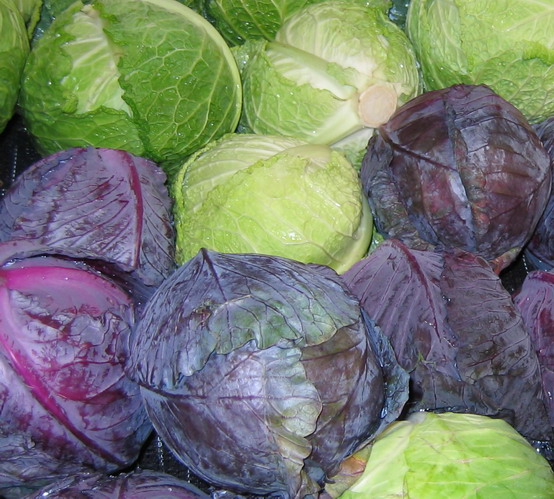
Not surprisingly, then, members of the brassica family, which includes cabbages and all sorts of happy leafy green guys that are full of folate and iron and vitamins and good stuff, are noted to have lots of potential umami locked within their tissues. However, most of the taste is not apparent until the greens are either cooked “beyond palatability” or they are fermented. The “cooking beyond palatability” comment is straight from the authors of The Fifth Taste (Kasabian and Kasabian, pp. 26); I am of the belief that it is a personal taste thing. In the South, all deep green leafies are eaten cooked to death with a hunk of pork or pork fat and plenty of water. As I noted in my kale recipe, this does cook out a lot of the vitamins, however, most every southerner I know drinks up the juice, or “pot likker” where all of the water soluable vitamins have gone, so nothing is particularly wasted. Some of the vitamins that are destroyed by heat are gone, but then, have you ever gnawed on a tough old kale leaf? Yeah, I bet you got strings in your teeth, too. Ick.
Anyway, as I was saying, the traditional way of eating greens is to cook them to death, and lo, and behold–they really taste good when they are done, and I am pretty sure it isn’t just the power of pig fat that manages it.
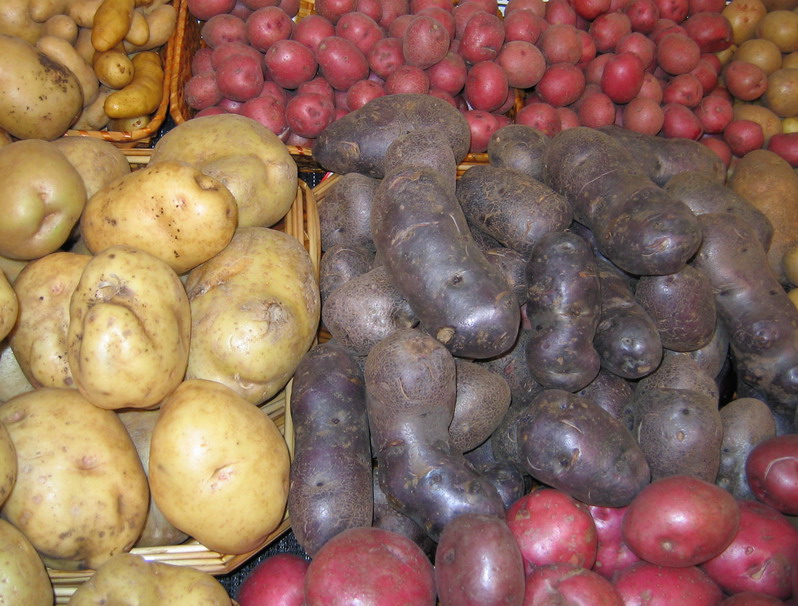
There is apparently a good amount of natural umami in potatoes, particularly mature ones. I can see that–particularly when you have a batch of roasted or fried ‘taters, they do seem awfully earthy and good. Browning them seems to bring out the flavor, and really–I think that leaving the skin on helps, too. There is a lot of flavor in the peel of the potato that gets lost if you toss it out, so I almost always leave them on. I just scrub my potatoes almost unto death before cooking them. One thing I have noticed, however, is how beautifully potatoes pair with either truffles or mushrooms. Okay, truffle -oil- or mushrooms–I haven’t yet cooked with a truffle yet, and if I got my hands on one, I probably would not be cooking potatoes.
Maybe risotto.
Carrots, I am told on pretty good authority, have a good bit of umami, but I suspect that the older ones have more. I would bet that parsnips, being related to carrots, probably have some, too, and that both would be enhanced by roasting or simmering with other umami rich ingredients. Like, cut up some potatoes, carrots and parsnips, and roast them in the bottom of the pan you are roasting a chicken in. A chicken which you have loosened the skin, and stuffed ground up sauteed mushrooms underneath it. That sounds pretty good, especially if you baste it all with some sherry now and again.
And add garlic–you know, because while garlic seems to lack umami, it makes up for it by tasting like garlic, which is one of my favorite flavors of all time.
As noted before, soybeans are umami powerhouses; according to the Kasabians, dried legumes of other sorts carry a kind of umami known as “synergizing umami.” This is a rather complex interaction between amino acids and nucleotides which amps up the discernable umami flavor in foods. (Not a lot of information is available yet on how that works, but apparently, some sorts of foods have nucleotides that kick up any umami in their presence up a few notches.)
Anyway, dried legumes such as kidney beans, navy beans, lima beans and lentils all are apparently well endowed with synergizing umami, which means that if you cook them with a straight up umami source such as dried mushrooms, chicken stock, red wine and maybe a little tiny bit (or a big hunk) of bacon or ham, they will taste even better, as all of the amino acids and nucleotides get together and form a happy square dance that entertains the taste buds throughout the meal.
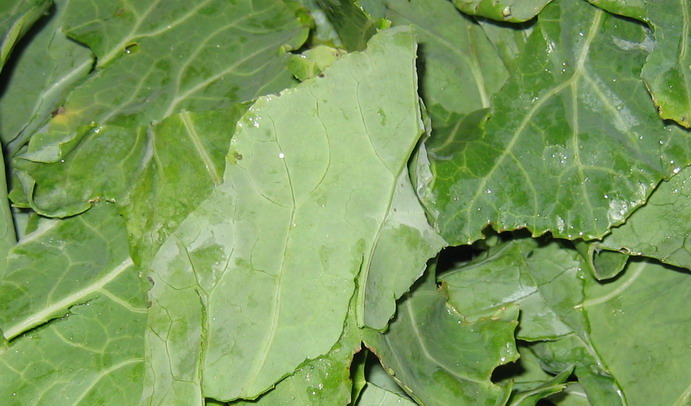
What it all boils down to is this–if you want to cook your greens to death–go for it. If you don’t, don’t worry, but in either case, add some good umami ingredients. You have to cook dried beans to death, but they are better if you add umami ingredients, so, why not? As for potatoes–keep them in their jackets, and fry or roast them, and as for carrots and parsnips–they are good roasted, too.
What I find most interesting so far about all of this information, is that the vegetables that are being cited as being so tasty and good, are the ones that poor folks all over Europe and the US used to eat. (And they probably still do.) Nothing is cheaper than carrots, potatoes, dark leafy greens, cabbages, and dried beans.
It just makes me think that I always was right when I would say, “Peasant food is good food,” before digging into a meal of pinto beans, fried potatoes and cornbread with a bowl of collard greens on the side.
Sauteed Kale with Shiitake, Balsamic Vinegar and Truffle Oil
Kale is one of my favorite winter vegetables.
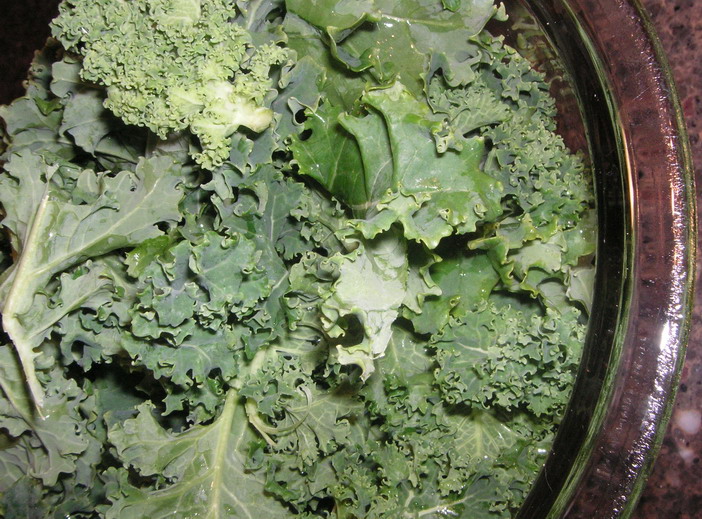
It always has been, though I have to admit that I seldom eat it was cooked when I grew up. In our home, kale was simmered all day on a back burner, in a big pot, seasoned with a ham hock or a hunk of jowl bacon. Though the leaves were completely flaccid and olive drab by the time they were done, they were smoky, sweet and so good splashed with vinegar, salt and pepper that I could eat huge bowls of them. (I used to drink the juice, too–in the South that green stuff is called “pot likker,” and it is filled with all the vitamins and minerals leached out of the vegetative matter after the long cooking process. It also tasted really, really good.)
But, I don’t cook kale like that anymore. For one thing, it stinks up the house a bit, and Zak objects to it, and for another, I have figured out how to cook kale other ways that are just as good, but which leave more of the vitamins and minerals unmolested and intact.
This recipe is a variation on one I invented years ago for my vegan personal chef clients. Thier version was more distinctly Asian in concept and form: it consisted of lacinato kale, fresh and dried shiitake mushrooms, garlic, scallion and ginger, soy sauce, black pepper, rice vinegar and sugar.
This time all I had was curly leafed kale, and I wanted to make more of a European-styled saute rather than a stir fry. So, I switched the ingredients around, though I decided to use as many Western umami ingredients as I thought would be prudent without turning the dish into a gloppy mish-mash of an ill-concieved fusion.
I definately wanted to keep the vinegar; kale, particularly the curly-leafed varieties, can be bitter, and acidic ingredients tend to tone down bitter flavors. So, I switched to balsamic vinegar. Since I wasn’t cooking for vegans, I decided to be luxurious and add a half teaspoon of saved bacon grease to the olive oil. I could have added crumbled bacon if I wanted to make the dish really over the top fattening and tasty, but I didn’t. I am still trying to chill out on the fattening food now that the holidays are done.
The other luxury item I did add, however, was a good drizzle of black truffle oil at the end of cooking. It took a good side dish and pushed it over the edge into an absolutely delicious one. The inherent sweetness of the kale is accentuated by the bacon grease, the golden shallots and the sweet undertones of the balsamic vinegar. The earthiness of the mushrooms is enhanced by the truffle oil and the garlic, and the sprinkling of herbs and black pepper bring a sharpness to the entire flavor profile that provides clarity and a rather ringing note to the ensemble.
I was rather glad that Zak doesn’t like kale and declined to try any. That meant there was more for Morganna and I.
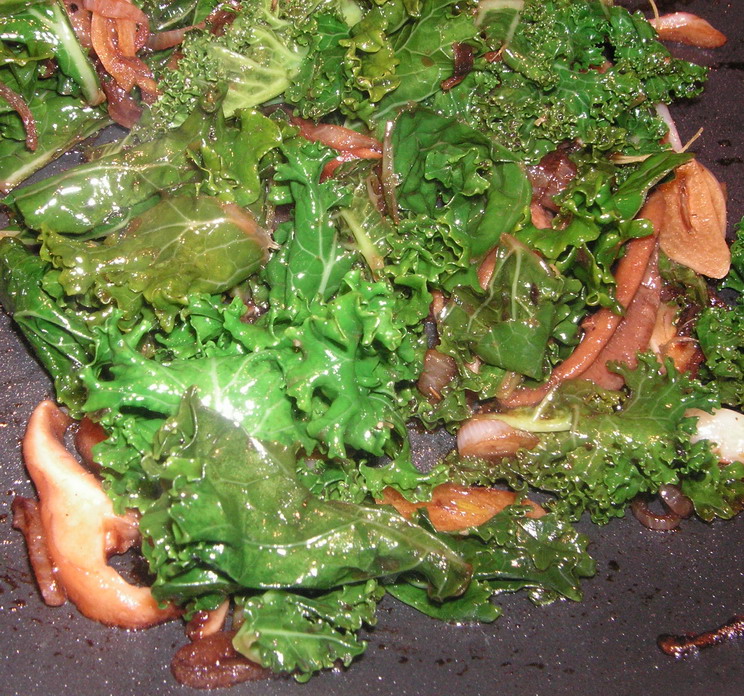
Sauteed Kale with Shiitake, Balsamic Vinegar and Truffle Oil
Ingredients:
3 tablespoons extra virgin olive oil
1/2 teaspoon bacon grease
2 medium sized shallots, thinly sliced
6 fresh shiitake mushrooms, stems removed, caps thinly sliced
3 large cloves garlic, peeled and thinly sliced
freshly ground black pepper to taste (More is better.)
pinch dried oregano or thyme
1 small bunch fresh young curly kale, washed and dried, thick stems removed, leaves torn into bite-sized bits
1/4 teaspoon salt
1/3 cup chicken broth
2 tablespoons balsamic vinegar
1/4 teaspoon black (or white) truffle oil
Method:
In a heavy-bottomed, deep frying or saute pan, heat olive oil and bacon grease until grease is melted. Tilt pan to coat bottom evenly.
Add shallots to pan, and cook, stirring constantly until they begin to turn golden. Add shiitakes, and cook until shallots turn dark golden and shittake begin to take on color. Add garlic and cook until pale gold and fragrant. Add pepper and herb, then kale.
Stir and toss to coat kale with oil, then sprinkle with salt and pour chicken broth into pan. Cover pan, and allow chicken broth to simmer, steaming kale. Remove lid–kale should be brilliant green and beginning to wilt, and chicken broth should be reduced to nearly nothing. Add balsamic vinegar and stir and toss kale until balsamic vinegar simmers away to nearly nothing; what is left should cling very tightly to the leaves.
Remove from heat, pour in truffle oil, stir to combine and serve immediately.
This is very good with a mushroom risotto, quiche or baked macaroni and cheese for a light supper.
Umami: The Meat of the Matter
When discussing umami, I have consistently described it as “savory,” “satisfying,” and “meaty.”
What is more “meaty,” than meat?
It is true that meat and poultry have a great deal of potential umami locked within them. Since umami is nothing but the flavor of amino acids, which are the building blocks of proteins and muscle tissue is made up of protein, then it stands to reason that meat is one of the greatest sources of natural umami one can use.
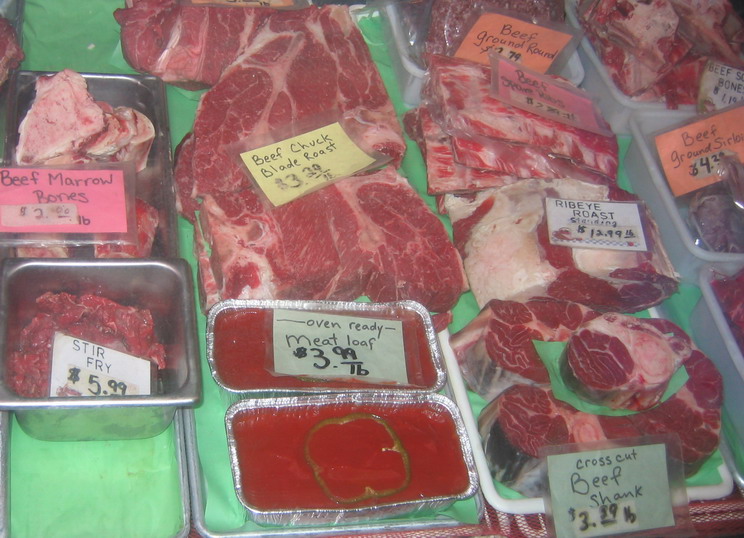
While there is umami in every kind of meat, there are some meats that are naturally endowed with more umami than others.
And that whole “darker fungi/wines/vinegars have more umami than lighter ones” rule of thumb doesn’t hold true with meat, strangely enough. According to the authors of The Fifth Taste: Cooking with Umami, poultry are richer sources of umami than beef. (Lamb has about as much umami as beef, veal and venison both are loaded with umami, and pork, unless it is a cured product has about as much potential umami as beef. However, cured pork products such as country ham, bacon or dry cured sausages are filled with umami, and greatly enhance any food with which they are cooked. Of course, just about anyone from the South could have told you that last part.)
However, the rule of thumb that involves age and umami does hold true when we are talking about most meats. In general, an older stewing hen will have more potential umami locked within her cellular structure than a young pullet, just as aged, complex red wines have more umami taste than a young, fruity red.
In addition, dry aged meats, such as beef and lamb, or pheasants and wild rabbits that are hung to age after slaughter, have more umami unlocked by the action of bacterial enzymes than meat that is cooked while still very fresh. (I am reminded in these two instances–the age of the animal before slaughter, and aging the meat after slaughter, of a saying my Gram always had. “Age before beauty,” she would say to me every time I held a door open for her. I don’t know if she would have frowned at my macabre application of her saying or bray with laughter.)
Another general rule when it comes to meat is that meat cooked on the bone or with the bones of the animal will have more flavor than boneless cuts of meat. That is because a great deal of umami is locked within the bone marrow, and in the connective tissues that hold muscle, fat and skin to the bone.
There are certain cooking methods that are best employed in order to unlock the amino acids that provide umami taste in meat. Marinating meats before cooking them in a liquid filled with umami ingredients such as red wine, vinegar, soy sauce, and perhaps the soaking liquid from dried mushrooms would go a long way toward creating an umami-rich dish. Searing meat in a hot pan before stewing, braising or turning it into soup not only browns the meat in a non-enzymatic, non-caramelizaton of simple sugars and amino acids known as the Maillard reaction, it also releases a plethora of amino acids from the meat to the surface of the meat. This changes the flavor and aroma of meat considerably. After searing, one can braise or stew the meat, a form of cooking which releases even more umami-bearing amino acids into the cooking liquid, which is usually consumed with the meat. (If the meat is cooked on the bone, then even more umami enters the cooking liquid via the bone marrow and connective tissues.)
That is why gravy is so darned good, somtimes even better than the meat it is meant to go with. It is good because it is jumping with amino acids, which are even easier for our body to break down and utilize than complete proteins that are in meat. That is also why stocks and broths all taste so wonderful as well–they are the simmered essence of amino acids.
Some people theorize that the fact that chicken broth and stock is filled with amino acids is part of why chicken soup is reputed to have such a restorative effect on sick people. It is a very nourishing liquid that not only tastes good, but is simple to digest.
How can a cook go wrong, really?
What have we learned in this installment?
1. Meat on the bone has more flavor than meat off the bone.
2. Don’t throw your bones away, save them in the freezer until you have a whole lot of them and then make stock, and save it, for it is liquid gold.
3. Age over beauty. Or, in other words, old stewing hens make better soups than pullets or fryers.
4. Dry aging, in whatever permutation that you use it, is good for most meats, particularly beef, venison and lamb.
5. Cured pork cures bland food. I am serious about that. A little bit of ham, jowl bacon, a smoked hock, or some bacon will bring flavor to anything you cook in it.
6. Brown your meat, whether you do so in the course of roasting or sauteeing or you do it before you braise or stew it. Pale meat is boring and bland. Don’t go there. And while you are at it, unless you like pale, rather tasteless stocks, roast your bones, and your vegetables in the oven before you chuck them in the stockpot with the wine and the water. Your stock will be the better for it. (And speaking of stock–here is another little saying for you. This one is from Chef Aukstolis, my instructor for “Stocks and Sauces.” “If your stock sucks, your sauce will suck.” So will your soup, stew or whatever else you make with it. So, to keep the stock from sucking, roast those bones.)
7. If you cook meat with other umami ingredients, you are only taking a good thing and making better. (Here is a third saying–“Too much is always better than not enough.” Points to anyone who knows where that obscure bit came from.)
So there are my thoughts on the umami of meat. Tomorrow look for an examination of umami in vegetables, and maybe even a book review.
Umami In The West
After the long series of posts where I outlined the prevalance of umami ingredients in use in Asia, this singular post on umami ingredients from Europe and the Americas will seem rather paltry by comparison.
The fact is, however, when it comes to Western methods of using the umami flavor, cooks traditionally have reached for that source of the most prevalent umami taste: meat. Whether meat is used as the main attraction, such as in the traditional Sunday roast chicken, or as a flavor enhancer for a vegetable dish, such as country-style string beans with ham hocks or bacon, by and large, meat figures most prominently as the bearer of umami in most Western culinary traditions. (More on meat and umami in a separate post.)

Of course, there are exceptions to the rule, and while there are not as many different specifically umami-laden preparations, condiments and sauces available from the Western culinary traditions as there in the East, there are plenty of alternatives to the use of meat as a sole bearer of umami. (My theory on why Asian cuisines have developed so many umami sources is that, due to the fact that traditionally, in the East, meat was not as plentifully eaten as in Europe and the Americas, it thus was not as much of a staple item. In order to add umami taste to their food along with a healthful dose of amino acids, Eastern cooks were then obliged to look to alternative sources besides meat, hence all of the fermented vegetables, soy products and sea vegetables that came into use.)
You may be surprised to see ketchup in the illustration above; you shouldn’t be. Tomatoes have a large amount of naturally occurring glutamate–one of the largest amounts of any fruit, and so they pack an umami punch that nearly cannot be beaten. Why do you think the Italians, Spaniards, Portuguese, and French, once they ceased fearing that they were poisonous adopted them so readily into their cuisines? They are delightfully flavorful and enhance a remarkable number of food items.
The addition of salt synergizes with glutamate and makes the umami taste stronger; this explains why when you salt a sunwarmed tomato, the fruit suddenly tastes more tomatoey.Ketchup has a good amount of salt, sugar and acidic components, making it a concoction that takes advantage of four of the five evolutionarily advantages basic tastes programmed into our palates.
No wonder everyone all over the world loves ketchup, (it is often used in Asian recipes, such as pad thai) and no wonder some people are apt to pour it over everything and pronounce it “better.”
Ketchup is not the only form in which to utlize tomato-based umami; anything where the tomatoes have been cooked or treated in order to remove some of the water and concentrate the flavors will be brimming with huge amounts of umami. Like ketchup, tomato paste is made from whole tomatoes that have been simmered to remove most of the water; I prefer to keep on hand the even more concentrated form of it available in tubes. A tablespoon or two of that is enough to perk up anything that could benefit from a quick shot of tomato. Tomato paste can also be made of sun-dried tomatoes. Here, a second form of water-removal and flavor concentration is used in the processing of the tomato. I tend to prefer to use either plain sun-dried tomatoes or olive oil packed sun-dried tomatoe, instead of tomato paste–they are more versatile and texturally interesting by far. The completely dry ones can be run through the Sumeet to process them into a dark red, aromatic powder that can be used to garnish finished dishes, or they can be rehydrated and diced, or if one would like, pureed into a paste.
Of course, one could also count any form of canned or fresh tomatoes or tomato juice as an umami ingredient. A secret ingredient to vegetable soup and spaghetti sauce my grandmother used to use was a shot or two of V-8 or Clamato juice. Clamato, in particular, is filled with glutamate, being made of both tomatoes and clams. When she sneaked it into her dishes, there was never a discernable seafoody flavor; the soup just tasted gratifyingly savory and good.
Worchestershire sauce is yet another Western umami ingredient. A potent brew of anchovies, tamarind, soybeans, vinegar, garlic, shallots, onions, salt, molasses and sugar, worchestershire sauce is a heady entry into the umami-lover’s arsenal. I, personally would consider it even more versatile and useful than ketchup, but that is simply a personal taste. A distant relative of fish sauce, worchestershire sauce has an interesting history that goes back to India under the British Empire, and has been commercially made since the 1830’s. But it is no wonder that the sauce is popular all over the world, being a popular table condiment in Europe, the United States, China and Japan, as it is a complex mixture of many natural sources of glutamate, and has hints of each of the five basic tastes that the human tongue is designed to discern.
Speaking of anchovies, they figure prominently in the cookery of many European countries, such as Italy, France and Great Britan. These strongly scented little fish, as we already know from our discussions of fish sauce and worchestershire sauce, are absolutely packed with amino acids, and when fermented, packed in brine, salted and dried or mashed into a stiff puree, they bring a huge amount of umami to any dish in which they are included. I, personally, came late to my love of anchovies, and still am only fond of using them in cookery: I learned what they did for foods when I was in culinary school and learned to make real caesar salads.
However, once I knew what they could do, I stopped being fearful of them, and have been known to slip some mashed anchovies or anchovy paste into a pasta sauce that has somehow gone awry. I learned that puttanesca is simply not right without a liberal dose of anchovy and that a bit of it in any tomato-based sauce will make it simple sparkle and shine in a way that is difficult to predict if one is not aware of the existance of umami.
Ripe olives contain a significant amount of umami taste, and when used with tomatoes and anchovies, as in the aforementioned puttanesca sauce, really throw down and give the tongue something to dance over. The salt from the brine, of course, intensifies the umami of all olives, but it is the darker, more ripe varieties that have more umami overall. Though, I am not sure one should count those canned giant black California olives that are so often used as garnishes in bad Tex Mex restaurants as containing umami, since I cannot really discern much of a flavor in them at all. Spanish manzanillas or Greek kalamatas, on the other hand, are well-endowed with big, palate-pleasing flavors full of the rich meaty hallmark of umami.
And now, we come to mushrooms and truffles. Both are fungi, and as we have already discussed, fungi are full to bursting with umami flavor. In general, the darker the fungus, the more umami it carries; this is true when it comes to European and American mushrooms. Porcini, particularly the dried ones, black trumpets, and portabello mushrooms all contain large amounts of naturally occurring glutamate, while white mushrooms, chanterelles and oyster mushrooms carry smaller amounts. Notice, however, that I said -smaller- amounts. Umami is still present in all mushrooms, so use what you have! And, as always, if you rehydrate dried mushrooms in water, stock or wine, be sure and use some of it in your sauce, gravy or soup.
The trend of darker fungus containing more umami is reversed when it comes to truffles. With these highly prized fungi, it is the paler white truffle that outperforms the black truffle when it comes to umami.
I personally, have never cooked with truffles, except in culinary school. I have eaten them a few times, and been amazed at how much flavor such a tiny bit of tissue can hold and release into a dish. To me, these little earthen gems are magical, but quite beyond my budget. However, if one wants to utilize the food-enhancing qualities of the truffle’s aroma and flavor, an affordable alternative is available in truffle oil. Made from olive oil into which truffles have been steeped, I have used it at the end of cooking to enhance scrambled eggs, omelettes, cream sauces for steak and fish, and mushroom sautes.
As in rice wines, grape wine is yet another carrier of umami, though, like mushrooms, the darker the wine, the more likely there is to be a lot of potential umami taste locked within it. Gutsy aged reds and fortified wines such as sherries, ports and madeiras are more apt to have a lot of potential umami than young reds or whites.In many cases, it is often the aging that brings the umami flavor out, particularly if the wine is aged “on the lees,” meaning, with the dead yeast cell sediment.
Vinegar, which is produced from the lactic acid fermentation of juice or wine, also contains a significant amount of umami. Aged vinegars such as the balsamic vinegars of Modena, Italy, contain significantly greater amounts of glutamates, so they are more highly valued as flavor enhancers than young vinegars. I learned while I was in culinary school to perk up sauces based on meat or poultry stocks by adding a shot of some sort of aged wine or sherry vinegar at the end of cooking. The acid gives cuts the richness and gives a bit of sparkle to the sauce, but no doubt, the added umami was lending a helping hand as well. (I still will add a tablespoon of balsamic vinegar to most meat gravies–especially turkey and pork gravies, though I seldom tell anyone I am doing it. It really gives the gravy that added something that it seems to lack. Now, I suppose, everyone will know my secret.)
Cheeses, especially well-aged hard grating cheeses, are great sources of umami. The longer a cheese ages, the more chance bacterial enzymes have a chance to work on the curds, changing their character and developing complex flavors. Parmigiano-Reggiano is practically off the scale in ithe amount of umami it bears, but parmesan, romano and asiago are three other cheeses filled with umami, which are easier on the wallet. (Just don’t use that awful crap in the green can–you know which one I mean!) A special category of cheeses, (even if I am allergic to them and should never eat or cook with them) must be noted–the ones that have been aged with molds, such as the blue-green cheeses and the ripened, soft cheeses. These have had double enymatic action from both beneficial bacteria and molds, and so are filled with the rich complexity of umami. Gorgonzola, Roquefort, and Maytag all can give a huge amount of umami flavor with the use of a sparing amount of cheese.
The best rule of thumb when it comes to assessing the umami in cheese is to remember that the older it is, the more likely it is to be umami-filled.
Finally, I will briefly talk about corn.
All grains carry quite a bit of potential umami, but often require significant processing to make it available for the tongue to taste.
Not so corn; its potential umami is easily made available by cooking it as a vegetable, or by using it as a grain in breads, tortillas and chips. Many Native American societies were based upon the consumption of corn, and so there are many preparations that go beyond corn on the cob that are all very flavorful and very satisfying. Posole, a dried, lye treated corn, is one example of an amazingly simple, but flavorful dish that relies heavily upon corn’s native umami flavor. Usually cooked into a stew flavored with onions, chiles and tomatoes, posole is a soul-stirring meal that is very savory and soul-satisfying. Another simple dish that relies heavily upon the simple, but delectable flavor of corn are hand-made tortillas, which are in turn eaten plain, or are wrapped around any number of fillings for a seemingly endless number of dishes in Native American cuisines.
There are many more umami-loaded ingredients to go–look for a couple more posts where we look into a few more sources of the often overlooked “fifth flavor.”
And, as always, I will include a few recipes to spark imaginations.
Weekend Cat Blogging: Mamma’s Got a Brand New (Old) Chair!
You know, cats are strange.
They just love to discover a new, or rather, old friend.
They love this chair that Zak’s Grandpa handed down to us when he had his condo redecorated. It is a comfy chair, too, it rocks and swivels and is very cushy. I don’t love the upholstery, but it isn’t bad.
And it has been our still box-filled guest room ever since we moved in.
Until two days ago, when I brought it out of storage, and placed it in the corner of my office where the windows are.
My thought was to have a nice place for me to sit and read.
The cats, however, assumed I had brought their favorite chair out of hiding just for them.

And since it has been out, my office has been the COOL place to visit. Oh, yes. I always have at least one cat in there with me now, though as you can see from the illustrations, it is usually more.
It all started yesterday when I came in to find Grimalkin lounged on the top of the rocker, with Tatterdemalion and Lennier happily sprawled in the seat. And they were all cosy and cute and happy and purring and just as pleased as anything to have such a nice new place to sit, when Gummitch decided that if three was good, four was better.
So, he jumped up, pushed the kitten back and took himself a seat. And disagreements commenced.

Grimmy ran off, while Lennier and Gummitch exchanged clawless fisticuffs, and the kitten looked annoyed.
Eventually, Gummi settled in the window, Grimmy jumped up on my desk and settled in her corner where I have a little cushion for her, and Lennier and Tatter settled in for a nap.

As you can see, for all that Gummitch basically sat on her, she is unaffected and is quite settled in for a long, happy sleep.
For more weekend cat blogging where food bloggers from all over the world show off our beloved kitties, check out Claire and Kiri at Eatstuff. Also check out Indira’s Kittaya, at Mahanandi. Go down into the comments and read the very moving story of how he came to live in Indira and Vijay’s household.

Categories:
- Admin (rss) (55)
- Blogs and Blogging (rss) (81)
- Book Reviews: Cookbooks (rss) (43)
- Book Reviews: Non-Cookbook Food Books (rss) (38)
- Cats and Cat Blogging (rss) (47)
- Chinese Cooking Lessons (rss) (32)
- Culinary School Stories (rss) (18)
- Dairy Pruducts: Cultured and Barbaric (rss) (4)
- Documentary Filmmaking (rss) (1)
- Essays, Rants and Reflections (rss) (260)
- Fighting Hunger (rss) (12)
- Food and Kids (rss) (45)
- Food in the News (rss) (126)
- Food Media (rss) (98)
- Food Preservation (rss) (18)
- Food Safety (rss) (45)
- Gardening (rss) (30)
- Herbs and Herb Blogging (rss) (20)
- Holidays (rss) (50)
- Kat Blogging (rss) (22)
- Kitchen Science (rss) (36)
- Leftover Makeover (rss) (8)
- Life, the Universe and Everything (rss) (131)
- Local and Sustainable (rss) (227)
- Local Athens Food and Foodies (rss) (42)
- Meatless Mondays (rss) (32)
- Menu For Hope (rss) (5)
- Nutrition, Diet and Health (rss) (84)
- On The Farm (rss) (8)
- Recipes: Almost Vegetarian, Vegetarian and Vegan (rss) (294)
- Recipes: American Regional (rss) (37)
- Recipes: Appalachian Hillbilly (rss) (33)
- Recipes: Bread, Pasta, Grains (rss) (95)
- Recipes: Canning and Preserving (rss) (8)
- Recipes: Chinese (rss) (123)
- Recipes: Comfort Food (rss) (120)
- Recipes: Cookies (rss) (16)
- Recipes: Desserts (rss) (48)
- Recipes: French (rss) (25)
- Recipes: Fruits and Vegetables (rss) (302)
- Recipes: Greek, North African and Middle Eastern (rss) (31)
- Recipes: Indian (rss) (137)
- Recipes: Italian (rss) (42)
- Recipes: Japanese (rss) (7)
- Recipes: Jewish (rss) (4)
- Recipes: Korean (rss) (6)
- Recipes: Meat, Poultry and Fish (rss) (220)
- Recipes: Mexican/Native American/ Latin American/Caribb (rss) (27)
- Recipes: Original (rss) (108)
- Recipes: Thai (rss) (27)
- Recipes: Tofu (rss) (17)
- Recipes: US Regional (rss) (16)
- Recipes: Vietnamese (rss) (8)
- Restaurant Stories (rss) (28)
- Sewing, Quilting, Arts and Crafts (rss) (16)
- Simple Chinese Recipes (rss) (30)
- Slow Food and Heritage Foods (rss) (10)
- Spice Blogging (rss) (44)
- The Chinese Cookbook Project (rss) (14)
- The Chinese Pantry (rss) (39)
- The Documentary (rss) (2)
- The Kitchen Saga (rss) (17)
- The Locavore's Bookshelf (rss) (15)
- The Unsung Adventures of The Culinary Nerd (rss) (6)
- Tools and Toys (rss) (35)
- Uncategorized (rss) (10)
- With a Side of Politics (rss) (48)
Archives:
- August 2012 (9)
- July 2012 (12)
- September 2011 (3)
- August 2011 (7)
- July 2011 (8)
- June 2011 (16)
- May 2011 (17)
- April 2011 (11)
- December 2010 (9)
- November 2010 (5)
- February 2010 (1)
- December 2009 (5)
- November 2009 (7)
- October 2009 (10)
- September 2009 (16)
- August 2009 (14)
- July 2009 (14)
- June 2009 (7)
- May 2009 (17)
- April 2009 (10)
- March 2009 (25)
- February 2009 (13)
- January 2009 (10)
- December 2008 (5)
- November 2008 (5)
- October 2008 (6)
- September 2008 (13)
- August 2008 (8)
- July 2008 (11)
- June 2008 (18)
- May 2008 (13)
- April 2008 (14)
- March 2008 (16)
- February 2008 (17)
- January 2008 (19)
- December 2007 (25)
- November 2007 (18)
- October 2007 (24)
- September 2007 (16)
- August 2007 (15)
- July 2007 (15)
- June 2007 (10)
- May 2007 (14)
- April 2007 (16)
- March 2007 (17)
- February 2007 (20)
- January 2007 (13)
- November 2006 (1)
- October 2006 (8)
- September 2006 (14)
- August 2006 (25)
- July 2006 (30)
- June 2006 (28)
- May 2006 (34)
- April 2006 (29)
- March 2006 (24)
- February 2006 (30)
- January 2006 (38)
- December 2005 (40)
- November 2005 (37)
- October 2005 (32)
- September 2005 (25)
- August 2005 (30)
- July 2005 (28)
- June 2005 (21)
- May 2005 (8)
- April 2005 (22)
- March 2005 (17)
- February 2005 (29)
- January 2005 (10)
Search Site:
Links:
- Lily’s Wai Sek Hong
- 101 Cookbooks
- A cat in the kitchen
- A Veggie Venture
- Accidental Hedonist
- Cha Xiu Bao
- chez pim
- Chocolate & Zucchini
- Chopstick Cinema
- Chowhound.com
- Chubby Hubby
- Cook sister!
- Cooking with Amy
- da*xiang
- Eat Local Challenge
- Eating Liberally
- Ecocentric
- Eggbeater
- Epicurious
- Farmgirl Fare
- Fatfree Vegan
- Foodgoat
- ForkandBottle.com
- Green Olive Tree
- Hooked on Heat
- Jaden’s Steamy Kitchen
- Kalyn’s Kitchen
- Lucullian delights
- Mahanandi
- Matt Bites
- MeatHenge
- mmm-yoso!!!
- New York Times – Dining & Wine
- Pizza Goon
- Rasa Malaysia
- Ruhlman
- Sailu's Kitchen
- Serious Eats
- SF Gate: Food & Dining
- Simply Recipes
- Soul Fusion Kitchen
- Tastespotting
- The Amateur Gourmet
- The Cleaner Plate Club
- The Food Section
- The Grub Report
- thecookscottage
- U.S. Food Policy
- Wandering Chopsticks
- Washington Post Food and Dining
- Wasted Food
Meta:


Powered by WordPress. Graphics by Zak Kramer.
Design update by Daniel Trout.
Entries and comments feeds.