
Cook Local, Eat Global
What Does Fresh Turmeric Taste Like?
I very abjectly apologize for keeping everyone in suspense over the question of what, exactly does fresh turmeric taste like.
I didn’t get to apply my culinary skills to that conundrum until last night, and then, instead of blogging about it, I blogged about cats instead. Why:?
Because I am wicked, and wanted people’s minds to burn all through Christmas day, wondering about those turmeric roots sitting in the produce drawer of my fridge, and how they tasted.
In reality, I figure very few people are waiting with bated breath to hear what I thought of the lovely vibrant orange rhizomes (for turmeric is more properly called a rhizome rather than a root, being a swollen, underground stem rather than a true root) but, I will write about them anyway, just for fun.
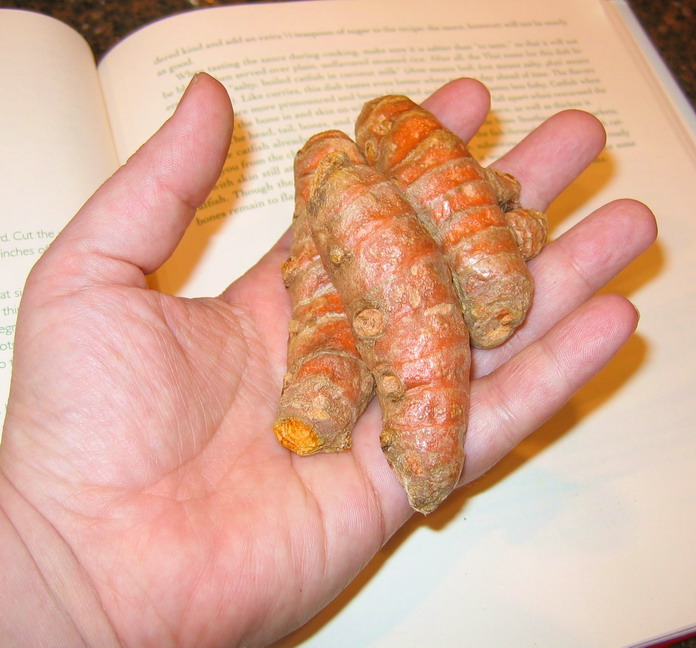
As you can see, turmeric is sized and shaped similarly to its cousin, ginger, though the dull brownish skin is thin, much more like the skin of young ginger. It scrapes off easily with the edge of a spoon, revealing a throbbingly vivid orange hue that made me think of cotton saris and tropical flowers. When I peeled it, I was careful to wear latex gloves; knowing as I do exactly how easily the dried, powdered form stains skin, I was taking no chances with the fresh juice.
The scent of it was interesting: I can discern a hint of the dried turmeric smell, which always strikes me as somewhat dusty and dim, however, the fresh rhizome is pungently aromatic, with a spicy savor similar to the scent of fresh galangal, but not as strong. It has a vaguely floral smell, too, that somehow reminded me of jonquils or daffodils.
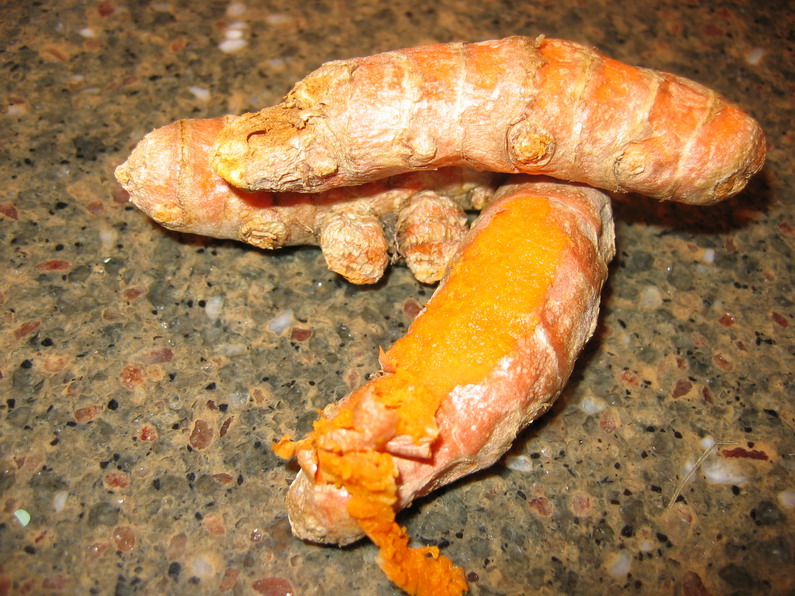
As for what to do with it–I took my question to Google, and one of the first recipes that came up was from Kasma Loha Unchit’s website. Kasma is one of my favorite Thai cookbook authors, and she is very generous on her website with recipes from her two books, It Rains Fishes and Dancing Shrimp. (In writing this post, I just discovered that both books are out of print, and am distressed by this news. They are both gems and they deserve to be read and used by many people.)
The recipe I found was for Catfish Rounds Simmered in Turmeric-Flavored Coconut Sauce, and since it involved coconut milk, catfish, galangal, lemongrass and turmeric–all favorite ingredients in this house–I figured there was no way it could be bad, so why not go for it?
I have never had any recipe from Kasma turn out badly, and this one was no exception. I did modify it somewhat, but mostly only from necessity. I only had access to boneless filets of catfish, so, as I could not rely upon the head, bones and tail of the fish to flavor the sauce, I added a teaspoon of Penzey’s Seafood Base to the coconut milk as it simmered. I also allowed the sauce to simmer for a good twenty minutes or so before adding the fish and cooking it for another twenty minutes, just to allow the flavors to develop more fully. Finally, though I followed her instructions and made the dish salty (Kasma notes in her instructions that a direct translation for the Thai name of the dish comes out to “salty boiled catfish in coconut milk), I found that the saltiness needed a little bit of acidity to balance it, so at the end of cooking, I added the juice of one half of a lime.
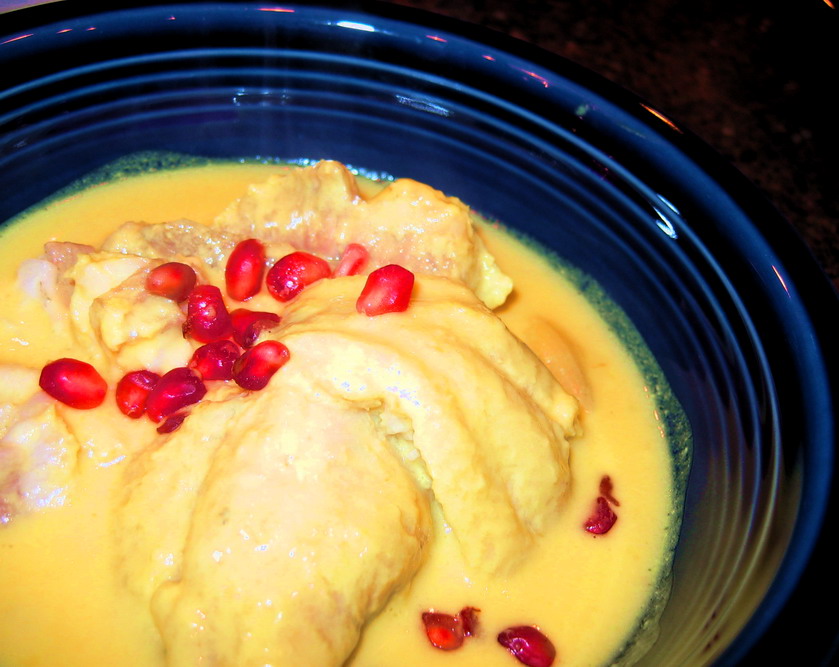
I ended up also adding a garnish of pomegranate seeds, just because I thought that their shimmering rubine color would look lovely atop the creamy yellow, turmeric-flavored sauce.
Speaking of which–since I had a bit less turmeric root than she calls for in her recipe, instead of just smashing it with a cleaver as she suggests, I cut it into slices and then crushed it, in order to expose more surface area to the coconut milk than would be possible by her method. This would allow for maximum extraction of flavor and color from the rhizomes by the coconut milk.
And it worked beautifully–I was surprised to see threads of yellow spiralling out from the slices of turmeric root after I tossed them into the simmering coconut milk. Within mintues, the formerly snow-white liquid had become the color of butter; by the time the dish was finished and ready to serve, the color had deepened to be close to a true daffodil yellow.
Not really a curry, nor even truly a soup, the dish is meant to be eaten with plenty of plain steamed jasmine rice, and is meant to be a sweet, salty foil for a hotter, spicier dish. To go with it, I stir fried gai lan with ripe jalapenos, onions, garlic and fermented black beans, then added oyster sauce and a bit of Shao Hsing wine to deepen the flavor and balance all the heat-producing ingredients in the dish.
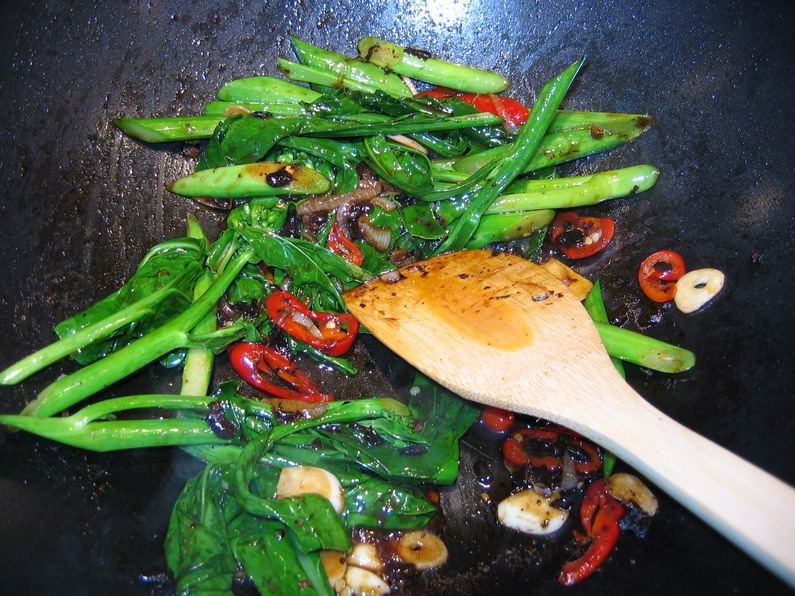
Together the two dishes were a study in contrasting colors, flavors, textures and aromas. The catfish was well-loved by all three of us, even though Morganna expressed surprise to hear that Thai people love catfish as much as we do. “I thought only hillbillies and southerners liked catfish,” she said, as she plucked a morsel of it up with her chopsticks and examined it before popping it into her mouth.
When I pointed out that some of the largest catfish in the world live in the Meekong River Delta, and that they would dwarf our dining room table, she nodded and said drily, “One of those would make a heck of a fish fry. You could feed a whole village.”
Kasma notes that the catfish is good reheated the next day, and in fact, it tastes even better after sitting overnight in the refrigerator.
I don’t know about that yet, as I haven’t yet sneaked a taste of the leftovers.
But when I do know, I will be sure and tell everyone what I think.
Weekend Cat Blogging: Merry Christmas to One and All!
Clare at Eatstuff was all set to have the worst Christmas of her life.
Her beloved cat, Kiri, had slipped out a window at her parent’s home, and disappeared.
He was gone for five days and she despaired of ever seeing him again.
However, at 2:30 AM on Christmas morning (Claire and Kiri are in Australia, dontcha know?), she heard something on the back porch, and then heard faint mewing.
And there he was.
So, it turned out to be the best Christmas ever!
In order to celebrate with Claire and Kiri, I am presenting two seasonal photographs.
The first one is of my beloved Grimalkin, underneath our Christmas tree a couple of years ago. It was the last real live tree we had–last year we got a fiber optic tree and it is a temple of tackiness. It is splendid, especially with the hundreds of extra lights Zak loads it down with every year.

But doesn’t Grimmy look festive under the tree? She loved sleeping under the real tree, but isn’t enamored of the faux one. Lennier, on the other hand, likes to lay under it and gaze up at the blinking multi-colored lights. We think it is because it reminds him of the “mothership.” (He is, after all, an alien in a cat suit.)

This next picture is not one of our cats; this is a lucky photograph taken by my dear friend Tom, who caught his cat, Rusty, gazing down at the “candles” in his bedside fountain, before taking a sip of water. Considering that this was taken in just the light of the LED candles, it is a great shot and it really is terribly festive and seasonal, so I begged Tom to be allowed to use it on my blog for this weekend’s festive catblogging extravaganza.
For more weekend catblogging, go visit Claire and Kiri at Eatstuff. And if you have cats who would like to wish the foodbloggers of the world a Merry Christmas, post them on your blog, and leave your URL in a comment in Claire’s blog and she will add your link to her page.
Merry Christmas, one and all. I hope I will be able to do a quick post tomorrow–but with the feast I am cooking, I may not be able to. If not, look for me again, the evening of Boxing Day. (That’s December 26th….)
Ginger Lemon Sandwich Cremes
I have a confession to make.
I buy cooking magazines, and I read them.
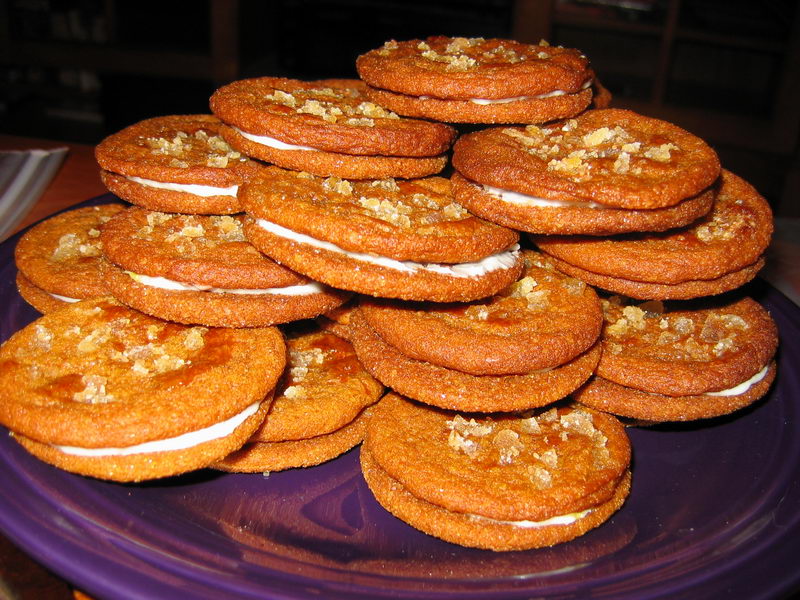
And I see recipes that sound interesting, but I seldom actually use them. I mean, other than looking at them and thinking, “What a good idea,” then running into the kitchen to recreate a dish like it from memory, I don’t really -use- the recipes as they were intended. I don’t cook from them; they are inspiration.
So, this Christmas, I decided I would force myself to try some of the recipes in some of my cooking magazines for cookies. Since I make new cookies every year anyway, why not see if I could find some really nice cookies to bake from some of these luscious-looking creations in the pile of magazines that teeter precariously on my desk?
So, I tried to do that. With the Ginger Lemon Cookies from Fine Cooking Magazine’s special Holidays edition, I mostly adhered to the recipe as written: I only changed a couple of very minor things.
And I liked the result pretty well, and they went over nicely with my erstwhile taste testers.
But then, I found a prize-winning recipe in the January 2006 edition of Cook’s Country Magazine, for “Molasses Spice Lemon Sandwich Cookies”, and I got to thinking. I got to thinking about one of my favorite store-bought cookies, which are from the UK. They are ginger snaps with creamy sour lemon icing in between them and they are devilishly tasty.
And the more I looked at the recipe from Cook’s Country (which is put out by the Cook’s Illustrated team, and which involves a lot of recipes from readers, rather like the wildly successful and purely awful Taste of Home Magazine, which is the cooking magazine with the highest circulation–or at least it was at one time) and I thought about the Fine Cooking recipe, and those wonderful British cookies, I decided to heck with exactly reproducing the magazine recipe. I was all for combining the recipes with a dash of my own ideas and coming up with a third, unique version that featured the best of both recipes, while duplicating the good parts of the commercial cookies.
While the results turned out not to be as absolutely fabulous as I would like, the cookies were solidly good, shading into excellent.
One thing I might change is the use of all melted butter in the construction of the cookies–melted butter makes cookies with a chewy texture, reminiscent of oatmeal cookies. It also gives the cookies a tendency to crisp a bit, and I think that the crispiness was too much. The topping of crystallized ginger, which I took from the Fine Cooking recipe was good, but too chunky, so I should try to mince it finer next time. And, finally, my instinct to add more lemon juice to the filling was a good one, but I needed still more, to balance the very sweet cookies.
The original Cook’s Country recipe had molasses, which made the cookies quite dark in color. I had no molasses, so I used honey instead. However, I didn’t take the darkness of molasses into account when I baked the cookies, so I may have baked them a bit longer than necessary in an effort to get the cookies the same color as in the magazine photograph. So, instead, next time, I think I will bake them about a minute less, to go with more of a chewy, instead of a crisp-chewy texture.
I also dropped the use of cloves, reduced the cinnamon and upped the dried ginger in the dough, as well as adding a considerable amount of freshly grated ginger, which changed the flavor profile of the cookies considerably. Adding a bit of lemon extract and lemon oil to the dough enhanced the ginger flavor without making the citrus apparent. In addition, I added lemon oil and lemon zest to the filling, bringing a very strong lemony scent to the icing, which I think really made the overall flavor sing. The acidity of the icing is cooling, while the ginger is very warming; this balance of contrasting sensations is the best part of eating these cookies.
So, here is an early Christmas gift for everyone–a cookie that came from four different sources: two different magazine recipes, the memory of a cookie from the UK (or should I say biscuit?) and my own propensity for tinkering in the kitchen.
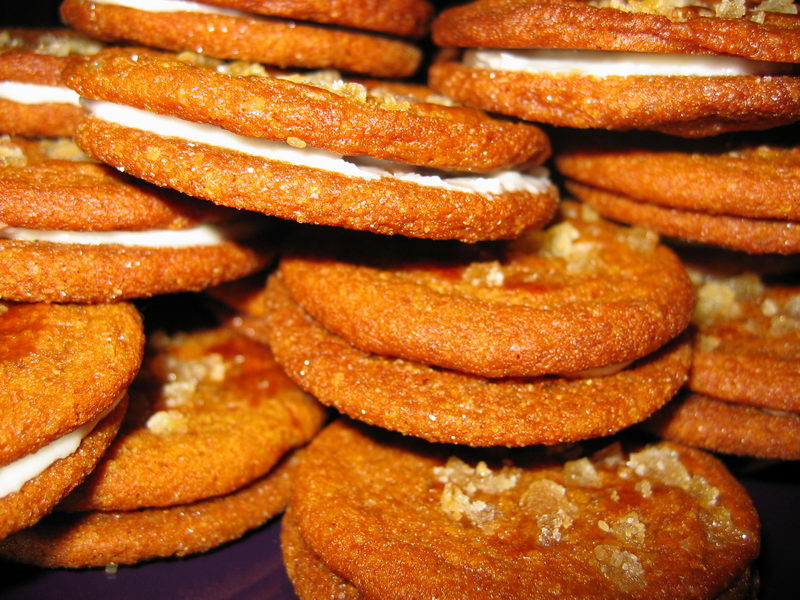
Ginger Lemon Sandwich Cremes
Cookie Ingredients:
2 cups all-purpose flour
2 teaspoons baking soda
1/2 teaspoon ground cinnamon
2 teaspoons ground ginger
3 tablespoons grated fresh ginger root
1/2 cup white sugar
1 cup raw sugar
1/4 cup honey
1 teaspoon lemon extract
5 drops lemon oil
1 large egg
12 tablespoons (1 1/2 sticks) butter, melted and cooled
1/2 cup white sugar
1 egg white lightly beaten
3 tablespoons minced crystallized ginger
1 tablespoon raw sugar
Filling Ingredients:
3 tablespoons butter softened and at room temperature
4 tablespoons lemon juice
zest of 1 lemon
5 drops lemon oil
2 cups confectioner’s sugar
Method:
Mix together flour, baking soda, cinnamon, ginger, and grated fresh ginger in a medium bowl.
In a mixer bowl, blend together sugars, honey, lemon extract, lemon oil, egg and melted butter until well combined. Add dry ingredients in three parts, mixing well after each addition. Dough will be somewhat fluid and quite sticky.
Cover bowl with plastic wrap and refrigerate for about an hour, or until dough is quite firm.
Preheat oven to 375 degrees F. Line two baking sheets with silpats or parchment paper.
Place 1/2 cup of sugar in a small bowl. In another small bowl, mix together crystallized ginger and raw sugar.
Scoop out dough into 1 tablespoon pieces, and roll into small balls. Roll half of the resulting balls in the sugar, and place on baking sheet, flattening them gently with your fingers into 1/4 inch thick rounds. The other half of the balls, flatten without rolling into sugar. These you brush with egg white and then sprinkle with the crystallized ginger, pressing it down lightly to get it to stick to the dough.
Bake until tops are just beginning to crack–about eight minutes. (In my really efficient convection oven–I baked them for a total of only six minutes–adjust accordingly if you have such an oven.) Turn the cookie sheets 180 degrees halfway through baking to ensure even browning. (With my convection oven, I turned them after four minutes, and baked them for another two minutes and they came out pretty well, though in retrospect, I maybe should have only baked them for five minutes….)
Remove from oven and allow to cool for three minutes in the pan, then remove to wire rack to cool completely.
To make filling, whisk together butter, lemon juice, zest and oil. Add sugar and whisk together until smooth.
To assemble, place a bare teaspoon of filling on the back of one of the sugar-topped cookies, spreading the filling to within 1/4 inch of the edge. Top with one of the ginger-topped cookies, and press down to bring filling neatly to the edge. Allow filling to set up for about an hour before storing in an airtight package.
From Land of Plenty: Rabbit with Sichuan Pepper
I think that Fuchsia Dunlop’s book, Land of Plenty, is probably the single Chinese cookbook from which I have cooked the most recipes. My copy is already dog-eared and stained by the kisses of soy sauce and sesame oil; in the photo to the right you can see that I also have various recipes marked, waiting to still be tried out.
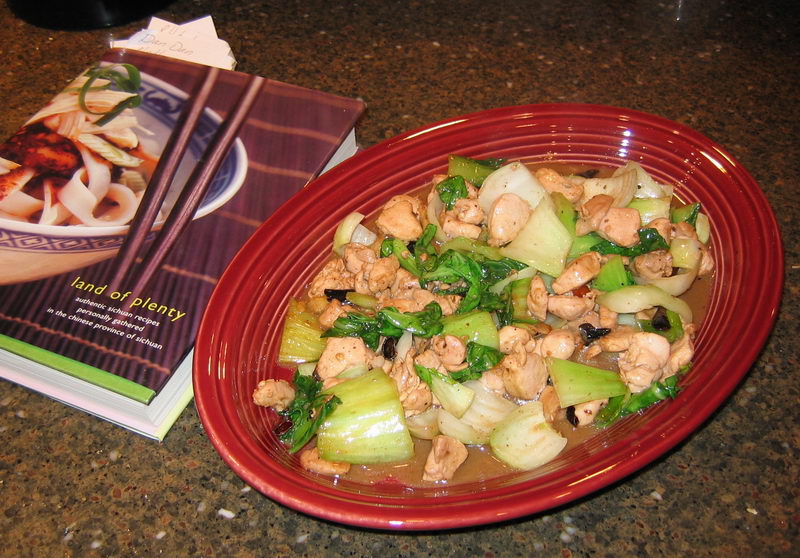
Ever since I saw the three rabbit recipes she included in the book, I have been itching to try them.
And every time I see rabbits at the North Market Poultry and Game stall, I think, “Ooh, I should get one and try one of Fuchsia’s recipes,” but I end up getting more lamb or perhaps some catfish instead.
Which is very odd, because I really love rabbit. I think that there is nothing finer than rabbit gravy, unless it is squirrel gravy, and some of my favorite dishes in restaurants have involved rabbit braised in some delightful fashion with lots of herbs, caramelized onion and garlic.
Well, for whatever reason, on Saturday, after I picked up the beef tenderloins for our Christmas dinner, I threw caution to the wind and picked up a bunny and decided I was going to cook it sometime this week.
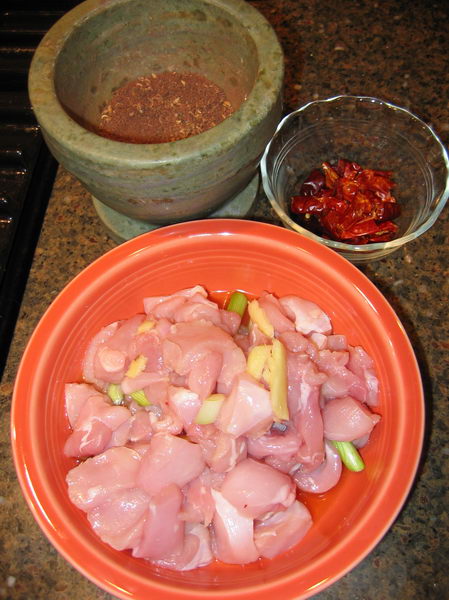
I gave Morganna the option of me cooking a typical European rabbit stew, or one of the Sichuanese preparations.
She didn’t even bat an eyelash. She said, “Sichuan bunny sounds fascinating. Let’s have that. Can I help cook it?”
Of course she could.
So, I read through the recipes and ended up choosing “Rabbit with Sichuan Pepper” on page 173, though I modified it somewhat, because as most of my readers should know by now, I am nearly constitutionally incapable of simply following a recipe, no matter how wonderful it is.
I just cannot do it.
But before I go into the recipe, let me say a few words about rabbits, and the structure of thier bodies.
There is a reason why most recipes for rabbit involve frying the meat or roasting it, or stewing pieces still on the bone.
That is because removing the bones from a rabbit is tedious, irritating and not terribly simple.
If you eat a braised rabbit dish that appears to have no bones, that is because the critter was cooked until the flesh fell off the bone into delectable little shreds of sweet goodness.
I mean, look, I can bone out a chicken without blinking an eye. I can take a full chicken carcass and reduce it to frying parts and then whip the bones out before most people can open a box of KFC and dig in. I went to culinary school and got good at those things, and so, I am not generally afraid of boning anything.
But you know, I realized something as I fiddled around with the rabbit: mammalian structure is not quite as convenient to removing bones as avian structure is.
And of course, the flesh and tendons in rabbits are a bit different.
We did manage, eventually. Morganna was frustrated enough to consider using her teeth, but that was strictly frowned upon, so she gave up on that idea.
So, if anyone out there decides to do the recipe as Fuchsia writes, “1 1/4 pounds rabbit meat, on or off the bone,” make it on the bone. Just hack that sucker apart with a cleaver like I should have done in the first place, and leave the bones in. They’ll add flavor, and just warn your family that there are bones so they know not to chip teeth on them.
I swear that is what most Chinese folks would have done.
I changed the cooking directions a bit–I was supposed to deep fry the meat and then drain it and pour almost all of the oil out of the wok, then add the Sichuan peppercorns and dried chiles, then go on to construct a sauce.
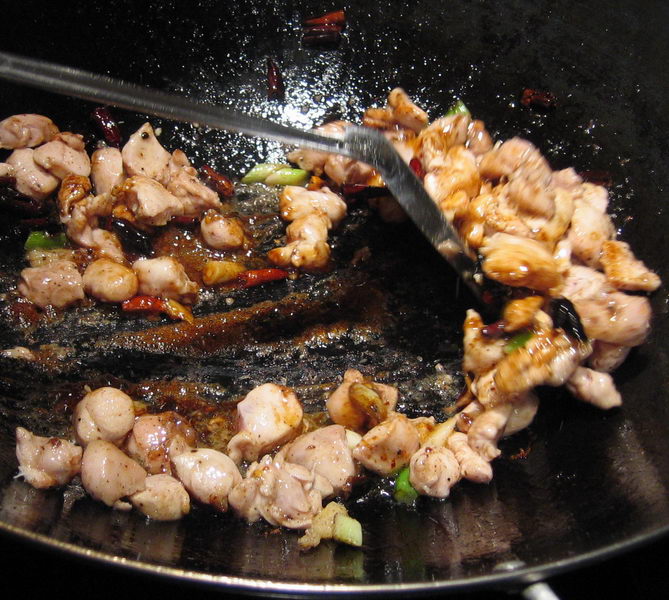
As I noted before–I don’t like to do deep fry if I can avoid it. So, I cut the pieces of rabbit into smaller cubes, and stir fried it. It still turned out phenominally well; the slightly gamey flavor of rabbit really stood up to the fire of the chiles and the icy heat of the Sichuan peppercorns.
I also ground the peppercorns, because I don’t like the texture of them left whole in sauces. That meant that I used a good bit less of them–only about a teaspoon of the ground, instead of the two tablespoons of the whole that is called for in Fuchsia’s recipe.
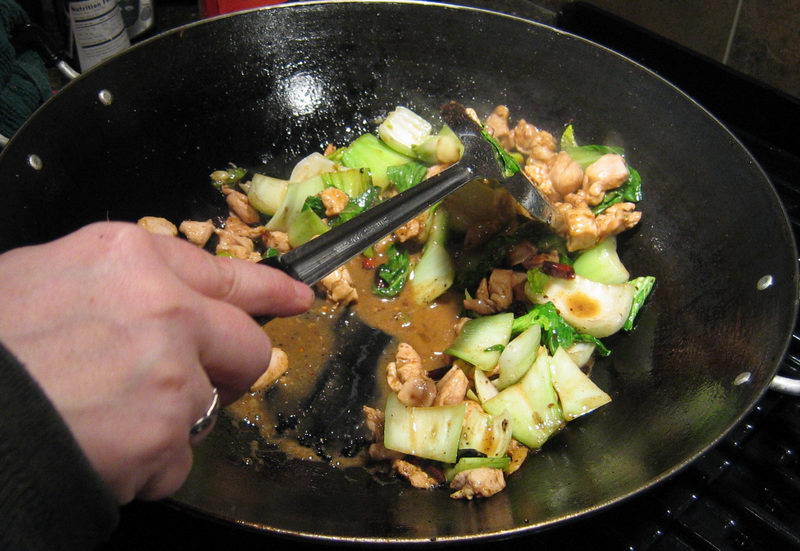
I also added some Shanghai bok choi at the end, mainly because I was too lazy to cook a second dish tonight! I think it was fine with it, but I should probably try tmaking it without sometime.
And I will make it again, though I think that I will use fewer chiles next time. I used the Tien Tsin chiles from Penzey’s and they are really beastly hot. She calls for “a generous handful” of dried Sichuan chiles, but I think that my modest twelve chiles might have been too much. This stove heats the wok so hot that the oil really can penetrate the chile and be infused with its fiery essence.
Rabbit with Sichuan Pepper
Ingredients:
1 1/4 pound rabbit meat, deboned if you are crazy like me, and cut into 1/2 inch cubes
3 scallions, white parts only, thickly sliced on the diagonal
1/2″ cube fresh ginger, peeled and smashed with the side of a cleaver
1 tablespoon Shao Hsing wine
1 1/2 teaspoons cornstarch
2 1/2 tablespoons peanut oil
8-12 Tien Tsin dried chiles, snipped in half, with most of the seeds removed
1 teaspoon freshly ground Sichuan peppercorns
2 teaspoons dark soy sauce
1/2 teaspoon raw sugar
2 heads Shanghai bok choi, rinsed, trimmed and cut into 1″ chunks (optional)
1/2 cup chicken broth
1 teaspoon sesame oil
Method:
Toss rabbit meat with the scallions, ginger, wine and cornstarch. Allow to sit and marinate at least thirty minutes, although, I think a couple of hours is better.
Heat wok until it smokes, add peanut oil. Toss in the chiles and ground Sichuan peppercorns, and stir, frying until very fragrant–about thirty seconds (This is one of those times that if you have a vent hood, you really need to use it. The hot chile oil is nothing to play with onces it becomes aerosolized.)
Add the rabbit and the marinade–watch out for splatters from the wine. Spread out into a single layer on the bottom of the wok and allow to brown on the bottom before starting to stir fry–about forty-five seconds to a minute. Then stir fry like mad. When most of the pink is gone, add the soy sauce and sugar, and stir and fry to create a thick sauce. If any of the marinade has begun to stick to the bottom of the wok, use the soy sauce to deglaze.
Add the bok choi, if you are using it and the broth. Stir and fry until the bok choi is crisp-tender, and the sauce has reduced and clings thickly to the meat and greens.
Remove from heat and add the sesame oil and stir it in well before pouring contents of wok into a warmed serving plate.
Serve with -lots- of steamed rice–this is another “cai” which is so spicy it forces you to eat a lot of rice.

Now, if you liked that recipe, I have to tell you there are many more where that came from in Land of Plenty. And if you would like a chance to win a copy of the book, along with an autographed copy of Henry Chung’s Hunan Style Chinese Cookbook, (that book is out of print and hard to find, btw) and some Sichuan peppercorns and Tien Tsin chiles, then head on over to A Menu for Hope, and donate five dollars to Unicef to help the folks in Kashmir who have been devestated by the earthquake. If you want a chance to win these goodies, just put in your personal note that you want a chance to win them, and remember–you get a chance for every five dollars you donate! And, if you don’t want my goodies–hey, there are plenty of other prizes and gifts for you to check out at Chez Pim.
But of course, you are also quite welcome to just donate some cash to help the people of Kashmir. So far, over $11,000 has been raised by food bloggers through the Menu of Hope campaign, and we have two more days before it ends. I’m really thrilled to see how much love there is among the food-bloggers and our readers–but, of course, I would very much like to see Unicef get as much help as possible, so if you haven’t donated–and you can, please do. The people of Kashmir need you.
Thank you all.
Whole Foods Comes to Columbus
I know that Whole Foods often gets called, “Whole Paycheck” by its detractors, and is often decried for putting smaller, locally owned natural foods stores out of business, but I rather like them. Now, not on any account do I think they are the greatest thing since sliced bread, but I do think that being able to shop in such a store once in a while is a pretty good thing, and a fun experience. When we lived in Providence, Rhode Island, we used to shop there fairly frequently, and I often found some interesting cheeses and produce items I had not ever seen before and so got the chance to try them and maybe add them to my pantry on a semi-regular basis. I also found that thier “365” brand staple items were comparably priced to regular grocery store items and often of better quality.
Well, the last time we went to Columbus, which would be last week, I discovered that they had opened a store there, much to the consternation of the folks at Wild Oats and Trader Joe’s, I am sure. When we went back yesterday to finish our Yuletide shopping excursion, we stopped in and discovered that not only had they opened a store, they opened -the second largest- Whole Foods in existence.
The place was like an airplane hanger–it was cavernously huge, and I noted, a lot of that space was wasted in making the aisles unecessarily wide.
Even though the place was packed with patrons, curiously poking and prodding the produce, sniffing the flowers, tasting the cheeses and asking incessant questions about the wine, there was more than enough navigation room in the aisles. It is possible that after they achieve the full complement of customers that I will bless the designer who made the aisles roughly as wide as a typical country lane, but right now, it just made the place look and feel curiously empty.
The other first impression we made was of the smell. For all that the store is huge, well-lit and airy, there was a lingering, unpleasant scent that was less than inviting. It gave the impression of a dank cave, as we wandered through the floral section. Zak noticed it and in his usual gentle fashion, wrinkled his nose and muttered to me, “What the hell smells like ass in here?”
“Maybe it is the flowers,” I said, nodding toward some potted, blooming orchids.
“I thought flowers were supposed to smell good,” he hissed.
I shrugged, steering toward the produce section. “Maybe they grow them in ass.”
Zak kept muttering, but I made my way through the beautifully arranged produce, bypassing all of the “normal” stuff and heading straight for the chiles, herbs and other fun stuff. It was there that I found a huge mound of fresh galangal, and next to it, fresh turmeric root. I blinked, picked some up and sniffed it, and then grabbed a bag and put some pieces in.
Turmeric is a relative of both ginger and galanga, and while it is most familiar to us as a bright yellow powder that gives mustard its color, it is in its unprocessed state a fairly flavorful, brilliant orange rhizome.
And I had never seen it offered fresh before, and thus, I had to know what it tasted like. Into the basket it went.
The mushroom section was nothing less than a temple to edible fungus–the number and kinds of fresh mushrooms on offer as above what I had seen even in places in California. It was amazing. But, bowing to the fact that Zak doesn’t really like mushrooms and barely tolerates the ones I put into the food as it is, I walked past the mushrooms, and was stopped by one source of the funky smell: a giant display of wheels of cheese, and cut wedges.
Of course, I picked up a wedge and took a deep sniff of it, and was rewarded with a good snootful of nutty cheesy aroma. I couldn’t help but admire a store in the US that kept cheese at room temperature, so that its full aromatic bouquet was released–most Americans are terrified of mold and and bacteria and don’t want to hear about the fact that without certain sorts of mold and bacteria, cheese would not exist.
I looked at the placard that declamed the type of cheese and saw it was “Parrano,” and was reading about its origin in Holland, when a very tall, somewhat bear-like shaggy gentleman came up with his shopping cart and said, “That is a fantastic cheese. It tastes like parmesan, but is smooth and soft like gouda. If you go into the cheese department, they will give you a taste of it.”
I looked up and smiled, and nodded, then stuck it in my cart. “You sold me on it.”
He blushed and then blinked. “Oh,” he added, looking down at his clothes. “I work here–I’m not just some random weird guy trying to get you to eat cheese.” He blushed, and grinned back at me. “I forgot that I wasn’t in uniform.”
I smiled at him and assured him that I didn’t think he had any untoward intention whatsoever (I have never had someone try a cheese-based pickup line, so I was pretty sure he was just a fan of the curd) and I waved him on his way and kept travelling through the giant land of food.
As I wheeled along, the bad odor strengthened until I got hit by a huge wave of fishiness.
Displayed in ice-covered glory about twenty feet away was a giagantic fresh seafood department. I could see piles of thawed squid, red snapper, sea bass, shrimp, tilapia, tuna and salmon, but I stayed firmly put. Finally, holding my breath, I ventured forth to get a closer look.
The fish all -looked- fine, but inhalation was a dangerous thing.
Zak, who grew up in Baltimore and Miami–two havens of seafood–shook his head and turned away.
The website may claim that they have fresh seafood flown in six times a week, but judging from the smell–it cannot be as fresh as they might like. It is certainly not fresh enough to tempt me into trying it; our local Kroger’s seafood aisle does not have a bad smell at all–only an oceany fragrance.
I simply refuse to buy seafood in a shop that smells like rotted fish guts. That may attract sharks, but it does not attract me, nor any other shopper who knows diddly about fish.
So, we headed to the olive bar, which offered twenty different kinds of olives.
We came back with manzanilla, pink olives with coriander, oil-cured Moroccan olives, Basque marinated olives, and some wee tiny ripe ones whose name I cannot for the life of me remember, but which taste delightful.
The actual cheese section is right next to the olive and olive oil section (the long row of olive oils prompted manic cries of “EVOO! EVOO!” from Zak who has taken to tormenting me with that particular Rachaelism) and is pretty amazing in the variety of interesting cheeses on display. The folks in the cheese department were all as friendly and helpful as their off-duty comarade; I appreciated that the staff was made up of folks who really love and appreciate food. We picked up several more cheeses, though I was happy to note that most of the prices they had on cheese was comparable to the prices at Curds & Whey, the small cheesemonger at the North Market.
I was rather worried that because Whole Foods can buy in more volume than the small, local cheeseman, that they might hurt his business by offering the same product at lower prices.
Thus far, this does not appear to be the case.
By the time we finished with the cheese aisle, we were tired of looking and shopping. The store was just too big, so we bypassed the packaged foods and staple items, breezed through the chocolate section where we did pick up a few things for gifts, and then sauntered through the prepared food stations.
We stopped and gaped, but we did not buy anything–the prepared food section is huge, absolutely gigantic. It was plain to me where Whole Foods in Columbus expects to make most of their money–in the home meal replacement business. Not only is it huge, but you can sit down and eat what you pick up there, or take it home, as is obviously intended.
There is also a huge bakery department, but the samples of some of the “artisan” breads I tasted lacked character. The crumb of the Italian country bread was nice enough, but it was obvious to me that they did a single or perhaps double fast rise at a warm temperature. There were none of the excellent flavors that develop if slow, cool temperature fermentation of the dough is undertaken as is done in the creation of real artisan breads.
So, we took our olives, cheeses and chocolates to the checkout lanes, and made small talk with the very friendly cashier. I was interested to note that they offer classes at Whole Foods in all sorts of cooking and food related topics, some of them taught by non-staffers. I may end up trying to teach a few classes there, but I may not–it is quite a shlepp.
All in all–it was a pleasant enough, if somewhat surreal experience, shopping in such a gigantic Whole Foods store. But, I have to admit–the fish department was disappointing, and while I liked the cheese section, I can get as good a selection and just as good prices at the North Market. The meat section tempted me not at all, and the bread was beautiful to look at, but nothing special to taste.
I suspect that Whole Foods will do quite well in Columbus, and I wish them well.
For myself, I am sticking with Bob, the Fish Guy, the folks at Bluescreek Farms, Curds & Whey and the Bee Guy at The North Market. Bob’s fish never smells of bait, the meat at Bluescreek is not only locally raised and wholesome, but tastes divine and is priced better than the stuff at Whole Foods, and I like the cheeseman and Bee Guy is great for conversation and honey.
As for real artisan bread, we have The Big Chimney Bakery here in Athens. They understand the use of slow rising and make bread to die for.
So, that just leaves the olive bar to attract us back.
And it will. When we are in the neighborhood, we will stop in and stock up on a variety of olives to satiate our taste for the little salty, bittersweet fruits.

Categories:
- Admin (rss) (55)
- Blogs and Blogging (rss) (81)
- Book Reviews: Cookbooks (rss) (43)
- Book Reviews: Non-Cookbook Food Books (rss) (38)
- Cats and Cat Blogging (rss) (47)
- Chinese Cooking Lessons (rss) (32)
- Culinary School Stories (rss) (18)
- Dairy Pruducts: Cultured and Barbaric (rss) (4)
- Documentary Filmmaking (rss) (1)
- Essays, Rants and Reflections (rss) (260)
- Fighting Hunger (rss) (12)
- Food and Kids (rss) (45)
- Food in the News (rss) (126)
- Food Media (rss) (98)
- Food Preservation (rss) (18)
- Food Safety (rss) (45)
- Gardening (rss) (30)
- Herbs and Herb Blogging (rss) (20)
- Holidays (rss) (50)
- Kat Blogging (rss) (22)
- Kitchen Science (rss) (36)
- Leftover Makeover (rss) (8)
- Life, the Universe and Everything (rss) (131)
- Local and Sustainable (rss) (227)
- Local Athens Food and Foodies (rss) (42)
- Meatless Mondays (rss) (32)
- Menu For Hope (rss) (5)
- Nutrition, Diet and Health (rss) (84)
- On The Farm (rss) (8)
- Recipes: Almost Vegetarian, Vegetarian and Vegan (rss) (294)
- Recipes: American Regional (rss) (37)
- Recipes: Appalachian Hillbilly (rss) (33)
- Recipes: Bread, Pasta, Grains (rss) (95)
- Recipes: Canning and Preserving (rss) (8)
- Recipes: Chinese (rss) (123)
- Recipes: Comfort Food (rss) (120)
- Recipes: Cookies (rss) (16)
- Recipes: Desserts (rss) (48)
- Recipes: French (rss) (25)
- Recipes: Fruits and Vegetables (rss) (302)
- Recipes: Greek, North African and Middle Eastern (rss) (31)
- Recipes: Indian (rss) (137)
- Recipes: Italian (rss) (42)
- Recipes: Japanese (rss) (7)
- Recipes: Jewish (rss) (4)
- Recipes: Korean (rss) (6)
- Recipes: Meat, Poultry and Fish (rss) (220)
- Recipes: Mexican/Native American/ Latin American/Caribb (rss) (27)
- Recipes: Original (rss) (108)
- Recipes: Thai (rss) (27)
- Recipes: Tofu (rss) (17)
- Recipes: US Regional (rss) (16)
- Recipes: Vietnamese (rss) (8)
- Restaurant Stories (rss) (28)
- Sewing, Quilting, Arts and Crafts (rss) (16)
- Simple Chinese Recipes (rss) (30)
- Slow Food and Heritage Foods (rss) (10)
- Spice Blogging (rss) (44)
- The Chinese Cookbook Project (rss) (14)
- The Chinese Pantry (rss) (39)
- The Documentary (rss) (2)
- The Kitchen Saga (rss) (17)
- The Locavore's Bookshelf (rss) (15)
- The Unsung Adventures of The Culinary Nerd (rss) (6)
- Tools and Toys (rss) (35)
- Uncategorized (rss) (10)
- With a Side of Politics (rss) (48)
Archives:
- August 2012 (9)
- July 2012 (12)
- September 2011 (3)
- August 2011 (7)
- July 2011 (8)
- June 2011 (16)
- May 2011 (17)
- April 2011 (11)
- December 2010 (9)
- November 2010 (5)
- February 2010 (1)
- December 2009 (5)
- November 2009 (7)
- October 2009 (10)
- September 2009 (16)
- August 2009 (14)
- July 2009 (14)
- June 2009 (7)
- May 2009 (17)
- April 2009 (10)
- March 2009 (25)
- February 2009 (13)
- January 2009 (10)
- December 2008 (5)
- November 2008 (5)
- October 2008 (6)
- September 2008 (13)
- August 2008 (8)
- July 2008 (11)
- June 2008 (18)
- May 2008 (13)
- April 2008 (14)
- March 2008 (16)
- February 2008 (17)
- January 2008 (19)
- December 2007 (25)
- November 2007 (18)
- October 2007 (24)
- September 2007 (16)
- August 2007 (15)
- July 2007 (15)
- June 2007 (10)
- May 2007 (14)
- April 2007 (16)
- March 2007 (17)
- February 2007 (20)
- January 2007 (13)
- November 2006 (1)
- October 2006 (8)
- September 2006 (14)
- August 2006 (25)
- July 2006 (30)
- June 2006 (28)
- May 2006 (34)
- April 2006 (29)
- March 2006 (24)
- February 2006 (30)
- January 2006 (38)
- December 2005 (40)
- November 2005 (37)
- October 2005 (32)
- September 2005 (25)
- August 2005 (30)
- July 2005 (28)
- June 2005 (21)
- May 2005 (8)
- April 2005 (22)
- March 2005 (17)
- February 2005 (29)
- January 2005 (10)
Search Site:
Links:
- Lily’s Wai Sek Hong
- 101 Cookbooks
- A cat in the kitchen
- A Veggie Venture
- Accidental Hedonist
- Cha Xiu Bao
- chez pim
- Chocolate & Zucchini
- Chopstick Cinema
- Chowhound.com
- Chubby Hubby
- Cook sister!
- Cooking with Amy
- da*xiang
- Eat Local Challenge
- Eating Liberally
- Ecocentric
- Eggbeater
- Epicurious
- Farmgirl Fare
- Fatfree Vegan
- Foodgoat
- ForkandBottle.com
- Green Olive Tree
- Hooked on Heat
- Jaden’s Steamy Kitchen
- Kalyn’s Kitchen
- Lucullian delights
- Mahanandi
- Matt Bites
- MeatHenge
- mmm-yoso!!!
- New York Times – Dining & Wine
- Pizza Goon
- Rasa Malaysia
- Ruhlman
- Sailu's Kitchen
- Serious Eats
- SF Gate: Food & Dining
- Simply Recipes
- Soul Fusion Kitchen
- Tastespotting
- The Amateur Gourmet
- The Cleaner Plate Club
- The Food Section
- The Grub Report
- thecookscottage
- U.S. Food Policy
- Wandering Chopsticks
- Washington Post Food and Dining
- Wasted Food
Meta:


Powered by WordPress. Graphics by Zak Kramer.
Design update by Daniel Trout.
Entries and comments feeds.