
Cook Local, Eat Global
Best Food Writing Anthologies And Blogs
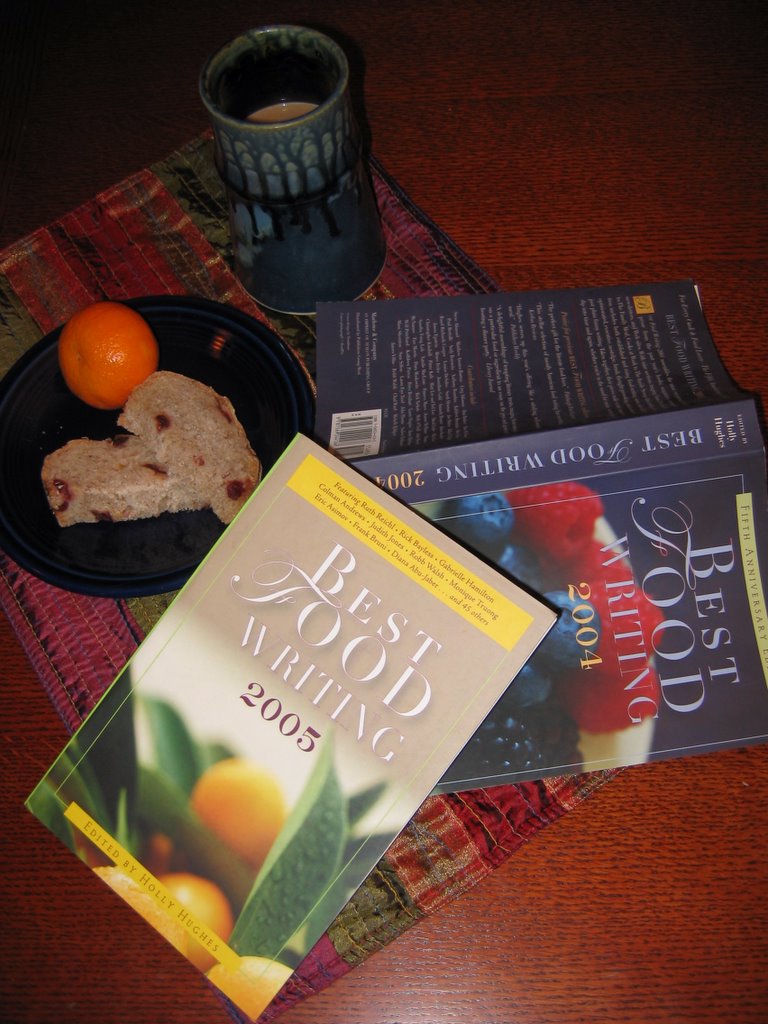 So, of course, I had noticed these anthologies of the Best Food Writing of whatever year, edited by Holly Hugues, when they first appeared annually starting in 2000.
But I hadn’t really read any of them until this May when I picked up the fifth anniversary edition, Best Food Writing 2004 while I was in Tennessee tending my aunt while she tended my uncle who was in the hospital.
Whenever I read an anthology, I always read the editor’s introduction; over the years, I have found that much of what goes into any given anthology depends upon what is in and on the editor’s mind at the time the collection is put together. Thus, an introduction can serve as a quick and dirty overview of the editor’s selection processes, preferences and prejudices.
I hadn’t read the Holly Hughes’ introduction to the 2004 edition in the bookstore–in fact, I didn’t browse the book at all–and it is a good thing that I was lax in my usual critical pre-purchase perusal.
Because if I had read the introduction, I would never have bought the book, which would mean that I would miss out on some fine essays and rollicking remembrances.
What was it in the introduction that would cause me to ditch the book, unread, right there in the bookstore?
It was this little jab the editor took at the food bloggers:
“…A plethora of food-themed weblogs have sprung up on the Internet with tempting names like chocolateandzucchini.com, meathenge.com, mylatesupper.com, iwashustreallyveryhungry.com, and nicecupofteaandasitdown.com. They’re just what you’d expect from internet writing–sloppy, unflitered, ungrammatical, self-involved prose (folks, don’t give up your day jobs)–but all the same, isn’t it curious that there’s such a large community of people out there who have so much time to think about food?” (pp xiv)
She goes on to ruminate on what a food writer is, what food writing is and why humans like it so much, but the first time I read the introduction, those words were lost on me as my brain had already seized up and slammed into my forehead when it came to that snarky little aside, “(folks, don’t give up your day jobs.)”
At that point, I had only been blogging for about three months, but for those months, I had endeavored to put up at least one post a day, for anywhere from five to seven days a week.
That is a lot of writing, for those who don’t engage in this sort of thing.
And here was this woman tossing aside all of the work that I had done, and all the work the other bloggers do, with casual wave of her hand and an insult thrown in just to add to the injury.
Ironically, one of the pieces chosen to grace the pages of the anthology was a wry and rather cheeky critique of food magazine’s editorial ideas of what makes for a dinner party menu that isn’t hell for the typical cook to execute, written by none other than food-blogger turned “real writer,” Julie Powell. The piece appeared in the pages of the New York Times–and honestly, I read it long before I knew who Julie Powell was or what her Julie/Julia Project had been, and I remember laughing aloud at the way she satirized the silly fusion menus one can find in some food magazines. Her first person antics as she dashes hither and yon in search of obscure ingredients made me giggle when I read them in the New York Times, but when I saw the piece in Hughes’ anthology, I gritted my teeth.
Not at Julie Powell, but at Holly Hughes.
Apparently, because Julie Powell got a book contract, and started writing for the New York Times, that made her a “real writer,” worthy of respect and above casual insults.
Yet, the only difference between Powell and say, Clotilde of Chocolate & Zucchini was a book deal. It didn’t matter that Clotilde and many other food bloggers had been feted in the media around the world, it didn’t matter that Clotilde herself was working on a book proposal at the behest of a New York publisher, what mattered to Hughes was that Powell had “made it” and the rest of the food bloggers “better not quit our day jobs.”
That cheap shot nearly kept me from bothering to pick up this year’s edition of Best of Food Writing, but seeing that pieces by Robb Walsh and Diana Abu-Jaber were included induced me to take up the book and peek cautiously inside at the introduction.
I wanted to see if Hughes had retained her snippy attitude toward food bloggers.
I found that her frosty disdain for food bloggers had thawed a great deal in the course of a year.
In the last paragraph of her introduction she writes, “This doesn’t mean, though, that passionate amateurs shouldn’t be invited to the table. At the end of this book, you’ll find a sampling of excerpts from various food-oriented Weblogs (a.k.a. blogs) I’ve found on the Internet. After days and days of browsing through blogs, I can say that there’s a lot of sloppy writing out there, but there’s also some very good stuff, full of a refreshing curiousity and excitement about food. These people are writing about food–shopping for it, cooking it, eating it–because they love food. And that’s what makes all the best food writers such a pleasure to read.” (pp xii)
Whoa.
That isn’t a complete reversal of opinion, but it is pretty damned close.
Somewhere in the course of a year, food blogs went from being an object of scorn to something worth browsing through because the authors of them -love food.-
What could have caused such a dramatic change of opinion?
I don’t know. It could be the knowledge that Powell’s blog in book form was coming out this year, with a lot of planned hoopla and fanfare. It could be the continued positive media coverage of the food blogosphere.
Or, it could be a simple softening of an editor’s attitude toward “unfiltered” media because she realized that blogs and bloggers were not going to just disappear–in fact–they were rising in popularity.
Let me explain–because “filtered media” is a bit of jargon that not every reader is going to get.
Traditional media–print, radio, film and television, have “filters” in the form of editors, publishers, producers, directors, stations and studios. These “filters” act in different ways to take the creative output of the writer and through successive stages, change it in various ways to improve upon it, change its form, or otherwise make it more “palatable” to the market or audience for which it is intended. Filters are necessary in traditional media, because, like it or not, the truth is, writing is a commodity in the media, and although a writer is the one who produces that commodity without which the media would cease to exist–they are not considered competent to make that commodity fit for public consumption.
That is the job of editors.
Editors (and in television and film, producers) are the first line of defense in the traditional media against a “bad” product. In the print media, that means a product that doesn’t sell in the form of books, newspapers or magazines. In the radio and television industry, that is a product that doesn’t bring in ad revenuw, and in the film industry, that is a film which sells no tickets.
Do you see where I am going with this?
Blogs, by and large, are unfiltered, in the sense, that they are produced solely by the writer. There is no editor shaping the author’s words into a more marketable form, nor is there an ad department doing market analyses and selling ad space.
In the blogosphere–it is all about the writer. The author calls the shots, and she can write about whatever she likes, in whatever way she likes without worrying about what an editor can and will say about it.
That is bound to make an editor feel a tad bit nervous–knowing that there are folks out there who are writing their hearts out on a subject that is her bread and butter–but they don’t give a fig what she thinks about what they write.
They aren’t writing for her.
They are writing for themselves and their readers–a group which grows by leaps and bounds every day. They are writing because they want to–not because they are getting paid to do it. They are writing for the sheer joy of it, because they love food, they are knowlegeable about it and they have ideas they want to convey to the public.
Perhaps last year, Hughes was confident that blogs were just a fad that would fade, and so she felt comfortable slinging barbs without worrying where they might fall.
But this year, when the food blogging commmunity just kept growing, and more than one food blogger had a book on the way, she rethought her position and realized that perhaps folks who write without worrying about money and what editors thought of them might have something interesting and useful to say, and so she took another look.
It could be any of these reasons, or none of them; I don’t really know why Hughes’ tune changed so drastically.
But I am glad it did–because next year–she may have quite a few seasoned bloggers–folks who have been writing nearly every day for several years–submitting some polished work for her to review that never saw a “filter,” and yet still managed to be passionate, witty, and full of the juice that makes for great food writing and reading.
I think that would be just awesome–the traditional media supporting the new media–and vice versa–working together, rather than against each other.
Because the truth of it is–even professional food writers don’t get rich writing about apples, restaurants or sustainable agriculture. The folks who get paid to write about food are primarily doing it because it is what they are passionate about–it is what they love.
They are in the same boat as we bloggers, only they get paid to do it.
It doesn’t make them better than us, only different.
Maybe Holly Hughes figured that out.
food & drink books blogs media
How Many Food Magazines Are There?
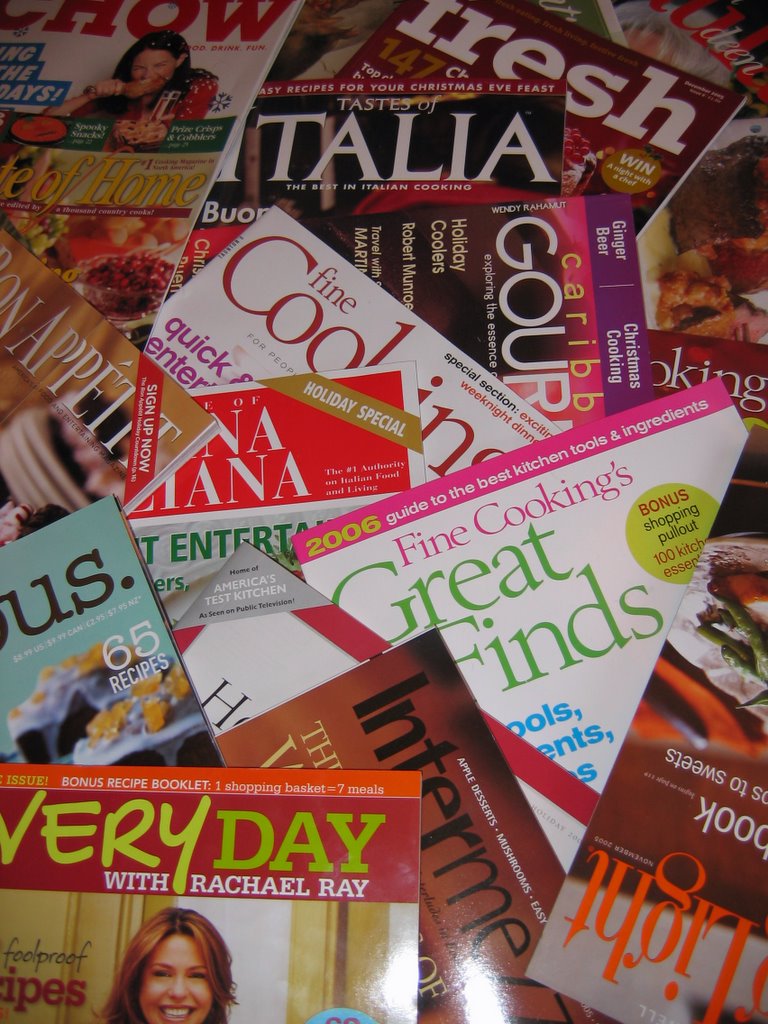 That’s a rhetorical question.
I really don’t know the answer.
But I do know this–there are a whole bunch of them.
Big ones.
Small ones.
Thick ones.
Thin ones.
This one has a shiny car,
This one has a cookie star,
What a lot of ‘zines there are!
(Okay, Dr. Seuss, I am truly sorry for bunging up your brilliant poetry. But the number of food magazines has boggled my mind, and so I plead temporary insanity.)
For reasons which I cannot now disclose, I have been haunting bookstores, newstands and grocery stores, picking up food magazines, and reading them.
And I have come to a few conclusions.
One–just as soon as I think I have found all the food magazines that there are in the United States, I find one or two more I have never heard of. And I sigh, and pick those up, too.
Two–They fall into several categories, of which there are three main ones. Food & Lifestyle magazines appear to be the largest category; these are the publications that not only talk about food, but also travel, place settings, alcoholic beverages, music and entertainment. In addition to beguiling the reader with beautiful food and recipes, they try to sell an image–a fantasty of a way of life the reader can aspire to. (I tend to get irritated by these magazines eventually.) Straight up Food and Cooking Magazines are the ones I tend to like the most, though there is one particular title that I am sure is my own personal kryptonite. When I look at it, I get weak in the knees, nausea strikes, and dizziness nearly overwhelms me. But most of this category I really like and they tend to be the ones I go out of my way to read every month. The third category, which is Everything Else, is a concatenation of speciatly magazines which cover one food-related topic, health-related cooking magazines, seasonal magazines and journals which cover food and culture.
Three–There is bound to be at least one or two food magazines that appeal to every foodie in the world. I don’t know this for certain, but the odds are with me. With fifty-plus titles in English, a double handful of which originating outside the US, there is bound to be something for everyone.
Four–There is bound to be at least one or two food magazines that make any given foodie want to hurl. If my theory that there is bound to be one or two magazines that will appeal to any given foodie, the opposite is likely to be the case.
So–I pose a question to my readers–what food magazines do you read? Which ones do you particularly like?
And which ones do you utterly abhor?
And finally, why?
Turkey Aquisition Complete!
 We went to Columbus yesterday to pick up a turkey at the North Market Poultry and Game stall. I didn’t call ahead or order one; I did that when we lived in Pataskala, but last year, because we had been focused on looking at houses in Athens, I forgot to order ahead of time, but was still able to just arrive and pick up a fresh, free-range bird.
The folks at North Market Poultry are not only smart enough to order enough turkeys for walk-in customers, but they are also friendly, funny and know their products inside and out. They can rattle cooking instructions off the top of their heads that would make Julia Child proud, and they are happy to tell you where every one of thier products come from. They cook their own turkey stock on site so their customers don’t have to, and they go out of their way to sell as many Ohio-raised birds and game animals as possible, including turkeys, rabbits, bison and venison.
Well, anyway, I saw that they had standard free-range Broad-Breasted Whites in their case, as well as some heritage birds.
Heritage turkeys are the big Thanksgiving trend in the foodie world, and I have yet to try one, myself. But, seeing that there were some in the case, and noting the physical differences between the two, I decided to give one a shot.
How different are they? Well, the legs are longer on the heritage birds, and the muscle development is more evident. The breast isn’t as overwhelmingly large as the mutant-looking commercial Broad-Breasted Whites (those birds are so deformed that they can barely walk, and instead waddle awkwardly, and some cannot lift their massive breasts to walk at all) and the color of the meat was a more pinkish tone with thinner, more tightly affixed skin.
These birds are of the Narragansett breed, and were raised at Speckled Hen Farm, a poultry farm in Morrow County Ohio, not too far from Columbus. They list on LocalHarvest, and if you click on the link you can go to a great photograph of one of the owner’s kids feeding gorgeous huge turkeys some bread. Speckled Hen Farms was featured on the blog Small Farms last month, and was written up in the newsletter for Local Harvest by Tana Butler, the blogger behind Small Farms.
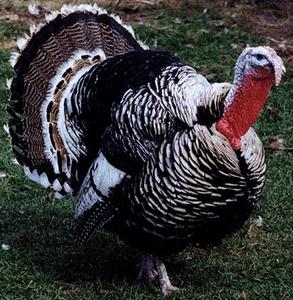
I have to say I am shocked at low lovely the Narragansett turkeys are from a purely aesthetic standpoint–they are very handsome birds. (The picture up above is a Narragansett male.) The males, when they strut about in their display–when they raise their tails, and puff out their feathers–are amazing in their size and color; they look something like the wily wild turkeys that roam the woodlands of Appalachia, foraging in the rolling fields and hills. I cannot help but admire their physical beauty–I did grow up going to county and state livestock shows after all, and developed an appreciation for the beauty of farm animals at an early age.
Historically speaking, the Narragansett turkeys came about when turkeys were brought from England to New England by the Puritans and then were interbred with the native wild turkeys.
I know what you are thinking–turkeys from England? I thought that they were from North America?
They were. When the Spaniards went to Mexico, they found domesticated turkeys there, and brought them back to Europe. Turkeys were among the first North American foodstuffs eagerly adopted by the Europeans, and turkey breeding took off on the continent and in England both. By the sixteenth century, turkeys were a standard part of the typical poultry yard, and so were brought with the Pilgrims, back to the colonies.
Interesting, eh?
At any rate, I am told by the good woman who sold me my very own twelve pound bird, that heritage turkeys should be cooked only to about 140 degrees internal temperature (with the thermometer in the thigh), and allowed to carry-over cook while it sits and rests for about twenty minutes. Otherwise, she said, they will dry out. Though I had heard not to brine a heritage bird, she said she brines hers and that the salt and extra moisture does nothing but enhance the already luscious native flavor of the meat. When I told her that I tend to stuff butter and fresh aromatics under the skin, then rub the skin with butter, salt and pepper, then start my bird on high heat, then turn it down after the skin browns and shrinks, she said that my method should work perfectly well for the Narragansett as well.
So, next Saturday, we shall see if my usual Thanksgiving method of combination high heat mixed with low temperature roasting will work as well with a fancy heritage bird as it does with a free-range broad-breasted white.
Weekend Cat Blogging: Are you a Good Cat or a Bad Cat?
 I promised a few more pictures of Dandelion for today’s weekend cat blogging, so here are a couple that show the two sides of her personality.
On the left, you see she is alert, sweet-tempered and gentle. Playful and inclined to purr.
 On the right, you see the Cat from Hell.
Actually, on the right you see her yawning again–she makes the most evil faces when she yawns.
In truth, little Dandel, as we often call her, is a very good natured girl cat, full of playful grace and lithe strength. She is getting along with the other cats famously–she plays with the younger boys, Lennier and Gummitch in particular, and with the kitten, Tatter. She is a little afraid of Ozy, because he is so large, but she sniffs noses with him respectfully and lets him pass. Jack has shown no inclination to bother her and when Grimalkin tries to dominate her, Dandel holds her own, sometimes with the help of gallant Gummitch, who is still in love with her and watches her from afar with moon eyes.
For more weekend cat blogging, check in with Claire and Kiri at Eatstuff–she is out of the hospital and recovering nicely, I am happy to say!
Jambalaya Juju
 It is spicy.
It involves rice.
It has sausage and ham in it.
Did I mention, it is spicy and involves rice?
Oh, yeah, I did.
Well, you can see why I think jambalaya may be my all-time favorite bit of American Southern Country-Folk food of all time.
Because it is spicy, involves rice and it has sausage and ham in it.
Three of my favorite things, right there–heat, rice and pig.
You cannot possibly go wrong.
Jambalaya is a dish that is claimed both by the Cajuns and the Creoles of south Louisiana, and I have heard credible origin stories from both sides. However, I think that like many of the foods of that region, no one can definitively argue which side is the rightful creator of the dish–it is something that grew organically from the varied ethnic groups who settled Louisiana in successive waves.
It is almost as if, with each wave of immigrants, someone threw something new into the pot which bubbled merrily on the collective kitchen fire, and eventually, what was served forth was jambalaya.
Some say it was inspired by the Spanish dish paella–and one can easily see that comparison. Paella involves rice cooked with spices, aromatics, herbs, sausage and seafood, and jambalaya is based on the same principle, though the practice of using a shallow pan to cook the dish such as the Spaniards use, is absent. The name, “jambalaya,” is said to come from the French “jambon” for “ham,” with “a la” added as a suffix. And while the sausages in Louisiana all tend to have French names, it is said that the German immigrants really got the sausage-making tradition going when they arrived….you see what I mean when I say that as far as I am concerned, everyone in South Louisiana can lay claim to the origin of the dish, because everyone had a hand in putting something in the pot.
 Now, I am not from South Louisiana, I am from West Virginia. We don’t grow rice there, no one eats crawfish or “mudbugs,” and there aren’t too many French speakers there. So, where did I pick up the habit of making jambalaya?
Not from a cookbook, if that is what you are wondering.
Nope–I learned it from several friends, all of whom have family roots sunk deep in South Louisiana and New Orleans. And I met all of them in southeastern Ohio.
Which, now that I think on it, is rather odd, but the world is a very strange place sometimes.
Anyway, it was kismet, because I was destined to bump into jambalaya–and believe me–it was love at first taste. It is a magical dish, full of flavor, fire and festivity. It is a melange of tastes that dance a wild two step on the tongue, leaving you hungry for just another bite, even when you are so full you are like to burst.
After my first taste, I knew I had to learn how to make it, which I did.
My friends are generous with their familes’ recipes.
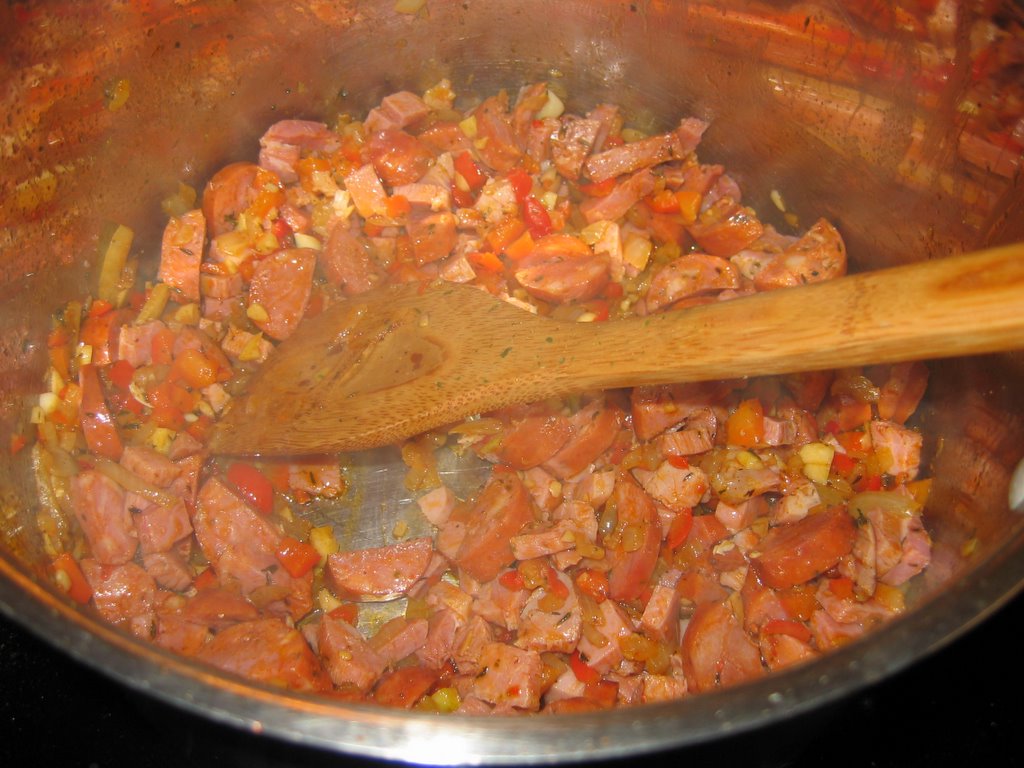
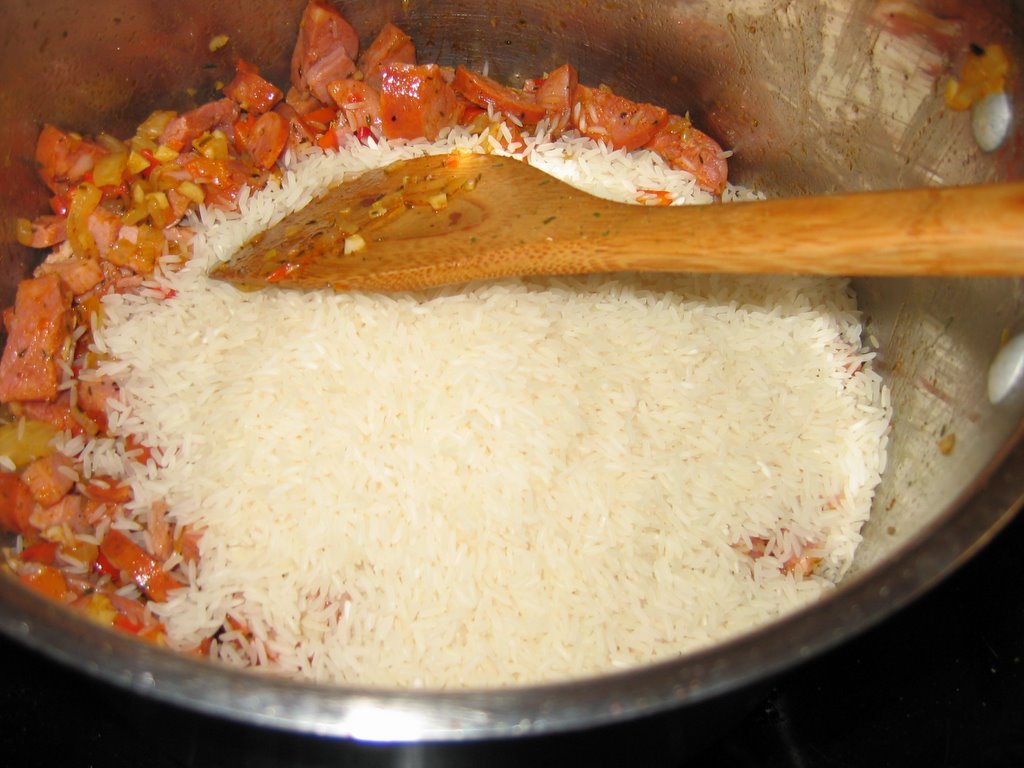 What it comes down to is this–you start with good flavoring ingredients: the holy trinity–onion, bell pepper and garlic, with some celery (or in my case, celery seed–Zak hates the texture of celery.) Then, you add fire, in the form of fresh chiles or dried cayenne–or both. Then, you have at least one pork product–that is, if you don’t keep kosher or halal or aren’t a vegetarian. In my case, I add two–really good quality ham and andouille sausage. Then, you can add any flesh, fowl or seafood you want–since I live in a land-locked state, this is usually chicken, though venison makes for an amazing jambalaya experience. Then, you have herbs, long-grained rice, wine, broth or stock and some fresh herbs to mix in for green color, fresh flavor and a little crunch.
And that is it. That is how it is made. It is a magical process of layering flavors that you coax out of each ingredient with whatever kitchen wiles you possess. It requires patience and diligence, and a couple of nice big pots, long wooden spoons and just the tiniest smidgen of good old Southern juju to make it come out right.
You will notice in the recipe that I am somewhat inexact about amounts and the like–that is because I was taught to cook this by feel. It is hard to put “by feel” into written instructions, but I tried–I hope it works for y’all.
Oh, you will also notice I said nothing about tomatoes.
I am a no-tomato jambalaya kind of person. Others folks disagree with me on this point, which is fine–that is their perogative. They can make their jambalaya with tomatoes and when I am at their house, I will eat it that way, because it is sinful to turn down a bowl of jambalaya, just plain sinful.
But at my house, no tomatoes are harmed in the production of jambalaya.
I save them for other, even more wicked, enchantments. (Like puttanesca.)
Oh, and one more thing–you can stretch this recipe or shrink it in any direction. Just keep the proportions of rice and broth or stock the same and you will do fine. You can add more or less meats. I don’t know if you can do it meatless. I have never tried. I am rather of the opinion that it might be boring that way, but you never know. I figure you can do an all seafood version, however.
 Jambalaya
Ingredients:
Enough olive oil, lard or bacon grease to cover the bottom of your jambalaya pot in a very thin layer (about 4-5 tablespoons)
1 large yellow onion, diced finely
1 fresh red bell pepper, diced finely
1-5 chile peppers (I used 5 serranos) de-seeded if you like and minced
1/2 teaspoon celery seed, lightly crushed (or one stalk celery, diced finely)
1 head garlic, minced
1 bay leaf
2 teaspoons Spanish smoked paprika
1 teaspoon half-hot Hungarian paprika
1/2 teaspoon dried powdered rosemary
1 teaspoon dried thyme
1/4 teaspoon dried rubbed sage
freshly ground pepper to taste
dried ground cayenne pepper to taste (or Cajun Creole seasoning to taste)
1/2 pound really good cooked ham, diced finely
1 pound andouille sausages cut in half lengthwise then cut into thin slices
1/2 cup dry red or white wine
3 cups long grain rice (I used jasmine, because that is what is in the house)
6 cups chicken broth or stock (Depending on your stove and rice, you may need up to a 1/2 cup more.)
2 cups shredded leftover chicken bits
1/2 cup minced fresh parsley
1/2 cup thinly sliced scallion tops
Method:
Get a nice big pot that has a lid and melt or heat your fat of choice in it.
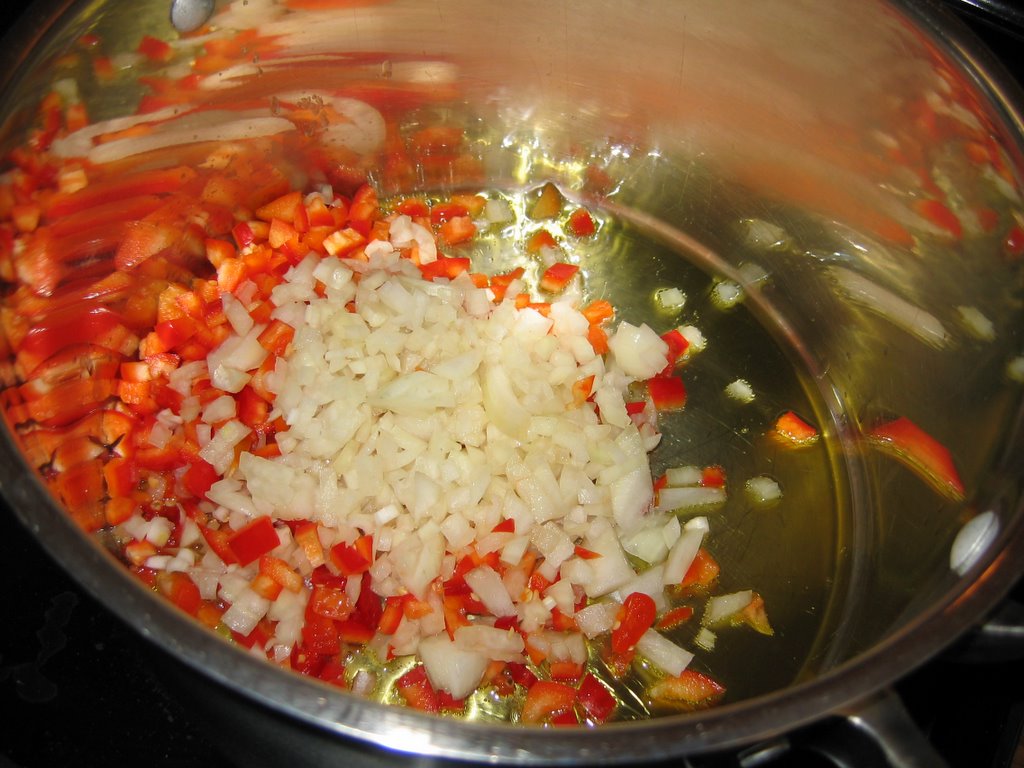
Throw in the onion, sweet pepper, chiles and celery seed or celery, and saute until the onions turn dark golden and start to turn reddish. Add garlic, bay leaf and dried spices and keep cooking, stirring, until the onions really start to caramelize and the garlic is golden and everything smells really, really good. Add the ham and sausage, and cook until they brown lightly.
Deglaze the pan with the wine, and allow most of the liquid to boil off.
Add the rice, and cook, stirring, until all of the rice is coated with the oil and is shiny and somewhat transluscent.
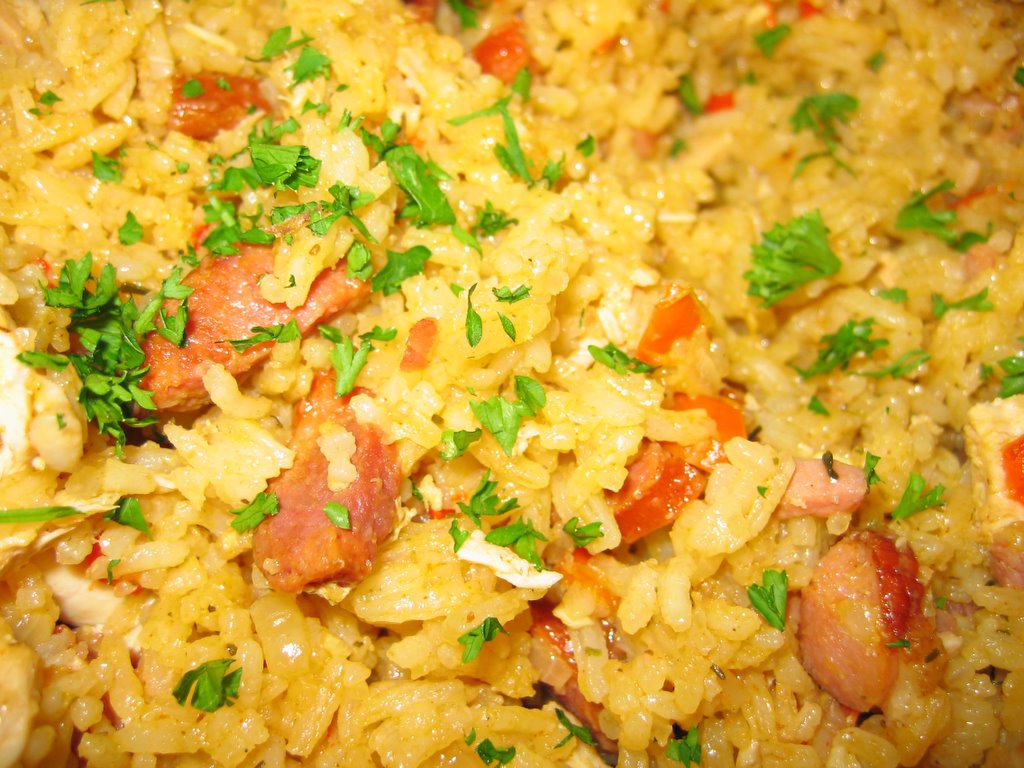
Add the stock or broth, and bring to a boil. Toss the chicken in on top of the rice. Clap the lid on the pot, turn down the heat to low and simmer for 10-20 minutes. Check after ten, and if it is looking done, eat it then. If not, put the lid back on. If the liquid is all gone but the rice is still not quite done, add a little bit more broth or stock, stir and then cover up and cook about five more minutes. This step is variable–because I don’t know how low the low on your stove is or how fresh your rice is. When I made this batch pictured here–it cooked in about ten minutes, because my stove was electric and didn’t cool as fast as it should, and the rice was super fresh.
Sprinkle with the parsley and scallion tops and stir them in and serve right away with a salad and some nice French bread.

Categories:
- Admin (rss) (55)
- Blogs and Blogging (rss) (81)
- Book Reviews: Cookbooks (rss) (43)
- Book Reviews: Non-Cookbook Food Books (rss) (38)
- Cats and Cat Blogging (rss) (47)
- Chinese Cooking Lessons (rss) (32)
- Culinary School Stories (rss) (18)
- Dairy Pruducts: Cultured and Barbaric (rss) (4)
- Documentary Filmmaking (rss) (1)
- Essays, Rants and Reflections (rss) (260)
- Fighting Hunger (rss) (12)
- Food and Kids (rss) (45)
- Food in the News (rss) (126)
- Food Media (rss) (98)
- Food Preservation (rss) (18)
- Food Safety (rss) (45)
- Gardening (rss) (30)
- Herbs and Herb Blogging (rss) (20)
- Holidays (rss) (50)
- Kat Blogging (rss) (22)
- Kitchen Science (rss) (36)
- Leftover Makeover (rss) (8)
- Life, the Universe and Everything (rss) (131)
- Local and Sustainable (rss) (227)
- Local Athens Food and Foodies (rss) (42)
- Meatless Mondays (rss) (32)
- Menu For Hope (rss) (5)
- Nutrition, Diet and Health (rss) (84)
- On The Farm (rss) (8)
- Recipes: Almost Vegetarian, Vegetarian and Vegan (rss) (294)
- Recipes: American Regional (rss) (37)
- Recipes: Appalachian Hillbilly (rss) (33)
- Recipes: Bread, Pasta, Grains (rss) (95)
- Recipes: Canning and Preserving (rss) (8)
- Recipes: Chinese (rss) (123)
- Recipes: Comfort Food (rss) (120)
- Recipes: Cookies (rss) (16)
- Recipes: Desserts (rss) (48)
- Recipes: French (rss) (25)
- Recipes: Fruits and Vegetables (rss) (302)
- Recipes: Greek, North African and Middle Eastern (rss) (31)
- Recipes: Indian (rss) (137)
- Recipes: Italian (rss) (42)
- Recipes: Japanese (rss) (7)
- Recipes: Jewish (rss) (4)
- Recipes: Korean (rss) (6)
- Recipes: Meat, Poultry and Fish (rss) (220)
- Recipes: Mexican/Native American/ Latin American/Caribb (rss) (27)
- Recipes: Original (rss) (108)
- Recipes: Thai (rss) (27)
- Recipes: Tofu (rss) (17)
- Recipes: US Regional (rss) (16)
- Recipes: Vietnamese (rss) (8)
- Restaurant Stories (rss) (28)
- Sewing, Quilting, Arts and Crafts (rss) (16)
- Simple Chinese Recipes (rss) (30)
- Slow Food and Heritage Foods (rss) (10)
- Spice Blogging (rss) (44)
- The Chinese Cookbook Project (rss) (14)
- The Chinese Pantry (rss) (39)
- The Documentary (rss) (2)
- The Kitchen Saga (rss) (17)
- The Locavore's Bookshelf (rss) (15)
- The Unsung Adventures of The Culinary Nerd (rss) (6)
- Tools and Toys (rss) (35)
- Uncategorized (rss) (10)
- With a Side of Politics (rss) (48)
Archives:
- August 2012 (9)
- July 2012 (12)
- September 2011 (3)
- August 2011 (7)
- July 2011 (8)
- June 2011 (16)
- May 2011 (17)
- April 2011 (11)
- December 2010 (9)
- November 2010 (5)
- February 2010 (1)
- December 2009 (5)
- November 2009 (7)
- October 2009 (10)
- September 2009 (16)
- August 2009 (14)
- July 2009 (14)
- June 2009 (7)
- May 2009 (17)
- April 2009 (10)
- March 2009 (25)
- February 2009 (13)
- January 2009 (10)
- December 2008 (5)
- November 2008 (5)
- October 2008 (6)
- September 2008 (13)
- August 2008 (8)
- July 2008 (11)
- June 2008 (18)
- May 2008 (13)
- April 2008 (14)
- March 2008 (16)
- February 2008 (17)
- January 2008 (19)
- December 2007 (25)
- November 2007 (18)
- October 2007 (24)
- September 2007 (16)
- August 2007 (15)
- July 2007 (15)
- June 2007 (10)
- May 2007 (14)
- April 2007 (16)
- March 2007 (17)
- February 2007 (20)
- January 2007 (13)
- November 2006 (1)
- October 2006 (8)
- September 2006 (14)
- August 2006 (25)
- July 2006 (30)
- June 2006 (28)
- May 2006 (34)
- April 2006 (29)
- March 2006 (24)
- February 2006 (30)
- January 2006 (38)
- December 2005 (40)
- November 2005 (37)
- October 2005 (32)
- September 2005 (25)
- August 2005 (30)
- July 2005 (28)
- June 2005 (21)
- May 2005 (8)
- April 2005 (22)
- March 2005 (17)
- February 2005 (29)
- January 2005 (10)
Search Site:
Links:
- Lily’s Wai Sek Hong
- 101 Cookbooks
- A cat in the kitchen
- A Veggie Venture
- Accidental Hedonist
- Cha Xiu Bao
- chez pim
- Chocolate & Zucchini
- Chopstick Cinema
- Chowhound.com
- Chubby Hubby
- Cook sister!
- Cooking with Amy
- da*xiang
- Eat Local Challenge
- Eating Liberally
- Ecocentric
- Eggbeater
- Epicurious
- Farmgirl Fare
- Fatfree Vegan
- Foodgoat
- ForkandBottle.com
- Green Olive Tree
- Hooked on Heat
- Jaden’s Steamy Kitchen
- Kalyn’s Kitchen
- Lucullian delights
- Mahanandi
- Matt Bites
- MeatHenge
- mmm-yoso!!!
- New York Times – Dining & Wine
- Pizza Goon
- Rasa Malaysia
- Ruhlman
- Sailu's Kitchen
- Serious Eats
- SF Gate: Food & Dining
- Simply Recipes
- Soul Fusion Kitchen
- Tastespotting
- The Amateur Gourmet
- The Cleaner Plate Club
- The Food Section
- The Grub Report
- thecookscottage
- U.S. Food Policy
- Wandering Chopsticks
- Washington Post Food and Dining
- Wasted Food
Meta:


Powered by WordPress. Graphics by Zak Kramer.
Design update by Daniel Trout.
Entries and comments feeds.