
Cook Local, Eat Global
The Naked Post: Pork, Tofu and Gai Lan
So you notice that this post is naked.
No, not that way–there are no pictures.
There are two good reasons for this.
While I was cooking dinner last night and Morganna was poised to record it all with the camera, she got through photographing the ingredients and poof! The rechargable batteries went dead, and that was that.
And–when I tried to upload at least those photographs this morning, Blogger was having none of that. After three tries, I gave up and decided to have an all-nude-review of a recipe today, and to heck with it.
I would have written about this last night, but my computer was busy being taken apart and put back together. Yes, I now have a new computer desk, one made of wood, even, so it has a keyboard drawer that works. It isn’t held on with duct tape, prayers and baling twine anymore. That is, to misquote Martha, “A good thing.”
So, now that we have established that my post is unillustrated, and I have a desk that works, lets talk about dinner last night.
It all started as I was looking through some of my out of print Chinese cookbooks, looking for recipes I could do at some point in the future, particularly when I write about each book. I think that my write ups for “The Chinese Cookbook Project” will be more fun if I did a recipe or two from each book, rather like I did that one recipe from one of Fu Pei Mei’s book. So, in preparation for that, I was digging through the books I had planned to highlight with a pack of post-it notes and a pen and was marking recipes that sounded fine and tasty.
And I came upon one, in one of the books–it might have been Irene Kuo’s excellent Key to Chinese Cooking–for pork and some sort of green in black bean sauce. Fermented black beans tend to make everything taste good; they have an overabundance of compounds in them that give the savory flavor that the Japanese call “umami.” And since I have a nice cannister of them on my counter, I thought, “Why not?”
I also had another pound of gai lan still in the refrigerator that needed to be eaten. And I had a pair of small but thick boneless pork loin chops in the freezer. I knew that by themselves, that wouldn’t be enough for three people for dinner, even with lots of rice, but I also knew that Zak and Morganna could pick up some pressed tofu at the Asian market, after he picked her up from school, and I had some fantastically sweet carrots from the farmer’s market that would go quite well with it all.
So, out of the freezer came the pork, and I explained to Zak where to find the spiced dry (pressed) tofu at the market and the game was afoot.
Did I use the Irene Kuo recipe? Well, no, not so much, because by the time I had decided to do pork and gai lan, I had moved on to another book, and when I went back through all of the bookmarks, I couldn’t find the recipe. Maybe it was a phantom–maybe the idea came out of my own head and I just thought I had seen it in one of my books.
Maybe, just maybe, I am losing what is left of my mind. I just turned forty and senility is already plucking at my sleeve. Great.
Maybe, just maybe, I am over-reacting, because it didn’t matter if I didn’t have a recipe. While I cannot show you how prettily the dish turned out, I can tell you that it ended up tasting quite delicious–I used a lot of garlic which mellowed out the sharpness of the larger gai lan stems, and the fermented black beans added a dark mysteriousness to the sauce which was nothing more than soy sauce, chicken broth and Shaoxing wine with a final kiss of sesame oil. Garlic also pairs perfectly with pork; Zak and I are of the opinion that the sharpness of ginger is a better partner to beef, while the rounder heat of garlic goes with the sweetness of pork. I will still use a bit of garlic in a beef dish and a bit of ginger with pork, but always in smaller amounts.
Zak and Morganna appeared fresh from the store, and starving, right after I had given up and put all of my cookbooks fairly neatly away in their new shelves upstairs. Zak plopped two packages of tofu in front of me–one, the proper one, and the other a spicy extra firm marinated tofu by the same company. Fascinating. I set that one aside (look for a new tofu recipe next week), and took up the proper one, and after being implored by Morganna’s beseeching eyes, I started making dinner.
“Spicy or not spicy, Morganna?”
“Spicy,” she said decisively. “We’ve had mostly mild food this week.”
“Need to heat up your chi?” I asked as I dug in the freezer for the Sichuan peppercorns and the ripe jalapeno chiles.
Morganna looked up from rinsing the gai lan. “Yep.”
We worked together in silence; she peeled garlic, I sliced an onion, she measured out the fermented salted black beans and mashed them with the back of a spoon, I cut the large stalks of gai lan into diagonal slices. Jasmine rice bubbled away in the rice cooker, perfuming the air with its hunger-inducing sweet fragrance.
Our stomachs growled.
Morganna patiently shook the frying pan into which we had poured a few of the Sichuan peppercorns, waiting until their flowery scent wafted up. She took them from the heat and poured them into the stone mortar to cool before she ground them into a fine, reddish-brown powder. By that time I had sliced the carrots into thin diagonal ovals, and was working on the pork. The tender meat was more difficult to cut fully thawed than it would have been if I had gotten to it when it was still half-frozen, but the extremely sharp edge of little cleaver took care of that, and I still ended up with thin morsels of pork. Thinner slices cook faster, and they also give the illusion of an abundance of meat in a dish.
One of the new things I did that I know was influenced by my re-reading of Irene Kuo was that I marinated the pork not only in cornstarch and Shaoxing wine, but also in sugar. This accomplishes two things–it flavors and tenderizes the meat, but also, when the sugar hits the hot wok with the pork, it caramelizes and forms a delectable coating on the pork, and on the wok, which is then deglazed by a good slosh of soy sauce and wine. I really think that adding the sugar to the marinade and not the sauce really made a difference with the sauce in this dish–it was so good, Morganna and I wanted to drink it from a spoon.
It cooked as usual–heat the faithful cast iron wok, add the oil, heat some more, and then in went the aromatics–a tiny pinch of the Sichuan peppercorns, and the sliced onion. I cooked the onion until it turned quite golden, and then added the sliced garlic, ginger and chile. I also think that thoroughly cooking the onions until they soften and begin to caramelize before adding other ingredients added another layer of depth to the sauce’s flavor. I know I have gotten that way about cooking onions from my experiences with Indian foods, but now, I cook onions darker in everything I cook. No more cooking them just until they are transluescent for me–they seem too water and insipid in flavor.
So, no matter if I am cooking Chinese, Thai, Italian, Mexican or French–I cook my onions until a color of one shade or another blooms on them, and the flavors are so much better–and it is a debt I owe to Indian cookery.
I haven’t come up with a fun name for this dish yet–maybe I should ask my readers to name it. When I asked Zak and Morganna they said, “Just call it good.”
So, for now, that is what we are calling it:
Good Pork Tofu and Gai Lan
Ingredients:
2 small, but thickly cut pork loin chops, sliced into 1″ X 1/2″ slices
1 1/2 tablespoons Shaoxing wine, or sherry
1 tablespoon cornstarch
1 teaspoon brown or raw sugar
3 tablespoons peanut oil
1 medium onion, peeled and thinly sliced
1 heaping tablespoon fermented black beans, mashed
5 cloves garlic, peeled and sliced thinly
1/2″ cube fresh ginger, peeled and thinly sliced
2 red jalapeno chiles, thinly sliced on the diagonal
1 tablespoon Sichuan peppercorns, stems removed
1 8 ounce package thick cut dry spiced tofu, cut on the diagonal into thin slices
1-2 tablespoons thin soy sauce
1 tablespoon Shaoxing wine
1 pound gai lan, washed and trimmed
4 small carrots, peeled and sliced into 1/4″ thick diagonal slices
1/4 cup chicken broth
1/4 teaspoon sesame oil
Method:
Mix together pork slices, wine, cornstarch and sugar and set aside to marinate for at least twenty minutes. (You can do this while you prepare all the other ingredients for cooking.)
Toast the Sichuan peppercorns by putting them in a heavy-bottomed skillet and shaking it back and forth over high heat until they release a nice, strong, flowery-spicy scent. Pour them into a mortar, and after they are cool enough to touch, grind them up into a nice reddish brown powder.
To prepare the gai lan–trim the bottom bit of the stalks where it was cut from the roots, and discard. After washing, dry thoroughly in a salad spinner. Cut off large leaves, and then cut them into 3-4″ lengths. Cut off any thick stems–thicker than 1/2″ or so–and if the peel is very tough, peel them. Then cut these thick stems diagonally into slices about as thick as your carrot slices. Put your carrot slices and gai lan stem slices together in a bowl, and put the leaves and thinner stem pieces together in a bowl.
Heat up your wok, when it releases its breath in a wisp of white smoke, then add peanut oil and allow it to heat for a minute, until it shimmers from the convection currents. Add onion, and stir and fry until they wilt. Add a pinch of the powdered Sichuan peppercorn, and keep stir frying until the onion turns distinctly golden.
Add the ginger, garlic, chile and black beans all at once, and stir and fry until the whole is very fragrant. (At this point is usually when the stomach starts to growl–I swear that nothing is better than the smell of garlic, onions and fermented black beans cooking.) This should take about one minute.
Add the meat, reserving any liquid marinade that isn’t clinging to the meat. Spread the meat into a single layer on the bottom of the wok, and let it sit, undisturbed until you can smell it browning–because of the sugar in the marinade this is faster than usual. At that point, start stirring and frying. Add tofu, and keep stirring and frying until most of the pink is gone from the meat. Add the extra marinade, if there is any, the soy sauce and the Shaoxing, and if there is any browned bits in the bottom of the wok, scrape them up.
Add the gai lan stem slices and the carrot, and stir and fry for about a minute or two. Spread the gai lan leaves over all, and add the chicken broth, then stir vigorously but carefully. The idea is to get the already cooked stuff up on top of the gai lan and get it down into the wok where the leaves will wilt into a velvety-sweet texture and be coated by the sauce. Add another pinch of Sichuan peppercorns and stir madly until the leaves begin wilting.
Once the leaves have wilted sufficiently, pull the wok from the heat, and stir in the sesame oil, then put into a warmed serving dish.
Sprinkle with a very generous pinch of the ground Sichuan peppercorns, and serve with steamed rice.
I am really sorry that I have no pictures of this dish–however–as I am informed that I will be making it again, I figure I can post photographs next time.
Short and Serious: Avian Flu
Okay, first of all, this is a short post, because I don’t really have a functioning computer desk, because my keyboard shelf has given up the ghost for the last time. Particle board desks do not appreciate being taking apart and put back together more than say, once, maybe twice. This poor thing has had this treatment three times in a year, and that was enough. It is done, finished, over, and gone.
So, we haven’t put the new desk together, and as I do have a wee spot of the carpal tunnel, I don’t want to spend too long typing in this bizarro position.
So, I thought I would post a bit about the Avian flu, which is tangentially food-related as this killer virus is carried primarily by domestic poultry. And while so far, it hasn’t seemed to mutate into a variant that can jump from human to human, there are folks in Asia who caught it from birds dying from it anyway. Not a whole lot of folks, but enough to make myself, and the World Health Organization, a tad bit paranoid. (Ever hear of a pandemic? I bet you wish you hadn’t.)
So, I decided to highlight a few news items relating to this current health issue, just to, you know, maybe get folks to pay attention to it and you know, be prepared. (How do you prepare for a pandemic?)
So, today, the EU has issued a health warning to their citizens to not eat raw poultry (do people do that?) or eggs (okay, that I know from) because there have been some wild birds infected with the fatal Avian flu virus found in Croatia. They have also suspended importation of poultry and eggs from countries where there have been outbreaks. Mind you, the link between humans eating infected poultry products and catching the disease has not been proven–it is just a supposition.
Here is a good overview of the issue of a possible avian flu pandemic which delves deep into the science of it, but in a language that laypersons can wrap our heads around.
What is the US government doing about the possibility of an influenza pandemic? Well, some money has been allocated for research, but some congressional democrats say this isn’t enough, and warn that the Bush administration is delaying on taking action while other countries, such as Great Britain, have already started implimenting their plans. (I am not surprised–considering how well FEMA responded to a hurricane that it could see coming for days–none of us should expect our government to work efficiently to avert a disaster that is formless and on the horizon.)
It isn’t just the democratic congresscritters who are upset about how unprepared the US government is in the face of avian flu; Micheal Leavitt, Secretary of Health and Human Services, is also pretty sure no one is ready to deal with this issue.
What can we do?
Well, Tamiflu, an anti-viral, might help prevent you from getting the virus in the first place, but I will tell you the first line of defense is to eat well, and have a good immune system, and WASH YOUR HANDS. Often. All the time. Most people pick up influenza viruses from touching surfaces where the virus hangs out for a little while until you get it on your hands. Like lavatory knobs in public restrooms, or telephones.
Also, as noted by an anonymous, poster, check out Flu Wiki, and especially take note of their preparedness guide.
And, in the case of an epidemic–have some supplies in your home–food, water, that sort of thing. Food deliveries may be affected and slowed, and one of the surest ways to have a strong immune system is to be well-nourished. Stock up on any medication which you need on a daily basis, and have lots of soap, and for situations where you have no water, get some hand sanitizer, too, and maybe some breathing masks like medical personnel wear.
After that, I guess we all pray a lot, and hope that the damned virus doesn’t mutate any further.
And on that cheery note, I will leave you all to have as sleepless a night as I am going to have.
I promise that tomorrow I will post about something more happy.
Pei Mei’s Chicken with Sweet Soybean Paste
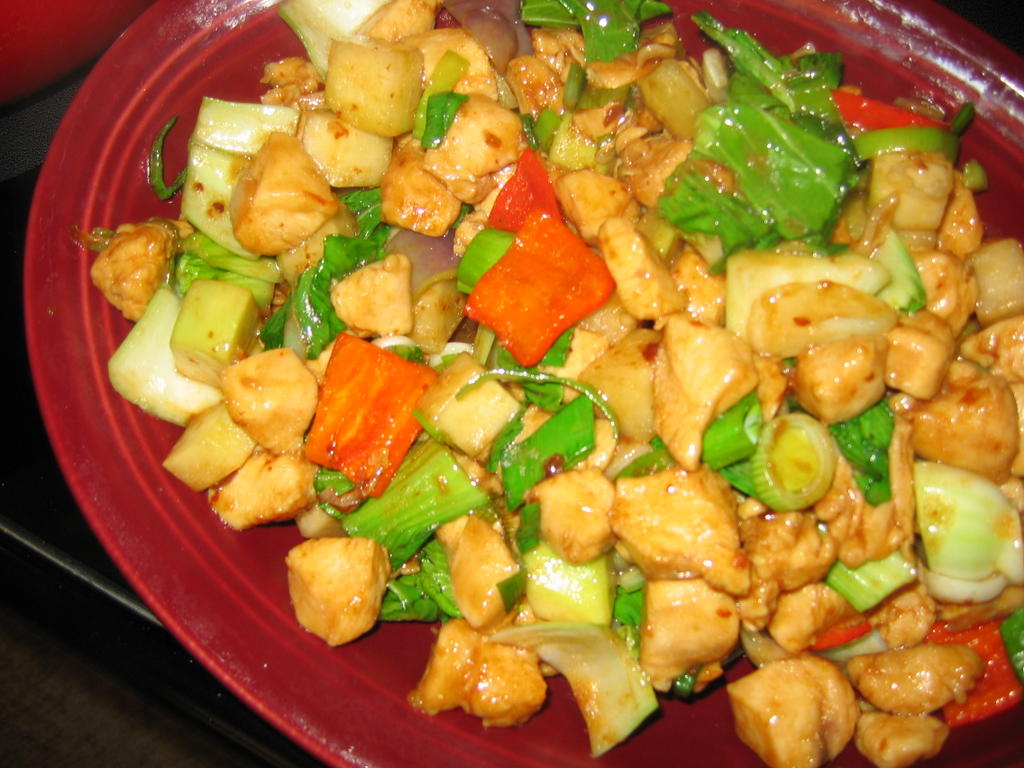 Morganna thinks that I should give this recipe a more dramatic name–something like, “Falling Down the Stairs Chicken,” or “Accident-Prone Chicken.”
No, the chicken didn’t fall down the stairs, but Morganna did, on her way to dinner, whereupon she cracked the back of her head on a step and bled a lot and was in a lot of pain.
So, we learned a few things:
One–peroxide is great at getting blood out of hair.
Two–my ability to diagnose a concussion is still operative. (No, she doesn’t have a concussion–we took her to the ER to make sure.)
Three–this chicken is really just as good cold as it was when it first came out of the wok.
We discovered the third, because we didn’t get to eat until I had cleaned Morganna’s head bump up and got the bleeding to slow down, and I checked her eye tracking and pupil dialation rates. By the time we sat down, the chicken was pretty well cold, but it tasted mighty fine anyway, and even Morganna ate some of it, along with a full bowl of rice. (An encouraging sign–nausea is a symptom of a concussion.)
After dinner, we all trooped off to the ER, where we spent a delightful evening waiting around to be ignored. Finally, the doctor came in and confirmed my suspicion that she probably didn’t have a concussion, then they cleaned her up again and sent us on our way with some peroxide and neosporin.
But, back to the chicken.
 As you might be able to tell from the title of this post, I adapted this recipe from Pei Mei’s Home Style Chinese Cooking, though I made a few changes.
First of all, I exchanged the cucumber that was supposed to be diced and stir-fried for a kohlrabi. For one thing, I had kohlrabi and I didn’t have a cucumber; for another thing, neither Morganna nor Zak will touch a cucumber under any circumstances. I figured that while kohlrabi doesn’t taste like a cuke, it will have a similar enough texture and color that it would work well in the recipe.
I also used both purple and red peppers in the recipe, because that is what I had–it originally called for two red bell peppers, and what I had was one red one and one purple one, so I figured that was what I was going to use. I also substituted a very small leek for the scallion–again–because that is what was on hand. (I also added some baby bok choi because I wanted some greens and felt too lazy to do two stir fries for one meal.)
I also used chicken breast meat because–can you guess? That is what was thawed out. The original recipe called for 1/2 of a chicken, boned and then cut into 1/2 inch dice. I figured I could bone out a breast and dice it just as well.
The only difference in the sauce was that I used a tiny bit of Shao Hsing wine in addition to the ingredients Pei Mei specified; I used it primarily to deglaze the bottom of the wok after a bit of the soy sauce and cornstarch that I used to marinate the chicken stuck to the bottom and browned.
Technique wise–I changed the entire thing. She called for frying the chicken and vegetables in three cups of oil for fifteen seconds before draining out the oil and stir frying the scallions and garlic, then adding the chicken and veg back in and adding the sauce ingredients.
As I noted in my previous post, I do not do that whole oil-blanching thing. That is something that is done in restaurants, where you can have a wok or a fryolater full of oil in order to just dunk some foodstuffs in it for a few seconds. At home–it is too much work for too little benefit, and you end up with food that is really too oily to be very healthy. I just stir fried the ingredients in a standardized order–the aromatics first, then the chicken, then the vegetables, then the sauce mixture and the garnish, and it was done.
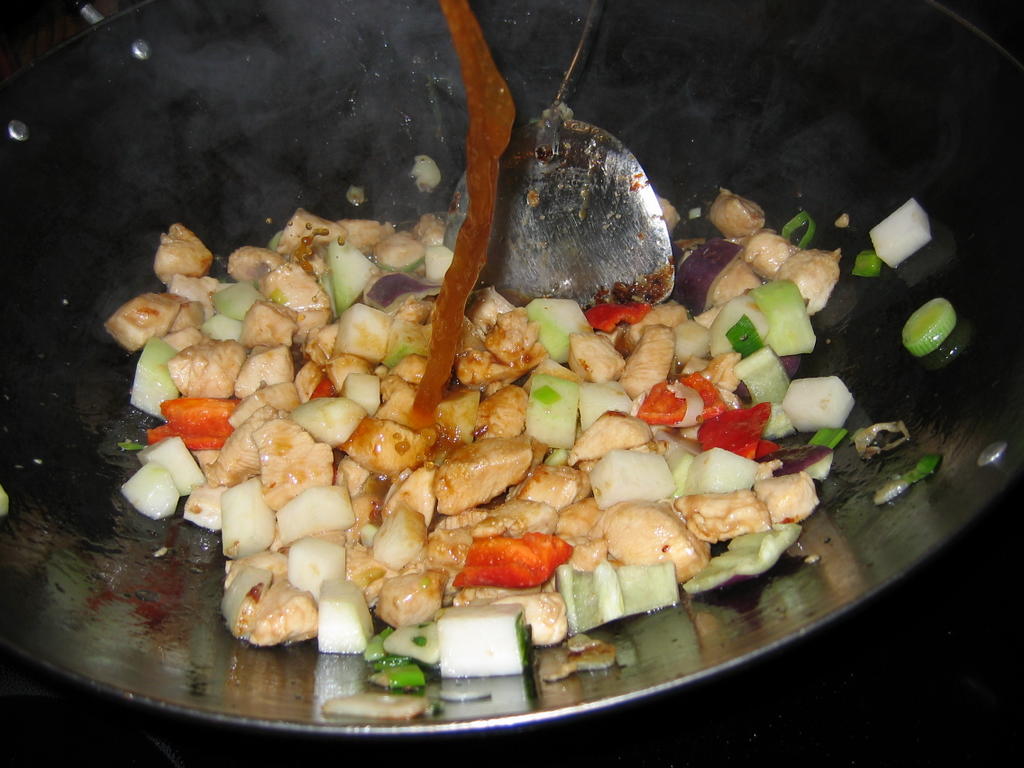 I am pretty sure this is a Taiwanese recipe, though neither Pei Mei, nor her co-author, Angela Cheng, who is her daughter, make mention of this. I just think so because of the prominent use of the sweet bean paste as an ingredient–I have read that Taiwanese dishes are noted for their use of sweet bean sauce or paste. Some dishes from Beijing also make use of this ingredient, so it could be of northern derivation as well.
Wherever it comes from, it is a thoroughly delightful dish, and one that I will cook again in the future. It is easy, with an elegantly simple sauce that has a very pleasing flavor and appealing color.
In the recipe below, I am giving the ingredients and techniques as I made it tonight, though in parenthesis, I am giving the ingredients used by Pei Mei in her original dish. I won’t go into the actual original method, however, because I cannot imagine anyone wanting to heat up three cups of oil just to fry something for fifteen seconds, then drain it out and stir fry the rest of the dish. It just seems–like a waste of time and materials to me.
Although I am keeping the more accurate title, “Chicken with Sweet Soybean Paste,” I think I will always remember this dish as “Falling Down the Stairs Chicken.”
Maybe I should have named it “Family Crisis Chicken” for its ability to withstand whatever small household emergency crops up right before dinner.
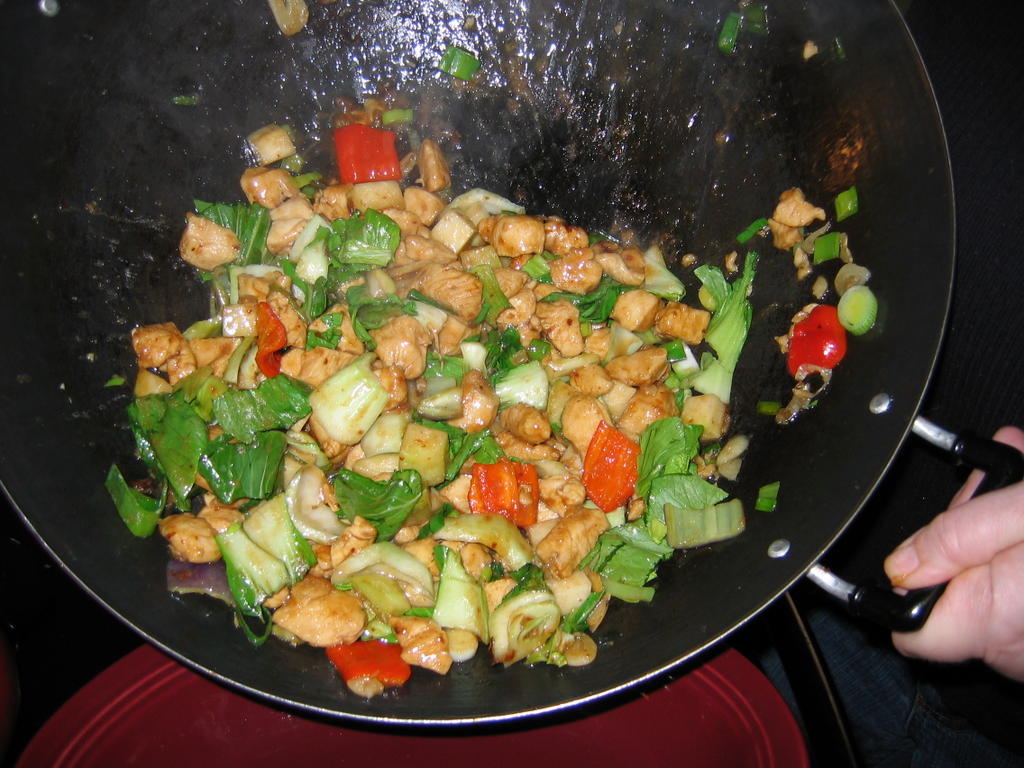 Pei Mei’s Chicken with Sweet Soybean Paste
Ingredients:
1 whole boneless skinless chicken breast, cut into 1/2 inch dice (1/2 chicken)
1 tablespoon thin soy sauce
1 1/2 tablespoons cornstarch
1 1/2 tablespoons sweet soybean paste
2 1/2 teaspoons sugar (2 teaspoons sugar)
1 teaspoon sesame oil
1/2 tablespoon thin soy sauce
2 tablespoons chicken broth (water)
3 tablespoons peanut oil
3 garlic cloves, thinly sliced
1 small leek or large scallion, thinly sliced, white and light green parts only
1 tablespoon Shao Hsing wine (not in original)
1 medium kohlrabi, peeled and cut into 1/2 inch dice (1 medium cucumber, diced)
2 small sweet peppers, cut into 1/2 inch squares
3 baby bok choi, cut into 1/2 inch slices (not in original)
1 small leek or scallion, dark green parts, thinly sliced
Method:
Toss chicken with soy sauce and cornstarch until liberally coated. Marinate for at least twenty minutes.
Mix sweet soybean paste, sugar, sesame oil, soy sauce and chicken broth in a small container, set aside.
Heat wok. When it smokes, add peanut oil, and heat until it ripples. Add garlic and leek or scallion, and stir fry for ten to fifteen seconds. Add chicken all in one layer, and allow to sit undistirbed on the bottom of the wok for about thirty-five to forty seconds, or until you can smell the meat begin to brown. Stir fry, scraping chicken off the bottom of the wok and tossing it vigorously, until most of the chicken is opaque.
Drizzle wine into pan, and scrape browned bits from it. Add kohlrabi to pan and stir fry for about a minute. Add sweet peppers, and continue stir frying for thirty seconds. Add sauce ingredients and bring to a boil, then add bok choi and stir and fry just until the leaves begin to go limp. Add sliced leek or scallion tops and serve immediately.
Or, alternatively, allow to cool to room temperature while you deal with whatever family crisis happens just as you bring the dish to the table, and eat it over warm rice. It will still taste good anyway–I promise.
The Chinese Cookbook Project VI: The Julia Child of China
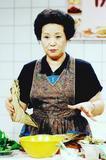 Julia Child said that her second favorite cuisine next to French was Chinese; she recognized that Chinese cookery was a complex art dependant upon fresh ingredients and mastery of technique, and she appreciated the depth and breadth of flavor called forth by one of the oldest culinary traditions in the world.
Often called by the media, “The Julia Child of China,” author, cooking instructor and television personality Fu Pei Mei undertook a great challenge–to teach mastery of Chinese cooking technique to as many people as possible.
A native of Dalien, in Northeastern China, Pei-Mei moved to Taiwan when she was nineteen years old, and there she worked at a trading company, and then appeared in television commercials promoting electric appliances. Much like Julia Child, she did not learn to cook until she was married, and like Julia, once she started learning the skills of the kitchen, Pei-Mei strove to perfect them.
Her quest for perfection and her ability to teach the skills she aquired to others led to her starting a popular weekly television show in Taiwan in 1962; her show continued for thirty-nine years. During those years, she taught nearly four thousand recipes to untold numbers of viewers in Taiwan and around the world. (There are some Chinese-Americans and Taiwanese who grew up watching her show, much as many of us here grew up watching Julia Child.)
In addition to the television show, in 1955, she started the oldest cooking school in Taiwan, “Pei-Mei’s Chinese Cooking Institute.” More than thirty thousand students, Chinese and foreign, attended and learned the techniques and secrets of regional Chinese cookery. She also judged Chinese cookery contests in Taiwan, Hong Kong and Japan, and she put on cooking demonstrations around the world.
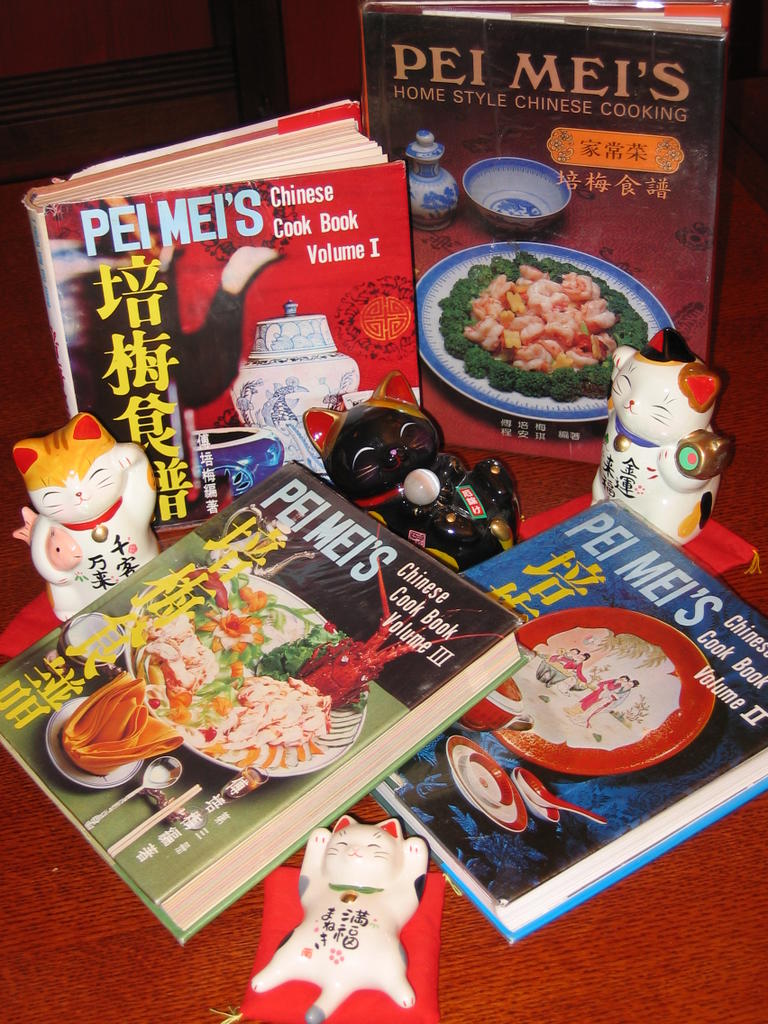 Of course, Pei-Mei also wrote cookbooks–some of the most popular cookbooks ever written in China.
Pei Mei’s Chinese Cookbook, Volumes I-III are beautifully put together sets of recipes, with full-color illustrations of each dish. The text appears in both Chinese and English, making this set of books a treasured resource for both Chinese and Chinese-American households.
Her books were de rigeur for every bride, and copies, often with hand-written notes in the margins, have been passed down from mother to daughter to granddaughter in both China and the United States for years. They are now all sadly out of print, and are somewhat difficult to find, but they are all worthy of attention from serious students of Chinese cookery.
Volume I is set up regionally; after a basic introduction to Chinese ingredients which includes photographic illustrations, the recipes are arranged according to general geographical boundaries of Eastern, Southern, Western and Northern cuisines. These chapters give pictorial introductions to dishes representative of each region, while snacks and desserts merit their own chapter at the end of the book.
For example, the chapter on the Southern region, which includes Canton, showcases the ubiquitous white-steamed whole chicken with scallions, minced pigeon in lettuce cups, and soup in winter melon.
Volume II is put together in a completely different way; the recipes are arranged according to their main ingredients, starting with chicken, moving through duck, pork, beef, fish, seafood, eggs and beancurd and vegetables, with separate chapters for soups , noodles and desserts. As with Volume I, each recipe is illustrated with a full-color photograph, and the book includes explanatory notes and illustrations on Chinese ingredients and techniques.
Similar to Volume I, Volume III is organized regionally, but this time, instead of broad regional categorizations, the chapters are more specific to named provinces. In addition to being focused on provincial cookery, this book presents dishes appropriate for formal dinners and banquets, resulting in dishes that include luxury items like shark’s fin and are beautifully garnished. Instructions on how to present a formal dinner, including seating etiquette are presented both in Chinese and English.
After the very composed and artful dishes of Volume III, the more laid-back and simple foods presented in Pei Mei’s Homestyle Chinese Cooking are a welcome comfort. I have to admit that while I have attended a formal Chinese banquet (Zak’s grandfather’s 80th birthday, hosted by his business partner Mr. Ting), and I greatly enjoyed myself, I do prefer the more robust and homey dishes that are cooked by and for family, so I saw many more recipes that I wanted to try in this slim volume. Maybe it is because my first tastes of “real” Chinese cookery were the homestyle dishes that Huy cooked for the employees to eat at dinner time at China Garden, or maybe it is because that is the kind of cooking I prefer in any cuisine. (I should also note that this book has text only in English–perhaps it was written with an American/European/Australian audience in mind; however, the dishes are still very “Chinese”–they use authentic ingredients such as preserved vegetables, hot bean sauce and dried bean curd sticks.)
However, while I like the fourth, smaller book the best, I have to say that all of the books are lovely and well worth seeking out. The way I see it–millions of Chinese housewives, Mammas and Popos cannot be wrong–these books teach real Chinese food for real people to cook and eat. If you find them, pick them up and do not let them go, unless you are passing them down to another person to learn from–they really are a wonderful resource.
Sadly, Fu Pei Mei died last September of cancer at the age of seventy-three. She was mourned and honored by many people all over the world who saw her as their mentor and teacher. Her daughter, Angela Cheng, and her daughter-in-law, Theresa Lin, are both great cooking teachers and authors in their own rights, and they are carrying on in Pei-Mei’s footsteps: writing books, teaching classes, appearing on television and on the radio across the world.
I very much hope that they are as influential upon generations of Chinese cooks as Fu Pei Mei was, and they continue the good work she started–I would hate to see China lose its culinary heritage to the booming success of Western-style fast food.
News, Food and More News
 Halal Food Choices Rise in US Markets
This is good news: along with the growing population of US citizens who are Muslim, there is a corresponding rise of markets which sell food which conforms to the requirements of halal.
Halal roughly equates to the more commonly known kosher dietary laws held by many Jews, and until very recently, it was difficult for American Muslims to find halal food, which is a requirement for the observation of Ramadan.
According to the Miami Herald, there are around fifty restaurants and markets which sell halal foods in that city alone; nationwide, the number is up to 3,500, which is a significant rise from the just 300 outlets in 1999.
The high point of the story for me was this quote from the owner of a halal food internet outlet: “‘Over the last two or three years in particular, there has been demand for halal foods of other types: Mexican, Italian, Philly cheese steak,” said zabihah.com’s Amanullah. “My cultural food is American cultural food.”’
The United States is truly becoming multi-cultural and globalized–and I think that is a good thing, for many reasons. My favorite reason is this–countries which have been the crossroads of several civilizations have always had the most interesting culinary traditions. Perhaps, the United States is in the process of evolving a truly global cuisine, one that is representative of every ethnicity and tradition on earth.
That thought does my heart good.
US Studies Show that if Humans Are Served Too Much Food, They Will Eat It
That is another “duh” moment in research–anyone who has ever been near one of those, “All you can gobble down” buffet restaurants like Golden Corral could have told folks that. People belly up to salad bars and buffet lines like they haven’t eaten within the past decade, and their waistlines generally show it.
At any rate–Reuters reports that US researchers have found that people will eat past their point of hunger, if they are served larger portions of food. The study tracked nearly two dozen men and women over an eleven day period, and shows that human behavior is remarkably consistent where “super-sized” meals are concerned. Folks eat them, consistently, and it makes them overweight.
Now, I would like to point out two things: the sample size is very small, possibly skewing the results. And–eleven days isn’t as long as it seems.
However, some of the findings were dicouraging–like, people would eat larger portions when offered of everything -but- vegetables. I bet that made nutritionists want to fall on their swords.
And, no matter what increments food came in, small or large, people would overeat.
I suspect that overeating in times of abundane is an evolutionary strategy that is hard-wired. We are meant to put on fat, because it helps humans survive lean times. However, in the US today, there are hardly ever any lean times, so our genetic programming is working against us.
Beignets are Back!
Okay, this is from NPR’s All Things Considered, so you have to listen up.
Cafe du Monde served chicory coffee and beignets again for the first time since Hurricane Katrina swept through, this past Wednsday, October 19th. The New Orleans landmark center for hot fried dough and coffee survived the hurricane relatively unscathed, and so could open her doors and serve the slowly returning population once more.
That, like the declaration that “My cultural food is American cultural food” has made my week.
Food news can be good news.

Categories:
- Admin (rss) (55)
- Blogs and Blogging (rss) (81)
- Book Reviews: Cookbooks (rss) (43)
- Book Reviews: Non-Cookbook Food Books (rss) (38)
- Cats and Cat Blogging (rss) (47)
- Chinese Cooking Lessons (rss) (32)
- Culinary School Stories (rss) (18)
- Dairy Pruducts: Cultured and Barbaric (rss) (4)
- Documentary Filmmaking (rss) (1)
- Essays, Rants and Reflections (rss) (260)
- Fighting Hunger (rss) (12)
- Food and Kids (rss) (45)
- Food in the News (rss) (126)
- Food Media (rss) (98)
- Food Preservation (rss) (18)
- Food Safety (rss) (45)
- Gardening (rss) (30)
- Herbs and Herb Blogging (rss) (20)
- Holidays (rss) (50)
- Kat Blogging (rss) (22)
- Kitchen Science (rss) (36)
- Leftover Makeover (rss) (8)
- Life, the Universe and Everything (rss) (131)
- Local and Sustainable (rss) (227)
- Local Athens Food and Foodies (rss) (42)
- Meatless Mondays (rss) (32)
- Menu For Hope (rss) (5)
- Nutrition, Diet and Health (rss) (84)
- On The Farm (rss) (8)
- Recipes: Almost Vegetarian, Vegetarian and Vegan (rss) (294)
- Recipes: American Regional (rss) (37)
- Recipes: Appalachian Hillbilly (rss) (33)
- Recipes: Bread, Pasta, Grains (rss) (95)
- Recipes: Canning and Preserving (rss) (8)
- Recipes: Chinese (rss) (123)
- Recipes: Comfort Food (rss) (120)
- Recipes: Cookies (rss) (16)
- Recipes: Desserts (rss) (48)
- Recipes: French (rss) (25)
- Recipes: Fruits and Vegetables (rss) (302)
- Recipes: Greek, North African and Middle Eastern (rss) (31)
- Recipes: Indian (rss) (137)
- Recipes: Italian (rss) (42)
- Recipes: Japanese (rss) (7)
- Recipes: Jewish (rss) (4)
- Recipes: Korean (rss) (6)
- Recipes: Meat, Poultry and Fish (rss) (220)
- Recipes: Mexican/Native American/ Latin American/Caribb (rss) (27)
- Recipes: Original (rss) (108)
- Recipes: Thai (rss) (27)
- Recipes: Tofu (rss) (17)
- Recipes: US Regional (rss) (16)
- Recipes: Vietnamese (rss) (8)
- Restaurant Stories (rss) (28)
- Sewing, Quilting, Arts and Crafts (rss) (16)
- Simple Chinese Recipes (rss) (30)
- Slow Food and Heritage Foods (rss) (10)
- Spice Blogging (rss) (44)
- The Chinese Cookbook Project (rss) (14)
- The Chinese Pantry (rss) (39)
- The Documentary (rss) (2)
- The Kitchen Saga (rss) (17)
- The Locavore's Bookshelf (rss) (15)
- The Unsung Adventures of The Culinary Nerd (rss) (6)
- Tools and Toys (rss) (35)
- Uncategorized (rss) (10)
- With a Side of Politics (rss) (48)
Archives:
- August 2012 (9)
- July 2012 (12)
- September 2011 (3)
- August 2011 (7)
- July 2011 (8)
- June 2011 (16)
- May 2011 (17)
- April 2011 (11)
- December 2010 (9)
- November 2010 (5)
- February 2010 (1)
- December 2009 (5)
- November 2009 (7)
- October 2009 (10)
- September 2009 (16)
- August 2009 (14)
- July 2009 (14)
- June 2009 (7)
- May 2009 (17)
- April 2009 (10)
- March 2009 (25)
- February 2009 (13)
- January 2009 (10)
- December 2008 (5)
- November 2008 (5)
- October 2008 (6)
- September 2008 (13)
- August 2008 (8)
- July 2008 (11)
- June 2008 (18)
- May 2008 (13)
- April 2008 (14)
- March 2008 (16)
- February 2008 (17)
- January 2008 (19)
- December 2007 (25)
- November 2007 (18)
- October 2007 (24)
- September 2007 (16)
- August 2007 (15)
- July 2007 (15)
- June 2007 (10)
- May 2007 (14)
- April 2007 (16)
- March 2007 (17)
- February 2007 (20)
- January 2007 (13)
- November 2006 (1)
- October 2006 (8)
- September 2006 (14)
- August 2006 (25)
- July 2006 (30)
- June 2006 (28)
- May 2006 (34)
- April 2006 (29)
- March 2006 (24)
- February 2006 (30)
- January 2006 (38)
- December 2005 (40)
- November 2005 (37)
- October 2005 (32)
- September 2005 (25)
- August 2005 (30)
- July 2005 (28)
- June 2005 (21)
- May 2005 (8)
- April 2005 (22)
- March 2005 (17)
- February 2005 (29)
- January 2005 (10)
Search Site:
Links:
- Lily’s Wai Sek Hong
- 101 Cookbooks
- A cat in the kitchen
- A Veggie Venture
- Accidental Hedonist
- Cha Xiu Bao
- chez pim
- Chocolate & Zucchini
- Chopstick Cinema
- Chowhound.com
- Chubby Hubby
- Cook sister!
- Cooking with Amy
- da*xiang
- Eat Local Challenge
- Eating Liberally
- Ecocentric
- Eggbeater
- Epicurious
- Farmgirl Fare
- Fatfree Vegan
- Foodgoat
- ForkandBottle.com
- Green Olive Tree
- Hooked on Heat
- Jaden’s Steamy Kitchen
- Kalyn’s Kitchen
- Lucullian delights
- Mahanandi
- Matt Bites
- MeatHenge
- mmm-yoso!!!
- New York Times – Dining & Wine
- Pizza Goon
- Rasa Malaysia
- Ruhlman
- Sailu's Kitchen
- Serious Eats
- SF Gate: Food & Dining
- Simply Recipes
- Soul Fusion Kitchen
- Tastespotting
- The Amateur Gourmet
- The Cleaner Plate Club
- The Food Section
- The Grub Report
- thecookscottage
- U.S. Food Policy
- Wandering Chopsticks
- Washington Post Food and Dining
- Wasted Food
Meta:


Powered by WordPress. Graphics by Zak Kramer.
Design update by Daniel Trout.
Entries and comments feeds.