
Cook Local, Eat Global
Meatless Monday: South Indian Style Vegetable Saute
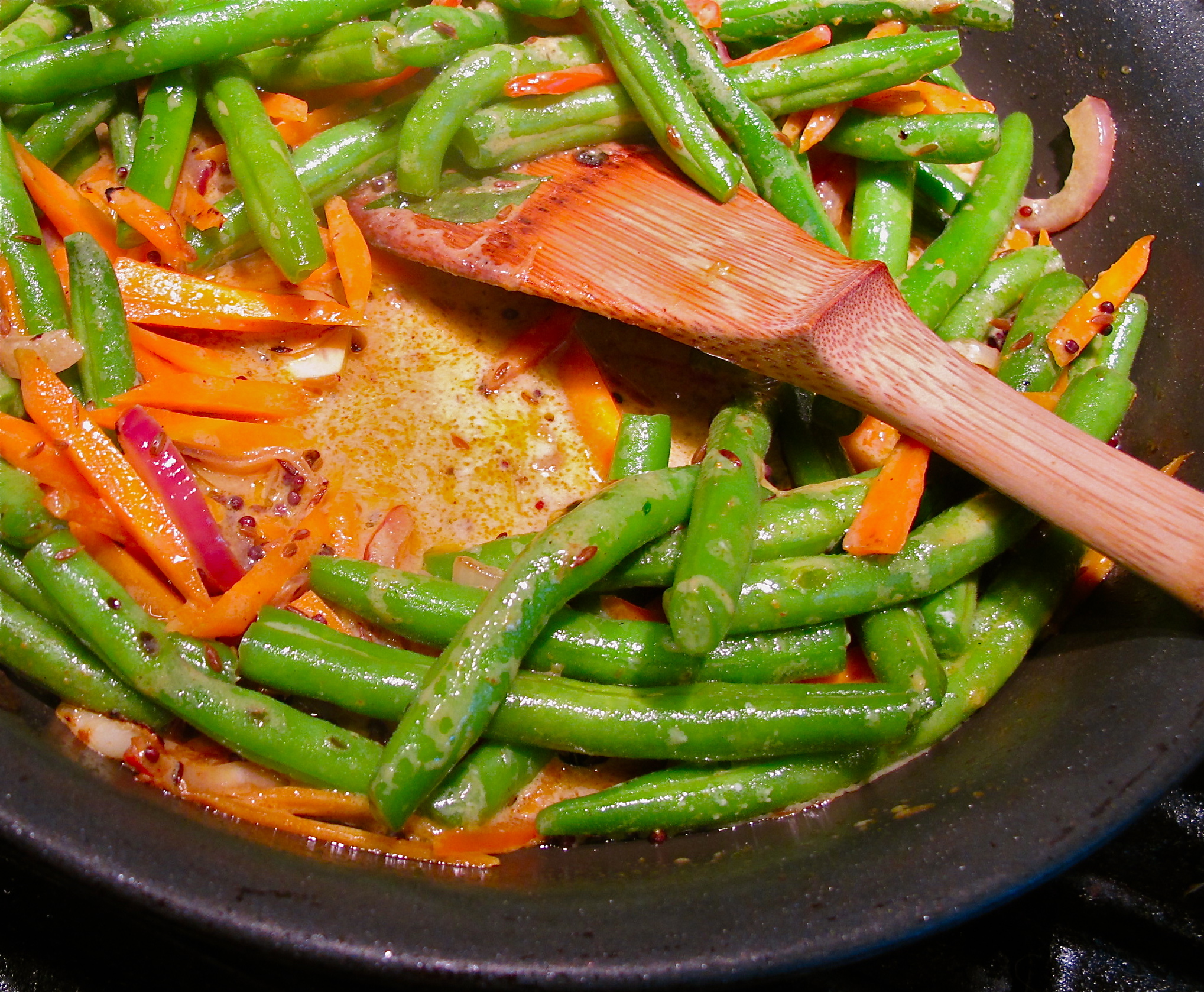
No, this isn’t traditional. At least, I don’t believe it is a traditional Indian dish. It’s possible that I hit upon a cooking method and ingredient list that is used in some of the South Indian states as a traditional dish by sheer luck, in which case, if there’s a real name for this, please, someone let me know.
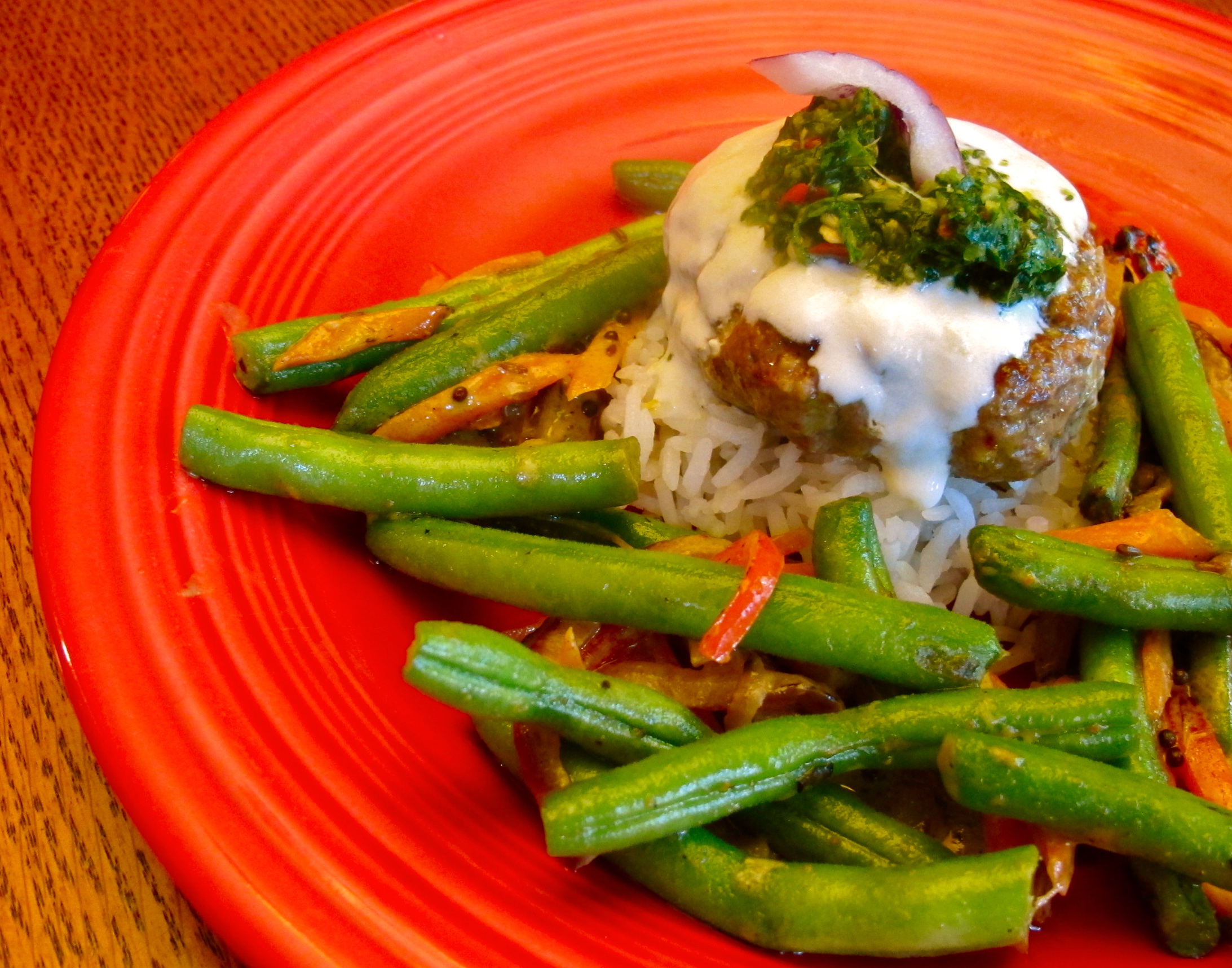
Basically, I put this dish together to go with the Lamb Patties With Incendiary Green Chutney out of the vegetables from our garden and the other ingredients I had from the farmer’s market and laying about in the pantry.
This was meant to be a side dish, but if you wanted it to be the centerpiece of your dinner plate, you could add either tofu or paneer cheese and serve it with rice, spelt or wheat berry pilau or bread for a complete meal. You’d just pre-fry the tofu or cheese, then drain it on paper towels and then add it back to the pan at the same time you add the green beans so it has a chance to soak up the flavors from the pan without becoming overly brown.
I was inspired to make this because my curry plant is finally large enough to harvest bits and pieces, and I really wanted to use the musky-scented leaves in some sort of vegetable dish. I had green beans, a sweet bell pepper, garlic and carrots from our garden, as well as one purple onion from the market. Cumin seeds and mustard seeds go beautifully with curry leaves, so out of the cabinet they came.
Since the lamb patties are dry–though they are served with a green chutney and yogurt that acts as a sauce, I decided to add a little coconut milk to the pan to make a small amount of thick, clinging sauce which I colored with a scant bit of turmeric and smoked paprika. The paprika adds a subtle smoky flavor as well as color–I’ve found that it gives Indian food just a little bit more of a depth than plain paprika does.
Anyway, this is simple to make and tastes lovely. Zak, Kat and I gobbled it down gleefully–the vegetables retain their color and crunch, while still absorbing lots of the scents and savors of the spices. The coconut milk binds it all together and adds just enough moisture to keep the vegetables both crisp and juicy.
Well worth the time it took to think out and make, and is a good quick side dish or main dish to add to your repertoire.
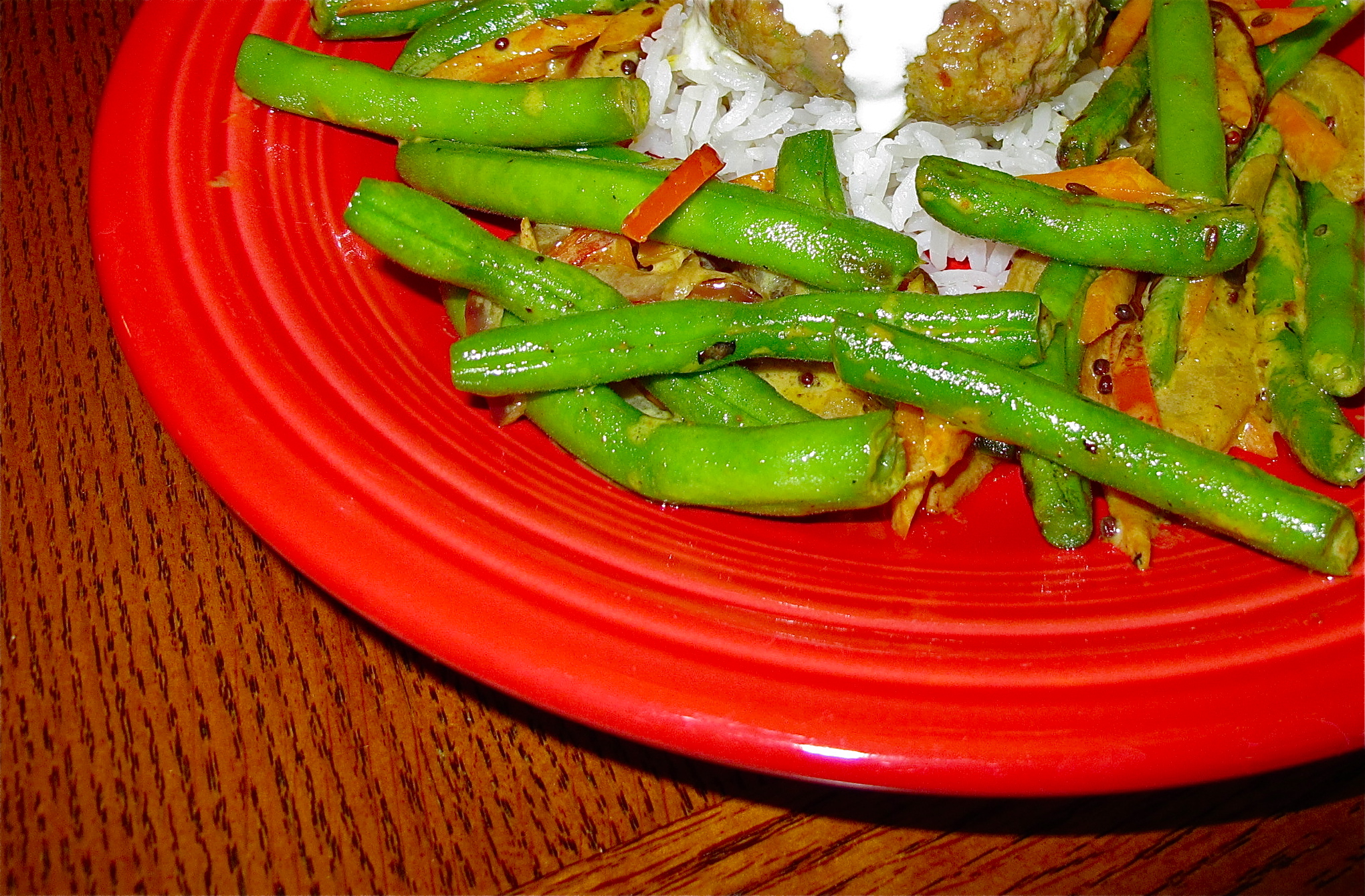
South Indian Style Vegetable Saute
Ingredients:
1 tablespoon coconut oil or peanut oil
1 medium red onion, peeled and thinly sliced
1/4 teaspoon salt
2 large garlic cloves, peeled and thinly sliced
1/2 teaspoon whole cumin seeds
1/2 teaspoon whole mustard seeds
10 curry leaves
1 small red bell pepper, seeded and cut julienne
3 carrots, peeled and cut julienne
8-12 ounces green beans, washed, topped and tailed and blanched then drained
1/2 cup coconut milk, divided
1/8 teaspoon ground turmeric
1/8 teaspoon smoked paprika (or regular paprika)
salt to taste
Method:
Heat the oil in a heavy-bottomed skillet over medium high heat. Add the onion, sprinkle with salt and cook until the onion is turning golden. Add the garlic, cumin seeds and mustard seeds, then the curry leaves. Cook, stirring, until the garlic takes on a golden color and the onions are darker gold. Add the pepper and carrot, and cook, stirring, for several minutes, until the carrots start to become tender and take on color.
Add the green beans, and cook, stirring until the onions are well browned and the vegetables have nice brown spots in places. add half of the coconut milk, add the turmeric and paprika, and stir to combine. Cook down until the coconut milk virtually disappears and the vegetables are tender. Add the rest of the coconut milk, stir and cook for one more minute.
Add salt to taste and serve immediately.
Makes enough for three adults and one child.
Lamb Patties With Incendiary Green Chutney
Indian food has an unfortunate reputation of being both time consuming and difficult.
This is not necessarily true.
Yes, there are curries out there that should properly be cooked down for hours and hours on low heat, curries which involve multiple spice pastes ground to just the correct texture and added at just the right times. The holiday, festival and banquet foods of India -are- indeed complex and involve a great deal of preparation and work to make properly.
But you know that everyone in India doesn’t eat or cook those dishes every day.
AND, I hope you also know that everything that is cooked and eaten in India isn’t a curry, with lots of sauce, right? You know that by now, surely.
What I’m getting at is that there are plenty of fairly simple, straightforward homestyle dishes cooked in India, and they are just as delicious and easy when cooked for our families here in the United States.
And this is one of those dishes.
These lamb patties are a riff off of several Madhur Jaffrey recipes and others I’ve used over the years. I’ve cooked those recipes often enough that I just sort of make up my own version off the top of my head, spicing the patties however I feel like on that particular day. These patties are simplicity itself to make–thy just require ground lamb, fresh garlic, ginger, scallions or shallots, fresh mint, spices and a wee bit of yogurt. They are mixed together and then pan fried in the tiniest amount of oil possible, because the rich lamb has enough fat to almost keep the patties from sticking to the pan.
Traditionally, when serving a non-sauced or dry dish in most Indian households, a wet salad, raita or chutney is served with it. For these patties, I chose to do a variation on my more traditional Green Chutney recipe. In this version, I used more cilantro, less mint and added Thai basil to the herbs. I used one large garlic clove, and plenty of fresh ginger, lime zest, lime juice and five red Thai chilies from my garden.
Let me tell you about these chilies.
They are beastly hot. I think it was because of our drought in June, but they are swelteringly, tongue-blisteringly hot this year. And I used five of them, because the seasonings in the lamb are so soft and gentle, that I really wanted the chutney to light a fire in the mouth. You can use as many or as few as you like, but use red ones, because the flecks of red look really pretty in the velvety green chutney.
For cooling the arson I committed with the chuntey, I also served the patties with a drizzle of my own homemade Greek yogurt. (Yes, you will eventually get a recipe for that–but I’m still tinkering about with it. Be patient!)
The texture of the patties is meltingly tender–especially if you are careful when you mix in the seasonings not to knead the meat too harshly. When you form the patties, be gentle and don’t compact the meat too tightly, just gently pat it into shape to get the proper tenderness. Also, make certain to let a crust form on the bottom of the patties before trying to flip them. That way they’ll have a lightly crisped outside and that soft melt-in-the-mouth inside, AND they won’t fall apart when you flip them.
This is an easy Indian main dish–I had it cooked and table ready in a mere 45 minutes, though I could have managed 30 minutes if I’d rushed at it.
Fast enough for a weekday dinner…and bursting with flavor, texture and color.
Lamb Patties With Incendiary Green Chutney
Ingredients:
1/2 teaspoon cumin seed
1/2 teaspoon coriander seed
1/4 teaspoon fennel seed
1/2 teaspoon cardamom seed
1 whole clove
5 peppercorns
1/4 teaspoon ground turmeric
1/8 teaspoon smoked paprika
1 pound ground lamb
1 teaspoon yogurt
1″ cube fresh ginger, peeled and cut into chunks
2 large cloves garlic, peeled
2 scallions, white and light green parts only
7 large fresh spearmint leaves
1/2 teaspoon salt
scant amount of oil to pan fry
1/2 cup packed cilantro leaves
1/4 cup packed Thai basil leaves
1/4 cup packed spearmint leaves
dark green tops of one scallion
zest of 1/2 lime
5 red Thai chilies
juice of 2 limes
salt to taste
Method:
Toast the first six ingredients lightly over medium heat in a heavy bottomed skillet. When browned and fragrant, pour into a spice grinder and grind to a powder. Mix with the rest of the ingredients up to but not including the scant oil to pan fry, kneading the meat mixture gently with your hands. Do not knead roughly.
Gently form into round patties about three inches in diameter and 1/2 inch thick.
Set aside for a few minutes while you prepare the chutney.
Take all the rest of the ingredients up to but not including the lime juice and grind thoroughly in a food grinder. Put red-flecked green paste in a bowl and stir in lime juice. Salt to taste.
In a wide, heavy bottomed skillet, heat a small amount of canola oil over medium heat. When the pan is smoking hot, add the patties, and leave them in position for at least two minutes, or until a crust forms on the bottom, and the patties are easily picked up with a spatula and flipped. Cook for eight minutes, or until the other side is browned and somewhat crisp and the inside is a pale pink and very tender.
When patties are done, serve them atop rice, drizzled with yogurt and topped with some the Incendiary Green Chutney.
Eat it and weep tears of joy and pain from the chutney’s relentless firepower. (Or at least, eat it and your nose will run!)
Now see, that wasn’t so hard, was it? And it was mighty good too–admit it.
Good enough to make again, I’ll wager.
Frittata? Omelet? Eh, It’s Eggs and Vegetables
So, here’s the deal.
I like vegetables.
A whole lot. Like, when I was a kid, it was way easier to get me to eat my vegetables than it was to get me to eat most meats. (Bacon, lamb, trout fillets and good fried chicken were exceptions. I always loved those.)
In fact, for years, I was certain I didn’t like steak, because I associated that word with pieces of chewy, grey dried-out shoe-leather on a plate.
Yeah, lots of folks in my family overcooked meat.
But vegetables, man–even if I didn’t like them overcooked, if Mom served them to me raw, I was all over that. Green beans–cooked or raw–were my favorite. But carrots came a close second. Turnips, yeah!
So, let it suffice to say I’ve always been a big fan of the members of the vegetable kingdom.
But I’ve also always loved eggs.
Boiled, scrambled or fried, eggs have always had a fond place on my plate. This is probably because I grew up eating really good eggs from Grandma and Grandpa’s farm–I’m a great believer when it comes to truly fresh eggs from truly happy hens who spend their lives eating a varied diet of insects, greens, grain and kitchen scraps will convert most egg-haters into lovers of the beautiful hen-fruit.
But you know what’s weird?
I went through most of my childhood without ever having the two combined into one glorious dish.
No one in my family made omelets, and I’m pretty sure know one had even heard of a frittata.
And this is a sad thing.
It wasn’t until I was a teenager on a summer road trip/vacation to Monticello with my parents that I tasted a Western omelet at a roadside diner somewhere in rural Virginia. It was listed as a “specialty of the house” and was made with onions, bell peppers and sausage bits fried together then folded into the eggs with some really nice melty cheddar cheese. Well, actually, I think it was American, but that’s beside the point.
That was the first time vegetables and eggs were combined in my mouth and it rocked my world.
And so, I took to learning how to cook eggs and vegetables together.
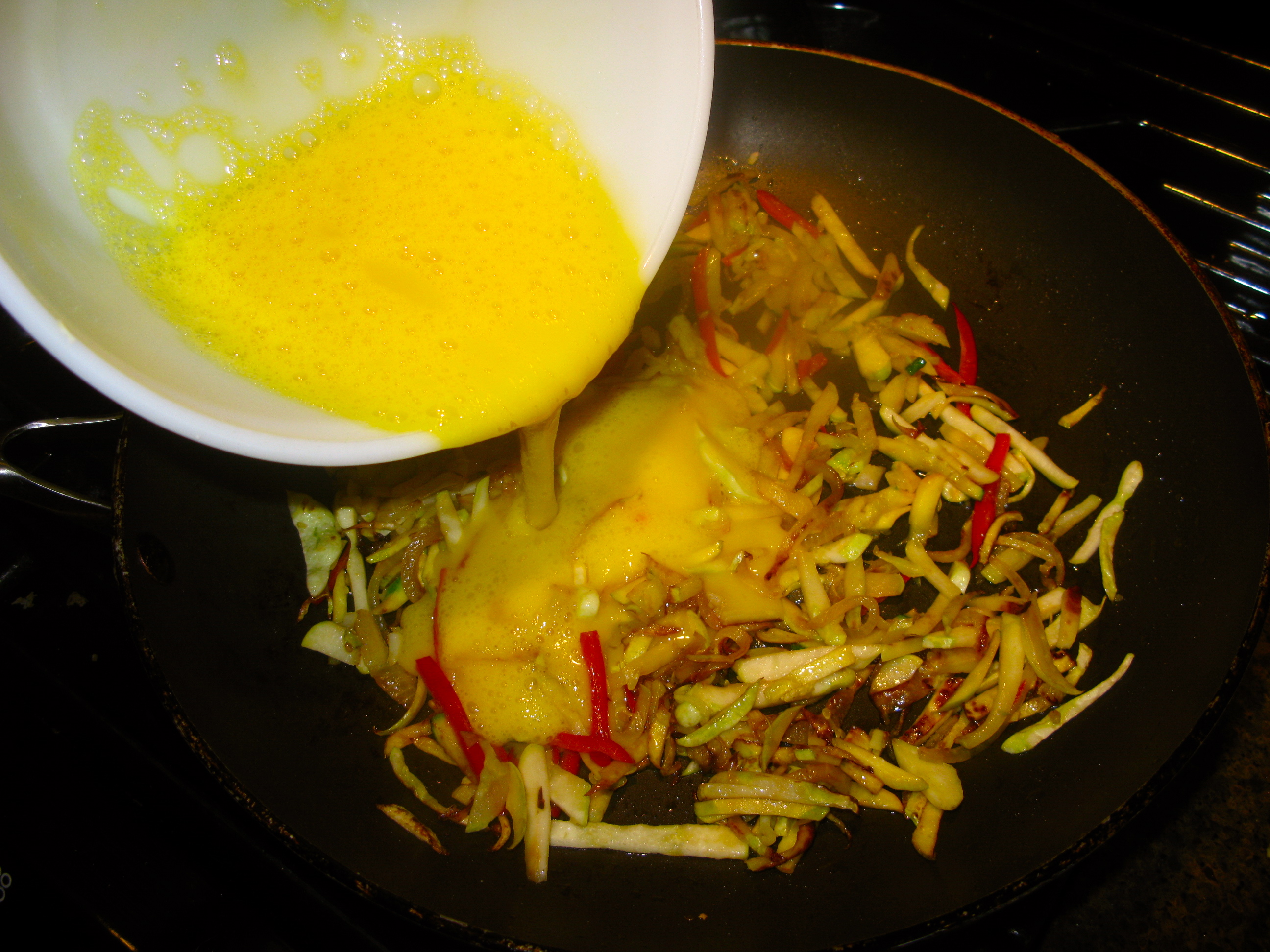
Which leads to this post, which was supposed to be about making frittatas, except I forgot what I was doing about halfway through making mine and folded it and OOPS–made an omelet.
I’m sure you’ll all forgive me.
But it’s a weird omelet, in that it’s browned on the outside the way a frittata is, and I cooked the vegetables first in the pan I cooked the eggs in, like you do a fritatta. In fact, it’s a fritatta, except I didn’t flip it or stick it under the broiler, but instead half flipped it and half-folded it and damned if it didn’t turn out tasty as well.
This is another of my posts where I remind people not to fear failure in the kitchen. Failures often result in something interesting that you might not have discovered if you’d done everything right the first time. Besides, if it tastes good, is it really a failure, even if it didn’t come out as you meant it to? Besides, remember what Julia Child said about you being alone in the kitchen, so who’s to know if you make a mistake? No one if you don’t tell them, that’s who.
So, never apologize, even if your frittata turns out to be more omelet-like than you intended.
That said, do try making something like this recipe. It is quite good, and serves two to three people for a good brunch or a light lunch. I like it a lot with some sourdough bread toasted with great butter, but nothing is stopping you from replacing that with a salad, or even better, a salad with some garlic bread on the side.
Oh, and what to call this? The Frisky Frittata? The Almost Omelet? Plain old Eggs and Vegetables?
I like calling it Oeufs Verts, which is, of course, French for “Green Eggs” as in “Green Eggs and Ham.”
No, the eggs aren’t green themselves, nor is ham involved, but I like the sound of it, and if you use green vegetables (in this version, I used scallions and zucchini along with sweet red peppers) and herbs, I think that takes care of the “verts.”
Besides, this is a nice vegetarian dish and you cannot get more “green” than that, can you?
Besides, everything sounds better “en Francais.”
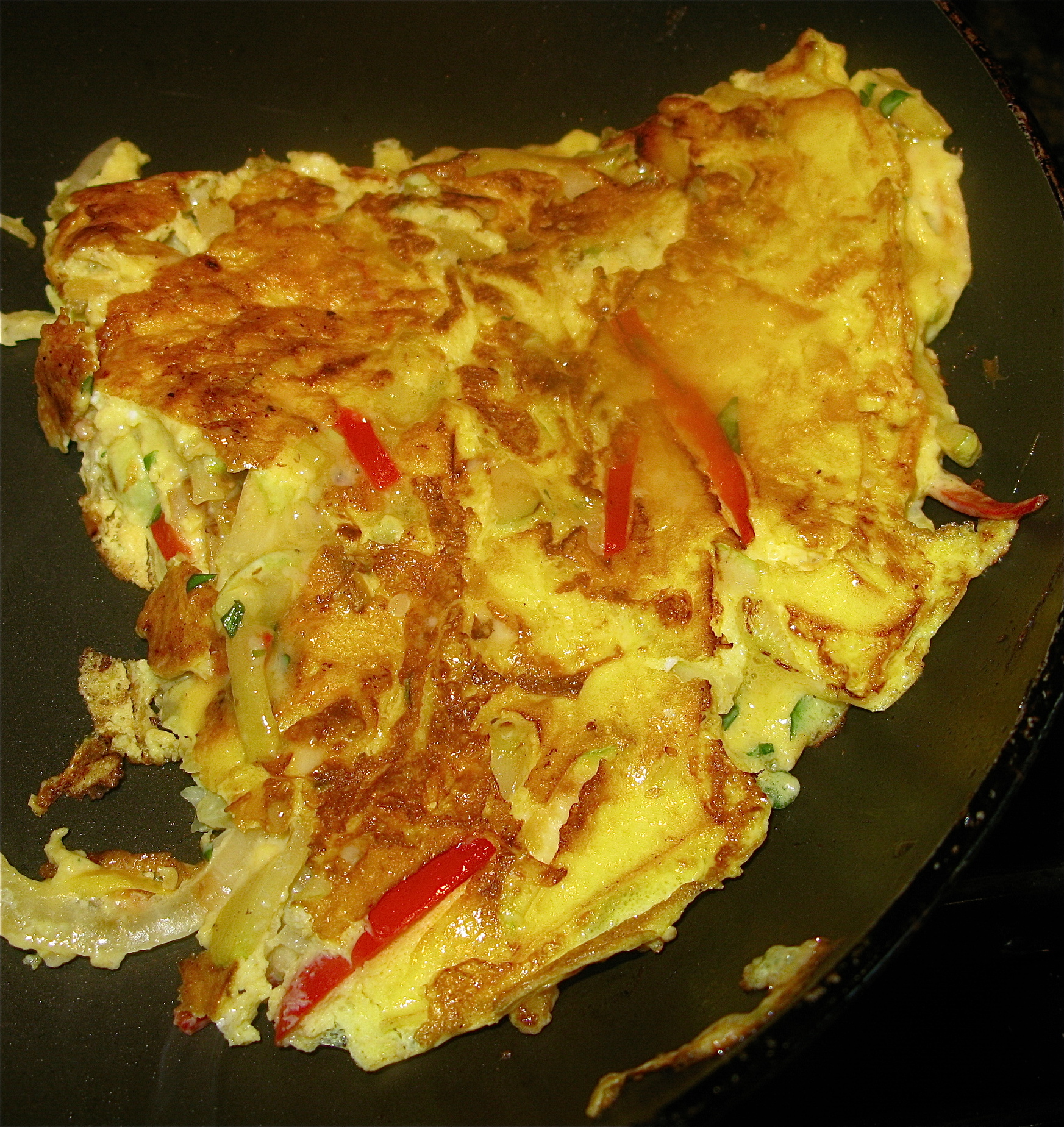
Oeufs Verts
Ingredients:
1 1/2 tablespoon olive oil or butter
2 scallions, cut into thin slices on the diagonal
1/4 teaspoon salt
freshly ground black pepper to taste
1 small zucchini, cut julienne
1/2 small red bell pepper, cut julienne
4 eggs, well beaten, then blended with 1 tablespoon of milk
1 teaspoon butter
2 teaspoons or more to taste of freshly chopped fresh herbs–I used basil, Italian parsley and tarragon
3 tablespoons grated sharp cheddar cheese or any strong cheese of your choice
Method:
Heat the olive oil or butter in a heavy-bottomed 9″ in diameter non-stick or well seasoned cast iron pan on low heat.
Add the scallions and sprinkle with salt then season to taste with freshly ground black pepper, and cook until it’s just beginning to turn golden. Add the zucchini and peppers and cook, stirring until the onions are browning and the edges of the zucchini are brown and the peppers show a bit of browning action, too.
Add the teaspoon of butter, and melt, turning pan this way and that to distribute the melted butter and to spread out the sauteed vegetables. Use a spatula if you need one to get the vegetables into a uniform single layer on the bottom of the pan.
Pour in the eggs off heat, then put them back on heat again and let them begin to set on the bottom. Sprinkle with the herbs.
As the eggs cook, push the cooked edges toward the center of the pan with a spatula and then tip the pan to let the uncooked egg slide toward the outer edges. Keep doing this until there is a uniform layer of cooked egg on the bottom and most of the inside is starting to look a bit dry.
Sprinkle on the cheese and then carefully slide your spatula (A large vinyl fish spatula works best for this) under the eggs and lift it up, tipping the pan away from the eggs as you lift. Carefully fold the eggs over, so that you overfold it slightly, letting the last of the uncooked egg and some of the cheese to hit the hot bottom of the pan. Set it back on the stove and cook for about thirty seconds to one minute longer, then remove your mostly half-moon shaped eggs and vegetables from the pan and set it on a serving plate.
Cut it into wedges to serve.
You can saute any vegetables you like in this dish, just adjust cooking times accordingly. I like lacinato kale sauteed with onions and garlic in this dish and if you use a lot of it, it really makes the eggs green.
When All Goes Awry…
Today was the day for catastrophic housekeeping failures.
And my best friend (and partner in film making crime) Dan said I should make a blog post of it, so that all of my loyal readers can discover that even The Culinary Nerd has her off day in the kitchen. That way they can take heart when all goes awry in their kitchens and know that they are not alone, for lo, The Culinary Nerd is with thee.
And with thee, I most certainly am today.
It didn’t actually start in the kitchen.
It started in the adjacent utility room. I went to do some laundry, so I put a load in the washer, then went to clear the load out of the dryer from yesterday and discovered something.
Something bad.
Something really bad.
A ballpoint pen had been washed and dried. And had thus leaked its ink all over the load of laundry and worse, the drum of the dryer.
Luckily, no clothes were harmed in this debacle. The load had been the bathroom rug which had been helpfully watered by a visiting two year old who didn’t quite make it to the potty, along with all of my farmer’s market bags, dishtowels and cleaning rags. The pen likely was in one of the bags, but it could have been dropped in the pile of cleaning clothes by accident.
However, while none of the clothes were touched by ink, two dishtowels I had embroidered by hand WERE marked hideously by splotches and splortches of blue-black ink.
I was strong.
I neither cried nor threw anything.
I just ran to the internet to find out what would remove ink from a dryer drum.
Hairspray said one site. Goo Gone or Oops! said another. (These are commercial solvents that do great work on crayons, sticker gunk and bubble gum.) Nail polish remover.
Then a fourth site said “Rubbing alcohol.”
I was suddenly reminded of my senior year of high school, when my then boyfriend had taken up a Sharpie marker and had written, “Aardvarks Have More Fun” in large letters across a classroom wall. And then admitted it to our journalism teacher. While she marched off to get the principal, he and I skedaddled to the chemistry lab where we beseeched our favorite teacher for a solvent to solve our wee dilemma.
He handed us a gallon-sized container of industrial grade isopropyl alcohol and sent us on our way with the admonition that unlike water which is just called “the universal solvent,” isopropyl alcohol really did dissolve just about anything you’d use to put a mark on a wall.
Which it did. My boyfriend wiped it off the newly painted eye-bleeding yellow wall, while under the eyes of ten fellow students and then handed me the jug and sent me off to return it to the lab.
By the time she got there with the vice principal, there wasn’t even any fumes left to tell the tale.
And all of the students smilingly denied knowing anything about any aardvarks having anything looking like fun in that general vicinity. Since there was no proof of vandalism, no one got in trouble, though I suspect that incident, along with a few others, probably drove the poor journalism teacher to drink.
So, with aardvarks and graffiti dancing in my head, I went to get my rubbing alcohol, and found that there was barely a tablespoon left in the entire house.
So, I went out to buy several bottles of it and returned. (Mind you, it’s nearly time to pick up Kat from art camp, and the laundry is still not done.)
So, pour, pour, wipe, wipe, scrub, scrub, cough, sputter, cough, swoon, sneeze, swoon, gasp.
Yeah, I discovered that even with the household strength alcohol you can get at the drugstore, you really shouldn’t stick your head in the drum of a dryer while you try and clean it. The fumes are….um….heady. And unpleasant.
On the other hand, how the hell you are supposed to see what you are doing while cleaning ink out of the dryer drum with alcohol without sticking your head in and feeling a bit fumy is more than I can tell you.
So, I’d clean for a while, start gasping and coughing and then would take a rest and breathe fresh air from the open windows.
After an hour of scrubbing, and a break to go pick Kat up in a torrential rainstorm, I managed to get it clean. Then, I had to let it air out, lest I stick laundry in it, turn it on and the alcohol fumes ignite with the gas flame that warms the dryer.
So, I figured while I was waiting for the airing out process to do it’s job, I’d go into the kitchen and see how my newly fermented yogurt was doing while it was straining.
Yes, I’ve taking up culturing my own dairy products. And yes, there will be more posts. In fact, I had planned today to write a post about making yogurt, but well, things got in the way.
Like ink stains in the dryer and on my towels. (Though the alcohol also took most of the ink out of the towels as well. Which is good, because I worked really hard on the embroidery.)
Anyway, I cut down the yogurt and promptly splashed whey on the counter and when I squeezed the cheesecloth wrapped yogurt lightly, discovered that the cheesecloth I was using was not finely woven enough to let the liquid out without letting out too much of the yogurt solids. Even with four layers of it employed, I ended up with yogurt squirted up one arm and down my chest.
So, yeah.
Another mess to clean up. Which I did, but I was mighty grumpy to have lost so much yogurt.
However, after licking it off my hand, (waste not, want not–besides my hand had been scrupulously washed in hot water and soap before touching the wayward dairy product) I discovered that the taste was better than the last batch, so I was getting somewhere in making my own personal blend of cultures in my quest for Greek yogurt that is even better than the creamy and dense commercially available Fage.
So, I scraped the yogurt out of the useless four layers of cheesecloth into a glass storage jar, which ended with lots of cursing and attempts to pry the sticky zillion yards of cloth off my person.
And then I did some more laundry, which did not result in the house catching fire, so I must have done that right.
While that was going, I decided to start preparing to make dinner. It WAS going to be ma po tofu with dry fried string beans and steamed jasmine rice.
I always make the rice first, so I measured out two cups of rice, rinsed it and popped open the rice cooker, ready to pour the rice in, and gagged when I was confronted by a swarm of fruit flies, and the stomach churning odor of rotted rice.
The last time the rice cooker had been used was two weeks ago when I was in Reno, Nevada, at a family meeting. Morganna had made Thai food for Zak and Kat while I was gone and no one had cleaned out the rice cooker.
I scrubbed it clean, swooned, gagged and scrubbed it some more and declared that I was not about to eat rice tonight, and called Zak to tell him my adventures.
He agreed we’d go out to eat and I thought nothing of it.
I cleaned the kitchen, finished the laundry and thought it was all over.
However, I was wrong.
The pork I had thawed out for the ma po tofu had leaked pink raw pork juice all over the microwave.
It dripped out and down, onto the toaster, the counter top and…the bowl of heirloom tomatoes from my garden below.
The tomatoes nearly made me cry.
I tossed them in the compost bucket to feed my worms, then scrubbed everything on that side of the kitchen clean again, putting the turntable from the microwave into the dishwasher and cleansing every nook and cranny of the toaster inside and outside.
I put the pork back in the fridge after double-bagging and resealing it, and after Zak came home, we went out for dinner.
I even ate a piece of cheesecake for dessert–which is something I NEVER do, especially when I am not sure what the hell went into the making of said cheesecake.
But it tasted pretty good, and I didn’t have to make it myself.
Because lord knows what would have happened if I’d turned my hand to cheesecake today.
The water bath probably would have exploded or something.
That all said–I want to let all of you know–shit happens. It happens in quantities large and small, sprinkled throughout a week, or like I had, all in one day.
And when it does, the best thing to do, is shake your head, laugh, clean up the mess and then have some cheesecake.
Because even bad cheesecake makes a bad day better.
Meatless Monday: Caramelized Sweet Corn
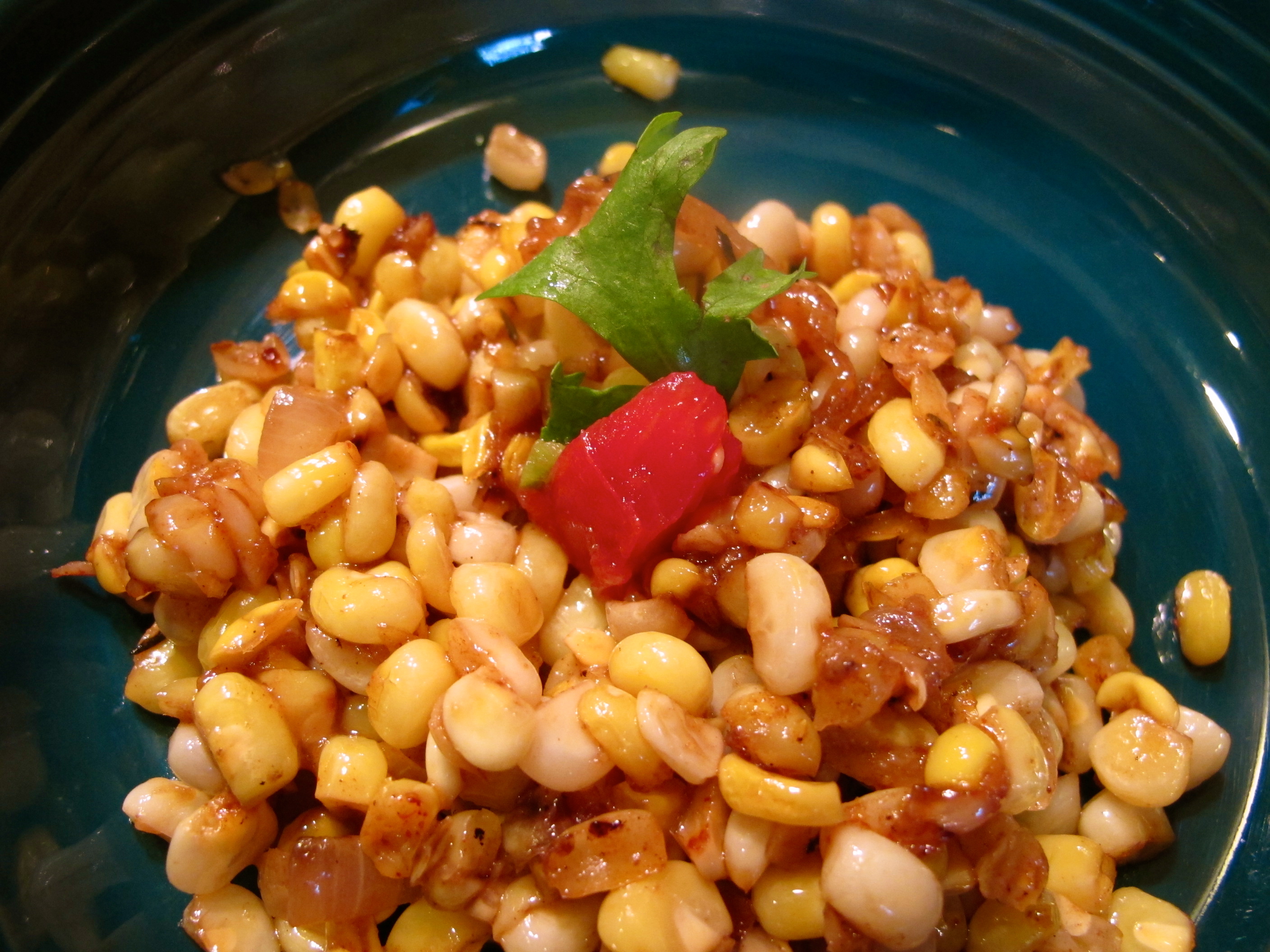 I’m certain that all of you know that corn isn’t really a vegetable, but is actually a grain.
But in the summer, when sweet corn is young, full of sugary plump kernels, bursting with flavor, we eat it like a vegetable.
And generally in the summer, we eat it on the cob.
Why?
Well, it’s more fun that way. Whether boiled, roasted, grilled or deep fried, corn on the cob is a hands-on, messy, joyful summer bundle of gustatory joy that I would never deny anyone. It’s just plain old wonderful.
But sometimes, (not very often) every now and then, you want something different.
And that’s when it’s time to cut corn from the cob and caramelize it.
Yep. Caramelize it.
Cook it in a nice hot saute pan until the sugars brown and the edges get a tiny bit crispy, while the inside of the kernel is chewy, yet still juicy.
Let me tell you, that’s some mighty fine eatin,’ as one of my uncles on the farm used to say. It isn’t as messy as corn on the cob to eat (though getting the kernels off the cob entails a wee bit of mess-making), but it is bursting with flavor.
This version I’m giving you here is vegetarian, made with vegetable broth, but I’ve also made a richer version with beef stock in it. I like them both–the vegetarian version is lighter with a more pure corn flavor–the beef broth gives a darker, deeper flavor, with the meatiness contrasting beautifully with the browned sugars of the corn.
I meant this to be done as a side dish, but you know, if you have some cooked and drained black beans, you could add those, and maybe even a sprinkling of shredded extra sharp or smoked cheddar cheese to make a light but still satisfying vegan or vegetarian main dish. I reckon that if you had some rendered bacon fat sitting in your fridge or you wanted to add some chopped cooked bacon to the dish you could, though it would ruin the corn for your vegetarian and Muslim friends, so don’t do that. Certainly not this close to Ramadan, right?
Suffice to say, this is a versatile enough recipe you could make all sorts of variations to your own taste. The only necessary ingredients are the butter or olive oil, the onions and garlic, salt, pepper, corn and broth. After that, the additional ingredients are up to the contents of your refrigerator, panty, spice cabinet and your imagination.
Let me know what you come up with when you make this–I’d love to hear what goodies you add to this very simple corn recipe.
Oh, and one more thing–use the freshest sweet corn possible. The sugars in corn convert to starch as soon as the ear is torn from the stalk. The more sugar that’s in your corn, the more caramelization you can achieve when you cook it and the better it will taste. If you use starchy corn that’s a week old or more, you’ll have to -add- sugar to it to make it come close to tasting as good as it should. So, avoid that by just using corn that is no more than three days old, if possible.
Caramelized Sweet Corn
Ingredients:
1/2 dozen ears corn, shucked and de-silked
2 tablespoons butter or olive oil
1 medium onion, peeled, cut in half and then sliced very thinly
1/4 teaspoon salt
1-2 cloves garlic minced
freshly ground black pepper to taste
1/2-3/4 cup vegetable broth
roughly chopped fresh cilantro, parsley or basil for garnish
Method:
Cut the corn from the cob. This is somewhat tricky and a bit messy, and you’ll likely miss a few kernels here and there, but you can do it. My Grandma always did it this way, even when she was freezing corn for the winter, when we processed corn by the bushel, and she never cut herself or anything else except the corn. Eventually, Grandpa did make her a more efficient corn cutter, but that was after I was seven years old or so and she’d been cutting it with a knife before that for something like thirty years.
Basically, you hold the corn on a cutting board or inside a wide, shallow bowl, vertical, with the pointy end in one hand, and the flat end where it attached to the stalk held firmly against the board or bowl. I tend to use a bowl–it keeps the kernels from scattering hither and yon all over the cutting board and countertop and on my chest, when I’m cutting it. But Grandma always just used her cutting board.
Using a sharp knife of any sort you like–I use a chef’s knife, Grandma used a butcher knife and my mother used a paring knife–the shape and type matters less than it’s sturdiness and sharpness–carefully start at the top of the cob, and with a slight sawing motion, cut down the entire cob. This should separate the kernels from the cob. Don’t cut too deeply–you’ll get cob bits–but don’t cut too shallowly–then you leave lots of kernel on the cob. Practice will help you get it right–and you’ll find that depending on the width of your knife blade, you can cut up to three or four rows of kernels off at a time.
Continue around the corn until as many kernels as possible have been separated from the cob.
When you are done, wash your hands and knife well–they’ll be sticky with corn juice.
In a medium sized heavy bottomed saute pan, heat the butter or oil on medium heat until the butter melts and foams or the oil ripples and shimmers. Add the sliced onion and sprinkle well with the salt. Cook, stirring, until the onion is medium golden colored. Add the garlic and cook for one more minute, until the garlic is fragrant and beginning to turn golden at the edges.
Add the corn kernels all at once and turn the heat down to medium low and cook, stirring, until the onions turn deep golden brown and the corn has started browning well around the edges. Add black pepper to taste and keep cooking and stirring, until the corn is showing a great deal of golden brown color and everything smells browned and delicious. (There should also be brown bits of sugar and starch clinging to the bottom and sides of the pan at this time.)
Deglaze the pan with the broth, cooking and stirring, scraping every bit of the browned goodness from the bottom of the pan. Cook, stirring, until almost all of the broth is evaporated, and the corn is shiny and uniformly golden brown.
Garnish with roughly chopped herbs, and serve immediately. Feeds about three or four adults as a good side dish.

Categories:
- Admin (rss) (55)
- Blogs and Blogging (rss) (81)
- Book Reviews: Cookbooks (rss) (43)
- Book Reviews: Non-Cookbook Food Books (rss) (38)
- Cats and Cat Blogging (rss) (47)
- Chinese Cooking Lessons (rss) (32)
- Culinary School Stories (rss) (18)
- Dairy Pruducts: Cultured and Barbaric (rss) (4)
- Documentary Filmmaking (rss) (1)
- Essays, Rants and Reflections (rss) (260)
- Fighting Hunger (rss) (12)
- Food and Kids (rss) (45)
- Food in the News (rss) (126)
- Food Media (rss) (98)
- Food Preservation (rss) (18)
- Food Safety (rss) (45)
- Gardening (rss) (30)
- Herbs and Herb Blogging (rss) (20)
- Holidays (rss) (50)
- Kat Blogging (rss) (22)
- Kitchen Science (rss) (36)
- Leftover Makeover (rss) (8)
- Life, the Universe and Everything (rss) (131)
- Local and Sustainable (rss) (227)
- Local Athens Food and Foodies (rss) (42)
- Meatless Mondays (rss) (32)
- Menu For Hope (rss) (5)
- Nutrition, Diet and Health (rss) (84)
- On The Farm (rss) (8)
- Recipes: Almost Vegetarian, Vegetarian and Vegan (rss) (294)
- Recipes: American Regional (rss) (37)
- Recipes: Appalachian Hillbilly (rss) (33)
- Recipes: Bread, Pasta, Grains (rss) (95)
- Recipes: Canning and Preserving (rss) (8)
- Recipes: Chinese (rss) (123)
- Recipes: Comfort Food (rss) (120)
- Recipes: Cookies (rss) (16)
- Recipes: Desserts (rss) (48)
- Recipes: French (rss) (25)
- Recipes: Fruits and Vegetables (rss) (302)
- Recipes: Greek, North African and Middle Eastern (rss) (31)
- Recipes: Indian (rss) (137)
- Recipes: Italian (rss) (42)
- Recipes: Japanese (rss) (7)
- Recipes: Jewish (rss) (4)
- Recipes: Korean (rss) (6)
- Recipes: Meat, Poultry and Fish (rss) (220)
- Recipes: Mexican/Native American/ Latin American/Caribb (rss) (27)
- Recipes: Original (rss) (108)
- Recipes: Thai (rss) (27)
- Recipes: Tofu (rss) (17)
- Recipes: US Regional (rss) (16)
- Recipes: Vietnamese (rss) (8)
- Restaurant Stories (rss) (28)
- Sewing, Quilting, Arts and Crafts (rss) (16)
- Simple Chinese Recipes (rss) (30)
- Slow Food and Heritage Foods (rss) (10)
- Spice Blogging (rss) (44)
- The Chinese Cookbook Project (rss) (14)
- The Chinese Pantry (rss) (39)
- The Documentary (rss) (2)
- The Kitchen Saga (rss) (17)
- The Locavore's Bookshelf (rss) (15)
- The Unsung Adventures of The Culinary Nerd (rss) (6)
- Tools and Toys (rss) (35)
- Uncategorized (rss) (10)
- With a Side of Politics (rss) (48)
Archives:
- August 2012 (9)
- July 2012 (12)
- September 2011 (3)
- August 2011 (7)
- July 2011 (8)
- June 2011 (16)
- May 2011 (17)
- April 2011 (11)
- December 2010 (9)
- November 2010 (5)
- February 2010 (1)
- December 2009 (5)
- November 2009 (7)
- October 2009 (10)
- September 2009 (16)
- August 2009 (14)
- July 2009 (14)
- June 2009 (7)
- May 2009 (17)
- April 2009 (10)
- March 2009 (25)
- February 2009 (13)
- January 2009 (10)
- December 2008 (5)
- November 2008 (5)
- October 2008 (6)
- September 2008 (13)
- August 2008 (8)
- July 2008 (11)
- June 2008 (18)
- May 2008 (13)
- April 2008 (14)
- March 2008 (16)
- February 2008 (17)
- January 2008 (19)
- December 2007 (25)
- November 2007 (18)
- October 2007 (24)
- September 2007 (16)
- August 2007 (15)
- July 2007 (15)
- June 2007 (10)
- May 2007 (14)
- April 2007 (16)
- March 2007 (17)
- February 2007 (20)
- January 2007 (13)
- November 2006 (1)
- October 2006 (8)
- September 2006 (14)
- August 2006 (25)
- July 2006 (30)
- June 2006 (28)
- May 2006 (34)
- April 2006 (29)
- March 2006 (24)
- February 2006 (30)
- January 2006 (38)
- December 2005 (40)
- November 2005 (37)
- October 2005 (32)
- September 2005 (25)
- August 2005 (30)
- July 2005 (28)
- June 2005 (21)
- May 2005 (8)
- April 2005 (22)
- March 2005 (17)
- February 2005 (29)
- January 2005 (10)
Search Site:
Links:
- Lily’s Wai Sek Hong
- 101 Cookbooks
- A cat in the kitchen
- A Veggie Venture
- Accidental Hedonist
- Cha Xiu Bao
- chez pim
- Chocolate & Zucchini
- Chopstick Cinema
- Chowhound.com
- Chubby Hubby
- Cook sister!
- Cooking with Amy
- da*xiang
- Eat Local Challenge
- Eating Liberally
- Ecocentric
- Eggbeater
- Epicurious
- Farmgirl Fare
- Fatfree Vegan
- Foodgoat
- ForkandBottle.com
- Green Olive Tree
- Hooked on Heat
- Jaden’s Steamy Kitchen
- Kalyn’s Kitchen
- Lucullian delights
- Mahanandi
- Matt Bites
- MeatHenge
- mmm-yoso!!!
- New York Times – Dining & Wine
- Pizza Goon
- Rasa Malaysia
- Ruhlman
- Sailu's Kitchen
- Serious Eats
- SF Gate: Food & Dining
- Simply Recipes
- Soul Fusion Kitchen
- Tastespotting
- The Amateur Gourmet
- The Cleaner Plate Club
- The Food Section
- The Grub Report
- thecookscottage
- U.S. Food Policy
- Wandering Chopsticks
- Washington Post Food and Dining
- Wasted Food
Meta:


Powered by WordPress. Graphics by Zak Kramer.
Design update by Daniel Trout.
Entries and comments feeds.