
Cook Local, Eat Global
Finally, I Can Write About Food Again
I have been crying, off and on for five days.
Out of anxiety, trepidation, exhaustion, joy and pride, for nearly the past week, tears will clog my throat and dim my vision at odd moments. A song, a word, a face, a thought–all of these will inspire the overwhelming flow of emotions welling up in my eyes. My voice is hesitant, shaky, a croaking whisper, because a part of me is so certain that this is all a dream, and that I will awaken to the world as it was before, the world where I was ashamed of what my beloved Republic had become, where I feared for the future of my daughters.
The world changed on Tuesday, and we Americans were all part of it. Hope triumphed over fear, love over hate, unity over division and the future over the past. And we were all a part of it.
No, this post isn’t about food, but it is important, because it explains why I couldn’t write about food for about a month.
These past weeks, I have been working to elect a leader I truly believe can help turn our country around,a leader who I believe will be as good for the world as he is for the United States. He is someone who thinks as I do, someone who, well, thinks–and very clearly, deeply and sensibly at that.
And every time I thought to sit and write a post, I couldn’t manage it. I didn’t want to write about food. I wanted to write about politics–and while this -is- my blog, I also know that my readers are a very diverse lot, especially politically, and they come here to read about food, not politics, religion, and social issues. So, I just censored myself and kept my thoughts in my own head, or talked about them to my friends and family, and to the people I contacted during the campaign.
The upshot of all of this is although I am relieved and overjoyed at the outcome of the election, I know that the work is not done. I have been inspired to become more politically active, not less, and so while I will be continuing to write about food here, I may also start another blog where I can write about the other topics which make my heart soar and where my gift for cogent thought and clear writing are put to good use. I will link to it here, but will keep the two blogs pretty well separate.
Thank you all for your patience and concern as I held myself incommunicado for a long stretch of time. I have been reading comments and will return to my usual practice of answering them, answering emails and writing posts soon. Probably after this weekend, which is Parents’ Weekend here at Ohio University, which means the restaurant will be a madhouse. (In a good way, of course, but it will be crowded and crazy.)
The Scent of a Kitchen
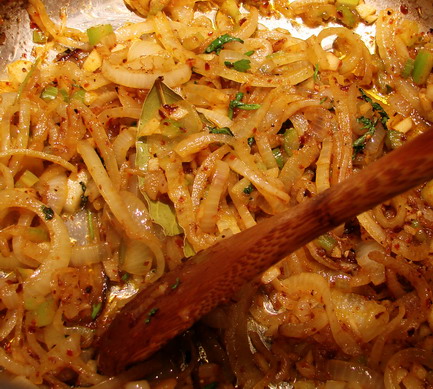
Kate at The Accidental Hedonist had a great post the other day on the subject of her favorite food aromas, and it got me to thinking.
Quite a few of the foods she listed as having her favorite aromas seemed pretty universal to me–freshly baked bread being one and coffee being another. I think that everyone loves those two scents–in fact, I think that if someone wanted to market a scent that would make Americans think of Mama and the comforts of home, it would combine freshly baked bread with coffee and perhaps vanilla.
I suspect that for Americans, sage has got to be a nearly universal favorite food smell because it is the scent that embodies one of our favorite food holidays: Thanksgiving.
Other aromas that she lists as favorites are less typically American and more personal to Kate. One is freshly popped kettle corn, which though I am sure many people love, is not necessarily a scent that everyone I know would recognize, and the other is fresh whiskey straight from the still–not nearly as many people I know have had the opportunities to smell that as Kate has. (Being as she is the author of a book on the subject of whiskey, and I know she traveled to many distilleries doing research, I suspect she is probably an expert on the olfactory experience of the water of life.)
Garlic and onions, which she lists together, have scents that I know for a fact polarizes people’s opinions, sometimes even within the same household. While I side with Kate and simply love walking into a home that is fragrant with the essence of what I consider to be good cooking, which is to say browned onions and golden garlic, many other people I know are quite simply offended at having such odors permeating a living space.
I remember the Pakistani-Bangladeshi Muslim couple I used to cook for were divided on the issue of cooking smells. The husband hated having his home smelling of the kitchen, while the wife felt that the scent of cooking made a house a home. So, she would ask me to use the vent hood when I browned onions and cooked garlic, but was less stringent in her request when I cooked fresh ginger and spices, since these odors did not bother her husband.
Many other people I know also operate their vent hoods or open windows before, during and after cooking onions and garlic, and while I realized that this desire for a home unscented with cooking alliums is a personal choice and thus I respect it, I cannot help but note that it makes me sad, because to me, the scent of onions and garlic IS home to me.
Any reader of this blog has to know that nearly everything I cook other than desserts, is liberally laced with large amounts of garlic, onions and ginger, so it is inevitable that my kitchen, and in fact, the entire lower floor of my house, smells of them. In fact, when I am stir-frying and thus using the vent hood to get the smoke and the heat out of the kitchen, not only do I spread allium smell all over my house, the odor is swept outside into our driveway and sometimes goes as far as the street. Many of my friends have joked that they need only stand downwind of my house and sniff the air to know what I am cooking for dinner.
Imagine a tall, slender red-haired man stepping out onto the deck of his log cabin three doors down the hill from my house. He raises his head and sniffs the air, his nostrils twitching as they catch the scent of browned onions, garlic and ginger mixed with….chilies, there they are, cumin, cardamom, coriander, cinnamon and–ah–there it is–lamb. He smiles and starts walking up the hill because he knows that his sister is cooking lamb curry for dinner and the door is always open to him. That would be Dan, who has literally said that he has smelled my cooking at least one house down the road from mine, so it is a slight exaggeration to have him smelling it from his porch, but not by much.
When I come downstairs in the morning after I have cooked a traditional Chinese or Indian meal, I love being able to smell the lingering odors from dinner. I have found that in addition to the holy trinity of my kitchen of garlic, onions and ginger, some odors linger lovingly longer than others. One is the comforting, woodsy scent of toasted sesame oil, and another is the nutty, creamy aroma of Shao Hsing rice wine. Cumin, cardamom and cloves linger lovingly in the air after I make curry, and the tang of fish sauce and lime juice blended with chilies tells me that the spirit of the Thai food I cooked the night before is still wafting through my home.
And the truth is I know that I would rather my kitchen and home smell like good, well-seasoned food than any cleaning potion ever invented by man–even Pine Sol. (That is a big admission because I adore the smell of Pine Sol–it reminds me of my childhood in a good way.) Whether the scent of my kitchen involves alliums, rising dough, freshly baked bread, pie straight from the oven, fish sauce in a hot wok or kimchi bubbling on my counter in its initial fermentation, (yes, Kate, I disagree with you on the kimchi–to me, fermenting cabbage smells good) it always smells deliciously of home to me, and brings myself and many other great joy.
Eat Local Challenge: Eating Locally While On The Road
You know, it really isn’t easy eating locally while on a cross-country trip.
Especially if you are traveling with a two-year-old.
So, I have to admit to the fact that we stopped at a McDonald’s somewhere in Pennsylvania to get Kat some fries as well as to give us all a chance to stretch our legs.
But one does what one must sometimes.
Needless to say, after two days of driving, we are here at Lake Winnipesaukee, and Kat is settling in pretty well. Tomorrow, Zak and I will be striking out for two whole days on our own, to a bed and breakfast called Bear Mountain Lodge in Bethlehem, New Hampshire. While on our way to and around the White Mountains, we plan on picking up some local foods such as maple syrup and cheddar cheese, as well as seeking out local restaurants for our meals.
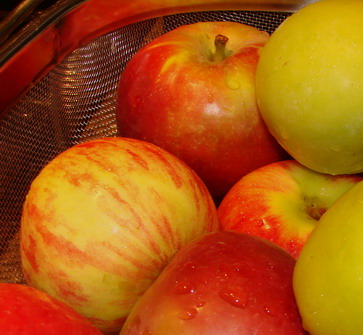
However, I was surprised upon stopping at a rest area in Stockbridge, Massachusetts (yes, the town that Alice Brock and Arlo Guthrie made famous) to find a farm-stand of locally grown fruits, vegetables and herbs just outside of the otherwise corporate food haven. I bought us some truly fine McIntosh apples. Kat, Zak and I enjoyed their tart, flowery flavor and crisp juiciness for the last bit of the drive through Massachusetts and New Hampshire. It was a definite improvement over the french fries, not only in taste and nutritive value, but also when it comes to supporting a local farmer, a local economy and eating in a way that is better for the environment.
Of course, when one is driving across country, it seems silly to worry about eating green when one is spewing carbon monoxide into the air from an internal combustion engine. The irony of those local apples hit home for me while we were stuck in traffic outside of Worcester, Mass.
They still tasted divine, though–crisp and sour-sweet.
Oh, and one more thing–the price of the apples was much higher than I was used to back in Ohio. As I paid for them, I thought to myself that now I understood why some people say local produce is too expensive.
On the other hand, I have noticed that nearly everything up here in New England is more expensive than I am used to in Ohio. (Except for gasoline–it is cheaper here than at home.)
No Pictures
Something is wrong with the image browser on my blog.
We are going out of town tomorrow, so here is the deal–I will post stuff until we get back, and I will take photographs, but I am not going to bother trying to fix the image browser.
So, there will be no pictures here for a while–probably until we get back in ten days or so.
Preserving The Chili Pepper Harvest: Chinese Chile-Garlic Sauce
This year, I planted a whiskey barrel with Thai chilies and basil; eight starts of Thai Dragon chilies, a dozen of Siam Queen basil. These relatively few plants kept us in fresh Thai ingredients for the entire summer and early fall. The rainy early summer resulted in lush growth but the first chilies were fairly mild; however, the drought that fell upon Ohio in the late summer (something like eight weeks without appreciable rain) made for smoking-hot ripe chilies.
The same was true for all of the farmers around here–their first chilies were mild, the ones harvested after the drought, no matter what variety, were at the hotter end of what that variety can be.
It all has to do with water content in the fruits. The less water the plants get, the less water is able to be stored in the tissues of the fruit. The less water in the fruit, the more concentrated the essential oils and flavoring components in the chile, and the better they will be.
By the end of September, there were so many chilies on the plants that they were leaning over, unable to support the weight of the plethora of ripe fruits. Because we are going out of town for ten days, I decided yesterday that I needed to go ahead and pick the ripe chilies and preserve them somehow and leave the green ones on the plants to pick when we came back. Once I got close to the plants, though, I noticed that there were very few green fruits, except on one plant that is still covered with blooms.
So, using scissors, I cut the heads off of all the chile plants, except the one that was still blooming, and brought the bundle of plant tops, all filled with brilliant scarlet fruits, inside.
I spread them out on the dining room table, put on latex gloves and went to work stripping the chilies off of the stalks.
Every now and then, a green fruit would appear, and those I set aside, with their stems intact, to be frozen. The red fruits, however, went together in a bowl, to be turned into my own homemade chile-garlic sauce. The red fruits I very carefully separated from their stems and the little green caps that attach the fruit to the stem–these tough bits of plant matter would not be tasty ground up inside my Chinese-style chile garlic sauce.
I had help in my work from Delia, who decided to gnaw upon a green chile after she picked up one of the plant tops and dashes away with it.
Karma was instant and brutal; the kitten jumped straight up in the air and dashed away.
She didn’t stay away long–while I was still patiently snapping green caps off of the red chilies, she jumped up on the table and watched the proceedings intently, while she batted at the chile leaves idly with her polydactyl paws.
It is imperative to wear gloves even when harvesting chilies–the oils, especially in really hot varieties like these Thai chilies–can be very irritating to skin, and even if it doesn’t bother your hands, if you should rub your eye or nose, you could be in for a world of pain.
(Can you tell I have done that before? It really, really sucks, so now I am quite cautious.)
But, let us talk about how to make Chinese Chile-Garlic Sauce.
This is one of my pantry staples, and last year, I decided to go ahead and make my own. One may ask why, since it is easily obtained in the store, is cheap and tastes pretty darned good. Well, it has to do with the satisfaction of doing something yourself–of growing something from a seedling to a ripe fruit, picking it and turning it into something else. Not only is it satisfying on its own, every time you use the results of your efforts over the next year, that satisfaction from a little bit of self-sufficiency returns to you. Besides–as good as the store bought versions taste–the homemade ones are better.
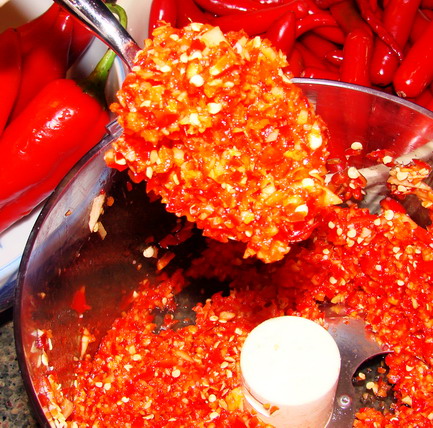
The version I made last year was fairly tame, but very flavorful, since I made it with red New Mexico chilies, serranos and cayennes. This year’s version was made with my own Thai chilies and two types of cayenne, both bought from the Farmer’s Market. I put together mixed red chilies with fresh garlic, also from the Farmer’s Market, with some salt, some sugar and some locally made apple cider vinegar (rice vinegar is more traditional, but apple cider vinegar is local and works fine, too), and ground it all into a thick paste in the food processor.
While grinding the chilies, it is a good idea to put the vent hood on in your kitchen and open the windows, especially if you are using really hot chilies. Otherwise, you might find it hard to breathe, and if you have asthma, the capsaicin in the air my trigger an attack of wheezing. So, keep your albuterol handy, and keep the ventilation going, even if it is cold outside. Better to put on a jacket and breathe, I say!
After everything is ground together, I add more vinegar–enough to make the sauce somewhat fluid–it thins as it ages–and then I stir it all up well. Once it is stirred, I scrape the resulting sauce into a jar, screw on or lock down the lid and let it sit on my counter for a day in a slightly warm place. After that, I let it finish aging in the refrigerator–it is ready to eat in about a week, but it tastes best after a month. I still have a tiny bit of the gallon I made last fall, and it is divine; this batch will be hotter, but with an amazing garlicky aroma from the hardy German garlic I used this time around.
I use this Chinese chile-garlic sauce in lots of my stir-fries, and Zak loves to put a big spoonful into his ramen. It can be used to spice anything up, but I like it best in my Chinese recipes–it tastes better than any store-bought version I have ever had. The chile fragrance is just amazing, and the garlic is much more pronounced than the commercially made types.
Of course, this is not the only way to preserve the chile harvest. I also made kimchi Hunan salted chilies and frozen chilies. Last year, I also made kimchi-style cucumber pickles, which I just opened two nights ago. WOW, were they amazingly good–they tasted great on bulgogi burgers with lettuce, tomatoes, homemade chile-garlic sauce and ketchup. I also discovered that I really like just snacking on these pickles, when I need a pick-me-up during the day. They sure are an eye-opener.
But this recipe is probably the easiest to manage for a beginning pepper preserver. While the Hunan salted chilies are technically simpler, having only two ingredients, I have heard from folks who have had them go awry. This can happen with lactic acid fermentation, so if you are wary of losing a batch of chilies to the problem of not enough salt and rot, I suggest you try this sauce. The vinegar keeps everything chilled out and fresh.
Chinese Chile-Garlic Sauce
Ingredients:
1 1/2 pound red chilies–at least 1/3 of them Thai if you like really hot foods sauce–if you like it milder, make 1/2 of the chilies fresh red New Mexico chilies
1 3/4 pounds fresh garlic cloves, peeled
1/3 cup kosher salt
1/2 cup vinegar, divided (either apple cider vinegar or wine vinegar taste fine with this recipe–I used rice last year and apple cider this year) *
1 tablespoon raw sugar
Method:
Wash your hands very well with lots of soap and water. Wash all of your utensils–you will need a food processor, a large bowl for mixing and a storage jar–one that holds two quarts is perfect. If you have a dishwasher, just run the utensils and storage jar–and lid–through the dishwasher and put it on the heat dry cycle. This will sterilize them effectively.
Put latex or other protective gloves on your hands before starting this recipe. While working, do not touch yourself, your cat, anyone else (unless it is someone you really dislike), your clothes–anything–while you have chile oil on your gloves. If you need to go to the bathroom, pull off the gloves, throw them away, and wash your hands and wrists well with cold water and lots of soap. Go to the bathroom, wash your hands, come back and put on new gloves, then finish the recipe.
Remove the stems and green caps from the tops of the chilies. Wash them well under cold water and let them drain in a colander until they are mostly dry.
Place 2/3 of the chilies, half of the salt, and 1/4 cup of the vinegar into the food processor and grind into a paste. Put the paste into your mixing bowl.
Put the garlic cloves into the food processor with the rest of the chilies, salt and sugar, and grind to a fine paste.
Mix with the chile paste, then add the rest of the vinegar. Pour sauce into prepared jar, push any paste clinging to the sides of the jar down, and put into the fridge.
*If your paste is too thick without much liquid at all, add a little bit more vinegar. This will depend on how juicy your garlic is–some is dryer than others. But it should be thicker than you eventually want it to be–as it ages over the next week to two weeks, the chilies will break down and become more fluid. So, don’t worry if it is a little bit thick and dry.
Put the lid on the jar tightly and allow to sit on a warm counter top for twenty-four hours. Then, store in the refrigerator. Allow to age for one to two weeks before tasting. Keep refrigerated.
Mine lasts about a year if properly refrigerated.

Categories:
- Admin (rss) (55)
- Blogs and Blogging (rss) (81)
- Book Reviews: Cookbooks (rss) (43)
- Book Reviews: Non-Cookbook Food Books (rss) (38)
- Cats and Cat Blogging (rss) (47)
- Chinese Cooking Lessons (rss) (32)
- Culinary School Stories (rss) (18)
- Dairy Pruducts: Cultured and Barbaric (rss) (4)
- Documentary Filmmaking (rss) (1)
- Essays, Rants and Reflections (rss) (260)
- Fighting Hunger (rss) (12)
- Food and Kids (rss) (45)
- Food in the News (rss) (126)
- Food Media (rss) (98)
- Food Preservation (rss) (18)
- Food Safety (rss) (45)
- Gardening (rss) (30)
- Herbs and Herb Blogging (rss) (20)
- Holidays (rss) (50)
- Kat Blogging (rss) (22)
- Kitchen Science (rss) (36)
- Leftover Makeover (rss) (8)
- Life, the Universe and Everything (rss) (131)
- Local and Sustainable (rss) (227)
- Local Athens Food and Foodies (rss) (42)
- Meatless Mondays (rss) (32)
- Menu For Hope (rss) (5)
- Nutrition, Diet and Health (rss) (84)
- On The Farm (rss) (8)
- Recipes: Almost Vegetarian, Vegetarian and Vegan (rss) (294)
- Recipes: American Regional (rss) (37)
- Recipes: Appalachian Hillbilly (rss) (33)
- Recipes: Bread, Pasta, Grains (rss) (95)
- Recipes: Canning and Preserving (rss) (8)
- Recipes: Chinese (rss) (123)
- Recipes: Comfort Food (rss) (120)
- Recipes: Cookies (rss) (16)
- Recipes: Desserts (rss) (48)
- Recipes: French (rss) (25)
- Recipes: Fruits and Vegetables (rss) (302)
- Recipes: Greek, North African and Middle Eastern (rss) (31)
- Recipes: Indian (rss) (137)
- Recipes: Italian (rss) (42)
- Recipes: Japanese (rss) (7)
- Recipes: Jewish (rss) (4)
- Recipes: Korean (rss) (6)
- Recipes: Meat, Poultry and Fish (rss) (220)
- Recipes: Mexican/Native American/ Latin American/Caribb (rss) (27)
- Recipes: Original (rss) (108)
- Recipes: Thai (rss) (27)
- Recipes: Tofu (rss) (17)
- Recipes: US Regional (rss) (16)
- Recipes: Vietnamese (rss) (8)
- Restaurant Stories (rss) (28)
- Sewing, Quilting, Arts and Crafts (rss) (16)
- Simple Chinese Recipes (rss) (30)
- Slow Food and Heritage Foods (rss) (10)
- Spice Blogging (rss) (44)
- The Chinese Cookbook Project (rss) (14)
- The Chinese Pantry (rss) (39)
- The Documentary (rss) (2)
- The Kitchen Saga (rss) (17)
- The Locavore's Bookshelf (rss) (15)
- The Unsung Adventures of The Culinary Nerd (rss) (6)
- Tools and Toys (rss) (35)
- Uncategorized (rss) (10)
- With a Side of Politics (rss) (48)
Archives:
- August 2012 (9)
- July 2012 (12)
- September 2011 (3)
- August 2011 (7)
- July 2011 (8)
- June 2011 (16)
- May 2011 (17)
- April 2011 (11)
- December 2010 (9)
- November 2010 (5)
- February 2010 (1)
- December 2009 (5)
- November 2009 (7)
- October 2009 (10)
- September 2009 (16)
- August 2009 (14)
- July 2009 (14)
- June 2009 (7)
- May 2009 (17)
- April 2009 (10)
- March 2009 (25)
- February 2009 (13)
- January 2009 (10)
- December 2008 (5)
- November 2008 (5)
- October 2008 (6)
- September 2008 (13)
- August 2008 (8)
- July 2008 (11)
- June 2008 (18)
- May 2008 (13)
- April 2008 (14)
- March 2008 (16)
- February 2008 (17)
- January 2008 (19)
- December 2007 (25)
- November 2007 (18)
- October 2007 (24)
- September 2007 (16)
- August 2007 (15)
- July 2007 (15)
- June 2007 (10)
- May 2007 (14)
- April 2007 (16)
- March 2007 (17)
- February 2007 (20)
- January 2007 (13)
- November 2006 (1)
- October 2006 (8)
- September 2006 (14)
- August 2006 (25)
- July 2006 (30)
- June 2006 (28)
- May 2006 (34)
- April 2006 (29)
- March 2006 (24)
- February 2006 (30)
- January 2006 (38)
- December 2005 (40)
- November 2005 (37)
- October 2005 (32)
- September 2005 (25)
- August 2005 (30)
- July 2005 (28)
- June 2005 (21)
- May 2005 (8)
- April 2005 (22)
- March 2005 (17)
- February 2005 (29)
- January 2005 (10)
Search Site:
Links:
- Lily’s Wai Sek Hong
- 101 Cookbooks
- A cat in the kitchen
- A Veggie Venture
- Accidental Hedonist
- Cha Xiu Bao
- chez pim
- Chocolate & Zucchini
- Chopstick Cinema
- Chowhound.com
- Chubby Hubby
- Cook sister!
- Cooking with Amy
- da*xiang
- Eat Local Challenge
- Eating Liberally
- Ecocentric
- Eggbeater
- Epicurious
- Farmgirl Fare
- Fatfree Vegan
- Foodgoat
- ForkandBottle.com
- Green Olive Tree
- Hooked on Heat
- Jaden’s Steamy Kitchen
- Kalyn’s Kitchen
- Lucullian delights
- Mahanandi
- Matt Bites
- MeatHenge
- mmm-yoso!!!
- New York Times – Dining & Wine
- Pizza Goon
- Rasa Malaysia
- Ruhlman
- Sailu's Kitchen
- Serious Eats
- SF Gate: Food & Dining
- Simply Recipes
- Soul Fusion Kitchen
- Tastespotting
- The Amateur Gourmet
- The Cleaner Plate Club
- The Food Section
- The Grub Report
- thecookscottage
- U.S. Food Policy
- Wandering Chopsticks
- Washington Post Food and Dining
- Wasted Food
Meta:


Powered by WordPress. Graphics by Zak Kramer.
Design update by Daniel Trout.
Entries and comments feeds.