
Cook Local, Eat Global
Blog Images Are Kaput
Hey folks!
This is a test post–something is awry with my blog–it keeps inserting junk code and the images I uploaded are somewhere, but not on the image browser.
I’m working on it, but in the meantime, I am going to see if this post, sans images works.
October 2008 Eat Local Challenge
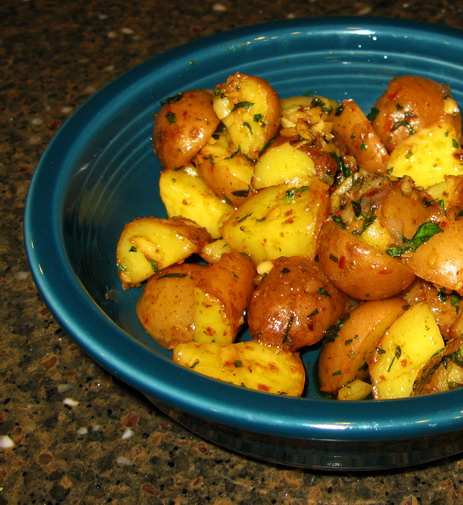
October 2008 is when the fourth annual Eat Local Challenge is taking place, and I signed up.
I felt kind of silly signing up, since I eat locally all the time anyway, but when I thought about it, it does make sense to participate.
Taking part in this challenge gives me incentive to remember to write about shopping for, growing, cooking and eating local foods. Living in Athens, Ohio, it is sometimes really easy to take our local bounty for granted, because we have such a vibrant local food community that is thriving and growing with each passing month.
But as vibrant as this local food movement is here in Athens, it is wrong for me to take it for granted. With the economy the way it is, I must remember how hard it is to start a local small business, especially a food business and it is harder still to keep it afloat. So now more than ever, it is important to not only eat local food and support local communities, it is important to talk about it, and spread the word to others so that people can get inspired to go out and make local food happen in their own areas.
Another thing that will be interesting about this eat local challenge is that Zak, Kat and I will be away for ten days, starting this Friday, visiting Zak’s parents up in New Hampshire. So, I will have lots of opportunities to try out local food in a place that is NOT Athens, Ohio. Karl and Tessa try very hard to eat local foods, but the growing season in New Hampshire is short, so it is really challenging there in ways that is not really the case here in Appalachian Ohio. I mean, Athens has a year-round farmer’s market, which is not the case in their little corner of New Hampshire.
So, it will be a fascinating experiment, to say the least.
Anyway, if any of my readers are interested in signing up to take part in the 2008 Eat Local Challenge, they can go visit the Eat Local Challenge blog and sign up, joining thousands of other folks who are trying to eat as locally as possible.
Now, here are my parameters for this year’s challenge:
My definition of local will include foods grown or produced in Ohio (except when I am visiting New Hampshire–then I will strive to eat foods grown or produced in New Hampshire.) I will also strive when eating out to eat at locally owned, independent restaurants, and will try and feature them in my blog, especially the ones that use locally grown produce and other local foods.
My exemptions are simple–if it cannot be grown in Ohio, then I claim it. Eating locally is not about depriving yourself of coffee, tea, sesame oil, spices, chocolate or soy sauce. It is about incorporating as many local foods as possible into your diet. This often winds up being healthier, because most local foods are either whole foods or are minimally processed, so it forces us to get back in the kitchen and cook.
If there is anything that is eschewed by the eat local movement, it isn’t spices, chocolate or coffee, it is fast food and industrially processed foods.
My goal for this month is to highlight local foods in my blog, and to talk about how I am working to preserve local foods for the winter, which is not only an interesting topic in the first place, but it is also passing on practical knowledge to others as well.
Pumpkin Masoor Dal: It’s Vegalicious!
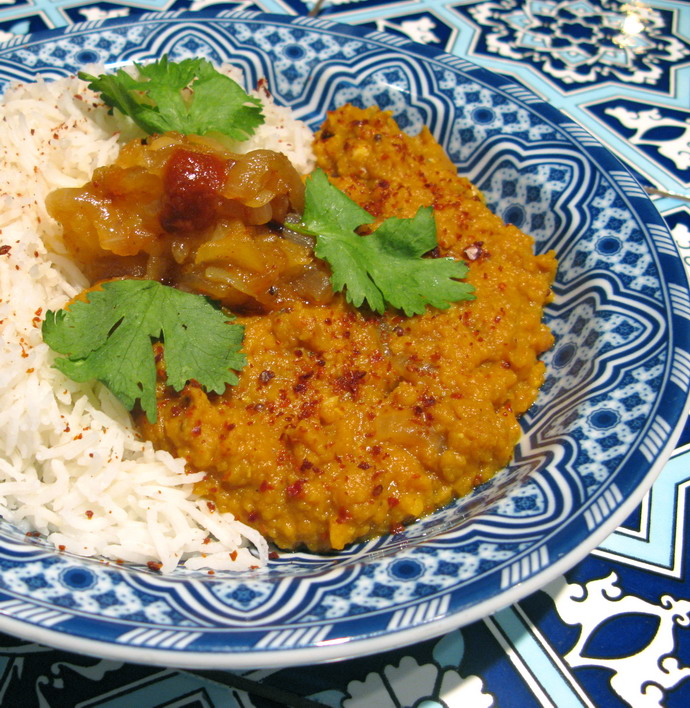
This is not an authentic Indian recipe.
This is an authentic Barbara recipe.
I came up with the idea of using pureed pumpkin in masoor dal while I was making vegan stuffed acorn squashes with rice, almonds, golden raisins and Punjabi spices last weekend at Restaurant Salaam as a dinner special.
The smell of the roasted squash melded beautifully with the spices, especially the caramelized onions, garlic and ginger, and it reminded me of a soup that was served at Zak’s sister’s wedding. It was a cream of roasted butternut squash soup garnished with finely diced Granny Smith apples, and seasoned with caramelized onions.
It made me wonder what a dal wo uld taste like made similarly.
Then, later, when I was home and cleaning up the dishes from dinner, I looked over at the pumpkin Zak had bought for Kat sitting on the counter and I thought, “I bet pumpkin would work just as nicely as squash and would have the benefit of seeming even more seasonal and autumnal than squash.”
Pumpkin just sounds more appetizing than squash. Squash–well the word just makes you think of what you do with bugs, not food. Don’t get me wrong, I love squash and eat them all the damned time, but the name just isn’t really appealing.
Besides, I reasoned that for those who don’t want to bother with roasting a squash and mashing it up just to make dal could use canned solid-pack pumpkin, which, in my opinion, tastes just fine.
Now, the truth is, you could get a pumpkin, bring it home, and roast it and puree it all by yourself to make this dal, and if you want to do that, more power to you. Good luck finding a good eating pumpkin–I will warn you that most of the ones in the supermarkets are grown to be used as jack-o-lanterns and decorations, not for eating, and so while they are pretty to look at, don’t have much in the way of flavor. You would do better to buy one from a farmer at a farmer’s market where you can ask them if this is an eating pumpkin or a pie pumpkin, or if it is one grown just for Halloween.
If you do go that route, good on you, God bless you and here’s how you cook your pumpkin: cook it just like you would an acorn squash. Cut it in half (be careful with this step), and scrape out the innards–all the seeds and strings must go. Heat your oven up to about four hundred degrees F., and then oil the inside and outside of the pumpkin with canola or sunflower oil, and lay it hollow-side down on an oiled baking sheet, and bake it until you can insert the tip of a sharp knife through the skin into the flesh. How long will it take? I have no idea, because I don’t know how big your pumpkin happens to be. You just have to keep checking on it.
Or, you can just open up a can or two of pumpkin and make sure you like this dish well enough to go through all the trouble of cutting, gutting and roasting your own pumpkin for it.
Anyway, this dal is very thick and has a lot of body. You can thin it out once it is cooked by adding water, vegetable stock, or apple cider, or you can be non-vegan and add chicken stock. Or, you can do as I did and leave it pretty thick and not worry overmuch about it.
You want to have about equal parts pumpkin puree to cooked masoor dal to mix together as the base of the dal. If you use a fourteen ounce can of pumpkin, then you want about two cups of cooked red lentils.
After you mix them together, you season the puree with some salt and a tiny amount of sugar, and then you make your tarka, which is browned onions, garlic, ginger and spices in plenty of canola oil. (Or, if you don’t care if it is vegan, you could use butter or ghee.) This mixture is stirred into the dal right before serving.
Then, for the final flavor burst, I caramelize more onions, along with thinly sliced tart apples, and top the dal with this mixture, and serve it with steamed basmati rice.
The results were amazing–good enough to send me in search of a fresh pumpkin for the next time I make the dal. The pumpkin-dal puree is velvety and savory with just a hint of sweetness from the honey, but not enough to make it cloying, and the flavors of the tarka are deliciously earthy. The topping of caramelized onions and apples adds a final touch of tangy-sweet-spiciness to the dal, completing its flavor profile. The only other addition I would make to this dal would be to add roasted pumpkin seeds (yet another reason to use a fresh pumpkin next time) to give the dal an element of crunch.
This is a very rich, satisfying dish, very filling and extremely nutritious. Pumpkin is low in calories, and high in beta carotene, and thus vitamin A, and has fairly high amounts of Iron, folate, potassium, calcium and dietary fiber. The lentils are packed with protein (which becomes a complete protein with the addition of rice to the meal), and also contain fiber, while the onions, garlic and ginger are filled with antioxidants and natural compounds which have antibiotic properties and anti-cancer properties.
But don’t eat it because it is vegan and good for you.
Don’t eat it because it is a successful autumnal fusion of Native American foodstuffs with Indian spices and cooking techniques.
Eat it because it tastes really, really good.
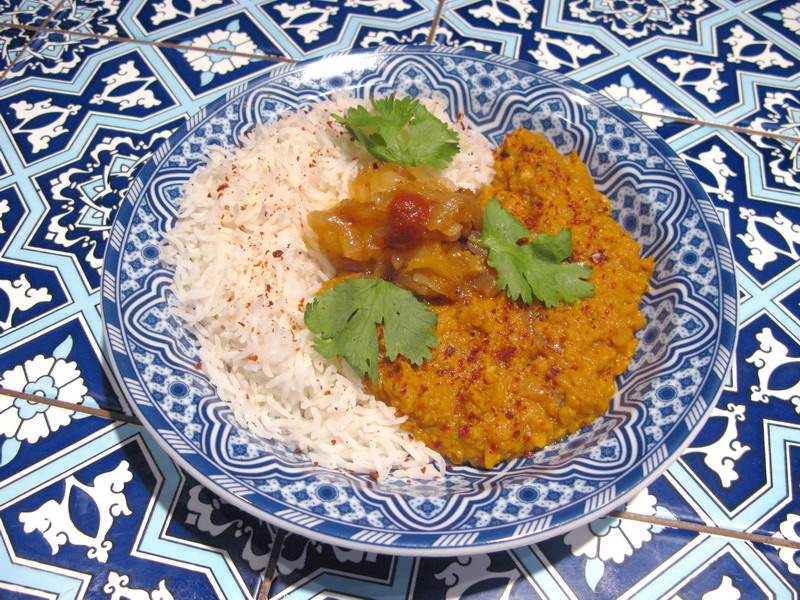
Pumpkin Masoor Dal
Ingredients for the Dal:
1 1/2 cups of uncooked red lentils (masoor dal)
1 teaspoon turmeric
1 tablespoon garam masala or curry powder (I prefer garam masala)
1 14 ounce can of solid-pack pumpkin
salt to taste
1 teaspoon raw or brown sugar
water, vegetable broth, or apple cider (as needed and if desired)
3 tablespoons canola oil, butter or ghee
3 cups thinly sliced yellow onions
4 cloves garlic, minced
2 tablespoons minced fresh ginger
1 1/2 tablespoons brown mustard seeds
1 1/2 tablespoons cumin seeds
Ingredients for the Topping:
2 tablespoons canola oil, butter or ghee
1 1/2 cups thinly sliced onions
1/2 teaspoon salt
2 cups peeled thinly sliced tart apples
1 teaspoon raw or brown sugar
pinch of ground cloves
1 tablespoon mild chili flakes like Kirmizi or Aleppo pepper
sriracha sauce, mild chili flakes and cilantro leaves for garnish
Method:
Sift through the lentils with your fingers to remove any twigs, stones or other bits if unnecessary inedible matter, then rinse them well. Put them into a pot, cover with water 3/4 of an inch above the lentils, add turmeric and garam masala or curry powder. Bring to a boil, turn down heat to medium low and cook, stirring as needed, until the lentils cook down to a puree–this takes around thirty minutes.
Remove from heat and stir in the pumpkin until well combined. Taste for salt, add as much as is necessary and stir in teaspoon of sugar. (If you are not vegan, you can use honey instead.) If you think that the dal will be too thick, return it to the stove on low heat and thin it with a little bit of water, vegetable broth or apple cider until it is the consistency you like, though keep in mind it is supposed to have a good bit of body to it.
Set aside and keep warm. (At the restaurant, we keep it in a steam table; at home, you can use a warming oven, a regular oven set on its lowest heat setting or a crock pot to keep it warm. If you keep it on a low burner on your stovetop, keep an eye on it and stir now and again to keep it from burning. Or put a flame-tamer under the pot.)
At this point, if you have two good-sized saute pans, you can make the tarka and the topping at the same time, or you can do them one at a time. I like doing them both at once, though, because it is faster and more fun. Or, you could cook the topping while the lentils are boiling, and then set it aside and keep it warm, and then cook the tarka after the lentils are done. However you want to do it is fine with me.
At any rate, in order to cook the tarka, bring the 3 tablespoons of canola oil to heat in a heavy-bottomed saute pan over medium-high heat. Add the onions, and cook, stirring, until they are deep gold in color. At this point, add the garlic and ginger and cook, stirring, until the onions are deep reddish brown and everything is quite fragrant. Then, add the mustard seeds and coriander seeds and cook, stirring, until the cumin seeds turn brown and the mustard seeds pop–it should take about a minute and a half or two minutes.
Stir the tarka into the dal, and put a lid on it to capture the fragrance of the steam.
To make the topping, heat the canola oil in a heavy-bottomed wide saute pan, and add the onions.. Sprinkle with salt and cook, stirring, until the onions are golden. Add the apples, sprinkle with the sugar, add a pinch of cloves and cook, stirring, until the onions and apples are golden brown. Add the chili flakes, and cook for two more minutes, until the red coloring from the chili flakes tints the apple/onion mixture.
To serve, put on plate alongside steamed basmati rice. Top both with a mound of apple-onion mixture, add a dot of sriracha sauce in the center of the topping, and sprinkle mild chili flakes over all. Add whole cilantro leaves as garnish.
Note: I suspect that one could do several variations on this dish that would be tasty. One could go vegetarian rather than vegan and use honey instead of sugar and butter or ghee instead of canola oil. One could use a combination of caramelized and raw apples as garnish. One could add pumpkin seeds as a garnish in addition to the caramelized onions and garlic. One could use a winter squash instead of pumpkin. One could add a puree of roasted sweet red peppers to the dal and pumpkin puree.
One could even add bacon, but I suspect that would be sacrilegious.
It would certainly be sacrilicious, as my brother-in-law would say.
An Inspired Idea: Tonnato Puttanesca

I have already written about the delectably sensuous pasta sauce from Naples, puttanesca. This velvety concoction of tomatoes, olives, capers and anchovies which is known as “whore’s sauce” is one of my very favorite comfort foods. It makes for a quick supper from the pantry when I haven’t had a chance to think too long and hard about what to cook. but it never tastes like something thrown together thoughtlessly.
It tastes artful.
A good puttanesca is a balance of salty, sweet and savory flavors sparked with the fragrance of capers and garlic.The salty flavor obviously comes from all of the preserved ingredients: the olives and capers are brined, and the anchovy paste is also well-salted. Sweetness comes from the cooked canned and sundried tomatoes, as well as from my carefully caramelized onions and lightly browned garlic. The savory note comes from the umami punch carried by the anchovies or anchovy paste; I have tried to make purely vegetarian versions of puttanesca, and while they were all very good, they lacked the depth and smoky nuance that the anchovies bring.
But, you know, as much as I adore spaghetti puttanesca, and could probably eat it three times a week without being fatigued, I always wondered if there wasn’t something else I could do with that sauce.
When Hilarie at Restaurant Salaam asked me to come up with a new sauce for seared tuna, for whatever reason, puttanesca leaped into my consciousness and refused to be dislodged. And even though Hil is not herself fond of olives, she jumped on the idea and insisted that I give it a whirl.
So, I did.
And I am really glad I did, because this is a dish I would serve proudly to anyone, anywhere, anytime. (Provided, of course, that they were able and willing to eat fish and olives, of course. I would never, ever serve this to a vegan, for example, or a Jain, or to someone who just plain old didn’t like fish. That would not only be cruel to the diner, it would be a waste of a rare and delicious bit of fish.)
I like the combination of a very expensive cut of fish with what is essentially poor-folks food from the back-alleys of Naples. (And the irony of serving whore’s sauce on tuna steak appeals to my bawdy sense of humor as well.) But as appealing as the combination is intellectually, it is even more pleasing to the palate.
Rare or medium rare seared tuna, with its clean, rich ocean flavor really pairs amazingly well with the melange of salty, sweet and savory flavors and strong fragrances of puttanesca. They are just two great tastes that taste great together, to use the old advertising line from those old Reese’s Peanut Butter Cup commercials.
A note here on the issues of the overfishing of tuna–I am of the opinion that if we are going to eat tuna at all, it should be very sparingly. I think that everyone gives up a portion or two of sushi, sashimi, seared tuna and tuna fish sandwiches per week, that perhaps the resulting slump in demand for the fish would cause overfishing them to slow down, and perhaps stop altogether. Besides, with the amount of mercury found in the flesh of these large predatory fish, it is probably a good idea to treat tuna as “a sometimes food” as the modern, newly-ascetic Cookie Monster would say. (What is up with that, anyway? The whole reason that Cookie Monster is a monster is because of his immoderate love of cookies and his habitual gluttony regarding same. Or, at least, I got that message when I was a kid. Political correctness has gone too far.)
Be that as it may, tonnato puttanesca turned out to be a delicious entree, one that combines the richness of seared fish with the earthiness of whore’s sauce, and I am very pleased I had the idea to combine them.
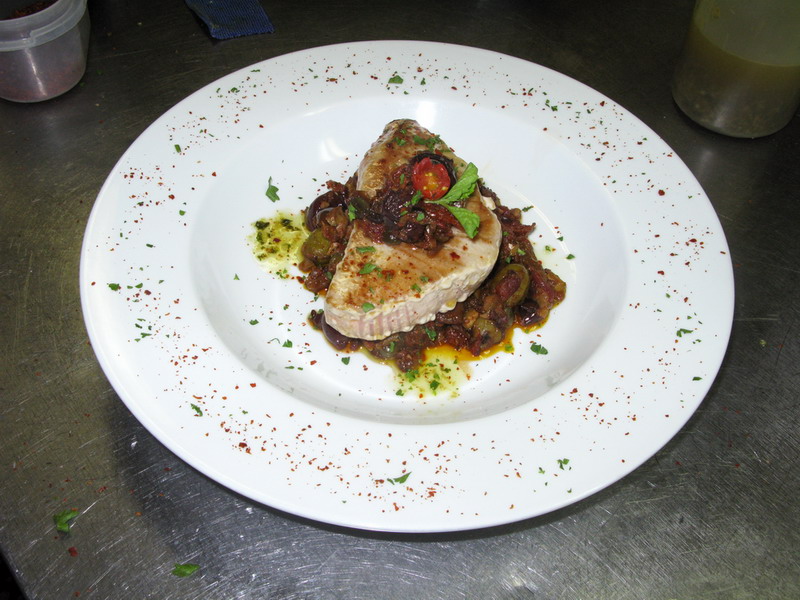
Tonnato Puttanesca
Ingredients:
3-4 tablespoons olive oil
1 small onion, thinly sliced
4-5 cloves fresh garlic, minced
3 anchovy fillets, chopped finely or 1 1/2 teaspoons anchovy paste
1/2 pound pitted Kalamata olives, drained and chopped roughly
1/3 pound pitted green unstuffed olives, drained and chopped roughly
1/4 cup finely minced oil-packed sun-dried tomatoes
3 tablespoons capers, drained of brine and rinsed thoroughly, then drained again
1 teaspoon or to taste red chile flakes (optional)
1/4 cup dry red Italian wine
1 14 ounce can diced tomatoes with their juice (I use Muir Glen Fire Roasted Organic)
handful of fresh basil leaves, minced
1/4 cup extra virgin olive oil
1 clove garlic, minced and pounded into a paste
1 cup basil leaves, minced and pounded into a paste
2 teaspoons olive oil
4 tuna steaks
minced basil and basil sprigs for garnish.
Method:
First, make the puttanesca sauce. This recipe will make a sauce that is not very fluid. Instead, it will hold together like a salsa or relish on the plate, making a good platform for the tuna steak.
Heat the first measure of olive oil on medium heat in a heavy bottomed skillet or pan. Add onion and cook until softened and golden, stirring now and then. Add garlic and anchovy and continue cooking until garlic turns golden, the onions brown slighty and the anchovy fillets disintegrate. (If you are using anchovy paste, do not add at this point–add it after the olives and capers have cooked for about a minute.)
Add olives, sun-dried tomatoes, capers, and chile flakes, and continue cooking until very fragrant, about three minutes. Add wine and allow alcohol to boil off.Add tomatoes and their juice after the alcohol has boiled away and turn heat down slightly and allow to cook until it thickens up and most of the liquid is boiled away.
Remove from heat and stir in first measure of minced basil.
Next, make the garlic and basil infused olive oil.
Mix together the 1/4 cup extra virgin olive oil with the garlic and basil paste, and allow to steep for about an hour or so.
Just before serving, stear tuna steaks.
Heat two heavy-bottomed skillets (not nonstick–I like cast iron or heavy stainless steel) over medium high heat until they smoke slightly. Add one teaspoon of olive oil to each and tip pans back and forth to coat the bottom thoroughly. Add tuna steaks two per skillet. Allow to sear on the first side undisturbed for a few minutes, or until a nice brown crust is formed. Watch the sides of the fish; a line of white cooked flesh will come up from the bottom toward the top. At this point, turn the fish and press the second side down with the back of the spatula. Put a lid down on the pan, and allow to cook undisturbed for the same amount of time it took to sear the first side.
For rare tuna, sear both sides of the steak, then if you like, using tongs, lift and hold each edge of the tuna against the hot pan to sear them as well. This looks much prettier, and you still have a nice red interior.
For medium rare tuna, after you sear both sides and clap the lid over the fish, let it cook until the edges turn beige on their own. That should lead to a pinkish red interior that is warm all the way through.
For medium well tuna, meaning warm all the way through and barely pink on the inside, before you clap the lid on the pan, squirt about 1/4 cup of water into the pan, then slap the lid on it (the oil will make is splatter, so use the lid as a shield while you squirt in the water–I use a squeeze bottle as it is easier to get the water in without being burned since my hand can stay out of the way. Pouring the water in usually involves getting my hands spattered and burned by hot oil, which, while I am used to it, still sucks.
The steam from the water will help cook the tuna through without drying it out.
For well done tuna–open a can. Okay, okay, if you really want well done tuna, do yourself a favor and slice the steak in half so you have two thinner tuna steaks instead of one thick one. Then cook as per my instructions for medium-well tuna, except because the steak is thinner, it will steam through more quickly and lose less juice and flavor that way.
To plate this dish, take about a half cup of the sauce and drain any remaining liquid from it. Mound it in the center of the plate. Place a tuna steak on top of the mound, and then drizzle the basil garlic oil over the fish. Then place about a tablespoon of the puttanesca on top of the fish, and dot the edges of the puttanesca on the plate with basil garlic oil, then sprinkle with minced basil, mild chili flakes (;like Aleppo or Kirmizi pepper) and top the little mound of puttanesca with a basil sprig.
It’s Kimchi Time Again!
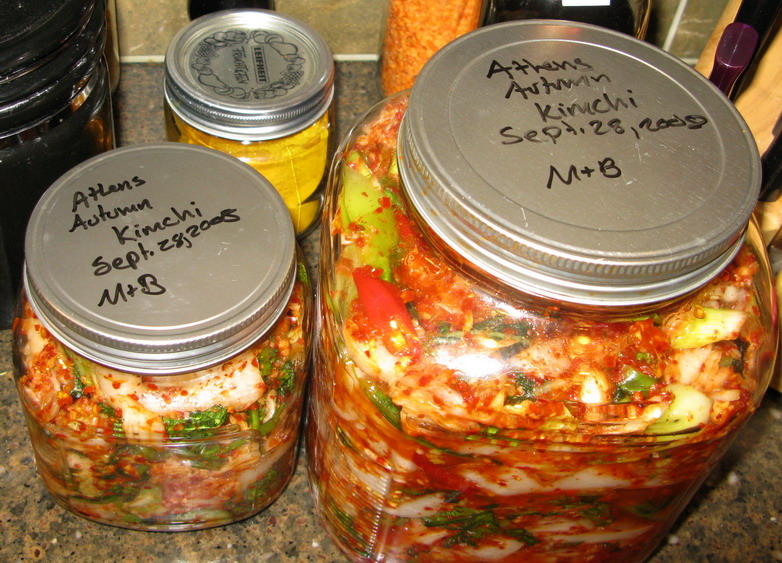
Yes.
The nights have become crisp and cool, and the autumn harvest of Napa cabbage has begun.
The Farmer’s Market is filled to bursting with locally grown goodness: garlic heads nearly as big as my palm, cayenne chilies longer than my hand, Japanese globe turnips, bok choy, Chinese bunching onions, crinkly violet and vibrant green mustard, juicy-crisp daikon radishes–it is a food lover’s paradise right now. These items, of course, are all in addition to the usual summer suspects which are still producing plenty of fruits: tomatoes, eggplants, summer squashes, sweet bell peppers, cucumbers, lettuces, green beans, sweet corn. Of course, that is not to mention the fruits, but the point is that while autumnal vegetables and fruits are definitely in evidence, with piles of hard-shelled winter squashes and pumpkins all over the place, and baskets of sweet potatoes and white potatoes, the summer vegetables are still going strong.
In fact, I think that September is probably one of the best months at the Athens Farmer’s Market, because the deep, rich soil of our county goes through a frenzy of fecundity, throwing out pound after pound of delicious produce with each passing day. Even the garden on my deck has thrown caution to the wind and is currently putting out more Thai chilies, Thai basil and bok choy than we can eat ourselves.
So what is there for us to do but preserve what we cannot eat now?
That is where kimchi comes in.
Kimchi is the Korean answer to the human need for fresh vegetables during the harsh winter months.
This national dish, or rather, type of dishes, is basically a mixture of vegetables and seasonings, often including huge amounts of chili peppers, which are then fermented by the process of lactic acid fermentation. This process, which is carried out by the naturally occurring lactobacillus bacteria (which live in the air and on the surface of vegetables), creates lactic acid from the sugars present in the vegetables. This results in a naturally bubbly, tangy food product that is beneficial to health in many ways. Scientists from around the world have found that lactic acid fermented foods may have anti-cancer properties, and Korean scientists recently found that kimchi may have anti-viral properties that were beneficial in treating bird influenza.
These possible health claims for kimchi aside, what is known about it is that it is low in calories, high in fiber, filled with vitamin C, beta carotene, iron and other beneficial nutrients. The exact nutritional profile depends on what ingredients are used to make the kimchi, so these statements are just generalizations.
It also tastes good, and makes other foods taste good too. I love it in noodle soup, and with beef or chicken. It is great in fried rice, too.
The first time I made kimchi was last April, and then I used seasonal local ingredients to great effect, including ramps (wild Appalachian garlic), radishes, Japanese globe turnips, mustard greens, and of course, the giant Napa cabbage that inspired the entire idea. (When you see a cabbage that is bigger than your baby, you just need to buy it and use it for something special. Well, at least, I have to, I don’t know about you.)
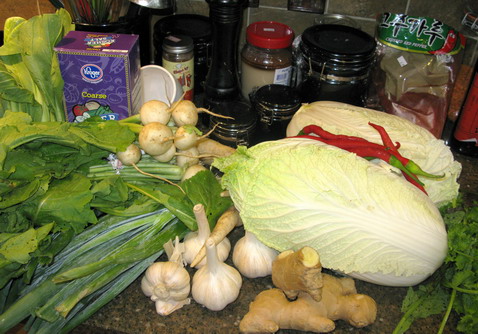
This time around, I ended up using three smaller Napa cabbages, two heads of bok choi, some Japanese globe turnip tops, mustard greens (I love the way mustard greens taste in kimchi), giant cayenne chilies, scallions or Chinese bunching onions, and huge heads of German extra hardy garlic. All of these ingredients were organically grown here in Athens county by the good folks at Shade River Farms, Haulin’ Hoof Farm, Green Edge Gardens/Athens Hills CSA, and Rich Gardens Organic Farm.
The very few non-local ingredients were the kosher salt, and the ginger, Korean chili flakes and fish sauce. The former I bought in at Kroger and the three latter ingredients came from our local Asian market. (And I must insist on using the Korean chili flakes–they add the proper flavor and color to the kimchi. And they are easily found in most Asian markets in cellophane packets. They are brilliant scarlet and very fragrant–you cannot miss them.)
How does this Athens Autumn Kimchi taste?
Well, truthfully, I have no idea. I have to wait three days before tasting it, to give the little lactobacillus guys a chance to do their stuff.
I promise to report back on the results.
But I suspect that it will not only taste like kimchi, but it will also have the flavor of this very special place–a small town in Appalachian Ohio, a place of clay soil and steep hills, winding rivers and streams and brilliant blue skies, country houses and rolling pastures dotted with grazing cattle, horses,sheep and goats.
I suspect it will taste like home.
Until then, here is the recipe I used, if you feel the need to gather up some of the early autumn harvest and make yourself a jar or two of kimchi to enjoy over the next few months. (Once it ferments after three days, you can start eating it, and it will stay at about that level of fermentation if you keep it in the fridge for around a month. I have kept mine longer, although it keeps fermenting the whole time you store it. The cold retards the process somewhat, but it doesn’t stop it. Some people don’t like the flavor of long-fermented kimchi, but I do, so I don’t mind that it keeps going and going and going, rather like the Energizer Bunny.)
Oh, one more thing–before you make this recipe, you might want to read my first post on making kimchi–“Up Close and Personal With Kimchi”–some of the photographs of the process may be helpful to you, as well as the general commentary.
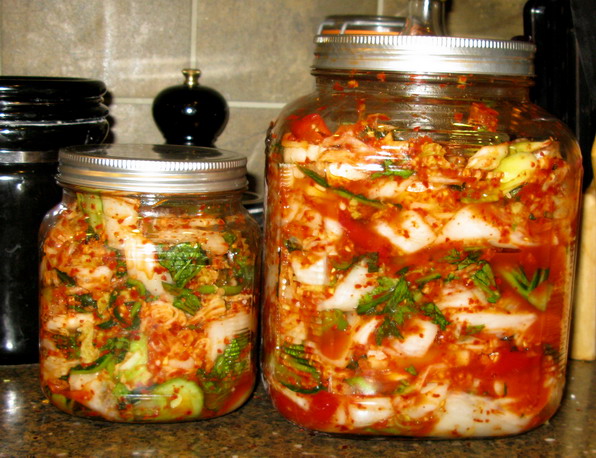
Athens Autumn Kimchi
Ingredients:
8 pounds Napa cabbage
1 pound bok choy
1/2 pound turnip greens
1 1/4 cups plus 1 tablespoon kosher salt
3 heads garlic, peeled and sliced
4″ long chunk of fresh ginger 1″ thick, peeled and sliced
1 1/2 cups Korean ground red chiles
2 bunches scallions or Chinese bunching onions, trimmed, washed and sliced thinly (about a cup and a half)
1/2 pound fresh mustard greens, washed and sliced into 1/2″ wide ribbons
2-6 fresh red chilies, stemmed and quartered (this depends on how hot your chilis are, how big they are and how hot you want your kimchi to be)
2 pounds diakon radishes, peeled and cut into thin half-rounds
1/3 cup fish sauce (if you are a vegetarian, leave this out)
2 teaspoons raw or brown sugar
Method:
Fist, you need to gather your materials: you will need a one-gallon jar, and a one quart jar (I made enough so Morganna could take some back to the dorm with her) preferably glass, with a screw on lid or self-locking lid. Run them both through the dishwasher and make certain to put it through the heat dry cycle. Or, wash it well by hand, then pour boiling water over both the jars and the lids, then allow them to air dry. Also, you will need a very large bowl, crock, pot or basin and a large plastic bag. I used one of the giant Ziplock bags which are meant for storage of household items. It is tough enough to be rinsed out and used for later batches of kimchi, and it makes the periodic mixing of the cabbage during the brining process much easier.
You will also need a pair of latex gloves for yourself and any and all of your helpers. You do not want to get the chili oil on your hands when you mix the kimchi and pack it into the jars. It is pretty wicked stuff.
You will also want to scrub your sink out well with soap and rinse it well before you start.
Once all of this is accomplished, you can start making your kimchi.
First, cut off the root end of the Napa cabbages, and then strip away the tough outer leaves. Cut them in half longitudinally.
Then, making a v-shaped cut with your knife, cut the core of the cabbage, then pry it out with your fingers.
Then, depending on how dirty and bug-infested your cabbage may be, you can either wash each leaf individually before cutting them by spraying them under running water, and then setting them on paper towels to dry, or if the cabbages are pretty clean, like the ones this time were, you can fill your sink with cold water, and cut your cabbage leaves into two inch square pieces and dump them into the sink. Swish the pieces around with your hands, then pull them out to dry on a paper-towel lined countertop.
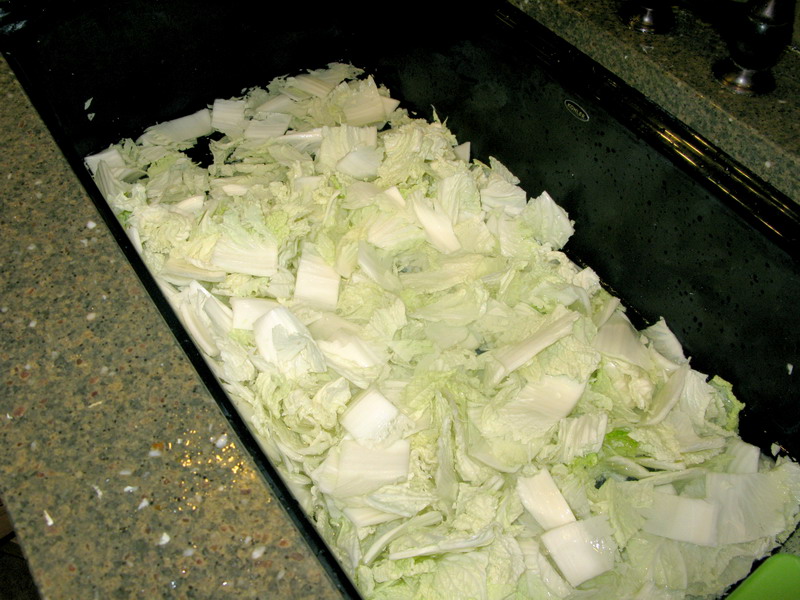
If you use the former method, cut the leaves into two inch square pieces -after- they are washed. It is easier to wash individual leaves when they are whole than after they are cut up.
Cut and wash the bok choy the same way as you did the cabbage. For the turnip greens, cut off the big stems and central veins, remove any yellowed bits and rinse well by either spraying or swishing. Once they are clean, cut them into 1″ wide ribbons.
The next step is salting the cabbage, bok choy and turnip greens.
Squeeze out as much washing water as you can by grabbing handsful of the greens and squishing them well. Dump two handsful of greens into the bag, then sprinkle with some of the one and a quarter cup of salt. Then reach in and squish the greens, rubbing the salt well into them. Continue this process of layering greens and salt, squishing and massaging with each layer.
When all of the greens have gone into the bag, and all of the one and a quarter cup of salt is used, seal up the bag. Give the greens a good shaking and squishing through the bag and then set aside for three hours. Every half hour or so, give the bag a good shake and a squish, making certain that the greens are covered by the juices coaxed from them by the salt. This brining process has two purposes. One is to remove excess water, and the other is to help kill bacteria that are not lactobacillus so that the fermentation can go on properly without the vegetables being attacked by microbes that cause them to rot instead of ferment.
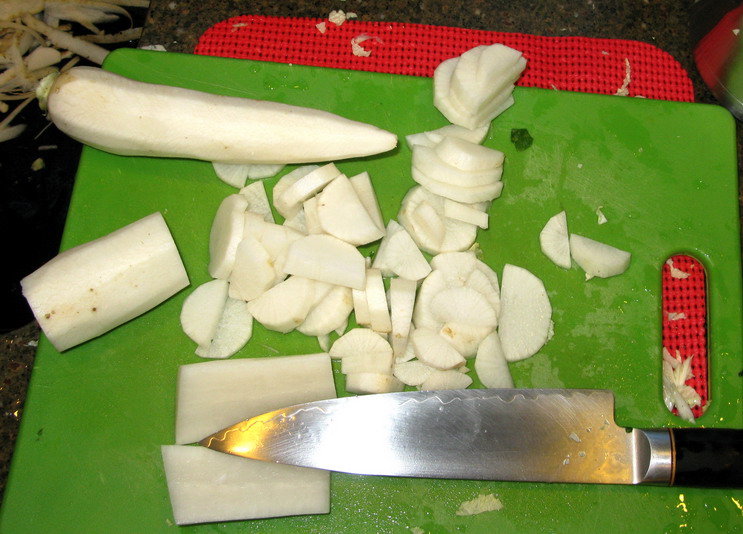
While the greens sit in the brine, cut up your daikon, mustard greens (you may wonder why I don’t brine the mustard greens–it is because there isn’t as much water in them as there are in the other three greens) and scallions. Take your ginger and garlic slices and grind them up into a paste in a food processor.
After three hours have passed, it is time to drain and rinse the greens.
Dump them into a colander, and allow all of their juices to drain away. Then, squeeze out as much liquid with your hands as you can. Rinse under cold water, tossing the leaves as you go. Finally, squeeze out as much water as you can with your hands and put them into whatever mixing apparatus you have–a big bowl, crock, pot or basin.
Add all of the other ingredients to the greens, including that last tablespoon of salt, and put on your gloves. Now, the fun part begins.
Start mixing.
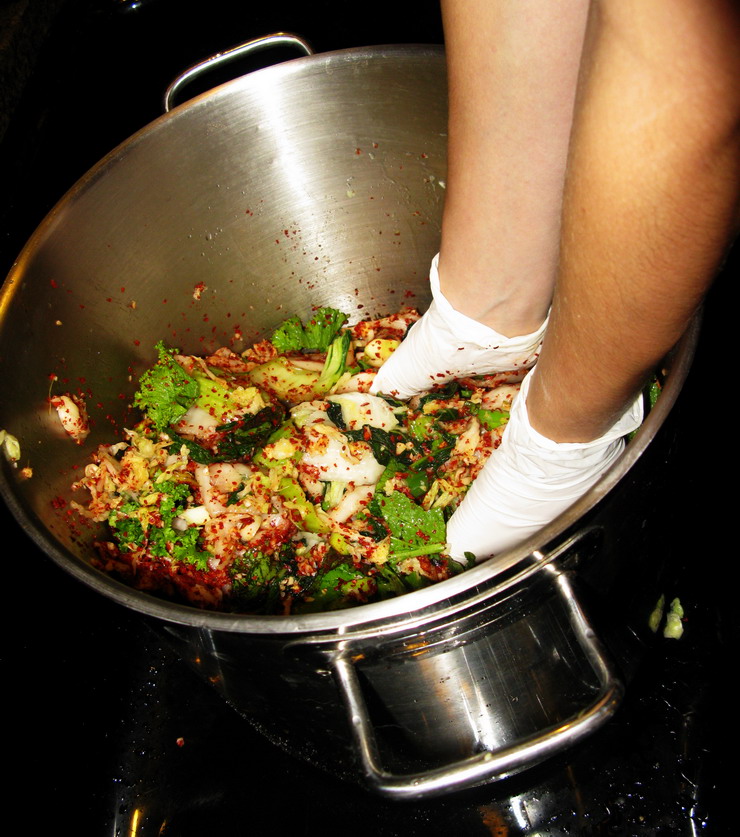
Squish, toss, turn, mix, fold, spindle and mutilate your ingredients in your mixing bowl. (We used our big stockpot set down in the sink for this job–it contains the ingredients really well.) Massage the stuff well into each other, making sure some of everything gets into some of everything else.
After everything is well blended, start packing the kimchi into your very clean and dry jars.
You don’t have to pack everything down tightly so that there is no air in the jar, you just have to tamp everything down gently with the back of your hand.
When the jars are filled, screw the lids on loosely and set into a cool, dark place at room temperature for three days to allow the fermentation to begin.
You will see bubbles fizzing up to the top of the jars as the fermentation process goes along–that is how you know that everything is working properly.
After three days, you can open and taste your kimchi. After that, refrigerate it for storage.

Categories:
- Admin (rss) (55)
- Blogs and Blogging (rss) (81)
- Book Reviews: Cookbooks (rss) (43)
- Book Reviews: Non-Cookbook Food Books (rss) (38)
- Cats and Cat Blogging (rss) (47)
- Chinese Cooking Lessons (rss) (32)
- Culinary School Stories (rss) (18)
- Dairy Pruducts: Cultured and Barbaric (rss) (4)
- Documentary Filmmaking (rss) (1)
- Essays, Rants and Reflections (rss) (260)
- Fighting Hunger (rss) (12)
- Food and Kids (rss) (45)
- Food in the News (rss) (126)
- Food Media (rss) (98)
- Food Preservation (rss) (18)
- Food Safety (rss) (45)
- Gardening (rss) (30)
- Herbs and Herb Blogging (rss) (20)
- Holidays (rss) (50)
- Kat Blogging (rss) (22)
- Kitchen Science (rss) (36)
- Leftover Makeover (rss) (8)
- Life, the Universe and Everything (rss) (131)
- Local and Sustainable (rss) (227)
- Local Athens Food and Foodies (rss) (42)
- Meatless Mondays (rss) (32)
- Menu For Hope (rss) (5)
- Nutrition, Diet and Health (rss) (84)
- On The Farm (rss) (8)
- Recipes: Almost Vegetarian, Vegetarian and Vegan (rss) (294)
- Recipes: American Regional (rss) (37)
- Recipes: Appalachian Hillbilly (rss) (33)
- Recipes: Bread, Pasta, Grains (rss) (95)
- Recipes: Canning and Preserving (rss) (8)
- Recipes: Chinese (rss) (123)
- Recipes: Comfort Food (rss) (120)
- Recipes: Cookies (rss) (16)
- Recipes: Desserts (rss) (48)
- Recipes: French (rss) (25)
- Recipes: Fruits and Vegetables (rss) (302)
- Recipes: Greek, North African and Middle Eastern (rss) (31)
- Recipes: Indian (rss) (137)
- Recipes: Italian (rss) (42)
- Recipes: Japanese (rss) (7)
- Recipes: Jewish (rss) (4)
- Recipes: Korean (rss) (6)
- Recipes: Meat, Poultry and Fish (rss) (220)
- Recipes: Mexican/Native American/ Latin American/Caribb (rss) (27)
- Recipes: Original (rss) (108)
- Recipes: Thai (rss) (27)
- Recipes: Tofu (rss) (17)
- Recipes: US Regional (rss) (16)
- Recipes: Vietnamese (rss) (8)
- Restaurant Stories (rss) (28)
- Sewing, Quilting, Arts and Crafts (rss) (16)
- Simple Chinese Recipes (rss) (30)
- Slow Food and Heritage Foods (rss) (10)
- Spice Blogging (rss) (44)
- The Chinese Cookbook Project (rss) (14)
- The Chinese Pantry (rss) (39)
- The Documentary (rss) (2)
- The Kitchen Saga (rss) (17)
- The Locavore's Bookshelf (rss) (15)
- The Unsung Adventures of The Culinary Nerd (rss) (6)
- Tools and Toys (rss) (35)
- Uncategorized (rss) (10)
- With a Side of Politics (rss) (48)
Archives:
- August 2012 (9)
- July 2012 (12)
- September 2011 (3)
- August 2011 (7)
- July 2011 (8)
- June 2011 (16)
- May 2011 (17)
- April 2011 (11)
- December 2010 (9)
- November 2010 (5)
- February 2010 (1)
- December 2009 (5)
- November 2009 (7)
- October 2009 (10)
- September 2009 (16)
- August 2009 (14)
- July 2009 (14)
- June 2009 (7)
- May 2009 (17)
- April 2009 (10)
- March 2009 (25)
- February 2009 (13)
- January 2009 (10)
- December 2008 (5)
- November 2008 (5)
- October 2008 (6)
- September 2008 (13)
- August 2008 (8)
- July 2008 (11)
- June 2008 (18)
- May 2008 (13)
- April 2008 (14)
- March 2008 (16)
- February 2008 (17)
- January 2008 (19)
- December 2007 (25)
- November 2007 (18)
- October 2007 (24)
- September 2007 (16)
- August 2007 (15)
- July 2007 (15)
- June 2007 (10)
- May 2007 (14)
- April 2007 (16)
- March 2007 (17)
- February 2007 (20)
- January 2007 (13)
- November 2006 (1)
- October 2006 (8)
- September 2006 (14)
- August 2006 (25)
- July 2006 (30)
- June 2006 (28)
- May 2006 (34)
- April 2006 (29)
- March 2006 (24)
- February 2006 (30)
- January 2006 (38)
- December 2005 (40)
- November 2005 (37)
- October 2005 (32)
- September 2005 (25)
- August 2005 (30)
- July 2005 (28)
- June 2005 (21)
- May 2005 (8)
- April 2005 (22)
- March 2005 (17)
- February 2005 (29)
- January 2005 (10)
Search Site:
Links:
- Lily’s Wai Sek Hong
- 101 Cookbooks
- A cat in the kitchen
- A Veggie Venture
- Accidental Hedonist
- Cha Xiu Bao
- chez pim
- Chocolate & Zucchini
- Chopstick Cinema
- Chowhound.com
- Chubby Hubby
- Cook sister!
- Cooking with Amy
- da*xiang
- Eat Local Challenge
- Eating Liberally
- Ecocentric
- Eggbeater
- Epicurious
- Farmgirl Fare
- Fatfree Vegan
- Foodgoat
- ForkandBottle.com
- Green Olive Tree
- Hooked on Heat
- Jaden’s Steamy Kitchen
- Kalyn’s Kitchen
- Lucullian delights
- Mahanandi
- Matt Bites
- MeatHenge
- mmm-yoso!!!
- New York Times – Dining & Wine
- Pizza Goon
- Rasa Malaysia
- Ruhlman
- Sailu's Kitchen
- Serious Eats
- SF Gate: Food & Dining
- Simply Recipes
- Soul Fusion Kitchen
- Tastespotting
- The Amateur Gourmet
- The Cleaner Plate Club
- The Food Section
- The Grub Report
- thecookscottage
- U.S. Food Policy
- Wandering Chopsticks
- Washington Post Food and Dining
- Wasted Food
Meta:


Powered by WordPress. Graphics by Zak Kramer.
Design update by Daniel Trout.
Entries and comments feeds.