
Cook Local, Eat Global
Upgrades, Snafus and Other Blog Stuff
We are working on upgrading WordPress for Tigers & Strawberries. That is the good news.
The bad news is that SpamKarma2, the spam filter that keeps the porn, ads and other bullshit spam comments off my blog has decided to somehow blacklist ME, so I have not been able to comment on my own blog in about a week or so. This is frustrating. It may be that someone hacked my account and added my IP address to the blacklist on spam karma, but Zak can’t really figure out what happened.
So, here is the deal. I’ll keep T&S up and running while he works on it, but if you post a comment and you want me to answer it–send it to me in email as well. Because for right now, I cannot really contribute to conversations via the comments threads.
And, while I am at it, here is a question for the readers–what kinds of posts would you like to see on T&S in the future? Work has taken a lot of my time, and Kat and the rest of the family, of course, takes up a lot of time, so I am running out of ideas as to what to write about. So, if anyone has any suggestions, I would be pleased to hear from you.
Thanks for everything, and have a nice Sunday!
Easy Artful Plate Design
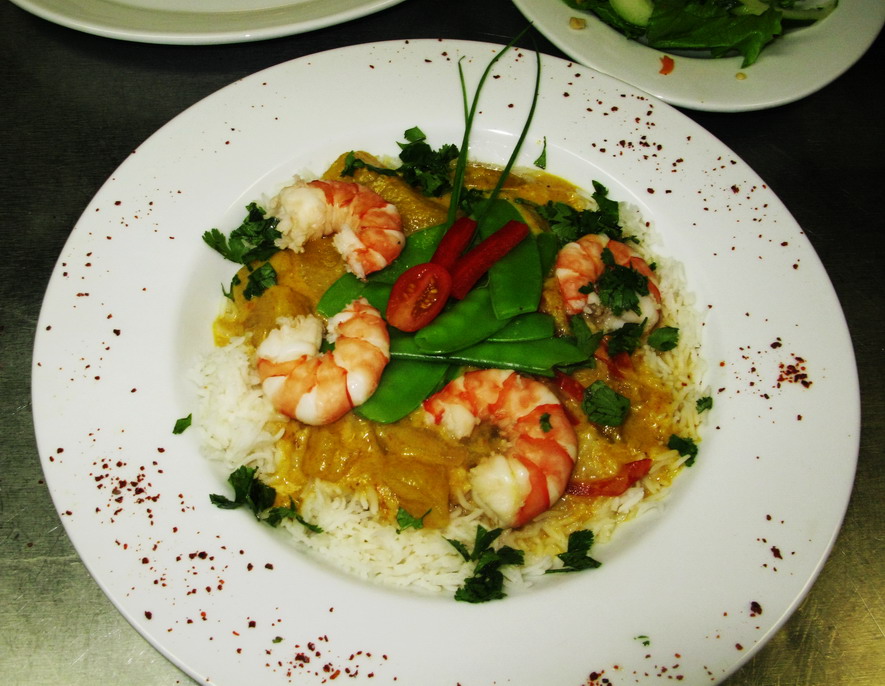
One of the things I like best about working in a restaurant is that it simply isn’t enough to make food that tastes great–it also has to look good.
Everyone eats first with their eyes (and arguably, with their noses), long before the first morsel passes their lips. And there are few things more satisfying to a server or chef than to see guests’ eyes light up when beautiful plates are set before them, steam writhing upwards in an enticing dance, carrying delectable aromas forth.
People become excited when they see food that is colorful arranged on a plate in an artful, thoughtful manner. The greatest chefs present delicate morsels arrayed like sparkling gems on pristine plates painted with vibrant colored sauces. This sort of presentation is an art form, with architectural elements made of edibles, stacked layers of different textures and flavors combined for gustatory as well as visual impact, and requires a great deal of skill that is often beyond the abilities of most home cooks.
And while I am capable of such presentation, and appreciate it, it is not how I choose to present my own creations. It is too fussy for me, and as beautiful as I find the works of Eric Ripert to behold (I still haven’t tasted his food, although Morganna, lucky wench, has and she tells me that his dishes are as heavenly on the tongue as they are delightful to the eyes), my own aesthetic is informed by the food and cooking I grew up with on the farm in West Virginia. I guess you can take the girl out of the hills, but the hillbilly still remains, deep in her heart, expressing itself in small, unexpected ways.
My own culinary aesthetic is for ethnic home cooking–multi-cultural soul food, if you will–presented simply, but beautifully, in a way that is respectful to the cultures which originated it, while still allowing playful personal experimentation.
And when presenting these comforting foods simply, that doesn’t mean I just slop some stuff on a plate and call it done–I like to make my food, particularly at Salaam look just as good as it tastes. But, I am not going to sit and build a stack of dinner on a plate, either, because I want my guests to be comfortable with their food. In many cases at Salaam, when we present the foods of the Silk Road, we are already venturing outside of many of our guests comfort zone, by giving them unfamiliar ingredients and dishes from places many of them may not have ever heard of, or thought about at all.
In such cases, it is best to give the guests something to hold on to–a touchstone that they can relate to. And so my more casual, but still beautiful, plate design is that touchstone. I don’t give them food that they may have to puzzle out how to eat it, I just present them with food that is about what they would get in someone’s home, only I have gussied it up a bit.
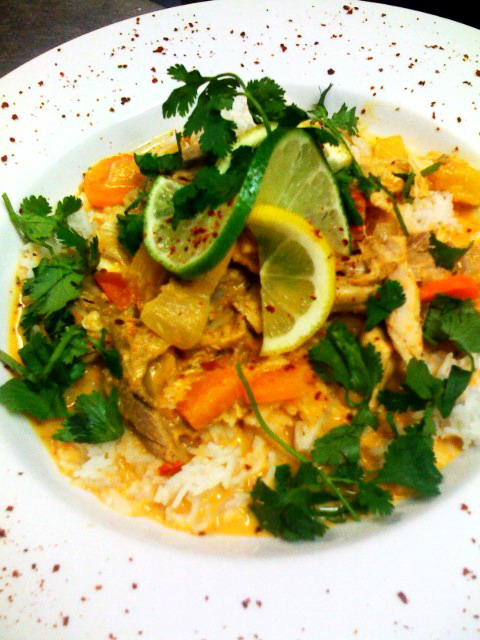
There are some principles to my seemingly loosey-goosey method of casual plate design. I like a balance in colors, which you can see in both of these Thai coconut milk curries. The yellow curry in the first picture has primarily warm colors from the turmeric-colored curry, the pink shrimp, the tomatoes, mangoes and sweet red peppers, but this is balanced with the fresh cool shades of green from the cilantro, chives and snow pea pods. The white rice and plate make a nice, neutral canvas for the brilliant colors of the ingredients–and of course, steamed jasmine rice is the traditional starch served with the curry.
Contrasting or complementary colors make a plate pop–that is something to keep in mind. Look at the red pepper and tomato on top of the pile of snow peas in the first photograph. They look yummy, not only because they are yummy, but because red and green are complementary colors–opposites on the color wheel. Red, yellow and blue are primary colors; orange, green and purple are secondary colors made of a combination of two primary colors. Green is a combination of yellow and blue–what makes it complementary to red is that it lacks red in its makeup. Orange is blue’s complement and purple is yellow’s. For plate designs that really stand out–try and use complementary colors next to or on top of each other.
Colors that are next to each other on the color wheel make for a harmonious look. This is exemplified in the second photograph–the warm colors red, orange and yellow colors abound in this plate, making it all harmonious. The only cool color is green from the cilantro and lime slice, although the lime slice is a yellowish green, making it a warmer green than the cooler, bluer cilantro. The use of primarily warm colors makes this plate look happy, harmonious and cheerful, and the deep, cooler green of the cilantro pops in contrast to the reds, yellows and oranges, while the lime just fits right in with them.
I also like to use both symmetry and asymmetry in my plate design. As you can see in both photographs, symmetry is very pleasing to the human eye. Look at how the shrimp are arrayed in a circle, all pointing in the same direction, so the curves of the shrimp give a sense of motion to the composition. This radial symmetry exists in nature all over the place–look at daisies and other compound flowers, or the markings on a sand dollar. I like echoing the natural world on my plates–it is a harmonious design that is calming to the human psyche.
The lemon and lime slices twisted and placed carefully atop each other in the second photograph of the red curry chicken also echoes the radial symmetry of a flower. These are sprinkled with brilliant scarlet pepper flakes to give a contrast in color which reminds me of the freckles in the throat of a lily blossom.
Asymmetry comes in with the yellow curry. Note that I put two chive leaves in the center. They are of differing lengths, and while they stick up from the plate and offer a sense of height, they are not the same height. They also point in the same basic direction, so they introduce an element of asymmetry into the otherwise almost perfectly symmetrical design. This adds and element of movement, and it draws the eye toward the center of the plate where the beautiful emerald green snow peas are piled in a casual, imperfect conical shape.
On the red curry plate, you can see I tucked a sprig of cilantro under the citrus “flower” to once again add a sense of height and a random, asymmetrical element.
These casual “rules” of plate design can be used by any home cook to make their foods look better. And, if a dish looks better, I have found that it often tastes better–because, as I noted at the beginning of this post–people eat first with their eyes, then their noses, and finally with their mouths.
So there we are. Think about a balance of colors, a sense of movement and height and the pleasant effect of symmetry contrasted with the surprising element of a touch of asymmetry when you present your guests at home with a delicious dinner. You may find that with a little bit of thought and care that your food will not only look better, it will taste better too.
Enchanted Forest Pasta: It’s Local And Seasonal

Today was a gorgeous spring day: the sun was bright, the sky was a perfect robin’s-egg blue, and flowers bloomed, filling the birdsong-laden air with fragrance.
Zak’s favorite tree is blooming, the tree that always says “springtime” to him–the redbud.
A native to the eastern US, particularly the Appalachian mountain regions, the redbud is a very small leguminous tree which in the spring is covered with tiny magenta-violet blossoms that look like miniature sweet pea flowers. Of course, there is a reason for that–remember I said that the tree was leguminous, meaning it is related to garden peas, sweet peas, peanuts, locust trees, beans of all sorts and lentils.
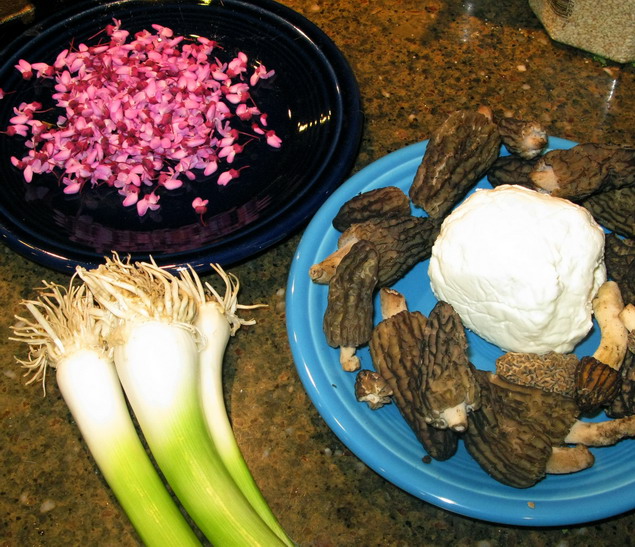
These tiny, lovely blossoms are edible, a fact little known outside of Appalachia. They are most often eaten raw in salads or used as a garnish, although they are also sometimes added to sauces or soups so they barely cook, retaining their fresh rosy coloration. Their flavor is rather bean-like, lightly sweet and somewhat starchy, with a tiny tang in the finish.
Long ago, the greenwood twigs and bark were also used to season game meats, leading to the common name, “spicewood tree” by which it is still known in isolated areas of Appalachia.
I like eating the flowers–I like the fresh sweet bean flavor, and in the past, I have mostly used it in salads and salad dressings, although I have also cooked with it, most notably in stir-fried dishes. But, as much as I enjoyed adding redbud flowers to chicken with bitter melon, the application wasn’t really as seasonal and local as it could have been.
I mean, there are plenty of classic Appalachian springtime foods one can gather from the wild with redbud flowers. Ramps are a perfect example, as are morels and tiny baby sheep sorrel.

I lucked into a pint of morels at the farmer’s market on Saturday which had been gathered by Chris Schmiel, founder of the Athens County PawPaw Festival, cultivator and gatherer of pawpaws, black walnuts, spicebush berries, ramps, wild mushrooms and all the other fine bounty of our Appalachian woodlands. He also makes the most delicious fresh chevre I have ever eaten in my life. Moist and soft with no chalky mouthfeel and delicately flavored with just a hint of sharpness, it is amazing. I buy some every week starting in the spring and continuing into fall, as long as his goats continue giving milk.
This afternoon while we drove off to Lancaster to pick up some sewing machine needles, as I watched the scenery pass and saw all of the redbuds in joyous bloom, I had the inspiration of combining morels, redbuds and chevre into a pasta sauce. If I’d have had ramps, those would have gone into the sauce as well, but I was out of them. Instead, I used some green elephant garlic, which I bought from Rich Tomsu at the market on Saturday.
(When I told Zak about the idea, he grinned and said that what he liked best about local foods was the seasonality of them. That you only have redbuds, ramps, and asparagus for short periods of time, so you eat a lot of them, and feast, and it is like a holiday that you look forward to all year around. Because, as he said, yeah, eating local is politically satisfying and good for the environment, but what turned him into a convert was that it all tasted so good. )
Green elephant garlic looks an awful lot like leeks, (there is an excellent reason for that–elephant garlic is more closely related to leeks than to garlic) but I discovered while I was cooking it that it smells and tastes like a milder form of ramps. The green and white stalks worked perfectly in the sauce, which I decided to call “Enchanted Forest Pasta” because the conical shape and wrinkled visage of morels reminds me of what little gnomes wearing pointy hats might look like, and because I always think that eating flowers is somewhat fey and not entirely proper. There is just something fairytale-like about eating foods gathered from the woodlands, and I cannot help but think that I eating what elves and spriggans might eat if the did indeed exist.
Like most simple pasta sauces, this dish went together easily and quickly. The morels required the most effort, being as they tend to hide grit and dirt in their hollow centers or among the wrinkled whorls and crevices of their surfaces. I rinse them briefly in water, cut them in half, trimming the bottom of the stem if it is tough, and then I shake each halved cap in a small bowl, knocking loose any remaining dirt and sand. Then, I take the caps out of the bowl and set them aside to dry until it is time to cook them.
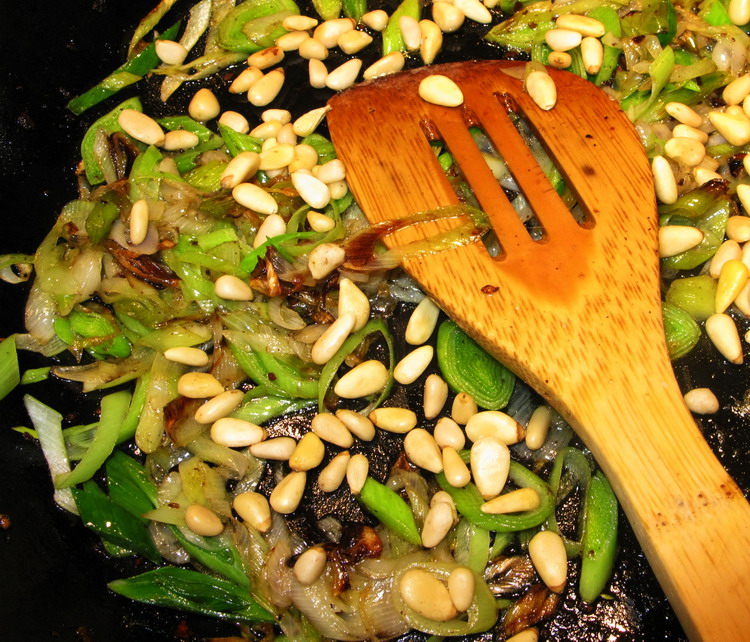
The only non-local ingredient that I used in this sauce (the pasta wasn’t local, either, nor was the Aleppo pepper, now that I think on it) was the handful of pine nuts I added to it. I just thought that they would taste good with it, and I wanted something with a bit of crunch other than the fresh buttered breadcrumbs I made out of the heel of a loaf of honey oat bread from The Village Bakery, which is just down at the bottom of the hill our house sits on. While the pine nuts were good, honestly, I think that the breadcrumbs would have been fine on their own.
So, here is the recipe–note that it has fewer ingredients than most of my recipes, and that makes it great for a weeknight for normal folks, for a weekend after a long night shift for a restaurant worker. It is a beautifully balanced dish–the meaty, earthy morels flavor the cream and thus the sauce, but are held in check from overpowering everything by the sweet sharpness of the green garlic, and the tang of the goat cheese. The breadcrumbs and pine nuts add crunchy brown notes and the redbud blossoms add as sweet, leguminous crunch and aroma. It is the essence of springtime in the Appalachian hills and valleys I have always called home.
This would be great with a baby spinach salad topped with roasted baby beet slices and dressed with a simple balsamic vinegar and olive oil dressing.

Enchanted Forest Pasta
Ingredients:
1/4 cup butter, divided
1/2 cup green elephant garlic, white and light green parts only, thinly sliced (or use regular green garlic, leeks, or the white and rose colored part of ramps–the bulb parts)
pinch salt
1 pint fresh morel mushrooms, well washed and dried, stems trimmed as needed, and cut in half longitudinally
1/2 teaspoon Aleppo Pepper flakes or a pinch of hot pepper flakes or freshly ground black pepper to taste
1/2 cup freshly ground up breadcrumbs from some really good, but somewhat stale, wholegrain bread
1/2 cup dark green parts of green elephant garlic leaves, or leeks or regular green garlic or ramp leaves, thinly sliced
1/4 cup pine nuts–optional
1/3 cup cream
4 ounces fresh chevre
1/2 cup fresh redbud blossoms, stems removed
salt and pepper to taste
Method:
Put one tablespoon of the butter in a heavy-bottomed skillet over medium heat and allow to melt. Add green elephant garlic slices and sprinkle with salt, and saute until white parts are golden, stirring constantly to break up the slices into rings. Add one more tablespoon of butter, and add the mushrooms, and cook, stirring until they shrink a bit and soften, about three minutes. Add the Aleppo pepper, the pepper flakes or black pepper, and scrape out contents of pan into a bowl and set aside.
Add another tablespoon of butter to the pan and stir in the breadcrumbs, and cook until toasted and fragrant–about two minutes. Scrape out into a bowl and allow to cool.
Add final tablespoon of butter to the pan, and add the green tops to the garlic, along with pine nuts. Cook, stirring, breaking up garlic slices into rings, until fragrant and pine nuts are lightly toasted. Add the first batch of garlic and the morels back into the pan, and deglaze pan with the cream, scraping up any browned bits that have stuck to the bottom.
Allow cream to reduce for about two minutes, then crumble the chevre into the pan, stirring until it melts and incorporates itself into the sauce.
Add 1/2 of the flowers to the pan, and stir well to combine. Add salt and pepper to taste if needed. Toss the sauce with cooked, drained al dente pasta, then garnish with the remaining flowers and the breadcrumbs.
Serves four for a main course.
Chefs And Profanity: Some Thoughts
Pete Wells wrote an interesting piece for the New York Times last week on the subject of chefs and profanity. Entitled, “Too Much Heat in the TV Kitchen?,” the article notes that while extreme language in the kitchen is nothing new, largely unedited consumption of it by the media, and then the reading/television viewing public -is- a new, rather odd, phenomenon.
Opening the story with examples from the latest episode of Bravo’s “Top Chef” where the contestants melt down and fling curses and imprecations at each other, a March 24 New Yorker profile of Chef David Chang (a great article, by the way–if it was online, I’d link to it), and of course, the notorious Gordon Ramsay of “Hell’s Kitchen” and “Kitchen Nightmares,” Wells’ readers are deluged with a barrage of video and print evidence that chefs are angry, foul-mouthed individuals who apparently cannot express themselves verbally without tossing expletives into their sentences like croûtons into a salad.
And, apparently, not only does the public like it that way, they now -expect- it to be that way. In the new mythology of television reality shows, chefs are swaggering bad boys, badder than rock stars, and ten times tougher, in large part because they carry knives and play with fire twelve hours a day under working conditions that would make the average testosterone-laden, hard-drinking, heroin-shooting, groupie-banging lead guitarist run away, crying like a little girl for mamma.
And if there is one thing that is true, we humans like our myths.
Especially if they are based in part on truth.
Because, the truth is that most restaurant kitchens are stressful and hellish workplaces in the best of times. They are most often cramped, filled with dangerous equipment which may or may not work properly, open flames from various sources, both fixed and movable, inadequate ventilation, open vats of boiling oil, not to mention loads of very sharp objects which are meant to cut, rend and otherwise disassemble ingredients, but which are equally capable of taking off a finger or portion thereof, or ripping open an arm, a hand or any other body part that gets in the way. (No I am not just talking about knives, but also electrical equipment like bone saws, food processors, immersion blenders, and meat slicers, all of which carry immense destructive potential.)
And the stress–the necessity of working impossibly quickly and accurately, of neither wasting valuable raw materials, nor sending out inferior product, and of putting out sometimes hundreds upon hundreds of plates a night–all while working in close quarters with similarly stressed out people–it is enough to crack anyone one at least once.
When you put human beings into work conditions like these, and push them to perform perfectly, you cannot expect them to not blow off steam somehow. That is where the swaggering comes in, the gallows humor, the profane banter, and the camaraderie where insults become terms of endearment and where sexual innuendo and blatant sexual harassment of both men and women becomes the norm. (This is why many restaurant kitchens are considered to be hostile workplaces to women–a situation which is changing, and which is not the focus of this essay, but which I will talk about in the future.)
You have to understand that most kitchen workers are overworked, underpaid, and often have very little life outside the kitchen. They don’t get enough sleep, they often eat too little, and they cannot relax in any normal way, so they turn to alcohol, drugs, sex, and yes, foul language, to make it through the days and nights of their existence, all so they can turn out endless plates of gorgeous food for people who have the money and leisure time to spend on it, people who most often would never sit down to break bread with these cooks, and even if they would, might be dismayed at how the cooks would act and talk at the table.
This sort of adaptive behavior–reacting to extreme stress with foul language, dark humor and consumption of various inebriating substances–is nothing to be ashamed of, but nor should it be lionized, either.
I mean, it used to be, and still is true, that when chefs were called out to the dining room to speak to a table of guests, they would behave graciously and with courtesy. (There have always been exceptions–Marco Pierre White, the original chef from hell who once made a young cook named Gordon Ramsay cry, for example, is also said to have thrown customers out of his three-star restaurants for requesting salt and pepper.)
But now, it seems that we Americans expect all chefs to be the way we see a few of them act on television, that having a foul-mouthed, bullying persona is normal and natural to the life of a chef.
A lot of people might blame all of this reverence toward the irreverence of chefs and cooks on Anthony Bourdain, because his best-selling memoir, Kitchen Confidential, laid bare the seedy underbelly of the culinary world, and was for most people who had never stepped foot into a professional kitchen, a revelation. It was a look inside the harsh, hard life of line cooks and chefs, a look at what kitchens are really like for non-celebrities and it did whet readers’ appetites for the gritty ugliness that supports and creates the glittering facade of haute cuisine. But, the truth is that all Bourdain did was tell the unvarnished truth of his life and the lives of fellow cooks and chefs. Yes, he glorified that life, because he was living it, he loved it and he loved those in that life–but that is because you cannot possibly live and work in that way without loving it. You -have- to be tough, you have to be strong and you have to have a thick skin to get by and ultimately succeed in a professional kitchen.
But what American television producers have also ignored when they show Gordon Ramsay heaping abuse on the hapless, untalented victims who volunteer to be terrorized on his show “Hell’s Kitchen”, is that in order to be as successful a chef as Ramsay (who has a total of twelve Michelin stars to his credit, which is no mean feat), you not only have to have a thick skin and a load of talent.
You have to have heart.
You have to have passion.
You have to have love.
And not just for food, either.
You have to love people.
You have to love the people you work with and for, even if you sometimes lose your temper and yell.
You have to love the people you are feeding, because that is what being a chef is truly all about.
It is about feeding people, body and soul, the creation of your heart and hands. It is about giving them love in the visceral form of food that has been elevated beyond simple sustenance into the realm of art.
It is about giving them a piece of yourself.
That is what I find most disturbing about the recent insistence upon portraying all chefs as bullying, ego-driven martinets who seem to revel in treating their cooks and each other as verbal punching bags. It bothers me because I know that in order to cook from the heart and make food that will make grown men weep with joy and longing, you have to have a heart to cook from.
And that is the truth that Bourdain knew and knows, that Ramsay and White both know, but which I fear American television producers ignore and misrepresent in the name of ratings.
And it is a god damned shame.
Appalachian Pasta Primavara
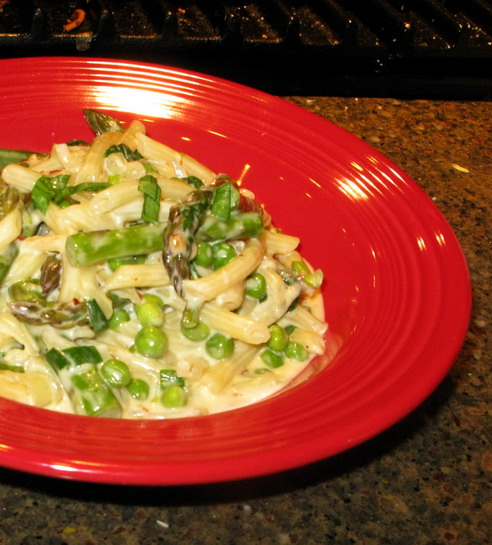
Spring is finally in full swing, with sunny days, cool nights and the warming earth is sending forth shoots, leaves and flowers to be enjoyed by all who long for fresh green vegetables after a winter of potatoes, turnips, squash, and frozen and canned veggies.
This recipe came out of what was in my refrigerator. Much of it came from the farmer’s market, so it is local, but I have to admit that the asparagus was from the grocery store (and California before that) and the peas were frozen, also probably originally from California. We still have a week or so to go for fresh peas and asparagus here. BUT, as soon as I get my hands on them, and maybe some morel mushrooms plucked from our damp Appalachian earth, you can be certain that I will be making this dish again.
It started out as pasta alfredo. Except that as I was digging about in the fridge, I thought to myself, “Alfredo isn’t really that nutritive, and it can be somewhat bland. Let’s add some onions and garlic–ooh, I have fresh local green garlic from the farmer’s market. And ooh–look, I have that asparagus I bought yesterday. Oooh. And the ramps from the farmer’s market–those will certainly add flavor. And frozen baby peas. And oh, look–that fresh goat cheese I picked up at the farmer’s market too. I bet that would be awesome.”
So, out of the fridge and pantry came all of the aforementioned bounty, and within twenty-five minutes, dinner was on the table: pasta with springtime vegetables in a sauce made from local cream, goat cheese and a sprinkle of imported Parmesan.
I think that the only way to improve this dish, other than using locally grown peas and asparagus, would be to add morel mushrooms to it. Zak would disagree with me, but that is because he suffers from funguphobia, which is a very sad thing. Sad for me, anyway, because that means I seldom get to indulge in my funguphilia. Zak, on the other hand, is perfectly happy avoiding mushrooms.
Anyway, here is the recipe, which is simple to put together and makes a great meatless meal in celebration of the fresh springtime foods, especially if you add a spinach and leaf lettuce salad with delightful radishes like we had from the market as well.
Zak calls this dish “Twigs and Berries Pasta,” because of the shapes of the vegetables and the penne I tossed with it, but I prefer my slightly more accurate name.
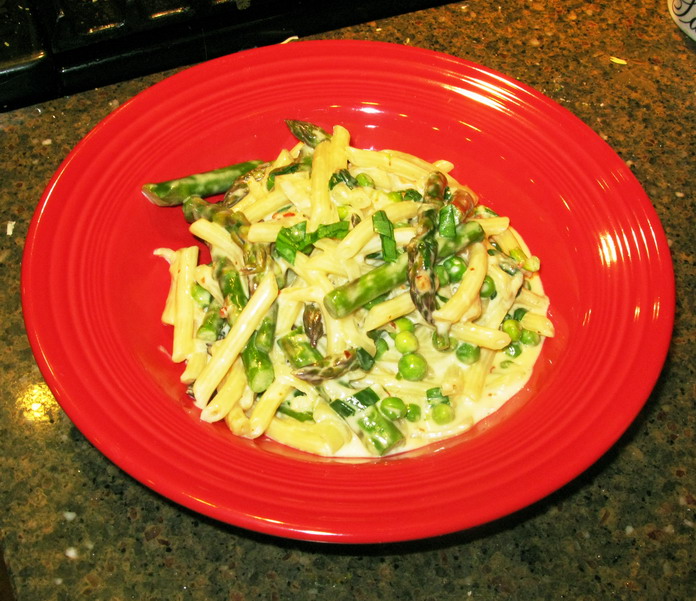
Appalachian Pasta Primevara
Ingredients:
2 tablespoons butter
3/4 cup thinly sliced onion
1/4 teaspoon salt
1 tablespoon minced green or regular fresh garlic
1/2 teaspoon Aleppo pepper flakes
3/4 pound thin asparagus, trimmed and cut into 1″ lengths
1 cup freshly shelled or frozen peas, thawed
1/3 cup heavy cream
1/4 cup freshly grated Parmesan cheese
4 ounces fresh goat cheese
1 cup thinly sliced ramp leaves
Method:
Heat butter over medium heat in a heavy-bottomed skillet until it melts, then add onion. Sprinkle with salt and cook until golden, stirring as needed. Add garlic, Aleppo pepper flakes and asparagus and cook until garlic is golden and fragrant and asparagus is bright green, but only half-tender. Add the peas and the cream, and cook.stirring until the asparagus is tender and the cream reduces slightly.
Add the two cheeses, and stir until the melt, then stir in the ramp leaves, and add cooked pasta to the pan, and toss to combine.
Serve with salad.
(You could add baby spinach leaves to this at the end along with the ramp leaves, or some morels when you cook the onions.)

Categories:
- Admin (rss) (55)
- Blogs and Blogging (rss) (81)
- Book Reviews: Cookbooks (rss) (43)
- Book Reviews: Non-Cookbook Food Books (rss) (38)
- Cats and Cat Blogging (rss) (47)
- Chinese Cooking Lessons (rss) (32)
- Culinary School Stories (rss) (18)
- Dairy Pruducts: Cultured and Barbaric (rss) (4)
- Documentary Filmmaking (rss) (1)
- Essays, Rants and Reflections (rss) (260)
- Fighting Hunger (rss) (12)
- Food and Kids (rss) (45)
- Food in the News (rss) (126)
- Food Media (rss) (98)
- Food Preservation (rss) (18)
- Food Safety (rss) (45)
- Gardening (rss) (30)
- Herbs and Herb Blogging (rss) (20)
- Holidays (rss) (50)
- Kat Blogging (rss) (22)
- Kitchen Science (rss) (36)
- Leftover Makeover (rss) (8)
- Life, the Universe and Everything (rss) (131)
- Local and Sustainable (rss) (227)
- Local Athens Food and Foodies (rss) (42)
- Meatless Mondays (rss) (32)
- Menu For Hope (rss) (5)
- Nutrition, Diet and Health (rss) (84)
- On The Farm (rss) (8)
- Recipes: Almost Vegetarian, Vegetarian and Vegan (rss) (294)
- Recipes: American Regional (rss) (37)
- Recipes: Appalachian Hillbilly (rss) (33)
- Recipes: Bread, Pasta, Grains (rss) (95)
- Recipes: Canning and Preserving (rss) (8)
- Recipes: Chinese (rss) (123)
- Recipes: Comfort Food (rss) (120)
- Recipes: Cookies (rss) (16)
- Recipes: Desserts (rss) (48)
- Recipes: French (rss) (25)
- Recipes: Fruits and Vegetables (rss) (302)
- Recipes: Greek, North African and Middle Eastern (rss) (31)
- Recipes: Indian (rss) (137)
- Recipes: Italian (rss) (42)
- Recipes: Japanese (rss) (7)
- Recipes: Jewish (rss) (4)
- Recipes: Korean (rss) (6)
- Recipes: Meat, Poultry and Fish (rss) (220)
- Recipes: Mexican/Native American/ Latin American/Caribb (rss) (27)
- Recipes: Original (rss) (108)
- Recipes: Thai (rss) (27)
- Recipes: Tofu (rss) (17)
- Recipes: US Regional (rss) (16)
- Recipes: Vietnamese (rss) (8)
- Restaurant Stories (rss) (28)
- Sewing, Quilting, Arts and Crafts (rss) (16)
- Simple Chinese Recipes (rss) (30)
- Slow Food and Heritage Foods (rss) (10)
- Spice Blogging (rss) (44)
- The Chinese Cookbook Project (rss) (14)
- The Chinese Pantry (rss) (39)
- The Documentary (rss) (2)
- The Kitchen Saga (rss) (17)
- The Locavore's Bookshelf (rss) (15)
- The Unsung Adventures of The Culinary Nerd (rss) (6)
- Tools and Toys (rss) (35)
- Uncategorized (rss) (10)
- With a Side of Politics (rss) (48)
Archives:
- August 2012 (9)
- July 2012 (12)
- September 2011 (3)
- August 2011 (7)
- July 2011 (8)
- June 2011 (16)
- May 2011 (17)
- April 2011 (11)
- December 2010 (9)
- November 2010 (5)
- February 2010 (1)
- December 2009 (5)
- November 2009 (7)
- October 2009 (10)
- September 2009 (16)
- August 2009 (14)
- July 2009 (14)
- June 2009 (7)
- May 2009 (17)
- April 2009 (10)
- March 2009 (25)
- February 2009 (13)
- January 2009 (10)
- December 2008 (5)
- November 2008 (5)
- October 2008 (6)
- September 2008 (13)
- August 2008 (8)
- July 2008 (11)
- June 2008 (18)
- May 2008 (13)
- April 2008 (14)
- March 2008 (16)
- February 2008 (17)
- January 2008 (19)
- December 2007 (25)
- November 2007 (18)
- October 2007 (24)
- September 2007 (16)
- August 2007 (15)
- July 2007 (15)
- June 2007 (10)
- May 2007 (14)
- April 2007 (16)
- March 2007 (17)
- February 2007 (20)
- January 2007 (13)
- November 2006 (1)
- October 2006 (8)
- September 2006 (14)
- August 2006 (25)
- July 2006 (30)
- June 2006 (28)
- May 2006 (34)
- April 2006 (29)
- March 2006 (24)
- February 2006 (30)
- January 2006 (38)
- December 2005 (40)
- November 2005 (37)
- October 2005 (32)
- September 2005 (25)
- August 2005 (30)
- July 2005 (28)
- June 2005 (21)
- May 2005 (8)
- April 2005 (22)
- March 2005 (17)
- February 2005 (29)
- January 2005 (10)
Search Site:
Links:
- Lily’s Wai Sek Hong
- 101 Cookbooks
- A cat in the kitchen
- A Veggie Venture
- Accidental Hedonist
- Cha Xiu Bao
- chez pim
- Chocolate & Zucchini
- Chopstick Cinema
- Chowhound.com
- Chubby Hubby
- Cook sister!
- Cooking with Amy
- da*xiang
- Eat Local Challenge
- Eating Liberally
- Ecocentric
- Eggbeater
- Epicurious
- Farmgirl Fare
- Fatfree Vegan
- Foodgoat
- ForkandBottle.com
- Green Olive Tree
- Hooked on Heat
- Jaden’s Steamy Kitchen
- Kalyn’s Kitchen
- Lucullian delights
- Mahanandi
- Matt Bites
- MeatHenge
- mmm-yoso!!!
- New York Times – Dining & Wine
- Pizza Goon
- Rasa Malaysia
- Ruhlman
- Sailu's Kitchen
- Serious Eats
- SF Gate: Food & Dining
- Simply Recipes
- Soul Fusion Kitchen
- Tastespotting
- The Amateur Gourmet
- The Cleaner Plate Club
- The Food Section
- The Grub Report
- thecookscottage
- U.S. Food Policy
- Wandering Chopsticks
- Washington Post Food and Dining
- Wasted Food
Meta:


Powered by WordPress. Graphics by Zak Kramer.
Design update by Daniel Trout.
Entries and comments feeds.