
Cook Local, Eat Global
Preparing for Kat’s Arrival: Sewing, Cooking and Freezing
As I have come into the third trimester of my pregnancy with Kat, I have come to a few determinations.
One is that pregnancy is much easier on a 24-year-old body than it is on a 40-year-old body.
This does not mean that I regret having Kat; it just means that I am noticing a distinct difference in how my body responds to pregnancy this time around. My responses to pregnancy when I was twenty-four were much more classic: very tired, nauseous and cranky in the first trimester, very energetic and take charge in the second trimester, and then back to tired and cranky (and on bedrest) for the third trimester. (So far, we have avoided bedrest this time around. But for the last six weeks of my pregnancy with Morganna, my blood-pressure shot up, there was some protein in my urine and I started retaining fluid like a ripening watermelon. Fears of pre-eclampsia forced my doctor to tell me I had to go to bed and stay there, lest I end up in the hospital. In addition, I had to eat a low-sodium diet. This did not make me happy, but fear of hospital stays made me comply. But let it be known, that I am of the firm opinion that bed rest utterly and completely sucks.)
This time around, my experiences have been different. I was tired, nauseous and cranky for the frst trimester, and couldn’t eat meat. The not eating meat is distinctly opposite of my experience with Morganna where I craved meat of all sorts, particularly bloody rare or raw steaks. Not so this time. The scent of blood would send me running to the toilet. The second trimester, the nausea mostly faded, and I got -some- energy back, but never experienced the amorousness or the burst of crazy energy that most women seem to get in the middle three months of pregnancy. I returned to being able to eat -some- meats, but not very many, and found myself craving a lot of beans and corn and whole grains. And greens! I still go crazy for greens. (And chocolate, but that is a constant with me anyway.)
This third trimester has seen the return of the nausea, a return of the very strong meat aversion (I am disgusted to find that I only like to eat ground meats, chicken–so long as it is not bloody when I cut it up) and cured meats like ham, bacon or sausages. I also can eat and crave fish, which is good so long as I avoid the mercury-laden ones like tuna.), and a dwindling of energy that is very irritating, since I feel like I need to do everything in the world to get ready for Kat’s birth.
What is it I am doing?
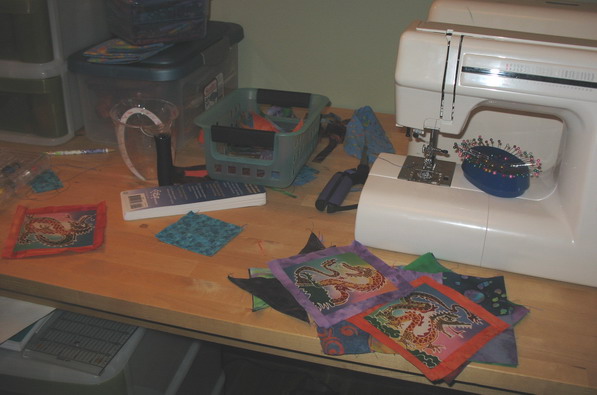
Well, I am working on a quilt for her, and even though my sewing machine has started showing signs of becoming possessed again, the work is going well and reasonably fast. It is a very brightly colored scrappy quilt done primarily in batiks and hand-dyed fabrics from my stash, that include some hand-painted Indonesian batiks of dragons. You can kind of see them up in the photo at the beginning of the entry there. When the quilt top is done, which should (cross my fingers) be sometime this week, I will post a photo of it.
What do I mean when I say my machine is showing signs of becoming possessed? Well, I seem to have this effect on machinery that I use often–maybe Dan will pipe in on the comments and talk about all of the evil things that my presence used to do to the copy machines, heat tape binders and computers at the copy shop where we used to work together. Mechanical machines are the most badly affected, and the sewing machine I have is very much a mechanical one. (I break mechanical watches when I wear them–they just stop. My mother is the same way, and so was her father–interestingly, all three of us can also dowse for water. Weird crap. Grandpa’s theory was that we had some sort of difference in our electromagnetic field that caused these effects.) Anyway, sewing machines will work for me for a certain period of time, and then just start going haywire in weird ways. I do all the troubleshooting things one is supposed to do, and most of the time, these efforts do nothing, and the machine either has to be taken in for adjustments, or it just starts working again on its own recognizance.
The latter is what happened to my machine. On Saturday, while I tried to work on the quilt, it started losing it and eating fabric, the tension on the bobbin thread went mad, and the upper thread just started breaking for no reason. Nothing I did helped. I was certain that I would have to drive the beastie to Columbus this week to get it worked on, and had resolved to do this (though I did threaten the machine that if I had a shotgun, the three of us–machine, shotgun and I–would be going to the backyard and the machine would have been blown into a thousand pieces by the time I was finished with it), and had finally calmed down over it.
Yesterday, on a whim, I decided to try and see if it would behave.
It worked like a brand new machine that had just been tuned up, cleaned and oiled.
That is what I mean by “possessed.”
The other preparations I have been making have been in the kitchen. I am cleaning out our freezer and refilling it with food that Morganna and Zak can just pull out and either microwave or throw into the oven. So, I have been cooking a lot of old standards and favorites, (which I have already blogged about), such as chili, Vegetarian Enchiladas Verde, lasagne, and shepherd’s pie, and breaking up the recipes into two portions. One, we eat right away, and the second portion, I either layer into aluminum foil pans, and seal up with foil then freeze, or I dump into freezer bags, label and freeze. That way, we don’t have leftovers, but, we also have dinners ready for right after we bring Kat home to eat while I am recuperating and concentrating on getting into a breastfeeding routine with Kat.
Here is a good place to talk a little bit about freezing things for later.
Some foods freeze well.
Some foods do not.
Most things like stews, soups, and casseroles freeze really well. For stews, soups, chilis and pasta sauces, I cook them all the way, cool them all the way, and then pack them into ziplock freezer bags, press out all the excess air, and freeze them right away. (It helps if you label the bag with a Sharpie permanent marker before you fill it. After you fill it or freeze it, it is rather a pain in the butt to label it properly. And when I say properly, I mean, put the name of what you made, how many servings, and the date. Always put the date on the package.)
Potatoes in stews and soups and curries don’t so much freeze well. They get mushy in the freezer. If you must have them, it is best to omit them, and then make a note on the package for them to be added after the meal is thawed and warmed up on the stove. It never hurts a soup or stew or curry to cook a bit longer anyway, and so you can let it simmer along, then add some freshly cut up ‘taters, and then garnish it all up nice when the potatoes are done and voila–you have a fresh-tasting meal.
There is an exception to the potatoes rule. Mashed potatoes are fine frozen–in large part, I suspect because they are already mushy. So shepherd’s pie works fine, or heck, just a container of frozen mashed potatoes works nicely as well.
Casseroles I do differently. I love those little square foil pans that you can get at the grocery store. I use those to layer up a portion of the recipe, which I follow up to the baking part. Then, I seal up the pan with some foil, upon which I have written the necesssary information, including baking instructions, and boom, into the freezer it goes. Once it is frozen, I then take it back out and seal the whole thing up in a large ziplock freezer bag which I push the excess air from. This keeps the casserole tasting fresher–foil in a freezer can get pushed aside and opened up, and can allow freezer burn to happen.
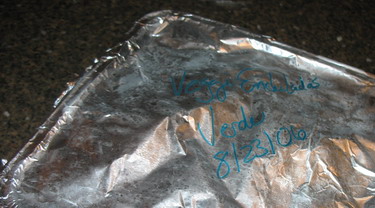
Tonight, I am going to do two pans of moussaka, a classic Greek casserole of eggplant, potatoes, lamb and tomato sauce and a thick, egg and cheese enriched bechemel topping. To freeze that, I will layer to the vegetables and meat sauce and leave off the bechemel, then freeze it. The bechemel instructions I will print out, seal onto the foil wrapper with freezer tape, then seal the whole thing into a bag and put in the freezer. That way, Morganna or Zak can make the bechamel and pour it over the thawed casserole, then stick it in the oven. (Or, for that matter, I can make the bechamel and pour it over before popping it in the oven, while Zak or Morganna make salad.)
I need to get into making some pasta sauces, and putting them up in bags. Some puttanesca would be nice and freezes well, as does bolognese.
And–another project for this week includes the making of chicken stock–this will help me clear out my freezers of chicken bones, necks, feet and backs, which have been stored there with the intention of making stock at some point in the near future. I’ll drag those out today, let them thaw in the fridge, and then probably tomorrow, put the big stockpot on the stove and just watch it all day. (Yes, look for posts about moussaka and chicken stock later this week.) That way, the finished stock will take up less room than the bones, and it will be easy for me to take out and use what I need after Kat is born.
Until tomorrow, then, good cooking to you all! (I am off to see if my sewing machine is still behaving or if it has gone the way of Damien.)
Women, Memories and Food: A Trio of Book Reviews
After reading and enjoying Shoba Narayan’s Monsoon Diary: A Memoir With Recipes, I remember thinking to myself that I wished that there were more books like it out there.
Of course, there are countless culinary memoirs out there, from Anthony Bourdain’s Kitchen Confidential to Ruth Reichel’s epic trilogy chronicling her rise as a shining star of foodiedom, but I was less interested in reading about the lives of food professionals and more drawn to the narratives penned by authors who were not intimately involved in the culinary world. (My one exception is Julia Child and Alex Prud’homme’s My Life In France, which tells the story of how Child transformed herself from a wide-eyed expatriate in Paris to the American kitchen icon we all know and love. That story I thoroughly enjoyed and plan to read again at some point in the near future.)
Specifically, I wanted to hear more about the experiences of women, particularly those from other cultures, and how they expressed their feelings about food. Narayan’s book, of course, was not -all- about food, but it was the thread that bound the narrative together, and I found the way she wove her experiences in the kitchens of both her homeland of India and her adopted country of America to be enlightening and completely fascinating.
The fact that she added recipes to the mix made it all the more delightful.
In seeking out similar works, I was thrilled to find three treasures, all similar to Monsoon Diary in tone and expression, but differing drastically, just as the telling of any person’s life is going to be enormously different from the accounting of another individual’s experiences.
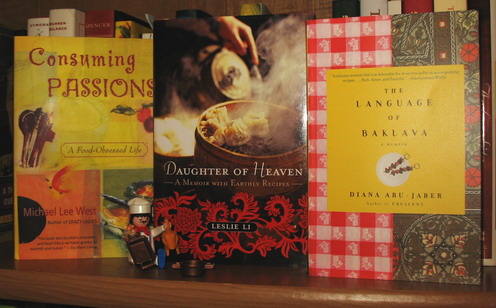
Diana Abu-Jaber’s The Language of Baklava tells a tale of a girl growing up between two vastly different cultures: the suburban America of her mother and the beautiful, urban and rural Jordan of her father. Torn between the extremes of growing up half Arab and half American, speaking both Arabic and English, eating delicious Lebanese food at home and standard American fare at school, Abu-Jaber does her level best to fit into both worlds, and finds herself alternating between comfort and disquiet as she navigates back and forth from one world to another.
Told with wit, poetry and a deft sense of humor, The Language of Baklava is a beautiful evocation of what it is like to being a citizen of a liminal reality. Abu-Jaber grows up “betwixt and between,” neither wholly one nationality or the other, but finally, in adulthood, she learns to embrace the totality of her experience and her family and celebrate everything which gives her a unique storyteller’s voice.
Abu-Jaber, like Narayan, does sprinkle delicious-sounding recipes throughout her narrative, so that readers can conjure up the dishes that fire her memories with fragrant poignancy.
Leslie Li’s Daughter of Heaven: A Memoir With Earlthy Recipestells a very different tale: that of a girl born of an American-born Chinese mother and a very traditional, very strict Chinese father. Li’s paternal grandfather was Li Zongren, the first democratically-elected vice president of China, to whom Chiang Kai-shek left power when he fled China for Formosa in 1949.
Nine years later, Nai-Nai, Li’s grandmother, her grandfather’s first wife, comes to live with her son’s family in the United States and fills their backyard with her vegetable garden and begins cooking traditional meals for her granddaughters. At first, Li and her sisters resist their grandmother’s food, but soon enough, they become seduced by its savor, and eventually, it becomes the lifeline that ties the family together. Li intersperses memory with history with recipes, and paints a stunningly realistic and nuanced portrait of her grandmother in process, immortalizing her in prose, which is a fitting offering to any beloved ancestor.
Michael Lee West’s Consuming Passions: A Food Obsessed Life, is not as tightly written a narrative as either Abu-Jaber or Li’s books, but while episodic and written into self-contained short remembrances and essays, it counts as a memoir. Rather than making of her life a tightly woven fabric that presents the story from beginning to end, West makes a patchwork crazyquilt, showing a glimpse of childhood here, and adulthood there, with a kaledscopic cast of characters turning up in each paragraph, dropping jewels of wisdom or hilarity from their mouths.
West, who, yes, is a woman, grew up in the South, and comes fully equipped as every Southerner does, with a family that is made up not of real people, but characters from an unwritten novel. (I know this is true of all Southerners, for I am one such person myself, and each and every person to whom I am related sounds like they stepped right out of some novel somewhere. Just ask anyone who has heard me tell the epic stories that revolve around my people.)
This Southern propensity for having unwritten novels for lives and characters for family members is probably related to the fact that nearly eveyone in the South is a born storyteller, innately gifted with gab, and a flair for the dramatic and the comedic in equal portions. West tells some great stories, and without fail she spins every yarn into something pertaining to food, and like all generous hostesses, she gives us the recipes for all of the dishes she serves forth.
I laughed aloud while reading Consuming Passions, as I suspect any reader would. I also gasped once or twice, and winced. It is just that kind of book.
All three of these memoirs are worthy reads; each of them gives a glimpse at the life of an ordinary woman who is living an extraordinary life.
Of course, reading these “extraordinary” lives leads an astute reader to understand that all lives are meat and bread for a skilled author; in the hands of an exacting wordsmith, the ordinary, the everyday, and the usual are transformed into the sublime.
Thoughts on Cooking (Or Not) For Kids
As my pregnancy wends its way into the home stretch, and I am continually reminded by the ever-more-frequent interior pummelling I am recieving of the incipient arrival of Kat, a small being whose food choices I will have a great deal of input into, I find myself thinking on the issues surrounding food and children more and more often.
Both food and children are subjects fraught with emotion to Americans; the intersection between them is a particularly perilous sea of contradiction, conflicting advice, well-meaning but misguided theories, media manipulation, health warnings, fears, paranoia and worries. Every parent must think on this issue, at least a little bit (I refuse to believe that parents just go on autopilot and feed kids whatever the television tells them to feed them–for this, I may be rightly or wrongly called an idealist), as they blunder through their experiences as the guiding light and civilizing influence upon the wee humans under their care.
We must remember that every parent brings his or her own food experiences, good and bad, prejudices, likes and dislikes and attitudes to the family table when it comes to feeding their kids, and we must also remember that no matter how poorly we think some parents make thier choices, often they believe that they are doing the best that they can for their kids and so we should be gentle in our criticism.
I cannot help but think deeply on this issue myself, because my experiences with food growing up were very different than my peers in most cases. Because my grandparents farmed, growing enough vegetables, fruits, fish, fowl, eggs, pastured beef and pork, to feed most of our family at least most of the time, I was not as firmly ensconsed in the advertising-led descent of the American diet into fast-food, packaged food mediocrity. At the time I was growing up–the late sixties and seventies, processed foods were still more expensive than plain, fresh foods, and fast food was still seen as an extravagance or treat. Sure, I still was given Kool-Aid or Hi-C to drink now and again, but water and milk were the beverages of choice, and soda or tooth-achingly sweet iced tea (which I never really liked) were given only in small amounts and as a summertime treat. People who drank soda habitually were looked down upon, and my mother and Grandmothers decried the practice of giving little kids soda habitually as being “bad for them.” (Now, there was no real discussion as to what exactly was bad about it, except for the sugar content, but the practice was still widely condemned.)
So, I grew up with a mother and two grandmothers who cooked to different degrees from scratch, who used minimal processed foods, with aunts and a father who all could throw down and put a fine meal on the table, too. I learned to eat what adults ate, and little concession was made to my child’s palate. Yet, still, my parents were not “food Nazis.” We still enjoyed pizza and went out for McDonald’s now and again, and more infrequently, to “nice” steakhouses and restaurants, where I got my first tastes of aged, rare-cooked filet mignon, a meat so far removed from my mother’s thin, well-done steaks that I did not recognize them as the same food. I grew up with fishermen in the family, so, alothough I was a pre-teen before I tasted shellfish or seafood, I had a love of freshwater fish: lake perch, catfish, bass, and bluegill, with rainbow trout being my favorite food of all time.
And yeah, I ate my share of grilled cheese sandwiches made of Velveeta, with canned Campbell’s cream of tomato soup, or peanut butter and jelly sandwiches on white bread. (Though, eventually, my mother relented when my father and I pressed the fact that we liked whole wheat bread (or as we called it, “brown bread”) better and started buying it. I grew up with hot dogs from the neighborhood beer joint, piled high with chili sauce, raw onions, mustard and coleslaw, or fried baloney sandiwches doused in hot sauce.
But on the whole, I realized as I grew up and went over to friends’ homes for supper, that my food history was very different from theirs. At their houses I encountered many more convenience foods such as frozen pizzas, Hamburger Helper, and tuna noodle casseroles (a hideous waste of canned tuna, packaged noodles and cream of mushroom soup in my opinion, both then and now), and was offered soda or Kool-Aid to drink, even though I would have preferred milk. It got to the point that I was more likely to have kids over to eat at our home, (with Mom’s blessing) than I was to eat with my friends, because I couldn’t stand the food they served, while with my Mom, I knew that my friends were getting good food. (And my Mom, bless her heart, would cook extra food for my friends who came from poorer households, and would carefully make sure to leave the table while we were still eating so that my friends could clear out the serving bowls without being made self-conscious. Neither she nor Dad ever said much about it, but it was their way of making sure my friends got healthy food as much as possible without hurting their sense of pride.)
Now, with all of this history behind me, I am looking forward to what it will be like to feed Kat as she grows up, continually in my care, her feeding my responsibility until she is old enough (and hopefully wise enough) to feed herself. I am both excited and humbled at the thought that it will be up to Zak and I to introduce her to the wide world of food, and it is an awesome responsibility. I -do- wonder if she will be a “picky” eater, though I am not too afraid of that possibility. If it is indeed true that food preferences are influenced in the womb, I don’t think I will have to worry about Kat disliking anything, except perhaps large slabs of meat, as I have eaten a varied, whole grain, vegetable, fruit, dairy and egg-based diet from day one of this pregnancy with small amounts of fish and meat added in as I can tolerate them. If kids are affected by their parents’ food choices, then I am not too concerned, as both Zak and I eat heartily and well, and Morganna, too, is very fond of good food, to the point where she cannot any longer tolerate fast food. (When she lived with her father, through most of her childhood, she ate mostly packaged and fast food, to the point that at times, I despaired of her ever liking real food.)
And, if television marketing of “kids’ food” is influential, I am not too worried. None of the three of us who live in this house watch television habitually. In fact, we only have the television in order to watch DVD’s of selected films and television shows, so we seem to miss out on advertising alltogether. Even our magazine consumption is such that we tend to miss most mainstream ads, to the point that when we visit friends and they have television on, we watch the commercials, stuptified at their number, inanity and crude techniques used to sell products that none of the three of us consider to be either useful or desireable. All I can think of when I watch them is “This stuff works?”
Apparently, it does with those who watch television, though, if the thing isn’t even turned on, I guess marketing is pretty ineffectual.
I find myself cruising through the “inner aisles” of the grocery store, looking at all of the “kids’ food” options, and pondering them. The cereal aisle is a wasteland of high fructose corn syrup and processed grains–simple carbohydrates all made “appealing” by the use of artificial food colorings in hues never seen in nature and smiling cartoon characters on the boxes. The frozen food section is rife with entrees and snacks aimed directly at kids: pizza rolls, “cheese” filled pretzel bites, corndogs, and chicken patties shaped like dinosaurs or Nickelodeon characters. A glance at the ingredients list of these items shows me that fat is apparently the primary food group for kids, with sugar and salt coming in close behind. Even the baby-food aisle is not safe from ickiness–sugar and starch seem to be the order of the day in those cute little jars of pureed foods aimed at every baby in every highchair in America.
You notice I am not even mentioning the phenomina of green or blue ketchup, as I find them to be to horrid to contemplate, because they further the idea that food for kids must be as fake as possible, and further the idea that food is not just food, but entertainment. While this is the case with adult food as well (El Bulli’s novel approach to foodstuffs that surprise and delight adults comes to mind), I don’t think that food she be marketed as entertainment to small children on the basis of making it look as little like food as possible.)
(Okay, there–I did mention the green and blue ketchup, even though I told myself I wouldn’t.)
What is the point of this long and rambling post?
Well, that it really isn’t -that- hard to cook for kids, and that cooking isn’t even necessary in order to feed kids a decent meal, without resorting to crap from the freezer or from the fast-food joint down the street.
Kids don’t need to eat french fries, tater or instant mashed potatoes just to save Mom the effort of cooking from scratch.
It just takes a bit of planning and effort is all.
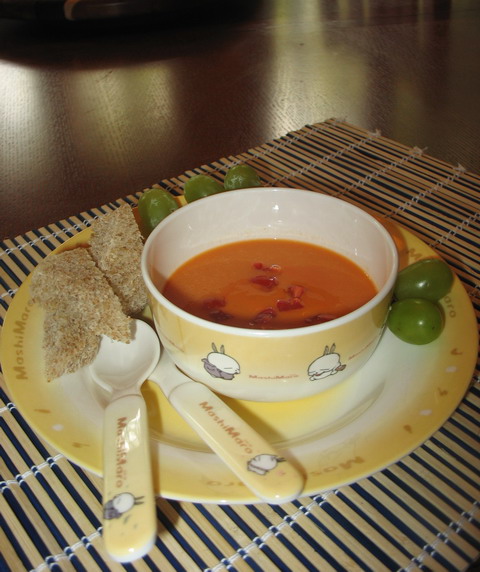
Look at the wee lunch pictured above. Whole grain bread from the local bakery, trimmed of crusts and cut into triangles. (Kids like novel shapes cut into sizes to fit their little hands. I remember this from helping prepare lunch for my younger cousins.) Cream of tomato soup from Pacific Organics that actually tastes like tomato, and is low in fat, but still flavorful. (I like it with a dollup of sour cream, myself, but a sprinkling of freshly chopped cherry tomato is great, too.) And, locally grown white grapes, just in from the farmer’s market on Saturday.
I didn’t have to cook a thing, but it is a nutritious, tasty meal, balanced and flavored appropriately for a kid’s palate. It is attractive, with contrasting colors and textures, and it comes on a plate with cute little Japanese cartoon character bunnies on it, with utensils sized to fit small hands.
What more can a kid ask for? And how long did it take me to put it together?
Five minutes.
I could have added cheese, in the form of a grilled cheese sandwich, made on that whole wheat bread, with some good aged cheddar cheese that is in the fridge. The only reason I didn’t was because I didn’t want to eat a grilled cheese sandwich after the photos were taken–so I ate bread instead. If I had done the sandwich, the time taken would have been upped to about ten minutes.
Ten minutes out of a day to make lunch is nothing. It isn’t hard.
It also isn’t hard to puree or mash a bit of what the rest of the family is eating for dinner to feed a baby. If you do more of it than is needed at a sitting, you can freeze it in ice-cube trays and pop the little portions into ziplock bags to be thawed up and reheated later. Heck, some adult foods care soft enough on their own without being mashed up much, and you get the added bonus that baby -wants- to eat whatever it is that is on your plate, and so will lunge for it heartily, while ignoring the very same thing that is right in front of her on her own plate. (Morganna was that way, as were all of my cousins. They saw what the adults were eating and wanted that and to hell with the crap out of jars that was being pushed at them.)
My point is this: I wish parents listened less to advertising, slowed down and spent more time in the kitchen and dining room with their kids, than worry so much about enriching their kids lives through playdates, early nursery schools, “educational” TV and infant swimming lessons.
Food is fundamental to human life. We -need- it to live, whereas a missed playdate is not going to kill us. The lack of Mozart in a baby’s life will cause no great harm (what did babies do before Mozart was born, I wonder?) but, a lack of nutrients is deadly.
Food is also fundamental to culture–it is intrinsically tied to our own sense of self and history, and to our families, and to our communities. How we eat, and how we teach our children to eat reveals much about us as a people.
Currently, the dominant American media-driven culture is filled with artificial foods of dubious nutritive value, and as a partial result, we have what is continually touted as an obesity epidemic.
Is this what we want to pass on to our children?
I don’t think so.
At least, I know that I don’t want to, and I notice that here in Athens, where local, sustainable food is a goal worked on by a large group of committed community members, there are plenty of other parents who don’t want to pass on to our kids the plastic, not so fantastic American fast food culture.
Instead, we opt to cook for our kids, and spend time teaching them what real food tastes like, where it comes from and what to do with it. We recognize the value of spending time with our kids in the kitchen and the dining room, teaching them healthy eating habits that not only help them grow strong bodies, but also happy hearts and minds. We opt to pass on older American traditions that value food as an intimate part of life, as a partner in creating bonds between family members and the community.
As we look back at these older traditions, I hope that we are also looking forward to a happier, healthier future for our kids, and others like them.
Chinese Yard Long Beans
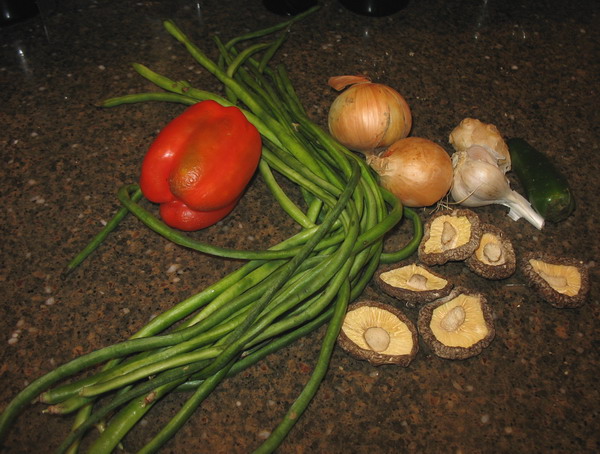
The bounty that comes from my CSA box is continually astounding to me.
This past Saturday, we were treated to a bundle of one of my favorite Asian vegetables, Vigna sesquipedalis, also known as Chinese yard-long beans. (They are also known as asparagus beans, but I have no idea why–they do not taste a thing like asparagus to me.) These beans are the same thing as a dried pea that is known in the US as black-eyed-peas or crowder peas. I never much cared for black eyed peas when I was growing up–they had an odd sweet smell and flavor that I never grew to like.
What is particularly odd about that is the immature green pods, which are served as yard long beans, do not have a sweet flavor at all. In fact, they have a distinctive starchy flavor, and an interesting tender-crisp texture–almost like regular green beans that have been blanched.They are often likened to green beans, but I don’t think that they are much alike at all–green beans are much sweeter and have a “greener” more grassy flavor. Yard long beans seem to have a starchy, proteinous flavor more like a dried bean, but in a fresh bean form.
They are particularly full of vitamins and nutritients: they are an excellent source of vitamins A and C, folate, protein, complex carbohydrates and a small amount of iron. They are low in calories, and, because they lack the strings that green beans have, they are simpler to prepare: simply snip or cut off the ends, and then cut into 2″ lengths to prepare them to stir fry.
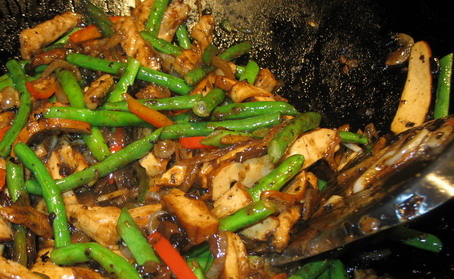
Morganna’s first day of school was today, so I told her I would make her whatever she liked for supper, as a celebration. She begged me to make a stir-fry, something that I haven’t done as much of recently, because as I slow down and my energy wanes, my ability to efficiently do so much kitchen prep is lowered. But, for my girl, of course, I will make a stir fry.
We had the long beans, so I knew I had to use those, and we had pressed tofu and tender boneless pork loin chops. I had fresh green chiles and a sweet bell pepper that I thought would add a note of sugar to the dish, as well as providing a contrasting color to the deep velvety green of the beans. For seasoning, Morganna asked for fermented black beans, so I added sweet onions, garlic and ginger, and I limited the condiments to light soy sauce, Shao hsing wine and sesame oil. The last flavor note I added were three rehydrated black mushrooms, whose umami fragrance really brought a strong element of the savory to the dish.
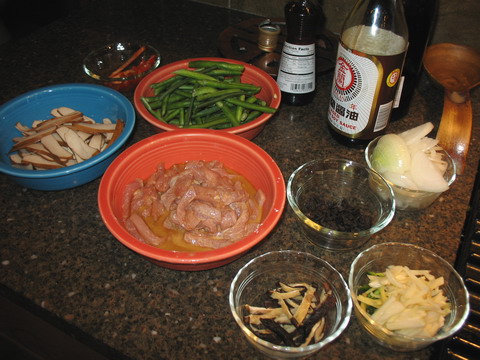
Stir Fried Yard-Long Beans with Pork and Pressed Tofu
Ingredients:
3/4 pound lean pork loin chop, trimmed of fat and cut into 1/4″ wide by 1″ long by 1/4″ thick slices
1 tablespoon Shao Hsing wine
1 tablespoon light soy sauce
2 tablespoons cornstarch
3-4 tablespoons peanut oil
1 small yellow onion, peeled and sliced thinly
1 tablespoon fermented black beans, lightly crushed
1 green jalapeno, cut into thin slivers
1/2″ chunk fresh ginger, peeled, and shredded into very thin slivers
3 large cloves garlic, cut into thin shreds
3 black mushrooms, rehydrated, stemmed and cut into 1/8″ thick slices
1/2 pound pressed tofu cut into similar sized slices as pork
1 tablespoon Shao hsing wine
1 tablespoon light soy sauce
3/4 pound Chinese yard-long beans, ends trimmed and cut on the bias into 2 1/2″ lengths
1/2 small red sweet bell pepper, cut into very thin, 2″ long slices
1/4 teaspoon toasted sesame oil
Method:
Mix meat and first amounts of wine and soy sauce together and toss with cornstarch until liquids thicken and are clinging to the meat. Set aside to marinate for twenty minutes, preferably while you prepare the rest of the ingredients.
Heat wok until it is smoking. Add peanut oil, and allow to heat for another thirty seconds, or until oil ripples and shimmers.
Add onion, black beans, jalapeno and ginger and stir fry for about a minute, or until very fragrant. Add garlic and mushrooms, and stir fry for another minute. Add meat, reserving any marinade that is not clinging to the meat. Spread meat into a single layer onto the bottom of the wok and allow to sit undisturbed to brown for about a minute or so. Add tofu to wok. Stir fry until most of the pink is gone from the meat.
Deglaze wok where marinade has clung to the sides and bottom and browned with wine and tofu, stir rapidly to scrape up marinade bits. Add beans, and stir fry for another minute to minute and a half, or until meat is done.
Add bell pepper, stir fry thirty seconds, then remove from heat and drizzle in sesame oil, stirring well to combine.
Turn out into a heated platter and serve with steamed jasmine rice.
Belly Blessings: Henna, Dance and Delicious Food
Parties are not my strong suit.
Let me rephrase that.
I -love- catering parties. I like making up beautiful platters of food, and serving it and feeding lots of people all at once. -THAT- is fun and challenging for me. I like planning the menus, and doing the decorations and all of the little details that make parties special. I’ve done many weddings for friends and clients, and I always go out of my way to make the food and decorations reflect who they are and thier own unique personalities.
I also catered both of my own weddings (this is not a course of action I would suggest for most brides or mothers of brides, by the way…it is very stressful to do), and for the first one, made and decorated my own wedding cake–a three tiered confection decorated with icing roses, real ivy and a little cupid dude on top. (I learned my lesson on that first cake–never bake your own wedding cake. So, for the second one, I had someone else do that, though I still did the decorations–fresh flowers, an arbor made of dried flowers and twigs, and fairy figurines made by hand by my Aunt Judy. Not as stressful, but still beautiful.)
So, with all of this evidence to my MarthaStewartness in the offing–why do I say that parties are not my strong suit?
Well, it isn’t the putting them together I am not good at.
It is the delegating others to help put them together, and attending them, particularly when I am supposed to be one of the centers of attention that I am not so good at.
I am much happier ensconsed in the kitchen, making the platters pretty, cooking appetizers and making up punch, than I am being in the midst of the “fun” part of the party.
Social anxiety, I believe, is what such an anti-social attitude is called. It isn’t really anti-social tendencies–because I really want to make people comfortable and help them have fun. I just don’t want anyone congratulating me and telling me how wonderful I am while I am doing it.
WEEELL–to make a long story short, we decided to have a baby shower/blessing party, and that means, as the Mamma-To-Be, that I am going to be the center of attention. Since I have been tired a lot recently, and have struggled just with making food on an everyday basis that is not only palatable to my ever-shrinking palate and nausea-ridden stomach, Zak and his family deemed it improper that I should knock myself out cooking up a bunch of food.
For once in my life, I actually listened, and so Zak and I decided to leave the cooking to someone else.
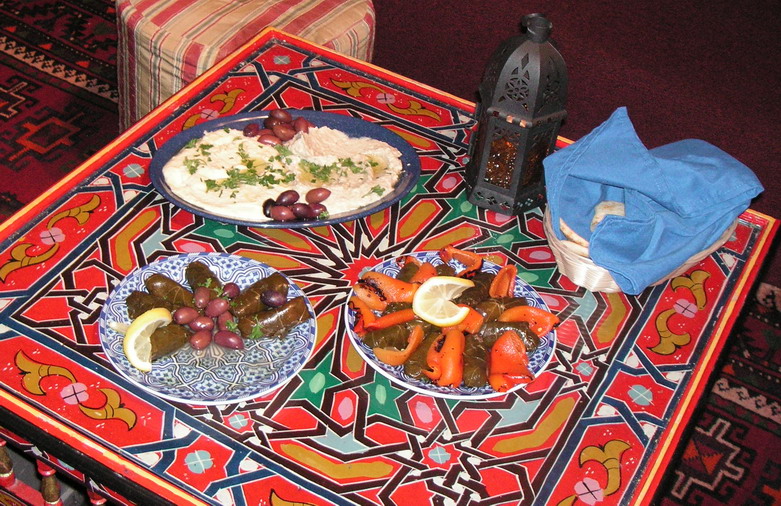
Who did we choose?
Hilary of Shishah Cafe here in Athens.
You know, I don’t write nearly enough about the great places to eat here in Athens, and so today, I am going to rectify that a bit. Hilary is a great cook, and her new place, which just opened this spring, is a beautiful gem of a restaraunt, tucked away in a brick-paved alleyway. It is a hookah bar, technically, where one can go and smoke Arabic blends of tobacco from beautiful, handmade glass hookahs, but because Hilary is not able to breathe smoke, the ventilation system is supurb, and I have happily eaten dinner there and never been able to smell the tobacco smoke from a hookah just next to me.
The decor at Shishah is fantastic–it looks like a setting for one of the tales of A Thousand Nights, with beautiful Arabic tile and oriental carpets everywhere, in vibrant blues, maroons, reds, and violets, with brass accents. It is so pretty that there is no need, in having our party there, to think about bringing in anything to decorate–it is all there.
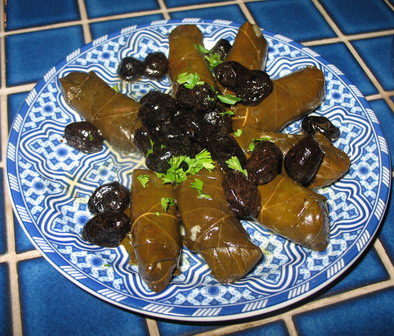
And the food–ah, that is the real beauty. Hilary makes the most wonderful dolma, baba ganoush, hummus, tabbouleh and couscous salad in the world, and she garnishes every plate with delicious Moroccan oil cured olives, Kalamata olives and roasted red pepper slices. And then there is the baklava and Turkish coffee–buttery-rich pastries filled with perfectly roasted and ground nuts in a honey syrup, paired with coffee as black as night and sweet as sin.
Eating such gorgeous food is definately a blessing to any belly, but is certainly is a great blessing to the belly of a pregnant woman whose ability to eat anything but vegetables is becoming more and more compromised.
Once we decided on a venue, I had the inspiration of asking Eli, a lovely and talented woman whom I met years and years ago, if she would bellydance for us. Eli, along with some of her friends, dances at Shishah once a week anyway, and I thought that having a dancer would be appropriate, because some believe that the long-ago origins of the bellydance, also called baladi, was as a preparation for childbirth. The sensuous, sinuous movements of the dancer’s hips and belly were not necessarily meant to be sexually inviting; (though one cannot deny the explicit beauty of it) instead, they were meant to imitate the movements of a woman’s belly in childbirth. (In truth, there are as many speculations on the origin of bellydance as there are those who study it–I am only giving one version of the “history” of bellydance–a history which has yet to be thoroughly documented.)
It is said by some that women danced for women, before and during labor, as means of supporting, encouraging and strengthening the laboring woman with their presence and their skill. There are also those who say that the dance was used as a fertility blessing dance before a wedding; this probably is true and is the origin of the modern Arab tradition of having a dancer perform at weddings.
With a tradition like that, how could I not want a dancer to bring her blessings to the party?
Eli was delighted to dance and when Tessa, Zak’s stepmother, suggested we see if we could find a henna artist, I was happy to find out that Eli also does henna. (Which I should not have been surprised by–the first time that I met Eli was at a henna party where she and I and a mutual friend all were doing henna for each other and a bunch of other young women.)

Henna is another ancient art-form that is intimately tied to women and women’s experience. It is a beautifucation treatment for the skin which uses finely ground dried henna plants, sifted and mixed with an acidic ingredient and essential oils into a thick paste, which is applied, most often to hands and feet in artistic designs. The paste dries, and as it dries, it forms a stain, variously colored deep burgundy, blackberry brown, pumpkin, cherry red or maroon, depending on the type of henna used and the other ingredients added, which lasts, depending on where it is applied for a few days to several weeks. Henna art is practiced in Muslim countries, and is a tradition all over India, among people of many faiths, and is used to celebrate holidays, weddings, and yes, the birth of children.
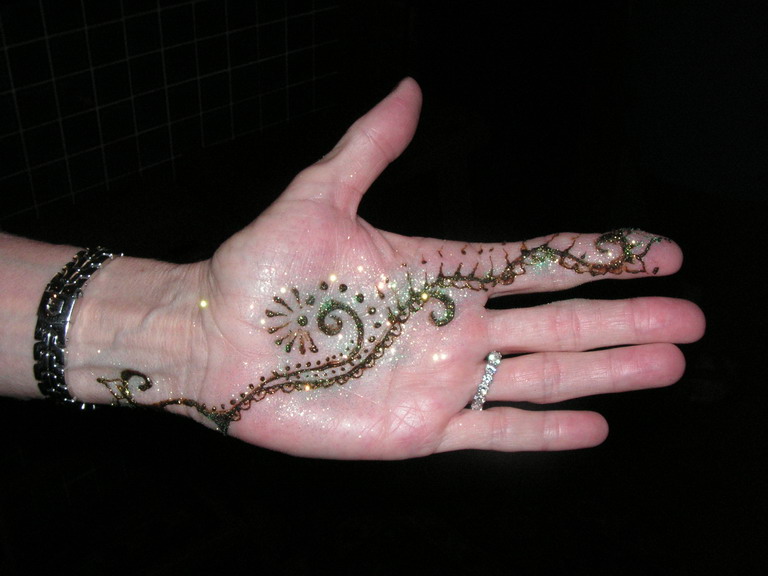
I have been enamored of henna for years, and have had it done on my hands off and on for over a decade. My favorite henna artist, who also happens to be a scholar on the subject who is writing a PhD thesis on it, is Catherine Cartwright Jones, who lives up in Stow, Ohio, of all places. Check out her website to see some amazing work with henna, woad, indigo, and turmeric, all natural plant-based dyes, on skin, and to read the history and cultural significance of henna. Eli, like myself and hundreds of others, has learned from Catherine, and so she, too, has become a very talented henna artist who is very comfortable with her medium and makes beautiful, joyful symbolic art to beautify women of all ages.
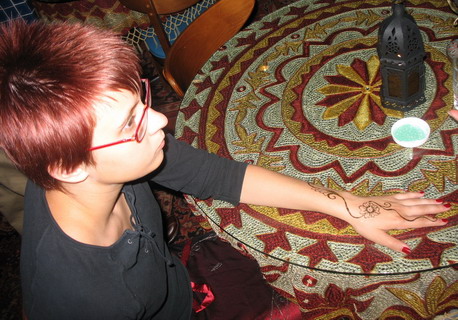
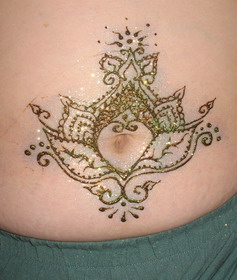
Henna has been popularly done on pregnant bellies in the US for a decade or so now–and I have been present at festivals where many pregnant women had their bellies hennaed as a symbolic, artisitc blessing over the years. Henna doesn’t stain very darkly on the skin of the belly–it is very soft and thin there–the darkest stains take on the thicker, dryer skin of the palms and soles of the feet, with the tops of the hands and feet taking stain the next best.
Eli was happy to do my belly, and as you can see, she did a lovely lotus flower to bless both Kat and myself, and she even utilized the newest fad in henna from India–glitter and glued on jewels to enhance the paste while it dries. After that, she did henna for all of the women who requested it and I was thrilled to see both my mother and Tessa avail themselves of one of the most lovely body arts in the world. Morganna, too, along with most of the other female guests, also sat for henna on their hands, so she will have a pretty look to go to school with tomorrow.
It was a lovely party, and my belly was blessed in every way. Our friends and family were there, having fun, and listening to and making beautiful music (Zak and Dan played flute and drum for Eli to dance to) and we all ate food that was a joy to both look at and consume. Everyone complimented us on how much fun they had and what a great idea for a baby shower it was, and all went home satisfied.
As for me–I went about the entire party with my hennaed belly on display, and did not succumb to any thoughts negative body-image thoughts, ate, talked and had a great time.
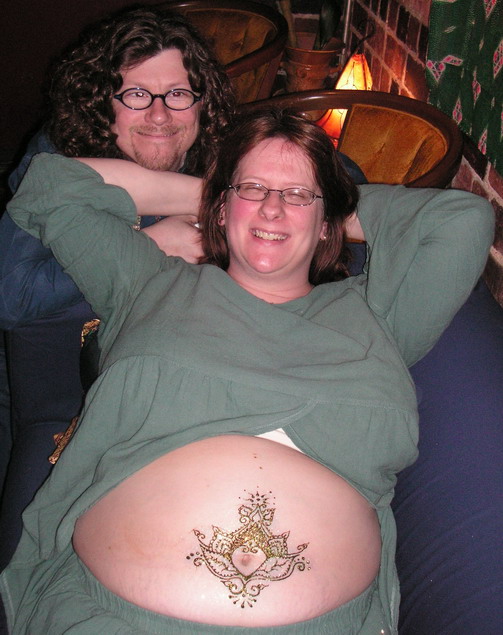
Not bad for someone who prefers to be anonymously in the kichen, making beautiful platters of food and sending them out with minons who keep me from having to circulate and be told what a lovely party I have thrown.

Categories:
- Admin (rss) (55)
- Blogs and Blogging (rss) (81)
- Book Reviews: Cookbooks (rss) (43)
- Book Reviews: Non-Cookbook Food Books (rss) (38)
- Cats and Cat Blogging (rss) (47)
- Chinese Cooking Lessons (rss) (32)
- Culinary School Stories (rss) (18)
- Dairy Pruducts: Cultured and Barbaric (rss) (4)
- Documentary Filmmaking (rss) (1)
- Essays, Rants and Reflections (rss) (260)
- Fighting Hunger (rss) (12)
- Food and Kids (rss) (45)
- Food in the News (rss) (126)
- Food Media (rss) (98)
- Food Preservation (rss) (18)
- Food Safety (rss) (45)
- Gardening (rss) (30)
- Herbs and Herb Blogging (rss) (20)
- Holidays (rss) (50)
- Kat Blogging (rss) (22)
- Kitchen Science (rss) (36)
- Leftover Makeover (rss) (8)
- Life, the Universe and Everything (rss) (131)
- Local and Sustainable (rss) (227)
- Local Athens Food and Foodies (rss) (42)
- Meatless Mondays (rss) (32)
- Menu For Hope (rss) (5)
- Nutrition, Diet and Health (rss) (84)
- On The Farm (rss) (8)
- Recipes: Almost Vegetarian, Vegetarian and Vegan (rss) (294)
- Recipes: American Regional (rss) (37)
- Recipes: Appalachian Hillbilly (rss) (33)
- Recipes: Bread, Pasta, Grains (rss) (95)
- Recipes: Canning and Preserving (rss) (8)
- Recipes: Chinese (rss) (123)
- Recipes: Comfort Food (rss) (120)
- Recipes: Cookies (rss) (16)
- Recipes: Desserts (rss) (48)
- Recipes: French (rss) (25)
- Recipes: Fruits and Vegetables (rss) (302)
- Recipes: Greek, North African and Middle Eastern (rss) (31)
- Recipes: Indian (rss) (137)
- Recipes: Italian (rss) (42)
- Recipes: Japanese (rss) (7)
- Recipes: Jewish (rss) (4)
- Recipes: Korean (rss) (6)
- Recipes: Meat, Poultry and Fish (rss) (220)
- Recipes: Mexican/Native American/ Latin American/Caribb (rss) (27)
- Recipes: Original (rss) (108)
- Recipes: Thai (rss) (27)
- Recipes: Tofu (rss) (17)
- Recipes: US Regional (rss) (16)
- Recipes: Vietnamese (rss) (8)
- Restaurant Stories (rss) (28)
- Sewing, Quilting, Arts and Crafts (rss) (16)
- Simple Chinese Recipes (rss) (30)
- Slow Food and Heritage Foods (rss) (10)
- Spice Blogging (rss) (44)
- The Chinese Cookbook Project (rss) (14)
- The Chinese Pantry (rss) (39)
- The Documentary (rss) (2)
- The Kitchen Saga (rss) (17)
- The Locavore's Bookshelf (rss) (15)
- The Unsung Adventures of The Culinary Nerd (rss) (6)
- Tools and Toys (rss) (35)
- Uncategorized (rss) (10)
- With a Side of Politics (rss) (48)
Archives:
- August 2012 (9)
- July 2012 (12)
- September 2011 (3)
- August 2011 (7)
- July 2011 (8)
- June 2011 (16)
- May 2011 (17)
- April 2011 (11)
- December 2010 (9)
- November 2010 (5)
- February 2010 (1)
- December 2009 (5)
- November 2009 (7)
- October 2009 (10)
- September 2009 (16)
- August 2009 (14)
- July 2009 (14)
- June 2009 (7)
- May 2009 (17)
- April 2009 (10)
- March 2009 (25)
- February 2009 (13)
- January 2009 (10)
- December 2008 (5)
- November 2008 (5)
- October 2008 (6)
- September 2008 (13)
- August 2008 (8)
- July 2008 (11)
- June 2008 (18)
- May 2008 (13)
- April 2008 (14)
- March 2008 (16)
- February 2008 (17)
- January 2008 (19)
- December 2007 (25)
- November 2007 (18)
- October 2007 (24)
- September 2007 (16)
- August 2007 (15)
- July 2007 (15)
- June 2007 (10)
- May 2007 (14)
- April 2007 (16)
- March 2007 (17)
- February 2007 (20)
- January 2007 (13)
- November 2006 (1)
- October 2006 (8)
- September 2006 (14)
- August 2006 (25)
- July 2006 (30)
- June 2006 (28)
- May 2006 (34)
- April 2006 (29)
- March 2006 (24)
- February 2006 (30)
- January 2006 (38)
- December 2005 (40)
- November 2005 (37)
- October 2005 (32)
- September 2005 (25)
- August 2005 (30)
- July 2005 (28)
- June 2005 (21)
- May 2005 (8)
- April 2005 (22)
- March 2005 (17)
- February 2005 (29)
- January 2005 (10)
Search Site:
Links:
- Lily’s Wai Sek Hong
- 101 Cookbooks
- A cat in the kitchen
- A Veggie Venture
- Accidental Hedonist
- Cha Xiu Bao
- chez pim
- Chocolate & Zucchini
- Chopstick Cinema
- Chowhound.com
- Chubby Hubby
- Cook sister!
- Cooking with Amy
- da*xiang
- Eat Local Challenge
- Eating Liberally
- Ecocentric
- Eggbeater
- Epicurious
- Farmgirl Fare
- Fatfree Vegan
- Foodgoat
- ForkandBottle.com
- Green Olive Tree
- Hooked on Heat
- Jaden’s Steamy Kitchen
- Kalyn’s Kitchen
- Lucullian delights
- Mahanandi
- Matt Bites
- MeatHenge
- mmm-yoso!!!
- New York Times – Dining & Wine
- Pizza Goon
- Rasa Malaysia
- Ruhlman
- Sailu's Kitchen
- Serious Eats
- SF Gate: Food & Dining
- Simply Recipes
- Soul Fusion Kitchen
- Tastespotting
- The Amateur Gourmet
- The Cleaner Plate Club
- The Food Section
- The Grub Report
- thecookscottage
- U.S. Food Policy
- Wandering Chopsticks
- Washington Post Food and Dining
- Wasted Food
Meta:


Powered by WordPress. Graphics by Zak Kramer.
Design update by Daniel Trout.
Entries and comments feeds.