
Cook Local, Eat Global
Do You See What I See?
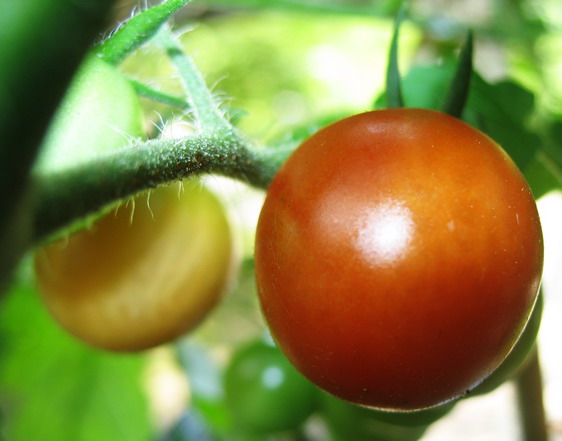
Yes, that is indeed what it looks like.
My first ripe tomato of the season. It was on one of the seven foot-tall tomato plants, and there is one near it that will be ripe tomorrow.
I rewarded myself by eating it after I transplanted some potted flowers and redid some of our window-boxes on the deck with summer annuals. The pansies and violas had finally been done in by the heat.
So, after supper, out on the deck I went to make the garden up there happy and pretty again, and after all that work, I went and picked my first cherry tomato, sat down in my rocking chair, and popped it in my mouth.
It was sweet, tangy and wonderful–filled with juice and flavor.
I can’t wait until the other ones start to ripen!
Panang Neur: Panang Curry Beef
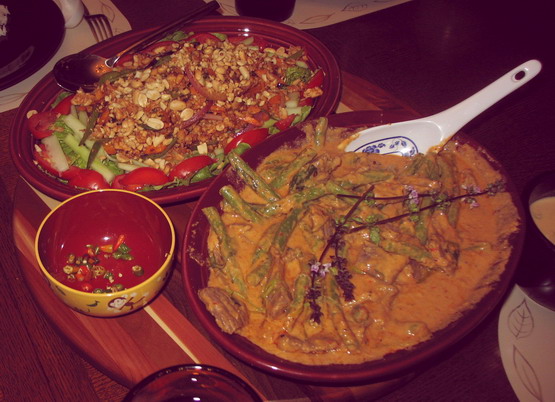
Panang neur, otherwise known in English as Panang curry beef, is a fairly dry coconut milk curry that is named after the city of Panang, which borders southern Thailand and Malaysia. The chile paste is often thickened with peanuts, so those with a peanut allergy should avoid this dish; for others, the flavor is indescribably good. Panang is a fairly mild curry when served in most restaurants; however, it can be made as hot as the cook and diners would like through the addition of more chiles when the curry itself is cooked.
One ingredient that is necessary to this dish, which of course, I did not -have- when I cooked it on the 4th, are kaffir lime leaves. These are the leaves of the kaffir lime tree, and they are redolent of citrusy-floral fragrance, and when shredded, add an indescribable flavor to the curry. I thought I had a few of them frozen yet left; however, when I looked for them, they were not in evidence; I then remembered cooking the last of them in a tuna dish months ago. Since I had already started making the curry paste, I went on without the leaves, but the finished dish, while quite flavorful, was nowhere nearly as fragrant and rich without the scent of kaffir lime.
If you, like me, cannot find the kaffir lime leaves in your town, do not despair, and do not use the dried leaves instead. They have little flavor left in them. Instead, order fresh leaves from Thaigrocer.com. I have ordered fresh lime leaves, galangal, lemongrass, and bird chiles from them many times and have never, ever been disappointed. When I absolutely cannot get to Columbus to buy my Thai fresh herbs in person, I order from this place, and they always send the best produce imaginable.
I first tasted panang neur at Siam Square, a tiny Thai restaurant in Providence, Rhode Island, which served the best Thai food I have ever tasted. (With the exception of a place in Ithaca, NY where we ate once when my brother-in-law graduated from Cornell. Their Spicy Basil Squid was to die for and was so blazingly hot and good–ah. I thought I had died and gone to heaven!)
Siam Square is where my palate was trained in Thai food. The chef, a woman, used to peek through her kitchen window to watch me eat, to see if the food she had made for me was too hot–because I kept insisting to the waiter, who had come to know us, that I really could take the heat. Slowly, over time, she just started ratcheting up the heat, and the other flavorings in my food, to the point where the waiter finally told me I was eating like a Thai person.
That experience not only made me crazier for Thai food than I was before, but it also spoiled me for eating in any other Thai restaurant. Everyplace we have lived since we left Providence has had mostly disappointing Thai food, which has necessitated that I learn how to make it, using my memory of how the chef at Siam Square cooked it. (And yes, I developed the tom kha gai recipe I posted yesterday based on how her soup tasted: she, too, used a bit of red curry paste in hers, because, as the waiter told me, when I asked if that was what I tasted in the soup, “it adds a little bit of complexity to the flavor–its the shrimp paste in the curry paste that does it.”)
She made panang curry with beef and green beans, so that is what I put in mine. Her curry paste included a bit of cardamom seeds, in addition to white peppercorns, so mine does too. (Though you will note that I eschew white peppercorns in this recipe and instead used grains of paradise, so as to keep my allergy to pepper in check.) She also colored her paste with dried chiles colorado–because as the waiter told me, they added color but no heat.
If you don’t want to make your own curry paste–though of course, I think you should–use Mae Ploy brand, and add a bit of ground white peppercorns, cardamom and peanuts to it. It will give the curry a much fresher flavor that more closely replicates my beloved chef’s way of making this dish.
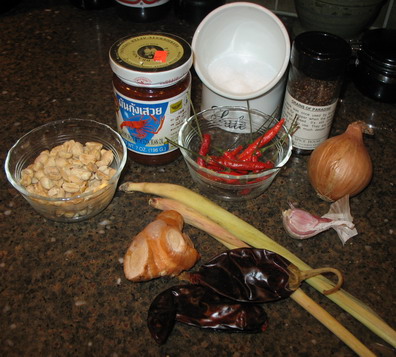
Panang Neur
Curry Paste Ingredients:
1 teaspoon kosher salt
6 cloves garlic, minced
1 tablespoon cilantro roots and/or stems, cut finely
2 dried chiles colorado, soaked in warm water until soft, stems and seeds removed
15 fresh red Thai bird chiles
1 teaspoon white peppercorns or grains of paradise
1/4 teaspoon cardamom seeds, removed from pod
1 teaspoon minced fresh or frozen galangal root
2 stalks of lemongrass, bottom third only, dried leaves removed, minced
1 tablespoon minced lime zest
1 shallot, minced
1 teaspoon fermented shrimp paste (do not leave this out, please–unless you cook kosher or are allergic to shrimp–in that case, I have heard that you can use red miso instead)
3 tablespoons unsalted, dry roasted peanuts
Method for Curry Paste:
Using either a mortar and pestle, pound the ingredients into a paste, in the orer in which they are written.
Or, be like me, and use a Sumeet grinder and put them all in the grinder jar together and process away until it turns into a deep
orange paste.
Ingredients for Curry:
1 can Mae Ploy brand coconut cream
1 recipe or 1/2 cup panang curry paste
1 pound top round beef, sliced thinly against the grain into 2″ long strips
4 tablespoons fish sauce
2 tablespoons palm or raw sugar
1 pound fresh green beans, topped and tailed, and blanched and drained
20 kaffir lime leaves, shredded, or the zest of 2 limes, similarly shredded
5-12 fresh red bird chiles, sliced thinly–to taste (I actually left these out because I was making this dish in part for the lady who is recovering from surgery. Since I don’t know her heat tolerance, I saw no reason to make this curry very strong.)
Method for Curry:
Put half the coconut cream into a wide, heavy skillet and heat until it is simmering. Add curry paste, and stir, cooking until it is quite flavorful. Add the rest of the coconut cream, lower heat and bring to a simmer. stir in meat, then season with fish sauce and sugar, and cook, stirring until mixture comes back to a boil. Lower heat again until the dish cooks at a bare simmer. Add half the shredded lime leaves.
Allow curry sauce to reduce until it thickly coats the meat, and cook until the meat is done through, and is tender.
Add the green beans, stir to coat. Garnish with remaining lime leaves and the chile slices, and serve with steamed jasmine rice.
Note: In the first photograph above, the other dish presented with the Panang Neur is Nam Sod, a Thai minced chicken salad.
Thai Chicken Soup For The Soul: Tom Kha Gai
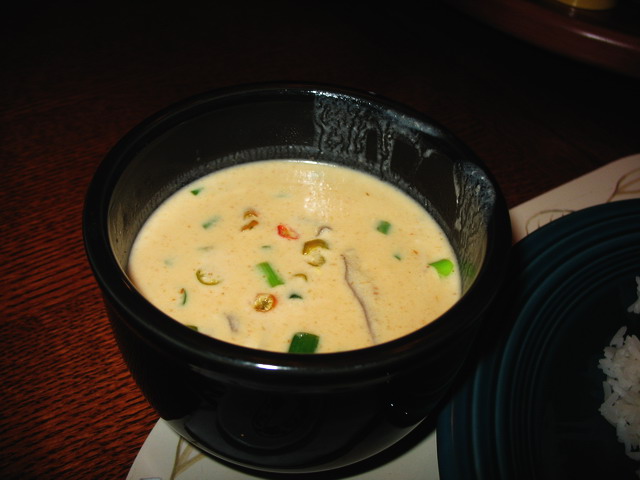
Some foods are comforting because they remind us of our childhoods.
They remind us of home, mother, milk, and the warmth of grandmother’s kitchen. They take us back to when life was good, and simple and food was something that came to you without effort. As children, we asked, and then, did receive.
Other foods are comforting because of what they are.
For me, Thai tom kha gai is comforting just because of what it is: a silky, velvety-smooth coconut-milk based soup filled with the flavors of lemongrass, galangal, lime, and chile, enlivened by small pieces of just-cooked chicken and slippery-sweet mushrooms. From the first time I tasted this soup, years ago in a Thai restaurant in Cleveland, I have longed for it, and every time I eat it since, from the first taste, I feel like I am coming home.
It doesn’t remind me of my childhood at all, or at least not the childhood I remember consciously of this life. It cannot–it is a soup born of a place of where yards are fillled with trees bearing tropical fruits, and kitchens exist in a room separate from the main house. It is born of a place where rice is the staple food, grown in emerald terraces, where gilt Buddhist temples rise from the trees, and where strong flavors are the rule of the day.
I was not born into such a world, but every time I taste tom kha gai, my heart is made at peace, my stomach is made happy, and I cannot help but smile, resting in the comfort of the flavors that envelop my senses.
Yesterday, I cooked up a Thai dinner: tom kha gai, nam sod and panang neur with steamed jasmine rice. In part, it was because I wanted to make a nice dinner to celebrate the holiday, and. in part, because I was on a mission of mercy. A friend of a friend is suffering post-surgical appetite loss, and it turns out that she is partial to Thai food. So, I promised to make up some Thai food to send over to her, in the hopes of kick-starting her appetite, as there is no place any closer than Columbus to get take out Thai. My hopes are that the healing powers of chicken galangal soup will assist in healing someone who is having trouble eating, and if it does, and she eats well, I promised to make some more Thai goodies to keep her eating, so that her body can do its work to repair itself.
The second word in tom kha gai, “kha,” means, “galangal,” and it is the backbone of the soup. Coconut milk is the vehicle that carries the flavor, but it is not the basis of the soup. It is all about galangal.
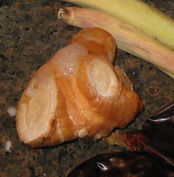
Galangal is the tougher, larger, more complex-flavored cousin to ginger. Also a rhizome, galangal is best used fresh or failing that, frozen; I have tried to use dried chips of it to make tom kha gai in the past and have failed miserably. Most of the sharp, medicinal tang of the flavor is dissipated when it is dried, so the complexity of galangal is lost, leaving on a whisper of mustiness behind.
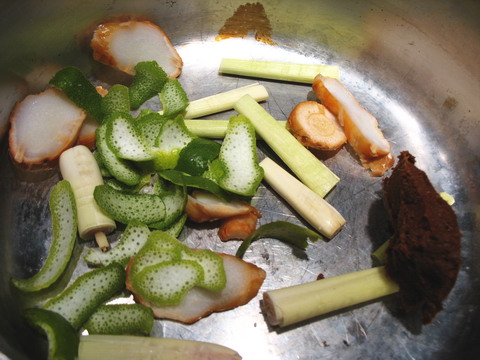
When fresh or frozen, however, the full impact of galangal is ready to be absorbed into the coconut milk-based soup. To infuse the broth with the galangal flavor, I buck tradition and simmer it very slowly over at least a two hour period of time. I leave the stalks of lemongrass and the lime zest or leaves in for the full time as well, allowing their fresh, floral flavors to fully invade the succulent coconut milk and chicken broth base along with the galangal. I also slip a tablespoon or so of red curry paste into the soup at this time to add a further note of complexity to the flavor.
Galangal is often found fresh at Asian markets that cater to southeast-Asian populations; it can even more often be found in plastic packages frozen. The rhizomes are simply cleaned up, and cut into big chunks, then packed in clear plastic and frozen, and I have found little difference in quality between fresh or frozen galangal. One thing I will note–these very tough, hard rhizomes are easier to cut once they have been frozen and thawed–they are like rocks otherwise. That is why I always use my heaviest cleaver to cut them when they are fresh.
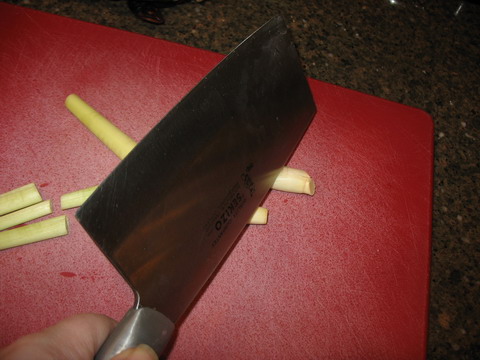
When the soup base is fully flavored by these aromatics, I fish them out with my wire skimmer, and discard them; neither galangal slices nor bruised lemongrass stalks (to bruise them, I cut the stalks as directed in the recipe, and then tap them heavily with the back edge of a cleaver–one can smash them with the flat of the cleaver as well, but one risks having them fall apart and leave shards of fibrous material in the soup if one completely mashes the stalks) are particularly edible unless they are cut very finely or pounded into a puree.
After the basic flavors are in the broth and the stalks, rhizomes and zest are discarded, I then add a lot of fish sauce to the broth, to add a deep, satisfying salty tang. Do not skimp on the fish sauce, no matter what you might think of what it smells like. With fish sauce, more is better. After I have tasted the soup, I then add the sliced mushrooms and the chicken bits, allowing them to simmer gently until just done; I do not like the chicken to become overcooked and tough. It should be as tender and silken as the broth.
Finally, a kiss of lime juice, a sprinkling of herbs and scallion tops, and out the soup goes to the table, accompanied by a bowl of sliced Thai chiles so diners can add as little or as much heat as they would like. (I like it very, very hot, personally, and find that there is no other soup in the world that can cure me of a cold faster than supremely spicy tom kha gai. It also gives my cheeks an attractive rosey glow, I am told.)
It is a simple soup to make, and it really is comforting. I hesitate to claim healing powers for it, but I do know that after eating last night, everyone’s sinuses cleared right up, including Heather’s, and she has been having a horrible time with allergies this week.
Tom Kha Gai
Ingredients:
2 19 ounce cans of coconut milk (I prefer Mae Ploy brand, but Cha Khao is also good)
1 quart chicken broth or stock
5 1/4″ thick quarter-sized to half-dollar sized slices of fresh or frozen galangal root
3 stalks lemongrass–bottom 1/3 only, bottom of stalks trimmed, and outer layers stripped away–cut into three equal pieces and bruise with the back of the cleaver
5 kaffir lime leaves, or the zest of two regular limes (I just cut the zest off in big pieces with a peeler to make it easier to fish out when all the flavor is gone from it)
2 tablespoons red curry paste, or to taste (recipe here, or you can use Mae Ploy brand–it is good)
fish sauce to taste
6 fresh shiitake mushrooms, stems removed and sliced thinly
1 whole boneless skinless chicken breast, trimmed and cut into 1/2″ cubes
juice of two limes or to taste
1/2 cup fresh cilantro leaves, stems removed
3 scallion tops, thinly sliced
red and green Thai bird chiles, sliced thinly as a garnish
Method:
Combine coconut milk, chicken broth, galangal, lemongrass, lime leaves, zest or oil, and curry paste in a heavy-bottomed pot. Bring to a boil, turn down heat and simmer. Season to taste with fish sauce. Turn down heat and allow to simmer for at least one half hour, forty minutes is better.
Fish out galangal and lemongrass. Add mushrooms and chicken. Simmer until chicken is done. Fish out lime leaves, add lime juice to taste, and garnish with cilantro leaves, scallion tops and sliced chilis.
The flavor should be a balance of spicy, refreshingly sweet and herbal and sour, with a musky note from the galangal.
The Issue of High Fructose Corn Syrup
My eloquent, if cynical, compatriot, Kate at The Accidental Hedonist has a post riffing on the recent NY Times article about our good friend and neighbor, high fructose corn syrup. I thought I would pick up the issue with her and examine it from my own perspective, as a little, you know, subversive dig on this fine and rainy Independance Day.
Why a dig? Well, what is more all-American than corn, and any product made from it? It is our native grain, a cultivated grass that cannot live without human intervention, a lifesaver to the Pilgrims and the backbone of many Native American diets.
So, what is my beef as a locavore with high fructose corn syrup, a home-grown sweetener if ever there was on, using our most patriotic of grains to produce a sugar that is cheaper to grow than sugar cane (which does not grow much in our continental US, and thus would have to be imported from Elsewhere), and comes from one of the most democratic of plants that can grow nearly anywhere? What exactly is my beef with high fructose corn syrup, hereafter known as HFCS?
The issue with HFCS is this–it is in nearly every processed food product out there in copious amounts.
The precipitious rise in total sugar consumption among Americans has more to do with eating processed foods that one does not think about having sugar in them–salad dressings, soups, tomato sauces, ketchup, bread and the like–than it does with Americans lacking “food discipline.” If you look at the statistics themselves, all taken from Marion Nestle’s book, What to Eat, and sourced by the author from the USDA, one notices a pattern emerging.
While total individual consumption of sweeteners increased among Americans from 1980 to 2004 from 120 lbs per capita to 142 pounds per capita, individual use of refined sugar (table sugar) -decreased- during the same span of years from 84 pounds per capita to 61 pounds per capita. The average individual consumption of HFCS, however, more than doubled between 1980 and 2004–going from a mere 35 pounds to 78 pounds per capita.
What happened? Did Americans dump out our sugar bowls and install pitchers of HFCS on our tables? No.
No, what happened was, the use of table sugar, meaning the stuff that we add to food ourselves, dropped, because Americans had taken heed to warnings that refined sugar was not so good for us from health professionals in the media. But if that is the case, how did we start eating so much HFCS, if we are lowering our own use of added sugars?
The answer is this, and it is quite simple: Americans are not themselves adding more sugar to their diets–it is being added to their diets by food processors.
My aim is not to lay all of the blame on the food processors and to vilify them as a group. Americans still have personal responsibility in their dietary choices, one of which I will harp upon quite readily–Americans’ consumption of soda, which is pretty much nothing but HFCS, water and flavorings, has also sky-rocketed. Anyone with three quarters of a brain should know that soda is not a healthy beverage for anyone, much less children who are now more apt to drink soda than milk. (In 1975, each American typically drank 27 gallons of soda per year; in 2005, that amount has doubled to 54 gallons. Thirty years ago, American boys drank twice as much milk as soda. Now, the statistics are reversed–boys drink twice as much soda as milk. These statistics are from Eric Schlosser’s new book, Chew on This: Everything You Don’t Want to Know About Fast Food, which is aimed at children.)
My goal is to point out that American consumers can hardly be held completely to blame for the obesity and diabetes epidemic when food processors have been adding large amounts of HFCS to most processed foods for years, including foods that one does not think about being sweet or containing any kind of sugar. One cannot avoid what one does not know exists. I think of HFCS as a “stealth” sweetener, because it is in so many foods that the average shopper would not think to look for it in, in large part because it serves a purpose other than sweetening foods. It is, like all sugars, hydroscopic (allthough HFCS is particularly hydroscopic) meaning it draws moisture from the air into the food product, thus keeping it softer, less dry, and tasting and feeling more fresh.
Unless the average American knows anything about the hydroscopic properties of sugars, they wouldn’t think to look for HFCS in non-sweet yeast breads, rolls and crackers, where it is used basically as a preservative.
And don’t start with me on “they should just read food labels” spiel. Yes, they should. But, how many harried Moms and Dads out there doing shopping in between work and home have a chance to do that? And why should they think to -look- for sugar of any sort in food items that are not normally thought of as sweet, such as jarred spaghetti sauce, unless they have -heard- that such items have high amounts of sugar added to them? It is not a logical assumption that one is going to find HFCS in one’s spaghetti sauce, unless one knows a decent amount about food processing in general, and let’s be real here–most people don’t know these things.
And yes, I -know- that the solution is for people to read labels, cut down on processed food, eat more whole foods cooked at home, and stop drinking soda, but for many time pressed individuals who do not know how to cook, this is all easier said than done.
The fact is that the more information that is out there about HFCS and how much of it is in processed food, the more chance there is that individuals and families will get the clue that they are more sugar than they think they are, which is helping to cause the massive amounts of obesity and diabetes we are seeing around the country, and might try and do something about it in their own lives.
But without good information getting out there, without the media of all types–from informal media like blogs to newspapers to television to radio to books–talking about HFCS, people are not going to be getting the information they need to make any sort of wise decisions.
One of the best dietary decisions an individual or family can make is to cut out drinking soda completely from their diets–sodas are nothing but empty calories, and can really add a great many calories to a daily diet very quickly. This, of course, leads to weight gain. In my very own experience, after I quit habilutally drinking soda as my main drink of choice (now it is water or unsweetened tea or coffee), I lost four dress sizes within a year and have stayed pretty steadily at the same size since. I not only look better, but I feel better.
Another good dietary choice is to try and cut back on processed foods, especially those with large amounts of HFCS–such as ready to eat cereals and other obviously sweetened products. But, even if one just learns to read labels habitually, a shopper can make a better choice in processed foods like spaghetti sauces, salad dressings and breads–while HFCS is used in many brands of these products, they are not in -all- brands. HFCS -can- be avoided, if a shopper knows to avoid it in the first place.
What I would like to see is some food processors cutting back on the use of HFCS in their products, but I figure that is a bit pie-in-the-sky. It is too easy to use in remedy of various processing ills, and it is too cheap, thanks to government subsidies keeping prices artificially low.
So, there it is, folks–my non-patriotic, cranky diatribe about our very own American corn-based sweetener and what I think is wrong with it.
Happy Independance Day.
As The Garden Grows….
I realized as I was tying up my second self-watering box of tomatoes yesterday morning that I had not written about the garden much recently.

There have been ups and downs. Right now, mostly ups–as in, the first box of cherry tomatoes I planted keep growing up, up, up, as if they are attempting to reach the moon. They are now officially taller than me, and even if you take into account the extra height afforded the plants by the planter, they are taller than Zak, too. They are, in fact, working on being taller than Bryian, our tallest friend.
These hybrid “Jellybean” cherry tomato plants are unreal–the original stakes I had for them were not sturdy enough and during one of our rather violent thunderstorms, the stakes were broken, and knocked over. The plants were somewhat mangled, however, we only lost one main stem out of the three plants. Zak and I fashioned newer stakes–about seven feet tall–out of heavy dowels, and after tying them back up a week ago, they have nearly climbed to the tops of those stakes.
At this point, I am planning on training the growing tips downward, doubling them back on the stakes. When they reach the deck railing, I will probably train them laterally along it.
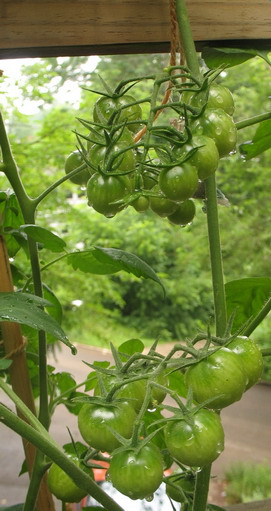
As you can see, these gigantic tomato plants are also loaded with tiny green fruits. About three weeks ago, I counted something like sixy-three fruits on one of the plants; I have no idea how many are on all three of them.
The other box of younger tomatoes is also doing well. There are two plants in it; one is a hybrid miniature plum tomato named “Juliette,” and the other is an open-pollenated heirloom variety called “Mr. Stripey.” Juliette is the more vigorous of the two plants; however, I did not know how prolifically she had fruited until I was tying the plants up yesterday and saw large clusters of plum-shaped green tomatoes.
The basils planted in with those two tomatoes are also doing very, very well; they are the most vigorous growers of all of my many basil plants. You can kind of see them peeking out from the sides of the bushy tomato plants. Not only are tomatoes and basil classic flavor combinations in the kitchen, they are good garden companions as well.

Mr. Stripey–so named for its smallish red and yellow streaked fruits–even though it was the smallest and spindliest of the tomato plants I put in, has several round, fluted fruits.
If all of these fruits ripen well, I have a feeling we are going to be inundated with small tomatoes within a month or so.
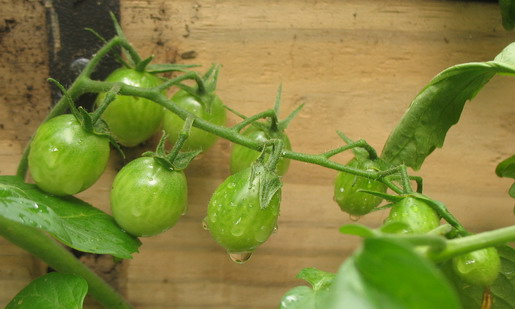
Which is fine; I am looking forward quite eagerly to making fresh tomato sauces, salsas and just eating them right off the vine!

Categories:
- Admin (rss) (55)
- Blogs and Blogging (rss) (81)
- Book Reviews: Cookbooks (rss) (43)
- Book Reviews: Non-Cookbook Food Books (rss) (38)
- Cats and Cat Blogging (rss) (47)
- Chinese Cooking Lessons (rss) (32)
- Culinary School Stories (rss) (18)
- Dairy Pruducts: Cultured and Barbaric (rss) (4)
- Documentary Filmmaking (rss) (1)
- Essays, Rants and Reflections (rss) (260)
- Fighting Hunger (rss) (12)
- Food and Kids (rss) (45)
- Food in the News (rss) (126)
- Food Media (rss) (98)
- Food Preservation (rss) (18)
- Food Safety (rss) (45)
- Gardening (rss) (30)
- Herbs and Herb Blogging (rss) (20)
- Holidays (rss) (50)
- Kat Blogging (rss) (22)
- Kitchen Science (rss) (36)
- Leftover Makeover (rss) (8)
- Life, the Universe and Everything (rss) (131)
- Local and Sustainable (rss) (227)
- Local Athens Food and Foodies (rss) (42)
- Meatless Mondays (rss) (32)
- Menu For Hope (rss) (5)
- Nutrition, Diet and Health (rss) (84)
- On The Farm (rss) (8)
- Recipes: Almost Vegetarian, Vegetarian and Vegan (rss) (294)
- Recipes: American Regional (rss) (37)
- Recipes: Appalachian Hillbilly (rss) (33)
- Recipes: Bread, Pasta, Grains (rss) (95)
- Recipes: Canning and Preserving (rss) (8)
- Recipes: Chinese (rss) (123)
- Recipes: Comfort Food (rss) (120)
- Recipes: Cookies (rss) (16)
- Recipes: Desserts (rss) (48)
- Recipes: French (rss) (25)
- Recipes: Fruits and Vegetables (rss) (302)
- Recipes: Greek, North African and Middle Eastern (rss) (31)
- Recipes: Indian (rss) (137)
- Recipes: Italian (rss) (42)
- Recipes: Japanese (rss) (7)
- Recipes: Jewish (rss) (4)
- Recipes: Korean (rss) (6)
- Recipes: Meat, Poultry and Fish (rss) (220)
- Recipes: Mexican/Native American/ Latin American/Caribb (rss) (27)
- Recipes: Original (rss) (108)
- Recipes: Thai (rss) (27)
- Recipes: Tofu (rss) (17)
- Recipes: US Regional (rss) (16)
- Recipes: Vietnamese (rss) (8)
- Restaurant Stories (rss) (28)
- Sewing, Quilting, Arts and Crafts (rss) (16)
- Simple Chinese Recipes (rss) (30)
- Slow Food and Heritage Foods (rss) (10)
- Spice Blogging (rss) (44)
- The Chinese Cookbook Project (rss) (14)
- The Chinese Pantry (rss) (39)
- The Documentary (rss) (2)
- The Kitchen Saga (rss) (17)
- The Locavore's Bookshelf (rss) (15)
- The Unsung Adventures of The Culinary Nerd (rss) (6)
- Tools and Toys (rss) (35)
- Uncategorized (rss) (10)
- With a Side of Politics (rss) (48)
Archives:
- August 2012 (9)
- July 2012 (12)
- September 2011 (3)
- August 2011 (7)
- July 2011 (8)
- June 2011 (16)
- May 2011 (17)
- April 2011 (11)
- December 2010 (9)
- November 2010 (5)
- February 2010 (1)
- December 2009 (5)
- November 2009 (7)
- October 2009 (10)
- September 2009 (16)
- August 2009 (14)
- July 2009 (14)
- June 2009 (7)
- May 2009 (17)
- April 2009 (10)
- March 2009 (25)
- February 2009 (13)
- January 2009 (10)
- December 2008 (5)
- November 2008 (5)
- October 2008 (6)
- September 2008 (13)
- August 2008 (8)
- July 2008 (11)
- June 2008 (18)
- May 2008 (13)
- April 2008 (14)
- March 2008 (16)
- February 2008 (17)
- January 2008 (19)
- December 2007 (25)
- November 2007 (18)
- October 2007 (24)
- September 2007 (16)
- August 2007 (15)
- July 2007 (15)
- June 2007 (10)
- May 2007 (14)
- April 2007 (16)
- March 2007 (17)
- February 2007 (20)
- January 2007 (13)
- November 2006 (1)
- October 2006 (8)
- September 2006 (14)
- August 2006 (25)
- July 2006 (30)
- June 2006 (28)
- May 2006 (34)
- April 2006 (29)
- March 2006 (24)
- February 2006 (30)
- January 2006 (38)
- December 2005 (40)
- November 2005 (37)
- October 2005 (32)
- September 2005 (25)
- August 2005 (30)
- July 2005 (28)
- June 2005 (21)
- May 2005 (8)
- April 2005 (22)
- March 2005 (17)
- February 2005 (29)
- January 2005 (10)
Search Site:
Links:
- Lily’s Wai Sek Hong
- 101 Cookbooks
- A cat in the kitchen
- A Veggie Venture
- Accidental Hedonist
- Cha Xiu Bao
- chez pim
- Chocolate & Zucchini
- Chopstick Cinema
- Chowhound.com
- Chubby Hubby
- Cook sister!
- Cooking with Amy
- da*xiang
- Eat Local Challenge
- Eating Liberally
- Ecocentric
- Eggbeater
- Epicurious
- Farmgirl Fare
- Fatfree Vegan
- Foodgoat
- ForkandBottle.com
- Green Olive Tree
- Hooked on Heat
- Jaden’s Steamy Kitchen
- Kalyn’s Kitchen
- Lucullian delights
- Mahanandi
- Matt Bites
- MeatHenge
- mmm-yoso!!!
- New York Times – Dining & Wine
- Pizza Goon
- Rasa Malaysia
- Ruhlman
- Sailu's Kitchen
- Serious Eats
- SF Gate: Food & Dining
- Simply Recipes
- Soul Fusion Kitchen
- Tastespotting
- The Amateur Gourmet
- The Cleaner Plate Club
- The Food Section
- The Grub Report
- thecookscottage
- U.S. Food Policy
- Wandering Chopsticks
- Washington Post Food and Dining
- Wasted Food
Meta:


Powered by WordPress. Graphics by Zak Kramer.
Design update by Daniel Trout.
Entries and comments feeds.