
Cook Local, Eat Global
When the CSA Gives You Treasures…Make Pasta Primavera!
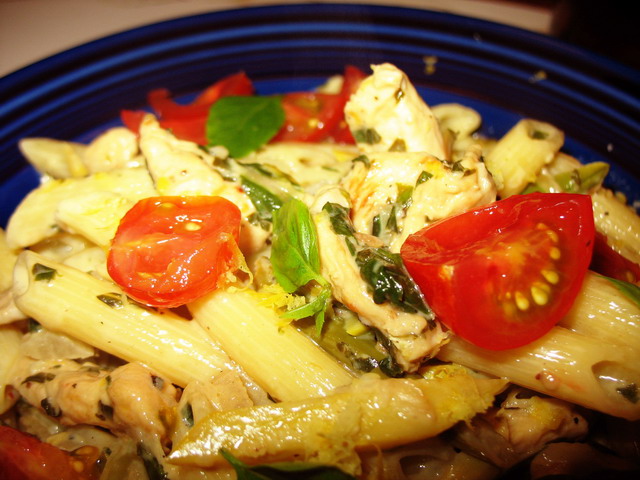
Last Saturday was the first official CSA box from Athens Hills CSA/Green Edge Gardens, and Becky, the farmer/proprietress/all-around-awesome lady packed us a box filled with absolute treasures. Baby beets, some late asparagus, fresh shiitake mushrooms, gorgeous chard (and so sweet, too), fresh flat leaf parsley, baby carrots and the sweetest minature baby zucchini, yellow crookneck and pattypan squashes you can imagine.
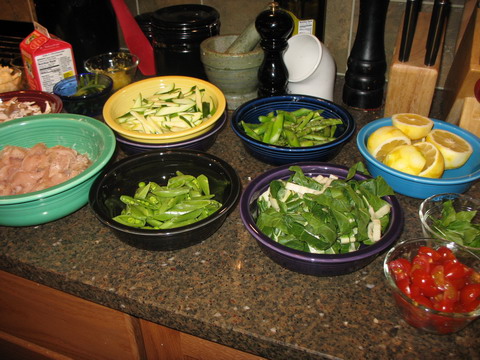
I also happened to pick up at the farmers market some sugar snap peas, green beans, paper-thin skinned new potatoes, fresh onions, garlic, and some cherry tomatoes that were started in a passive solar greenhouse back in January that taste like summer’s sweetest kiss. God, those tomatoes were heavenly!
What to do with all of that bounteous beauty?
Well, I happened to have a lemon or three in my refrigerator and some bushy basil plants ready to be cut back up on my deck, so my first thoughts were towards pasta, and one of my favorite early summer pasta dishes is pasta primavera, which is essentially a mixture of springtime vegetables and greens, in some sort of sauce dressing pasta. I wrote about it last year, and I made a similar sauce this time around, and added one locally raised free-range chicken breast for a bit of protein. When I added sauteed squash, mushrooms, snap peas, asparagus, chard, onions, garlic, blanched garlic scapes and a wedding bouquet sized bunch of basil, the flavors were out of this world. I ended up dressing two pounds of pasta, and feeding six hungry adults on a very, very small budget! It was great!
The best part of it, though, was this–Morganna’s boyfriend Donny, who is, apparently a picky eater, though I would never have guesed that by the way he eats at our house, ate every one of the vegetables in the dish without complaint and liked it so much, he joined everyone else in having second helpings. Picky eater, indeed!
So what goes into pasta primavera? Well, as far as I am concerned, any spring or early summer vegetable is fair game. I didn’t add beets because they would have made some weird color issues that I am not sure I would have approved of. Besides, I am saving those baby beets to be roasted and served in a salad with chevre, mixed greens and sunflower sprouts.But, just about everything else that came home with us was used. No potatoes, because I didn’t want to add starch to the already starch-based pasta. That just seems rather redundant. But the mushrooms, scapes, asparagus, green beans, squash, and chard all did fine together. I did use quartered cherry tomatoes, a bit of finely grated lemon zest and Greek Columnar Basil leaves as garnish at the end, and they added a fresh zip to the whole affair.
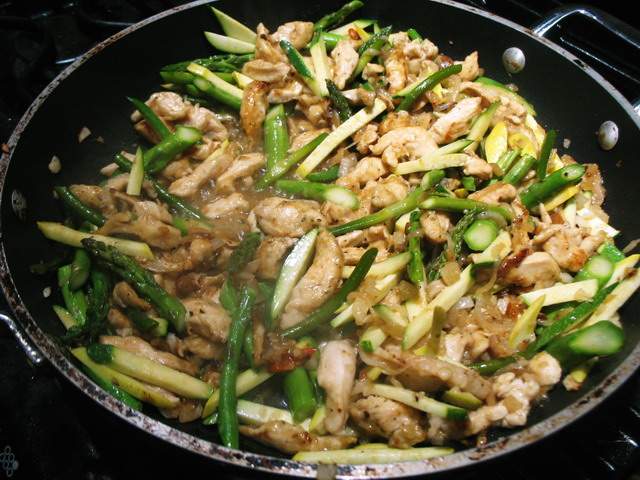
As for the sauce–I did make it essentially the way I made according to last years recipe, with a few twists and changes. I used more sherry than last year, and I used the juice of one more lemon. I left out the lemon oil, however, and the turmeric from the flour coating the chicken slivers. This led to the sauce being a pale beige in color. However, I added a huge amount of basil minced–about a cup and a half of it, that I had minced in the food processor, at the very end of cooking. This changed the color and flavor of the sauce considerably. Whereas last year’s recipe was really lemony, this one was much more complex, with the sweet nuttiness of the sherry combining with the tangy lemon juice and the neutral chicken broth to make the base of the sauce, that was then made fragrant and sensual with the addition of that huge amount of basil in the end.
Oh, and I added three Thai bird chiles, cut on the bias into thin slices to the saute, to put a quiet zing in the sauce.
So–if you want to replicate this dinner, and I thiink that you should–just take the recipe from last year, and make the changes I did to the sauce, and use whatever early vegetables you like in the saute.
I have no doubt that what I made is not what could ever be called “traditional” Italian–however, I am certain that it was very flavorful, and that my family, friends and I would all have no problem making it and eating it again.
Eating this way–with the freshest produce of the seasons–retrains one’s tastebuds and even one’s way of seeing food.
I have found that because I was raised eating the vegetables, fruits, meat and eggs from my grandparents’ farm, that I am predisposed to wanting to eat this way, but Zak grew up with the grocery store mindset, and his taste has changed a great deal since we started being strongly committed to eating the bounty of our local foodshed. Morganna, too, has become very attuned to the seasonal dance of fruits and vegetables, and with each trip to the farmer’s market, she finds new treasures to be excited about. Last Saturday is was sweet and sour cherries, blueberries and raspberries. Who knows what she will cause her to dance with excitement this week?
I think that when we talk about local foods and why it is important to eat them and support local farmers, we often lose sight of the sensual aspects of eating seasonally and locally.
When we wait with joyful anticipation for the first sweet ripe tomatoes of the season, instead of settling for the plastic, flavorless imports that grace the produce department of the grocery store twelve months out of the year, we really appreciate the flavor, texture, aroma and colors of the local, real product. We become emotionally invested in our food–we become connected to it, and it stops being mere fuel, but instead becomes a physical pleasure that is undeniable in its strength.
We must not overlook the strength that the sensual pleasures of the table when it comes to bringing people together, and creating bonds of love, fellowship and friendship among people. It is fundamental to human culture to eat together, to share the bounty of food and to thus be nurtured and sustained, not only on a physical level, but also on an emotional and spiritual level.
Food stops being just something we need to keep our bodies going, and returns to being one of the strands of human culture, woven over thousands of lifetimes as we come together to share the physical gifts of the Earth.
So, when I talk about local food, I really want people to remember that eating locally isn’t just a political or economic action.
It is also a sensual choice that offers as a profound opportunity to reconnect with the Earth, with our food, and with each other.
What can be more healthy, on an individual or community level, than that?
Anthony Bourdain Stirs The Pot on Salon.com
I have to admit that I have a great deal of fondness for Anthony Bourdain; while he may offend others with his foul mouth and strongly-stated opinions on topics that range from vegans (they are rude and self-centered), Rachel Ray (she is the anti-Christ), and women in professional kitchens (glad they are there, but it is likely to remain a sexist environment), his “real world” attitude combined with his wham-bam writing style has endeared him to me.
So, of course, I had to mention that there is a three-page interview with him on Salon today, eloquently titled, “Bite Me.” I’m a subscriber to Salon, but you can also jump through a few hoops to read some of their premium content free if you just want to read a story or two per day.
It is a fun read–and it is well worth the time it takes to wade through all the comments, as Bourdain seems to irritate a lot of folks who seem to squawk most amusingly whenever he opens his mouth. He has stuff to say about eating meat, eating vegetables, table manners, sustainability and the local foods movement, so there is something there for everyone. Oh, yeah, and he talks about eating sand, fur and shit in the first paragraph of the story–so–you can’t miss it. As I said, there is something there for everyone.
While I was perusing Salon this afternoon, I also noticed that there is an article decrying the current snobbish fascination with varietal “high percentage” chocolates in favor of the common treats of childhood like Hershey’s Kisses. “The Sweet Smell of Snobbishness” by Oliver Broudy takes a swipe at the new super foodie trend of luxury chocolates in a quick, stylishly written column.
A Magickal Transformation: Blueberry Baked German Pancake

There are some dishes that seem more to be the work of an alchemist or a sorceress than something a mere cook has whipped together in the kitchen. Baked German pancakes are one such dish: from a simple, runny batter of eggs, milk, flour, salt and butter, poured into a shallow baking dish and popped into a hot oven, emerges a towering, puffy, glorious cumulous cloud of a pancake, golden brown and lighter than air.
When you add a pinch or two of aromatic spices and a tipple of vanilla extract, and perhaps scatter a constellation of freshly plucked blueberries over the batter, the sorcery becomes deeper and more eloquent; the pancake that is drawn from the oven is as fragrant as a field of wildflowers, and as showy as a tiger swallowtail butterfly newly unfurled from her crysalis.
The first time I ever saw and tasted a German pancake was at the home of a friend; her mother made one in her cast-iron skillet from a mixture involving Bisquick, eggs and milk. The resulting runny batter was transmuted in her oven into a cup-shaped blossom of a confection–she served it sprinkled with powdered sugar and filled with freshly sliced strawberries.
She told me it was simple to make, and gave me the recipe, but for whatever reason, at the age of fourteen, I was certain that such a divine creation that was crisp and light as seafoam on the edges, and rich and spongy in the middle, could not be easy. It had to require some trick, some sleight of hand, that I was incapable of performing, so I tucked the recipe away, and eventually, forgot about it.
I did not taste such a thing again for years.
It was not until we moved to Providence, Rhode Island, so that I could attend Johnson & Wales Culinary that I once again beheld the miracle that is called a German pancake, only I found that others called them, Dutch pancakes or “Dutch Babies.”
And I didn’t taste them at school, but instead, at a chain of diners that are ubiquitous in New England: “Bickfords.”
Bickfords is where one goes to eat breakfast all day or all night. It is where one goes for coffee and omelettes at three in the morning after alll the bars are closed, and where one goes for a quick lunch with business collegues the next day. A cross-section of the populace of Providence was in evidence at all hours of the day and night at the local Bickfords, with the human scenery changing from hour to hour. My favorite time to visit was late at night, after Zak was off work at Borders, and I had finished a night class, and was too tired to cook anything to eat at home. At midnight on a weeknight, one saw troops of Goth kids too young for the bar scene, coming for a bite to eat after a long session of role-playing Mage: The Ascention or Vampire: The Masquerade. Dressed in the requisite black fishnet, spikes, lace, leather and chains, with hair in every hue of the rainbow (but with red, black and purple the most popular shades), these folks were great fun to spy upon, as their conversation was dominated by a concatenation of a retelling of the events of their recent gaming sessions, thoughts on the recent anime trends, what was doing on the X-Files, and on ongoing description of who was with who, what and where in their little corner of the high school, early college universe.
These night owls would combine fascinatingly with young couples like ourselves, college students, truck drivers on a long haul, groups of science-fiction geeks, computer programmers and barflies stopping their binge drinking for a little coffee and sustainence before returning to an alcoholic haze.
One of the most popular items on the menu for this disparate group of people to order was the Dutch Pancake, or a smaller version, the “Dutch Baby,” or, if one really needed a jolt of sugar and starch, a “Big Apple Pancake”, which consisted of apples sauteed in butter and sugar that had a quantity of the pancake batter poured over them, and then baked in the oven until a sticky, sugary apple-scented brown cloud of pancake appeared at the table like magic, a feat which never failed to elicit oohs and ahs from the famished late night customers. However, I glancing at their current menu offerings, I see that Bickfords has become “Bickfords Grille” and has removed all versions of the Dutch pancake except the “Big Apple” from their menu, so the puffy, powdered-sugar kissed pancakes served with lemon wedges seem to only live at the Bickfords of my memory, and no longer is a part of current reality.
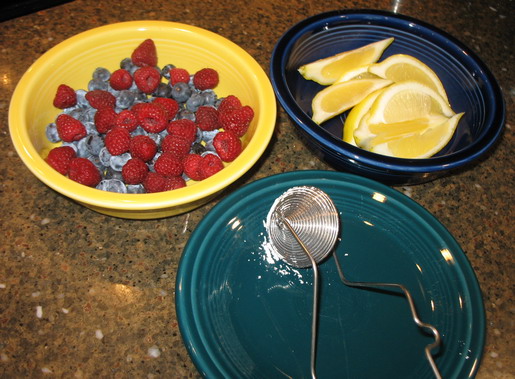
So, now we come to the recipe. It really is simple, though I do not bother with anything like Bisquick, preferring to not have to use a convenience product that is no more convenient than taking the time to measure flour, salt and baking powder. There is no real alchemy involved, except that which is contained within the eggs, milk, flour and oven themselves: a child could make these cloud-like pancakes with ease, and in fact, it would make a good celebratory breakfast for a future Mother’s or Father’s Day that a youngster of about ten years old could manage.
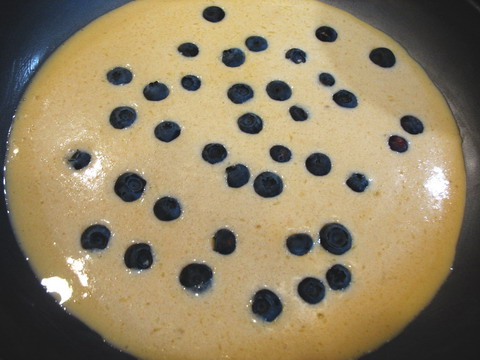
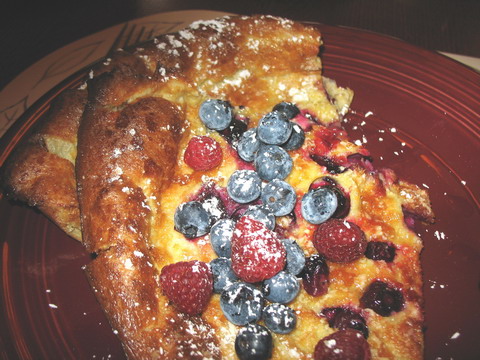
My variation on the recipe contains some cardamom, cinnamon and vanilla in the batter; just before baking, I scattered a generous handful of fresh blueberries into the batter after it was poured into the pan. I had raspberries, too, but those, I simply served on top of the baked pancake along with more blueberries, powdered sugar and freshly squeezed lemon juice, from wedges I had ready in a bowl beside the serving plates.
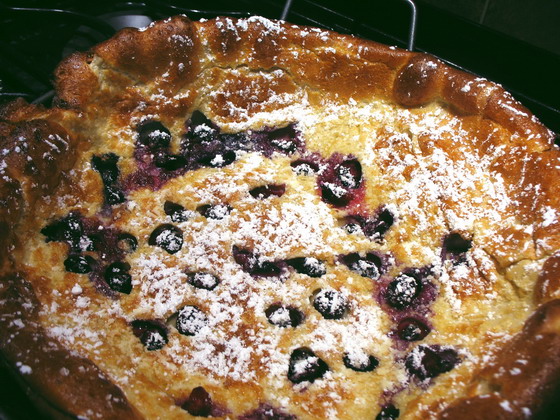
This version would make a good, light, simple dessert for four people; for a light breakfast, it is good for two people.
I have a special Oven Pancake Pan from Chicago Metallic that I use for this recipe, but in truth, you can use a twelve-inch cast iron skillet or a set of four six-inch skillets or miniature pie pans or cake pans to bake this pancake.
I bet it would be good with sweet cherries, strawberries or blackberries baked inside it as well.
Blueberry Baked German Pancake
Ingredients:
3 eggs, at room temperature
1/2 cup milk
1/2 teaspoon vanilla extract
1/2 cup all purpose flour
1/2 teaspoon salt
1/8 teaspoon cinnamon
1/8 teaspoon cardamom
2 tablespoons melted butter
1/3 cup fresh blueberries, stemmed, washed and thoroughly drained
lemon wedges for serving
powdered sugar for serving
mixed fresh berries for serving
Method:
Preheat oven to 450 degrees F. Butter one 12-inch skillet or pan or four 6-inch skillets or pans.
Break eggs into a medium sized mixing bowl, and beat well until thoroughly combined. Beat in milk and vanilla extract.
Put all dry ingredients into a sifter. Sift over the milk and egg mixture, whisking to combine dry ingredients thorougly with the liquid. The batter should be thin and pale colored.
Whisk in melted butter until the batter is smooth and slightly thicker.
Pour the batter into the prepared pan or pans and scatter the blueberries evenly over the batter. Bake for 15 minutes at 450 degrees F. (If you have a convection oven, as I do, bake only for ten minutes.) If you are making baby pancakes, they will be done after this amount of time–remove from oven, and proceed with serving instructions.
If you are making a large pancake, lower oven temperature to 350 degrees and bake for another 10 minutes (if you have a convection oven, as I do, bake for only 2 more minutes.)
To serve, dust with powdered sugar, and cut into wedges. Sprinkle each serving with additional berries and give each person a lemon wedge or two to squeeze over thier pancake pieces.
Sour Cherry Lattice Top Pie
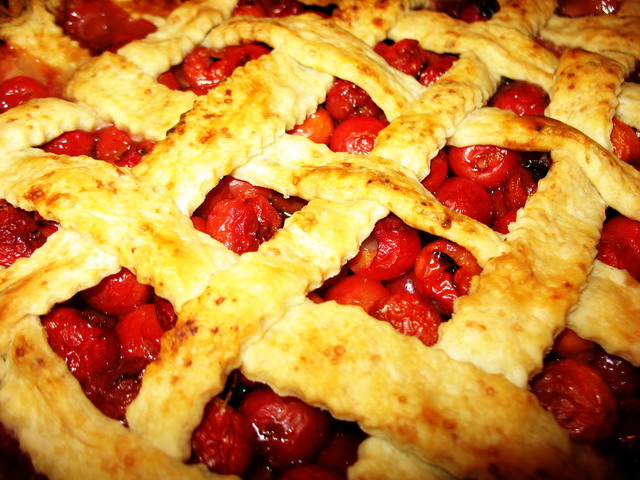
One of the prettiest pies known to humanity is a sour cherry lattice top pie.
Or, at least, I think so.
The brilliant color of the cherries is set off by the seemingly intricate woven strips of pastry; the fruit looks like round ruby baubles set in a golden filagree. The openwork top also allows the fragrance of the filling to fully permeate the air, so while the pie bakes, the whole house is filled with the scent of cherries, spices and browning pastry.
It really is a joy to behold.
I was always afraid of making latticework pie tops for years, even though I grew up watching my Grandma patiently weave them herself. She especially liked lattice tops for cherry or blackberry pies; she eschewed them for apple pies, stating simply, “Apples aren’t as pretty as cherries and berries, so there is no need to show them off.”
How does one make a lattice-work top for a pie?
Well, the traditional way looks complicated, but is really easy.
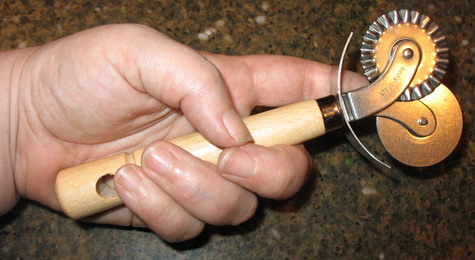
All you do is roll out your pastry for the top crust just as you would for a double-crust pie. But, instead of draping that round of pastry over the filled bottom crust, trimming it and pinching the edges to make a decorative border, you cut 1/2″ strips of pastry out of the rolled top. I like to use a fluted edged pastry cutter to cut the strips, because it makes the pie top look even fancier, but you can use a straight cutter, a pizza cutter or a knife just as easily. Just make sure to try and keep your strips the same width, and keep the cuts parallel.
I like using my Italian pastry cutter, shown above. It has two cutting wheels, so you can cut a straight or fluted edge, and you can use it to cut pastry, pasta, cookie dough or bread dough, depending on what you are up to. The wheels are sharp, so the pastry comes out with nice cleanly cut edges–no blurry flutes here! But, you could do just as well cutting straight edges with a pizza cutter or a very sharp knife, though I have to say, using a knife can be clumsy, and is the method most likely to cause crooked edges.
Once you have the strips cut, you lay out the first layer of them , using the shorter strips first, with each strip gradually increasing in length until the center strip, and then decreasing again. Do not trim the strips to fit at this time! Leave about a 1/2″ space between strips.
Next, you need to lay the second layer of strips and weave them into the first layer. This isn’t nearly as hard as it sounds.
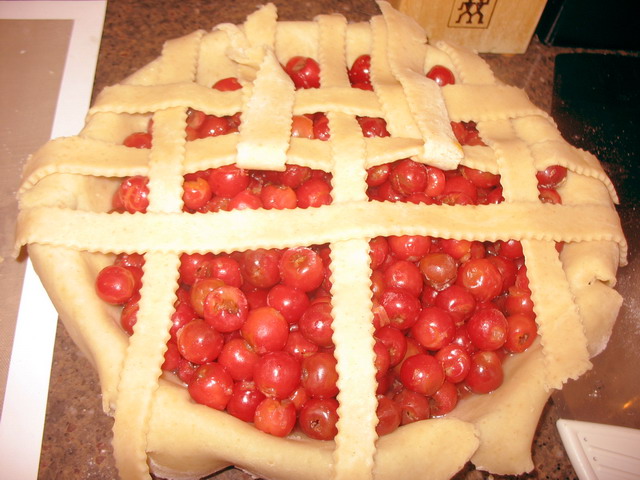
All you have to do is fold back every other strip of the first layer of pastry before you lay down the first strip of the second layer. Look at the photograph, and you can get the idea. Fold back every other strip of the first layer, lay down the first strip of the second layer, and then unfold the folded back strips and lay them flat once more. Then, before you lay the next strip, you take the strips from the first layer that were not folded back on the first go-around, and fold them back, then lay the second strip, and lay everything flat again.
Repeat as necessary, until you have covered your pie with a basket-weave effect lattice top.
Now, you need to trim the edges of your strips even with already trimmed edge of the bottom crust, pinch the edges of the strips to the bottom crust, and then tuck the edges under and squeeze gently against the top edge of the pie pan. Then, make a fluted edge by whatever means you prefer to do it–I use my fingers, but some people like to use spoons and fingers. (If you follow the link to the lard-butter pie crust recipe, there are photographs and extensive instructions on how to make the dough, roll out the crust, put it in the pan, fill it, place the top crust on top, trim it, and flute it, so fear not.)
The recipe for the filling is in large part from Ken Haedrich’s book, Pie, though I added the spices myself. The ginger, in particular, adds a delicious fragrance to sour cherries that is unbeatable. I also lowered the amount of sugar in the filling considerably, as I am fond of the tart flavor of sour cherries. If you want a sweet cherry pie, use sweet cherries, okay?
(For this pie, I am happy to say that the many of the ingredients are fresh and local to Ohio. I used lard from Harmony Hollow Farms here in Athens, cherries grown in Athens, and butter from Hartzler Family Dairy in Wooster, Ohio. If you live in Athens, Ohio, you can get the first two ingredients at the Farmer’s Market and the butter at The Village Bakery down on East State Street.)
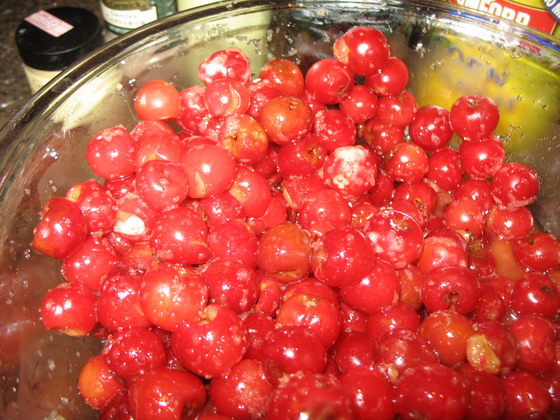
Sour Cherry Lattice Top Pie
Ingredients:
1 recipe Lard-Butter Crust (or, you can use all butter if you want)
6 cups fresh sour cherries, stemmed and pitted
1/2 cup raw sugar
1/4 cup cornstarch
1/4 teaspoon ground dried ginger
1/8 teaspoon ground cardamom
grated zest of one lemon
2 tablespoons cold butter, cut into small pieces
Method:
Preheat oven to 400 degrees F.
Mix together all filling ingredients except butter, and allow to macerate until the cherries release some of their juice.
Roll out dough for the bottom crust ,and lay it into 9 1/2″ deep dish pie pan, and then add filling. Smooth the filling flat with a spatula, and dot top with tiny bits of the 2 tablespoons of butter.
Cut strips, and use them to weave the top as directed above. Trim the strips and bottom crust as directed in the instructions for the Lard Butter Crust. Turn edges under and flute them as instructed and illustrated in the recipe for the crust.
Place pie onto silpat-lined baking sheet and place in the center oven rack and bake for 30 minutes. (20 minutes if you have a convection oven.) Reduce temperature to 375 degrees F and rotate pie 180 degrees, so that the part that faced the front of the oven now faces to the back. Bake until the top is golden brown and any visible juices bubble thickly–about 35-40 minutes. (With a convection oven, it is more like 25-30 minutes.)
Remove from oven and cool pie on wire rack for at least two to three hours before cutting into it and serving it. (My experience is this–with lattice top pies, it is best to serve them completely cool–otherwise, they will not be very pretty.)
Finding Substitutes for Black Pepper
Under normal circumstances, I would never advocate that a person attempt to find a substitute for the flavor of black pepper–or really, any other spice. They all taste unique, and substitutions do not happen on a one-to-one basis. However, when I discovered recently that I had developed an allergy to black pepper (which I still hope is some odd side-effect of being pregnant and will eventually go away), I found myself in the position to have to find something to take the place of that very commonly used spice in my cooking.
At first, this search was not very successful.
In Indian spice blends, like my house garam masala, I found that I could use some allspice instead of black pepper and have a satisfactory flavor and level of heat. The flavors of the two spices are in no way analogous, however, the level of “heat” that allspice registers on the tongue is of a similar caliber as the heat of black pepper, and so long as it is a spice blend containing at least four or five different flavors, it works fine.
As a stand-alone spice along with salt, however, allspice is not a very good substitute.
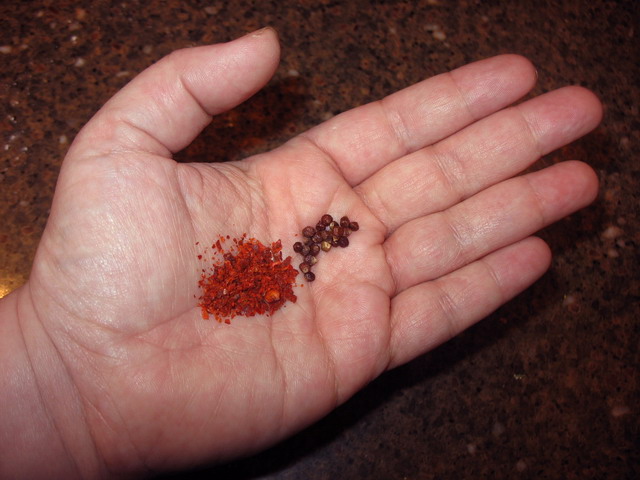
Then, in more of a “stand-alone” situation where I wanted the bite of black pepper, but didn’t want to hide it in a spice blend, I tried some of Penzey’s Aleppo Pepper flakes. Aleppo peppers are a slightly hot chile from Turkey, which combine a unique sweetness with just a little bit of a bite and very little heat. For some dishes, particularly foods that are Mediterannean in origin, Aleppo pepper flakes–pictured above–are a pretty good substute, though the sweetness of the chile is noticable and can throw off the flavor balance of some dishes.
Finally, a loyal reader, Mel, I believe, mentioned that I should try “Grains of Paradise,” a spice that was once used as a substitute for the more expensive black peppercorns back in the Middle Ages. She also said it was somewhat hard to find, however, with the Internet at my fingertips, I was not surprised to find it readily available from several online sources, including the one I bought some from–The Spice House, in Chicago. She mentioned that it was related to ginger, not black pepper, so both she and I were of the opinion that it might be a workable substitute.
I had heard of the spice, but had never run across it myself, so after ordering a jar of it, I decided to do a little research on it to see what gave it its flavor. So I let my fingers do the walking across the keyboard to my favorite source of knowledge on all things spicy: Gernot Katzer’s Spice Pages, and found a great deal of interesting and useful information.
Grains of Paradise, Aframomum melegueta, is a spice that is native to West Coast of Africa, and is particularly grown in Ghana. It is no longer very much used except in West African and North African cookery, though at one time, it was used as an inexpensive substitute for black pepper in Europe. None of the flavor constituents contain piperine, the substance that gives black pepper its flavor, so it is unlikely that I will have any sort of allergic reaction to this spice.
The spice consists of seeds, about the size of cardamom seeds, that grow together in a dried brown pod that also looks similar to a cardamom pod. The seeds, however, instead of being greyish black are reddish brown, until they are ground and then they are somewhat greyish, and very, very fragrant. (You can see them in the picture above.)
I was excited to try them when they came in yesterday, so I immediately tore open the box and opened the jar. Sprinkling a few out into my hand, I sniffed them, and discerned very little scent. When I first cracked a seed between my teeth, I was equally disappointed and wondered if I had gotten a shipment of very old, worn out spices, however, as I chewed the seed thoroughly up with my molars, a very distinctive fragrance and flavor was released.
What was it?
It tasted like a mixture of good dried ginger and black pepper. I popped another seed in my mouth, and kept chewing, and the flavor deepened. It definately had the black pepper sharpness teamed with the incomparable lingering scent of ginger.
I used it to sprinkle over my pollo ala plancha last night and was thrilled to discover that the flavor was very, very close to that of black pepper, with the ginger note only adding a welcome flowery scent to the dish.
It was great!
I think this will be my all-purpose pepper substitute from now on; I just need to order a new pepper mill to put it in!
Thank you, Mel!

Categories:
- Admin (rss) (55)
- Blogs and Blogging (rss) (81)
- Book Reviews: Cookbooks (rss) (43)
- Book Reviews: Non-Cookbook Food Books (rss) (38)
- Cats and Cat Blogging (rss) (47)
- Chinese Cooking Lessons (rss) (32)
- Culinary School Stories (rss) (18)
- Dairy Pruducts: Cultured and Barbaric (rss) (4)
- Documentary Filmmaking (rss) (1)
- Essays, Rants and Reflections (rss) (260)
- Fighting Hunger (rss) (12)
- Food and Kids (rss) (45)
- Food in the News (rss) (126)
- Food Media (rss) (98)
- Food Preservation (rss) (18)
- Food Safety (rss) (45)
- Gardening (rss) (30)
- Herbs and Herb Blogging (rss) (20)
- Holidays (rss) (50)
- Kat Blogging (rss) (22)
- Kitchen Science (rss) (36)
- Leftover Makeover (rss) (8)
- Life, the Universe and Everything (rss) (131)
- Local and Sustainable (rss) (227)
- Local Athens Food and Foodies (rss) (42)
- Meatless Mondays (rss) (32)
- Menu For Hope (rss) (5)
- Nutrition, Diet and Health (rss) (84)
- On The Farm (rss) (8)
- Recipes: Almost Vegetarian, Vegetarian and Vegan (rss) (294)
- Recipes: American Regional (rss) (37)
- Recipes: Appalachian Hillbilly (rss) (33)
- Recipes: Bread, Pasta, Grains (rss) (95)
- Recipes: Canning and Preserving (rss) (8)
- Recipes: Chinese (rss) (123)
- Recipes: Comfort Food (rss) (120)
- Recipes: Cookies (rss) (16)
- Recipes: Desserts (rss) (48)
- Recipes: French (rss) (25)
- Recipes: Fruits and Vegetables (rss) (302)
- Recipes: Greek, North African and Middle Eastern (rss) (31)
- Recipes: Indian (rss) (137)
- Recipes: Italian (rss) (42)
- Recipes: Japanese (rss) (7)
- Recipes: Jewish (rss) (4)
- Recipes: Korean (rss) (6)
- Recipes: Meat, Poultry and Fish (rss) (220)
- Recipes: Mexican/Native American/ Latin American/Caribb (rss) (27)
- Recipes: Original (rss) (108)
- Recipes: Thai (rss) (27)
- Recipes: Tofu (rss) (17)
- Recipes: US Regional (rss) (16)
- Recipes: Vietnamese (rss) (8)
- Restaurant Stories (rss) (28)
- Sewing, Quilting, Arts and Crafts (rss) (16)
- Simple Chinese Recipes (rss) (30)
- Slow Food and Heritage Foods (rss) (10)
- Spice Blogging (rss) (44)
- The Chinese Cookbook Project (rss) (14)
- The Chinese Pantry (rss) (39)
- The Documentary (rss) (2)
- The Kitchen Saga (rss) (17)
- The Locavore's Bookshelf (rss) (15)
- The Unsung Adventures of The Culinary Nerd (rss) (6)
- Tools and Toys (rss) (35)
- Uncategorized (rss) (10)
- With a Side of Politics (rss) (48)
Archives:
- August 2012 (9)
- July 2012 (12)
- September 2011 (3)
- August 2011 (7)
- July 2011 (8)
- June 2011 (16)
- May 2011 (17)
- April 2011 (11)
- December 2010 (9)
- November 2010 (5)
- February 2010 (1)
- December 2009 (5)
- November 2009 (7)
- October 2009 (10)
- September 2009 (16)
- August 2009 (14)
- July 2009 (14)
- June 2009 (7)
- May 2009 (17)
- April 2009 (10)
- March 2009 (25)
- February 2009 (13)
- January 2009 (10)
- December 2008 (5)
- November 2008 (5)
- October 2008 (6)
- September 2008 (13)
- August 2008 (8)
- July 2008 (11)
- June 2008 (18)
- May 2008 (13)
- April 2008 (14)
- March 2008 (16)
- February 2008 (17)
- January 2008 (19)
- December 2007 (25)
- November 2007 (18)
- October 2007 (24)
- September 2007 (16)
- August 2007 (15)
- July 2007 (15)
- June 2007 (10)
- May 2007 (14)
- April 2007 (16)
- March 2007 (17)
- February 2007 (20)
- January 2007 (13)
- November 2006 (1)
- October 2006 (8)
- September 2006 (14)
- August 2006 (25)
- July 2006 (30)
- June 2006 (28)
- May 2006 (34)
- April 2006 (29)
- March 2006 (24)
- February 2006 (30)
- January 2006 (38)
- December 2005 (40)
- November 2005 (37)
- October 2005 (32)
- September 2005 (25)
- August 2005 (30)
- July 2005 (28)
- June 2005 (21)
- May 2005 (8)
- April 2005 (22)
- March 2005 (17)
- February 2005 (29)
- January 2005 (10)
Search Site:
Links:
- Lily’s Wai Sek Hong
- 101 Cookbooks
- A cat in the kitchen
- A Veggie Venture
- Accidental Hedonist
- Cha Xiu Bao
- chez pim
- Chocolate & Zucchini
- Chopstick Cinema
- Chowhound.com
- Chubby Hubby
- Cook sister!
- Cooking with Amy
- da*xiang
- Eat Local Challenge
- Eating Liberally
- Ecocentric
- Eggbeater
- Epicurious
- Farmgirl Fare
- Fatfree Vegan
- Foodgoat
- ForkandBottle.com
- Green Olive Tree
- Hooked on Heat
- Jaden’s Steamy Kitchen
- Kalyn’s Kitchen
- Lucullian delights
- Mahanandi
- Matt Bites
- MeatHenge
- mmm-yoso!!!
- New York Times – Dining & Wine
- Pizza Goon
- Rasa Malaysia
- Ruhlman
- Sailu's Kitchen
- Serious Eats
- SF Gate: Food & Dining
- Simply Recipes
- Soul Fusion Kitchen
- Tastespotting
- The Amateur Gourmet
- The Cleaner Plate Club
- The Food Section
- The Grub Report
- thecookscottage
- U.S. Food Policy
- Wandering Chopsticks
- Washington Post Food and Dining
- Wasted Food
Meta:


Powered by WordPress. Graphics by Zak Kramer.
Design update by Daniel Trout.
Entries and comments feeds.