
Cook Local, Eat Global
Indo-Persian Cherry Kofta
The sour cherries are in season here in southeastern Ohio, and I am thrilled. Last year, I wrote a long post detailing my childhood obsession with sour cherries; for those who want to hear about how I, as a wee child, defended my own two sour cherry trees tooth and claw from the depradations of the birds, I direct you to the story entitled, “Cherry Memories.”
For those who want to hear what I have been doing with the current crop of sour cherries, stay right here.
At last Saturday’s farmer’s market, I bought two quarts of them; on Sunday, I made a lattice-topped cherry pie for Zak’s Father’s Day gift (yes, a recipe is forthcoming) and last night, with the last two thirds of a quart, I was going to make Persian Cherry Pilaf–which is one of Zak’s favorite dishes in all the world.
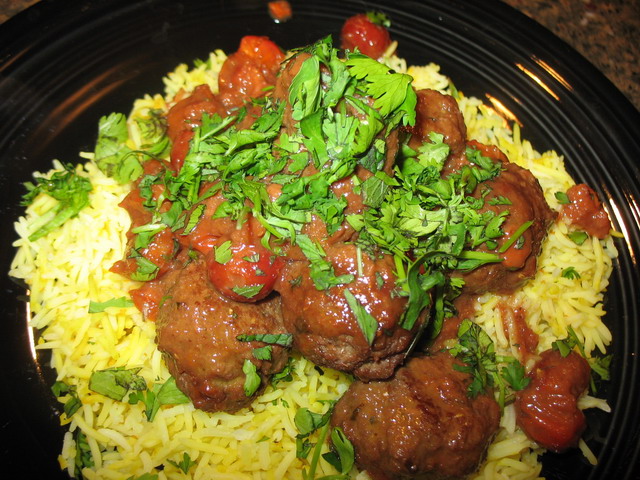
However, I wanted to try something different. So, knowing as I do the heavy influence Persian cuisine has had on the cooking of the northern regions of India by way of the Persian Mogul Empire, I decided to make a dish that was a fusion between Albalu Pillau–the Persian Cherry Pilaf that contains lamb meatballs, basmati rice toasted in lamb fat and then cooked with cherries and cherry juice–and a northern Indian style lamb kofta dish with sour cherries being the main component of the sauce. The kofta were to be served over basmati rice cooked with shredded fresh turmeric rhizome, so that it was pale yellow and fragrant.
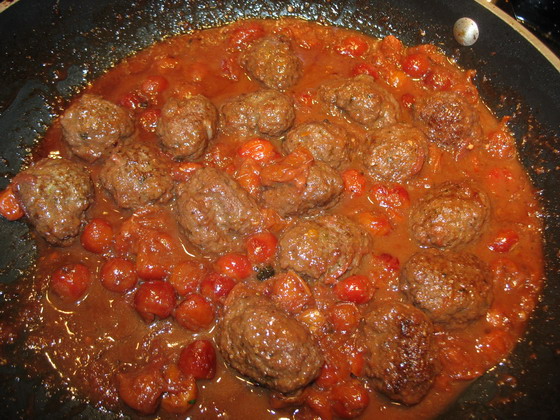
I discovered after I cooked the kofta and made the sauce that the results were very deeply flavored. One problem with cooking the rice with the cherry juice is that the while the cherry color is retained, much of the flavor is diluted by cooking the rice with it. Too much water or chicken broth is added, so the tart punch of the fruit is diminished. Cooking the sauce as I did with the kofta, where I cooked the cherries with cherry juice that reduced to one third of its starting volume, created a depth of flavor and color that was hard to resist. The sour jolt of the fruit was tempered by being cooked with the spices, onions and kofta, resulting in a pleasantly tangy dish that required very little salt and absolutely no sugar to balance it. The subtly-spiced kofta were stained a reddish brown from having been simmered in the sauce, and were filled with flavors that were equal parts Persian and northern Indian.
And the best part–was it was easier to cook than Albalu Pillau.
Indo-Persian Cherry Kofta
Ingredients for the Kofta:
1 pound ground lamb
1 medium garlic clove, peeled and sliced
1 golf-ball sized onion, peeled and sliced
1/2″ inch cube fresh ginger, peeled and sliced
3 whole cloves
1 tablespoon coriander seeds
1/2 teaspoon cumin seeds
1/4 teaspoon cardamom seeds (removed from pods)
1/4″ shard cinnamon stick (or a pinch of ground cinnamon)
1/8 teaspoon Aleppo pepper flakes (or, if you are not allergic to black peppercorns, use those)
2 tablespoons minced cilantro leaves (if you do not like cilantro, use mint instead)
pinch salt
Method:
Using a spice grinder, blender, Sumeet, mortar and pestle, or food processor, or any or all of the above, grind all ingredients except for lamb into a thick paste.
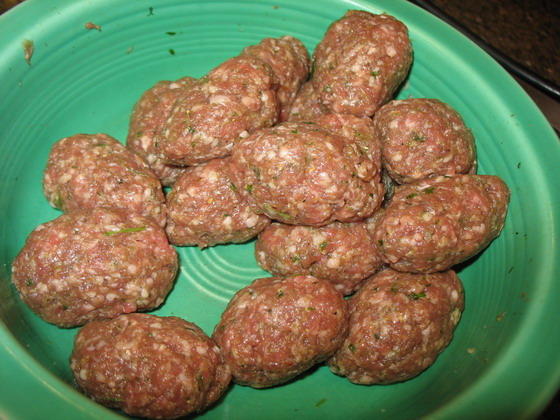
Mix spice paste and meat together gently with your fingers until well combined. Using a cookie scoop, melon baller or other method, divide meat mixture into equal sized balls–about two tablespoons each–and lightly shape between two damp palms into egg or football shapes. Do not compact the kofta–you want them to be very tender.
Ingredients for Sauce:
2 medium garlic cloves, peeled and sliced
1″ piece fresh ginger, peeled and sliced
1 thin 1″ long fresh turmeric rhizome, peeled and sliced (or use 1/2 teaspoon dried ground turmeric)
5 whole cloves
1/2″ piece cinnamon stick
1 1/2 tablespoons coriander seeds
1 teaspoon cumin seeds
1/4 teaspoon cardamom seeds (removed from pods)
1/8 teaspoon Aleppo pepper flakes or black peppercorns
2 tablespoons olive or canola oil
1 medium onion (the size of a baseball), peeled and thinly sliced
1-3 (depending on how hot you want your sauce to be–I used one) Thai chiles, minced
2/3 quart fresh or frozen pitted sour cherries
*1 1/2 cups sour cherry juice
salt to taste
1/2 cup fresh cilantro leaves, finely chopped
1/4 cup fresh mint leaves, finely chopped
Method:
Grind ingredients from garlic cloves to Aleppo pepper or black peppercorns into a thick paste. Set aside.
Heat oil on a medium flame in a heavy-bottomed, wide skillet. Add onions and saute until golden.
Gently add kofta, and shaking pan to turn kofta gently, cook until the kofta are browned all around and the onions are reddish brown. (Do not stir kofta and onions with a spoon, as this will break up the very tender meatballs. If you cannot shake the pan and get the onions and kofta moving enough, use a spatula to stir around the onions and to turn the kofta very gently.)
When kofta are browned and onions are cooked, add spice paste, minced chiles, cherries and cherry juice, stirring gently to combine. Turn heat down to medium low and cook, uncovered, until liquid reduces to one third its original volume, stirring gently as needed. The onions should break down into the sauce along with some of the cherries, while other cherries will remain somewhat whole, if made much smaller through loss of juice.
The sauce will reduce to the thickness that will coat a spoon, and be a rich carmine color. The kofta should be a dark brick-red brown. Taste the sauce add salt as needed . (I only needed a tiny pinch of it.)
Serve over a bed of turmeric rice with a generous garnish of freshly chopped cilantro and mint.
*Note: I had cherry juice I had frozen from last year’s crop of sour cherries. If you do not have access to such a thing, you can purchase sour cherry concentrate, which is sold to be used as a natural painkiller for sufferers of gout, arthritis and other joint diseases. Follow the directions on the label to reconstitute the juice and make the volume you want. You can make the flavor stronger by using more concentrate than is called for as well.
Some More Food In The News
Cat Meat Restaurant in China Closes Due to Protests
Recently I wrote about why it is that some people object to cute animals suffering but not “uncute” ones like pigs who also suffer, and I kind of wish that I had seen this article while I was working on the essay.
I have known for a long time that in Guangdong province in China, cat and dog meat are considered to be delicacies, and are supposed to be “warming” meats that one eats in the winter. Even though I love cats and dogs dearly, and have a house filled with them, personally, the thought of eating them myself is difficult to swallow. However, I also do not think it is right for me to decry other people’s practice of eating cats and dogs as uncivilized, just because I don’t like it. That is culinary cultural imperialism, and I refuse to engage in such ethnocentric, egocentric behavior.
Imagine my fascination to discover that the nascient animal-rights movement in China has become strong enough to affect change in the form of a small restaurant serving meatballs made from cats being shut down willingly in the face of protests from pet-owners and animal lovers.
Is this good?
I am of two minds about this issue. I have heard stories of cats and dogs suffering in cages in or near restaurants in China that serve their meat, and of them being killed in gruesome, inhumane fashions that are too grotesque to go into here. I also do not know how substantiated those stories are; I always fear that they are the sorts of exaggerations that are told in order to demonize those of another race. In situations where any animal is tortured before being eaten, and made to suffer grieviously in their lives, I am angered at the unnecessary cruelty of the practice, whether that animal is a cat, dog, cow or pig. If it is a case of the animals suffering at this restaurant, then, I cannot help but applaud the actions of the protestors.
On the other hand, if the animals were not suffering, and were killed humanely, and it is simply a case of some Chinese being more “Westernized” than others, I see it as a more subtle form of cultural imperialism. What I mean is, while it is Chinese people doing the protesting, they are adopting Western ways by choice, and calling those ways superior to Chinese traditions. This -is- what happens when cultures meet and make exchanges with each other–new traditions and practices are adopted back and forth, and some traditional practices may be lost. In some cases–that loss is a good thing–if this is a case where animals were suffering needlessly, then what great loss is there? But, it may be that other traditions are left behind which -are- beneficial to the Chinese people. (If not in this matter, then in another.)
My final say on the issue is this–I am happy to see that the active parties in this issue are the Chinese people themselves. The protestors were Chinese, acting on their own initiative, without outside interference, and the owner of the restaurant is Chinese working on his/her own initiative by making a business decision which is probably for the best. (Meaning, if protestors kept coming to the restaurant, he is better off serving something else that is more acceptable to the populace at large than to keep serving that which causes uproar and strife.) So long as the issue of eating cats and dogs in China continues to be addressed and debated by the Chinese people themselves, with the rest of the world taking a backseat and being silent, I am happy, because it is a case of culinary cultural self-determination–a process which I heartily endorse as good for all the parties involved.
(Thanks to Slashfood for bringing this story to my attention.)
Raising Kids to Eat Whole Foods in a T.V.-Free Zone
I loved reading Sandra Steingraber’s book, Having Faith: An Ecologist’s Journey to Motherhood, when I was pregnant several years ago. Even though much of what Steingraber wrote about was essentially depressing–the fact that environmental toxins and pollutants cannot help but become part of our breastfed babies’ bodies–her prose is so clear, descriptive and engaging that I could not help but be both entertained and made hopeful by her experiences.
Now, I am fascinated to learn from an essay posted to Alternet, that she has a second child, and has essentially raised them from infancy to school-age without having them be exposed to television advertising or to the foods marketed to children in typical American grocery stores. All of the food Steingraber’s family eats comes from a local Itheca CSA and a small downtown co-op grocery store, so her children have been exposed only to whole foods that she and her husband prepare.
The results are interesting. They do not like candy or soda (her son calls soda “too spicy,”) and the one time they tasted McDonald’s they abhorred the artificial flavors and the limp, soggy french fries. Her daughter, now attending school, loves spinach, and even after she found out that other kids hate it, said, “I guess children don’t like spinach…but I am a child who does!”
Her two children still go through the typical and age-appropriate food dislikes/cravings where one week, bananas are declared hideous, and the next, they are clamored for, but there are apparently not any tearful tantrums over not getting a cartoon-character endorsed box of sugar cereal, nor are Steingraber and her husband preparing separate meals of processed “kid food” for their children.
I cannot help but be interested in Steingraber’s experiences because in our home, we have a television, but we only use it to watch DVD movies, documentaries and downloaded Dr. Who episodes. I cannot remember the last time we regularly watched broadcast or cable television regularly, and I have noticed that because Zak, Morganna and I are not exposed to television advertising, we don’t hear about the “next big processed food/fast food/plastic food product, and so we do not shop for it.
I am wondering if, in our household where we, too, eschew processed foods and fast foods, and prefer to eat locally grown, seasonal products, we can manage to raise our baby, Kat (yes, she has a first name now–Katherine, called “Kat” for short) with similar tastes in wholesome vegetables, fruits, grains and dairy products. Time alone will tell….
(Thank you, Zak, for sending me this article.)
International Agricultural Legacy Gains Secure Home
A massive seed bank, larger than any other of its kind, with the inventoried items kept to international standards, will be made secure on the Norwegan outpost of Svalbard, according to the Washington Post.
The “doomsday vault,” as it is sometimes called, will contain seeds that represent 10,000 years of worldwide selective breeding, and will stand as a carefully guarded backup in the case of a planet-wide disaster such as a direct asteroid hit (such as the one that destroyed the dinosaurs), or a nuclear or bioweapon holocaust. In such a worst-case-scenario, having this protected seedbank would mean that once humanity began rebuilding, they would not have to start over at the beginning when it came to plant-based agriculture.
The facility will be built within the next two years, and then will start accepting donations of seeds for food plants from other seed banks. When the archive is filled, the vault will be sealed airtight, and humanity’s insurance policy will be saved, hopefully to never be opened again.
It is a remarkably far-sighted effort that is being undertaken and I am pleased to see it. Humanity tends to look only at the short-term future, and does not often look towards a far future, particularly if it includes some sort of unpleasant occurance such as war or ecological devastation. Seeing scientists from around the globe participating in this event gives me hope that humans really -can- think ahead and try to do the right thing.
Of course, I cannot help but wonder if anyone is looking toward the animal species, and is preparing a genetic “ark” to preserve DNA, sperm and egg samples from various fauna, both wild and domestic, in the case of such a catastrophic event.
(Thanks, once again, to Zak for sending this article–I was already aware of the project, but this is a really good explanation of what is happening that I had not caught.)
That’s it for Food in the News this time around–I am signing off for the rest of the day so Zak can do some work updating my computer. I am getting some new hard drives with lots of memory space on them, and a new color monitor so I can make Tigers & Strawberries better, faster and stronger than before, with prettier pictures and all of that good stuff.
Check Out These Three Late and One Missed Entry to The Spice is Right III!

I just wanted to do a quick post pointing readers to three exemplary entries which came in for the Spice is Right II: The Perfumed Garden. Two were late (which is okay, I am not a draconian taskmistress), and one had been emailed to me on time, but I somehow missed the entry.

But they are all so good, I wanted to post the pictures here, and point you back to the round-up post so you can read about them there–they are all just fantastic. I want to make sure that if you read the round-up before these recipes came on board, you give it a second glance now that they are all installed happily in place with the other fifteen great recipes.
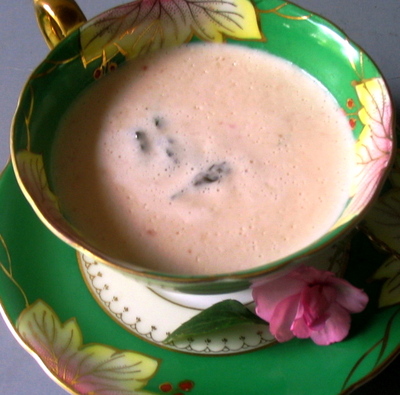
The entries include Raspberry Sour’s “Chocolate Rose Cakes,” which are molten chocolate cakes flavored with rosewater, coffee and amaretto, Lindy’s “Radish Cream Soup With Lavender,†which is one of the prettiest soups I have seen in a long time, Vaishali’s refreshing “Low-fat Sweet Lassi With a Hint of Rose,†and Danielle’s “Sour Cherry Sage Flower Jam,” which sparkles like rubies.
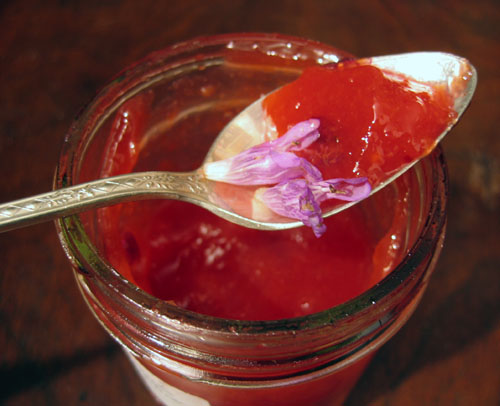
These are really lovely entries that I hope you will check out here or at their blogs, because they are really special recipes that deserve a second look.
Two Ways To Treat Dad Like a King: Castle Cakes

What is a king without a castle?
I don’t often do whimsy in my cooking, however, when Morganna and Brittany saw this castle-shaped Bundt cake pan from Nordic Ware in a catalog, they insisted I had to get it. I already have a small collection of the sculpted Bundt pans, (and have used the rose-shaped one many times) and am pleased with how well they work, so, while the three of us were at Sur la Table last week, we picked one up.
Of course, once the pan was aquired, the young ladies -had- to bake a cake in it. So, while I took care of the burgers, toppings, potatoes and corn for the Not-Quite-All-American-Cookout on Thursday, they were in charge of dessert.
They looked through the recipes in the Bundt Classics Cookbook, and at first were disappointed with the many choices that included cake mix in the ingredient lists. However, I pointed out one “from scratch” recipe that I had adapted in the past, and which I thought that they would like; it used fresh ginger as a flavoring agent. They wanted to do a lemon and ginger flavored cake, so I rewrote the recipe a bit to include lemon flavorings as well, and let them loose in the kitchen. (I am, of course, very pleased, that neither of them wanted to use a cake mix, but were instead, unfazed by the thought of baking a cake from scratch.)
They had a grand time, and made a beautiful, very fragrant cake that we garnished with fresh strawberries and sweetened sour cream.
Thier success to me to thinking of what to take to Dad for Father’s Day, which we celebrated yesterday after we took Brittany home. I decided to make him a chocolate cake, and found a recipe in the same book for a cake that is supposed to be the deepest, darkest chocolate cake ever. I, of course, changed the recipe around a bit; I added cinnamon and espresso powder to the flavorings, omitted the almond extract and exchanged it for double-strength vanilla extract. (You cannot actually taste the espresso and cinnamon in the finished cake–this was my intention–they both add depth to the chocolate flavor by adding bitterness and a floral quality that enhances the chocolate without standing out as their own flavors.)
I also rewrote the directions, noting that the order in which the recipe called for mixing the ingredients would result in a heavier, less aerated cake. Knowing how strongly flavored and rich the cake would be with 3/4 cup of cocoa, four eggs and a half pound of butter in it would be, I determined that I wanted the crumb to be as delicate as possible, so I redid the instructions to reflect the “creaming method” of butter cake making, instead of the rather haphazard directions the cookbook gave.

I also ended up adding a ribbon of seedless raspberry preserves into the batter as I poured it into the cake pan. This added extra moisture and just a little zing of flavor that sent the cake over the top. After sprinkling the cake with powdered sugar, I garnished it with unsweetened whipped cream and fresh raspberries.
Dad loved it–he said it was the best chocolate cake he had eaten in a long time, and he thought the castle shape was very, very cool. In fact, so far, everyone who has seen the castle cakes, before they are cut into, and start to resemble ruins, have loved the shape, so I highly recommend that if you want just a dab of whimsy in your kitchen, that you pick one of these up and give it a go. They are well-worth the investment, and they are simple to use–they have non-stick interiors that release the cake perfectly, especially if you take the extra step of using Baker’s Joy, a spray that includes both flour and oil in it, to liberally coat the interior surfaces before baking.
Here are the adapted recipes for your fun and Dad’s enjoyment. If you don’t have a castle-shaped Bundt pan, you can use any 10-cup tube-shaped pan in which to bake these cakes. They won’t be as cute, but they will taste just as good, I promise.
Now, all that remains is to decide which flavor your Dad would like? Lemony and gingery (and not nearly so rich) or deep, dark chocolate?
Lemon-Ginger Cake
Ingredients:
1 1/2 cups firmly packed brown sugar
1/3 cup softened butter
2 eggs
1 teaspoon lemon extract
1/4 teaspoon lemon oil
finely grated zest of one lemon
1 tablespoon finely grated fresh ginger
2 tablespoons minced crystallized ginger
1 1/3 cups milk
3 cups all purpose flour
1 tablespoon baking powder
1 teaspoon baking soda
1/2 teaspoon salt
1/4 teaspoon ground cardamom
Method:
Grease and flour your chosen 10 cup capacity tube cake pan, or use Baker’s Joy spray. Preheat oven to 325 degrees F.
In a mixer on medium speed, cream butter and sugar until light and fluffy. Add eggs, lemon extract, lemon oil, lemon zest and grated and minced gingers, and beat until well combined and fluffy.
Add milk, and beat until well combined.
In a separate bowl, mix together dry ingredients, and while beating the cake batter, add it gradually, beating until well combined.
Pour batter into prepared pan, and bake at 325 for 50-60 minutes (if you have a convection oven, check after 40 minutes–in our oven, it was done at this point), or until toothpick inserted in the center of pan comes out clean. Cool ten minutes in pan, then using a wire rack, invert pan, and gently remove from pan. Allow to cool completely on rack.
Sprinkle with powdered sugar, and garnish as desired with berries and sweetened whipped or sour cream.
Deep, Dark Chocolate Raspberry Cake
Ingredients:
3/4 cup natural process cocoa (I used Penzey’s)
1/2 teaspoon ground cinnamon
2 tablespoons espresso powder
2/3 cup boiling water
2 cups sugar
1 cup butter, softened
2 teaspoons double strength vanilla extract
4 eggs
1 cup buttermilk
2 1/2 cups flour
1 tablespoon baking soda
1/4 teaspoon salt
1/3 cup seedless raspberry preserves
Method:
Heat oven to 325 degrees F. Grease and flour a ten cup Bundt or tube pan, or use Baker’s Joy spray.
Stir cocoa, cinnamon and espresso powder (instant espresso) into boiling water until dissolved, then set aside. In a large mixing bowl, cream together sugar and butter until light and fluffy. Add vanilla extract and continue to beat until well combined. Scrape down sides of bowl as needed throughout the mixing process.
Add the eggs and beat until batter is fluffy and light yellow colored. Beat in buttermilk; at this point the batter will look curdled and broken. Do not worry about it–it is fine. Beat until combined.
Add the cocoa mixture and beat until smooth.
In a separate bowl, mix together flour, baking soda and salt, and gradually add to the batter while beating, until the batter is smooth and thick.
Spoon half the batter into pan. Using a teaspoon, drop in bits of the raspberry preserves, stretching them out into a ribbon through the batter. Finish filling pan with remaining batter.
Bake at 325 for 65-75 minutes or until toothpick insterted in center comes out clean. (If you have a convection oven, like I do, check after 50 minutes–mine was done at that time.) Cool in pan for ten minutes, then remove gently from pan and cool completely on wire rack.
Sprinkle with powdered sugar and garnish with unsweetened whipped cream and fresh raspberries. If desired, you can glaze the cake with melted raspberry preserves by brushing them on to make a shiny finish and to give added flavor. Then, proceed with the powdered sugar and garnishing.
Cookout: All-American Style? Or, Not….
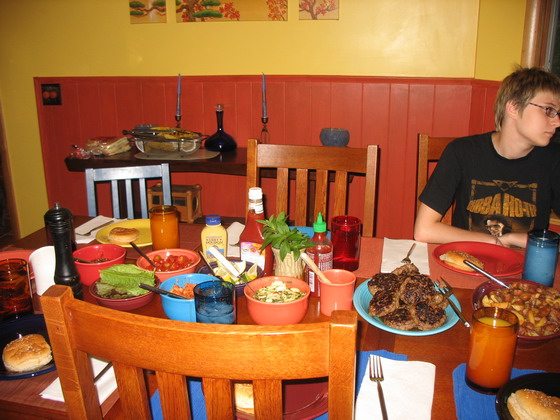
I get teased a lot for being unable to make “just plain old food.” Like, my macaroni and cheese is not from a box and it contains caramelized onions, fresh garlic and chipotle en adobo, along with at least three kinds of cheese. And my mashed potatoes contain lots of garlic, boiled and mashed with the potatoes, herbs, and sour cream instead of milk.
And then, there are my hamburgers.
I am just incapable of making a plain old burger by mashing ground beef into a patty and grilling it sans seasoning. Blah. Ick. Why do that? It doesn’t take -that- long to mince up some garlic or onions and some herbs maybe and to knead it in the meat along with some wine or some such. I mean, really. And it all tastes so much better that way. So, really, why bother to make plain old boring burgers, when I can make Bulgogi Burgers?
Especially when I can improve on my original recipe for the burgers and add fresh water chestnuts to the meat, all minced up nicely?
Yeah. That is pretty darned good. For the recipe as written, I added two whole fresh water chestnuts, peeled and minced to the meat when I mixed all the seasonings in. It added sweetness, moisture and a bit of crisp crunch.
So, yeah, we had a cookout and invited Dan and Heather and Bryian and Judi over so that we could all watch “Casablanca” afterwards with Morganna and Brittany. Morganna hadn’t seen the movie yet–which I do not understand how that could be, but well, it is up to me to make certain that she is properly educated in films now that she is here. So that was the reason for the cookout.
I guess I could have made Moroccan food to be thematic, but that is so expected on a movie night. Besides, Dan was all jonesing for that Bulgogi Burger taste after having read about them, so why not?
But what to have with it? Well, I reprised the Roasted Potatoes with Garlic and Thai Basil I made with the burgers the first time, but I decided that I needed to make something else.
And there was corn, up from Georgia at the Krogers. I was weak, and bought some. Yes, it wasn’t local, but I had a craving.
Besides, I wanted to finally do what I had been itching to do for a while: make Grilled Corn Masala. I had read about it in a Madhur Jaffrey book a while back and wanted to do it ever since. Basically, you cook your shucked and desilked ears of corn on a grill, while basting it with butter that has been seasoned with salt and garam masala. Then, when you serve it, you serve it with more of the melted, seasoned butter, and wedges of limes and lemons to squeeze over it.
That sounded both delicious and refreshing at the same time, and I really wanted to make it. So, we did–and it was just as amazing as I had imagined it to be. And it is so simple, even if you make your own garam masala like I do. Everyone loved it–how could one not? It was smokey and sweet, with a tingle of spices and a jolt of sour juice, all combining to make an explosion of flavors on the tongue.
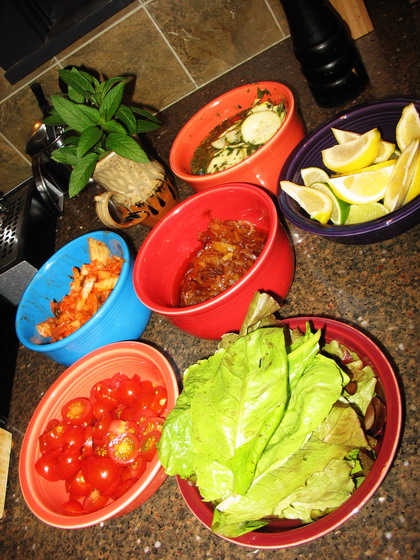
I also wanted to make, in addition to the onion jam and kimchee I served the first time I made the bulgogi burgers, some sort of pickle to top the burgers or to eat on the side. I decided on one of my favorite summer side-dishes–Thai Cucumber Relish, or what I alternatively call, Thai Quick Pickles. I call them that because they are very similar to a side dish my Grandma made at the height of the hot summer–thinly sliced cucumbers and onions set in a dish with ice cubes, cider vinegar, salt and sugar. As the ice cubes melt, they not only make the cucumbers ice cold, they also weaken the very strong vinegar solution.
The Thai version I make is a little more complicated, but not much. I left out the usual sliced onions because I already had the onion jam, and instead, doubled the amount of ginger I use. I am glad that I only used three Thai chiles, because they were smoking hot, and they really added a zip to the pickles, but boy, were they good, especially if you layered them on the burger with kimchee, lettuce, onion jam and the old standby, “The Rooster.”
Or, you could eat them on the side with the local, beautifully ripe early cherry tomatoes. They had to have been started in a greenhouse really early, but boy, were they delicious! They were good on the burgers, too, but I liked them just as well sliced up and put next to the Thai quick pickles for alternate bites between nibbles of corn and potatoes.
It was a most agreeable cookout menu, even if not one item on it was what could be termed “All-American,” at least, not in the usual way. I mean, burgers, potatoes, grilled corn and fresh vegetables are staples of the American cookout, but the way I made them, I paid tribute to the fact that America is a melting pot of culinary cultures. I liked doing it, too–because in my mind, the Korean-Indian-Thai flavors are just as American as plain old hamburgers and fries.
Besides, they taste a darned sight better than the standards served at most cookouts.
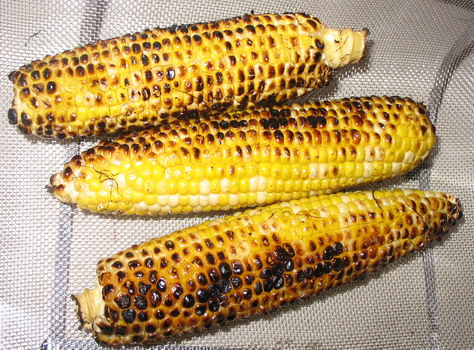
Grilled Corn Masala
Ingredients:
14 shucked and de-silked ears of corn
3/4 stick of butter
salt to taste
garam masala made from:
1 tablespoon cardamom seeds
1 teaspoon allspice berries
1 teaspoon whole cloves
1 teaspoon black cumin (kala jeera) seeds
1/3 of a nutmeg
1 2″-3″ stick of cinnamon broken up into smallish pieces
1/4 teaspoon Pakistani chile flakes (optional)
(toast all spices and grind into a fine powder with a mortar and pestle, coffee grinder or Sumeet)
wedges of lemon and lime to serve
Method:
Melt butter, and add salt to taste. Add garam masala to taste as well; you are aming for a nice fragrant amount of spices without them being overpowering.
Have grill hot and ready to cook. Brush each ear of corn completely with butter before placing it on grill.
Turning often and basting with butter, cook until corn turns a dark yellow with some kernels browned and caramelized.
Remove from grill and keep warm in a 170 degree oven until ready to serve.
Serve with remainder melted, seasoned butter, and serve with lime and lemon wedges to squeeze over before eating.
Thai Quick Pickles
Ingredients:
1 really large cucumber, peeled and sliced thinly
3 red Thai chiles, sliced thinly on the bias
1/2″ cube ginger, peeled and cut into a very fine julienne
1 tablespoon lime zest
rice vinegar to just cover the cucumbers
juice of one lime
2 tablespoons fish sauce (I use Golden Boy brand)
raw sugar to taste (about 1 tablespoon is sufficient for me, but others like it sweeter)
4 tablespoons finely minced fresh mint leaves
Method:
Mix cucumbers, chiles ginger and lime zest well in a small bowl. Add just enough vinegar to cover the cuke slices.
Add lime juice, fish sauce, sugar and finely minced mint. Toss well to combine. Taste and correct seasoning as needed. The flavor should be hot, sour, salty and sweet in a perfect balance, with a blast of coolness from the mint.
Allow to sit at room temperature or refrigerated for at least two hours before serving.


Categories:
- Admin (rss) (55)
- Blogs and Blogging (rss) (81)
- Book Reviews: Cookbooks (rss) (43)
- Book Reviews: Non-Cookbook Food Books (rss) (38)
- Cats and Cat Blogging (rss) (47)
- Chinese Cooking Lessons (rss) (32)
- Culinary School Stories (rss) (18)
- Dairy Pruducts: Cultured and Barbaric (rss) (4)
- Documentary Filmmaking (rss) (1)
- Essays, Rants and Reflections (rss) (260)
- Fighting Hunger (rss) (12)
- Food and Kids (rss) (45)
- Food in the News (rss) (126)
- Food Media (rss) (98)
- Food Preservation (rss) (18)
- Food Safety (rss) (45)
- Gardening (rss) (30)
- Herbs and Herb Blogging (rss) (20)
- Holidays (rss) (50)
- Kat Blogging (rss) (22)
- Kitchen Science (rss) (36)
- Leftover Makeover (rss) (8)
- Life, the Universe and Everything (rss) (131)
- Local and Sustainable (rss) (227)
- Local Athens Food and Foodies (rss) (42)
- Meatless Mondays (rss) (32)
- Menu For Hope (rss) (5)
- Nutrition, Diet and Health (rss) (84)
- On The Farm (rss) (8)
- Recipes: Almost Vegetarian, Vegetarian and Vegan (rss) (294)
- Recipes: American Regional (rss) (37)
- Recipes: Appalachian Hillbilly (rss) (33)
- Recipes: Bread, Pasta, Grains (rss) (95)
- Recipes: Canning and Preserving (rss) (8)
- Recipes: Chinese (rss) (123)
- Recipes: Comfort Food (rss) (120)
- Recipes: Cookies (rss) (16)
- Recipes: Desserts (rss) (48)
- Recipes: French (rss) (25)
- Recipes: Fruits and Vegetables (rss) (302)
- Recipes: Greek, North African and Middle Eastern (rss) (31)
- Recipes: Indian (rss) (137)
- Recipes: Italian (rss) (42)
- Recipes: Japanese (rss) (7)
- Recipes: Jewish (rss) (4)
- Recipes: Korean (rss) (6)
- Recipes: Meat, Poultry and Fish (rss) (220)
- Recipes: Mexican/Native American/ Latin American/Caribb (rss) (27)
- Recipes: Original (rss) (108)
- Recipes: Thai (rss) (27)
- Recipes: Tofu (rss) (17)
- Recipes: US Regional (rss) (16)
- Recipes: Vietnamese (rss) (8)
- Restaurant Stories (rss) (28)
- Sewing, Quilting, Arts and Crafts (rss) (16)
- Simple Chinese Recipes (rss) (30)
- Slow Food and Heritage Foods (rss) (10)
- Spice Blogging (rss) (44)
- The Chinese Cookbook Project (rss) (14)
- The Chinese Pantry (rss) (39)
- The Documentary (rss) (2)
- The Kitchen Saga (rss) (17)
- The Locavore's Bookshelf (rss) (15)
- The Unsung Adventures of The Culinary Nerd (rss) (6)
- Tools and Toys (rss) (35)
- Uncategorized (rss) (10)
- With a Side of Politics (rss) (48)
Archives:
- August 2012 (9)
- July 2012 (12)
- September 2011 (3)
- August 2011 (7)
- July 2011 (8)
- June 2011 (16)
- May 2011 (17)
- April 2011 (11)
- December 2010 (9)
- November 2010 (5)
- February 2010 (1)
- December 2009 (5)
- November 2009 (7)
- October 2009 (10)
- September 2009 (16)
- August 2009 (14)
- July 2009 (14)
- June 2009 (7)
- May 2009 (17)
- April 2009 (10)
- March 2009 (25)
- February 2009 (13)
- January 2009 (10)
- December 2008 (5)
- November 2008 (5)
- October 2008 (6)
- September 2008 (13)
- August 2008 (8)
- July 2008 (11)
- June 2008 (18)
- May 2008 (13)
- April 2008 (14)
- March 2008 (16)
- February 2008 (17)
- January 2008 (19)
- December 2007 (25)
- November 2007 (18)
- October 2007 (24)
- September 2007 (16)
- August 2007 (15)
- July 2007 (15)
- June 2007 (10)
- May 2007 (14)
- April 2007 (16)
- March 2007 (17)
- February 2007 (20)
- January 2007 (13)
- November 2006 (1)
- October 2006 (8)
- September 2006 (14)
- August 2006 (25)
- July 2006 (30)
- June 2006 (28)
- May 2006 (34)
- April 2006 (29)
- March 2006 (24)
- February 2006 (30)
- January 2006 (38)
- December 2005 (40)
- November 2005 (37)
- October 2005 (32)
- September 2005 (25)
- August 2005 (30)
- July 2005 (28)
- June 2005 (21)
- May 2005 (8)
- April 2005 (22)
- March 2005 (17)
- February 2005 (29)
- January 2005 (10)
Search Site:
Links:
- Lily’s Wai Sek Hong
- 101 Cookbooks
- A cat in the kitchen
- A Veggie Venture
- Accidental Hedonist
- Cha Xiu Bao
- chez pim
- Chocolate & Zucchini
- Chopstick Cinema
- Chowhound.com
- Chubby Hubby
- Cook sister!
- Cooking with Amy
- da*xiang
- Eat Local Challenge
- Eating Liberally
- Ecocentric
- Eggbeater
- Epicurious
- Farmgirl Fare
- Fatfree Vegan
- Foodgoat
- ForkandBottle.com
- Green Olive Tree
- Hooked on Heat
- Jaden’s Steamy Kitchen
- Kalyn’s Kitchen
- Lucullian delights
- Mahanandi
- Matt Bites
- MeatHenge
- mmm-yoso!!!
- New York Times – Dining & Wine
- Pizza Goon
- Rasa Malaysia
- Ruhlman
- Sailu's Kitchen
- Serious Eats
- SF Gate: Food & Dining
- Simply Recipes
- Soul Fusion Kitchen
- Tastespotting
- The Amateur Gourmet
- The Cleaner Plate Club
- The Food Section
- The Grub Report
- thecookscottage
- U.S. Food Policy
- Wandering Chopsticks
- Washington Post Food and Dining
- Wasted Food
Meta:


Powered by WordPress. Graphics by Zak Kramer.
Design update by Daniel Trout.
Entries and comments feeds.