
Cook Local, Eat Global
The Spice Is Right: A Reminder
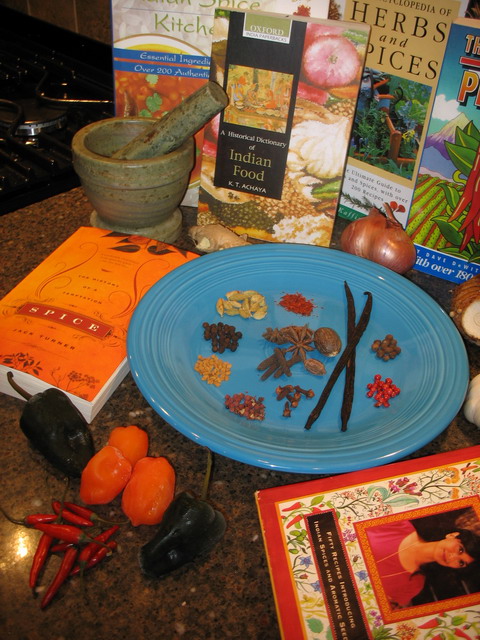
I want to thank the folks who have joined in to play with the first edition of The Spice is Right; y’all have sent me some fantastic posts and photos on the theme of “Ancient Spices.” I can’t wait to start doing the round up, because there is a lot to recommend all the goodies that have been sent in my email.
But there is still a wee bit of time left–you have until tomorrow at midnight to send me a post about an ancient spice–so, if you are so inclined, hop to!
And if you have already sent it in–be patient, and I promise a wrap up, if not by Sunday, by Monday. I do have a very full weekend ahead, so I may be slow (besides, this is my first wrap-up post, so be gentle!) but I promise that the results will be well worth the wait.
Now, there is a thunderstorm rolling in, so I best end this post and start working on the special announcement post that I promised last night, or some folks who have been waiting in suspense might get cranky if I don’t get to post before the lightning starts coming thick and fast!
Book Review: Gastronaut
I know that by now, people are starting to wonder why I keep doing all of these book reviews.
Am I catching up on my reading?
Well, sort of.
Have I given up on cooking?
Not a chance, though cooking has been a challenge of late, and when I have cooked, it has all tended to be simple boring things that everyone has already heard about before, like rice or mashed potatoes.
No, I am writing about books for a very good reason, one which I will finally explain, right here, in this very blog, tomorrow evening.
So, keep that in mind–tomorrow evening, the mystery of -why- Barbara has not been writing much directly about food will be solved. Right here. Stay tuned.
Until then–oh, yeah, I was writing about a book I read.
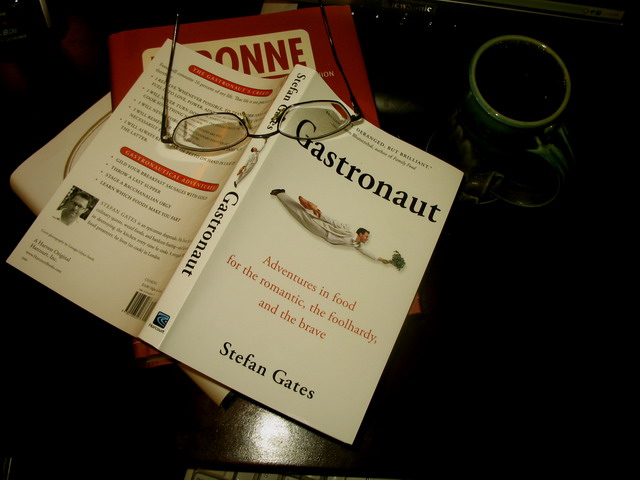
I have no bloody idea who Stefan Gates is, other than what his bio on the back of his book, Gastronaut, has to say about him, but I reckon he’s probably a fun guy to hang out with. The blurb on the back describes him as “a culinary desperado,” who lives for “culinary quests, weird foods, and hardcore feasting–and he revels in destroying the kitchen every time he cooks.”
Sounds like my kind of guy–so long as I don’t have to clean up behind him.
Gastronaut is an odd little book. I had to pick it up after seeing the author, dressed in a white suit, flying across the cover with a bouquet of greens preceeding him in one hand, and a pig’s head, clutched in the other hand, trailing behind him. The image was too surrealistic and bizzare to be ignored, so I picked it up on a whim and bought it.
It consists of a series of essays loosely based on food or around food, or about food, as it relates to cultural norms, bodily functions and sensuality, and a whole bunch of recipes, all written in a sketchy but very amusing manner. Gates includes a number of recipes that are only there for the sake of horrified curiousity, and he vociferously warns his readers to avoid cooking them at all costs.
He examines cannibalism, and relates how he set out to determine if eating people is explicitly illegal in Great Britan. He tried reading online material, talking to a cop (who was not amused by his questions), looking it up in legal tomes, and finally, asking some lawyers. The answer he got was, “probably.”
Of course, that is the end of his quest, but not the end of the chapter. He goes into detail about various recipes for human, and how those who have tasted human have described the flavor, just, you know, in case his retelling of the odd tale of the man who recently ate another man (who gave his consent) in Germany, hasn’t caused his readers to fling the book down in disgust and run away.
As if that is not stomach wrenching enough, he goes into the eating of bodily bits–fingernails, and the like. I will go no further with the descriptions of this, except to say, that while some might have found that chapter funny, I mostly found it disgustingly fascinating. In a very purile way, of which I am not proud.
Of course, the next chapter is about flatulence, and I do have to admit to laughing aloud several times as he described his experiment in trying to create the worst possible case of gas in himself by eating beans, jerusalem artichokes, broccoli, garlic and asparagus all in one day.
Of course, Gates didn’t bother to warn his wife or daughter that he was going to go through with this experiment–he just did it.
Okay, I did laugh, and more than once, but I have to say, that I grew up in a household where fart jokes were all the rage, and well, in truth, my husband channels Beavis regularly, so flatulence amuses me.
But, I just have to say this: if I were his wife–I would have kicked him out of the house for that night.
She must have the soul of a saint to sleep next to him while his guts were busy poisoning the air with noxious fumes.
It isn’t all grotesqueries, though Gates does glory in the potty humor. He gives good, servicable recipes for UK favorites such as clapshot (turnips and potatoes mashed together), and rabbit pie, and his instructions of how to go about cooking heroic dishes like turducken, pit roasted kid, goat, lamb or deer, suckling pig and Brillat-Savarin’s truffled turkey are clear and sensible, while still being entertaining.
But, clearly, this is not really a cookbook: it is a, well, I don’t really know what it is. It is a book of loosely-connected essays on topics loosely related to food that is pretty entertaining, if thoroughly odd.
I think that is what I liked best about it–it was odd, in that truly dry and witty way that good British comedians tend to be.
It was eccentric.
And I do like the odd book penned by an eccentric author now and again.
Simplicity of Flavor with an Ancient Spice
Once Popular, An Ancient Spice Becomes Forgotten
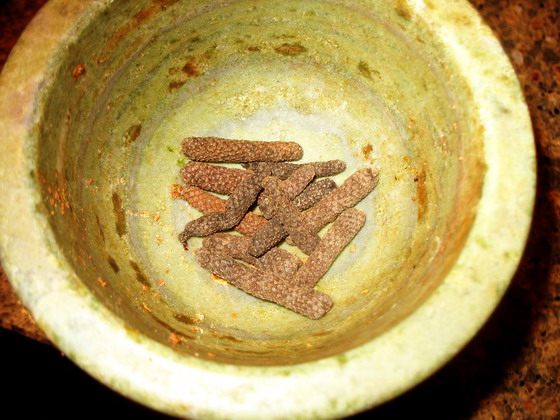
Long pepper, Piper longum or P. retrofractum, is actually the original “pepper” that took European cuisine by storm. The Greeks were the first great consumers of it, then the Romans. Its use spread over Europe in the Middle Ages, when it was imported from India, primarily by Arab and Venician traders. The word, pepper, (which comes from the Sanskrit root, pippali) at one time exclusively denoted the long pepper; when the more familiar to modern eyes and palates, round black pepper, (Piper nigrum) became widely available, because of its similar flavor, it inherited the already existing name.
“Long” pepper then became the name for P. longum or P. retrofractum, which dwindled in significance in the marketplace, and finally disappeared. (Interestingly, “long pepper” also was used to denote chiles after they become widely grown after the Spanish and Portuguese spread their cultivation from central America; this leads to confusion when reading old sources on the subject of spices, since while P. longum and P. negri are definately in the same family, chiles most certainly are not related.)
Now that black pepper is king, the knowledge of and use of long pepper has dwindled throughout most of the world, except for the places where it is still cultivated and where it grows wild: India and Southeast Asia, particularly Indonesia, Bali and Thailand.
Appearance and Flavor
The example I managed to procure of long pepper is the slightly shorter, though similarly flavored P. retrofractum, also known as Balinese Long Pepper. The spice is reddish black, with a dull, somewhat dusty appearance, and looks rather like a dried mature catkin from a pussywillow tree. This is a reasonable comparison, as the spice is the dried flower of the p.retrofractum vine, just as catkins are the blossoms of willow trees.Upon close inspection, the spice is shown to be made up of tiny seed-like granules, which are arranged around a hollow central core.
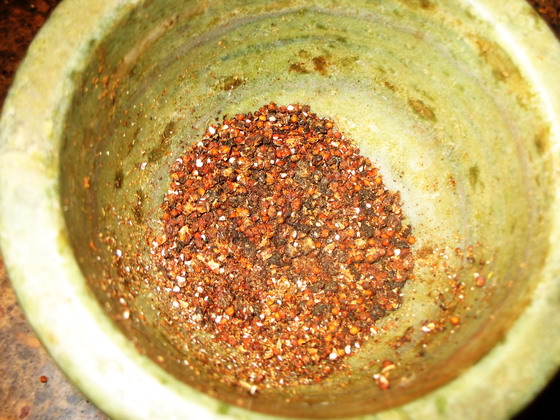
When ground, the individual granules become crushed and the interior is shown to be a russet color, and the flowery fragrance of the spice is released. Gernot Katzer, author of one of the best research sources on spices, Gernot Katzer’s Spice Pages, notes in his entry on long pepper that while there is more piperine (the volatile substance that makes black pepper taste like pepper) present in P. retrofractum than in P. nigrum, there is less essential oil, which is made up of secondary flavoring constituents. This leads to the two spices having very different scents and flavors.
I found long pepper to be more strongly floral scented than black pepper, with a greenish, herbal note reminiscent of lavender present. The flavor was similar to black pepper, but still distinctive; instead of the very strong “peppery” aroma that I am used to from black pepper, I noticed that long pepper was more subtle, with a flavor that was both biting and sweet.
Source
I have to thank regular reader Christopher Gordon for turning me on to long pepper, and for giving me the source for obtaining it.
Because, you know me, I find out about a spice I haven’t tasted, and I have to taste it, the sooner the better!
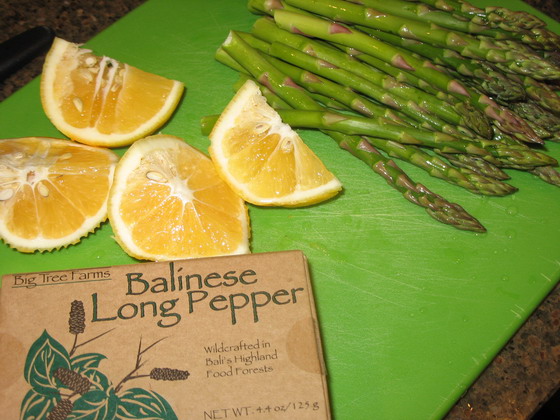
Anyway, the one place that Christopher told me about to get it and the one place I have found on the ‘net is Salt Traders. They specialize in all those different kinds of salt that folks have been reading about over at The Accidental Hedonist for a while now that Kate has turned her all-consuming gaze upon NaCl. Though they specialize in salt, they also carry Balinese long pepper from Big Tree Farms, a really neat outfit that supports sustainable use of Balinese natural resources through the making and marketing of wild-crafted artisan foods.
What to Do with It?
Now we come to the fun part. What does one do with long pepper?
Well, I think that one could confidently use it wherever one would use black pepper, though I have found that it loses its unique character when blended with too many other spices. That said, I have found that using it in place of black pepper in Indian foods, as part of a garam masala, for example, is just a waste of a perfectly fascinating and more expensive rare spice.
Christopher used his on Valentines Day to flavor some steaks; that is a laudable use, though I think much depends on the amount one uses. If you use just a sprinkling of it, again, I think that the flavor is overpowered, particularly when you are talking about something as strongly flavored as beef. However,. if one uses it to make a pepper crust as in the classic “Steak au Poivre,” you would end up with an interesting twist on the traditional recipe.
Last night, in my quest to simplify some of my culinary habits, I decided to feature long pepper in a very simple preparation of asparagus.
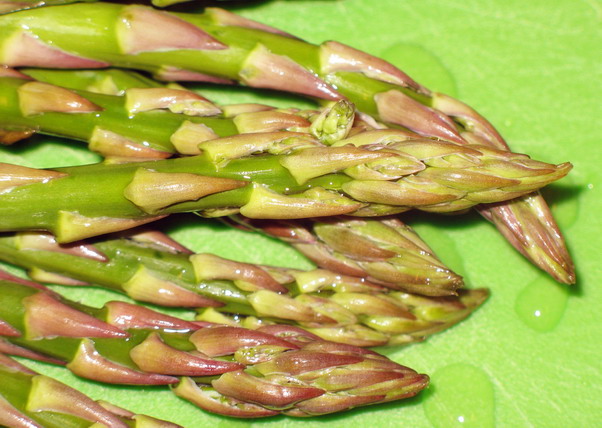
No, asparagus is still not yet in season here in Ohio; I was wicked and used spears I picked up at Whole Foods that had been grown in California. What can I say? I saw them and my mouth started watering, and I couldn’t resist. Soon enough–by next month, in fact, or the end of this month–we will be feasting on the glut of local asparagus until we all but turn green from all of the verdant, sweet spears we ingest.
However, that said, this is a very quick, simple way to cook asparagus that results in a very full flavor. The flowery long pepper paired with Meyer lemon peel and juice perfectly complimented the green sweetness of the asparagus, while butter added a bit of brown richness and a sprinkling of kosher salt added the final sparkling touch that sent the simple dish over the top when it comes to flavor.
Asparagus with Meyer Lemon and Long Pepper
Ingredients:
1 1/2 pounds of medium thin asparagus spears
10-12 pieces long pepper (once coarsely ground it makes a tablespoon + 1/2 teaspoon of spice)
zest of 1 large Meyer lemon (about two tablespoons of finely grated zest)
1 scant tablespoon butter
Juice of one Meyer lemon (about 1/4 cup of lemon juice)
kosher salt to taste
Method:
Rinse spears well, and snap off woody ends. This is most simply accomplished by taking one end of each spear between thumb and forfinger of each hand and bending it as close to double as possible. The spears will naturally snap off at the appropriate place. Once the ends are discarded (or you can save them for vegetable broth), cut each spear into thirds.
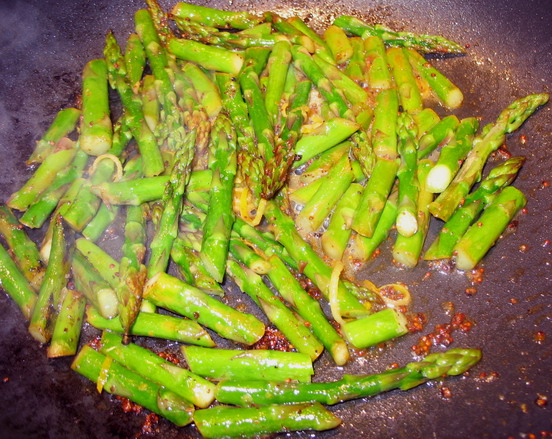
Hand grind the long pepper coarsely with a mortar and pestle, or put them into a ziplock bag and use a meat mallet to crush them, or use a rolling pin. Do not grind into a fine powder–this would render them too spicy for this purpose. (Besides, I like the texture.) The illustration above shows the level of coarseness they should be ground to.
Place the asparagus into a saute pan, and put a scant 1/2 cup to 3/4 cup of water in. On high heat, bring water to a boil, and cover asparagus with a lid. Allow to simmer and steam until the asparagus deepens in color and becomes slightly tender–about three minutes. Using the lid to catch the vegetable, drain off all the water.
Put the pan back on high heat, and sprinkle lemon zest and long pepper evenly over the asparagus. Allow remaining water to evaporate over heat, then add the butter, and toss the asparagus as the butter melts. Allow the asparagus to cook with the butter for about one minute.
Add lemon juice, and continue cooking and tossing, until most of the juice evaporates, leaving the asparagus evenly coated with butter, reduced lemon juice, pepper and lemon zest. Sprinkle with kosher salt to taste and serve immediately.
Book Review: My Life in France
I devoured this book in two days flat, even though I was supposed to be cleaning the house to prepare for a dear friend’s visit.
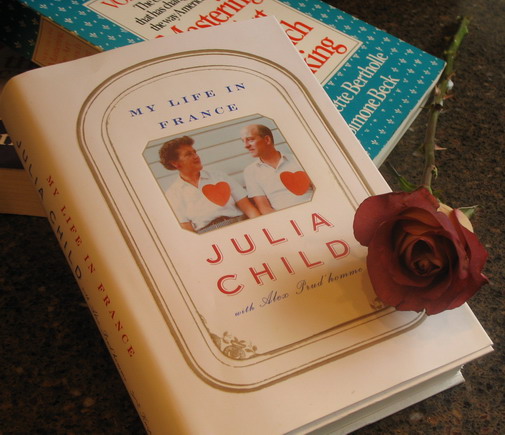
Every single spare moment of those two days was spent with my nose firmly planted in Julia Child’s My Life In France, a memoir that records her years living in and visiting France, her spiritual home, the land that inspired her to change the way America cooked.
Written in collaboration with her nephew, Alex Prud’homme, the book is a fascinating look at France and the US in the bustling postwar years of the late forties through the 1950’s and 1960’s through the eyes of a woman who, by her late thirties, had travelled to Ceylon and China, but who had yet to take up a whisk or saute pan.
To say that France changed Julia Child is an understatement.
France was the fertilizing influence that allowed Julia to change and grow, blossoming into the culinary giant we see her as today.
Told in her own words, as recorded by Prud’homme, the book narrates Julia’s first impression of French food, embodied in her first meal: sole meuniere. She and her husband, Paul, had stopped in Rouen, on the way from the port of Le Havre to Paris, where he was to be employed at the American embassy. For lunch, they decided upon :a Couronne, a restaurant well-praised by the Guide Michelin.
Although the Norman town of Rouen is famous for its duck, after consultation with the waiter, Paul chose sole meuniere.
“It arrived whole: a large, flat Dover sole that was perfectly browned in a sputtering butter sauce with a sprinkling of fresh parsley on top. The waiter carefully placed the platter in front of us, stepped back, and said, “Bon appetit!”
I closed my eyes and inhaled the rising perfume. Then I lifted a forkful of fish to my mouth, took a bite and chewed slowly. The flesh of the sole was delicate, with a light but distinct taste of the ocean that blended marvelously with the browned butter. I chewed slowly and swallowed. It was a morsel of perfection.
In Pasadena, we used to have broiled mackerel for Friday dinners, codfish balls with egg sauce, ‘boiled’ (poached) salmon on the Fourth of July, and the occaisional pan-fried trout when camping in the Sierras. But at La Couronne I experienced fish, and a dining experience, of a higher order than any I’d ever had before.”
Of course My Life in France is not just about food, and Julia’s relationship to it, which was profoundly changed by her experiences in Paris and her travels through the countryside.
It is also about people, and finally, readers can catch a glimpse of the relationships that nurtured Julia as she grew into the foodie icon she is lauded as today. Most interestingly, is her memories of her artist husband, Paul Child, a gourmet and wine afficianado who did all he could to support Julia’s growing interest in all things culinary. At first, when she simply wanted to learn to cook for the two of them and their friends, he was of course, vociferously helpful. When she took her first steps toward teaching and writing, however, is when Paul’s assistance and encouragment became vital to Julia’s growth, and he became almost an unsung collaborator. He helped with the illustration for her books by doing drawings and photographs himself; and when Julia flagged in promoting herself in the media, he pushed her forward into the limelight, happy to see his wife stretch and grow into a person larger than she thought she could be.
Also well-drawn and beautifully remembered is Julia’s relationship with her collaborator, Simone Beck, also known affectionately as Simca.
Simca’s contribution to both volumes of Mastering the Art of French Cooking is often overlooked in the United States, and Julia uses her memoir as a means to rectify this oversight. We most often remember that those books are written by Julia Child, and Beck’s (and for that matter, Louisette Bertholle’s) contributions go forgotten.
The truth is, the idea for the book came from Beck and Bertolle, and they had been working on a manuscript of tried and true French recipes for American cooks for some time and even had procured a publisher. However, they had been told by an editor to aquire an American collaborator who both knew French food and how to explain it in terms that American cooks could understand and appreciate. They approached Julia, and though at first, she refused to assist, later, she was convinced to look at the manuscript and do some work on it.
While the idea was Beck and Bertolle’s, the execution turned out to become pure Julia, which may soften some of the American propensity to downplay the contributions of the two Frenchwomen. Julia looked at the manuscript, and deemed it too arcane and dry for Americans, with explanations of technique that were neither clear not deep enough to ensure success for a cook who was not a French native. So, she set about rewriting it, a task that was to take the concerted effort of both Beck and Julia nearly a decade.
The chapters outlining the creation of both volumes one and two of Mastering the Art of French Cooking are among the most fascinating, at least to me, because it affords a look into the process of how a cook becomes a writer. Describing seemingly endless rounds of recipe testing in her kitchen and in Beck’s, Julia recounts the triumphs of thier working relationship, as well as the tensions. Both opinionated cooks with strong personalities and differing views of what constituted appropriate levels of recipe testing, the collaborators often disagreed, with the result being that while the collaboration was wildly fruitful, it was also very taxing, and sometimes threatened to weaken the friendship between the two women.
The friendship, though stretched and endured, culminating in the Childs’ building of a small home next to the house that Simca and her husband shared; the two families spent many happy holidays together in the sunny south of France. After Paul could no longer travel, Julia gave the house up, as they had agreed thirty years before, to Simca’s family.
A natural storyteller, Julia filled the narrative of her memoir with detail. Her words draw vivid portraits of the people, places and food of a France that have rapidly disappeared with the passage of time. Her wit, humor and infectious joi de vivre come through so pefectly, that I found myself hearing it all in her characteristic trilling voice. She and her nephew captured a series of moments in time that are important, not only as a portrait of a France that is no more, but also is a historical glimpse at the making of a culinary icon.
Needless to say, I cannot recommend this book enough to anyone who is curious about the life of Julia Child. It is illustrated throughout by the photographs of Paul Child, all of which echo his own artisitic vision, and wry sense of humor.
It is certainly a book that is not to be missed.
The Spice is Right Reminder
Hello, everyone!
This is just a quick reminder that the first round of “The Spice is Right” is coming to its deadline–April 15th!
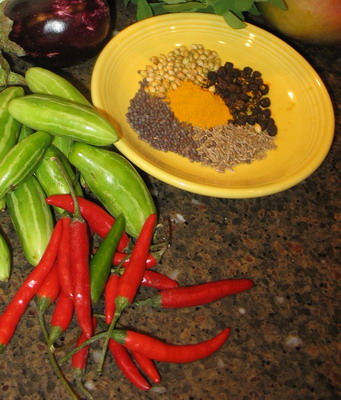
That means that if you want to participate in the event, where you write about a spice, and post a recipe with pictures and all that happy goodness, and then get included in the roundup, you have until April 15th to put it all up on your blog and then email me the link, and a picture and all of that good stuff as per the rules, which you can find here.
The theme this time around, is “Ancient Spices.”
What you take that to mean is up to you. Some will take it to mean a spice that has a long history of use in one or more cultures. Others might think it means a spice that has been sitting in their cupboards since Hannibal crossed the Alps with elephants. Still others might feel the need to use a recipe featuring a spice that is from a historical source, like Apicius.
It is up to you.
Thank you to the folks I have already received entries from–it looks like an awesome group so far. I look forward to posting the roundup–which will be up at some point after the 15th–depending on how my ISP behaves between now and the 15th, of course.

Categories:
- Admin (rss) (55)
- Blogs and Blogging (rss) (81)
- Book Reviews: Cookbooks (rss) (43)
- Book Reviews: Non-Cookbook Food Books (rss) (38)
- Cats and Cat Blogging (rss) (47)
- Chinese Cooking Lessons (rss) (32)
- Culinary School Stories (rss) (18)
- Dairy Pruducts: Cultured and Barbaric (rss) (4)
- Documentary Filmmaking (rss) (1)
- Essays, Rants and Reflections (rss) (260)
- Fighting Hunger (rss) (12)
- Food and Kids (rss) (45)
- Food in the News (rss) (126)
- Food Media (rss) (98)
- Food Preservation (rss) (18)
- Food Safety (rss) (45)
- Gardening (rss) (30)
- Herbs and Herb Blogging (rss) (20)
- Holidays (rss) (50)
- Kat Blogging (rss) (22)
- Kitchen Science (rss) (36)
- Leftover Makeover (rss) (8)
- Life, the Universe and Everything (rss) (131)
- Local and Sustainable (rss) (227)
- Local Athens Food and Foodies (rss) (42)
- Meatless Mondays (rss) (32)
- Menu For Hope (rss) (5)
- Nutrition, Diet and Health (rss) (84)
- On The Farm (rss) (8)
- Recipes: Almost Vegetarian, Vegetarian and Vegan (rss) (294)
- Recipes: American Regional (rss) (37)
- Recipes: Appalachian Hillbilly (rss) (33)
- Recipes: Bread, Pasta, Grains (rss) (95)
- Recipes: Canning and Preserving (rss) (8)
- Recipes: Chinese (rss) (123)
- Recipes: Comfort Food (rss) (120)
- Recipes: Cookies (rss) (16)
- Recipes: Desserts (rss) (48)
- Recipes: French (rss) (25)
- Recipes: Fruits and Vegetables (rss) (302)
- Recipes: Greek, North African and Middle Eastern (rss) (31)
- Recipes: Indian (rss) (137)
- Recipes: Italian (rss) (42)
- Recipes: Japanese (rss) (7)
- Recipes: Jewish (rss) (4)
- Recipes: Korean (rss) (6)
- Recipes: Meat, Poultry and Fish (rss) (220)
- Recipes: Mexican/Native American/ Latin American/Caribb (rss) (27)
- Recipes: Original (rss) (108)
- Recipes: Thai (rss) (27)
- Recipes: Tofu (rss) (17)
- Recipes: US Regional (rss) (16)
- Recipes: Vietnamese (rss) (8)
- Restaurant Stories (rss) (28)
- Sewing, Quilting, Arts and Crafts (rss) (16)
- Simple Chinese Recipes (rss) (30)
- Slow Food and Heritage Foods (rss) (10)
- Spice Blogging (rss) (44)
- The Chinese Cookbook Project (rss) (14)
- The Chinese Pantry (rss) (39)
- The Documentary (rss) (2)
- The Kitchen Saga (rss) (17)
- The Locavore's Bookshelf (rss) (15)
- The Unsung Adventures of The Culinary Nerd (rss) (6)
- Tools and Toys (rss) (35)
- Uncategorized (rss) (10)
- With a Side of Politics (rss) (48)
Archives:
- August 2012 (9)
- July 2012 (12)
- September 2011 (3)
- August 2011 (7)
- July 2011 (8)
- June 2011 (16)
- May 2011 (17)
- April 2011 (11)
- December 2010 (9)
- November 2010 (5)
- February 2010 (1)
- December 2009 (5)
- November 2009 (7)
- October 2009 (10)
- September 2009 (16)
- August 2009 (14)
- July 2009 (14)
- June 2009 (7)
- May 2009 (17)
- April 2009 (10)
- March 2009 (25)
- February 2009 (13)
- January 2009 (10)
- December 2008 (5)
- November 2008 (5)
- October 2008 (6)
- September 2008 (13)
- August 2008 (8)
- July 2008 (11)
- June 2008 (18)
- May 2008 (13)
- April 2008 (14)
- March 2008 (16)
- February 2008 (17)
- January 2008 (19)
- December 2007 (25)
- November 2007 (18)
- October 2007 (24)
- September 2007 (16)
- August 2007 (15)
- July 2007 (15)
- June 2007 (10)
- May 2007 (14)
- April 2007 (16)
- March 2007 (17)
- February 2007 (20)
- January 2007 (13)
- November 2006 (1)
- October 2006 (8)
- September 2006 (14)
- August 2006 (25)
- July 2006 (30)
- June 2006 (28)
- May 2006 (34)
- April 2006 (29)
- March 2006 (24)
- February 2006 (30)
- January 2006 (38)
- December 2005 (40)
- November 2005 (37)
- October 2005 (32)
- September 2005 (25)
- August 2005 (30)
- July 2005 (28)
- June 2005 (21)
- May 2005 (8)
- April 2005 (22)
- March 2005 (17)
- February 2005 (29)
- January 2005 (10)
Search Site:
Links:
- Lily’s Wai Sek Hong
- 101 Cookbooks
- A cat in the kitchen
- A Veggie Venture
- Accidental Hedonist
- Cha Xiu Bao
- chez pim
- Chocolate & Zucchini
- Chopstick Cinema
- Chowhound.com
- Chubby Hubby
- Cook sister!
- Cooking with Amy
- da*xiang
- Eat Local Challenge
- Eating Liberally
- Ecocentric
- Eggbeater
- Epicurious
- Farmgirl Fare
- Fatfree Vegan
- Foodgoat
- ForkandBottle.com
- Green Olive Tree
- Hooked on Heat
- Jaden’s Steamy Kitchen
- Kalyn’s Kitchen
- Lucullian delights
- Mahanandi
- Matt Bites
- MeatHenge
- mmm-yoso!!!
- New York Times – Dining & Wine
- Pizza Goon
- Rasa Malaysia
- Ruhlman
- Sailu's Kitchen
- Serious Eats
- SF Gate: Food & Dining
- Simply Recipes
- Soul Fusion Kitchen
- Tastespotting
- The Amateur Gourmet
- The Cleaner Plate Club
- The Food Section
- The Grub Report
- thecookscottage
- U.S. Food Policy
- Wandering Chopsticks
- Washington Post Food and Dining
- Wasted Food
Meta:


Powered by WordPress. Graphics by Zak Kramer.
Design update by Daniel Trout.
Entries and comments feeds.