
Cook Local, Eat Global
Navajo Fry Bread
 Some say that fry bread came from the time when about 8,000 of the Navajo people were imprisoned at Fort Summer, New Mexico during the nineteenth century. It is said that the Navajos were just given wheat flour and lard to eat–two commodities that were quite foreign to their bean and corn-based diets. Others say that the Navajo and folk of other tribes made the bread because they didn’t know what else to do with the government-granted wheat and fat they were given on the reservation to live off of. Still others say that they are a variation on the sopapillas that the Spanish settlers made that the Navajos found to their liking and learned to make.
In whatever case, what may well be a dish born of want and adversity, has become a symbol of pan-Native American pride a century later. Fry bread is comfort food with a big “C” to Native Americans, many of whom call themselves, “Indians,” in defiance of political correctness.
I know, because I am related to some of them.
I didn’t learn to make fry bread from my Grandma, even though she is the source of the Cherokee genes that gave me my eyes with the slight epicanthic folds and my high cheekbones. The looks she gave me, but the bread, well, that I learned on my own.
I learned it because Morganna wanted me to.
Fry bread, served with fruit, honey, or jam, or with bison-based taco meat, or pinto beans, is a staple food on the powwow circuit. Morganna grew up attending powwows with her stepgrandfather, another of Cherokee descent, and started doing fancy shawl dancing when she was only about eight or nine years old.
So, she grew up eating a lot of fry bread.
And, it was inevitable that she would ask me to learn to make it.
So, I did.
Most recipes are leavened either with baking powder or yeast, but I used both. Most recipe use only white flour, but I added whole wheat flour, because I like the flavor and texture it adds. Most recipes use milk or powdered milk for the liquid, but I used water. I also added a bit more honey for a more developed flavor, and then I decided to let the dough rise slowly in the refrigerator overnight. The longer, slow fermentation develops a delicious flavor in the bread, and the texture of it, once it is fried is light as a cloud on the inside, while the outside is chewy-crisp.
While they are similar to bhatura, they are not exactly the same. They are lighter on the inside, and the flavor is very different, due to the whole wheat flour and the honey. The yogurt in the bhatura gives the dough a characteristic tart flavor that is very distinct from the taste of these fry breads.
I made them this Sunday past when my Mom and Dad came to visit for the afternoon. I had cooked a pot of chili with three kinds of beans, chipotle chiles, smoked Spanish paprika, beer and coarsely ground beef in it; instead of serving it with the usual crackers that my parents would expect, I decided that fry bread was just the thing for dipping and scooping.
And I was right.
I think my Mom ate three pieces of the bread herself; my Dad only ate a moderate two pieces, but his bowl of chile was bigger.
As for Morganna: well, she says that I make the best fry bread in the whole world, but I think she is biased.
Besides, all the Indian kids say that about their Moms.
It’s a tradition.

Navajo Fry Bread
Ingredients:
5 tablespoons honey
3 tablespoons oil (I use canola or olive oil–lard is more traditional)
2 cups hot water (bathwater temperature)
1 tablespoon active dry yeast yeast (I use SAF)
2 cups whole wheat flour
1 cup all purpose flour
1 tablespoon salt
2 teaspoons baking powder
2-4 cups additional flour (evenly split between whole wheat and white flours)
Peanut oil for deep frying
Method:
Mix together honey, oil, water and yeast. Allow to sit to proof yeast.
Put first three cups of flour, salt and baking powder into bowl and stir well. When yeast mixture is foamy and thick, pour into flour bowl and stir until it forms a thick batter. Add in two more cups of flour, oil hands well and begin kneading to incorporate flour. Knead until the dough is firm and begins pulling away from sides of the bowl and pulls dough off of your hands.
Spray the inside of a large ziplock bag with canola oil, and put the dough in, then seal it up, leaving plenty of air inside. Put into the refrigerator and allow to rise for about twelve hours. Degas the dough by squeezing it and deflating it and let it rise again, preferably overnight.
When you are ready to fry, take the dough from the refrigerator and open the bag slightly, and allow the dough to come to room temperature. When it is warmed up, on a floured countertop, roll the dough into a long rope and cut into 12 equal pieces. Roll each into a ball, and flatten into a disk that is slightly thinner in the middle and fatter on the edges. Flour them sparingly, and keep the ones you are not working with covered to keep the dough from drying out.
Heat oil in a wok to frying temperature. (The easiest way to test if the oil is hot enough is to use a bamboo chopstick. If you put the tip of the chopstick in the oil and bubbles form around it immediately, the oil is hot enough. If it takes a minute or so for them to form–it is still too cool. Wait a minute and try again.)
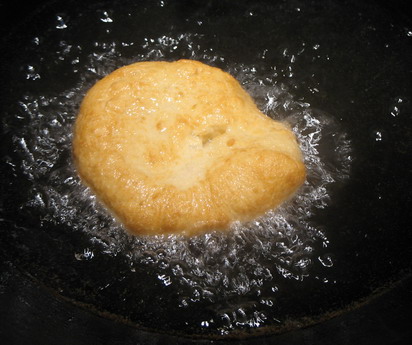
Slide each disk gently into hot oil and cook about 1 1/2 minutes per side, or until nice golden brown. Allow to drain on paper towels and serve hot.
A Modern Cantonese Dish: Beef With Mango
Cooking is not always an easy thing for me.

Which sounds bizzare, since I spend large chunks of my life cooking for myself and others. And then, when I am not cooking, I am thinking about cooking, reading about cooking, writing about cooking or taking photographs of food.
But some nights, I just really have no clue what on earth I would like to make for dinner. Sometimes I just don’t feel well, and my body is not in the mood for cooking or eating.
Tonight was one of those nights. I fretted all day over the thought of what to cook for supper, and worried and waffled and just stewed over it.
Nothing sounded good.
Maybe it was the smell of paint that was permeating the kitchen and making the air a nauseating miasma of fumes that was to blame; the entryway is in the midst of being painted and so there is no help for it–paint fumes have nowhere to go in a stairwell but up–and at the end of up is my kitchen.
I choose to believe that was the trouble, but it took me hours to latch onto an idea, and it came from the fact that I had seen mangoes on sale at the grocery store the other day.
I remembered reading in one of my over 100 Chinese cookbooks about a Cantonese recipe for beef stir fried with mangoes.
My mind and stomach latched onto that concept with a fervor bordering on obsession as I sped upstairs to find the exact cookbook I had seen it in.
I only had to go through about five books before I realized that it was in Yan-Kit’s Classic Chinese Cookbook.
And there it was, with a lovely photograph–that entire book is lavishly illustrated–that showed the rich beef stir fried with velvety -looking mango slices with green strips of scallion top for a garnish.
Of course, I commenced to change it significantly.
For one thing, for all that I love So’s cookbook, she does rely more on deep frying meats than I think is either healthy, desireable or worthwhile for a home cook. She called for slicing the beef (she calls for tenderloin, by the way, which would be intensely luxurious, once paired with the mango) marinating and then deep frying it, before draining it and stir frying it with the aromatics and the mango. I wasn’t about to indulge in that–for one thing, I was using a piece of London broil–a much less tender bit of beef than a tenderloin, so it wouldn’t take as well to the hot-oil bath. For another thing–it is a waste of time and oil for a home cook to deep fry an item before stir frying it–I understand why it is done in restaurants (it results in a velvety texture), but there it is more practical and less messy–but at home, the benefits do not outweight the hassle and mess.
Also, I changed the aromatics around. She used more garlic than I wanted; I tend to prefer garlic with pork and ginger with beef, and so, in my recipes will weigh the aromatics in that direction. For beef, I use more ginger than pork habitually. Considering the still lingering scent of the paint and its effect on my appetite, I went for more ginger still, as it has the power to quell even the worst bouts of nausea. I still used scallions, though I used one less than she recommended, as I very much wanted the ginger flavor to come to the fore. To boost the heat-giving property of the ginger, I also added a single ripe frozen jalapeno chile that I sliced very thinly on the diagonal; it provided a very subtle bite to the entire dish.
I also added red pepper and carrots to the dish; being too lazy to make a separate dish of vegetables means that most of my stir fries have a mixture of vegetables and meat that may not be traditional, but which I tend to carefully balance for flavor, color and texture. The slippery soft mango contrasts with the firm beef–it is yin, while the meat is yang. The mango, because I used one that was slightly underripe (which is important–if you use one which is very ripe, it will likely fall apart in the cooking and make the dish cloyingly sweet), was tart as well as sweet, so it contrasted with the sweet red bell pepper and the carrot, both of which were also texturally different in that they were two different types of crunchiness.

The marinade for the beef was little changed, but I did not make a separate sauce to be added at the end of cooking, and instead used my usual method of making sauce in the cooking process by adding some more dark soy sauce, some chicken broth and finally, some oyster sauce–a classic pairing with beef in Cantonese cookery–as I stir-fried.
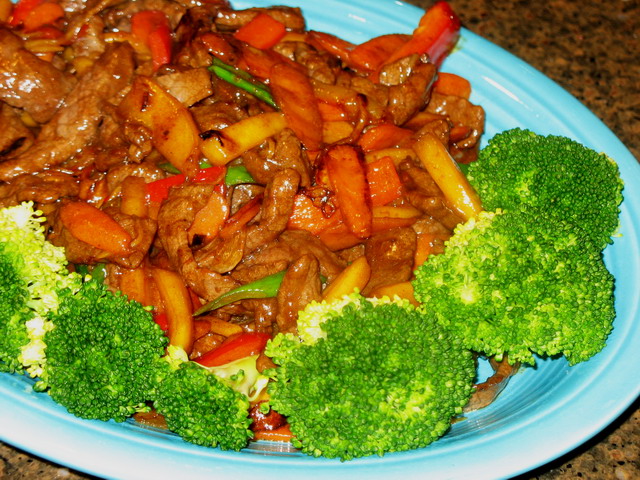
And, as you can see, I ended up garnishing it with some steamed broccoli, which gave a flavor and color contrast to the dish as a whole, as well as satisfying my desire for even more vegetables.
Like every other dish I have either learned directly or modified from So’s book–which I think of as an often overlooked classic–beef with mango turned out to be all that I had hoped for. A balance of sweet, savory and tart, crisp, soft and chewy, it was a very satisfying meal, when paired with the plain steamed broccoli and jasmine rice.
Cantonese Beef With Mango
Ingredients:
3/4 pound lean beef, cut into thin strips about 1 1/2″ long by 1/4″ wide
pinch salt
1/2 teaspoon raw sugar
6 turns on a peppermill’s worth of coarsely ground black pepper
1 teaspoon thin soy sauce
1 teaspoon dark soy sauce
1 teaspoon Shao hsing wine
2 tablespoons cornstarch
3 tablespoons peanut oil
2″ cube fresh ginger, peeled and cut into thin slivers
1 fresh or frozen red jalapeno cut into thin slices on the diagonal
1 clove garlic, cut in half longitudinally, then sliced thinly
3 scallions, white parts cut into thin slices, tops cut into 1″ sections and reserved separately
1 not very ripe mango, peeled, seeded and cut into 1 1/2″-2″ long thin slices
1 1/2 tablespoons dark soy sauce
1 cup carrots cut on the diagonal into thin slices
1/2 red bell pepper, cut into thin slices the size of the mango slices
1 tablespoon chicken broth
2 teaspoons oyster sauce
Method:
Mix beef with all the ingredients up to (but not including) the peanut oil and allow to sit for 15-20 minutes.
Heat wok until white smoke appears. Add oil, and heat for another ten-twenty seconds.
Add ginger and chiles and stir fry for about twenty seconds. Add garlic and white part of scallions, and continue stir frying for about forty more seconds, or until all is quite fragrant.
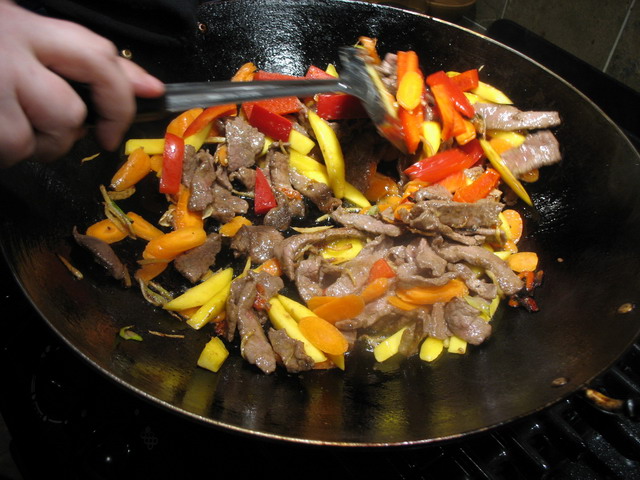
Add beef and press into a single layer. Pour mango slices on top. Leave beef undisturbed for about a minute–wait until you can smell the meat browning before beginning to stir fry. Stir fry until most of the red has left the beef. Add the soy sauce, stir to combine well, then add the carrots and sweet peppers, stirring until meat loses the last of its raw look. Add chicken broth, continue stir frying until a thick sauce forms, clinging to the meat and vegetables.
Add oyster sauce and continue stir frying until well combined–about thirty seconds.
Sabz Kofta in Rich Curry Sauce
 Two of my favorite Indian vegetarian dishes are malai kofta and sabz kofta; malai kofta is a vegetable kofta made with cheese mixed with mashed or grated vegetables and bread crumbs, and sabz are kofta made from grated vegetables mixed with garbanzo flour, also known as besan. (Kofta are little balls of meat, cheese or vegetables that are either pan fried or deep fried and are a favorite dish in Northern India.) Since until recently, I always lived near a good Indian restaurant where I could order these dishes often, or eat them from their buffet, I have never bothered to make them at home.
However, being deprived of my vegetarian kofta after a time is enough to send me to the kitchen. I determined that I liked sabz kofta just a bit better, so I decided to try my hand at them first.
I sought out recipes, and ended up using one from Neelam Batra’s The Indian Vegetarian: Simple Recipes for Today’s Kitchen. At least, I used her recipe for the kofta, while for the sauce, I modified one from Kaushi Bhatia’s Favourite Dishes of India, which is a book that is published in India, for Indians who speak and read English. I have a quite a few books like that, and have found that they tend to be great resources for very good, very authentic recipes that often represent more of the home style cooking of India. The curry sauce recipe I used was one meant to go with malai kofta, which looked like it would taste the way I had eaten sabz kofta at my Pakistani friends’ homes.
I discovered that while the general shape of the sabz kofta recipe was a simple one, the instructions were not clear enough for me to know how to make the dough the correct consistency. Really good sabz kofta are very tender, so much so that they very nearly fall apart when you bite into them, with just the barest crisp to the crust that gives away to a steaming and somewhat crumbly, moist interior. I ended up using too much besan to make the dough stiffer to hold it together, because I was unsure about how much to use, and the description in Batra’s recipe was not specific enough to guide me to make the dough the correct consistency. Also–there are no photographs in her cookbook to guide the sabz kofta novice in getting the texture of the dough correct, so really, unless you have seen them made on television or were taught by the side of a friend or relative, you would be lost reading this recipe.

I want to make this clear–I in no way am dissing Batra’s book or her recipes; I adore the book and used it often when I was learning Indian food, and in fact, this is the first recipe I have ever had come out less than amazing. (I am also sad to see that it has gone out of print.) And it is worth mentioning that even though I thought that the kofta were leaden and somewhat tough, Zak, Morganna and Donny all really enjoyed them, so maybe it was just me. Maybe my expectations were too high. (Or, maybe, the chef at Shere E Punjabi was just great at making sabz kofta–always a possiblity, because his were nearly always light and tender, perfectly spiced and steaming inside.
However, the next time I make these–and there will be a next time, for I really do have a passion for these kofta–I will make certain to not add any extra besan to the dough to make it less soft. (Batra’s words were this–“if the mixture is too soft, add a little extra garbanzo flour.” however, of course, she gives no description of how to determine exactly what “too soft” meant. This is a problem if you have never made these delicious little critters before.)
But, they were fun to make and the sauce was simple as well.The recipe for the kofta made enough that I could serve half the batch and freeze the other batch to be served at a later date. That necessitates that I just make up some sauce some night, thaw the kofta, and toss them in the sauce for a simmer and with some basmati in the rice cooker and maybe some palak paneer–supper is on the table in no time at all.
So, for now, here is my adaptation of Neelam Batra’s recipe for sabz kofta, combined with a slightly revised version of Kaushi Bhatia’s rich curry sauce.
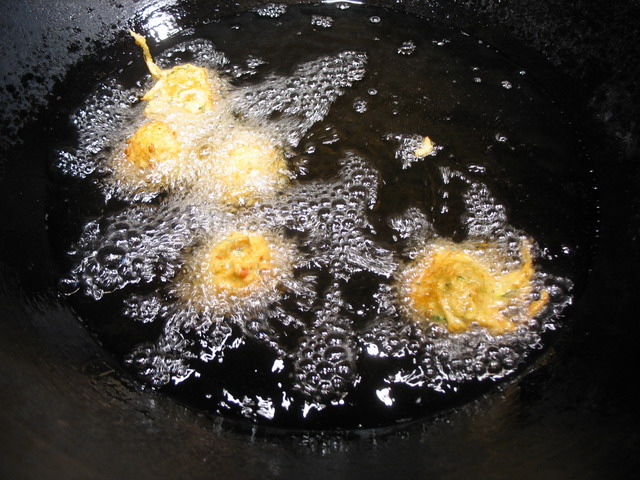
Sabz Kofta in Rich Curry Sauce
Ingredients for Kofta:
1 1/2 cups grated peeled russet potatoes (I used the food processor for all of the grating)
1 cup grated cauliflower
1 cup grated carrot
1 cup grated zucchini
1 cup grated onion
1/2 cup roughly chopped cilantro leaves
1 clove garlic, minced
2 tablespoons peeled and minced ginger
4-8 fresh Thai green bird chiles, minced–to taste
1 1/2-2 cups besan (garbanzo bean flour)
2 tablespoons freshly ground coriander
2 teaspoons freshly ground cumin
1 teaspoon freshly ground pepper
1 teaspoon salt
1/4 teaspoon baking soda
peanut oil for deep frying
Method for Kofta:
Mix together all ingredients down to the chiles in a medium sized bowl. In a separate smaller bowl, mix the rest of the dry ingredients, then sprinkle these over the vegetable ingredients in the first bowl. Knead together into a rough dough. If you think that the dough will not hold together, add a little more besan, but I would say do not add more than about 1/4 cup or so more. (I added more than that, and the texture of the cooked kofta suffered.)
Form into 1 1/2 inch balls–I used a cookie dough scoop and my hands to do this.
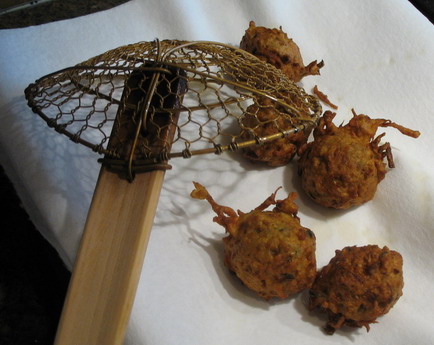
Heat oil in a wok or karahi or deep pot, until it is between 350-375 degrees. To test to see if the oil is hot enough drop a tiny bit of the mixture into the oil and if it bubbles and rises to the top, then the oil is ready. Deep fry the koftas, a handful at a time, until they are brown and crispy. Remove with a strainer-basket or a slotted spoon, and allow to drain on paper towels. You can keep them warm in an oven heated to 200 degrees while you make the curry sauce.

Ingredients for Curry Sauce:
2 teaspoons oil
1 medium onion, sliced thinly
1″ cube fresh ginger, peeled and chopped roughly
3 cloves garlic, roughly chopped
1/8 teaspoon cardamom seeds
2 tablespoons coriander seeds
1 1/2 teaspoons black peppercorns
2 1/2 teaspoons cumin seeds
1/4 teaspoon powdered cinnamon
6 whole cloves
1/2 teaspoon turmeric powder
2 tablespoons cashew butter
1 14 ounce can crushed tomatoes
2 cups water
salt to taste
1/2 cup rich yogurt
1/3 cup cream
large handful chopped cilantro
Method for Curry Sauce:
Heat the oil in a heavy bottomed pan–I used enamelled cast iron for this. Cook the onion, stirring, until it is a medium dark reddish brown, and then scrape it out of the pan into the bowl of a grinder or a blender or food processor. Add the ginger, garlic and spices if you are using a grinder like the Sumeet, if you are using a processor or blender, grind the spices with a coffee grinder first, then add them to the bowl of the appliance. Grind into a thick paste.
Reheat pan, pour paste into the pan and stir until well heated and fragrant. Add cashew butter, and stir until combined, then add tomatoes and water. Turn down heat and cook, simmering until the curry sauce thickens to coat the back of a spoon. Whisk the yogurt and cream together, then add to the sauce, stirring to combine. Taste for salt and correct seasoning. (You can prepare the sauce to this point, then hold it warm for about four hours, or cool it and keep it in the fridge until needed–the flavors will only develop and become more complex the longer you allow the curry sauce to sit.)
To the simmering sauce, add in the still warm kofta, and allow to sit, warming in the sauce for at least ten minutes or so.
Serve with plain steamed basmati rice.
Our Kitchens, Our Selves
Being a personal chef was a really fun, but sometimes, very weird gig.
It was fun, in that I got to meet quite a few very interesting people, and I cooked a lot of dishes I would never otherwise have cooked. It was weird, in that I got to go into people’s homes, and get a glimpse into how they lived their lives through a very intimate lens: their kitchens.

I found I could learn a lot about people by looking at their kitchens. And some of what I learned puzzled me a great deal.
One thing I have to say is that most of the people who hired me were monetarily very well off, and most of the time their kitchens showed it.
Many of my clients had the latest Sub Zeros, the best cooktops Gaggenau had to offer, and beautiful granite countertops on which I could set hot pans, or roll pastry dough with equal ease. The best of these kitchens were obviously set up with cooking in mind–and two clients in particular–two of my most wealthy families, in fact, were obviously kitchen people. The wives cooked, but one had recently gone back to teaching, and the other was laid up post surgery, and so neither could spend as much time in their kitchens as they would like, so I came into their lives to fill the gap.
These two families were truly food-centered, and I loved cooking for them, and in one case, with them. We collaborated on meals, we conspired, we cooked together. The lady whose foot was awaiting a second surgery would sit in the kitchen with me, enthroned at her huge antique table, her bad foot propped up on a padded stool, and she would keep me company while I cooked for she and her husband, who loved food, but had an intense fear of trying to cook it for fear of ruining it. The other lady, the professor, always made me tea and cookies when I came to cook and would sit and grade papers at her desk in the kitchen, and chat while I cooked soups, appetizers and entrees for her and her husband to share out for the next week. Invariably, she would end up at the stove with me, to “take a break from those papers,” as she would say, and she would have fun watching me create stir fries that she praised for their lightness or ratatouille that made her nose twitch in anticipation.
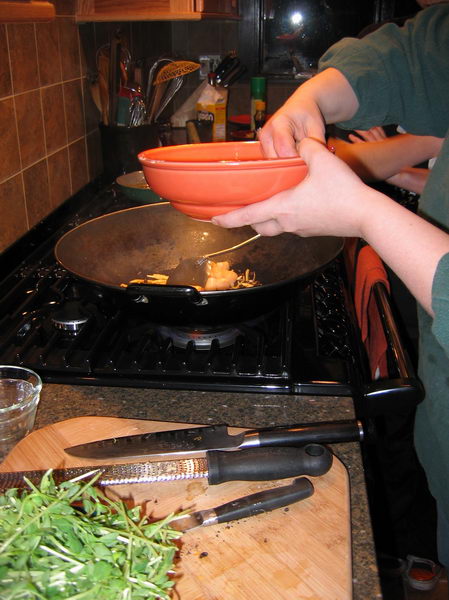
The kitchens of those two families were not only beautifully well-appointed with top-of-the-line appliances, it was obvious to me that they were made to be cooked in, and they had been cooked in. A glance in the cupboards and pantries confirmed my suspicion that serious cooks lived here. There were collections of well-used cookware–all good pieces that had obviously seen years of use. None of them were perfectly polished, and while some may have been brand-named, I saw just as many bits and pieces from restaurant supply stores as I saw of Le Creuset or Emile Henry.
When I brought out my prized woks, which are nothing to look at as far as beauty is concerned, these cooks sat up, took notice and oohed and awwed at them. “Oh, how many years have you had that one?” I remember the injured lady saying. “Please bring it here–oh, look at the seasoning on that. Almost black!”
Obviously, these two clients were women after my own heart.
Then, there were other clients. Clients who had gorgeous kitchens, absolutely lovely to look at, with gleaming matching sets of All-Clad copper-bottomed cookware hanging from the ceilings, every kind of appliance you could want, Sub Zeros with Wolf stoves and all the latest technology money could buy, but who had no spices in their cabinets that were not five years old, nor anything resembling staple items in their pantries–not even spaghetti nor even flour or sugar. I had to purchase every ingredient fresh for them.
And those Sub-Z’s? They were filled with wine, juice and take-out boxes.
And three year old soy sauce that wasn’t even opened.
It was no wonder the kitchens were so beautiful, because they had probably never been cooked in.
The saddest thing was that the latter folks, who would often tell me how they had just had their kitchens redone (and then, without my asking, would tell me the -cost- of the remodelling), vastly outnumbered the clients who had beautiful kitchens that not only were made to be cooked in, but were cooked in.
This made me wonder why people went to the expense to have those kitchens redone in the first place if they were not going to use them.
I didn’t think much more about it until this year when we redid the kitchen in this house. Then, of course, my mind went back to all of those kitchens I had cooked in, and the types of people who owned those kitchens.
For one thing, I was remembering the performance of each of the appliances I had used, and remembered that I was not overly impressed by the Viking, Wolf or Gaggenau ranges and cooktops I had used when it came to BTU’s. They looked beautiful, certainly, but after reviewing their prices and the BTU rating, I determined that looks were probably about all that these appliances were delivering.
Well, looks and prestige when it comes to the name.
I started looking at kitchen design magazines–of which there are a veritable plethora on the market these days, to gain inspiration. This is where I learned of the myriad of what I consider to be “useless frippery” appliances which are now being marketed to upscale clients who are redoing or building kitchens from scratch.
Things like “under-cabinet refrigerator drawers” for drinks or vegetables, wine coolers, and warming drawers so you can hold your breads, rolls, casseroles and the like at serving temperature for hours when preparing feasts for company. I looked askance at these items, even as I noted that most kitchen designs featured in the magazines included huge amounts of space–larger than even my large kitchen confines would allow. Sweeping vistas of multi-level kitchen islands and L-shaped countertops with multiple sinks took center stage, while large restaurant-style stoves dominated a back wall. Multiple ovens often took up another wall–sometimes up to three, with the warming drawers underneath. Stainless steel appeared to be the favored material for all of these appliances, giving a cold, harsh, industrial look to many of the designs.
I didn’t like much of what I saw, but I had definate ideas of what I wanted in my kitchen, and while some of what I wanted was indeed what one would call luxurious–the six-burner, four oven AGA comes to mind–the rest of my appliances were chosen because of their ratings from consumer magazines, not because they were considered by appliances salespersons or kitchen designers to be “top of the line.”
In fact, I found that many of the “top of the line” appliances were not as trustworthy as many of the lower-priced “consumer quality” appliances. I saw no reason to pay more for less quality, so I didn’t. The piece I splurged on was the AGA–and I chose it not only because it looks gorgeous and is something I have dreamt of for seventeen years, but because it had the performance rating to back up its beauty.
The rest of my kitchen, beautiful as it is, and made of high quality materials, is pretty well functional.
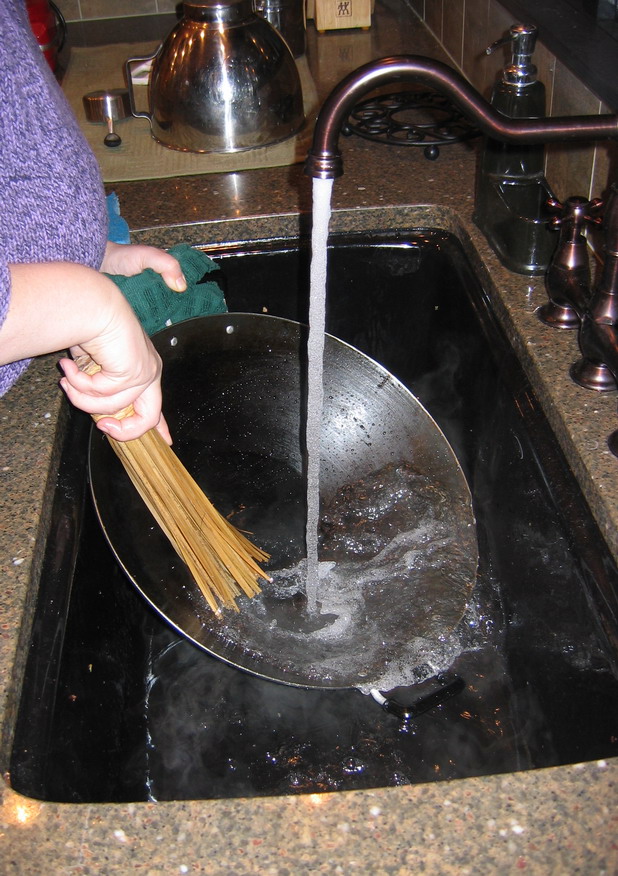
Even the lovely enamelled iron kitchen sink, which is large enough to bathe a small child in, was chosen not only for beauty, but for practicality–it is large enough for me to wash my wok without slopping water all over the countertops like I had done in all the conventionally sized sinks I had until now.
A regular reader sent me an article the other day from the New Atlantis, entitled, “Are We Worthy of Our Kitchens?” where author Christine Rosen examines issues close to my thoughts. She notes that in this age where family meals are on the decline, when fewer parents even know how to cook, and many children subsist on Happy Meals, the marketing of upscale kitchen appliances and expensive kitchen remodels is a booming business. She also cites the popularity of the use of the word “gourmet” to describe appliances, cookware and kitchens, noting that the meaning of the word had changed from a person who appreciated good food to something that denoted a quality of an object pertaining to good food.
In other words, owning gourmet kitchen appliances and equipment conveys “gourmethood” upon the person.
The other point that Rosen drives home, and is where, I think she really comes to the crux of the issue, is that people pay for these expensive kitchens, because they are seeking the solace of a home. They long for the comfort of a happy hearth and home where Mom is home baking cookies and everyone sits down to a meal at the end of the day where they can come together as a family. Whether the kitchen enables this activity or not is beside the point–the image is sold to the family, and they clutch at it, almost instinctively, because, of course, the kitchen is the heart of the home.
What have I to say about this, I, who grew up in a lower-middle class home, with tiny kitchens?
The kitchen, no matter the size, -is- the heart of the home. That part the marketers have right–which is why that ploy works so well.
But it isn’t the appliances that make that heart beat.
It is the cook.
And the cook is not curtailed by substandard appliances, not if he or she cooks from the heart. (Though, I have to say, the cook might be confounded and irritated by substandard appliances–it isn’t easy to cook on a stove that has two BTU’s shared between four burners, after all. It takes a while, and is nerve-frazzling. Oven thermostats which lie about the temperature also can cause grey hairs and much gnashing of teeth.)
One does not need the best of everything to cook great meals. “One needs an open mind and mouth,” as cookbook author Buwei Yang Chow would say. One needs to have good senses, a love of ingredients, a willingness to practice techniques and experiment with new flavors. One needs a stong arm, a steady hand and good instincts.
In truth, one needs very few pieces of kitchen equipment in order to cook well. An excellent knife or two, a few good pots and pans, (in my case, a wok), some stirring impliments, a whisk, and reliable oven and stove and some bowls are all that is required for basic cooking.
Sure, food processors, grinders, mixers the the like make it easier–and I am not against any of those things. I would be a liar to say that I didn’t care about them when I very much do.
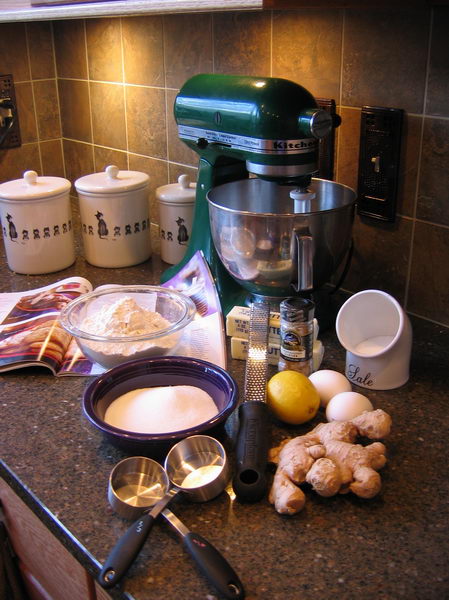
But they are not necessary, no matter what the marketing wizards behind Williams-Sonoma might say.
And so, my hope is this–no matter how modest or house-proud our kitchens are, I hope that we don’t buy into the myth that the latest gadgets are what will make us into real cooks and turn our kitchens into the “heart of our home.”
I hope that we learn that -we- are the heartbeat in our kitchens. We are the ones who breathe life into them, who bring to life the sacred fire of the hearth.
Because that is a truth that no marketer can give us, nor conversely, take from us.
Once realized, that truth is a light that will never go out, unless we neglect it, and let the hearthfire gutter because we have forgotten our own power to choose to make a house a home.
The Pantry Evolves
A little more than a month ago, I posted about my pantry and how disorganized and messy it was.
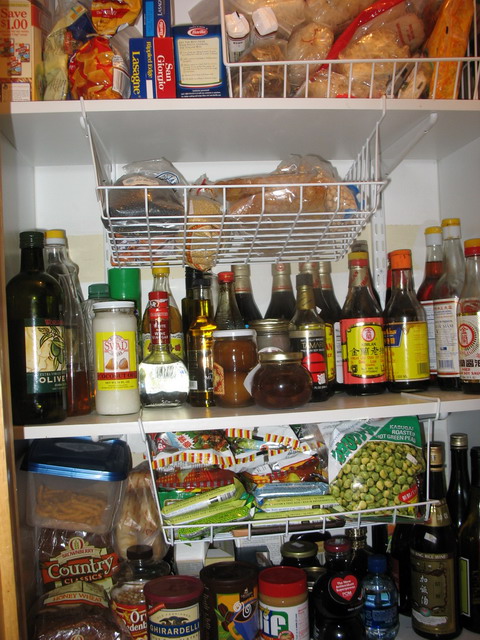
A bunch of kind folks commented to let me know that my pantry wasn’t that godawful and I should really not worry overmuch about it.
But, you know, due to a genetic flaw from the Bavarian side of the family, I have this underlying need for order and organization. It doesn’t express itself all the time, but sometimes it does, and this weekend was one of Those Times.

So, I tackled two messpits in the house: the utility room and the pantry. And now, if you go back and look at the photos from a month ago and look at these, the whole thing may not look that different at a casual first glance.
But the fact is–there is a whole hell of a lot more food stored in that closet now, AND, it is easier to find things in it. It makes sense now, even to people who Are Not Me. (And since there are two other people living in the house, that is important.)
Like, there is a system to it, and everything. Cooking wines and liquors are together, staples are together, noodles, Asian condiments, tomato products, broths, soups, snacking things and quick things like bread and peanut butter (that is the shelf that is primarily for Morganna and Zak), ramen and the like. There is an entire shelf devoted to cooking oils, then vinegars, soy sauces and other Asian sauces, and other liquid flavorings like Tabasco, and sweeteners like honey.
It makes my Germanic heart go pitter-pat.

And may I just say this: I absolutely love those organizing racks, baskets, shelf-clips, jars and closet dooflinkies that they sell at The Container Store, (but they sell at Lowe’s for a lot less) a whole lot? I am especially fond of the little racks that go on the inside of a door. I was able to put all of my Indian spices in one of those, along with a bunch of dried mushrooms, various Asian condiments and other really neat flavoring items that are small and would otherwise go missing.
Like tubes of anchovy paste.
I had three of them, because I kept losing the ones I already had. Now, I can find them, and know to not buy any for a while so as to avoid having more of the little buggers around the house than are necessary.
I’m getting a second one of those racks to go on the door. I don’t know what I will put in it, but something will go there. Maybe more Asian condiments, like soy bean pastes and the like. Right now, they are somewhat visible, but not comepletely so, on the next to the last shelf.

Ooh–and if you look at the bottom shelf you will see that I found fresh coconuts at Taj’s in Columbus. I just need to get cheesecloth so I can make fresh coconut milk. Indira has convinced me that I can do it.
And you know what that means? Probably fresh Thai curry. Maybe some other goodies.
I have ideas. You will see.
There is still a secondary pantry in the utility room. (And a cabinet devoted to herbs and spices in the kitchen.) I have an entire cabinet devoted to flours, sugars and other baking necessities. I still have tubs of rice in there as well, though, I am thinking of getting deeper, heavier storage bins for it. The bin I have for jasmine rice holds about fifteen pounds, but I buy it in 25 pound bags, while the basmati bin only holds five pounds, and I buy it in ten pound bags–and we go through it very, very quickly these days. So, that is my next project: rice storage facilities.

Categories:
- Admin (rss) (55)
- Blogs and Blogging (rss) (81)
- Book Reviews: Cookbooks (rss) (43)
- Book Reviews: Non-Cookbook Food Books (rss) (38)
- Cats and Cat Blogging (rss) (47)
- Chinese Cooking Lessons (rss) (32)
- Culinary School Stories (rss) (18)
- Dairy Pruducts: Cultured and Barbaric (rss) (4)
- Documentary Filmmaking (rss) (1)
- Essays, Rants and Reflections (rss) (260)
- Fighting Hunger (rss) (12)
- Food and Kids (rss) (45)
- Food in the News (rss) (126)
- Food Media (rss) (98)
- Food Preservation (rss) (18)
- Food Safety (rss) (45)
- Gardening (rss) (30)
- Herbs and Herb Blogging (rss) (20)
- Holidays (rss) (50)
- Kat Blogging (rss) (22)
- Kitchen Science (rss) (36)
- Leftover Makeover (rss) (8)
- Life, the Universe and Everything (rss) (131)
- Local and Sustainable (rss) (227)
- Local Athens Food and Foodies (rss) (42)
- Meatless Mondays (rss) (32)
- Menu For Hope (rss) (5)
- Nutrition, Diet and Health (rss) (84)
- On The Farm (rss) (8)
- Recipes: Almost Vegetarian, Vegetarian and Vegan (rss) (294)
- Recipes: American Regional (rss) (37)
- Recipes: Appalachian Hillbilly (rss) (33)
- Recipes: Bread, Pasta, Grains (rss) (95)
- Recipes: Canning and Preserving (rss) (8)
- Recipes: Chinese (rss) (123)
- Recipes: Comfort Food (rss) (120)
- Recipes: Cookies (rss) (16)
- Recipes: Desserts (rss) (48)
- Recipes: French (rss) (25)
- Recipes: Fruits and Vegetables (rss) (302)
- Recipes: Greek, North African and Middle Eastern (rss) (31)
- Recipes: Indian (rss) (137)
- Recipes: Italian (rss) (42)
- Recipes: Japanese (rss) (7)
- Recipes: Jewish (rss) (4)
- Recipes: Korean (rss) (6)
- Recipes: Meat, Poultry and Fish (rss) (220)
- Recipes: Mexican/Native American/ Latin American/Caribb (rss) (27)
- Recipes: Original (rss) (108)
- Recipes: Thai (rss) (27)
- Recipes: Tofu (rss) (17)
- Recipes: US Regional (rss) (16)
- Recipes: Vietnamese (rss) (8)
- Restaurant Stories (rss) (28)
- Sewing, Quilting, Arts and Crafts (rss) (16)
- Simple Chinese Recipes (rss) (30)
- Slow Food and Heritage Foods (rss) (10)
- Spice Blogging (rss) (44)
- The Chinese Cookbook Project (rss) (14)
- The Chinese Pantry (rss) (39)
- The Documentary (rss) (2)
- The Kitchen Saga (rss) (17)
- The Locavore's Bookshelf (rss) (15)
- The Unsung Adventures of The Culinary Nerd (rss) (6)
- Tools and Toys (rss) (35)
- Uncategorized (rss) (10)
- With a Side of Politics (rss) (48)
Archives:
- August 2012 (9)
- July 2012 (12)
- September 2011 (3)
- August 2011 (7)
- July 2011 (8)
- June 2011 (16)
- May 2011 (17)
- April 2011 (11)
- December 2010 (9)
- November 2010 (5)
- February 2010 (1)
- December 2009 (5)
- November 2009 (7)
- October 2009 (10)
- September 2009 (16)
- August 2009 (14)
- July 2009 (14)
- June 2009 (7)
- May 2009 (17)
- April 2009 (10)
- March 2009 (25)
- February 2009 (13)
- January 2009 (10)
- December 2008 (5)
- November 2008 (5)
- October 2008 (6)
- September 2008 (13)
- August 2008 (8)
- July 2008 (11)
- June 2008 (18)
- May 2008 (13)
- April 2008 (14)
- March 2008 (16)
- February 2008 (17)
- January 2008 (19)
- December 2007 (25)
- November 2007 (18)
- October 2007 (24)
- September 2007 (16)
- August 2007 (15)
- July 2007 (15)
- June 2007 (10)
- May 2007 (14)
- April 2007 (16)
- March 2007 (17)
- February 2007 (20)
- January 2007 (13)
- November 2006 (1)
- October 2006 (8)
- September 2006 (14)
- August 2006 (25)
- July 2006 (30)
- June 2006 (28)
- May 2006 (34)
- April 2006 (29)
- March 2006 (24)
- February 2006 (30)
- January 2006 (38)
- December 2005 (40)
- November 2005 (37)
- October 2005 (32)
- September 2005 (25)
- August 2005 (30)
- July 2005 (28)
- June 2005 (21)
- May 2005 (8)
- April 2005 (22)
- March 2005 (17)
- February 2005 (29)
- January 2005 (10)
Search Site:
Links:
- Lily’s Wai Sek Hong
- 101 Cookbooks
- A cat in the kitchen
- A Veggie Venture
- Accidental Hedonist
- Cha Xiu Bao
- chez pim
- Chocolate & Zucchini
- Chopstick Cinema
- Chowhound.com
- Chubby Hubby
- Cook sister!
- Cooking with Amy
- da*xiang
- Eat Local Challenge
- Eating Liberally
- Ecocentric
- Eggbeater
- Epicurious
- Farmgirl Fare
- Fatfree Vegan
- Foodgoat
- ForkandBottle.com
- Green Olive Tree
- Hooked on Heat
- Jaden’s Steamy Kitchen
- Kalyn’s Kitchen
- Lucullian delights
- Mahanandi
- Matt Bites
- MeatHenge
- mmm-yoso!!!
- New York Times – Dining & Wine
- Pizza Goon
- Rasa Malaysia
- Ruhlman
- Sailu's Kitchen
- Serious Eats
- SF Gate: Food & Dining
- Simply Recipes
- Soul Fusion Kitchen
- Tastespotting
- The Amateur Gourmet
- The Cleaner Plate Club
- The Food Section
- The Grub Report
- thecookscottage
- U.S. Food Policy
- Wandering Chopsticks
- Washington Post Food and Dining
- Wasted Food
Meta:


Powered by WordPress. Graphics by Zak Kramer.
Design update by Daniel Trout.
Entries and comments feeds.