
Cook Local, Eat Global
Shopping: Mission Accomplished!
So, we went to Columbus today to shop.
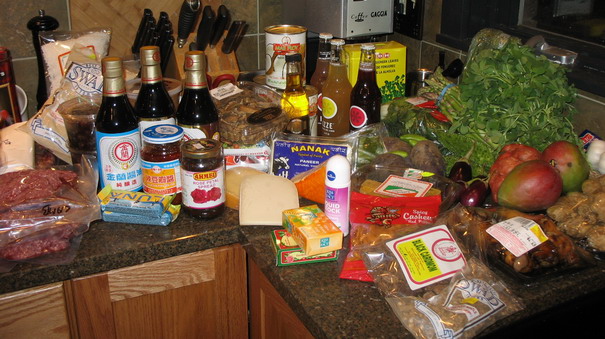
We do this fairly frequently, considering that Columbus is an hour and a half drive away from home. But we hadn’t gone there to shop for meat and chicken at the North Market since before Christmas.
Which meant, my freezer was becoming bare.
You know, we were down to some weird stuff like chicken bones, a bit of bacon, a pound of ground sirloin and a ham hock. Which, mind you, is fine–I can come up with any number of dishes that would utilize some of these items, but the possibilities for variety were limited, and being as I live with two people who -can- be picky eaters (though they generally are not), a larder which is rapidly approaching empty can be a tragic thing.
So, off we trundled to Columbus, in order to make the meat and chicken buying mission. I figured that while we were there, we would stop at the Columbus Asian Market, as I was nearly out of my favorite brands of soy sauce and coconut milk, neither of which are carried by our local, quite good New World Market. Besides–I needed bitter melon, gai lan and fresh water chestnuts, and these are not often available at our market.
We took Dan with us on our mission, and, as he and Heather have become enamored of the meats at Bluescreek, he, too, did some shopping. He also picked up fish sauce, as I suspect Heather is planning some Thai cooking soon. (You go, Heather! I hear you have been printing out my recipes! Woohoo!)
And we ate at the Hometown Chinese Carryout and Deli, which had a facelift while we had been away, and discovered that the food tasted just as lovely as we remembered it.
Then, because, you know, we were in Columbus, we decided to go to the really new, large Indian Market, Patna’s. Because, you know–we hadn’t been.
Ah—what a good idea we had!
They had fresh fenugreek greens, and curry leaves that smelled of heaven. I picked up some lovely tiny eggplant to stuff with spices, and some tiny little gourd-looking things that I have no idea what they are, but I bet they will be good. I will have to ask Indira at Mahanandi to help me identify them (Indira–if you read this–they are the wee green fellows on top of the purple potatoes in the picture), as I very much want to learn a nice way to cook them.

Morganna found a spice I had not run across before, so of course, I bought a small bag: Whole Ganthoda. They look like knobby cut up rhizomes of some sort. I will have to do research on it, ask around (Indira, Meena, VK–help!) and then figure out how to use it. And of course, I will report back here, dear readers.
I also found a beautiful crimson-colored jelly from Pakistan called “rose petal spread.”
Look for a recipe featuring it for Valentine’s Day….
Dan and Zak took all of my exclamations and excited jabbering with great patience, and they waited until Morganna and I finally exausted our curiosity and thrilled gathering of vegetables, dals, spices and greens.
Once we got up to the head of the line to pay, Zak made what he would claim was our most important purchase at Patna’s, which the very nice clerk smilingly retrieved from their refrigerated case: mango barfi.
You see, Zak adores barfi. He is passionate about it. He thinks it is one of the best sweets in the world. (For those who have not had barfi, or burfi, as it is sometimes spelled, it is a milk-based fudge made by simmering sweetened milk until the water has boiled away. Ground nuts, or pureed fruits are used to flavor it; the resultant thick mass is poured into a buttered dish to cool, and then it is cut into squares or diamonds and served as a sweet, and I am told it is used to make offerings in Hindu temples. (Morganna and Zak both delcare that is truly a divine comestible and thus is more than fit to be given to the Gods.)
Until this very day, Zak;s favorites had been almond-rosewater and pistachio barfi. That was before he tasted the mango barfi.
Barfi is very sweet, you see–I can only eat the tiniest of bits of it, and usually, I like it best with very hot unsweetened coffee or tea.
But the mango barfi–it has that slight tang from the mango pulp in it, and the overwhelming floral fragrance of mango that is utterly intoxicating. It is like golden sunlight in the middle of a blustery winter day. It is as sweet and bold as a laughing girl’s kiss, and as tart as her teasing words to an earstwhile lover.
It is utterly delightful.
And it made Zak’s day. (His day was also made when I showed him the milk powder I bought and when his brows fell in question, I smiled and said, “For gulab jaman.” His face lit up. Though, Morganna did a bit of a dance, so I think she was even more excited than he was at the prospect of fresh gulab jaman.)
After Patna’s, since we were in the neighborhood, we went to Whole Foods, where we stocked up on cheeses and olives, dried porcini mushrooms, some fresh mangos, freshly ground almond and peanut butters (peanut butter from honey-roasted peanuts is a delight–we just discovered that today), and purple potatoes to cook with our fenugreek greens. (Aloo Methi is something I have been missing, very, very much.)
As we were thirsty, we splurged on some Izze Sparkling Juice–they are nothing but fruit juice with carbonated water, but they are so delicious, and thirst quenching, that we each nabbed one. My favorite is still pink grapefruit, but Zak loves blackberry, while Morganna favors pomegranate. Dan did not partake, though I think he should have–they are that good. Considering how infrequently I drink soda–these bursts of fruit flavor with the tingling bite of bubbles are a real treat.
When we got home, and unpacked our parcels, Morganna bade me take pictures and blog about our trip. She said that the shopping was scary, though, as Dan pointed out–these are items that we stock up on when we can get them, and then we go months on end without needing them. This is especially true of the soy sauces, coconut milk and meats, and the spices and dried items. All of these are staples that are preserved to last for some time.
But still–seeing them all amassed on the counter was a tad bit frightening.
Oh, well. When I shop–I shop.
Tomorrow, I will be cutting up meats, and packing them for the freezer, and maybe pulling out chicken bones to make stock. And, I will be cutting up some galangal and fresh turmeric and freezing those as well. All the while, I will be planning a grand Indian feast for later in the week, and perhaps, a supper of Garlic Booger Chicken.
Stay tuned….
Weekend Cat Blogging: Gummitch the Handsome
Claire, of Eatstuff, and beloved companion of Kiri, the Amazing Christmas Miracle Cat, asked us to show folks what the cutest thing that our cats will do for this week’s Weekend Cat Blogging.
However, I already posted a couple of pictures illustrating that last week, (if you missed them, check them out here), so instead, I am posting a photograph that Zak took for me, which I call, “Gummitch the Handome.”
It is such a good picture, I think I have to print it out and hang it in the kitchen or my office, because it is such a good portrait of my sweet boy cat.
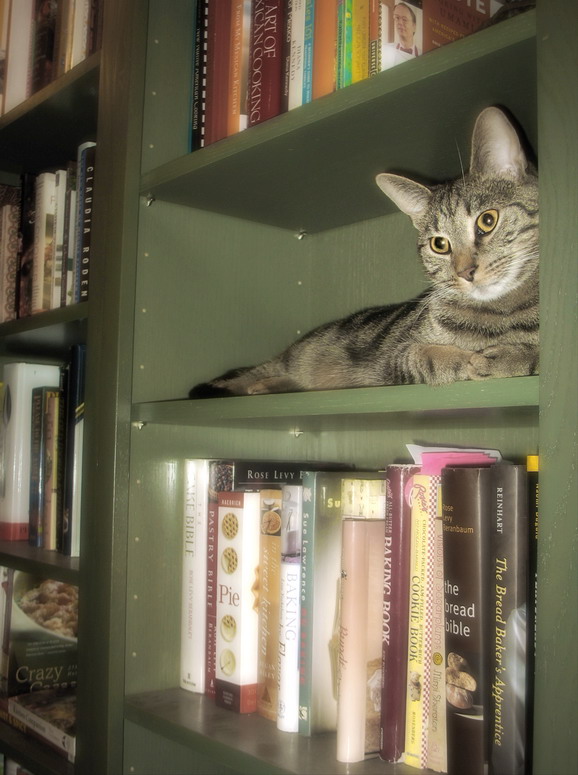
People in multiple cat households are like grandparents. We are not supposed to have favorites among our cat children. But, just as grandparents do have favorite grandchildren, whether they admit it or not, we cat-parents have our favorites, even though we love them all.
Gummitch, who was named after a cat in a Fritz Leiber story (even though he looks nothing like the Gummitch in the very famous tale–what he does look like is the cat on the cover of the book where I first read the story), is my especial favorite. We saw him two months after I suffered a miscarriage, and he was such a beautiful kitten, that we adopted him.
The love of a kitten is very good for soothing the sorrow of a grieving heart. And Gummitch is one of the most loving cats I have ever known.
He immediately bonded to me, and would sit for hours on my lap or next to me on the couch while I worked at writing, and he stayed small for so long, we thought he would never grow up.
But, grow he did, until he has turned into a very handsome, lithe, princely sort of cat. He is goodnatured, and loving to with the other cats. When we brought Tatter home, he started taking care of her immediately: washing her, cuddling down with her to sleep and gently playing with her.
And he still keeps me company. Most days, while I write in my office, he sleeps in the reading chair by the windows, content to keep an eye on me from there. Sometimes, he will wake up and put his paws on my leg, demanding a cuddle, which of course, I grant–how can one refuse eyes like that?
I Can’t Believe I’m Eating Leftovers: Char Siu Lo Mein
This post is for a friend who has likely made himself a pile of leftovers.

Because, it is that if you follow my char siu recipe, as my friend has done, you are bound to have a few leftovers, especially if you made it in order to make char siu bao, you are going to have leftovers.
And what leftovers they are.
Juicy, meaty goodness on the inside and crispy, caramelized golden (or red, if you do that food coloring thing) on the outside. Sweet and succulent.
Which means, you may not end up with leftovers, even if you plan for them, because you may find yourself or others in your household sneaking downstairs late at night and snitching bits and pieces of the char siu until nothing is left.
Well, let me tell you, if you can keep the late night mice from nibbling at the meat, you can make an awfully good dish with very little trouble, one that will taste as if it never had a thing to do with leftovers: char siu lo mein.
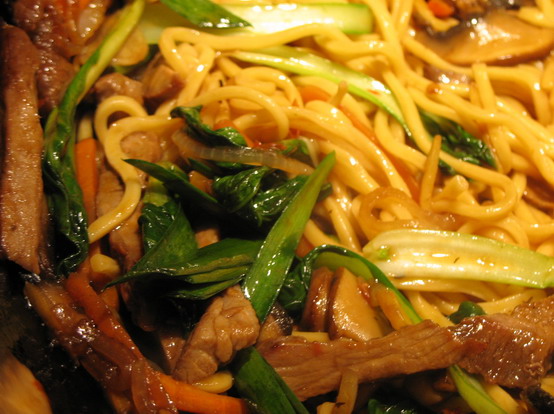
I highly suggest keeping the char sui leftovers under lock and key until you get down and make this recipe.
Because it is worth holding off on the pork until you can get to the noodles.
Char Siu Lo Mein
Sauce Ingredients: (Mix together and have ready)
1 ½ teaspoons. dark soy sauce
1 teaspoon honey
1 ½ tablespoons oyster sauce
2 tablespoons Shao Hsing wine
1 tablespoon hoisin sauce
2 tablespoons chicken broth
pinch five spice powder (I like Penzey’s brand)
Ingredients:
1 pound fresh lo mein noodles
small dab of sesame oil
1/4-1/2 pound char sui, cut into thin, diagonal slices as illustrated above about 1″X1/4″
1 tablespoon cornstarch
1 1/2 tablespoons Shao Hsing wine
4 tablespoons peanut or canola oil
1 medium onion, sliced thinly
1/2″ cube fresh ginger, peeled and cut into slivers
4 fat garlic cloves, peeled and thinly sliced
1 portobello mushroom cap, cut in half, then thinly sliced
freshly ground black pepper to taste
1 cup baby carrots, sliced thinly on the diagonal
1 head tatsoi , washed and dried, with the base cut off so the leaves are all separate
1/2 cup Chinese garlic chives, washed, dried and cut on bias into 1 inch pieces
1/2 teaspoon sesame oil

Method:
Bring large pot of water to a rolling boil. Loosen up the bundle of fresh noodles with your hands until they are all separated and sprinkle them into the pot, then stir with a chopstick so they do not cling together once they are in the water. Keep stirring so they don’t touch the bottom, and watch over them. Do not let them boil more than two or three minutes–I tend to boil mine for about two and a half minutes. They should be al dente. Then drain them into a colander in the sink, and rinse thoroughly with cold water tossing and separating them with your fingers so none of them even get a chance to stick together. (This cold water rinse also firms the noodles up.)
Then let them drain for a minute or two, and pour some sesame oil into your hands and massage it through the strands of noodles. This keeps them from getting sticky while they sit waiting to be stir fried in the wok.
Mix together char sui, cornstarch and wine. Allow marinade to sit on meat while you cut everything else.
Heat wok until it smokes. Add peanut oil, and when it is shimmering hot, add onion, and stir fry until it turns a nice golden brown. Add ginger and garlic and portabello mushroom, stir fry until onions are reddish brown, and mushrooms are cooking down and everything smells fragrant.
Add black pepper and meat, toss a few times, allowing the meat to brown slightly and the cornstarch marinade to brown on wok.
Add carrots, and stir fry another minute or so. Add tatsoi, and stir and fry until it begins to wilt, then add sauce, and deglaze wok.
When the sauce is bubbly, toss in noodles and stir and fry together until all is coated in sauce, and fragrant.
Add Chinese chives and sesame oil, toss to mix, then serve.
Note: You can use different greens with this. Collards are great–just wash and dry them really well, take out the center ribby vein, and roll them up like cigars and then cut them into thin ribbons. Baby bok choi is nice, too. Mustard greens would be spiffy, too. Whatever you like, really.
Freeganism: What’s Up With That?
You know, I am not good with extremists of any sort.
And that apparently includes freegans.
Even when I agree with some portion of whatever philosophy they espouse, there is something unsettling about extremist behavior that sets my teeth on edge.
I think it has to do with my inability to respect hypocrisy in any form. Or, maybe it is that while some of what freegans espouse makes sense, most of their logic has holes in it big enough to drive a recycled vegetable-oil burning Willys Jeep through.
I think in the end, that it is a combination of the rampant hypocrisy and the logical inconsistencies of the freegan lifestyle which gives me the desire to back away slowly, and hope that I go unnoticed by the idealistists who go dumpster-diving for their dinners. Hypocrisy and illogic are a potent mixture that reeks of irrationality, and frankly, people who are irrational by nature creep me out.
Before I go any further, it behooves me to defined what exactly a freegan is. Here is a definition from Wikipedia: “Freeganism is commonly understood as the practice of abstaining from any consumer goods except in those cases where the goods are obtained for free and have been divorced from the harm done by their production. The word “freegan” is a portmanteau of the words free and vegan.”
That doesn’t sound so bad.
Unless you think about it.
How, exactly can consumer goods be “divorced from the harm done by their production?”
They can’t.
Just because one picks up something for free that has been discarded, and doesn’t directly give money to the corporation which produced it, doesn’t make the production of that item harmless. I mean, the Nike shoes pulled out of a dumpster still were made from cowhide that came from a factory-farmed animal that was raised standing in her own feces, pumped with chemicals and feed made from ground up bits from other animals, and then slaughtered in an abbatoir by methods too gruesome to enumerate. The shoes were still sewn by underpaid workers who may or may not be children toiling in Third World sweatshops under life and health threatening conditions. The dyes and artificial materials in the shoes were still made by unsafe industrial processes that release harmful chemicals into the environment.
All of these facts are still true, whether a freegan picked up the shoes from a dumpster, a trashbag in front of a brownstone, traded for them at a freemarket, or lifted them from a store. (Yes, there is a document on Freegan.info that condones shoplifting. Yes, I was disgusted, too.)
The only difference is that no money was exchanged in the final link in the consumerist chain.
The lack of money changing hands hardly “divorces” a consumer good from the harm done in its production. That harm still occurs, and to say that if one doesn’t pay money for the item in question, the individual is somehow negating the harm is delusional, dishonest and frankly, full of crap. While it may be true that freegan lifestyles minimize the environmental impact of thier lives upon the Earth by limiting their involvement with American consumerist society, it is not true that “the Freegan holds no responsibility for the material and energy resources used in the production process, since the goods have already exited the production-consumption cycle where money is used in exchange for goods.”
It is disingenuous, not to mention hypocritical, for an individual to benefit from the use of a consumer item, yet claim no responsibility for the harm that went into the making of that item, simply because they paid no money for it. That harm is still there, and it still is happening, and the freegan is still benefiting from it, all the while protesting against the evils that arise from capitalism.
However, what I see in the freegan lifestyle is that regardless of how much disdain they hold for capitalist society, they are still benefiting from it. They decry consumer waste, but they have no problems utilizing the fruits of that waste.
They are scavengers, living upon the edges of the society they supposedly do not respect.
Freegans are right to go on about the excessive waste in American consumer-driven capitalist society. Americans do throw too much of everything away. We are a disposable society, and our landfills are bursting with plastic crap, excess packaging, appliances, furniture, electronics, clothing, medical waste, and worst of all, food. We toss everything out, and it isn’t right. It’s bad for the environment, it’s bad for us (because it is bad for the environment) and it is a hideous waste of resources that can be utilized by ourselves and others.
Freegans support efforts such as freecycling, trashpicking, and freemarkets in order to take useful items out of the waste stream and put them back to use. These are good and admirable goals, which I myself wholeheartedly support and practice.
I cannot help but have sympathy for the freegan view of trashpicking when it comes to ensuring that useable goods never make it to landfills, since I was taught trashpicking as a small child.
My paternal grandmother, Gram, was an inveterate trashpicker. Having lived on a low income most of her life, she had developed a finely tuned trashpicker’s awareness as a young mother. She discovered that better off neighbors didn’t always donate their unwanted clothing, appliances and furniture to Goodwill or other charities–they often threw them away. So, she learned to cruise along the curbside on evenings when trash went out, just to see if she could find something good.
And she often did. Chairs, tables, vases, coats, shoes, books–you name it, she found it. Everyone in the family teased her for her trashpicking ways, but she called it, “treasure hunting,” and never gave up the habit. She would walk her dog in the gloaming, smoking a cigarette, and at every pile of trash, she would pause, looking for likely “treasures.”
When I got old enough to carry stuff, I became a well-trained accomplice. Most of her terra cotta flowerpots came from the garbage, and several pieces of antique furniture that she eventually passed down to family members started out as throw-away finds.
When I went dumpster-diving to rescue an antique bedstead in college, and dragged it home to my apartment, I called Gram to tell her.
She was very proud.
But, it is dumpster diving of a different sort that gets freegans the most media attention.
Not only do they rescue antiques from the trash and polish them up for their own domiciles, they also glean food from garbage, and sometimes even eat food left on plates by other diners in restaurants and fast food places.
Over 100 billion pounds of edible food is wasted every year in the United States.
That is a fact.
In the midsts of all of this waste, there are millions of homeless people, working poor, rural poor, children and senior citizens in America who go hungry. Food insecurity is on the rise, driven by high unemployment rates and a weak economy.
Freegans do see the irony of this situation, but their response is not to work to reduce this imbalance; they only seem interested in helping themselves to the bounty that can be found in the garbage.
According to a New York Metro article by Amy Zimmer, some freegans, such as Adam Weissman, are unemployed by choice, and see their foraging for discarded food not as a matter of survival, but, rather, a “political act.” Others, such as Billy Pruz, say that they want people to “think about mass consumption, about the waste we produce.” He continues, saying, “Even if I had the money I wouldn’t want to spend it when there’s so much trash.â€
A third woman interviewed for the article, Janet Kalish, a schoolteacher from Queens who admitted that she had no economic need to dumpster-dive, said that she had soon become a full-time freegan after her first foray. “In this one night, I got more bread than I need for a week,†she said, adding, “I am concerned that when I open a bag I might be touching urine from a dog, but I try not to touch anything too sticky.â€
No mention was made by any of these three people, who arguably were not in need of free food (certainly not the woman who was employed and who admitted to no economic need), of the many homeless in New York who must go through garbage from grocery stores in order to have enough for themselves and their families to eat. You know, people like Morlan,19, quoted in a 2004 article by Inter Press Service, who, when seen by the manager of an upscale Manhattan grocery store as she pulled bread, fruits and vegetables from the garbage he had just put out, said, “I have zero cash right now, and no place to stay. What do you expect me to do?”
Not only do freegans with money compete with the homeless who have none, they network via the Internet on places to find the best dumpsters for food. This creates a “survival of the fittest” situation where the homeless who have limited (if any) access to the Internet are pitted against the freegans for food that arguably, many freegans do not need.
Most media coverage of the freegan movement focuses on the “squick” factor of people eating out of garbage cans, and overlooks the more pressing issue of the fact that many freegans seem to be priviledged, middle-class individuals who are practicing “voluntary simplicity,” by being purposefully unemployed or underemployed, or who are employed, but still feel the need to scavenge food that could be used by others who have no money, in order to “make a political statement.” Instead of asking the tough questions like “So, what about hunger and homelessness among people who don’t have jobs? Are you worried about that?” Most interviewers are like NBC’s Tucker Carleson, who completely missed the deeper implications of the choice of a freegan lifestyle, and instead noted, “It is kind of nasty. I mean, dumpsters are nasty,” while he interviewed freegan, Madeline Nelson, a former Fortune 500 company employee.
Even when Nelson mentioned the “Good Samaritan Law” that allows businesses and individuals to donate edible food to charities who work to fight hunger without fear of being sued, Carleson didn’t come back with the most obvious response, which would be: “Gee, you had a job, you’re well-dressed. You don’t look like you need to be scrounging around in dumpsters for food. So why not try to get the stores who throw out the food you eat to donate it to a food bank so that people who really need it can get it?”
No. Instead, he just went on about how gross it all was.
This is the crux of my issue with freeganism and freegans.
After reading the entire website, Freegan.info, including all of their manifestos, philosophy and practices, I see a bunch of privileged people who are fierce critics of American capitalism, yet, instead of doing anything constructive in response, they focus on self-benefit.
In a word, they are parasites.
They say that they are dropping out of the consumerist slave society that we live in, striking blows against corporate America, but in truth, they are living off of the refuse of corporate America. On the one hand, they decry agricultural methods as being harmful to the environment, and yet they feed from the very surplus that agriculture produces.
Freegans harken back to a simpler time, when humans were hunter gatherers, and life was “better.” In his essay, Liberating Our Consumption, Liberating Our Lives, Adam Weissman brings up the mythic Golden Age of Primitive Man, when all was beautiful and life was peaceful: “Before production, before industry, before agriculture, even before the advent of the ritual hunt, humans provided for themselves through direct communion with nature’s bounty, foraging fruits, nuts, seeds, berries, and roots. The land was not owned and food was not a product. People consumed to meet their needs, with little opportunity for waste or overconsumption. The only “producer” was the Earth itself. Human patterns of consumption were governed within the context of our native ecosystems. Humans existed as equals with other animals and the earth, not as owners, conquerors, “stewards,” or destroyers.”
I really hate to tell Weissman this, but his understanding of food anthropology and human prehistory is limited at best, and outright flawed at worst. Besides, I hardly equate taking the subway uptown to scavenge out of dumpsters with the real work that is involved in gaining enough calories to live in typical hunter-gatherer societies; for Weissman to conflate the two points to the delusional manner of the thought processes upon which freeganism is founded.
But be that as it may, you notice that the focus of his essay is on “our consumption,” and “our lives.” There is no real mention of helping out poor folks who are hungry. Lip service is paid in freegan philosophy to “not taking food from those who need it,” but the guidelines, Why Freegan? instruct neophyte freegans to visit soup kitchens and free lunches, or to scam for food stamps and government food handouts, with the reasoning that most of these places have plenty of food to spare, and they are just giving it away, so why not?
The truth is, most food banks, soup kitchens and organizations who give away free lunches are severely underfunded, and with the rising number of hungry families and individuals in this country, the problem is growing worse. Most workers at soup kitchens and food banks will not turn anyone away, but for a freegan who may or may not be employed, who is taking the food offered to them not out of need, but to make a “political statement,” is nothing but pure selfishness and childishness in action.
What turns my stomach about the entire concept of freegans eating out of dumpsters isn’t the idea that “dumpsters are nasty,” but that there are existing organizations of people who work together to try and reduce the massive amounts of food wasted in this country by persuading grocery stores, restaurants, individuals and corporations to donate what they would throw away to be distributed to food banks, homeless shelters, soup kitchens and other charity groups. America’s Second Harvest is the largest group, and they do great work getting stores to donate what they would otherwise throw away, then do reclamation work on it, so that it can distributed to food banks. A smaller grassroots organization, Food, Not Bombs, does similar work with food reclamation, although, they also stage vegetarian meals made with excess produce that would otherwise be thrown away, in order to make the public more aware of the issues of food waste and hunger in the United States.
The freegans do seem to know about Food, Not Bombs, because in Why Freegan? right after the admonition to not take food from those who need it, freegans are told, “Go to Food Not Bombs and help out, then take some extra soup and bagels for the road.”
Instead of just helping out volunteers who are trying to get food to the hungry because it is a good thing to do, freegans are urged to take some food, “in payment” one might say.
You know–for people who are against consumption, they sure know how to get what they want. Everything they seem to stand for, everything they do revolves around themselves. They will help a volunteer organization, but only if they get “paid” with food. They may not want to pay anyone else, but they sure want something for themselves.
No matter how it is dressed up, Freeganism is at base a self-serving ideology. It is just as selfish as the capitalism that it decries. It cannot exist outside of capitalism, indeed, it is dependant upon it. Without the massive waste that consumerism produces, the choice to live a freegan lifestyle would be impossible. Those who are truly dependant upon scavenging for their survival do not have this choice, and freeganism does very little to alleviate this condition.
A Tribute to the Nine Jewels: Navrattan Korma
I really enjoy dishes that have poetic names.

Even if the name is not in English, if it is poetic, I seem to remember it better, and appreciate it more.
Besides, poetic names usually have a story behind them, and we all know that part of the fun of learning a new recipe is that you get to hear the tale behind the making of it. (If we were not all fascinated at the stories behind recipes, there would be no one reading this blog–or any other food blog, for that matter.)
Navrattan korma is one of those poetically-titled dishes which I have come to love. But, it doesn’t just have a pretty name–it is also a delicious, if rich dish made of a medly of vegetables sauced in a yogurt sauce enriched with cream and ground almonds. It is usually gently spiced; my favorite versions have leaned heavily on cardamom seeds, garlic, pepper, and some fennel seeds. I also like to finish mine with a sprinkling of minced fresh mint and sliced almonds–the green freshness of the mint cuts through the richness and dances in a verdant swirl above the creamy sauce, while the crisp almonds contrast with the velvety softened vegetables.
The word “navrattan” comes from the Sanskrit “nav” meaning “nine,” and “ratnas,” meaning jewels, and it refers to the tradition of having nine beloved and trusted courtiers in the Indian king or emperor’s entourage. Emperor Akbar, one of the greatest of the Mogul Emperors, had among his “Navratnas,” great poets, orators, musicians, generals, writers, ascetics and mullahs. Akbar was himself a very learned man, and a great patron of the arts, so while the empire did expand during his reign because of military campaigns, much emphasis was also placed upon art, poetry, architecture, horticulture, music and literature.
Navrattan korma is said to be named for these men, these beloved jewels of the emperor’s court. Consisting traditionally of nine vegetables and fruits, and spiced with nine spices, it was numerogically perfect, as nine was triple lucky, being thrice three. It also happened to suit Akbar’s taste on “fast” days, when in sympathy with his Hindu subjects, he ate vegetarian meals. (Akbar himself was Muslim, but during his reign, many Muslims followed his lead and adopted many Hindu religious and cultural practices as their own.)
I first tasted navrattan korma Akbar in Columbia, Maryland, and that is where I first heard the story of the emperor’s nine courtiers from one of the waiters. He was, like myself, an armchair historian, and so he liked to regale me with tales of the old days of India in between filling up chai cups and water glasses. He especially was fond of the doings of the Mogul Emperors, and Akbar and Shajahani were his especial favorites. He suggested the dish to me when I said I wanted to eat only vegetables one night, but I wanted something different than my usual channa masala or malai kofta. He said that this dish would be filling, but still not as heavy as meat, and he was quite right.
After I tasted it, he and I had to have our usual game of “guess the ingredient,” for he would not openly give away the chef’s secrets. However, if I guessed correctly, he had no problem in confirming my cleverness. Besides, he always wanted to see how many spices I could unravel from the very well-melded mixtures in their dishes. I think it amused him.
At any rate, here is my version of the dish–it is based on the version I ate often at Akbar, but it is not exactly the same. You will notice that I did not end up with nine vegetables in the dish this time around. That is because I added what I had. If you like, you could add other vegetables to make up the difference: I would suggest mild chiles or red sweet peppers, or perhaps parsnips.
Navrattan Korma
Ingredients:
4 large cloves garlic, sliced
1/4 teaspoon dried ginger
1 bay leaf
1/2 teaspoon fennel seeds
1/4 teaspoon cardamom seeds
10 black peppercorns
15 white peppercorns
1/4 teaspoon cinnamon
2 whole cloves
1 tablespoon white poppyseeds
2 tablespoons butter or ghee
1 cup yogurt
1/2 cup roasted almond butter
1/2 cup half and half
salt to taste
1/2 cup frozen peas, parboiled until tender-crisp
1/2 cup sliced baby carrots, parboiled until tender crisp
1/2 cup frozen or fresh stringed green beans, cut into 1/2 inch lengths and parboiled until tender crisp
1/2 cup frozen baby lima beans, parboiled until tender crisp
5 baby potatoes, quartered, and boiled until done
1 turnip cut into a medium dice, parboiled until mostly done
6 baby mushrooms, quartered
water as needed
1/2 teaspoon powdered turmeric
garam masala (optional)
handful minced fresh mint
handful of sliced almonds
Method:
Grind together garlic with all spices (including the poppyseeds) until a fine, dry paste is formed. Heat ghee or butter in a heavy bottomed pan until it is bubbling and add spice paste and begin to stir. Stir until quite fragrant, then add yogurt, almond butter and half and half and stir until it is all combined. Taste and correct for salt.
Drain all the vegetables of their cooking water and add to the pan with the sauce. Add enough water to thin sauce to a consistency where it can simmer easily. Add the turmeric, and simmer, stirring now and again until the vegetables are all tender and the sauce has become thick and clings tightly to the vegetables. Taste for seasoning, and add garam masala if you like. Keep a close eye on the simmering process and do not let the vegetables or the sauce stick to the bottom of the pan. Add more water as necessary.
Serve with plain steamed rice or a pillau with golden raisins and almonds.
Sprinkle with the mint and almonds just before serving.
Note: This dish is best when cooked the day before it is needed, thoroughly cooled, and stored in the fridge overnight. Then, add a bit more water, and reheat over a slow fire. Simmer until the excess water is gone, then serve as noted above. Most Indian foods are best the next day, after the spices have had a good long rest in the fridge wherein they have time to get to know each other and become friendly as they settle into the overall flavor of the dish.

Categories:
- Admin (rss) (55)
- Blogs and Blogging (rss) (81)
- Book Reviews: Cookbooks (rss) (43)
- Book Reviews: Non-Cookbook Food Books (rss) (38)
- Cats and Cat Blogging (rss) (47)
- Chinese Cooking Lessons (rss) (32)
- Culinary School Stories (rss) (18)
- Dairy Pruducts: Cultured and Barbaric (rss) (4)
- Documentary Filmmaking (rss) (1)
- Essays, Rants and Reflections (rss) (260)
- Fighting Hunger (rss) (12)
- Food and Kids (rss) (45)
- Food in the News (rss) (126)
- Food Media (rss) (98)
- Food Preservation (rss) (18)
- Food Safety (rss) (45)
- Gardening (rss) (30)
- Herbs and Herb Blogging (rss) (20)
- Holidays (rss) (50)
- Kat Blogging (rss) (22)
- Kitchen Science (rss) (36)
- Leftover Makeover (rss) (8)
- Life, the Universe and Everything (rss) (131)
- Local and Sustainable (rss) (227)
- Local Athens Food and Foodies (rss) (42)
- Meatless Mondays (rss) (32)
- Menu For Hope (rss) (5)
- Nutrition, Diet and Health (rss) (84)
- On The Farm (rss) (8)
- Recipes: Almost Vegetarian, Vegetarian and Vegan (rss) (294)
- Recipes: American Regional (rss) (37)
- Recipes: Appalachian Hillbilly (rss) (33)
- Recipes: Bread, Pasta, Grains (rss) (95)
- Recipes: Canning and Preserving (rss) (8)
- Recipes: Chinese (rss) (123)
- Recipes: Comfort Food (rss) (120)
- Recipes: Cookies (rss) (16)
- Recipes: Desserts (rss) (48)
- Recipes: French (rss) (25)
- Recipes: Fruits and Vegetables (rss) (302)
- Recipes: Greek, North African and Middle Eastern (rss) (31)
- Recipes: Indian (rss) (137)
- Recipes: Italian (rss) (42)
- Recipes: Japanese (rss) (7)
- Recipes: Jewish (rss) (4)
- Recipes: Korean (rss) (6)
- Recipes: Meat, Poultry and Fish (rss) (220)
- Recipes: Mexican/Native American/ Latin American/Caribb (rss) (27)
- Recipes: Original (rss) (108)
- Recipes: Thai (rss) (27)
- Recipes: Tofu (rss) (17)
- Recipes: US Regional (rss) (16)
- Recipes: Vietnamese (rss) (8)
- Restaurant Stories (rss) (28)
- Sewing, Quilting, Arts and Crafts (rss) (16)
- Simple Chinese Recipes (rss) (30)
- Slow Food and Heritage Foods (rss) (10)
- Spice Blogging (rss) (44)
- The Chinese Cookbook Project (rss) (14)
- The Chinese Pantry (rss) (39)
- The Documentary (rss) (2)
- The Kitchen Saga (rss) (17)
- The Locavore's Bookshelf (rss) (15)
- The Unsung Adventures of The Culinary Nerd (rss) (6)
- Tools and Toys (rss) (35)
- Uncategorized (rss) (10)
- With a Side of Politics (rss) (48)
Archives:
- August 2012 (9)
- July 2012 (12)
- September 2011 (3)
- August 2011 (7)
- July 2011 (8)
- June 2011 (16)
- May 2011 (17)
- April 2011 (11)
- December 2010 (9)
- November 2010 (5)
- February 2010 (1)
- December 2009 (5)
- November 2009 (7)
- October 2009 (10)
- September 2009 (16)
- August 2009 (14)
- July 2009 (14)
- June 2009 (7)
- May 2009 (17)
- April 2009 (10)
- March 2009 (25)
- February 2009 (13)
- January 2009 (10)
- December 2008 (5)
- November 2008 (5)
- October 2008 (6)
- September 2008 (13)
- August 2008 (8)
- July 2008 (11)
- June 2008 (18)
- May 2008 (13)
- April 2008 (14)
- March 2008 (16)
- February 2008 (17)
- January 2008 (19)
- December 2007 (25)
- November 2007 (18)
- October 2007 (24)
- September 2007 (16)
- August 2007 (15)
- July 2007 (15)
- June 2007 (10)
- May 2007 (14)
- April 2007 (16)
- March 2007 (17)
- February 2007 (20)
- January 2007 (13)
- November 2006 (1)
- October 2006 (8)
- September 2006 (14)
- August 2006 (25)
- July 2006 (30)
- June 2006 (28)
- May 2006 (34)
- April 2006 (29)
- March 2006 (24)
- February 2006 (30)
- January 2006 (38)
- December 2005 (40)
- November 2005 (37)
- October 2005 (32)
- September 2005 (25)
- August 2005 (30)
- July 2005 (28)
- June 2005 (21)
- May 2005 (8)
- April 2005 (22)
- March 2005 (17)
- February 2005 (29)
- January 2005 (10)
Search Site:
Links:
- Lily’s Wai Sek Hong
- 101 Cookbooks
- A cat in the kitchen
- A Veggie Venture
- Accidental Hedonist
- Cha Xiu Bao
- chez pim
- Chocolate & Zucchini
- Chopstick Cinema
- Chowhound.com
- Chubby Hubby
- Cook sister!
- Cooking with Amy
- da*xiang
- Eat Local Challenge
- Eating Liberally
- Ecocentric
- Eggbeater
- Epicurious
- Farmgirl Fare
- Fatfree Vegan
- Foodgoat
- ForkandBottle.com
- Green Olive Tree
- Hooked on Heat
- Jaden’s Steamy Kitchen
- Kalyn’s Kitchen
- Lucullian delights
- Mahanandi
- Matt Bites
- MeatHenge
- mmm-yoso!!!
- New York Times – Dining & Wine
- Pizza Goon
- Rasa Malaysia
- Ruhlman
- Sailu's Kitchen
- Serious Eats
- SF Gate: Food & Dining
- Simply Recipes
- Soul Fusion Kitchen
- Tastespotting
- The Amateur Gourmet
- The Cleaner Plate Club
- The Food Section
- The Grub Report
- thecookscottage
- U.S. Food Policy
- Wandering Chopsticks
- Washington Post Food and Dining
- Wasted Food
Meta:


Powered by WordPress. Graphics by Zak Kramer.
Design update by Daniel Trout.
Entries and comments feeds.