
Cook Local, Eat Global
Weekend Cat Blogging: Catnip Crazy
Cats and catnip together make for amusing images to share.
This is Tatterdemalion’s first experience with catnip.
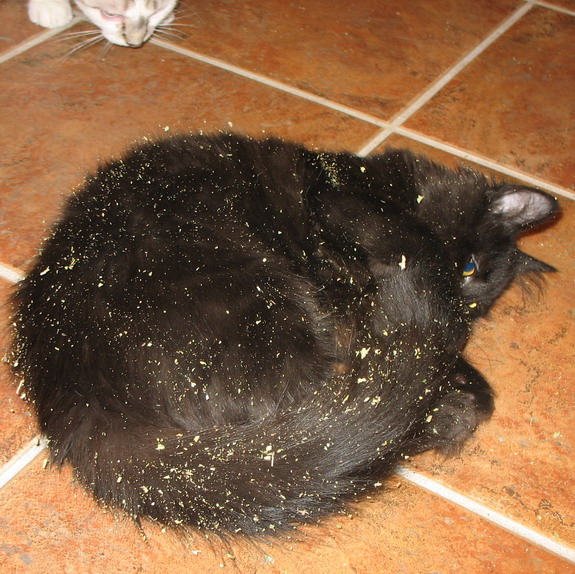
She has a good system worked out to get the maximum amount of exposure–she rolls in the stuff, and since her fuzz is so wild, the dried herb bits cling to her, everywhere.
As you can see, this strategy winds up to be very successful–she is covered from head to toe in most of the catnip I laid out for all seven cats.
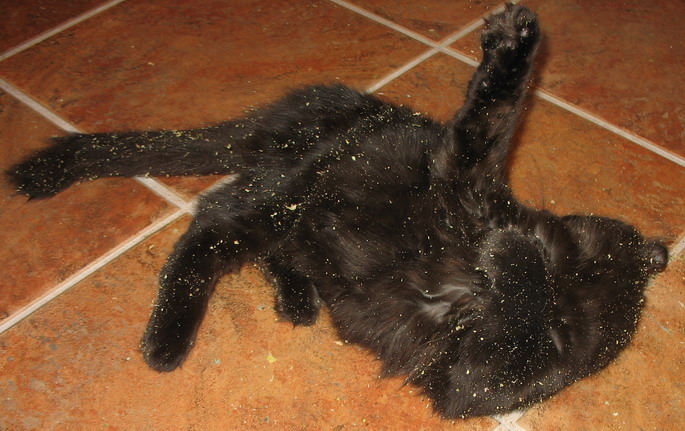
She is also apparently engaged in some sort of active feline yoga exercises. Or maybe it is Pilates. I don’t know, and I don’t think she does, either, but she appears to be having fun, and that is what matters.
Silly thing.
For more Weekend Cat Blogging fun, where food bloggers around the world show off pictures of their cats, go visit the amazing miracle cat, Kiri and his person, Claire, at Eatstuff. Every Saturday, they round up links to all the kitties from the participating blogs.
You Are What You Eat
When Kirk of mmm-yoso tagged me for this meme, I didn’t recognize that I had already done it once, back when Michael of Haverchuk twanged me.
But, I am going to do it again anyway, because I told Kirk I would. Besides, this time, instead of my favorite foods, I am going to tell you about my ten favorite dishes, which is infinitely more difficult.
It is more difficult, because I love all food, and nearly any dish in the world can be my favorite, depending on what season it is, what the weather is like, how I am physically feeling at that time, what I have eaten recently and what kind of mood I am in. Frankly, I am certain that as soon as I commit these ten dishes to paper, or as it were, to electrons, the list will change. However, I refuse to edit it after it is done, so what you readers will get is a snapshot of which ten dishes I most love at a singular point in time on this day in January 2006.
It is the best I can do.
Oh, and one more thing–these are not ranked in any particular order. I can’t do that. I draw the line there. These dishes are in the order that they came to my head, and that is where they are going to stay.
Hot and Sour Soup is an enduring favorite, even if I have only been eating it for about twenty-three years. My father mistrusted Chinese food when I was growing up, so I didn’t have any until I was in high school and was introduced to it by a pair of friends. But, it wasn’t until I went to college and discovered The China Garden restaurant in Huntington, West Virginia, that I tasted hot and sour soup.
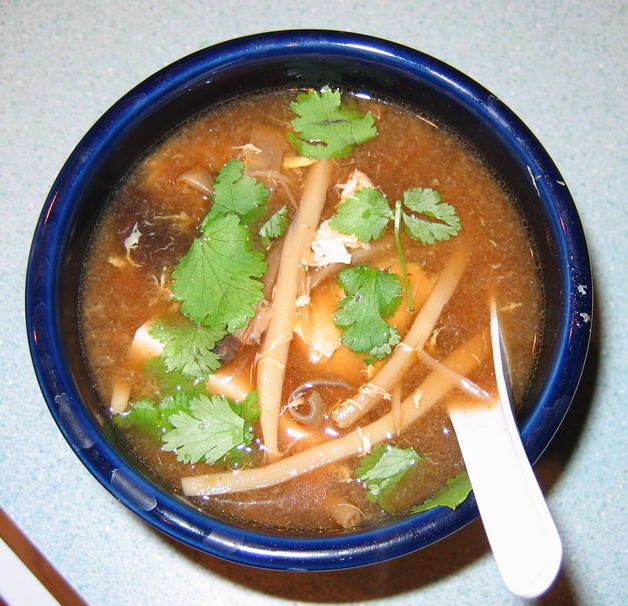
It was love at first sip.
It didn’t matter to me that I had no bloody idea what most of the ingredients floating about in the soup were. What mattered was that it was peppery, chile laden and sour, and unbelievably good. Huy made fantastic soup. By the time I was working there, after I left my first husband, I mostly lived off of that soup. Mei would sell me a quart at the end of the night for a quarter, and I would buy two quarts of it, carry it home, and then sit on the roof of my porch to look at the stars and drink soup, and ponder the meaning of freedom.
Of course, then, we moved away, and I couldn’t get Huy’s soup very often anymore, so I was forced to learn to make it.
And I did. After I learned to make soup like Huy’s, I played with the recipe, adding galangal and lemongrass, which changed it considerably, though I think, for the better. Now, people tell me I make the best hot and sour soup they have ever tasted.
Mine is good, and it might raise the dead, but Huy’s–his is the soup that tastes like freedom.
And freedom is better than resurrection any day.
I have already written about lasagne at length, but I can still add a few words here, anyway.
One thing that you will learn by reading this post is that I am not wedded to one single version of a dish being “right.” I mean, sometimes, only one certain flavor will do–like when it comes to King Crab Rolls, only the ones from Sushi King in Columbia, Maryland, count. Only those, and no other, can satisfy my craving for king crab, tobiko, rice and crispy bits of tempura batter. Nothing else will do. Sorry.
But with most of the dishes listed here–there is no one variant that pleases me. They are all good. (Unless they are just badly cooked or from a cardboard box or something.)
Lasagne is like that. I never really make it the same way twice. Never, ever. There are just too many ways to enjoy it. Too many pastas to use, too many cheeses, too many fillings–why should I limit my palate to one version of lasagne? It makes no sense.
I like the way my Mom makes it, with pepperoni, mushrooms, sausage and ground beef in the sauce, and a fairly plain ricotta filling. I like the way that most Italian-American restaurants in Providence, Rhode Island make it–very basic, very plain, very, very good. I like the way a Greek friend in high school’s Mom used to make it–as a bastard love-child between moussaka and lasagne–noodles layered with cinnamon-scented ground lamb and tomato sauce with slices of roasted eggplant and peppers, melty feta cheese, and a custardy bechamel on top.
In fact, I like that one so well, that now I have recalled it, I might have to haul off and try to recreate it, because it is sounding pretty damned good to me right now.
Okay, now that I have said that I am pretty easy-going about my favorite dishes, and that I don’t believe that there is any one “right” way to make them, I am going to turn back around and make a liar of myself.
There is one exception to that rule, and that is Mom’s potato salad.
Yeah, I mean, I will eat other potato salads, even my own, and they will be okay, I guess. But most potato salads are too sweet (Who puts all the sugar in the dressing, and why? What the hell is up with that?) or too mustardy (Whe dressing should be pale yellow, not blazing dandelion-colored!) or filled with sweet pickle relish (Which is nasty snot-colored stuff straight from Satan and belongs in no self-respecting potato salad.)
See, just when you thought I was easy-going and loved everything, you find out that I have one dish that I am a complete and utter food nazi over–and that is potato salad. (Yes, I am a southerner, you can now tell.)
My mother, like all southern mothers, if you hear their kids talk, makes the best potato salad. The difference between my mother and all the other mothers in the south is that mine really does make the best. All those other kids are either deluded, lying, or are too scared of the Wrath of Mama to tell the truth, because the truth is, my Mom’s is the best. No other potato salad will do.
And the hell of it is–she doesn’t make it very often. She never did make it too often, but she really doesn’t make it too much now.
Because it is a pain in the butt. Because she boils her potatoes whole, in their skins, to keep them from getting soggy. (That is rule number one for a good potato salad, which most people bugger up–avoid soggy potatoes.) Then, she has to let them cool enough so she can peel and dice them, into chunks not too big and not too small. She boils eggs, too (eggs must go into the salad eggs and potatoes are friends you know–without eggs, it is a salad made of lonely potatoes, and who wants that?), and chops them up. along with raw onion and celery, and sometimes green onion tops. (And when it is ramp season, yes, oh, yes, she will put ramps in it. I am drooling now, just thinking about it.)
Then, she makes the dressing–and this is what makes it great. She uses Helman’s mayonnaise (no other will do, and no Miracle Whip, you infidel freak!), French’s mustard (but only enough to give it a zing and to color the dressing a pale, buttery yellow), salt, pepper–and get this–pickle juice. Yep, pickle juice from hamburger dill slices. That is what makes the dressing tangy, pourable, tasty and good. No sugar. No pickles chopped up and none of that damned pickle relish. Just five things in the dressing–Helman’s, French’s, salt, pepper and Kroger’s brand hamburger dill slices pickle juice.
I can eat inordinate amounts of that stuff. And so can most of my cousins, aunts and uncles. Mom used to make it in the big roasting pan that we used for twenty-two pound turkeys at Thanksgiving, because if she didn’t, there wouldn’t be enough.
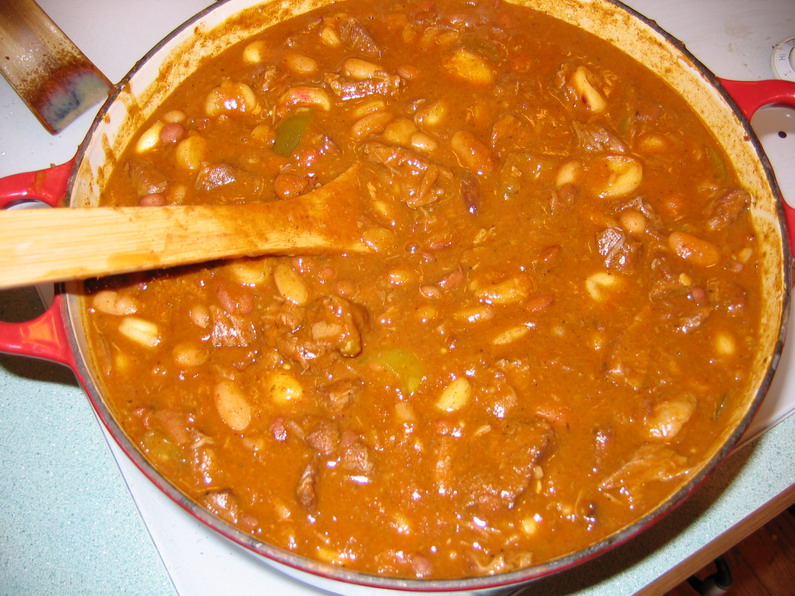
At our house, chili is a constant bone of contention between Zak and I.
I love chili.
He doesn’t.
Not only does he not love it, he generally doesn’t even like it. Most of the time, he tolerates it.
He makes exceptions for some of my derivations of chili–the pictured “Chupacabra” chili, he likes pretty well. It has goat, lamb, two kinds of beans and posole in it, in addition to tomatillos, onions, garlic and chiles. Lots of chiles.
But chili is another of those dishes that I am very democratic about. I like it every way except the way that they make in Cincinnati, which is gross beyond belief. Sweet chili with overcooked spaghetti, onions and cheese is disgusting. Sorry. No can do.
Chili should be thick.
It should be spicy-hot.
It should be redolent with cumin, garlic, onions and maybe Mexican oregano.
It should have cilantro in it. And maybe sour cream, and cheese.
It can have beans or not, and it can have meat or not. So long as it tastes good and isn’t sweet, I am not too picky on that point.
In culinary school, when I did my internship, some of my TA’s called me “The Chili Queen,” which to them, who were also chilihounds, was a title of great respect and honor. They called me this, because they could give me a pile of disparate ingredients, a bucket, steam kettle, or pot to cook in, and as little as forty-five minutes, and I could turn out a very respectable to downright tasty chili. I was the emergency back-up plan for whatever went awry, because they knew, that no matter what, they could come to me and I could make chili. (Or for that matter, gumbo, or any number of filling stews, but they liked chili best.)
By the time I was finished interning, I probably had made about fifteen different types of chili myself, and I liked them all.
Every now and then, I get a hankering for one of them for dinner, and Zak sighs and puts up with it, knowing that the next day, I will go out of my way to make one of his favorites, like Red Curry Chicken with Pineapple.
Fried chicken is another of those perennial favorites that I seldom will turn down if it is offered to me, and luckily, Zak agrees with me on it.
Popeye’s spicy fried chicken (and red beans and rice) is about the only fast food that I still will actually eat, and though it is greasy and godawful for me, it still tastes delightful. Fried chicken is one of those things I seldom cook, but probably should. A friend of mine and I once innovated a recipe that we called “Garlic Booger Chicken,” because we had marinated the chicken pieces overnight in buttermilk and garlic slices. The next day, when we fried it, we were too lazy to pick the garlic slices off the chicken before dredging it in flour, dipping it in egg and then rolling it in cornmeal. When we dropped it in the hot fat, the slices that had clung to the chicken pulled away and deep fried themselves. We fished them out, tasted them, and by damned, if those little garlic boogers were not the most delicioius things! They were like roasted garlic in that they were sweet, nutty and soft, but they had the beautiful crisp, deep fried outer coating that was from the gods. And they went beautifully with the fried chicken, so, that is how we both fried chicken ever after. (The only fried chicken better than it was my Gram’s–her secret was to add a bit of butter to the frying oil, and my Grandma’s–her secret was frying it lard. You cannot beat butter and lard in cooking, not even with garlic boogers.)
I haven’t made Garlic Booger Chicken in years.
I probably should rectify that situation, but I digress.
Fried chicken is one of those dishes that is cross-culturally satisfying. I have had it made by Chinese chefs and loved it, and I have had it made by West Virginia Mountain Mammas, and loved it equally. The Cubans of Miami make a pretty amazing fried chicken and the local grease pit fried chicken joint across town here in Athens, Miller’s Fried Chicken, makes not only fried chicken to die for, but real creamy chicken gravy that doesn’t come out of a jar.
The only fried chicken I categorically will not eat is KFC, because for whatever reason, it doesn’t taste good anymore. It just tastes brown. Like their gluey gravy tastes brown. Not chickeny, not meaty, just brown.
I don’t mind food to be brown, as these illustrations no doubt show, but they should taste like something other than just generically brown.

You knew that there had to be something sweet in here, right?
And if you read my first post regarding this meme, you already know that I am fanatical about sour cherries, to the point that I will eat them raw and unsweetened, right?
Well, no doubt you can guess that my favorite sweet in the world is Sour Cherry Pie. But only if it is a good pie, with a good all-butter or butter-lard or all-lard crust. And it is made with something other than that godawful, hideous red-food-coloring, corn syrup and tapioca-starch laden canned cherry pie filling.
That is one thing I won’t compromise on. No canned pie filling, ever. Ick. It is too sweet, which is the greatest mistake most pie bakers will make with sour cherry pies. They are SOUR cherries, which means they are meant to be sour, not sweet. If I wanted a sweet cherry pie, I would make it from SWEET cherries, not sour. Cherries come conviently pre-sweetened and not, take advantage of it and don’t you dare drown my precious sour cherries in cup after cup of sugar.
If you are going to do that, you might as well use that damned canned crap and be done with. Those poor sour cherries have already been lost–there is no use in visiting such horror on perfectly innocent, unsweetened fresh or frozen sour cherries.
As much as I like sweets, in truth, I like non-sweet food even better. Hence, the dearth of desserts on this list. Every year, when I was a girl, I got a cherry pie from my Grandma instead of a birthday cake, and every year my Gram or my Mom would make Chicken with Homemade Noodles for my birthday dinner. I wrote extensively about this dish back in December, and I don’t know that there is much else to say about it, except that I have yet to have a rendition of it I haven’t liked. I mean, it is a stewed chicken with tender, but still thick, hand-rolled egg noodles. How can that be bad? And when you serve it over a heap of fluffy, steaming hot, buttery mashed potatoes–how can your tongue not go to heaven?
Actually, I can see how it is bad–for the waistline. Double starch, butter, eggs, chicken fat, chicken–it all adds up to a dieter’s nightmare, but it sure does taste good. And if you only eat it once, maybe twice a year, or in my case now, every other year, you won’t die from it, and neither will your waistline.
Pot Roast is another of those childhood favorites that has come along into adulthood still loved, but not often eaten. If I ate pot roasts as often as I would like, I’d be as big as a house. But, I don’t, so I’m not, and all is well. But now and again, I just have to have a magnificent binge of a tough cut of meat cooked low and slow (or, in a pressure cooker, high and fast) until it falls apart. I gussie mine up a fair amount, especially compared to my Mom’s recipe which only included onion, bay leaves, salt, pepper and water–I am known to add wine, beer, garlic (very few dishes are cooked in this house without garlic–desserts are where I draw the line), chiles, herbs of all sorts, carrots, celery seed, mushrooms, parsnips, turnips–you name it, if I think it will taste good, into the pot it goes.
There is nothing better than sitting down to a plate of fork tender meat, meaning meat that you don’t need a knife to eat, that is filled with juice and flavor, with a plate full of vegetables braised in the meat broth, a pile of mashed potatoes, and a good swill of dark brown gravy thickened with a good roux brun. Well, there are things better than that, but as kids might be reading this, I will not go into them here, but there are few things better than good pot roast, vegetables and gravy.
And you know, I will tell the truth right here and now–the pot roast is all about the gravy. And while I adore beef chuck pot roast and lamb shoulder pot roast, and venison haunch pot roast, nothing beats a fatty bone-in pork shoulder for making gravy that will make your toes curl up with joy. Nothing, nope, nada, zip. Pork shoulder roast browned in a bit of bacon drippings, with plenty of caramelized onions, simmered with sherry and garlic makes the best gravy known to humanity. Gravy so good, you want to swim in it. Gravy so good, hell, you want to drown in it. Death by gravy is nothing to sneeze at.
I know I would go with a smile on my face.
My own personal decadence is a leftover meal from my childhood. Bits of leftover pot roast and gravy poured over fluffy white rice.
Oh, my. Just thinking of it is making me long for a plate of it right now.

I couldn’t admit to being a hillbilly without telling y’all how much I long for a bowl of pinto beans that have been cooked with a ham hock, with some cornbread to dip in it. I mean, by this point in this gargantuan essay of a post, y’all probably have figured out that I have not strayed far from my southern hillbilly roots–with the exception of hot and sour soup, most of these dishes are the classics of my childhood. I guess that I am in a nostalgic mood today.
But, even when I am not feeling southern or am wanting to admit to being a hillbilly at heart, I still love me a bowl of beans. Steaming hot and brown, surrounded with thick broth, topped with raw onions or scallion tops, they are pure comfort in a spoon. As is usual for me, I cook them fancier than the rest of my family, but I will not turn down their plainer cousins, either. If I smell them, I have to have them, and eating them will bring to my heart and stomach a peace that is eloquent of home, comfort and love.
And you can’t have beans without cornbread. Not only is it a case of instinctually pairing of complementary proteins, but they just taste right together. Beans are naked without cornbread, though in truth, I can eat cornbread without beans. I can eat cornbread just about any day, in any way. I can eat cornsticks, hot and crispy from the pan, I can eat cornbread cold the next day with butter. I can eat sweet cornbread and spicy cornbread and just plain old corny cornbread. I like it in all colors–yellow, white, red and blue, and I like it in all shapes and sizes.
I am very democratic when it comes to cornbread.
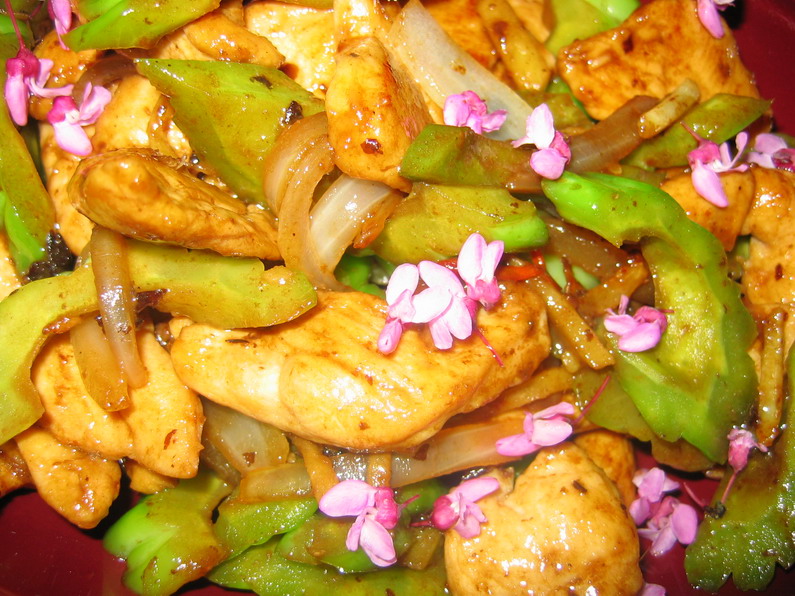
I am not just putting Chicken with Bitter Melon here for the sake of symmetry, though I admit that the poetry of it is aesthetically pleasing to me.
I have only been eating this dish for about a year, but it has rapidly taken its place in my palate as a favorite. It is a comfort food that I was not born to, and it is something that I find myself craving when I am troubled, or when I awaken deep in the dark watches of the night and cannot sleep.
There is something addictive about the flavor of bitter melon, that stays with me. I don’t know what it is–it is at once cooling and refreshing and invigorating at the same time. Combined with chicken and black beans, with browned onions, and it becomes a paragon of a dish, something so good that you cannot help but want to keep eating it long after your appetite is satiated.
Luckily, unlike pot roast swimming in gravy, it isn’t very fattening, so if I do overeat, I will not awaken the next morning and look in the mirror to be shocked by a sudden overnight growth into elephantine proportions.
Bitter melon is lyrical. It is bitter, yes, sometimes bitingly so, but it is also crisp, and tender, and sometimes just a bit sweet. Its texture is a poem, its color is a song, and I cannot imagine not loving it for the rest of my life.
I only wish I had not come to know it so late.
But, I guess that just means that I have to make up for lost time.
The Return of Pad Thai
Do you remember when I wrote about pad thai the first time and mentioned that the stir-fried noodle dish was infinately variable, and that there was no one way to make it? And I said that even I didn’t make it the same way every time, and that I would change around the ingredients to suit my mood, and what was in the pantry?
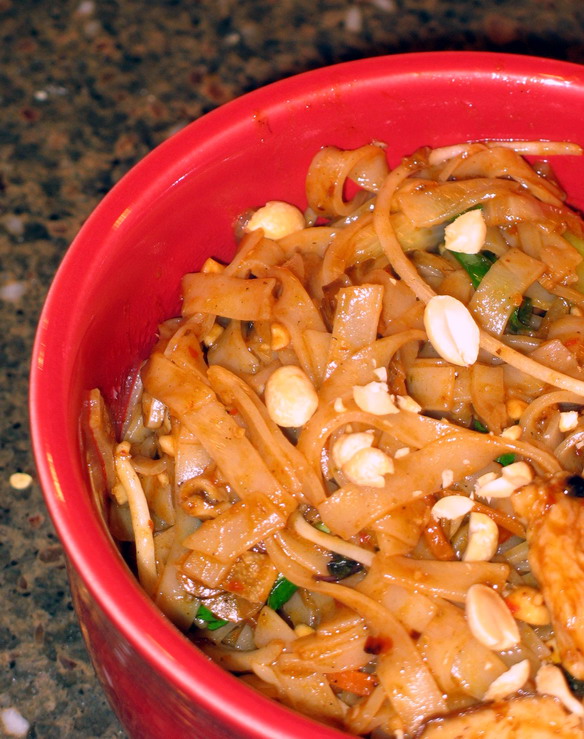
Well, here is proof. Another evening, another mixture of food items in my pantry, about 3/4 cup of leftover freshly made red curry paste, and a hungry family.
This leads to a second version of pad thai within a week.
And this one went over really well with the natives, including Dan, who happened to drop in just as we were eating.When I asked if he was hungry when I opened the door, he said, “No.” Then I said, “I have pad thai,” and he said, “Oh, well, I’m hungry then.”
So, forthwith, he was provided with a bowl, some chopsticks and a napkin. He already had a drink with him.
The addition of the fresh curry paste, while it is the most striking difference between the two recipes, isn’t the only one.
I added some pressed spiced tofu to this one as I only had 1/2 of a boneless skinless chicken breast thawed out. I found some opal basil (that is the purple, spice basil that tastes kind of like Thai holy basil) at the store fresh, so I added that. I had bean sprouts and red sweet pepper to throw in along with carrots. I didn’t use tamarind for a souring agent, but instead went with straight lime juice at the end. I did use actual palm sugar, which dissolves instantly and isn’t as sweet as raw sugar, in pretty copius amounts to offset the heat of the curry paste.
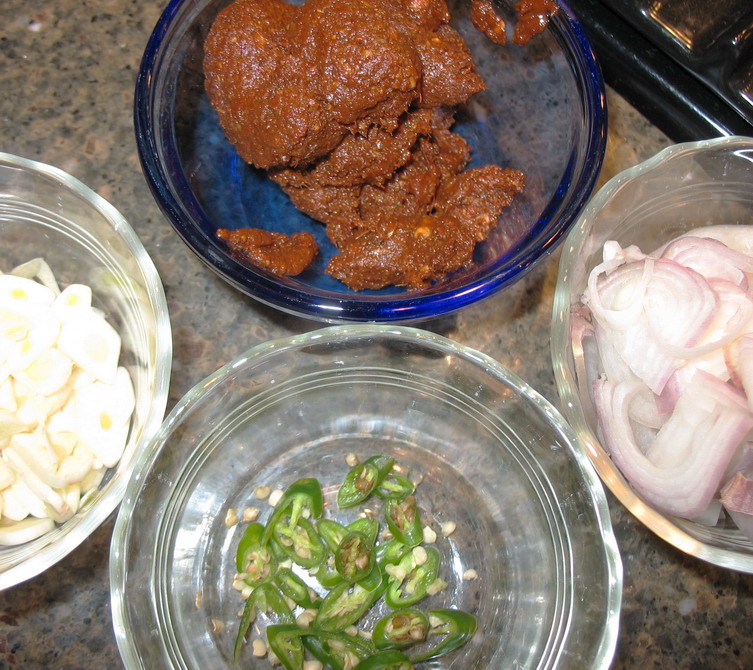
Another difference is that when I added shallots, chiles and garlic to this stir fry, I did not grind them up into a paste. I already had a paste, so I left these additional flavoring ingredients in thin slices to provide textural contrast and little bitty “flavor bombs” that add burst of aroma and taste in the mouth when they are bitten into. This adds another layer of complexity to this particular version of pad thai that makes it just a little more sophisticated than usual.

So, what I am saying is that this is pretty much a very different recipe for pad thai.
You can use commercially available red curry paste in this recipe. I won’t come to your house and berate you if you don’t make your own curry paste and use it. Just do me a favor and use Mae Ploy brand red curry paste–it tastes better and fresher than the other ones that come in cans. In my experience, though, in making it with commercially available pastes–you may not want to use as much paste–it is saltier when you buy it from the store than when you make it fresh. You don’t want your noodles to end up tasting like a salt lick.
One thing you will notice–neither of my recipes for pad thai include scrambled eggs. I will eat scrambled eggs in pad thai when I go out, but I don’t love them in there. I don’t really know why–probably because they tend to be dried out a bit with some bits of crispy lacy overcooked egg whites that I don’t find to be texturally appealing. So while you will see tofu and mushrooms and all manner of vegetables in my pad thai, what you won’t find is eggy bits.
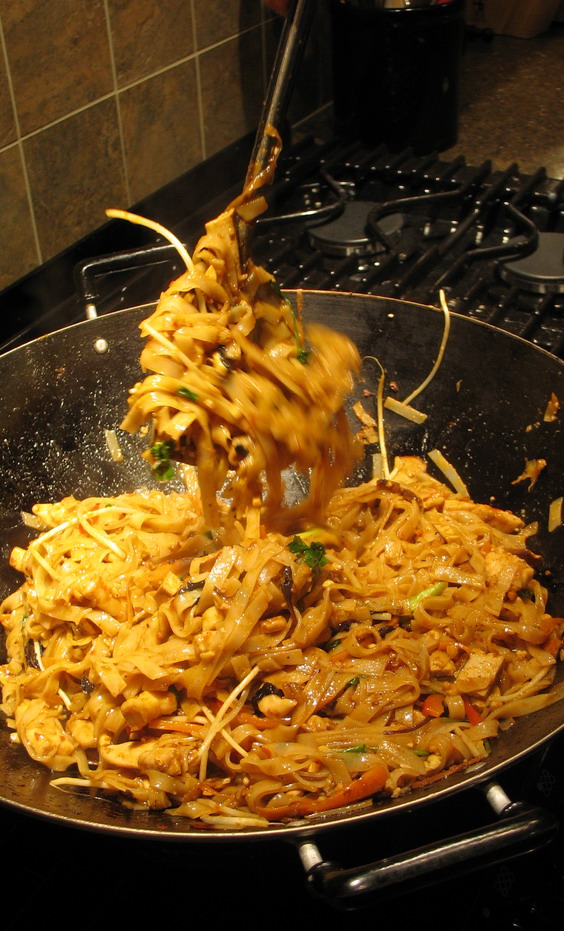
Cooking this version is only a little trickier than the other–the red curry paste, when you use your wok at extremely high temperatures, will want to stick. This meant that I ended up using a full cup of chicken broth when I cooked the noodles in the wok to get them to soften and not stick. No worries–the texture of the noodles turned out beautifully tender and a bit slippery with no tedency to gumminess or mushiness.
Pad Thai With Red Curry Paste
Ingredients:
1 package 3/4 inch pad thai noodles
4-6 tablespoons peanut oil for stir frying as needed
1 large shallot, peeled and thinly sliced
3-6 thai bird chiles, thinly sliced (to taste-optional)
1/3-3/4 cup red curry paste (to taste)
5 cloves garlic, peeled and thinly sliced
1/2 boneless skinless chicken breast, trimmed and sliced thinly, then marinated in 1 tablespoon fish sauce and 1 tablespoon cornstarch
6 ounces spiced pressed tofu, thinly sliced
7 fresh shiitake mushrooms, stems removed, caps thinly sliced
2-3 teaspoons palm sugar (to taste)
fish sauce, to taste
6 fat baby carrots, peeled and julienned
1/2-1 cup chicken broth
2 tablespoons oyster sauce
1/4 cup julienned red sweet bell pepper
2 handsful washed and dried cilantro leaves
1 handful washed and dried opal or thai basil leaves
1 handful washed and dried shredded scallion tops
1 handful bean sprouts, topped and tailed, washed and dried
1/2 cup coarsely crushed dry roasted unsalted peanuts
juice of 2 limes (to taste)
Method:
Soak noodles in warm water to cover until soft. Drain and allow to dry as much as possible. (If they are a little damp when you start stir frying don’t worry over it.)
Heat the wok until it smokes. Add the smaller amount of oil. (You can add more if you need to later.) Add shallot and chiles and stir fry until the shallots begin to brown. Add curry paste, and garlic and stir for about one minute, or until everything is extremely fragrant.
Add chicken and stir and fry until chicken begins to firm–about a minute and a half. Add tofu and mushrooms, and then add fish sauce to taste and to deglaze the red curry paste that has begun to stick to the sides and bottom of the wok. Scrape up the deglazed bits, and stir until the chicken is nearly done. Add carrots, and keep stirring.
Add noodles, a little more fish sauce and the smaller amount of broth. Stir fry like mad, trying very hard not to spew noodles all over your stove. The first few times you cook pad thai, you will spew the noodles, just keep going and cooking and you will get better at stirring this neatly in time. Add the red pepper bits and keep the noodles moving. (This requires good forearm muscles and biceps.)
When the noodles begin to cook down and become limp, check to see if you need more oil or broth. Correct as necessary. As the noodles approach the level of doneness you want, add the oyster sauce. Keep stirring. Add the cilantro, basil and scallion, and stir in until it wilts. If your noodles are done, turn out the fire, sprinkle noodles with bean sprouts and peanuts, then squeeze in the lime juice.
Scoop into bowls and enjoy. This recipe makes about six good sized servings.
Food Blog Awards Update
The polls are only open for one more week at The Accidental Hedonist for the 2005 Food Blog Awards.
And yes, I am nominated for Reader’s Choice: Best Post for “Meat Comes From Animals, Deal With It, Or Eat Vegetables.”
More importantly, Indira of Mahanandi is nominated for Best Food Blog Recipes and Too Many Chefs for Best Group Blog.
And, if you have never read her, I nominated The Food Whore for Best Food Blog Humor. Go read her and laugh.
And then go vote for her. Because she makes me laugh every time she posts.
There. That is the closest I can get to tooting my own horn.
Tooting other people’s, and then giving passing reference to myself.
I’m going to wash the stove now.
Thai Red Curry: A Lesson In Flavor Balance
When Americans talk about Thai food, many of them get caught up by the heat of the chile peppers, which either incites the machismo response of “I can take mine hotter than you can take yours,” or causes fear and distress among those whose palates are not accustomed to the burning sensation chiles impart to a dish.
But Thai food is not just about heat.
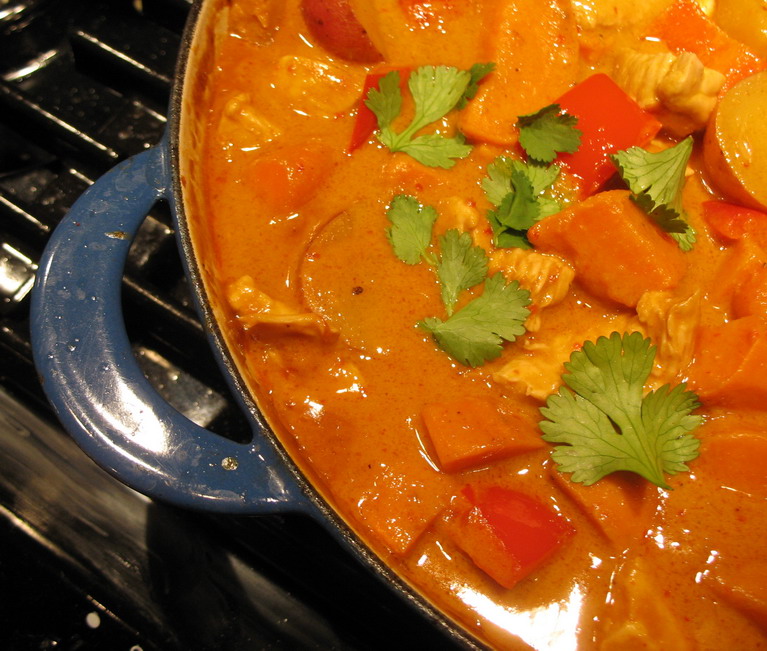
It is about balance.
It is about balance between flavors, an aesthetic balance in color, texture and form, and a balanced, nutritional diet.
If one focuses on the heat of Thai dishes, one loses the ability to percieve the glorious complexity that the cuisine has to offer. One loses the sour kiss of lime juice and tamarind, and the salty, savory kick of fish sauce and shrimp paste. It is hard to appreciate the incredible sweetness of pineapple or the luxurious richness of coconut milk if one is weeping in pain from the chiles. The floral aroma of kaffir lime leaves and pandanus leaves, or the medicinal tang of fresh turmeric and galangal get lost if one overloads her first Thai efforts with way too many chiles for her diners to tolerate.
Thai food is a complex, multi-dimensional sensual experience. To distill it down to one flavor sensation-the heat of chiles-is to dumb it down, to strip it of the layers of cultural and history that make it so special.
It is a travesty, and American cooks should not perpetuate such in their kitchens.
Yesterday, I gave Morganna her first lesson in Thai cookery; I did as I tend to with most students, and started her on keang pet daeng–red curry.
The reason I always start with red curry is that it many Americans associate Thai food most with either pad thai or a coconut milk curries. Of the coconut milk curries, the easiest to make, and the most balanced in terms of flavors is red curry. Neither overly sweet nor sour, nor overly spicy with chiles, nor very salty or bitter, red curry has aspects of all of these flavors in perfect proportions to each other. The curry paste is a good one to learn the procedure of making pastes with, because it is reasonably straightforward, and the dish can be dressed up or down with whatever fish, meat or fowl the cook prefers and a nearly endless variety of vegetables.
I have made red curry with shrimp and pineapple, deep fried tofu puffs, mushrooms and a mixture of root vegetables, and pork with sweet potatoes, but my favorite version, and the one that has never failed to please people is the one I present here: red curry with chicken, pineapple, and root vegetables.
As much as I adore making and eating various sorts of red curry at home, it is my least favorite curry to order in a restaurant. For whatever reason, I have found that in American Thai restaurants, red curry is the dish most likely to be bland, boring and flavorless. Perhaps because it has the reputation of being the most tame of all Thai curries, most restaurants present very watered-down versions of it that timid American palates enjoy. Perhaps we are just spoiled by what homemade curry pastes taste like, but for whatever reason, Zak and I have not been able to order red curry in a restaurant and be satisfied by it for many years.
So, I always make it at home, and don’t worry over it.
(Before I describe how to go about making the curry paste, I know that I am going to be asked what kind of already prepared curry paste someone can use if they don’t have time to make my curry paste, so I will just say so now. If you must use a packaged curry paste, Mae Ploy–in the resealable plastic tubs–makes the best on the market. Their red curry, panang and massamun pastes are all good–however, please don’t bother with making green curry if you are not going to make the paste from scratch. It won’t taste right. Trust me. In a future post, I promise to explain why.)
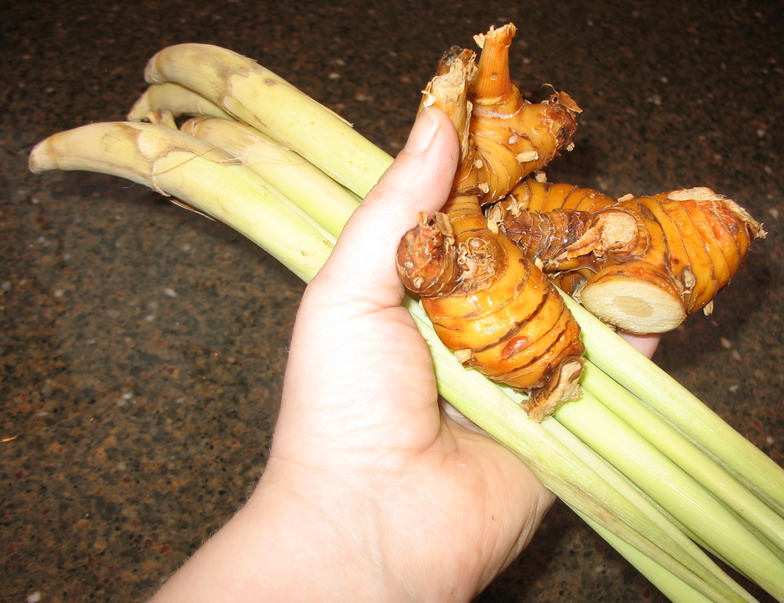
Two ingredients that are necessary to making Thai curry pastes fresh are fresh (or frozen) galangal and lemongrass. Many Asian markets and some Whole Foods produce sections carry fresh galangal. If you cannot get it fresh, as it is presented in the photograph, you can get it frozen in chunks at many Asian markets. Just look in the frozen cases where vegetable matter is sold and you can find it. It looks just as knobby and gnarled frozen as it does fresh–it is unpeeled. Folks just hack it into chunks and stick it into bags and freeze it. It is also, in whichever state you buy it, hard as a knot of wood. If you are going to be making curry paste by hand, chopping it in a food processor, and then mashing it into a pulp with a mortar and pestle, then I suggest frozen galangal. The aroma and flavor are nearly identical to the fresh, but the hard texture has been broken down a bit by the freezing process, so it is easier to pound into a paste. Just let it thaw out first. (You can refreeze what you do not use for another time.)
Lemongrass should be much easier to find. Look for stalks that are still pliable all the way up if you can manage it, with outer leaves that are only slightly dry. When you bring them home, wrap them loosely in a paper bag and keep them in the produce drawer of the fridge and they will stay fresh for several weeks. To use them, you cut off the very bottom of the stalk, then peel off a couple of the outer layers of leaves, then use only the lower third of the rest of the stalk. The upper stalk bits are too tough and dry to use. If you are making your paste by hand, I recommend using a food processor to chop the tough stalks into bits first, then the mortar and pestle to pound them together with the other ingredients.
My advice is to make sure that you can get these two ingredients before you decide to make curry paste. Fresh or frozen–dried is really not a good option. Dried galangal is okay for tom kha gai–galangal and chicken soup–but it really doesn’t do much for a curry paste. Dry lemongrass is about as good as sawdust; it is completely lacking in the lemony floral fragrance that the fresh stalks have. If you cannot find these ingredients where you live, try this website for fresh Thai produce. I have ordered from them several times and have always gotten great products and service from them.
When it comes to making the curry paste itself, I use my Sumeet grinder, the virtues of which I have extolled so many times on this blog I fear to become redundant. However, I have to say that if one intends to make a lot of Indian, Thai and Mexican dishes as I do, all of which require a great deal of flavoring pastes, the Sumeet pays for itself within six months. Blenders do not do an adequate job, food processors and choppers can only go so far, and frankly, the mortar and pestle are so time consuming and tedious that it deters most American cooks from even attempting to make curry pastes from scratch. Believe me, I have made curry pastes from scratch by using a food processor to chop everything to small bits, a coffee grinder to grind the dried spices and a mortar and pestle to turn all of it into a paste, and it is a long, and physically demanding job.
So, do yourself a favor and get a Sumeet. The price has even come down since Zak got me mine seven years ago. (Yes, mine is that old. And it still runs beautifully. I am telling you, when they build small appliances in India, they make them to last!) (And no, Sumeet International does not give me money to endorse them.)
Once the curry paste is made, I always work to balance the flavor of the curry sauce itself before I add the meat ingredient. This is so I can be certain to get the perfect flavor before I can no longer taste the sauce. I taste at every step, from tasting the just made curry paste, to tasting it after I have fried it in the coconut cream, to adding the coconut milk and fish sauce, (can you say “umami?” I knew you could) to adding the sweetener.
The only flavoring step I leave to the very last is the adding of the souring agent–in this case–lime juice. There is a very simple reason for this. Lime juice, if you add it early in the cooking process, will boil away before the curry is finished cooking. In that case, you would have to add more anyway, so always leave the lime juice until the last.
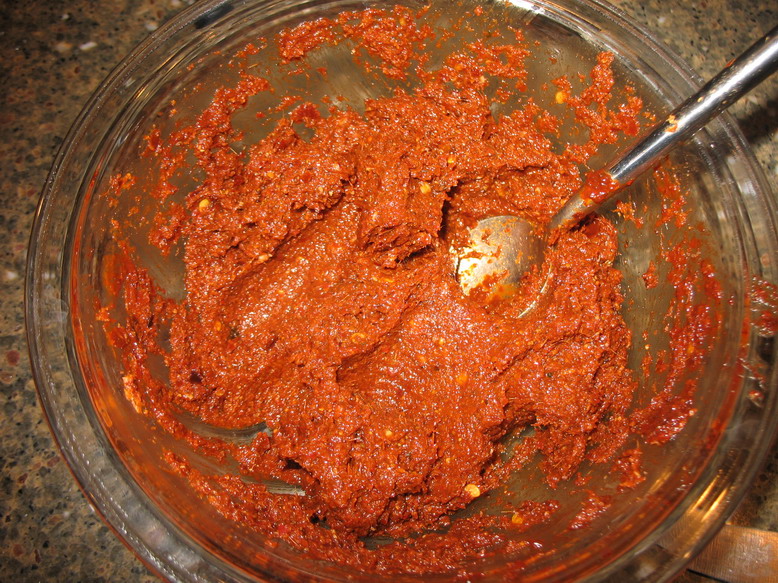
I realize as I write this, that red curry sounds like the most complex dish in the world to make. That is not the case; Morganna even admitted to that as we worked together. She said, “It is not hard: there are just a lot of ingredients to keep track of.” It is just that there is so much advice for me to give to make the process simpler for a beginner, because I remember how hard it seemed when I started. But now that I have no fear of it, and have a good piece of equipment to help me, I can make curry pastes quite simply and easily.
So, without further ado, here is the recipe for my red curry paste and a curry made with it. I adapted from two recipes, over a series of years, and have changed it considerably. The original recipes which inspired my version come from Kasma Loha Unchit’s book, It Rains Fishes, which is sadly out of print, and Su-Mei Yu’s Cracking the Coconut.
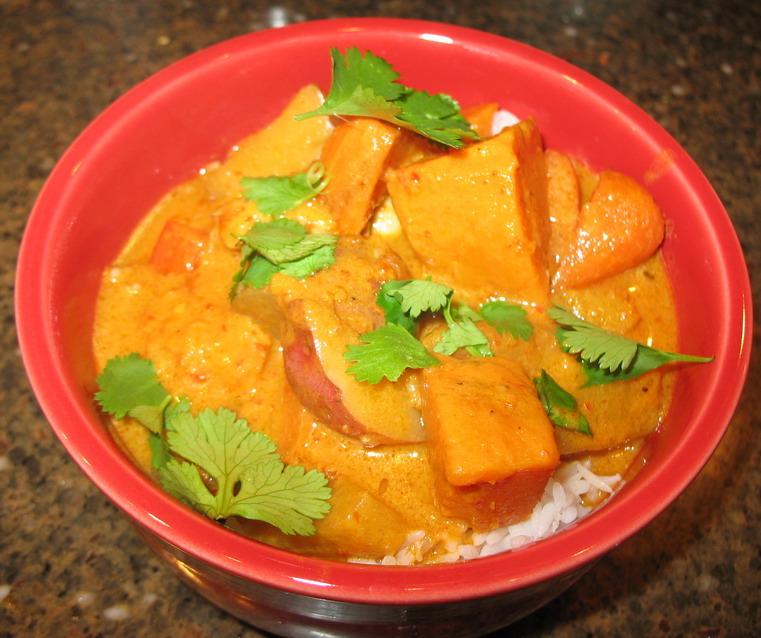
Red Curry Chicken with Pineapple and Root Vegetables
Curry Paste Ingredients:
8 large dried red chile colorado/New Mexico chiles, soaked in warm water until softened
1/2 teaspoon white peppercorns
1/2 tablespoon coriander seeds
1 teaspoon. kosher salt or sea salt
8 large cloves garlic, peeled and chopped
2 black cardamom pods
1/4 teaspoon cardamom seeds
1/4 teaspoon ground nutmeg (or a chunk of whole nutmeg about 1/4″ cubed
1 stalk lemongrass, prepared as noted above, and sliced into thin slices
1″ cubed chunk fresh galangal root, peeled and cut into thin slices
10-15 fresh or frozen red Thai bird chiles (prik kee noo)
2″ square chunk red sweet bell pepper
1 tablespoon lime zest, finely grated
2 tablespoons cilantro stems (or 1 tablespoon cilantro roots)
1 1/2 teaspoons shrimp paste (Do not leave this out. I don’t care that it looks ugly and smells scary. If you don’t use it your curry won’t taste right.)
Method:
Remove stems to dried soaked chiles and squeeze out excess water. Remove stems from fresh chiles. If you have a grinder like a Sumeet, load up as many of the ingredients as will fit in the jar and process it until they are smooth. Scrape contents out into a bowl, and finish with the rest of the ingredients. Scrape them out into the bowl, and mix them thoroughly together. Do not leave out that shrimp paste!
If you are going to go for the food processor and mortar and pestle route, grind the hard dried spices like peppercorns and cardamom into rough, coarse bits. Mix this with the salt. Chop all the other ingredients in a food processor into as fine a paste as you can manage. It will not be very fine.
Using the salt/spice mixture as an abrasive, add a bit of it to the bowl of the mortar, along with a bit of the chopped up bits and take the pestle and start grinding away. Pound until a smooth paste forms. Dump this into a bowl, and repeat steps as needed.
Put on some music, get a groove going and get comfortable. You will be there for a while. (Do you see why I have a Sumeet?)
Ingredients for Curry:
About 2/3 of the batch of red curry paste–or to your taste (What you don’t use you can put in the fridge or freezer in a tightly sealed container for another day–or you can do what I am doing and make pad thai the next day and use the rest of the paste up. But, it does keep for about a week or two in the fridge, and forever in the freezer.)
1 can Mae Ploy coconut milk
1 can Chao Koh coconut milk
1 1/2 tablespoons (or to taste) raw sugar
Fish sauce to taste (I use Golden Boy brand)
1/2 fresh pineapple, cut into generous chunks along with whatever juice escapes from the pineapple
5 new potatoes, scrubbed and cut into quarters
12 baby carrots cut diagonally across the center axis
1 sweet potato, peeled and cut into crescent-shaped chunks
1 1/2 boneless skinless chicken breasts, trimmed and cut into 1″ chunks
lime juice to taste (I use the juice of 1 1/2-2 limes, depending on how juicy they are.)
handful cilantro leaves
Method:
Crack open the can of Mae Ploy coconut milk (Do not shake it up before opening it) and scrape out the thick coconut cream from the top. There will be lots of it–Mae Ploy is very creamy. (For a less rich curry, use two and a half cans of the Chao Koh.) Put the coconut cream in the bottom of a wide, heavy bottomed pan. (Enamelled cast iron rocks for cooking Thai curries.) Heat it up on high until the cream melts and begins to bubble. Add the curry paste, and cook, stirring, until you have a thick, dark orange-red, very fragrant paste. Turn down the heat and cook slowly, for about fifteen to twenty minutes. The longer you cook at this stage, the better your curry will be. Put on meditative music, pull up a stool, sit down and stir. You will thank me if later if you do this. Taste the mixture as soon as you mix them together and after they have cooked. Taste the difference? Good.
After about twenty minutes have passed, add the rest of the can of Mae Ploy, and the contents of the can of Chao Koh, which you may shake up before you open. Stir the coconut milk into the curry, and when it is mixed in all the way, taste it. It tastes flat, doesn’t it? Fear not.
Take up the fish sauce fearlessly. Shake in a good amount of it. (I think I use at least a third of a cup of it, but I don’t know, because I shake it in until it smells right.) When you think you have enough, stop, stir, and then taste. Not only should it taste a little salty, that flatness will have been dealt with. It suddenly tastes better! (Umami is at work again.) Add the pineapple, juice and sugar. Stir in well, and taste it again.
There should be a balance now between hot, savory, salty and sweet. Taste for it. Adjust as necessary. For heat, add more curry paste, by the half teaspoonful. For savory and salty, add fish sauce. For sweet, add sugar, by the pinch.(If salt is the only lack, add a pinch or two of kosher or sea salt instead of fish sauce, if you want. But really, you cannot add too much fish sauce.)
At this point, add the potatoes and carrots and cover pot, lower heat to a simmer and cook until the vegetables are halfway tender. Add the sweet potatoes at this time. Cover and cook again until the roots are almost done, then add chicken. (Doing it like this makes sure you do not overcook the chicken. It should just be barely done.)
Taste the sauce. Add as much lime juice as is needed to balance everything with a good shot of sour.
Sprinkle with cilantro leaves and serve in bowls over steamed jasmine rice.
Note: If you can get kaffir lime leaves, add 2 or 3 of them to the curry when you put the potatoes and carrots in. They will add an incomparable floral scent to the curry that is intoxicating.
There it is.
This was the first way that I got Zak to eat sweet potatoes. Now, he likes them just plain roasted or mashed, but the best way to eat them is still in red curry. Coconut milk and sweet potatoes just do lovely things for each other.

Categories:
- Admin (rss) (55)
- Blogs and Blogging (rss) (81)
- Book Reviews: Cookbooks (rss) (43)
- Book Reviews: Non-Cookbook Food Books (rss) (38)
- Cats and Cat Blogging (rss) (47)
- Chinese Cooking Lessons (rss) (32)
- Culinary School Stories (rss) (18)
- Dairy Pruducts: Cultured and Barbaric (rss) (4)
- Documentary Filmmaking (rss) (1)
- Essays, Rants and Reflections (rss) (260)
- Fighting Hunger (rss) (12)
- Food and Kids (rss) (45)
- Food in the News (rss) (126)
- Food Media (rss) (98)
- Food Preservation (rss) (18)
- Food Safety (rss) (45)
- Gardening (rss) (30)
- Herbs and Herb Blogging (rss) (20)
- Holidays (rss) (50)
- Kat Blogging (rss) (22)
- Kitchen Science (rss) (36)
- Leftover Makeover (rss) (8)
- Life, the Universe and Everything (rss) (131)
- Local and Sustainable (rss) (227)
- Local Athens Food and Foodies (rss) (42)
- Meatless Mondays (rss) (32)
- Menu For Hope (rss) (5)
- Nutrition, Diet and Health (rss) (84)
- On The Farm (rss) (8)
- Recipes: Almost Vegetarian, Vegetarian and Vegan (rss) (294)
- Recipes: American Regional (rss) (37)
- Recipes: Appalachian Hillbilly (rss) (33)
- Recipes: Bread, Pasta, Grains (rss) (95)
- Recipes: Canning and Preserving (rss) (8)
- Recipes: Chinese (rss) (123)
- Recipes: Comfort Food (rss) (120)
- Recipes: Cookies (rss) (16)
- Recipes: Desserts (rss) (48)
- Recipes: French (rss) (25)
- Recipes: Fruits and Vegetables (rss) (302)
- Recipes: Greek, North African and Middle Eastern (rss) (31)
- Recipes: Indian (rss) (137)
- Recipes: Italian (rss) (42)
- Recipes: Japanese (rss) (7)
- Recipes: Jewish (rss) (4)
- Recipes: Korean (rss) (6)
- Recipes: Meat, Poultry and Fish (rss) (220)
- Recipes: Mexican/Native American/ Latin American/Caribb (rss) (27)
- Recipes: Original (rss) (108)
- Recipes: Thai (rss) (27)
- Recipes: Tofu (rss) (17)
- Recipes: US Regional (rss) (16)
- Recipes: Vietnamese (rss) (8)
- Restaurant Stories (rss) (28)
- Sewing, Quilting, Arts and Crafts (rss) (16)
- Simple Chinese Recipes (rss) (30)
- Slow Food and Heritage Foods (rss) (10)
- Spice Blogging (rss) (44)
- The Chinese Cookbook Project (rss) (14)
- The Chinese Pantry (rss) (39)
- The Documentary (rss) (2)
- The Kitchen Saga (rss) (17)
- The Locavore's Bookshelf (rss) (15)
- The Unsung Adventures of The Culinary Nerd (rss) (6)
- Tools and Toys (rss) (35)
- Uncategorized (rss) (10)
- With a Side of Politics (rss) (48)
Archives:
- August 2012 (9)
- July 2012 (12)
- September 2011 (3)
- August 2011 (7)
- July 2011 (8)
- June 2011 (16)
- May 2011 (17)
- April 2011 (11)
- December 2010 (9)
- November 2010 (5)
- February 2010 (1)
- December 2009 (5)
- November 2009 (7)
- October 2009 (10)
- September 2009 (16)
- August 2009 (14)
- July 2009 (14)
- June 2009 (7)
- May 2009 (17)
- April 2009 (10)
- March 2009 (25)
- February 2009 (13)
- January 2009 (10)
- December 2008 (5)
- November 2008 (5)
- October 2008 (6)
- September 2008 (13)
- August 2008 (8)
- July 2008 (11)
- June 2008 (18)
- May 2008 (13)
- April 2008 (14)
- March 2008 (16)
- February 2008 (17)
- January 2008 (19)
- December 2007 (25)
- November 2007 (18)
- October 2007 (24)
- September 2007 (16)
- August 2007 (15)
- July 2007 (15)
- June 2007 (10)
- May 2007 (14)
- April 2007 (16)
- March 2007 (17)
- February 2007 (20)
- January 2007 (13)
- November 2006 (1)
- October 2006 (8)
- September 2006 (14)
- August 2006 (25)
- July 2006 (30)
- June 2006 (28)
- May 2006 (34)
- April 2006 (29)
- March 2006 (24)
- February 2006 (30)
- January 2006 (38)
- December 2005 (40)
- November 2005 (37)
- October 2005 (32)
- September 2005 (25)
- August 2005 (30)
- July 2005 (28)
- June 2005 (21)
- May 2005 (8)
- April 2005 (22)
- March 2005 (17)
- February 2005 (29)
- January 2005 (10)
Search Site:
Links:
- Lily’s Wai Sek Hong
- 101 Cookbooks
- A cat in the kitchen
- A Veggie Venture
- Accidental Hedonist
- Cha Xiu Bao
- chez pim
- Chocolate & Zucchini
- Chopstick Cinema
- Chowhound.com
- Chubby Hubby
- Cook sister!
- Cooking with Amy
- da*xiang
- Eat Local Challenge
- Eating Liberally
- Ecocentric
- Eggbeater
- Epicurious
- Farmgirl Fare
- Fatfree Vegan
- Foodgoat
- ForkandBottle.com
- Green Olive Tree
- Hooked on Heat
- Jaden’s Steamy Kitchen
- Kalyn’s Kitchen
- Lucullian delights
- Mahanandi
- Matt Bites
- MeatHenge
- mmm-yoso!!!
- New York Times – Dining & Wine
- Pizza Goon
- Rasa Malaysia
- Ruhlman
- Sailu's Kitchen
- Serious Eats
- SF Gate: Food & Dining
- Simply Recipes
- Soul Fusion Kitchen
- Tastespotting
- The Amateur Gourmet
- The Cleaner Plate Club
- The Food Section
- The Grub Report
- thecookscottage
- U.S. Food Policy
- Wandering Chopsticks
- Washington Post Food and Dining
- Wasted Food
Meta:


Powered by WordPress. Graphics by Zak Kramer.
Design update by Daniel Trout.
Entries and comments feeds.