
Cook Local, Eat Global
From My Rasoi: Jeweled Chicken
I love to cook Indian food, and am finally comfortable at improvising new dishes based upon the foods, spices, and cooking methods used in the varied culinary traditions of that vast subcontinent. So, it should come as no surprise that when Meena of Hooked on Heat decided to start a monthly blogging event based around Indian foods, I would not hesitate to join in the fun. Each month, we get a different theme to work with, and we email her links to our posts on that theme by the last Friday of the month, and that is it.
The title of the event is “From My Rasoi;” “rasoi” means “kitchen” in Hindi.

This month’s theme is winter, and in celebration of that, I decided to work with a seasonal ingredient that I wait all year for–pomegranates.
I have always loved pomegrantes, ever since my father introduced them to me in childhood. He, too, loved to eat them, and for a treat, we would buy and share one. I always loved how the seeds were like hidden treasures, tiny garnets or rubies concealed in a network of pith and leathery skin. The sour-sweet burst of them in my mouth was a tiny explosion of flavor, and the juice would stain my fingers and lips a sticky-sweet magenta.
Pomegranates became a winter evening ritual, a quiet moment between Dad and I when we could discuss Greek mythology and the fruit’s connection thereto–for those who do not know the tale of Persephone and Hades, the summary is thus: Persephone, the daughter of Demeter, the Earth Goddess, was kidnapped by Hades, and taken to the Underworld. There, she pined for her mother, while above, her mother pined such that the formerly fecund fields lay fallow and the land was gripped in perpetual winter. People and animals starved, while Persephone was offered any manner of sweetmeat and drink to quench her own hunger and thirst. Mindful that if she ate anything in the land of the dead that she would become one of them, she refused all sustainance.
Eventually, clever Hades offered her a pomegranate, and she ate three or six seeds–depending on which version you are reading.When Demeter finally found her daughter, and demanded her return, Hades pointed to the pomegranate, and declared that Persephone was now his and would rule as Queen of the Dead at his side. Zeus, petitioned by the angered mother who refused to let the seasons turn until her daughter was released, ruled that for every seed which Persephone ate, she must stay one month with Hades as his queen, and for the remaining months, she could roam the earth with her mother, bringing light and fertility to the land, so that man, bird and beast need not starve.
So, Persephone came forth from the Underworld, and brought to earth the joyous relief of spring.

It is easy to see why the pomegranate is a symbol of fertility in many lands; it is filled with seeds. These tiny gems are used in many cultures in cookery, not only for their mythic connotations, but also to add acidity and sweetness to dishes ranging from desserts to entrees. The Persians, in particular, were and are fond of the pomegranate, and they brought thier use of it in meat dishes to Northern India during the Mogul Empire period.
It is with these historical and mythic ideas in mind that I came to create Jeweled Chicken.
I decided to use my wok to cook this curry, on high heat, very like the use of a karahi, or a round-bottomed cast iron cooking vessel from India that is used like a wok. I started with one thinly sliced onion, which I liberally salted and cooked in canola oil on very high heat until it browned deeply. Then, I added a single thinly sliced ripe chili pepper, slivers of ginger, two cloves of thinly sliced garlic and finely ground black pepper, coriander seeds, a bit of cumin, cinnamon, cloves and cardamom. I continued cooking until the whole mixture was incredibly fragrant and very browned.

Then, I added the chicken, laying it in a single layer and allowing it to brown lightly on one side before stir frying it briskly. When it was nearly cooked through, I added a bit of chicken broth; if I had been able to find my bottled pomegranate juice, I would have used that in preference, but since I couldn’t, I didn’t.
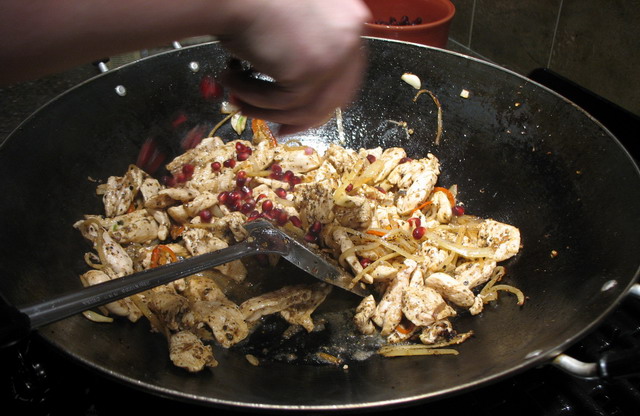
Just before the chicken was done, I added the pomegranate seeds, carefully leaving 3/4 of them whole, while squeezing the juice from 1/4 of them and discarding the seeds, in order to flavor the chicken and stain it a very pale pink. (Seeding a pomegranate can be a messy business, but I cut the fruit into four sections, and then deseed them in a bowl filled with water. The seeds sink, and all bits of the pith, skin and membranes float and are easily removed from the water before draining the seeds in a colander.)
After stirring it carefully to heat the seeds through for about a minute, I added half of the cilantro and cooked, stirring, until it wilted and its green fragrance infused the dish. At that point, I added the rest of the cilantro, stirred it once to incorporate it and then scraped the contents of the wok into a heated serving dish.
We ate it with yellow rice and some saag aloo garnished with mint. It was a delicious dish, and everyone declared that it should become a regular part of winter meals as it was reasonably easy to put together (once the pomegranate seeds were extracted from the fruit, that is) and was quickly cooked. It was very fragrant and light and made a very good, light change from all of the heavy meals of the holiday season. I was very pleased with how it turned out, and think that it would be very good paired with a simple dal tarka, basmati rice with peas and maybe a cooling raita.
 Jeweled Chicken
Ingredients:
3 tablespoons canola oil
1 large yellow onion, thinly sliced
1 teaspoon salt
1″X1″X2″ cube fresh ginger, cut into thin slivers
1 ripe jalapeno pepper, thinly sliced
2 cloves garlic, thinly sliced
1 tablespoon coriander seeds, freshly ground
1 teaspoon cumin seeds, freshly ground
1/2 teaspoon black peppercorns, freshly ground
1/2 teaspoon cardamom seeds, freshly ground
1/2 teaspoon cinnamon
3 cloves, freshly ground
1 1/2 boneless skinless chicken breasts, trimmed and sliced thinly
1-2 tablespoons pomegranate juice or chicken broth (or even water)
seeds from 1 large pomegranate
1 1/2 cups (loosely packed) cilantro leaves
Method:
Heat wok or karahi until smoking. Add oil, swirl to coat bottom and lower third of sides well. Add onion and salt and stir fry until medium golden brown. Add ginger, pepper and garlic and continue cooking until onions are a medium brown, then add spices and continue cooking until onions are browned and the whole is very fragrant.
Add chicken, spreading it in a single layer over the bottom of wok. Allow to lay motionless to brown a bit on the bottom, the stir fry until most of the pink of the chicken is gone. Add a bit of pomegranate juice or chicken broth to moisten chicken, and keep frying, stirring constantly.
Add 3/4 of pomegranate seeds, then squeeze juice from 1/4 of seeds into wok. Discard squeezed seeds. (Or, you can use bottled pomegranate juice at this point, and keep all the seeds whole.) Add 1/2 of cilantro leaves and Stir fry for about a minute or two, until chicken is fully cooked and very fragrant and the leaves are quite wilted. Add remaining leaves, stir to combine, then remove wok from heat and scrape contents into a heated platter for serving.
Culinary New Year’s Resolutions
It is that time of year, when we look over the past year and meditate upon what we did right, what we are proud of, what we rejoice in. And, of course, some of us also look at where we went wrong, what we utterly bungled and what we need to improve.
In doing so, we often decide to do better in the coming year, and we make promises to ourselves and others in the form of pledges and resolutions.
After forty years, I have come to find out that most of these resolutions get broken, often in short order, but sometimes, good faith effort bursts forth into successes, and improvement occurs.
I have to admit, that my resolution last year, that is to begin learning to play an instrument, did not come to fruition. I will thus, redouble my efforts in this coming year, and hopefully make inroads in that realm.
Zak, on the other hand, kept his resolution and really did learn to bake a good loaf of bread. He got out of the habit of it after we moved, but his loaves really are something special, and I hope that my gift of a couple more bread cookbooks will assist in that regard.
Since it has been nearly a year since I first started writing this blog, I decided it was appropriate to share some New Year’s resolutions in the culinary realm with my readers, as a way to help chart the course of Tigers & Strawberries as I sail with it into the coming months. There are changes coming in my online writing life which I have alluded to in the recent past, and which will be unveiled in very short order, which may alter my writing greatly, but which will hopefully do nothing but enhance the work I have put into Tigers & Strawberries over the past eleven months.
Anyway, enough pre-resolution blather.
Let the promises begin!
In the coming year, I hope to engage in some or all of the following, and then blog about it here:
Cook more Thai food. I realized after we moved this blog over Thanksgiving weekend, when I sat down to categorize all of the entries so that folks could find all of my archived recipes, that I had not cooked much in the way of Thai food this year. I suspect that has come about because I started the Chinese Cookbook Project a little less than a year ago, and so began to really focus on my studies of Chinese cuisine and cookery. However, I have taught many classes in Thai food in the past, and even just a couple of years ago, cooked a great deal of Thai dishes at home for our regular meals. So, I resolve to return to my pattern of exploring the beautifully flavorful, colorful and intensely fragrant foods to Thailand in the next year.
Cook more fish. I have already started working on this resolution this year, so all I am resolving to do is to continue to expand on my knowledge of fish cookery. Now that I am no longer horrified that I will utterly mangle any fish or seafood that comes into my grasp, I can experiment more widely without fear of dishonor and failure.
Actually cook from some of my hundreds of cookbooks. This is a hard one. I actually very seldom cook from cookbooks, and it is even more rare for me to actually follow a recipe as it is written. Considering how many times I have followed a recipe completely as written and come up with a rather inedible result, I think that has made me gunshy when it comes to cracking open a cookbook and using it as it is meant to be used. However, this year, I have decided to open the cookbooks and use some of the recipes, though, with my eyes and mind open to the fact that my instincts are good and if something in the recipe doesn’t look right, I will feel no compunction about changing it. Just so long as I note the changes in the blog, I see nothing wrong with this course of action.
Cook from recipes in newspapers and magazines every now and then. This is a corollary of the previous resolution–in addition to trying out recipes from my hundreds of cookbooks, I am going to start actually cooking some of the recipes from my archived collection of cooking magazines, while also trying recipes from recent issues. Again, I am going to keep myself open to changes in the recipe; I have to note that one of my newest cookie recipes, the Ginger Lemon Cremes, which were popular among some of the friends and family, came about because I combined two different cookie recipes from two different magazines, along with a healthy dose of personal inspiration and creativity. I cannot help but think that such culinary cross-pollinizations will have positive effects on my cooking in the future.
Write more book reviews. I have no idea why I do not write more book reviews here. I read a great many books on topics of interest to food lovers. Of course, I read more cookbooks than I cook from, but I also read books on agriculture, food history, food culture, food in women’s history, and, now and again, fiction that is of interest to food lovers. I also am a cinephile who has a list of favorite food movies that I should really take the time to review publicly. Oh, and I just recieved the to boxed sets of Julia Child’s “The French Chef” series that I should review. I am not sure why I don’t write many more reviews here than I do–they are always well recieved and I have fun writing them, and for several years, I actually wrote a great many reviews of books on spiritual topics for pay, so I can be quite prolific with them when I feel like it. For whatever reason, I have a block in my mind on the subject, but it is time to work past it and just do it.
Write more articles on the local Athens food scene. I keep meaning to do this–write in depth on the farmers, restauranteurs and food producers that make the Athens, Ohio food scene something really exciting, especially when you look at the fact that we are in Appalachian Ohio–not a place one thinks of as a hotbed of culinary activity. However, the local sustainable food scene here is thriving and growing, and I really need to write about it. If nothing else, I can show the world that if we can do it in Athens, you can do it wherever you are.
Write more essays. These, too, are well-recieved by my readers, but I don’t always get the urge to write them. Well, I should just stop waiting for the urge and just bloody well write them and be done with, and stop being such a dweeb about them. There are any number of topics that I can go off on and write passionately, but sometimes, it is just easier to write about what I had for dinner. However, considering the posts that I was nominated for in the Food Blog Awards in the category of “Best Post” were all of the essay variety–I should not let my inherent laziness get in the way of writing that which I am good at.
Get off my butt and start teaching classes again, and blogging about that. I love to teach, and this year, I need to finally, now that my upstairs kitchen can be fitted out for students, need to get down to opening up my little cooking school so I can offer classes again and blog on that topic. Teaching is one of the things that forces me out of my own head and into other people’s heads, and makes me improve in my cookery by leaps and bounds. Just as writing this blog has made me a better writer, teaching makes me a better teacher, and frankly, blogging and teaching are going to be very complimentary to each other. In writing explanations on how to do something, I have learned how better to teach difficult culinary skills. In teaching these skills live, I have learned how better to explain them in writing.
Keep having fun. This is the one I am putting in last, though it should have been first. The problem with resolutions is that they often have a puritanical whiff of being good for one, and being hard, and work, so they tend to be the antithesis to that which is pleasurable and fun. However, the truth is, I am a writer by nature. I like writing–it is work, but it is also fun. I also love to cook, and in doing so, I derive great joy. Doing something that combines the two has a great potential for a lot of fun, and I don’t, in my typical dutiful honor-bound Germanic mindset, do not want to lose sight of that. I do not, under any circumstances, want this blog to turn into something that is not fun. So, I refuse to allow that to happen, and as soon as it starts feeling like that, I will post something, anything, that reminds me that the kitchen is my favorite playroom.
Whole Foods Columbus Update….
We went back to Whole Foods in Columbus today, as we drove in to take Heather knife shopping at Sur la Table, where she can test drive the knives and I get a great discount.
And since we were in town, why not take Heather and Dan to Whole Foods.
The first thing I noticed when we walked in was that the ass-fragrance was no longer a force which slammed into the patrons’ nostrils at the door.
In fact, there was the pleasant smell of citrus from the produce section and flowers from the floral department.
Even after I put a pound and a half of fresh turmeric root in my cart and headed toward the fish section, I was not assaulted by odiferousness.
However, once I got up to the fish counter, and leaned in to take a look, the heavy smell of fish once again got to me. It was bad enough that I will not buy fish from them, but at least the smell is confined to within a few feet of the fish counter.
That is much, much better.
I also discovered something while we were there.
See–before we went there, we went to the North Market, and I saw Meyer lemons. Oh, how I love me some Meyer lemons. Their floral fragrance, the sweet yet sour juice, the medicinal tang of the peel–oh, I adore them. And I saw them at the produce place at the North Market, but then I saw the price and nearly keeled over dead, right there in front of them, between the pomegranates and the quinces.
$6.99 a pound.
You read that right. $6.99.
There was nearly a dead redhead right there, on the floor.
After we had been all through the Whole Foods, and were about to go to the checkout line, I came to my senses and remembered the Meyer lemons, and raced back to the produce section, deftly avoiding the dear little old ladies and the certain death of a yuppie man navagating his cart by the stars while doing day trading on his celphone.
They had Meyer lemons.
At, get this–$1.99 a pound.
I did a little victory dance right there among the citrus fruit. I started singing, “I’ve got sunshine, on a cloudy day,” while I ripped open a plastic bag and began piling those beautiful dandelion-yellow fruits, full of juice and sweetness, into it.
I ended up with nearly three pounds of those little beauties, much to the amusement of the day-trading yuppie.
Then, I dashed back towards the cart, and nearly plowed into my cheese-department friend from our first visit, who as recognized by my compatriots who had only read his description in the blog. I apologized profusely, told him he had lovely taste in cheese, and continued onward, finally safely depositing my precious cargo into the cart without mishap.
The moral of this story is–corporate businesses sometimes do have an advantage over local businesses, and sometimes the consumer wins.
Oh, and then we went on to Sur la Table, and with the last of my Generic Winter Holiday money, I bought a knife I did not need, but lusted over anyway.
As I told Zak, I would rather have a knife than beautiful clothes.
The other moral to this story is this: if you love a woman, you give her BTU’s and steel.
I am a very beloved woman.
Thai Inspirations: Spicy Tuna with Basil
I realized when I was eating the catfish simmered in coconut milk with fresh turmeric that I had gotten out of the habit of cooking Thai food. I guess in my never-ending quest to learn as much as possible about Chinese cookery, I forgot to keep up with my studies on Thai cookery.
Tasting the lovely creamy yellow turmeric sauce made me want to rectify that situation.
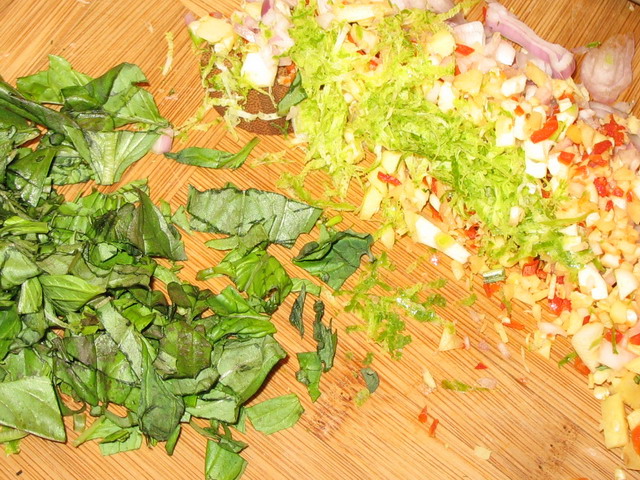
I always have a range of Thai ingredients on hand; fish sauce, shallots, coconut milk, chiles, white peppercorns, frozen galangal and lemongrass and often lime leaves are seldom absent from my kitchen. Today was no exception, so I pulled out shallots, garlic, ginger and two Thai dragon chiles and minced them all up. Since I had no lime leaves, I added about a tablespoon of lime zest and a handful of Thai basil leaves.
I had thawed a yellowfin tuna steak and decided to see how it fared treated the way I usually stir fry chicken in a recipe reminiscent of Spicy Chicken with Basil. I thought about searing the tuna steak whole, and then pouring the sauce over it, but I decided that if I cut the fish into 3/4″ cubes, that there would be more surface area to get into contact with the very flavorful sauce. In addition, I could add the handful of green beans I found in the vegetable drawer in the fridge to round out the meal.
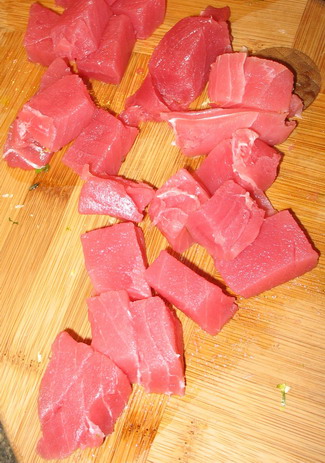
I have no idea if anyone in Thailand would cook a tuna steak this way, but I rather doubt it. However, Zak and I were very pleased with the result–the fish itself was not the best in the world. If it had been really good tuna, Zak said that the dish would have been superlative.
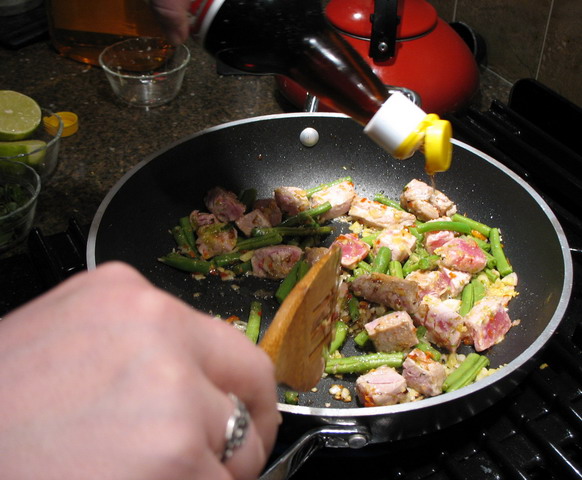
What pleased me most was that it was simple to cook, it had a great balance of spicy, hot, sour and salty flavors, and it went together extremely quickly. It also had a minimum of ingredients, and went perfectly with plain steamed jasmine rice. I could imagine anyone coming home from work, putting the rice in the rice cooker, then within the forty minutes it takes for it to cook, have the fish and vegetables prepped and ready to cook.
Cooking took a total of about five minutes, give or take a few seconds. You will notice that I cooked the tuna to medium-rare; I would never suggest cooking it to well done for this recipe. I like the flavor and texture contrast that medium rare tuna affords, and besides, the bright pink interior of the fish looks lovely with the vibrant emerald basil and grass-green beans.

Spicy Tuna with Basil
Ingredients:
2 tablespoons peanut oil
2 shallots, peeled and minced
2 large cloves garlic, peeled and minced
1/2″ cube fresh ginger, peeled and minced
1/8 teaspoon freshly ground white peppercorns
2 Thai dragon chiles or 4 Thai bird chiles, minced
1 tablespoon finely grated lime zest or 2 kaffir lime leaves, shredded finely
1/2 pound green beans, rinsed, strung and snapped into 1″ lengths
1/2 pound tuna steak, cut into 3/4 inch cubes
1/2 teaspoon raw sugar
2 tablespoons fish sauce
1 tablespoon chicken broth
juice of one lime
handful roughly chopped Thai basil leaves
Method:
Heat wok or deep saute pan. Add peanut oil and heat until near the smoking point.
Add shallots, garlic, ginger, peppercorns, chiles and lime zest or leaves, and stir fry until very fragrant and shallots start to brown–about one minute.
Add green beans, and continue stir frying about 45 seconds.
Add tuna, and stir and fry to sear all sides of the tuna. When it is about halfway through being seared (half the pink has turned white), add the sugar, fish sauce and chicken broth. Continue stir frying until very little pink is showing. Add lime juice and basil leaves and stir fry for another thirty seconds to heat through, then remove from heat and serve immediately over steamed jasmine rice.
Salad with Pear, Pomegranate and Fried Chevre
I love salads, but I don’t write about them much.
I think it is because I generally have only a few salad tricks, and once those are revealed, there is not much else to discuss.
I like mixed greens. My standard salad dressing consists of olive oil, balsamic vinegar, soy sauce and honey. There is usually a fruit, or a vegetable, or both, layered atop the greens. Often almonds or walnuts find themselves scattered over the top. And if there are flowers blooming that are edible, they are the garnish, along with some sort of cheese, usually a nice, tangy chevre.
You cannot write about that more than once or twice, before people begin to think that you lack creativity or initiative when it comes to salads.
However, I must note that while Bryian was scarfing down the salad Christmas night, he said, “You know, I really don’t like salad at all, but I always love yours because yours tastes interesting and good.” If you knew Bryian and how much he really doesn’t care for salad, you would know how high of a compliment that is. Perhaps, I should not be so humble and modest about my salad.
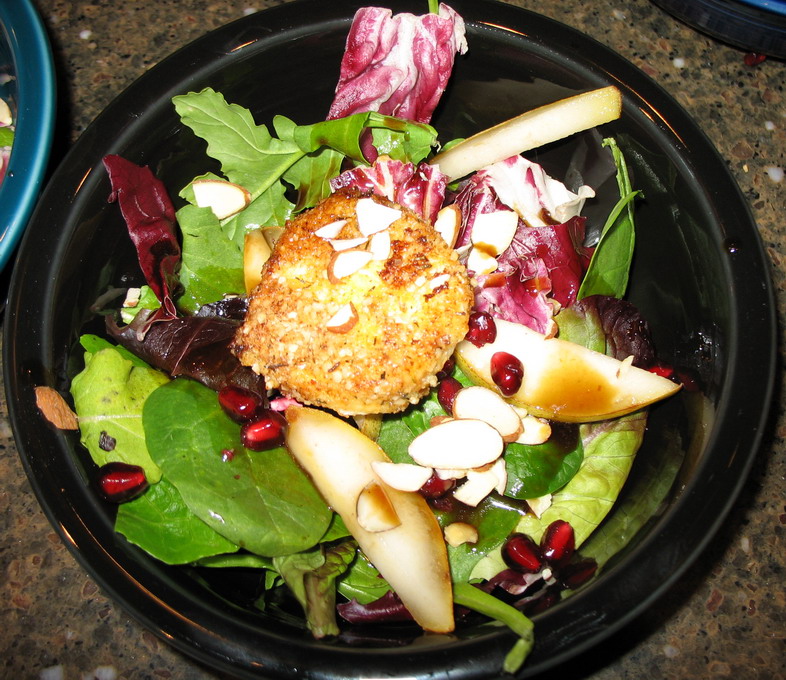
Holidays, however, create an excuse to dress up. The house gets decorated, the people wear nice clothes and all sorts of festive foods parade out of kitchens in various states of prettification.
The salad I served on Christmas was no exception.
It included a spiffed up dressing, two kinds of fruit, and chevre that had been blanketed in breading and fried to a crisp on the outside, and to a molten wonderfulness on the inside.
And that is a salad to write about.
I had never fried goat cheese, though I had eaten it at a couple of restaurants. It really is simple to do–you just cut slices from a roll of chevre (use waxed, unflavored dental floss–it breezes right through the sticky cheese and makes a nice clean cut), let them come to room temperature, dunk them in beaten egg and then roll them in some sort of breadcrumb action. Then you fry them in shallow oil for a minute or two on each side–just until they brown. Then drain them on a paper towel lined plate, and put them on top of your salad, then dress it. Voila! Instant fanciness.
Since I couldn’t find my panko, I used seasoned matzoh meal, which made a lightly crisp, well-browned crust. I seasoned it with some dried shallots from Penzey’s, salt and pepper, and some Herbes de Provence. I used about 1/8″ deep canola oil in a heavy bottomed frying pan to cook them, and they cooked quite quickly and easily–about one and a half minutes per side was all that as necessary. They just took a bit of watching.
The rest of the salad was mixed baby greens, ripe Anjou pears, pomegranate seeds and sliced almonds.
Oh, and the dressing. I used pomegranate molasses in place of some of the balsamic vinegar, lowered the amount of honey and used sea salt and black pepper instead of the soy sauce. Pomegranate molasses is found in Middle Eastern markets, and is a sweetish, sour, very thick, nearly black fluid that is basically pomegranate juice that has been reduced to the point where it is the texture and color of molasses. (I guess you now know where the name came from.) The best comes from Lebanon–I use Cortas brand, because it is consistently a good balance between tangy and sweet, with a very floral fragrance and aftertaste. One bottle should last you a very long time, because a little goes a long way in any recipe–it is a very rich flavoring.
I urge anyone who tries to recreate this dressing to do this to taste, but the basic ratio for the ingredients is thus: 3 parts oil to 1/3 part pomegranate molasses and 2/3 part balsamic vinegar to 1/4 part honey. Salt and pepper to taste.

Categories:
- Admin (rss) (55)
- Blogs and Blogging (rss) (81)
- Book Reviews: Cookbooks (rss) (43)
- Book Reviews: Non-Cookbook Food Books (rss) (38)
- Cats and Cat Blogging (rss) (47)
- Chinese Cooking Lessons (rss) (32)
- Culinary School Stories (rss) (18)
- Dairy Pruducts: Cultured and Barbaric (rss) (4)
- Documentary Filmmaking (rss) (1)
- Essays, Rants and Reflections (rss) (260)
- Fighting Hunger (rss) (12)
- Food and Kids (rss) (45)
- Food in the News (rss) (126)
- Food Media (rss) (98)
- Food Preservation (rss) (18)
- Food Safety (rss) (45)
- Gardening (rss) (30)
- Herbs and Herb Blogging (rss) (20)
- Holidays (rss) (50)
- Kat Blogging (rss) (22)
- Kitchen Science (rss) (36)
- Leftover Makeover (rss) (8)
- Life, the Universe and Everything (rss) (131)
- Local and Sustainable (rss) (227)
- Local Athens Food and Foodies (rss) (42)
- Meatless Mondays (rss) (32)
- Menu For Hope (rss) (5)
- Nutrition, Diet and Health (rss) (84)
- On The Farm (rss) (8)
- Recipes: Almost Vegetarian, Vegetarian and Vegan (rss) (294)
- Recipes: American Regional (rss) (37)
- Recipes: Appalachian Hillbilly (rss) (33)
- Recipes: Bread, Pasta, Grains (rss) (95)
- Recipes: Canning and Preserving (rss) (8)
- Recipes: Chinese (rss) (123)
- Recipes: Comfort Food (rss) (120)
- Recipes: Cookies (rss) (16)
- Recipes: Desserts (rss) (48)
- Recipes: French (rss) (25)
- Recipes: Fruits and Vegetables (rss) (302)
- Recipes: Greek, North African and Middle Eastern (rss) (31)
- Recipes: Indian (rss) (137)
- Recipes: Italian (rss) (42)
- Recipes: Japanese (rss) (7)
- Recipes: Jewish (rss) (4)
- Recipes: Korean (rss) (6)
- Recipes: Meat, Poultry and Fish (rss) (220)
- Recipes: Mexican/Native American/ Latin American/Caribb (rss) (27)
- Recipes: Original (rss) (108)
- Recipes: Thai (rss) (27)
- Recipes: Tofu (rss) (17)
- Recipes: US Regional (rss) (16)
- Recipes: Vietnamese (rss) (8)
- Restaurant Stories (rss) (28)
- Sewing, Quilting, Arts and Crafts (rss) (16)
- Simple Chinese Recipes (rss) (30)
- Slow Food and Heritage Foods (rss) (10)
- Spice Blogging (rss) (44)
- The Chinese Cookbook Project (rss) (14)
- The Chinese Pantry (rss) (39)
- The Documentary (rss) (2)
- The Kitchen Saga (rss) (17)
- The Locavore's Bookshelf (rss) (15)
- The Unsung Adventures of The Culinary Nerd (rss) (6)
- Tools and Toys (rss) (35)
- Uncategorized (rss) (10)
- With a Side of Politics (rss) (48)
Archives:
- August 2012 (9)
- July 2012 (12)
- September 2011 (3)
- August 2011 (7)
- July 2011 (8)
- June 2011 (16)
- May 2011 (17)
- April 2011 (11)
- December 2010 (9)
- November 2010 (5)
- February 2010 (1)
- December 2009 (5)
- November 2009 (7)
- October 2009 (10)
- September 2009 (16)
- August 2009 (14)
- July 2009 (14)
- June 2009 (7)
- May 2009 (17)
- April 2009 (10)
- March 2009 (25)
- February 2009 (13)
- January 2009 (10)
- December 2008 (5)
- November 2008 (5)
- October 2008 (6)
- September 2008 (13)
- August 2008 (8)
- July 2008 (11)
- June 2008 (18)
- May 2008 (13)
- April 2008 (14)
- March 2008 (16)
- February 2008 (17)
- January 2008 (19)
- December 2007 (25)
- November 2007 (18)
- October 2007 (24)
- September 2007 (16)
- August 2007 (15)
- July 2007 (15)
- June 2007 (10)
- May 2007 (14)
- April 2007 (16)
- March 2007 (17)
- February 2007 (20)
- January 2007 (13)
- November 2006 (1)
- October 2006 (8)
- September 2006 (14)
- August 2006 (25)
- July 2006 (30)
- June 2006 (28)
- May 2006 (34)
- April 2006 (29)
- March 2006 (24)
- February 2006 (30)
- January 2006 (38)
- December 2005 (40)
- November 2005 (37)
- October 2005 (32)
- September 2005 (25)
- August 2005 (30)
- July 2005 (28)
- June 2005 (21)
- May 2005 (8)
- April 2005 (22)
- March 2005 (17)
- February 2005 (29)
- January 2005 (10)
Search Site:
Links:
- Lily’s Wai Sek Hong
- 101 Cookbooks
- A cat in the kitchen
- A Veggie Venture
- Accidental Hedonist
- Cha Xiu Bao
- chez pim
- Chocolate & Zucchini
- Chopstick Cinema
- Chowhound.com
- Chubby Hubby
- Cook sister!
- Cooking with Amy
- da*xiang
- Eat Local Challenge
- Eating Liberally
- Ecocentric
- Eggbeater
- Epicurious
- Farmgirl Fare
- Fatfree Vegan
- Foodgoat
- ForkandBottle.com
- Green Olive Tree
- Hooked on Heat
- Jaden’s Steamy Kitchen
- Kalyn’s Kitchen
- Lucullian delights
- Mahanandi
- Matt Bites
- MeatHenge
- mmm-yoso!!!
- New York Times – Dining & Wine
- Pizza Goon
- Rasa Malaysia
- Ruhlman
- Sailu's Kitchen
- Serious Eats
- SF Gate: Food & Dining
- Simply Recipes
- Soul Fusion Kitchen
- Tastespotting
- The Amateur Gourmet
- The Cleaner Plate Club
- The Food Section
- The Grub Report
- thecookscottage
- U.S. Food Policy
- Wandering Chopsticks
- Washington Post Food and Dining
- Wasted Food
Meta:


Powered by WordPress. Graphics by Zak Kramer.
Design update by Daniel Trout.
Entries and comments feeds.