
Cook Local, Eat Global
The First Step To Avoiding Food Waste: Efficient Storeroom Procedures
There is a mantra that every chef knows and drills into the heads of every prep and line cook: “First In, First Out.” Abbreviated to FIFO, this simple principle is at the core of avoiding food loss and waste in a busy restaurant kitchen.
What it means is that you use the older food before you use the new food–preferably, even before you have new food come in. You want to avoid as much overlap between new and old ingredients as possible, although, you -never- want to go with an empty cooler, freezer or pantry. At the same time, you don’t want to have stuff on your shelves that dates back to the Clinton administration, either.
How does this get done?
It requires work, but keeping inventory of what you have and making note of what you use over the period of a week or a fraction thereof (for fresh seafood, you don’t order enough for a week, necessarily, you order enough for a few days, and have several orders come in through the week). These records help the chef avoid over-ordering perishable foods such as meats, fruits, vegetables, fresh herbs, dairy and eggs, all of which are expensive, and can really drive food costs up if they end up in the trash bin.
Once inventory is done, preferably weekly, and orders are made, then orders must be received and put away properly in order to maintain the ideals of FIFO.
When a chef or cook takes an order or perishables in the back door of a restaurant, it behooves him or her to examine each item carefully to make certain that it is as it should be. Lettuce should be crisp, not wilted, eggs should be properly and carefully crated, clean and unbroken and crabs should be alive and wriggling, not dead and smelling of stagnant ocean. Most reputable purveyors will not send anything but the best to their clients, but everyone has a bad day and everyone makes mistakes. Examining the order in front of the delivery person is the way to ensure that if an item is not of the proper quality, the problem can be rectified immediately by alerting the delivery person and if necessary, the customer service department right away. Then, the offending item is loaded back on the truck and a credit is issued on the order. If you wait until the truck is off to another delivery to complain, it is much harder to get this level of service, and you may end up with food that is at the worst, unusable, and at best, questionable.
After the order is in the back door, then the more physical work of FIFO begins.
Instead of putting new stock willy-nilly onto the storeroom shelves, the proper procedure is to pull the older stock to the front of the shelves, and put the newer stock behind it. The same goes for refrigerated and frozen stock. When we are discussing walk-in refrigerators and freezers, that is a lot of cases of food to be moved, but it is necessary if we are to keep the food contained therein at its peak of freshness and flavor.
One thing I started to do with refrigerated and frozen stock when I was responsible for receiving and stock rotation in a chain restaurant years and years ago, was I would write the date an item came into the restaurant in a black permanent marker, and the expiration date in red. This way, I could keep track of shipments and easily make certain that older product was used before newer, thus reducing accidental food waste by 10 percent, which in turn, lowered food cost.
Proper management of refrigerators, whether they are walk-ins or reach-ins, also is crucial to controlling food loss; food safety also begins in a well-managed refrigeration unit.
Many foods have the potential to carry food-borne bacteria which can, if improperly handled, result in an outbreak of food-borne illness. In order to avoid these possibilities, it is imperative for chefs and cooks to carefully stock and clean the refrigerator.
Cross-contamination occurs when one food comes into contact with another, and can lead to illness, even if the food are fresh and otherwise safe to consume. In order to avoid this there are established protocols determining where different types of food are placed in the refrigerator. Foods which have a high potential to carry harmful bacteria, and which can easily contaminate other foods by dripping on them or touching them, should be stored on the lowest shelves of the refrigerator, and should either be placed in fully enclosed containers or, should be placed on trays in order to hold any liquid which may escape. On the lowest shelf, the only thing the liquid could contaminate is the floor, but still–it is best to be avoided. It is easier to stop a leak in the first place than it is to clean it up afterwards.
Raw chicken, seafood or meats all should be stored on the lowest shelves of the refrigerator, placed with the oldest stock in the front, the newer stock behind, and they should all be labeled and dated. That way, if a prep cook or line cook needs to take stock out, they can easily reach in and grab the oldest ingredients and use them first, thereby reducing stock loss. In the fast paced world of a restaurant kitchen, you don’t want your cooks having to slow down and think about which container of chicken legs they want to use–they need to just reach in and grab the proper ones on the first try.
Raw eggs are also stored near the bottom of the refrigerator, because most commercial eggs in the US have the potential to be contaminated with salmonella, just like raw chicken. This avoids the possibility of an egg cracking and dripping on something like lettuce which is going to be used raw in a salad.
Fruits, vegetables and herbs that are going to be eaten raw should go on the top shelves, while already cooked (and fully contained and thoroughly covered) foods, dairy products, jarred condiments and vegetables and fruits which are going to be eaten cooked can all be kept in the middle shelves.
These sorts of strict protocols governing which shelves upon which we store foods in a refrigerator seem somewhat draconian and overly cautious, but the truth is, they reduce the chances of cross-contamination which not only reduces the incidence of food born illness, but also reduces the possibility of food waste, because if cross-contamination occurs, any contaminated foods must either be fully cooked before eating or thrown away.
Take for example, the possibility of raw chicken dripping onto an entire case of romaine lettuce which was meant to be eaten in a salad. Salmonella bacteria cannot be washed away with just water and mild detergent–bleach is necessary to fully disinfect anything touched by salmonella. Bleach, however, makes an awful salad dressing, so it is obvious that one cannot safely eat Caesar salad that has had raw chicken juices dripped on it. Lettuce -can- be cooked, but is it likely that anyone is going to want to eat an entire case of stir-fried or braised romaine lettuce as a dinner special? While some chefs might try such a tactic to save the lettuce, most would just throw it away, thus wasting an entire case of otherwise edible food.
It is best to simply avoid any such occurances by careful management of recourses and storage facilities.
How do restaurants keep fresh produce fresh?
Truly, it is most often done by using it as fast as possible, but there are also some tricks chefs and cooks use to keep some highly perishable foods fresh for the longest period of time possible.
Lettuces are washed as soon as they come into the back door, and are allowed to dry thoroughly before being put away in loosely wrapped plastic bags or loosely covered plastic boxes. Air-flow helps keep leafy greens leafy and crisp; dry lettuces keep fresh for a longer time than wet ones–degenerative bacteria need moisture in order to work. Keeping the lettuces, or any vegetable or fruit, for that matter, whole until soon before service also keeps them fresh for a longer period of time.
Fresh herbs, on the other hand, tend to like a bit of moisture in order to stay crisp and appealing. You can either dunk the cut stems, like a bouquet of flowers, into a container of water and loosely cover the tops with a plastic bag. This raises humidity slightly while still retaining air flow. Or, you can lightly dampen paper towels, and either loosely wrap them around the herbs and put the herbs in an open container or layer the herbs between the damp towels.
Fresh seafood should be kept in containers of ice to keep them very cold and fresh, and the ice should be changed as needed.
And of course, some fresh vegetables shouldn’t be kept in the refrigerator at all–potatoes, onions, garlic, shallots, and sweet potatoes should all be kept in bins in a dark, cool storeroom where humidity is low. Keeping them in a refrigerator lowers their quality significantly–potatoes will become mushy, and garlic and onions risk becoming moldy and sprouting under humid conditions.
That’s it for today–our next topic to cover is what to do when there is a surplus of raw ingredients which are on their way out to the trash bin. You know, vegetables and fruits which are not really fresh enough for their originally intended purpose, but which are not bad enough to discard.
A New Series: Avoiding Food Waste in Restaurants–An IIntroduction
By now, nearly everyone has heard that Americans waste half of our food. This was published in the 2004 findings of an eight year long, USDA-funded study done by anthropologists at University of Arizona’s Bureau of Applied Research Anthropology.
Most of the waste occurs after food gets into consumer outlets such as grocery or convenience stores, in homes, after the food is purchased, and in restaurants. This is a shame, because if we could save some of this food, it could be used to help alleviate the hunger problem we have in our country. We could also save a great deal of money in the process.
There are plenty of ways for restaurant workers, cooks, chefs and owners to reduce the amount of waste that occurs within their establishments, and the truth is, most chefs strive to keep food waste at manageable levels. The main reason for this is because food waste affects food cost, which is the largest, most easily controllable expense which affects the profitability of any restaurant. Another reason that chefs work at keeping food waste to a minimum, is because, as a group, they tend to be among the most frugal people I have ever met. They hate to waste food. It is nearly a physical affront to many chefs to edible food thrown away.
As the grandchild of farmers and the great-grandchild of a butcher, I grew up with a similar attitude towards food waste. When you grow or otherwise produce food for a living, you know intimately the true cost of food in the form of very hard work. Vegetables just don’t spring up from the ground without effort, and meat doesn’t grow in supermarket meat cases already encased in Styrofoam and plastic wrap. Fruits, vegetables and grains require a lot of work to be brought to market, from soil preparation, starting seeds indoors or sowing them outdoors, to weed removal, to pest control, pruning, to harvest.
Meat production is even more tricky, as it involves keeping livestock healthy, well fed, happy (unless you raise them in a CAFO–confined animal feeding operation–situation, in which case, the happiness of the animal, unfortunately, doesn’t enter into the equation), and carefully bred. Mammals and birds all have different needs for housing, food, and water, and these need to be balanced carefully when raising them for food.
In the interest of respecting the effort that goes into growing food, it behooves chefs and home cooks both to try and reduce food waste in our kitchens; the great side effect of this is that we will also reduce our food costs. In the years ahead, as oil prices rise, and food prices continue to soar, these techniques of avoiding food waste are going to become even more important than they are now.
In the following series of posts, I will list the various ways that chefs avoid food waste in the kitchens of their restaurants. These techniques are useful not only in a professional setting, but can also be adapted to our homes to great effect. In addition, I will give examples from my own experience both in restaurant kitchens and on the farm, to show how many of these ideas which have become codified into restaurant practice grew out of formerly commonplace sensible frugality.
So, look for great tips on avoiding food waste in the next few posts–I hope you will not only find them edifying, but entertaining.
Kat’s Rainbow Sundress

Now you see what I’ve been up to for the past several days.
I made this little dress for Kat by copying a dress we bought last year in a local store. It had been made by someone here in Athens, and I drafted a pattern from it to make this dress. The fabric is all scraps from the quilt I made for Kat, primarily batiks, although there are some prints, too.
It took me about eight hours, from making the pattern, to making the patchwork fabric, to making the applique and applying it, then trimming the skirt with rickrack and finally putting it all together.
I am so pleased with how it went.
Here’s a close-up of the whole dress so you can see all of the colors.

Kat loves the dress, as you can see–she started dancing and wiggling around after I helped her into it, just to make sure it fit perfectly–which it does. It also has room to grow–the velcro closure is adjustable and I left extra length in the straps so I can let them out if I need to as she grows. I wanted it to last as long as possible!
After we took it off of her, so she could put her jeans back on, she grabbed it back and hugged it and grinned hugely.
Now, I am probably going to make a top for Morganna using a similar pattern, in blacks, purples, lavenders and greys. I am going to try and do a bat applique for the front…wish me luck!
About Ajwain
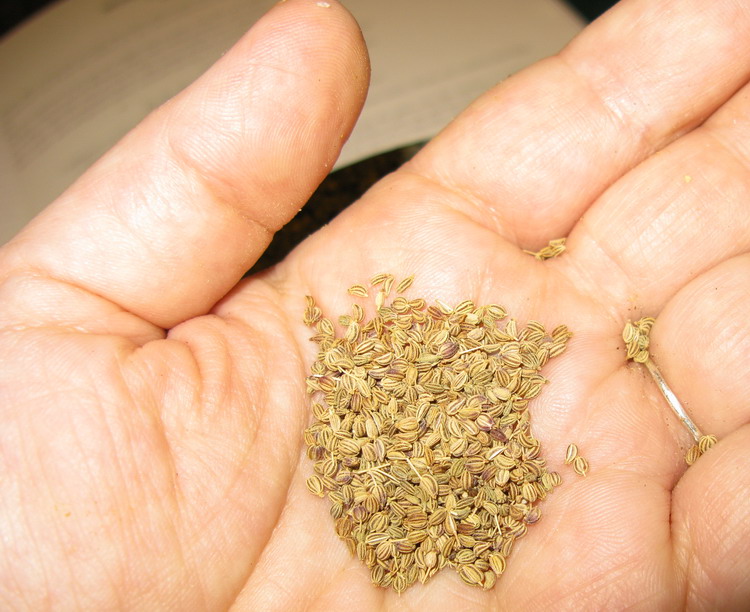
Ajwain is an Indian spice that is not terribly well known in the West, but it is very interesting, and should be used more often. Although it is a spice, being the fruit of Trachyspermum ammi, which is related to parsley, ajwain has a very strong herbal aroma and flavor similar to thyme or oregano.
Although it is an ancient spice, and it most likely originated around Egypt, it is neither grown nor used there in modern times. Now, it is primarily grown in Persia and India, and it is used mostly in Northern Indian cuisine, particularly in the states of Punjab and Gujarat.
I have seldom found recipes using it, but when I have added it to a marinade, curry or dal, I have liked the flavor a great deal, probably because I love thyme so much. (It is my favorite European herb.)
The most recent recipe I have made using ajwain is a very simply put together grilled chicken I found in Madhur Jaffrey’s excellent cookbook, Quick and Easy Indian Cooking. All it entails is grinding spices and making a paste of them with yogurt and lemon juice, and then rubbing it over boneless skinless chicken breasts or thighs. After allowing the meat to marinate for ten to fifteen minutes, it is grilled to perfection, or put under the broiler, and cooked until done. I only turn the pieces once, to make certain to brown the spice paste well, thus bringing out as much flavor as possible in it.
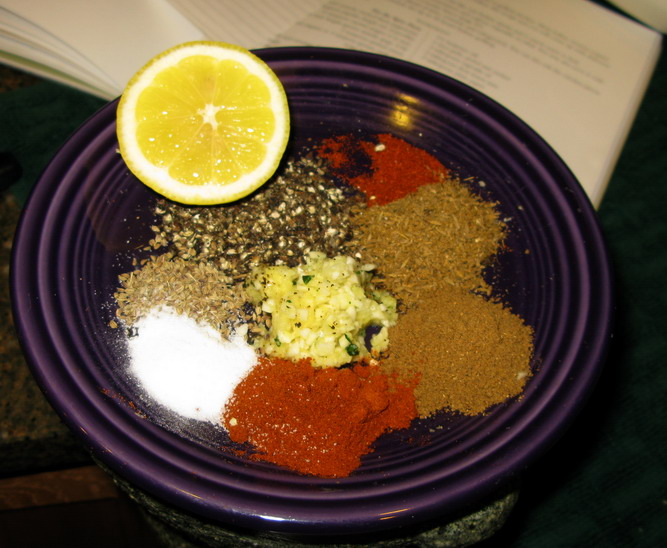
The other spices used in this dish are easily found in most grocery stores: black peppercorns, paprika, cayenne chili, cumin and turmeric, Garam masala can be found in most Indian markets or can be ordered from Penzey’s or, can be made fresh with your own preferred mixture of sweet and hot spices, and ajwain, while I have always been able to find it in any Indian market, and as noted by several readers, can also be found at Penzey’s, can also be substituted by using dried thyme or oregano. I wouldn’t just leave it out–its strong, herbal and medicinal flavor really adds a distinctive, delicious fragrance and flavor to the chicken. It blends perfectly with the sharp flavor of black pepper and the musky sweetness of cumin and adds a note of freshness to the spice mixture.
Once the spices are ground the the garlic either pounded into a paste or minced finely, there is nothing to this recipe. It is simple, very fast and most importantly, amazingly well-flavored. It is perfect for a quick dinner after work, especially if you have a rice cooker that you can use to make plain basmati rice or a yellow rice pillau. Then all you to make is a quick sauteed vegetable, and dinner is served!
(If you can get chicken that is organic and locally raised, the flavor with this spice rub is out of this world, and not to be missed. The texture of the chicken is also superior, very firm without being tough, tender without being mushy.)
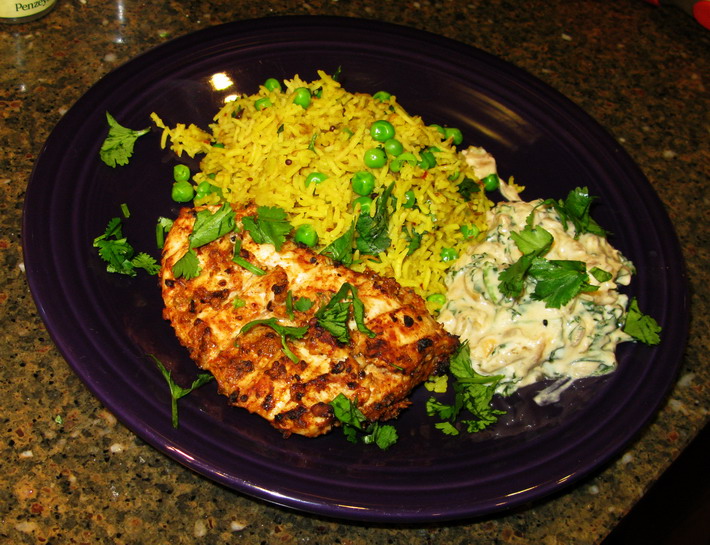
Spicy Grilled Chicken with Ajwain
Ingredients:
1 tablespoon coarsely crushed black peppercorns
1 tablespoon bright red sweet paprika
1 teaspoon ground turmeric
1/2 teaspoon ground cayenne, or to taste
1/2 tablespoon garam masala
2 teaspoons cumin seeds, ground
1 teaspoon ajwain seeds or dried thyme
1 1/4 teaspoons salt
2 cloves garlic, peeled and either finely minced or mashed into a paste
1 tablespoon canola or peanut oil
2 tablespoons fresh lemon juice
3 tablespoons plain yogurt
2 1/2 pounds boneless skinless chicken breasts and thighs
roughly chopped fresh cilantro or mint
Method:
Mix together the spices and salt, then add the garlic, oil, lemon juice, and yogurt and then rub the resulting paste all over the chicken. Allow the chicken to sit for ten to fifteen minutes, then grill or broil on high heat for about ten or fifteen minutes, or until the chicken flesh is firm and the juice that comes out from it runs clear instead of pink.
Garnish with cilantro or mint and serve immediately.
From Food Porn To Food Cost: Balancing Profit with Creativity
One of the most fun parts of working as a chef is the creative puzzle of coming up with off-menu specials that will not only wow diners, but which keep food costs low.
Food cost is something that every chef and line cook is acutely aware of–it is a fact of life in every restaurant, from the busiest upscale dining spot to the roadside diner. One must always strive to give the diner the highest quality food possible: the best flavors, colors and textures on a plate while still managing to keep costs low–optimally, under thirty percent of operations costs.
Keeping food costs low is going to become a greater priority in the coming months and years as fuel costs soar. Oil prices will not only affect gasoline prices and thus transportation costs for our food system, it will also directly affect food production costs. Many fertilizers are petroleum-based, and with more corn going to the production of ethanol, grain prices both for human consumption and animal feed have risen drastically, and will likely continue to do so. (I predicted all of this over a decade ago when I was in culinary school, mind you–I knew that once oil prices rose, the artificially low American food prices would also rise. Unfortunately, I was right. I wish I wasn’t.)
I like the challenge of making up new dishes that utilize items that we already have in our pantry. To me, that is as much fun as having a limitless pantry stuffed with exotic staples. Having limits tends to boost my creativity, instead of dampen it.
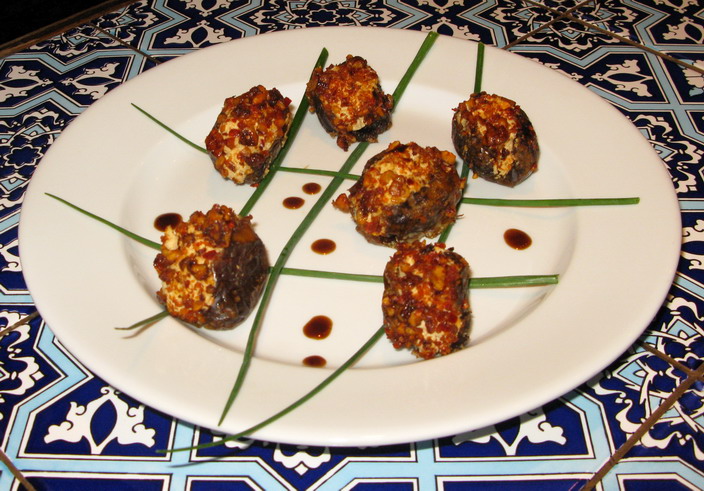
Take for example, the appetizer pictured above: Dates a l’Aziz.
This appetizer came to me in a dream as I was waking up one morning, and the more I thought about it, the better it sounded. With the exception of the chevre, it uses exclusively pantry items, from the moist, delicious medjool dates which we normally stuff with pecan halves and offer as a dessert, to the Turkish Kirmizi chili flakes to the pomegranate molasses, down to the sugar and spices with which we sugar the pecans.
It is a simple preparation of chevre flavored with pomegranate molasses and spices which is then stuffed into dates. The exposed cheese is then rolled in a mixture of sugared, spiced pecans and chili flakes. We serve them at room temperature so the flavors are at their height and we price them individually, so diners can order as many or as few of them as they like.
In order to market them, we made up a gorgeous platter of them arranged with mint leaves and parsley sprinkles, which servers brought to each table soon after seating. Letting diners see the appetizers first hand is even better than the most delectable verbal description either in a menu insert or from the server–people eat with their eyes after all. Waving a beautifully presented appetizer under a hungry person’s nose is like having a lingerie-clad nymph flitting in front of a lonely man–salivation, and desire are immediate.
These dates ended up to be a great hit among diners, while not hitting our food cost below the belt.
Which, in my world, is a perfect balance between profit and creativity.

Categories:
- Admin (rss) (55)
- Blogs and Blogging (rss) (81)
- Book Reviews: Cookbooks (rss) (43)
- Book Reviews: Non-Cookbook Food Books (rss) (38)
- Cats and Cat Blogging (rss) (47)
- Chinese Cooking Lessons (rss) (32)
- Culinary School Stories (rss) (18)
- Dairy Pruducts: Cultured and Barbaric (rss) (4)
- Documentary Filmmaking (rss) (1)
- Essays, Rants and Reflections (rss) (260)
- Fighting Hunger (rss) (12)
- Food and Kids (rss) (45)
- Food in the News (rss) (126)
- Food Media (rss) (98)
- Food Preservation (rss) (18)
- Food Safety (rss) (45)
- Gardening (rss) (30)
- Herbs and Herb Blogging (rss) (20)
- Holidays (rss) (50)
- Kat Blogging (rss) (22)
- Kitchen Science (rss) (36)
- Leftover Makeover (rss) (8)
- Life, the Universe and Everything (rss) (131)
- Local and Sustainable (rss) (227)
- Local Athens Food and Foodies (rss) (42)
- Meatless Mondays (rss) (32)
- Menu For Hope (rss) (5)
- Nutrition, Diet and Health (rss) (84)
- On The Farm (rss) (8)
- Recipes: Almost Vegetarian, Vegetarian and Vegan (rss) (294)
- Recipes: American Regional (rss) (37)
- Recipes: Appalachian Hillbilly (rss) (33)
- Recipes: Bread, Pasta, Grains (rss) (95)
- Recipes: Canning and Preserving (rss) (8)
- Recipes: Chinese (rss) (123)
- Recipes: Comfort Food (rss) (120)
- Recipes: Cookies (rss) (16)
- Recipes: Desserts (rss) (48)
- Recipes: French (rss) (25)
- Recipes: Fruits and Vegetables (rss) (302)
- Recipes: Greek, North African and Middle Eastern (rss) (31)
- Recipes: Indian (rss) (137)
- Recipes: Italian (rss) (42)
- Recipes: Japanese (rss) (7)
- Recipes: Jewish (rss) (4)
- Recipes: Korean (rss) (6)
- Recipes: Meat, Poultry and Fish (rss) (220)
- Recipes: Mexican/Native American/ Latin American/Caribb (rss) (27)
- Recipes: Original (rss) (108)
- Recipes: Thai (rss) (27)
- Recipes: Tofu (rss) (17)
- Recipes: US Regional (rss) (16)
- Recipes: Vietnamese (rss) (8)
- Restaurant Stories (rss) (28)
- Sewing, Quilting, Arts and Crafts (rss) (16)
- Simple Chinese Recipes (rss) (30)
- Slow Food and Heritage Foods (rss) (10)
- Spice Blogging (rss) (44)
- The Chinese Cookbook Project (rss) (14)
- The Chinese Pantry (rss) (39)
- The Documentary (rss) (2)
- The Kitchen Saga (rss) (17)
- The Locavore's Bookshelf (rss) (15)
- The Unsung Adventures of The Culinary Nerd (rss) (6)
- Tools and Toys (rss) (35)
- Uncategorized (rss) (10)
- With a Side of Politics (rss) (48)
Archives:
- August 2012 (9)
- July 2012 (12)
- September 2011 (3)
- August 2011 (7)
- July 2011 (8)
- June 2011 (16)
- May 2011 (17)
- April 2011 (11)
- December 2010 (9)
- November 2010 (5)
- February 2010 (1)
- December 2009 (5)
- November 2009 (7)
- October 2009 (10)
- September 2009 (16)
- August 2009 (14)
- July 2009 (14)
- June 2009 (7)
- May 2009 (17)
- April 2009 (10)
- March 2009 (25)
- February 2009 (13)
- January 2009 (10)
- December 2008 (5)
- November 2008 (5)
- October 2008 (6)
- September 2008 (13)
- August 2008 (8)
- July 2008 (11)
- June 2008 (18)
- May 2008 (13)
- April 2008 (14)
- March 2008 (16)
- February 2008 (17)
- January 2008 (19)
- December 2007 (25)
- November 2007 (18)
- October 2007 (24)
- September 2007 (16)
- August 2007 (15)
- July 2007 (15)
- June 2007 (10)
- May 2007 (14)
- April 2007 (16)
- March 2007 (17)
- February 2007 (20)
- January 2007 (13)
- November 2006 (1)
- October 2006 (8)
- September 2006 (14)
- August 2006 (25)
- July 2006 (30)
- June 2006 (28)
- May 2006 (34)
- April 2006 (29)
- March 2006 (24)
- February 2006 (30)
- January 2006 (38)
- December 2005 (40)
- November 2005 (37)
- October 2005 (32)
- September 2005 (25)
- August 2005 (30)
- July 2005 (28)
- June 2005 (21)
- May 2005 (8)
- April 2005 (22)
- March 2005 (17)
- February 2005 (29)
- January 2005 (10)
Search Site:
Links:
- Lily’s Wai Sek Hong
- 101 Cookbooks
- A cat in the kitchen
- A Veggie Venture
- Accidental Hedonist
- Cha Xiu Bao
- chez pim
- Chocolate & Zucchini
- Chopstick Cinema
- Chowhound.com
- Chubby Hubby
- Cook sister!
- Cooking with Amy
- da*xiang
- Eat Local Challenge
- Eating Liberally
- Ecocentric
- Eggbeater
- Epicurious
- Farmgirl Fare
- Fatfree Vegan
- Foodgoat
- ForkandBottle.com
- Green Olive Tree
- Hooked on Heat
- Jaden’s Steamy Kitchen
- Kalyn’s Kitchen
- Lucullian delights
- Mahanandi
- Matt Bites
- MeatHenge
- mmm-yoso!!!
- New York Times – Dining & Wine
- Pizza Goon
- Rasa Malaysia
- Ruhlman
- Sailu's Kitchen
- Serious Eats
- SF Gate: Food & Dining
- Simply Recipes
- Soul Fusion Kitchen
- Tastespotting
- The Amateur Gourmet
- The Cleaner Plate Club
- The Food Section
- The Grub Report
- thecookscottage
- U.S. Food Policy
- Wandering Chopsticks
- Washington Post Food and Dining
- Wasted Food
Meta:


Powered by WordPress. Graphics by Zak Kramer.
Design update by Daniel Trout.
Entries and comments feeds.