
Cook Local, Eat Global
Vacation Time
I’ll not be around for the next week or so–we are traveling tomorrow to visit Zak’s family in New England. First stop, Boston, then, up to the wilds of New Hampshire.
I may post a picture or two if I have time, but if not–I’ll be back around the 16th. Until then, happy cooking.
Tamari, Miso and Honey Make Everything Sunny
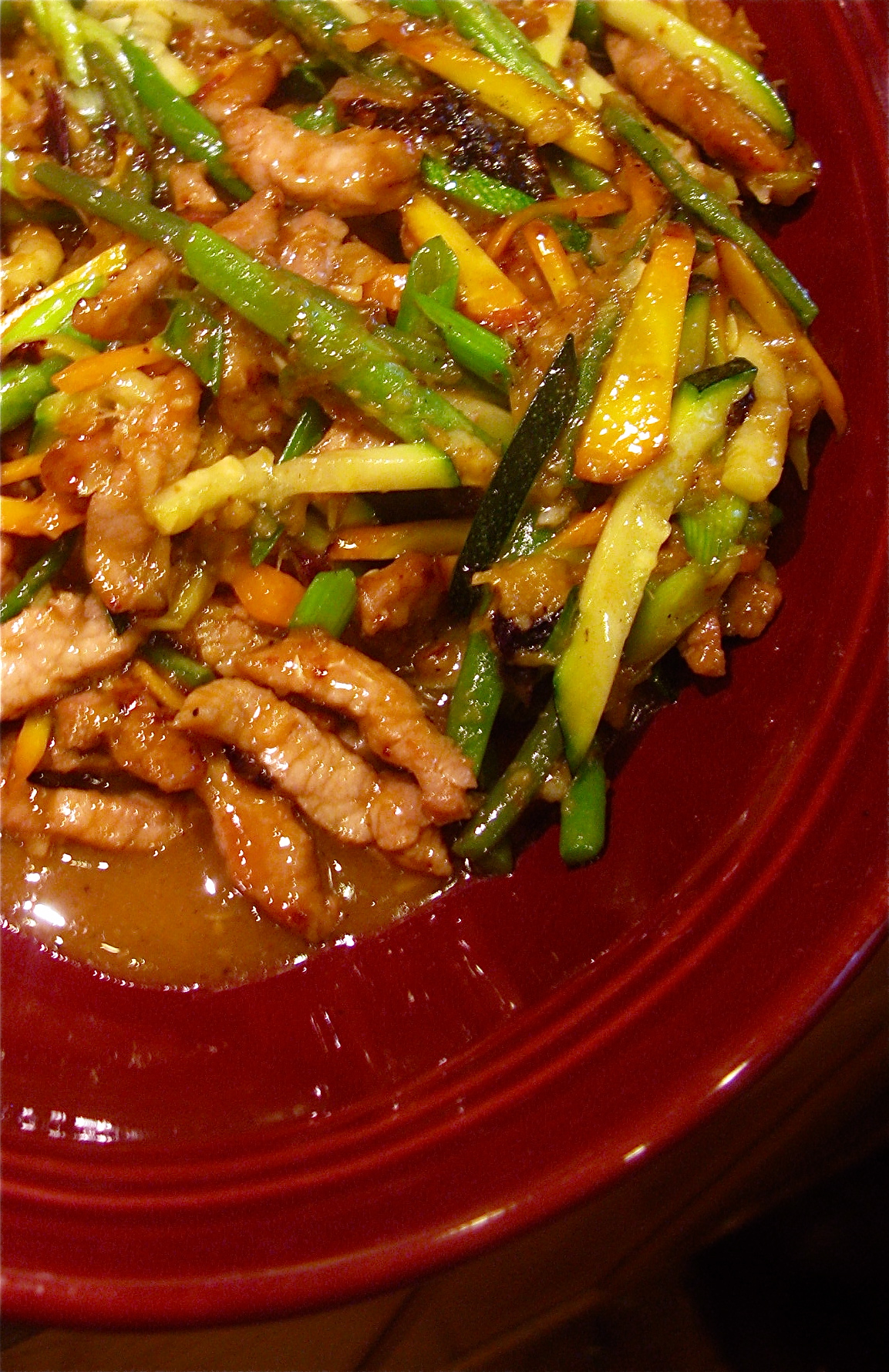
Why the rhyme?
I dunno.
Except, that somehow, the combination of those three ingredients -does- taste like sunshine. Like warm summer sunshine in a garden filled with flowers and buzzing bees. Really. Put the three together and then cook it and slather it on anything, and suddenly, even if its midwinter, you’ll feel like you’re hanging out with the bees, humming along and sipping nectar.
It’s the damnedest thing.
And if it actually -is- summer, and you use it on vegetables you just harvested from your garden, and pork from a local farmer, well, hot damn! It’s like summer inside, outside and all around.
I reckon you could use this sauce to make anything, but I did it as a stir fry with zucchini, haricot vert (those are wee tiny slender French green beans) and some beautiful multicolored (red and yellow) carrots, all of which were plucked, picked and pulled out of our garden by Kat. The pork was a single solitary pork chop that really only served to add a little protein and extra flavor to the vegetables and rice that we ate with it–but I have to say that the next time I grill pork–I reckon some version of this sauce will show slathered all over it. Same could be said for grilled eggplant. Or braised chicken. Or baked salmon. Or portabello mushroom caps stuffed with spelt pilaf and baked.
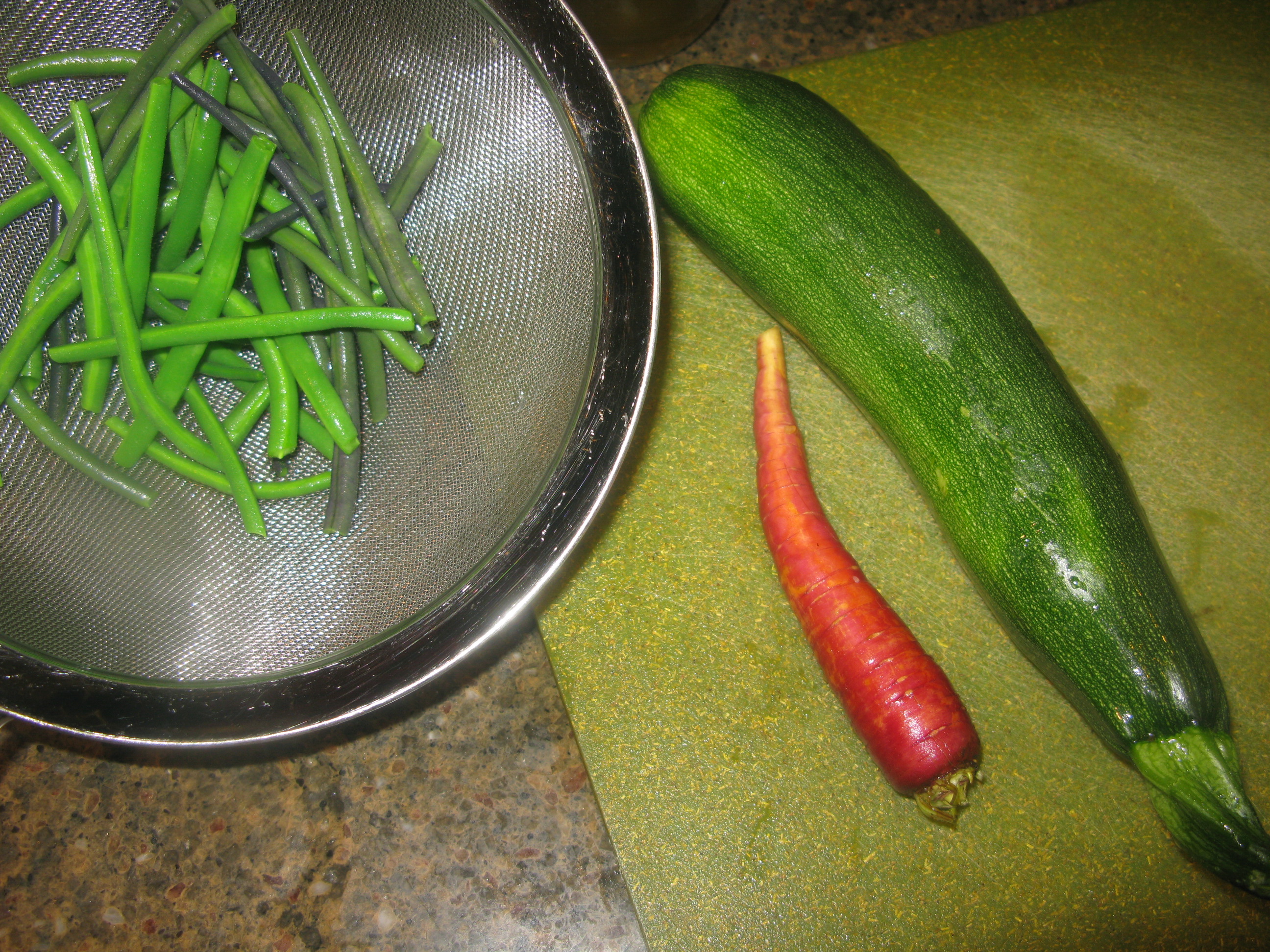
I don’t usually put zucchini into stir fries here at home, not because it isn’t good in stir fried dishes, but because Zak, until recently, (like until two days ago) didn’t like zucchini under any circumstances. So, I really only cooked it for myself, or myself and Morganna when she lived here, or myself and guests, always in separate dishes. BUT, because Kat picked this zucchini with her own little hands, she wanted to taste it and in order to support her on trying a new food, Zak said he’d try it to.
Woo hoo! And to the kitchen, I galumphed and promptly went to work with my knife.
Since the haricot vert are so slender, I used them as the basis for how I cut all the other vegetables–and the meat–which means I cut everything into thin julienne strips. To do this with either carrots or zucchini, or in fact, with anything cylindrical, is simpler than it would seem. All you have to do is make diagonal horizontal slices that are thin oval shapes first, then stack those and cut them into thin vertical slices. That’s all. Not hard, huh?
Meat is a bit harder to cut so thinly. The best way is to partially freeze the meat so you can cut it into thin horizontal slices, and then cut them into vertical strips, just like you did with the firmer vegetables. If you meat is thawed all the way, it simply is a beast to try and cut like that. Be patient and firm it all up in the freezer before you start.
The cutting is all the hard part–the rest is perfectly simple. Toss the meat in a bit of tamari, which is a Japanese style of soy sauce that doesn’t contain any wheat. It’s just fermented soybeans. Add some mirin–that is a sweetened rice wine, also from Japan–and then toss in some cornstarch and mix it all up until a thick marinade coats the meat.
Then, make a bit of sauce–mix together some more tamari and mirin, then add a little bit of vegetable broth or chicken stock, some honey and a goodly amount of shiro miso–that’s white miso–which is a mild, fragrant fermented soybean paste, and whisk it all together until it’s smooth.
Then, get ready and fire up the wok–because dinner is almost done.
How did they like the zucchini?
Well, Kat loved the sauce. She ate extra over her rice, which was exceptional for her, because she usually likes her rice plain. And she loved the beans and the carrots and ate inordinate amounts of them. And the pork was very much to her liking.
But, the zucchini–alas–was not her thing.
Zak tried the zucchini and declared it, “Inoffensive.” Which is a lot coming from him. (It wasn’t until the next day when I sauteed a zuke in just plain old good olive oil and salted it well at the end that he declared it, “Downright tasty,” and ate several pieces of it.)
As for me–I ate up the zucchini from the dish that they didn’t eat, and gladly, because it was delectable with this sauce combination. Especially after I added a little bit of toasted sesame oil at the end–it became almost my favorite way to cook and eat zucchini. I say almost, because I still like it best with just some olive oil, salt and maybe a fresh herb or two.
Anyway, here’s the recipe for a dish that would be just as good if you substituted a good pressed tofu for the pork.
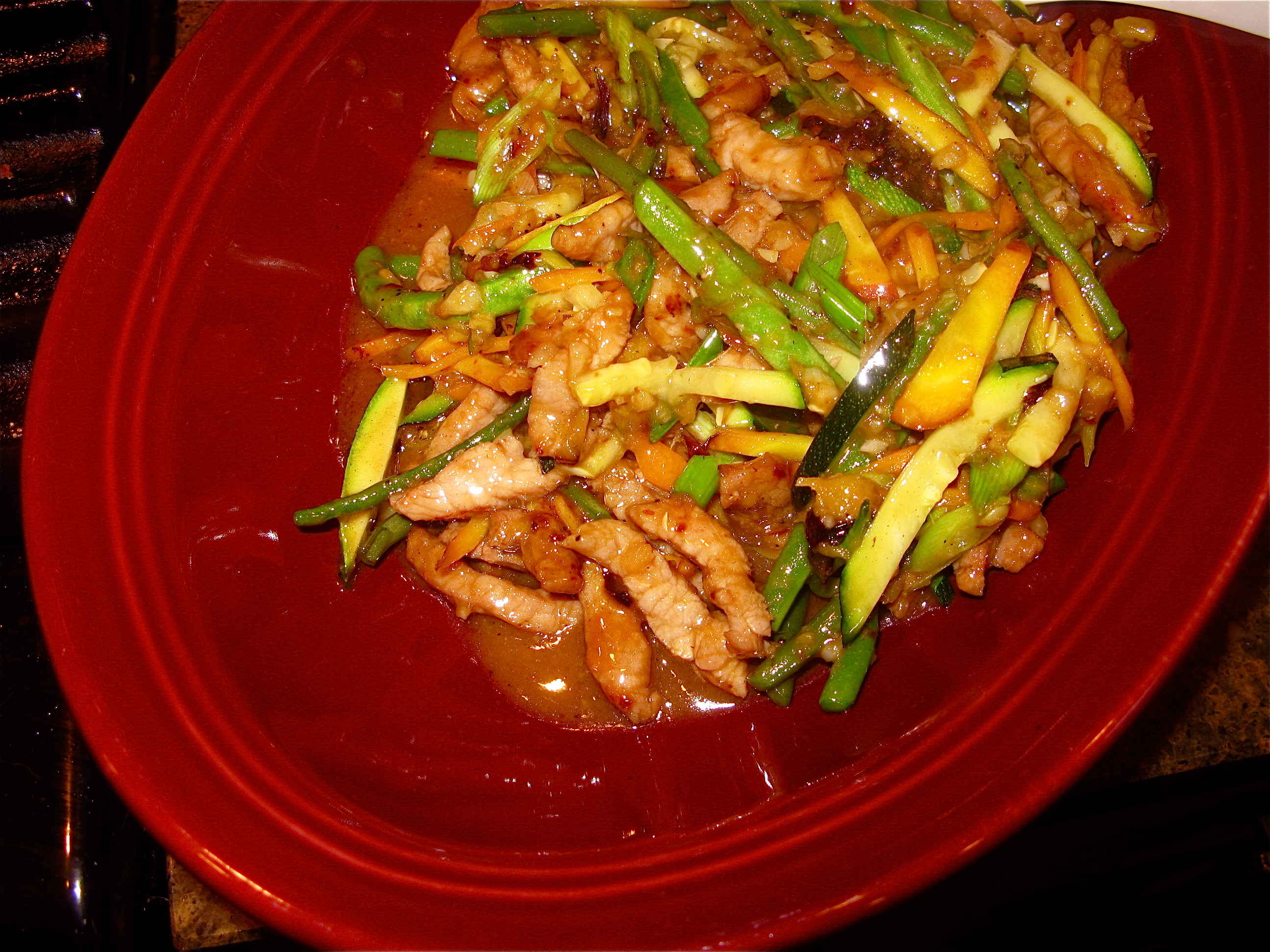
Summer Vegetables and Pork with Tamari,-Miso-Honey Sauce
Ingredients:
1/2 pound pork loin chop, cut into 1″ X1/4″X1/4″ slices
1 teaspoon tamari soy sauce
1 teaspoon mirin
2 teaspoons cornstarch
1/4 cup vegetable broth or chicken stock
1/4 cup mirin
2 teaspoons tamari
1 tablespoon shiro miso
2 teaspoons honey
2 teaspoons cornstarch
2 tablespoons peanut or canola oil
3 scallions, white and light green parts only, thinly sliced on the diagonal
1″ cube fresh young ginger, peeled and minced
1 garlic clove, peeled and minced
1 1/2 cup haricot vert, snapped and stringed, then very briefly blanched and then shocked in ice water
1 cup carrots, (2 medium carrots) scrubbed or peeled and cut into very thin julienne
1 cup zucchini (I medium small squash) cut into very thin julienne
1 teaspoon toasted sesame oil
Method:
Toss the meat shreds with the next three ingredients and set aside to marinate while you prepare the sauce and vegetables.
To make the sauce, whisk together the broth or stock, the second measures of mirin and tamari, the miso, honey and cornstarch until thoroughly blended. Set aside until it’s time to cook.
Heat wok over high heat until it smokes. Add canola or peanut oil and heat until it shimmers–about one minute. Add the scallions, and the meat immediately after. Spread the meat out into a single layer on the bottom of the wok and sprinkle it with the ginger and garlic. Allow to brown undisturbed on the bottom of the wok for about a minute and then begin stirring. Cook until most of the pink is gone from the meat. Add the carrots and then the beans, and cook until the meat is fully cooked. Add the zucchini and cook, stirring, until it browns a bit on the edges. Add the sauce ingredients, and cook, stirring, until the sauce thickens and clings to the meat and vegetables.
Remove from heat, drizzle with the sesame oil, and then stir it all up before scraping into a warmed platter or bowl. Serve with steamed rice. (This recipe makes enough for two hungry adults and one toddler, especially if everyone eats lots of rice with it.)
Meatless Monday: Eggplant, Squash and Tomato Gratin With Goat Tomme

Happy Independence Day! How about celebrating this year as “Independence from Meat Day?” Or, maybe, “Independence from Corporate Food Day?” Or, even better, “Independent Local Food Producer Day?”
Nah, I’m just having fun with the idea of a meatless Fourth of July, which is generally celebrated with grilled burgers, hot dogs, bratwursts, ribs, and steaks. Not that there’s anything wrong with any of the aforementioned grilled meat delights–I am an omnivore, after all, but I do think folks should eat more vegetables, which is why I devote at least one post per week to a meatless recipe that has creative ideas for eating more plant-based foods.
So, here we are, with another gratin. Why a gratin? Well, they are easy to make, endlessly variable, meaning you can play with the ingredients, and you can make them ahead, pop them in the fridge and then when it’s close to meal time, slide them into the oven and bake them straight from the fridge. That is, if you have a baking dish that puts up with that sort of behavior from a cook. Pyrex and Corning glass products work well for this purpose.
Oh, and gratins also usually include cheese, and as we all know, the only person who likes cheese better than me is the villain Dr. Two-Brains” from the PBS Kid’s show, “Word Girl.” (Okay, yeah, I like the show. It’s Kat’s favorite, and unlike many kid’s shows, the writing is witty enough for adults–especially adults who grew up reading super hero comics like I did.) Dr. Two-Brains was a mad scientist who had an accident in his lab wherein his brain was fused with a mouse’s brain. This unfortunate incident caused the formerly nice mad scientist to become an evil genius who is obsessed with cheese in all its forms and goes to great lengths to steal it.
Now, while I won’t steal cheese, (and I’m only sometimes an evil genius) I do love it and will put it into nearly any dish I can manage. Which is why I like gratins.
That said, let’s talk about goat tomme. First off, in America,”tomme” rhymes with “Rome.” In France and Switzerland, where it originated, it rhymes with “rum.” (Thanks, Meg!) It doesn’t sound like “to-may,” or “Tom,” or “Tom-may.” Got it? Good.
It’s a cheese of alpine origin which is often made with skim milk. Cow or goat milk can be used, and the milk is heated to a fairly low temperature before the rennet is added. It also is aged for at least five months and has a rustic edible rind of mold that looks sort of mossy or dirty–some varieties look like they were rolled about in a bed of garden soil.
The kind I used here was made from goat milk by my favorite local cheesemaker, Integration Acres. The flavor is nutty, rich and complex with a dry somewhat flaking texture. It makes a good substitute for aged Parmesan cheese, though it isn’t quite as salty. (Which is a plus in my book.)
You could replace the tomme in this recipe with any good dry grating cheese if you can’t get tomme. Asiago would be good.
As for the vegetables I used–you could change them up a bit. The eggplant could be paired with thinly sliced potatoes instead of the squash, the tomato could be left out and the squash could be paired with a kohlrabi slices instead of the eggplant, or whole fresh shiitake caps could be used in place of the eggplant. So many possibilities. Just try and keep a variety of flavors and textures in mind when you make up your own combinations.
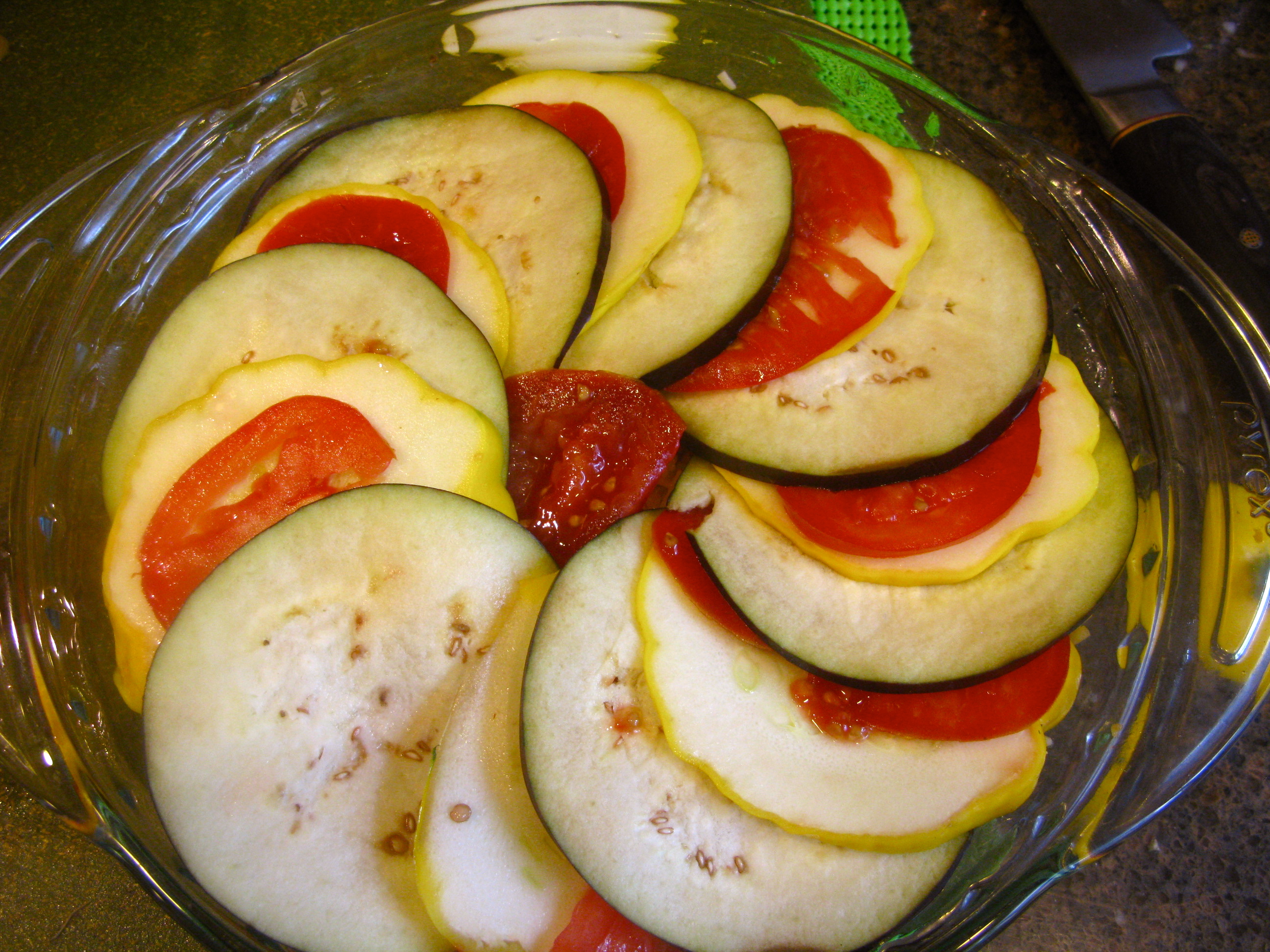
And the filling–I used leftover rice combined with a bit of the sauce and topped with sauteed shiitake mushroom slices and onions as the base over which I layered the alternating vegetables. You could use any grain you liked for this purpose, or you could instead go with just the caramelized onions and mushrooms. In either case, the filling makes the dish more, well–filling–than the vegetable slices alone would.
Finally, the sauce. I used vegetable purees whisked with a little bit of cream and Greek yogurt. (And minced fresh herbs and garlic, of course.) The vegetables I chose were roasted red peppers and tomatoes, but you could go with just the peppers, just the tomatoes or a totally different idea like roasted carrot puree. To be honest, I used roasted peppers from a jar and canned tomatoes in my puree, because that’s what was in the fridge, and the sauce turned out tasting just fine. You can start from scratch if you want–or just use up left over roasted vegetables from your fridge.
That’s the other truly cool thing about gratins–they can be used to clean the fridge of leftover bits and pieces by turning them into something amazingly good with very little effort. Like most casseroles, gratins are extremely frugal dishes, and knowing how to whip one up easily is a great weapon in a waste-conscious cook’s arsenal.
I know that the recipe list is long on this dish and it sounds complicated, but it isn’t. It took me about forty minutes to assemble the gratin and then about the same amount of time to bake it. Yeah, I know, I’m a professional chef and so I can cut and chop really fast and I’m good at streamlining steps by pureeing while sauteeing, but even if you’re a bit slower in the kitchen than I am, this dish takes very little time overall to prepare. AND, as I noted before, you can prep it as early as the night before you bake it and then pop it in the oven about an hour or so before dinner’s to be on the table, and voila! An easy vegetarian main dish without any headaches or fuss.
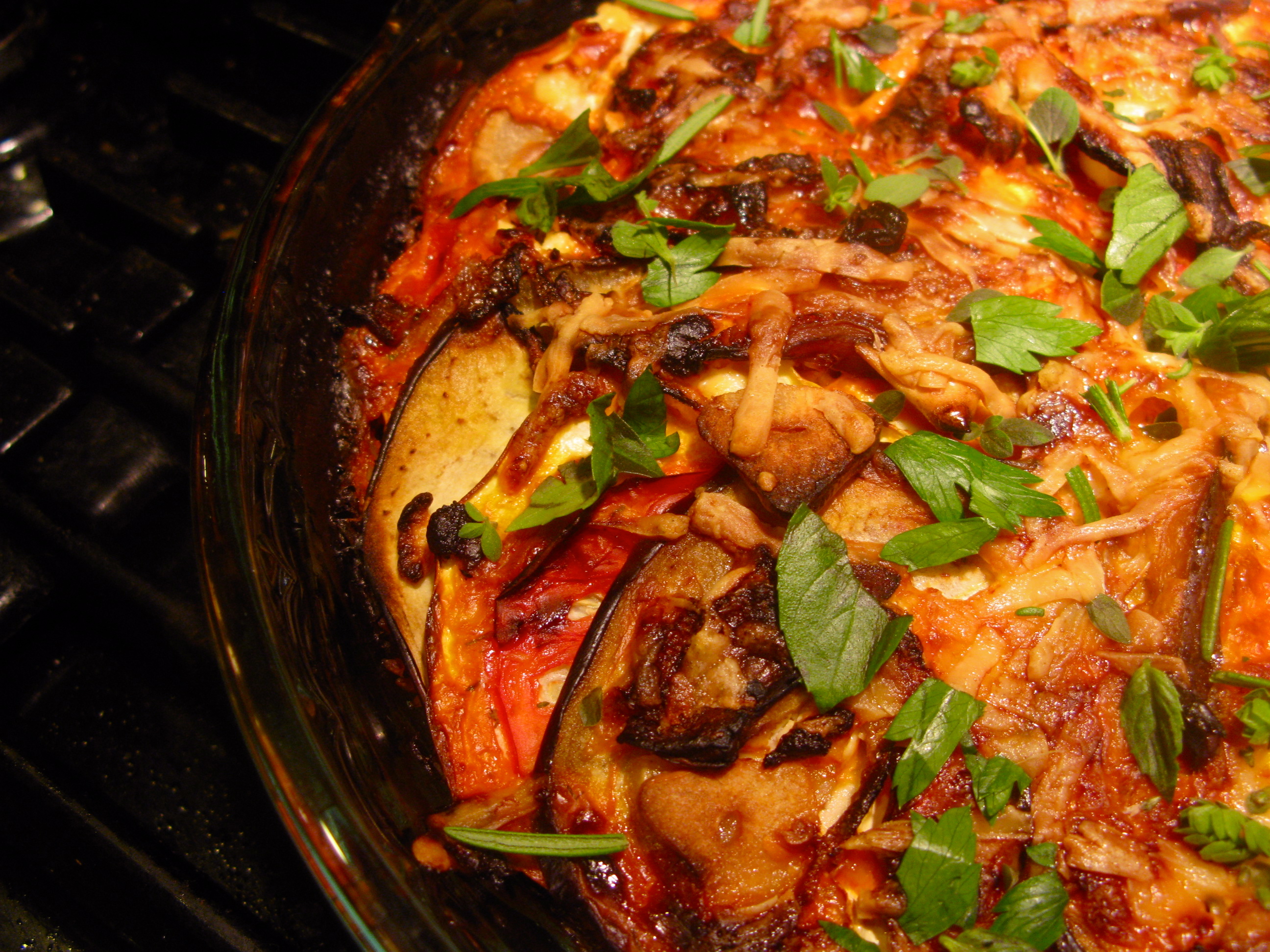
Eggplant, Squash and Tomato Gratin with Goat Tomme
Ingredients:
1 medium eggplant, thinly sliced
1 teaspoon salt
2 tablespoons olive oil
1 large onion, thinly sliced
1/2 teaspoon salt
5 large shiitake mushroom caps, thinly sliced
2 cloves garlic, minced
1 roasted red pepper
1/2 cup canned or roasted tomatoes
2 cloves garlic, minced
2 tablespoons minced fresh mixed herbs (whatever you like–I used basil, Italian parsley and mint)
3 tablespoons heavy cream
1/3 cup Greek yogurt
1 medium pattypan squash, thinly sliced
2 medium sized fresh tomatoes, thinly sliced
1/3 cup shredded goat tomme
3 tablespoon roughly chopped fresh herbs for garnish
Method:
Preheat oven to 375 degrees F.
Lay eggplant slices on layered paper or clean woven cotton towels and sprinkle well on both sides with salt. Allow to sit until the moisture drains from the eggplant, then carefully pat dry with clean towels.
Meanwhile, heat olive oil in a saute pan and add onions. Sprinkle with salt and cook, stirring as needed until the onions are golden. Add the mushrooms and garlic, and cook, stirring, as needed, until the mushrooms are golden brown and the onions are browned. Remove from heat and set aside.
While the onions are first sauteeing, put the roasted red pepper and tomatoes into a food processor or blender and puree. Add the garlic, herbs, cream and yogurt and run the machine until well combined. Or, you could whisk those ingredients in by hand, but I figure that you’ve already dirtied up your food processor, so why not use it?
Now, lightly oil a baking dish. I used a deep-dish glass pie pan to bake this–it turned out looking really sweet, so maybe you should try it. Anyway, oil your dish lightly with olive oil. Put your leftover rice in a bowl, and pour over it about 1/3 of your sauce and half of the onions and mushrooms and stir to combine. Pat this rice mixture into the bottom of your baking dish.
Top with alternating thin slices of your vegetables as shown above. Make it flat and pretty, pressing down when the layer is complete to make the layer solid and compact on top of the rice. Sprinkle with the remaining onions and mushrooms and carefully pour the remaining sauce over everything, being sure that a thin layer of sauce covers the vegetables. Sprinkle with cheese and bake for 40-60 minutes or until the cheese is browned and bubbly and the vegetables are tender.
Remove from oven and cool slightly before garnishing with sprinkled fresh herbs. Serve hot.
Growing the Three Sisters

They are the Holy Trinity of the First Peoples.
Corn, beans and squash.
There are many Native American tales, most of them originating among the Eastern tribes, about the Three Sisters. Some say that they existed as soon as land was separated from the sea. The Iroquois tell that they sprang from the body of Sky Woman’s (the mother of all humanity) daughter, after she died in childbirth. After she was buried, three plant sisters sprang up from the ground–one tall and dressed in pale green with long yellow hair, another who loved to hug and cling to her big sister, with a yellowish green dress dotted with purple and white flowers, and the third who was so young she could only crawl on the ground who wore a dark green dress, and liked to circle her sisters’ ankles and playfully pat their dresses. These three sisters fed the sons of Sky Woman’s daughter, and later, the rest of humanity, but they never, ever liked to be taken one from the other.
Always the Three Sisters stayed together, and if their wishes to be never parted were respected by their human brothers and sisters, they would reward them with great harvests and full bellies.
I may not look it myself, being pale of skin, hair and yes, but I am of Cherokee ancestry, and so I’ve always had a great respect and love for the ways of the First Peoples of our nation. When I was a Girl Scout, way back in the day, one of the first merit badges I chose to fulfill was the American Indian one–and as part of my work to earn that badge, I planted a small version of a Cherokee-style Three Sisters garden at my Grandma and Grandpa’s farm. They let me have a little plot of land where I made three round, flat-topped mounds, spaced the way the Cherokee did when they lived in the East, and these I planted over three successive weekends, with corn, beans and then squash.
The corn is planted first in the center of the mound, in a circle–and is allowed to sprout and begin to reach for the sky with its long, strap-like leaves. Then, the beans are planted in a circle around the corn. After the beans sprout, along the outside edges of the mound, squashes or pumpkins are planted.
This interplanting technique makes a great deal of sense from a scientific standpoint.
Corn is tall and straight, but is a heavy feeder, requiring a great deal of nitrogen in the soil to be healthy. Beans need something strong and stout to climb, because their vines will otherwise clamber on the ground and never reach the sun. So, they hug and twine up the corn stalks and thus reach upward for sunlight. They also fix nitrogen from the air in their roots, making it available for the corn to feed from. Squash vines don’t climb, but instead clamber over the ground, forming a living mulch that keeps the roots of both the beans and the corn cool, retaining moisture and retarding weed growth. They also have prickly vines and leaves, which helps keep marauding animals like raccoons out of the vegetable patch as the corn and beans ripen.
Harvest was a time of joy and celebration, with all the tribe, women, men and children, working together to bring in the mature vegetables. The complete proteins provided by the corn and beans nourished the people through their harvest and the winter, while the squash, baked in the fire with bear grease and maple syrup or honey from “The White Man’s Flies,” (honeybees!) provided vitamins and minerals to their diet.
When the season was over, the dying plants were chopped up with hoes and then dug back into the soil, replenishing it with fresh organic matter, enriching the soil for the next year’s crops.
This ancient form of farming works just as well today as it did hundreds and even thousands of years ago. While the founding of this method of intercropping is lost to us and is only commemorated in myths and stories, the techniques are just as accessible and sustainable as they were when they were first used.
My daughter, Morganna, who looks way more Cherokee than I do, decided this year to plant a Three Sisters garden in order to test out how well it worked in a small Community Garden plot as well as to both feel closer to her ancestors and feed herself and her household.

She prepared the ground herself, and though she didn’t use mounds of earth, she did plant in the proper sequence. Tight rows of corn first, then when they sprouted, beans surrounding the corn, then when the beans came up, squash along the edges of the rows. She chose to plant Silver Queen corn, various pole beans that can be eaten fresh and dried, and varieties of summer and winter squash, cucumbers, watermelon and good baking pumpkins. At every stage of the planting, she prayed and danced, and she sang and talked to her plants, hoeing and weeding until the garden grew big enough to create its own living mulch.
A generous third of her plot is taken up by the Three Sisters. The rest of it is tomatoes, peppers and eggplants, and potatoes and sweet potatoes intercropped, with sunflowers, herbs, cabbages and brussels sprouts along the periphery.
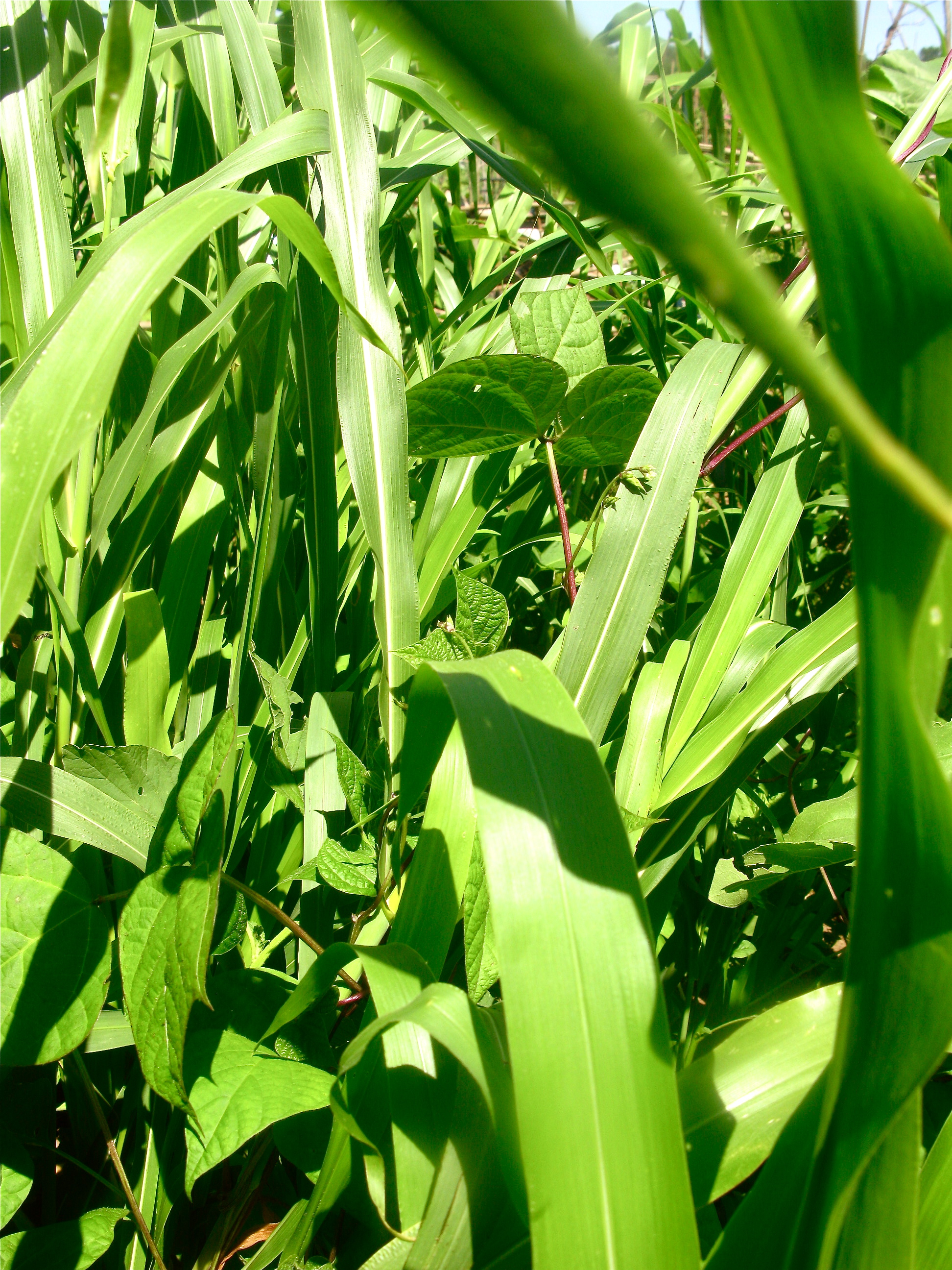
The garden has grown amazingly well–now the corn is taller than she is, and is starting to show tassels, while the beans are obediently climbing their way to the sun, and are just now starting to make purple and white blossoms. The squashes are not only blossoming, but setting fruit–she cut four zucchini yesterday and there are more to cut this weekend. Every plant is healthy, happy and productive and she is going to get an amazing amount of food from her twenty by eighteen foot plot this year. She and I already have plans for how to improve yields next year, and how to interplant even more effectively.
We’ll be combining both of our plots together next year–I’ll dismantle all but two of my raised beds, and this fall, we’ll till in compost and aged manure, then we’ll sow a cover crop. Next year, we’ll decide how much of the combined plots we should plant as a Three Sisters garden and plan for other crops around that central traditional plot.
Growing beans, corn and squashes this way really is simple, and it results in a very pretty, productive garden. I can’t recommend this style of gardening enough for people who want to try growing vegetables in ways different than the long rows of monocropping that we are used to seeing in fields all over the country.
Lamb With Cilantro and Curry Leaf Sauce

I like to play with cooking techniques when I come up with new dishes.
For example–I like to take the French techniques I learned in culinary school and apply them to other cuisines. Usually what happens is I end up with a recipe that tastes both traditional and sublime–the flavors of the original cuisine are there, and are simply boosted and magnified by using French techniques.
The results are subtle, and are not really what I would call a “fusion’ dish–to me, fusion cuisine is where the flavors AND techniques from two or more cuisines are mingled–hopefully in a sensible and respectful fashion–creating a dish that is completely new. In combining traditional flavors with a “foreign” technique, you end up with an original dish that tastes exactly like the original cuisine, but with some subtle difference in flavor, texture or mouthfeel.
This dish, for example, is basically an Indian lamb curry.
But, instead of cooking the meat in a water or yogurt based sauce, I cooked it in a stock, then reduced the resulting liquid into a thick, meat flavored sauce. The resulting sauce was then enriched with minced herbs (fresh cilantro from my garden and curry leaves) and smoothed out with a generous tablespoon and a half of Greek yogurt, then perked up with a squeeze of lemon juice. If I hadn’t reduced the stock first, I’d have had to use much more yogurt to thicken the sauce, and it would have diluted the rich meat flavor of the sauce.
This really is a simple and fast curry to make, especially if you have a pressure cooker. (Fear not–if you have no pressure cooker, a regular soup pot will do, it will just take a bit longer to cook!) The flavors are strong and clean, and go perfectly with a plain steamed basmati rice or a simple pilau with few ingredients.
It’s also good with a beautiful green salad, or maybe a dish of Bengali Summer Squash, since around here, zucchini, crookneck and pattypan squashes are all starting to come in, and this lamb dish would taste divine with squash on the side.
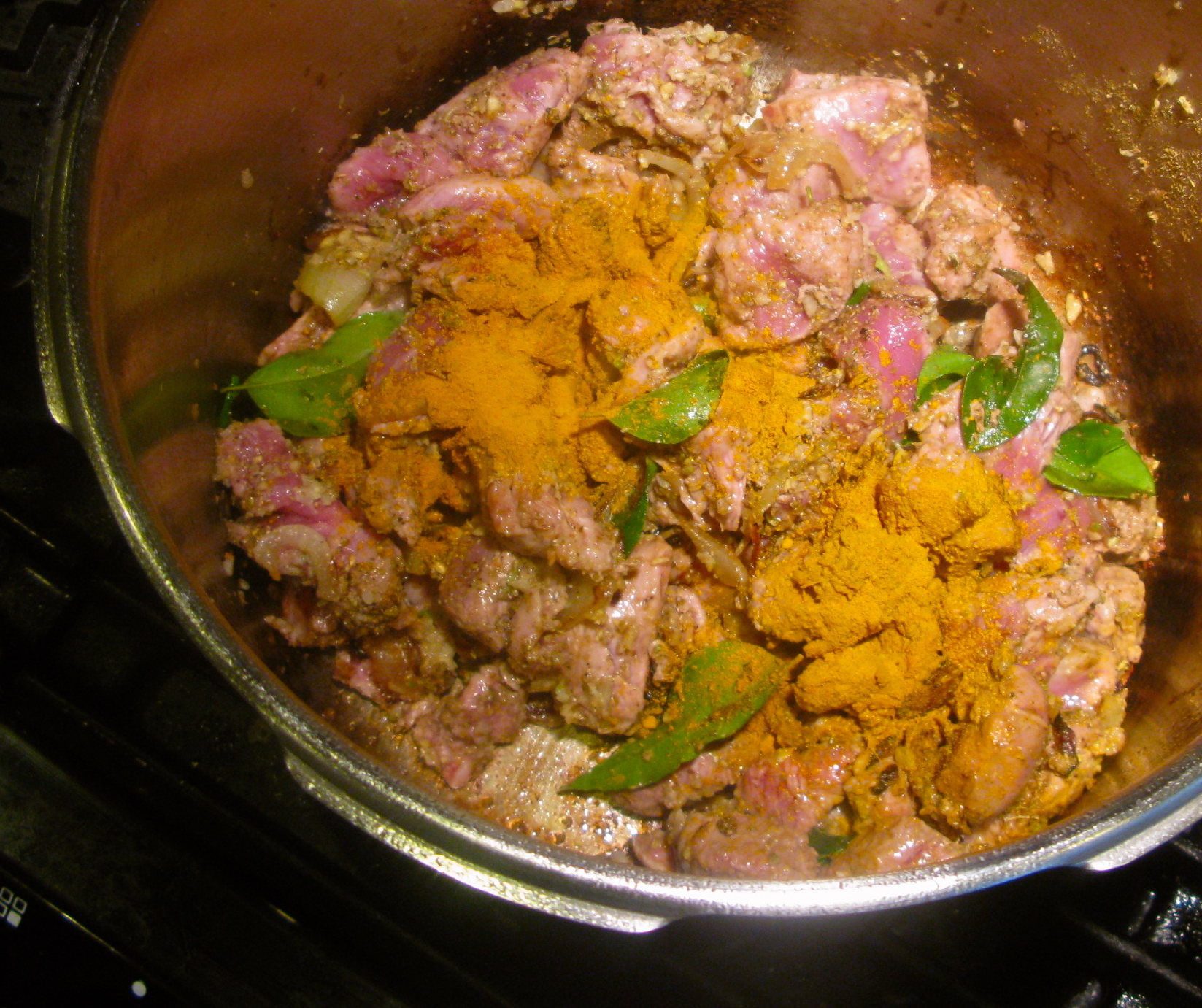
Lamb With Cilantro and Curry Leaf Sauce
Ingredients:
3 tablespoons ghee, canola oil or coconut oil
1 medium yellow onion, peeled and very thinly sliced
1 teaspoon salt
2 pounds lamb, cut into 1″ cubes and patted dry
3 to 4 large cloves garlic, minced
1″ cube fresh ginger, peeled and minced
1-3 red or green Thai chilies–to taste–stems removed and minced
10 fresh curry leaves
1 teaspoon fennel seeds
1/2 teaspoon cumin seeds
1 tablespoon coriander seeds
1/4 teaspoon fenugreek seeds
3 whole cloves
1/4 inch chunk cinnamon bark
25 green cardamom pods
1/4 teaspoon black peppercorns (you may add more of these to taste)
1 1/2 teaspoons dried turmeric powder
1/2 teaspoon paprika
1 1/2-2 1/2 cups lamb or chicken stock (For a pressure cooker, use 1 1/2-2 cups, for a regular pot use 2 1/2 cups)
2 heaping tablespoons Greek yogurt
salt to taste
1 tablespoon Aleppo pepper flakes
1 cup tightly packed fresh cilantro leaves
8 fresh curry leaves
whole cilantro leaves for garnish
Method:
Heat ghee or oil over medium heat in the bottom of either a pressure cooker or a large heavy bottomed pot. Add onion, slices, sprinkle with salt and stir. Cook, stirring, until the onion is a nice golden brown color.
Add the lamb, and spread so it is in an even layer over top of the onions. Cook undisturbed for about two minutes.
Sprinkle the minced garlic, ginger and chilies, and the whole curry leaves over the meat. Grind all of the whole spices into a powder and sprinkle over the meat, along with the turmeric and paprika.
Cook, stirring, until the lamb is mostly browned and the entire mixture smells very good. Pour in the stock and deglaze the pan carefully, scraping up any browned bits at the bottom.
If using a pressure cooker, bring the liquid to a boil, put the lid on the pressure cooker, lock it in place and bring up to full pressure. Turn down the heat to low, and cook for fifteen minutes, then remove from the burner and use the quick release method to release pressure and open the cooker.
For a regular pot, bring to a boil, cover, and turn heat down and simmer until the lamb is fork tender–about 40-45 minutes.
For both the pressure cooker and the regular pot, remove cover and return the heat to high. Boil to reduce the liquid until it thickens and is at about 1/3 of the starting volume. Basically, there should not be very much liquid left in the pot.
Add the two tablespoons of yogurt and stir well to combine. Turn the heat down and simmer 1 minute to incorporate the yogurt. Taste now for salt and add more if necessary.
Grind up the cilantro leaves and the 8 curry leaves in a food processor into a very finely minced green flurry. Scrape these tiny verdant bits into the pot and turn off heat. Stir well to incorporate. Stir in the Aleppo pepper flakes and then serve over rice on warmed plates immediately, garnishing with whole cilantro leaves.
This makes enough for 4-6 people, depending on what all else you serve with it.

Categories:
- Admin (rss) (55)
- Blogs and Blogging (rss) (81)
- Book Reviews: Cookbooks (rss) (43)
- Book Reviews: Non-Cookbook Food Books (rss) (38)
- Cats and Cat Blogging (rss) (47)
- Chinese Cooking Lessons (rss) (32)
- Culinary School Stories (rss) (18)
- Dairy Pruducts: Cultured and Barbaric (rss) (4)
- Documentary Filmmaking (rss) (1)
- Essays, Rants and Reflections (rss) (260)
- Fighting Hunger (rss) (12)
- Food and Kids (rss) (45)
- Food in the News (rss) (126)
- Food Media (rss) (98)
- Food Preservation (rss) (18)
- Food Safety (rss) (45)
- Gardening (rss) (30)
- Herbs and Herb Blogging (rss) (20)
- Holidays (rss) (50)
- Kat Blogging (rss) (22)
- Kitchen Science (rss) (36)
- Leftover Makeover (rss) (8)
- Life, the Universe and Everything (rss) (131)
- Local and Sustainable (rss) (227)
- Local Athens Food and Foodies (rss) (42)
- Meatless Mondays (rss) (32)
- Menu For Hope (rss) (5)
- Nutrition, Diet and Health (rss) (84)
- On The Farm (rss) (8)
- Recipes: Almost Vegetarian, Vegetarian and Vegan (rss) (294)
- Recipes: American Regional (rss) (37)
- Recipes: Appalachian Hillbilly (rss) (33)
- Recipes: Bread, Pasta, Grains (rss) (95)
- Recipes: Canning and Preserving (rss) (8)
- Recipes: Chinese (rss) (123)
- Recipes: Comfort Food (rss) (120)
- Recipes: Cookies (rss) (16)
- Recipes: Desserts (rss) (48)
- Recipes: French (rss) (25)
- Recipes: Fruits and Vegetables (rss) (302)
- Recipes: Greek, North African and Middle Eastern (rss) (31)
- Recipes: Indian (rss) (137)
- Recipes: Italian (rss) (42)
- Recipes: Japanese (rss) (7)
- Recipes: Jewish (rss) (4)
- Recipes: Korean (rss) (6)
- Recipes: Meat, Poultry and Fish (rss) (220)
- Recipes: Mexican/Native American/ Latin American/Caribb (rss) (27)
- Recipes: Original (rss) (108)
- Recipes: Thai (rss) (27)
- Recipes: Tofu (rss) (17)
- Recipes: US Regional (rss) (16)
- Recipes: Vietnamese (rss) (8)
- Restaurant Stories (rss) (28)
- Sewing, Quilting, Arts and Crafts (rss) (16)
- Simple Chinese Recipes (rss) (30)
- Slow Food and Heritage Foods (rss) (10)
- Spice Blogging (rss) (44)
- The Chinese Cookbook Project (rss) (14)
- The Chinese Pantry (rss) (39)
- The Documentary (rss) (2)
- The Kitchen Saga (rss) (17)
- The Locavore's Bookshelf (rss) (15)
- The Unsung Adventures of The Culinary Nerd (rss) (6)
- Tools and Toys (rss) (35)
- Uncategorized (rss) (10)
- With a Side of Politics (rss) (48)
Archives:
- August 2012 (9)
- July 2012 (12)
- September 2011 (3)
- August 2011 (7)
- July 2011 (8)
- June 2011 (16)
- May 2011 (17)
- April 2011 (11)
- December 2010 (9)
- November 2010 (5)
- February 2010 (1)
- December 2009 (5)
- November 2009 (7)
- October 2009 (10)
- September 2009 (16)
- August 2009 (14)
- July 2009 (14)
- June 2009 (7)
- May 2009 (17)
- April 2009 (10)
- March 2009 (25)
- February 2009 (13)
- January 2009 (10)
- December 2008 (5)
- November 2008 (5)
- October 2008 (6)
- September 2008 (13)
- August 2008 (8)
- July 2008 (11)
- June 2008 (18)
- May 2008 (13)
- April 2008 (14)
- March 2008 (16)
- February 2008 (17)
- January 2008 (19)
- December 2007 (25)
- November 2007 (18)
- October 2007 (24)
- September 2007 (16)
- August 2007 (15)
- July 2007 (15)
- June 2007 (10)
- May 2007 (14)
- April 2007 (16)
- March 2007 (17)
- February 2007 (20)
- January 2007 (13)
- November 2006 (1)
- October 2006 (8)
- September 2006 (14)
- August 2006 (25)
- July 2006 (30)
- June 2006 (28)
- May 2006 (34)
- April 2006 (29)
- March 2006 (24)
- February 2006 (30)
- January 2006 (38)
- December 2005 (40)
- November 2005 (37)
- October 2005 (32)
- September 2005 (25)
- August 2005 (30)
- July 2005 (28)
- June 2005 (21)
- May 2005 (8)
- April 2005 (22)
- March 2005 (17)
- February 2005 (29)
- January 2005 (10)
Search Site:
Links:
- Lily’s Wai Sek Hong
- 101 Cookbooks
- A cat in the kitchen
- A Veggie Venture
- Accidental Hedonist
- Cha Xiu Bao
- chez pim
- Chocolate & Zucchini
- Chopstick Cinema
- Chowhound.com
- Chubby Hubby
- Cook sister!
- Cooking with Amy
- da*xiang
- Eat Local Challenge
- Eating Liberally
- Ecocentric
- Eggbeater
- Epicurious
- Farmgirl Fare
- Fatfree Vegan
- Foodgoat
- ForkandBottle.com
- Green Olive Tree
- Hooked on Heat
- Jaden’s Steamy Kitchen
- Kalyn’s Kitchen
- Lucullian delights
- Mahanandi
- Matt Bites
- MeatHenge
- mmm-yoso!!!
- New York Times – Dining & Wine
- Pizza Goon
- Rasa Malaysia
- Ruhlman
- Sailu's Kitchen
- Serious Eats
- SF Gate: Food & Dining
- Simply Recipes
- Soul Fusion Kitchen
- Tastespotting
- The Amateur Gourmet
- The Cleaner Plate Club
- The Food Section
- The Grub Report
- thecookscottage
- U.S. Food Policy
- Wandering Chopsticks
- Washington Post Food and Dining
- Wasted Food
Meta:


Powered by WordPress. Graphics by Zak Kramer.
Design update by Daniel Trout.
Entries and comments feeds.