
Cook Local, Eat Global
Meatless Monday: Eats Roots and Leaves Salad With Blueberry Balsamic Vinaigrette
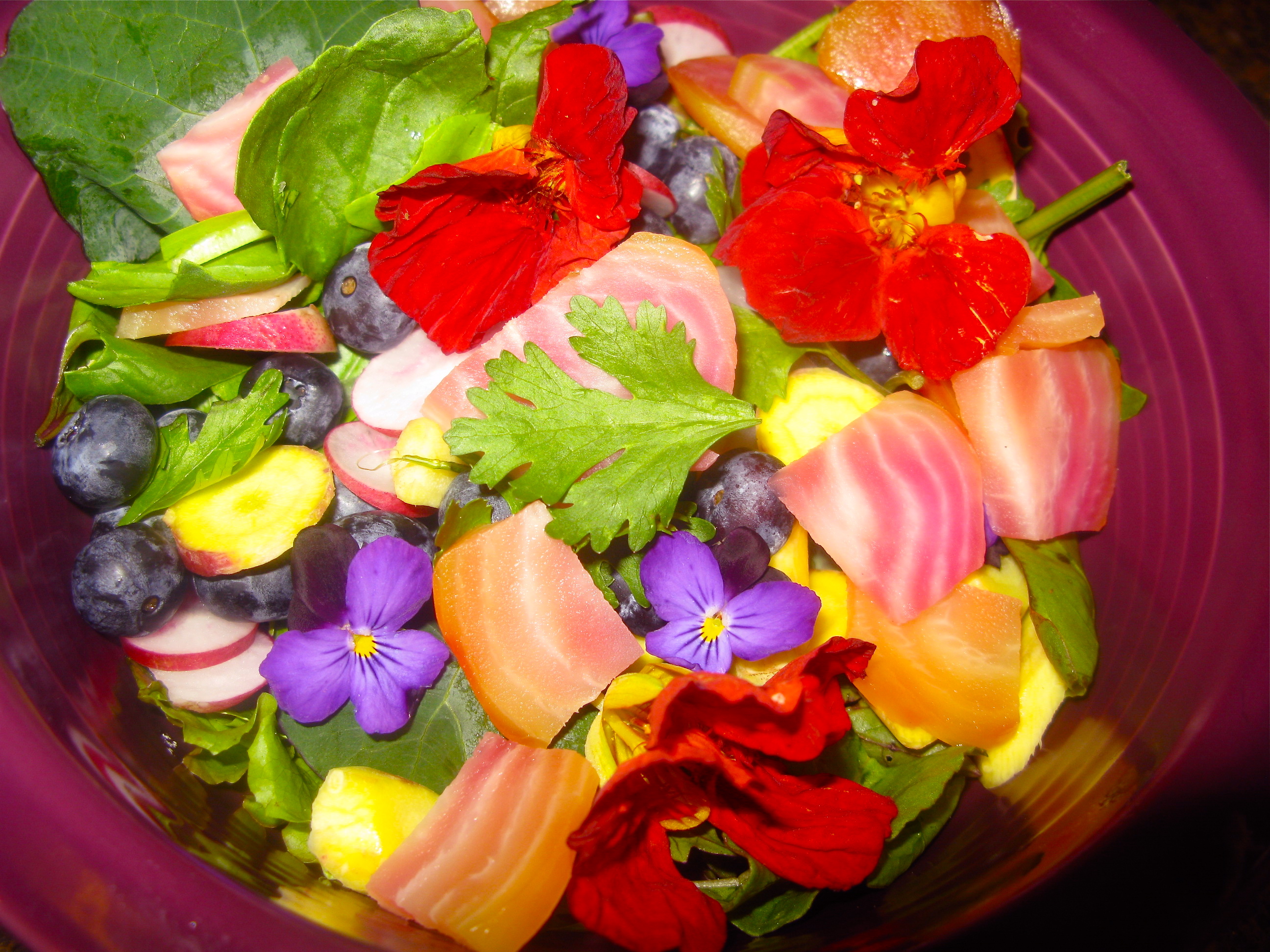
And flowers, and fruits.
Yes, I named the salad we ate tonight as a play on the famous book on punctuation by Lynn Truss, Eats, Shoots & Leaves. It’s because I used the first two carrots and the first beet that Kat pulled out of our garden plot. The carrots as you can see in the photo above, were yellow with purple skins, and the beet–well, it looks like some sort of psychedelic cross between a regular red beet, a golden beet and one of those striped white and red Italian “Chioggia” beets.

Kat not only was very proud of her two big carrots and big beet, she helped eat them, too.
There is nothing better to get a kid to eat their vegetables than to have them intimately involved in the planting, care and harvesting of said vegetables. I’m sure that’s part of why I was an enthusiastic vegetable-muncher as a child–I helped Grandma and Grandpa with every aspect of growing them. I knew how to plant seeds, weed, transplant seedlings, weed, harvest and weed by the time I was three.
I did a lot of weeding. I think it’s because Grandma and Grandpa had more trouble getting down among the weeds than I did by that time. Being three, young and short, made me a very good weeder. I was especially valuable among the strawberry bed and the turnip patch, where quick little eyes and quicker fingers could spot a blade of grass coming up between thickly planted berries and snag it from the ground before an older person even noticed it from way up where their eyes were.
But, I digress, as is often the case.
What about the leaves in this salad? Well, they are a mixture of the last of lettuces, some delicious fresh baby spinach (“Regatta” and “Bordeaux”–the former resists bolting really well and the latter is both delicious and very pretty with its arrowhead shaped emerald green leaves and fuchsia red veins and stems), baby bok choi and purple mizuna. When I say the last of the lettuces, what I mean is the last of the lettuces planted in our raised bed. I have a planter of the lettuces nearly ready to harvest up on our deck as well–they should be ready in about a week or so. The lettuces in our bed, which I planted in April, have finally started going to seed–which means they’ve started to send up flower shoots, and that makes them bitter. When you cut your lettuce leaves or heads right above the soil line and a white, milky juice flows out, you know its gone bitter.
I still have plenty of beautiful lettuces in that bed, but fear not–they shall not be wasted. Morganna is braising a rabbit tonight and tomorrow, she said she’d cut the rest of the lettuces down, and then braise them like the French do in the leftover rabbit stock. What a clever girl I have raised!
As for the flowers and fruit–well, the nasturtiums and violet colored violas were picked out of our garden plot today, and the blueberries came from the Farmer’s Market this weekend.
The dressing is super-simple–a balsamic vinaigrette that uses a locally produced blueberry syrup in place of half of the balsamic vinegar. This gives a fruitier flavor than my usual balsamic dressings, and in the context of this salad, it just tasted like the essence of summer.
Which is what this salad is–the colors, flavors and scents of summer on a plate. Or in a bowl. And it provides most of your full day’s supply of vitamins, minerals, leafy greens, fruits and vegetables.
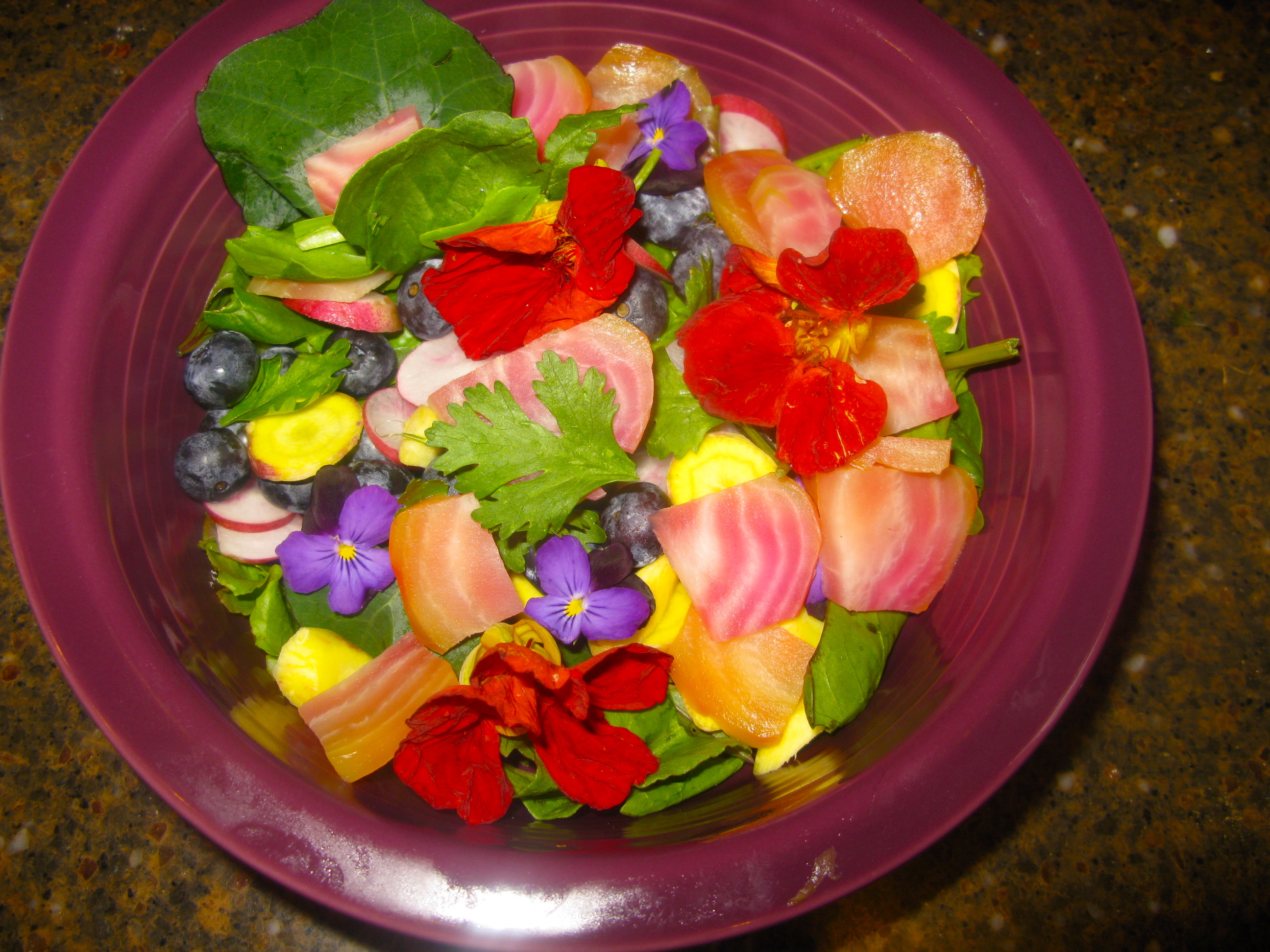
Eats Roots and Leaves Salad With Blueberry Balsamic Vinaigrette
Ingredients:
1 beet of whatever color you like (and if you can get a psychedelic one like ours, all the better)
4 cups of mixed summer salad greens, washed and dried. Use as many colors and textures you can.
2 large sweet carrots of whatever color(s) you can find
1 4 radish, thinly sliced
1/2 cup fresh blueberries, washed and dried
handful of viola blossoms
3-5 nasturtium blossoms–mix and match colors if you can!
1/2 cup cilantro leaves
1/4 cup lovage leaves
1/8 cup balsamic vinegar
1/8 cup real blueberry syrup, or blueberry juice
3/4 cup good extra virgin olive oil
1 tablespoon honey (or to taste)
1 teaspoon soy sauce (or to taste)
Method:
Preheat oven to 375 degrees F. Wash beet well, scrubbing all dirt from the skin. Trim the beet leaves to 1/4″ and reserve leaves for another recipe. Trim any long root from the other end of the beet. Wrap up loosely in a square of foil and toss the beet directly on the oven rack and bake for 40-50 minutes, or until a fork pierces it easily.
Rinse in cold water to cool beet.
While beet roasts, wash and dry the greens, then peel the carrots and cut them into 1/4 inch thick slices on a slight diagonal. The slices should be oval shaped when you are done.
When beet is cool, peel it, and cut into slices of whatever shape you like. You can also dice the beet. I tend to cut beets in half and then cut each half into slices.
Arrange the salad greens in a chilled bowl, and sprinkle the carrot slices, radish slices, beets and berries evenly over the top of the leaves. Arrange the herb leaves and then the flowers over the top of the salad, and let salad sit in the fridge while you make the vinaigrette.
Put all ingredients to the vinaigrette into a bottle and shake until emulsified. Drizzle as much as you like over the salad, toss and serve immediately.
Cooking Ahead: The Slacker Method
There’s a blog post called “Freezer Meals on the Cheap” that’s going around the ‘net these days that has some good advice for cooking and filling your freezer with food so that you can have “fast food” that is still home-cooked for days when life is too hectic for you to even think about cooking. Great ideas are presented in the post for buying up foods on sale, and then spending a weekend afternoon, cooking those foods up and portioning them out into containers and freezing them.
I’m very familiar with this way of cooking because that’s what I used to do for other people back in the day when I was a personal chef in Maryland. I used to get up in the morning, go grocery shopping for one of my client families, go to their house with my box of equipment and car full of food, and then cook up enough entrees and side dishes that were freezer friendly for a week’s worth of meals. Then, I’d freeze the meals in containers, clean the kitchen get paid and go home.
It’s not a bad way to do things, but for people who work and are loathe to give up a weekend afternoon–and frankly, I don’t blame you one bit for wanting a weekend afternoon that is NOT spent in the kitchen–it just sounds like too much work. And that’s because it IS work.
I just wanted to let you know that there’s an easier way to go about this, and while it works more gradually, it still works. This “slacker method” of cooking ahead has saved me on many a night when I was either too damned tired to cook anything or too damned busy to remember that I had to cook dinner until it was, oh, a half an hour before dinner time.
All you have to do is this: on a night when you are cooking something that goes nicely in the freezer, cook at least twice the amount you need. Then, when the food is done, you put it in a container or wrap it up and put it in the freezer.
Most foods that go well in a freezer don’t really take any longer if you double or even triple the recipe. Mind you, when I first started using my “slacker method,” I didn’t even do it on purpose: (that’s how you can tell its the “slacker method–” I came upon it by accident!) I wasn’t doubling or tripling my recipes–I was having trouble transitioning from cooking in quantity as a chef at work to cooking for two adults and one toddler at home. So, I accidentally cooked too much and had a buttload of leftovers that I had to do something with.
Rather than eat the leftovers for a week, I started packaging them up and putting them in the freezer to be used the next time I came home from work in time to cook dinner but without an ounce of will or gumption to stand in front of a stove again. On those nights, I could open up my freezer door, find a container marked, “taco filling,” defrost it in the microwave, heat up some taco shells and shred some cheese and cut up lettuce and cilantro, and BOOM! Like magic, a home cooked, nutritious meal seemingly out of thin air, put on the table faster than you can say, Rachael Ray. (With nary an utterance of EVOO in sight or hearing range.)
I’ve since refined my slacker method of cooking ahead. I actually keep freezer bags, reusable plastic (BPA-free, of course) containers, and a Sharpie marker in my kitchen so I don’t have to go hunting around frantically when it’s time to package stuff. (In my early days of cooking this way, I neglected to label some containers thinking, “Oh, I can tell chili from taco filling!” only to find that when I’m tired, headachy and hungry, no, I can’t.) I also buy extra ingredients on purpose and everything.
Dishes that are good for this method include chili, beans, lentils, stews, curries, mashed potatoes, nearly any kind of pasta sauces including marinara, puttanesca, pesto, and bolognaise, meatloaf, soups, rice dishes like jambalaya and pilaf, and casseroles like lasagne, squash (or any vegetable, now that I think on it) gratin, and arroz gratinado.
Lasagne is a great example of the slacker principle at work. It’s already a pain the butt to make and it takes a while. I have found over years of extensive experimentation (that’s a fancy way of saying, trial and error) that it takes no longer to layer noodles, fillings, sauces and cheeses into three casserole pans as it does for one. The prep is also not much more onerous for three pans as it is for one–the prep time doesn’t triple, or even double, but rather takes half again as much time as it would normally. (And for lasagne, I have found that shortcuts like using pre-shredded cheeses–which is not going to kill you–really cut the prep time down considerably.)
That’s a lot of different types of dishes. And truly, most of these dishes, if you double or even triple your recipe, you aren’t doubling or tripling your cooking or even your prep time. In my experience, it doesn’t take twice as long to make a six servings of puttanesca as it does to make three. Nine servings takes maybe five minutes of prep time longer for the same recipe. Pesto–if you make it in your food processor, only takes more time to pick off more leaves from your basil, but really–how long does it take to pick leaves off of basil in the first place?
Yeah. Not that long.
The beauty of this slacker method of cooking ahead is that if you cook five times a week normally, and you double the amounts you are cooking, you have put away meals for five days in the same time as it takes to cook dinner for those five nights anyway, with maybe 15 extra minutes added on.
And personally, I think it’s a heck of a lot less intimidating to spend an extra fifteen minutes five times a week for a total of one hour and fifteen minutes of extra labor, than it is to spend a whole a afternoon–two to four hours say–cooking all day on a weekend when you could be spending time with your friends and family doing something fun. The end result is the same–you fill your freezer over the course of five days with five more days worth of dinners. Do that a couple of weeks in a row and you have built up a stock of really varied, healthy, home-cooked meals for you and your family to enjoy on evenings when time is of the essence, or when everyone is just too damned hot/tired/cranky/or otherwise poopy to even think of cooking from scratch.
Yes, I’m ignoring the fact that for some of us, spending two to four hours cooking on a weekend afternoon is fun, because I’m not writing for us–I’m writing for everyone else. Or rather, I’m writing for the folks who do think its fun, but have other things to do on the weekends than cook all afternoon. And, I’m writing for the folks who are really intimidated by cooking five or six different dishes and packing them up for the freezer in the span of an afternoon. Let’s face it, that’s lots of prep, cooking and clean-up, and if you aren’t a professional, like me, or someone who just cooks a lot habitually, that kind of cooking marathon can seem like endless, purgatorial and just plain old no damned fun.
In conclusion, I want you to try my slacker method. It’s perfect remedy for busy folks who want good, nutritious, home cooked food, but who just have days when they can’t pick up the knife and saute pan.
As for recipes that work really well for cooking ahead–try these from my archives–I’ve used them for slacker freezer stockpiling exercises for years, and they never fail to taste good.
Taco Filling
Mangalore Chicken Curry
Mixed Greens and Mushroom Dal
Chana Bhatura (you can freeze the bhatura dough before cooking it, then thaw it out and fry it)
Shepherd’s Pie
Jamaican Beans and Rice
Arroz Gratinado
Braised Rabbit With Marsala Wine and Wild Mushrooms
There are plenty more applicable recipes here at Tigers & Strawberries–I just gave you a few to start out with.
Have fun cooking and filling your freezer like a slacker all week, and then enjoy doing nothing this weekend! It’s a good thing.
Slacker Notes:So, uh, when I wrote this post, I was such a slacker, I didn’t really give as much specific information as perhaps I could or should have, so some readers asked a few great questions down in the comments section. I decided that the information was so pertinent, that I should just put it up here in an addendum to the original post just so folks who aren’t in the habit of reading the comments to a blog post get the benefits of it, too.
Casserole Specifics
Okay, for lasagne or other casseroles–a reader asked if I cook it first and then freeze it, or I assemble it and then freeze it uncooked.
The answer is: I’ve done both and they both work pretty well.
And there are several ways to go about it. You can just make your regular one big pan of lasagne, (one that normally serves six people, say, and its only you and a significant other eating) and bake it as normal and then after dinner, cut the remaining lasagne into one or two portion bits and pack them up in containers, and then you can either thaw them in the fridge or microwave them from frozen. Works just fine. I’ve done it with lasagne, arroz gratinado, macaroni and cheese and shepherd’s pie, and none of them have suffered a bit for it.
Or, you can assemble one or two extra whole casseroles in freezer to oven dishes, and freeze then uncooked. To cook them, preheat your oven to about 25 degrees lower than your usual cooking temperature for that particular casserole, and bake it for about 50 percent longer than you usually would. In order to brown the top of your previously frozen casserole, in the last fifteen minutes of baking, turn the heat up on the oven to the regular temperature and that should give you a nice crusty brown, bubbly top.
I’ve frozen moussaka, pastitsio and lasagne this way and baked them both thawed and frozen and they all come out of the oven smelling and tasting divine.
Now, this isn’t very slackeriffic, because it involves prior planning, but if you just know that tomorrow is going to suck big-time at work and you are going to come home hungry, cranky and just plain not in a mood for cooking, you can take one of these uncooked casseroles out of the freezer and let it thaw in the fridge until you get home from work the next evening. Then, you preheat your oven all the way to its usual temperature and bake it as usual, just adding an extra five to ten minutes to the time it spends in the oven.
See–isn’t that simple?
Thawing Out And Reheating Liquids
I didn’t even think about telling everyone how I thaw out liquidy dishes like soups, stews, curries and sauces that freeze into a coherent block of ice until Kim, down below, asked me how to go about it. She’s right–beans and rice or taco filling or jambalaya–stuff that is relatively dry is simple to heat up from frozen in the microwave. But those troublesome liquidy dishes are a pain in the butt, and while yes, you CAN put them in the fridge to thaw overnight and during the day while you’re at work, planning ahead just isn’t a slacker-approved activity.
So, how do you get say, marinara sauce and meatballs that has frozen into a scarlet cube of tomato sorbet to thaw and heat up quickly?
This is going to sound bass akwards, but the way I do it is I use the defrost function on my microwave to get the frozen liquid to mostly return to a fluid state, and then I plop it all into a saucepan and finish heating it up to a boil on the stove.
My microwave has a defrost function that sets the time and temperature for thawing a frozen item based on its weight. A true slacker like me guestimates the weight, but if you have a baker’s scale you can tell your microwave the exact (or rounded up) weight of the marinara and meatballs. (In fact, if you are only partially a slacker, and are thus somewhat organized, you could write the weight of the item on the label when you pack it up for the freezer in the first place, so you don’t have to play guessing games or find your scale after work.)
Anyway, use the defrost function on your microwave and when you’ve got your stuff mostly thawed out, with maybe a little bit of ice in the center of the container, just sploosh the contents of said container into a saucepan, turn the heat on high and stir like mad, chipping away at that ice until it breaks apart and melts into the rapidly boiling liquid that surrounds it. Then, you just stir and cook until everything is heated through to serving temperature.
And then, dinner is served!
Tips from Readers:
So, as is usual, I got some nice ideas from readers. Just for the folks who don’t read comments, here’s some ideas that didn’t come from my slacker self, but instead are from the myriad of good, clever cooks who read this blog:
From Jenny V: One thing that can work if you’re cooking an entire extra casserole or lasagne is to line the baking pan with foil before filling it with the food. Then, after it is frozen solid, you can remove the pan from the freezer, leaving the foil-wrapped food behind in the cold, and add it back to your cabinets to use for other meals in the meantime. When you want to eat the leftovers, just pop the pre-formed foil container into the baking dish again and bake.
My Current Favorite Vegetable Variety: Cascadia Snap Peas
While herbicide contamination in commercial compost seems to have stunted many of my plants, it hasn’t stopped my six raised beds at the Westside Community Garden from producing decent crops.
Many of my radish plants have stunted, twisted roots, but I do have a big beet ready to pull from the ground, and other beets coming along slowly, but surely. My purple baby bok choy have taken months to grow to the height of three inches–which is weeks slower than they should be, but my purple mizuna is huge and beautiful. My tomato plants are covered with blooms and fruit, and
even my poor, sad eight-inch tall haricot vert plants are blooming wildly and producing harvestable beans.
And my lettuce patch has yielded four huge harvests so far and is still going strong, while the Slow Bolt cilantro is living up to its name and is producing a weekly harvest of flavorful green leaves and stems.
So all is not lost, not by a long shot. I consider my disappointing experience with bagged commercial manure and compost to be a learning opportunity, and have filed the data I have learned from it away in my memory banks, (and garden journal!) to be used for seasons long after this one.
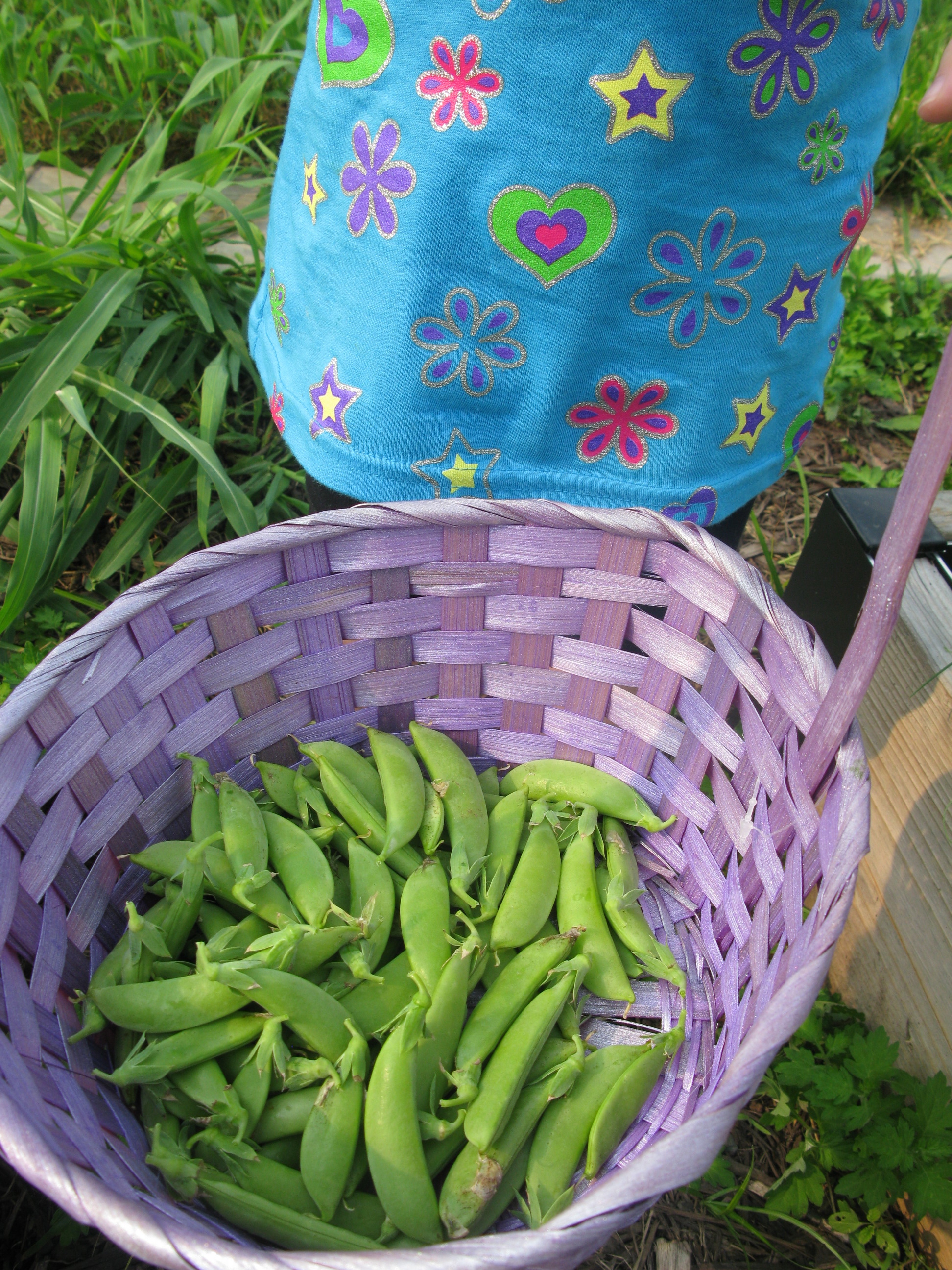
My favorite surprise vegetable success this year is sugar snap peas.
To be specific, “Cascadia” sugar snap peas.
My Grandpa complained about how hard peas were to grow in the garden, and many home gardeners find peas to be a lot of work, and that they take up a lot of space for a very small harvest.
Cascadia, however, has surprised me with it’s prolific nature.
Kat and I first harvested it a couple of weeks ago, and while we worked, I noted that there were plenty of blossoms left on the plant, so I didn’t do what my Grandpa always did–after he harvested peas, he pulled them up and gave the vines to the cows to eat (I’d have composted the vines, having no cows to feed), and planted something new there. I figured–“let’s see how many peas we get from this second flush of blossoms.”
Anyway, we picked a generous quart off of the plants intensively planted in three square feet of space. Even though the vines are 1/3 smaller than they should be–they are only about two feet tall rather than three–they still produced a massive amount of pods, though some were a bit undersized–just as the vines were.
So, last week, on Sunday, Kat and Zak and I were thrilled to find another bunch of peas dangling from the vines. We picked those and got about 3/4 of a quart. There were one or two blossoms left and I thought I might pull them, but then decided not to, because Kat wanted to go home and it was starting to rain, and thunder was rumbling in the distance.
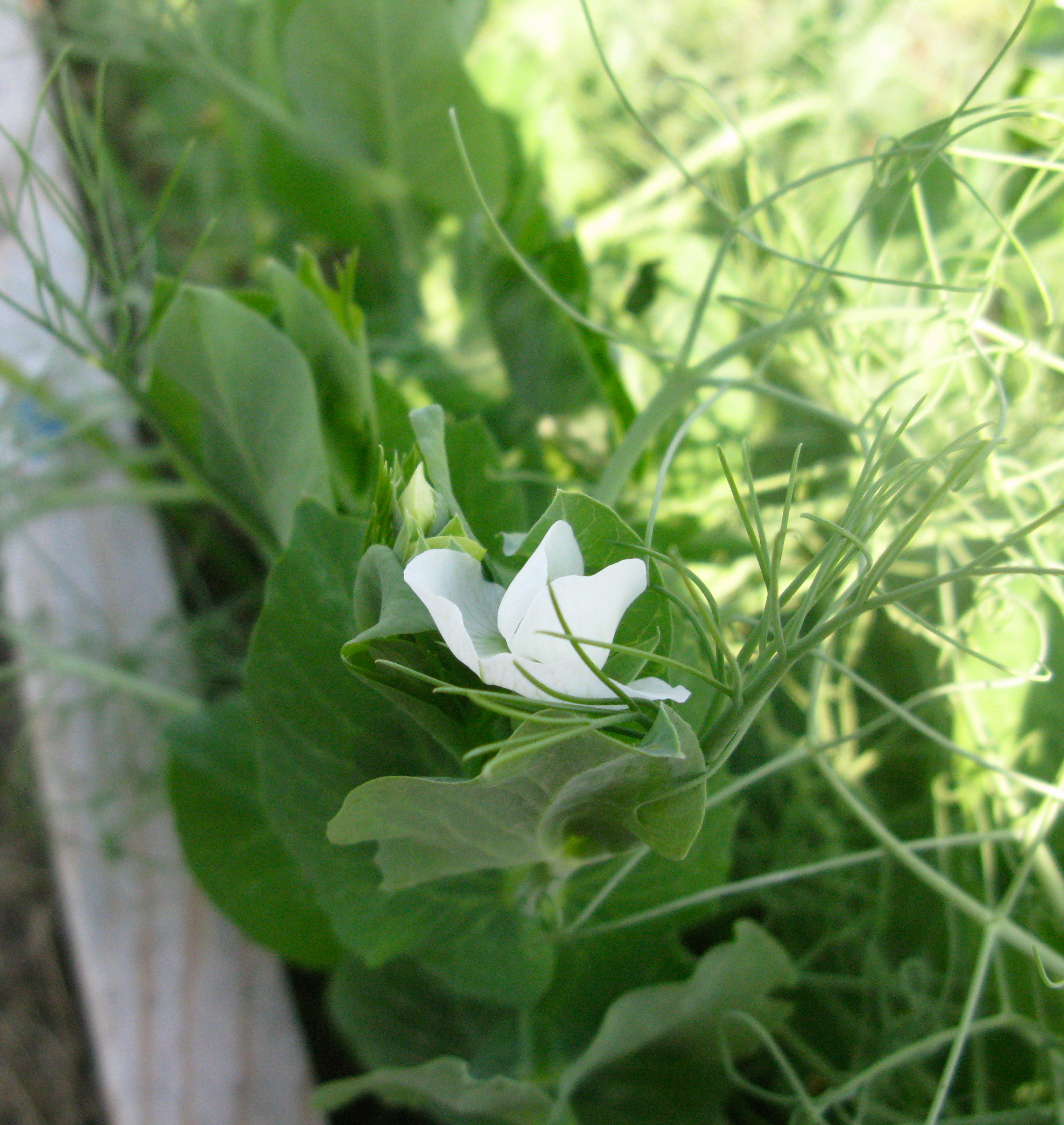
Imagine my surprise today, just THREE days later, when I showed up at the garden, ready to pull peas and plant broccoli raab seeds, to find the vines covered with a third flush of beautiful white blossoms! And when I say covered, I swear this third wave of blooms has more flowers on it than the other two combined.
And, on top of all of this, the peas are sweet, crisp and juicy. Eaten raw, they are sugary without a hint of the bitterness that sometimes comes accompanies raw peas, and when cooked they are sublime.
So, needless to say, next year, I’m planting Cascadia again, (and more than just three square feet of them, too) and I highly suggest that any other sugar snap pea lovers among you do the exact same. Even under the worst conditions, this variety really produces amazingly well.
Big Damn Heroes Steak
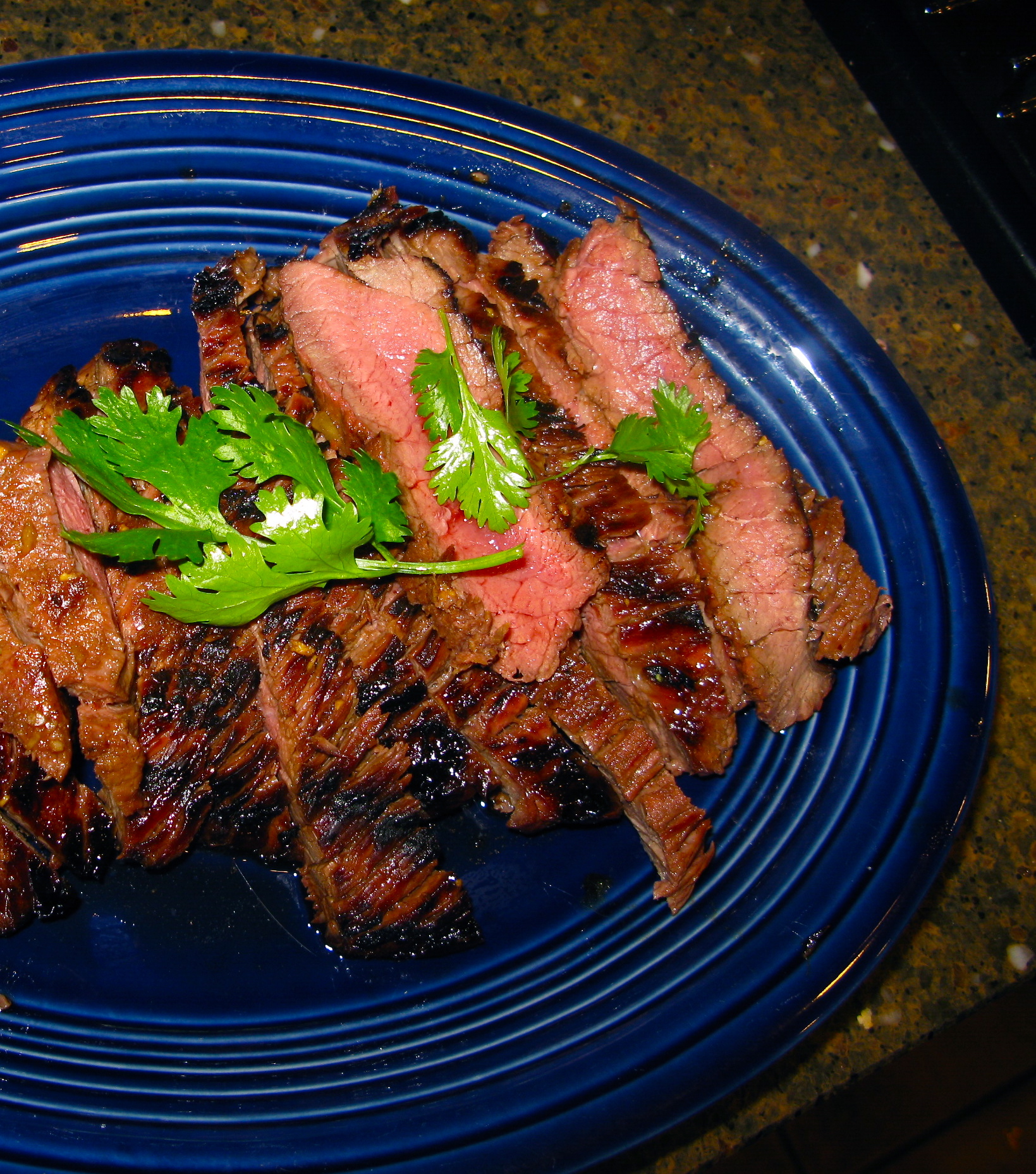
Ain’t it just?
Yeah, the name of this dish is a reference to one of my favorite SF television shows, the short-lived “Firefly.” In the future posited by Joss Whedon in “Firefly,” humanity has long ago left Earth, known as “Earth-That-Was,” to colonize a star system that consists of many terraformed planets and moons. A big war in the recent past occurred between the “Alliance,” which appears to be a governmental entity that favors corporations and the interests of affluent citizens, and the “Browncoats,” a group of rebels who favor the interests of the people who live in the frontier moons in societies that are much less affluent than those of the core planets, to the point that they are often impoverished or treated by corporations as slaves. The war was lost by the Browncoats, and it is from their ranks that many of the main characters of the ensemble cast of “Firefly” originate.
The term, “Big Damn Heroes,” comes from the episode “Safe.” Click the link to see the pertinent clip of the episode.
One of the most interesting parts of the background of “Firefly” is the blend of cultures represented in the show. Instead of a straight up “space opera” along the lines of “Star Wars,” where a fairly homogenous culture for humanity is posited for both the Empire and the Rebels, Whedon extrapolated from present-day culture that near future human culture would be a blend of Western, particularly, American influences, and Chinese culture, though the blending also includes bits of Japanese, Middle Eastern and other influences. American culture is very strongly represented by an Old West flavor in the costuming, sets, English vernacular, weapons, and even agricultural practices (cattle ranching and cowboys), especially on frontier moons.
So, now, we finally get the steak. It’s a combination of Japanese and American cowboy flavors and aesthetics, with ingredients that range from tamari soy sauce, mirin, garlic, ginger and sesame oil, to sugar and a good slug of cowboy whiskey in the form of Jack Daniel’s “Tennessee Honey” blended whiskey and honey liquor. And, I named it in honor of Dan, the hardworking site admin who single-handedly rescued this blog from the clutches of unscrupulous and devious hackers who decided to use it as a platform to defraud decent folk out of their hard-earned money.
I named it in honor of Dan, because it was the main course of the dinner I cooked for him (along with itty bitty cheesecakes) as a thank you for his heroic work restoring this blog to its proper functioning.
I used a less tender, but very flavorful cut of beef for this recipe: top round. Often marketed as “London broil,” top round is a fairly lean piece of beef that is usually cut about 1″ thick, and is well suited to many purposes, including grilling, broiling and when sliced thinly, stir-frying. As such, I often have a piece or two of it in my freezer, waiting to be transformed into one or another grilled or stir-fried dish at the spur of the moment. Top round isn’t a very tender piece of beef, however, so you have to cook it carefully, and present it thinly sliced. It’s flavor, however, is classically beefy without being as rich as a fattier steak like a ribeye or strip steak.
Instead of top round, one could also use a similarly tougher cut like flank steak or hanger steak for this dish–hell–you could use a more tender cut of beef like a porterhouse if you wanted to, but really, truly, I prefer the toothsome quality that the top round brings to this dish. (As Zak said last night, “London broil is a toothsome, but delicious piece of meat.”) Having to chew the meat a bit longer seems to result in giving your tastebuds more time to be entranced by the zesty marinade/sauce.
And, so, we come to the marinade, which as noted just above, also doubles as a sauce. I let the beef sit in it for about two hours–long enough for it to come to room temperature in preparation for grilling. (Meat is easier to cook accurately on a grill when it’s not cold. Cold meat takes longer to cook on the inside, and can lead to too underdone or overdone steak, neither of which is a happy thing.)
After putting the meat on the grill, I reserve a small amount of the marinade with which to baste the steak, while pouring the rest into a small saucepan and bringing it to a quick boil. After boiling it to kill any possible germs in it from the raw beef, I add another slug of the honeyed Jack Daniel’s to it, and cool it down to room temperature to give it a final, alcoholic kick. This I pour back into the container I used to marinate the steak (after I wash said container well, obviously) so the steak can be set back into the sauce to rest before slicing and serving.
After giving it a five minute rest in the sauce, I take the beef out and carefully carve it into thin, diagonal slices against the grain of the meat–cutting it this way shortens the muscle fibers and makes the meat more tender than it would be if you sliced it with the grain.
Then, I served the sauce, enhanced with roughly chopped cilantro, in a little gravy boat on the side.
Nothing could possibly be simpler.
And, it’s a fitting tribute to the beef-eating Big Damn Hero in your life.
Big Damn Hero Steak
Ingredients:
1 1/2 pound 1″ thick top round steak
2″ cube fresh ginger, peeled and finely minced
1 large clove garlic, peeled and finely minced
1/4 teaspoon Aleppo pepper flakes (or other mild chili flakes)
1 tablespoon raw sugar
1/4 cup mirin
1 1/2 tablespoons tamari soy sauce
1 teaspoon toasted sesame oil
3 tablespoons Jack Daniel’s Tennessee Honey, divided into 1 1/2 tablespoon increments
roughly chopped fresh cilantro
Method:
Place steak in a shallow baking dish. Rub well with the ginger, garlic, sugar and chili flakes on both sides.
Mix together the liquid ingredients well (use only the first 1 1/2 tablespoons of the whiskey), and pour over the steak, turning the meat once to coat both sides with the liquid.
Cover tightly with a piece of plastic wrap and let sit at room temperature for about two hours.
Prepare a charcoal grill for direct grilling. We like to use hardwood charcoal with soaked wood chips for smoking when we grill. For this dish, we used mesquite chips soaked and placed in a little box that is laid over the coals. You can also put them in a loosely wrapped foil packet and put that on the coals, or you can put them directly on the coals. Whatever you want to do. Just make sure that the fire is at least 400-450 degrees F.
When the grill is ready, oil the grate however you prefer, whether you use a spray or an oil-soaked paper towel held by long tongs rubbed over the grate.
Put the steak on the grill, brush the top with some marinade and close the grill cover. While the steak cooks, pour off most of the marinade into a small saucepan, reserving a bare tablespoon to baste the other side of the meat when you turn it.
Bring the marinade to a boil, let it boil for a minute, then add the remaining 1 1/2 tablespoons of whiskey. Wash the baking dish used for marinating the meat and pour the sauce back into it.
Turn the steak after about five minutes (for it to be cooked rare. For medium, cook longer. Please don’t cook top round to well done), and baste with the reserved tablespoon of marinade. Close grill lid again and cook for about another five minutes.
Remove meat from fire, put it back into the washed baking dish with the boiled marinade/sauce, and let rest for five minutes while you clean the grill.
After resting, remove steak, slice it thinly on the diagonal against the grain, and arrange on a serving platter. Sprinkle marinade/sauce with chopped cilantro and pour into a serving boat to be served on the side of the meat.
Meatless Monday: Grilled Corn With Secret Butter Sauce
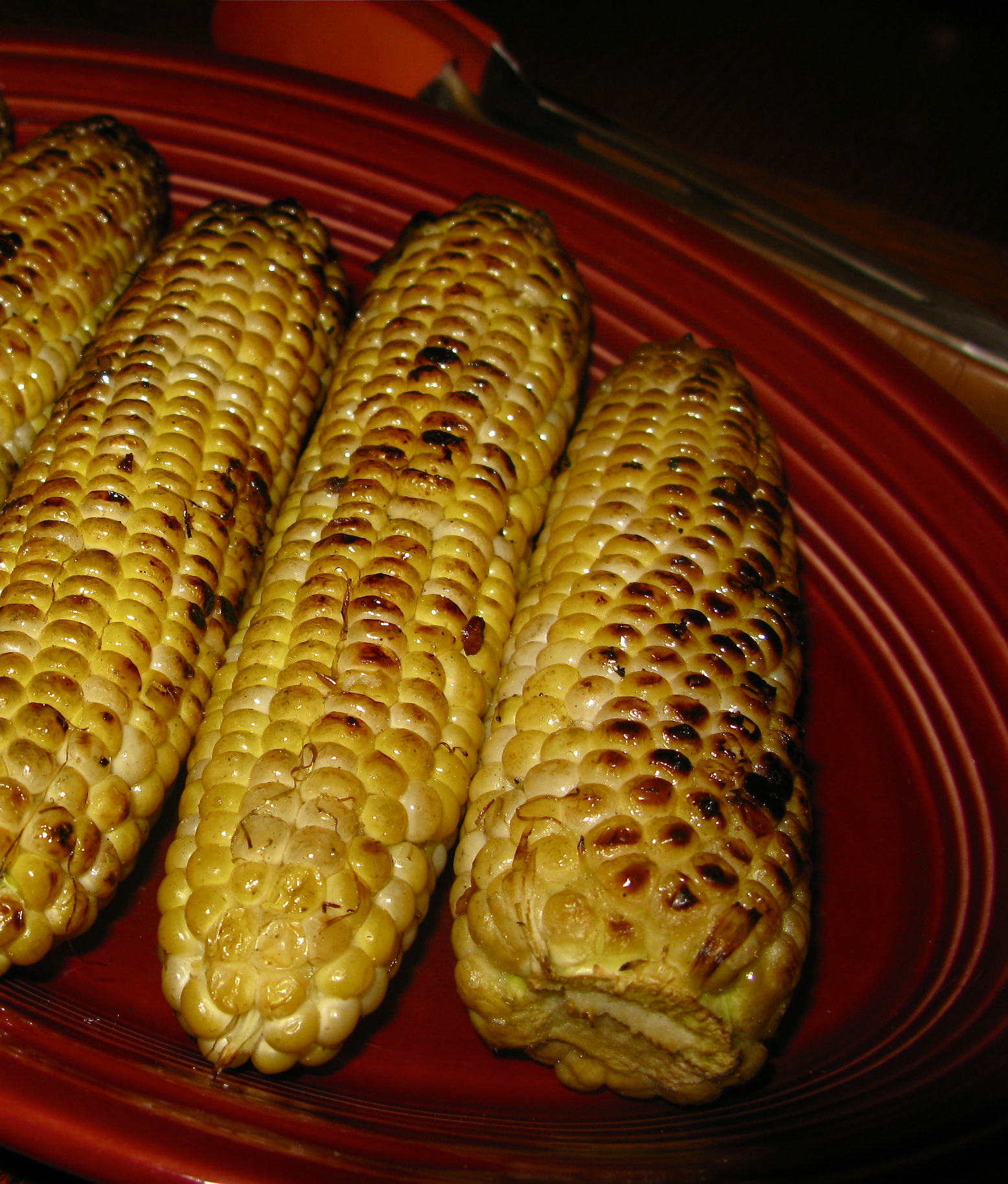
I used to love boiled corn on the cob. It was what I grew up eating, in copious amounts. When I was a growing teenager helping out on the farm, I could easily down three to four ears of fresh corn per meal without a thought, along with helpings of the green beans, tomatoes, potatoes and whatever meat happened to be there, too. It was all so good.
But then, Grandma once made roasted corn on the grill Grandpa built for them out of scrap metal and tractor parts. She had us pull the shucks off of the ears, but leave them attached to the stem below, which she cut long. (She harvested corn with a machete. Yeah, Grandma was a badass.) Then, we meticulously picked the silk off of the ears and she slathered room temperature butter over the ears, salted and peppered them liberally and then wrapped the husks back over the ears, tying them with twine at the top to hold them.
These corn “packets” she then set on the grill directly over hot coals to cook. She turned them often, using the long stem as handles, and while a bit of burning happened to the shucks, because they were green, fresh and filled with moisture, they didn’t go up in flames. Instead, parts would burn through and caramelize the corn underneath.
After about ten or fifteen minutes, depending on how hot she made the fire, she’d pull the corn off the grill, and snip the twine holding the leaves around the cob, and push them back down toward the stem, twisting them around the stem so we had a convenient, reasonably cool “handle” to hold our corn so we could eat it.
I fell in love, right then and there with smoky, fire-roasted corn. She had used older ears of corn for it, so they were a bit tougher and chewier than the milk-sweet corn she boiled, with the kernels so tender they just popped under your teeth, but the corn flavor was stronger in the older ears. Sometimes, she’d use young ears of the field corn Grandpa grew for the cows to roast–in those barely sweet kernels resided the most “corny” flavor ever. A flavor that just burst in the mouth and shouted “CORN!”
Years ago, at the Mountain State Arts and Crafts Fair in West Virginia, I bought Zak an ear of corn roasted on the fire in its husk, along with a bowl of beans and a side of cornbread. (That is soul food for a child born in West Virginia. The only thing missing is a mess of greens.)
He fell head over heels for grilled corn and ever since, that’s been the way he and I prefer to cook it.
But, our technique is different than the traditional grilling in the husk method.
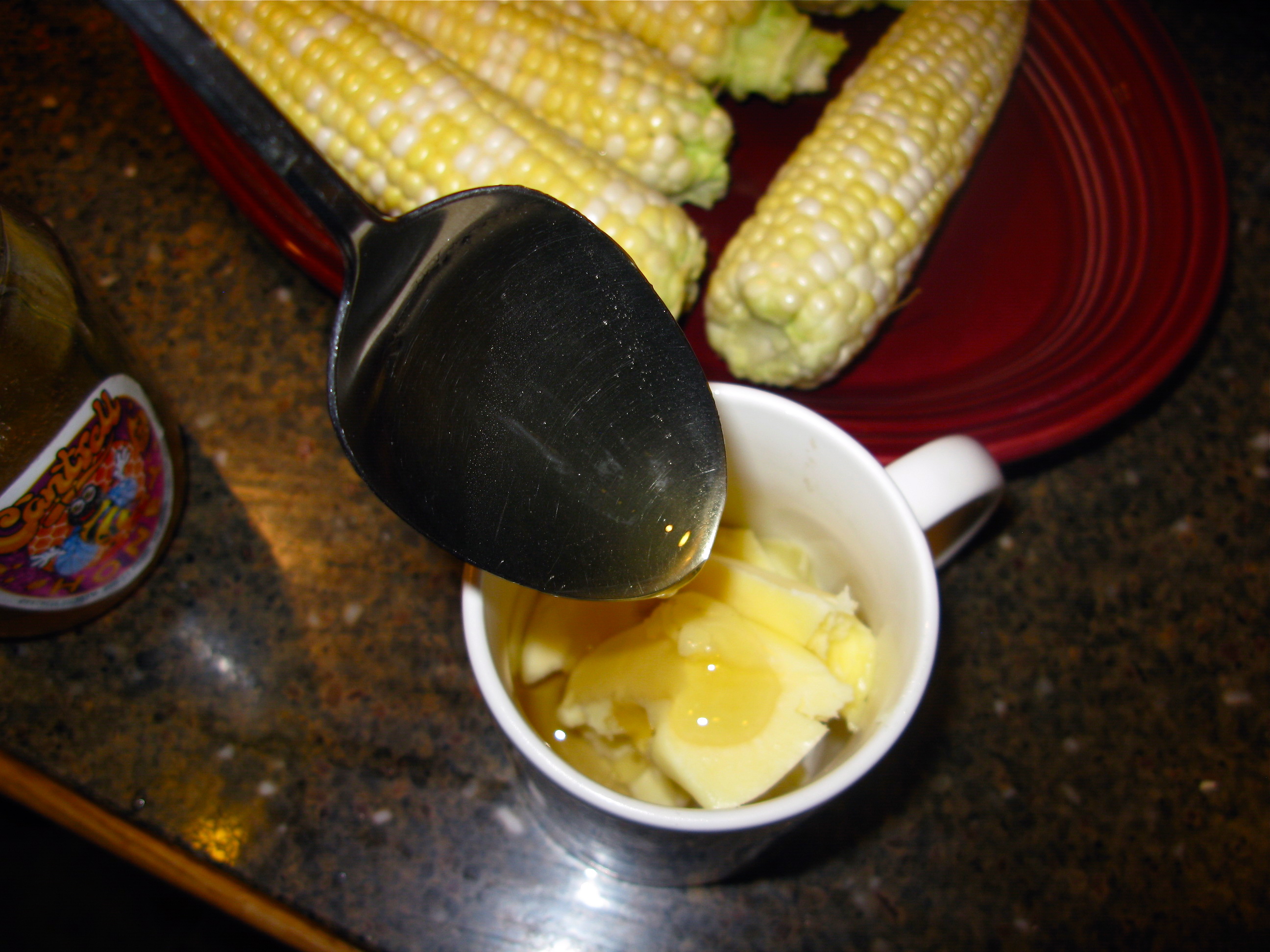
And, it involves a special butter sauce/marinade that is brushed on the corn during its entire cooking time, over and over.
The butter sauce was both of our ideas. it started with Zak suggesting I add honey and salt to the butter we brushed on the ears while they cooked.
That seemed like a perfectly sensible idea, so I did it. And it was good, but there was something missing. The addition of honey tipped the flavor balance too far over into the sweet side of things, but I didn’t want to just add more salt.
So, I took to thinking about something salty that wasn’t just salt.

Soy sauce! Soy sauce not only adds salt, but adds flavor as well, most importantly, it adds umami, that elusive sixth taste that humans find irresistible because it comes from proteins called glutamates, and way back in our evolutionary day, protein was just as important to our bodies as sugar and salt. The “meaty” umami flavor would balance the sweentess of the corn, and would make up for the fact that most of the corn you buy these days is almost always just sweet, and lacks that definitive corn flavor that isn’t just made up of sugar.
The addition of soy sauce to the honey and butter improved the final flavor of the grilled corn immensely, giving it a similar robustness found in the older “roasting ears” of corn my Grandma used to make grilled corn.
But, it wasn’t yet quite perfect. Because the soy sauce had done so well in the butter, I glanced through the Asian pantry shelf and came up with toasted sesame oil. A drizzle of that added that nutty quality that older corn kernels have that younger, more tender and texturally pleasing younger ears lack.
The butter was almost finished. I finally added the tiniest pinches of both Chinese Five Spice Powder and dried powdered ginger to the butter before melting it. The amounts are so tiny that you cannot, especially after the corn is grilled, pick out the individual spices at all–they simply add an indefinable fragrance, a flowery quality similar to the essence that corn husks give grilled corn when it is cooked wrapped in green leaves.
I know, why not just cook it in the husks like Grandma did, then? Wouldn’t that be easier than chasing down spices to give a similar effect? Well, yes, it’s easier, but Zak and I both like the caramelized flavor of grilled corn, and when the kernels are protected by the husks, they don’t brown much, and in fact, steam even more than they grill. It’s a semi-wet method of cooking, rather than the completely dry heat of the grill, and you get different results. Mind you, I like both results, but I do prefer the dry heat, caramelized method of grilling to the semi-moist, somewhat steamed method of grilling or roasting in the husk.
The final version of butter is magical. When you brush it on corn repeatedly while it grills over direct heat, it does something interesting. The corn ends up tasting more like corn than it started out tasting, and it doesn’t taste definably buttery, soy-saucey, salty, honied, sugary, spicy or anything else. It just tastes like the best grilled corn you’ve ever tasted in your life, and once it comes off the grill, nothing needs to be added. It just tastes perfectly balanced and good–fragrant and fresh and delicious, and nothing tastes better. (This includes my Grilled Corn Masala, which until this recipe was perfected, was my favorite grilled corn recipe.)
So, here is the recipe. Please note that the amounts for the ingredients are generally scalable to make larger amounts of butter for larger amounts of corn. This makes enough for a half dozen ears of corn, and so you could double the recipe for a full dozen ears, but please note this caveat: do not try exactly doubling the amounts of dried ginger and Five Spice Powder. Instead, add the normal tiny pinch, and then about half again as much–if you double it straight up to two pinches, you will end up overdoing the spices and they will become noticable. Now, that isn’t necessarily bad, mind you, but it does defeat the purpose of giving the corn an indefinable lovely fragrance that the diners can neither quite place nor get enough of.
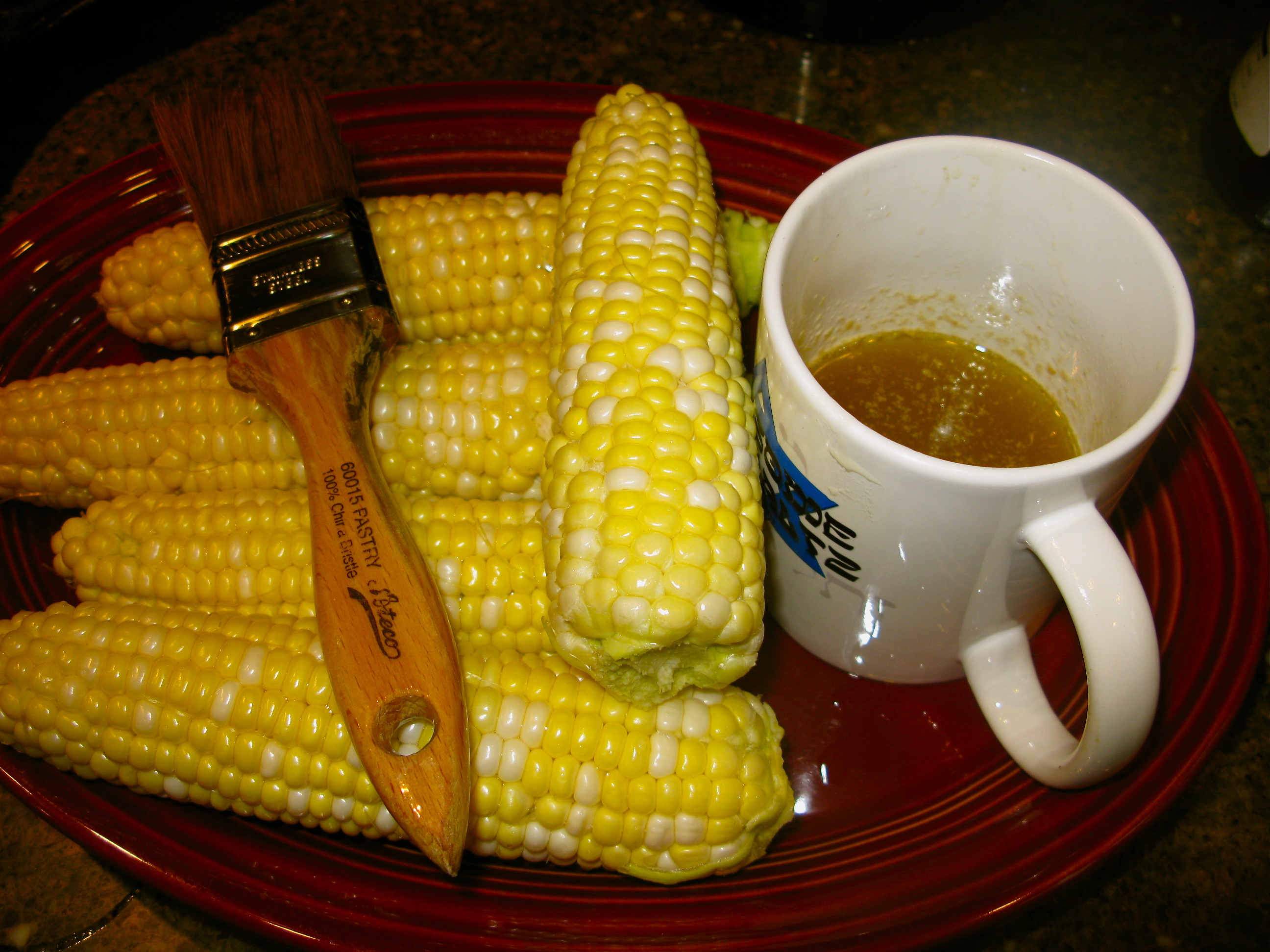
Grilled Corn with Secret Butter Sauce
Ingredients:
6 ears of fresh, local sweet corn (And yes, we have local sweet corn this early in Athens, from one ingenious farmer who starts her corn early under plastic hoop houses that warm the ground fast and make a very warm microclimate that pleases the baby corn plants.)
3 tablespoons of butter
1/2 tablespoon local honey
1/2 teaspoon to 1 teaspoon (depending on how salty your soy sauce is) Japanese style soy sauce
1/4 teaspoon toasted sesame oil
1 tiny pinch Penzey’s dried powdered ginger
1 tiny pinch Penzey’s Five Spice Powder
Husk and desilk the corn carefully.
Put the butter into a microwave safe mug or small bowl. Add honey, and melt in microwave. Remove from microwave, add soy sauce (taste as you go), and sesame oil, and whisk to combine. To get tiny pinches of the spices–and yes, Penzey’s work better for this recipe–use the tip of a very sharp, dry paring knife. Lightly scoop the spices with the tip of the knife, making just a tiny pile of the spices on the very tip. Tap the knife on the edge of the mug or bowl to drop the spices into the butter, and then whisk to combine.
Prepare your grill for direct grilling. If you use soaked woodchips in a smoker box, or directly on the fire, prepare those as well. (Hardwood chunks make the best fire for this recipe.) Make sure your fire is at least 400 degrees F when the coals are burned down. Set the grill up to be about three inches from the fire.
Set the corn on the grill the so that ears don’t touch each other and baste with the butter, turning the ears completely around with tongs to butter all sides. Close up your grill and cook for two minutes. Open grill, baste and turn corn again, then close lid for another two minutes. Continue cooking, basting and turning every two minutes until corn is done–it takes it about ten minutes to cook through, but it depends on the heat of your fire and the size of your ears of corn.
By the time you are done basting, there should be very little butter left. Remove the corn from the fire, and baste one more time on the serving platter before presenting the dish to your family.

Categories:
- Admin (rss) (55)
- Blogs and Blogging (rss) (81)
- Book Reviews: Cookbooks (rss) (43)
- Book Reviews: Non-Cookbook Food Books (rss) (38)
- Cats and Cat Blogging (rss) (47)
- Chinese Cooking Lessons (rss) (32)
- Culinary School Stories (rss) (18)
- Dairy Pruducts: Cultured and Barbaric (rss) (4)
- Documentary Filmmaking (rss) (1)
- Essays, Rants and Reflections (rss) (260)
- Fighting Hunger (rss) (12)
- Food and Kids (rss) (45)
- Food in the News (rss) (126)
- Food Media (rss) (98)
- Food Preservation (rss) (18)
- Food Safety (rss) (45)
- Gardening (rss) (30)
- Herbs and Herb Blogging (rss) (20)
- Holidays (rss) (50)
- Kat Blogging (rss) (22)
- Kitchen Science (rss) (36)
- Leftover Makeover (rss) (8)
- Life, the Universe and Everything (rss) (131)
- Local and Sustainable (rss) (227)
- Local Athens Food and Foodies (rss) (42)
- Meatless Mondays (rss) (32)
- Menu For Hope (rss) (5)
- Nutrition, Diet and Health (rss) (84)
- On The Farm (rss) (8)
- Recipes: Almost Vegetarian, Vegetarian and Vegan (rss) (294)
- Recipes: American Regional (rss) (37)
- Recipes: Appalachian Hillbilly (rss) (33)
- Recipes: Bread, Pasta, Grains (rss) (95)
- Recipes: Canning and Preserving (rss) (8)
- Recipes: Chinese (rss) (123)
- Recipes: Comfort Food (rss) (120)
- Recipes: Cookies (rss) (16)
- Recipes: Desserts (rss) (48)
- Recipes: French (rss) (25)
- Recipes: Fruits and Vegetables (rss) (302)
- Recipes: Greek, North African and Middle Eastern (rss) (31)
- Recipes: Indian (rss) (137)
- Recipes: Italian (rss) (42)
- Recipes: Japanese (rss) (7)
- Recipes: Jewish (rss) (4)
- Recipes: Korean (rss) (6)
- Recipes: Meat, Poultry and Fish (rss) (220)
- Recipes: Mexican/Native American/ Latin American/Caribb (rss) (27)
- Recipes: Original (rss) (108)
- Recipes: Thai (rss) (27)
- Recipes: Tofu (rss) (17)
- Recipes: US Regional (rss) (16)
- Recipes: Vietnamese (rss) (8)
- Restaurant Stories (rss) (28)
- Sewing, Quilting, Arts and Crafts (rss) (16)
- Simple Chinese Recipes (rss) (30)
- Slow Food and Heritage Foods (rss) (10)
- Spice Blogging (rss) (44)
- The Chinese Cookbook Project (rss) (14)
- The Chinese Pantry (rss) (39)
- The Documentary (rss) (2)
- The Kitchen Saga (rss) (17)
- The Locavore's Bookshelf (rss) (15)
- The Unsung Adventures of The Culinary Nerd (rss) (6)
- Tools and Toys (rss) (35)
- Uncategorized (rss) (10)
- With a Side of Politics (rss) (48)
Archives:
- August 2012 (9)
- July 2012 (12)
- September 2011 (3)
- August 2011 (7)
- July 2011 (8)
- June 2011 (16)
- May 2011 (17)
- April 2011 (11)
- December 2010 (9)
- November 2010 (5)
- February 2010 (1)
- December 2009 (5)
- November 2009 (7)
- October 2009 (10)
- September 2009 (16)
- August 2009 (14)
- July 2009 (14)
- June 2009 (7)
- May 2009 (17)
- April 2009 (10)
- March 2009 (25)
- February 2009 (13)
- January 2009 (10)
- December 2008 (5)
- November 2008 (5)
- October 2008 (6)
- September 2008 (13)
- August 2008 (8)
- July 2008 (11)
- June 2008 (18)
- May 2008 (13)
- April 2008 (14)
- March 2008 (16)
- February 2008 (17)
- January 2008 (19)
- December 2007 (25)
- November 2007 (18)
- October 2007 (24)
- September 2007 (16)
- August 2007 (15)
- July 2007 (15)
- June 2007 (10)
- May 2007 (14)
- April 2007 (16)
- March 2007 (17)
- February 2007 (20)
- January 2007 (13)
- November 2006 (1)
- October 2006 (8)
- September 2006 (14)
- August 2006 (25)
- July 2006 (30)
- June 2006 (28)
- May 2006 (34)
- April 2006 (29)
- March 2006 (24)
- February 2006 (30)
- January 2006 (38)
- December 2005 (40)
- November 2005 (37)
- October 2005 (32)
- September 2005 (25)
- August 2005 (30)
- July 2005 (28)
- June 2005 (21)
- May 2005 (8)
- April 2005 (22)
- March 2005 (17)
- February 2005 (29)
- January 2005 (10)
Search Site:
Links:
- Lily’s Wai Sek Hong
- 101 Cookbooks
- A cat in the kitchen
- A Veggie Venture
- Accidental Hedonist
- Cha Xiu Bao
- chez pim
- Chocolate & Zucchini
- Chopstick Cinema
- Chowhound.com
- Chubby Hubby
- Cook sister!
- Cooking with Amy
- da*xiang
- Eat Local Challenge
- Eating Liberally
- Ecocentric
- Eggbeater
- Epicurious
- Farmgirl Fare
- Fatfree Vegan
- Foodgoat
- ForkandBottle.com
- Green Olive Tree
- Hooked on Heat
- Jaden’s Steamy Kitchen
- Kalyn’s Kitchen
- Lucullian delights
- Mahanandi
- Matt Bites
- MeatHenge
- mmm-yoso!!!
- New York Times – Dining & Wine
- Pizza Goon
- Rasa Malaysia
- Ruhlman
- Sailu's Kitchen
- Serious Eats
- SF Gate: Food & Dining
- Simply Recipes
- Soul Fusion Kitchen
- Tastespotting
- The Amateur Gourmet
- The Cleaner Plate Club
- The Food Section
- The Grub Report
- thecookscottage
- U.S. Food Policy
- Wandering Chopsticks
- Washington Post Food and Dining
- Wasted Food
Meta:


Powered by WordPress. Graphics by Zak Kramer.
Design update by Daniel Trout.
Entries and comments feeds.