
Cook Local, Eat Global
Out Of Town
I’ll be out of town from Thursday to Sunday, traveling to Tennessee for my Uncle Frank’s memorial service.
New posts will once more appear starting on Monday.
Have a good weekend, all.
Maggots, Mushrooms and Malarky
Last week, two different people sent me a link to this New York Times Op-Ed piece: “The Maggots in Your Mushrooms”.
With a title like that, of course I had to read the thing, but after I did, I ended up shrugging my shoulders and saying, “So what?”
Which is definitely not the reaction that a writer wants when he or she writes an opinion piece. Editorial writing by its nature wants to inspire a response, preferably a strong one; the last thing the author of an opinion essay wants is for someone to finish reading it and say, “So, uh, dude–what’s your point?”
Because the point of an opinion essay is to have a point and to drive it home, skillfully, with carefully honed arguments and beautifully constructed spires of logic and reason.
Unfortunately for, E. J. Levy, the author of “The Maggots in Your Mushrooms,” the point of her essay is rather dull, and while it is factually based, her arguments, if you can call them that, are, on the whole, insipid.
What is the point of the essay?
As near as I can tell, Ms. Levy apparently just found out that the FDA allows a certain level of naturally occurring foreign matter in both processed and unprocessed foods, and it disturbed her.
At least I think it disturbed her, but I can’t be certain because she never states an opinion one way or another on what should be done about this policy. She never agrees nor disagrees with the FDA’s acceptance of a certain level of ““insect filth,†“rodent filth†(both hair and excreta pellets), “mold,†“insects,†“mammalian excreta,†“rot,†“insects and larvae†(which is to say, maggots), “insects and mites,†“insects and insect eggs,†“drosophila fly,†“sand and grit,†“parasites,†“mildew†and “foreign matter†(which includes “objectionable†items like “sticks, stones, burlap bagging, cigarette butts, etc.â€)” in our food.Instead, Levy merely states facts gleaned directly from the FDA publication, The Food Defect Action Levels: Levels of Natural or Unavoidable Defects in Foods That Present No Health Hazards for Humans, without stating her objections to or support for the FDA’s policies regarding these unappetizing yet unavoidable food contaminants.
It is almost as if she is trying to scare her readers, without coming out and taking responsibility for scaring them by simply using the FDA’s own facts against them while at the same time never giving a solution to what I suspect she considers to be problematic, lax rules concerning food purity.
It is damned sloppy writing for an award-winning, nationally acclaimed essayist.
And, as someone who spent much of her childhood on a farm, I have to say that this essay displays the kind of silliness I have come to expect from many city folks who are shocked, yes, shocked, to find out that farmers fertilize their fields with composted cow, pig and chicken manure, and who freak out at the thought that they may find a slug on the underside of a lettuce leaf. You know the kind of folks I mean–the ones who seem to fear dirt and all of the unsavory critters it contains, never realizing that without dirt, aka soil, we would bloody well have nothing to eat.
This sort of attitude irritates the crap out of me. I mean, after I read the essay I was ready to drive off to Missouri and shake some bugs over this lady’s lunch, which is really childish of me, but still–the whole thing just sounds so immature that I couldn’t help but want to respond in kind. It all seemed to come down to, “Oooh, scary–there are bugs in our food–icky-poo! And the evil, nasty FDA knows all about it and does nothing–grody to the max!
And since she starts out her essay referencing the current salmonella in peanut butter fiasco, it isn’t like Levy doesn’t know that there are legitimate concerns to be had regarding the safety of our food supply, and that there are honest-to-God gripes to be leveled at the federal agencies we entrust with overseeing food safety.
But bringing up the fact that there are a certain small number of nearly microscopic bug bits and vermin hairs in our canned goods and some stones in our dried beans which are allowed by the FDA trivializes the seriousness of the salmonella outbreak which has resulted in hundreds becoming ill and quite a few deaths. In heaping scorn upon the FDA for these realistic policies regarding harmless natural contaminants, I think that Levy is missing the point and muddying the water when it comes to the very real issue of foods contaminated by illness-causing pathogens, and is doing nothing to help the FDA do a better job of protecting consumer health.
But that’s just me. I grew up in the country where I was party to growing food in close contact with dirt, poop, insects, field mice, cats, slugs, snails, rocks, sticks and all sorts of other unsavory things.
So, I just don’t get it.
Food comes from dirt, and insects and rodents eat the same food that we do, and so they track dirt onto the food. All of it can’t be removed and it doesn’t hurt us (because really, if it was harmful, we wouldn’t be sitting here having this conversation at all–we’d have all died out long ago from overdoses of bugs, mouse droppings and blowfly maggots), so why freak out and divert attention from real problems with our food supply which can kill us?
Leftover Makover: Roasted Potatoes Transformed into Aloo Methi Tamatar
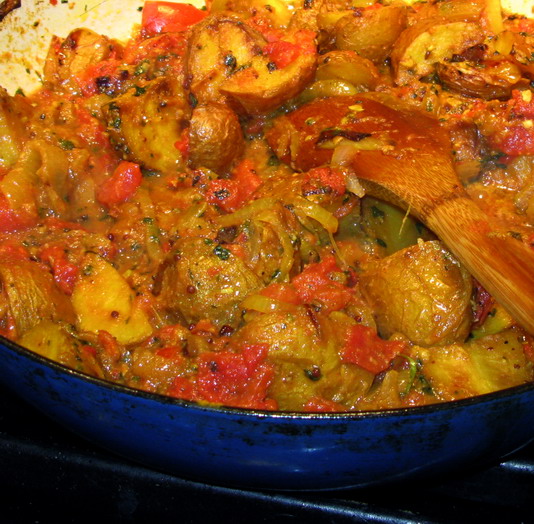
As the recession deepens and food prices creep upwards, it behooves everyone to make our best efforts to avoid wasting food. That means either learning how to cook exactly how much you need for a given meal, or saving and -actually eating- any leftovers you produce.
If you are like me, you probably save every bit of leftovers with full intentions to eat them, but then forget about them. Or, we eat them for a couple of days and then get sick of the same thing over and over and over, and then never want to eat whatever it is again.
But the truth is, it doesn’t have to be that way.
With a few spices, some pantry items and some ingenuity, we can transform leftovers into completely new and interesting dishes.
So today, I am unveiling a new series of posts which I will do whenever I come up with new ways with leftovers, entitled, “Leftover Makeover.”
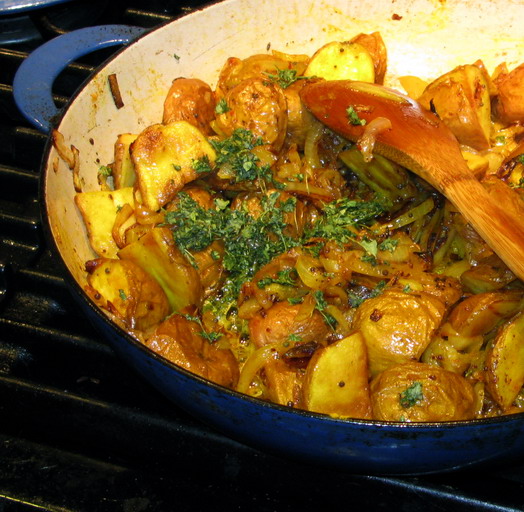
This first post shows how to transform plain roasted baby potatoes into a delicious curried potato, fenugreek and tomato dish, Aloo Methi Tamatar.
All that is required to makeover plain roasted potatoes into a curried delight are canola oil, onions, garlic, fresh ginger, dried fenugreek leaves, turmeric, cumin seeds, mustard seeds, chili flakes, canned tomatoes and salt.
All of these items live in my pantry anyway–and if you don’t have some of them, you will probably be okay changing the recipe to suit what you do have. For example, if you have no turmeric, but you do have curry powder, use that. If you don’t have dried fenugreek greens–though they are inexpensive to buy in Indian grocery stores, and if double wrapped in ziplock bags and kept in the freezer, they will stay fresh for a very long time–you could use fresh cilantro instead. Just take the “methi” out of the name of the dish, since methi means fenugreek. You could use ground cumin and mustard seed if you want, but they taste better as whole seeds.
And, of course, if it is summer, you can use fresh tomatoes and fresh methi or cilantro from your garden or farmer’s market.
This would be great with rice and some kind of dal–rajma dal or butternut squash dal would be great with this– for an inexpensive, delicious, very nutritious vegan meal–one that vegans, vegetarians and omnivores can all enjoy.
And, if you don’t eat all of the potatoes as a curry, take them and use them the next morning with eggs as an Indian Frittata.
Aloo Methi Tamatar
Ingredients:
3 tablespoons canola oil
2 cups thinly sliced yellow onions
4 cups leftover roasted potatoes
5 cloves garlic, minced
1 1/2″ cube fresh ginger, peeled and minced
1 1/2 tablespoons dried methi leaves, soaked in 1/2 cup hot water
2 teaspoons ground turmeric
1 tablespoon cumin seeds
2 teaspoons black mustard seeds
1 14 ounce can diced tomatoes
salt to taste
Method:
Heat the canola oil in a heavy-bottomed large skillet over medium high heat. Spread onions into a thin layer on the bottom of the pan and cook, stirring, until the onions are a deep golden color. Add potatoes, garlic, ginger, and stir well to combine and cook until the garlic and ginger are golden and the onions are a deep reddish brown.
Remove methi leaves from water and squeeze out excess from leaves. Sprinkle into pan with the turmeric, and cumin and mustard seeds. Cook, stirring, until mustard seeds pop. Add the soaking water and stir to combine well.
Turn heat down to low and add tomatoes.
Cook, stirring as needed, until most of the liquid is cooked away (this is a fairly dry curry) away and the flavors have had a chance to combine well–about twenty to thirty minutes. Add salt to taste and stir well.
Brittney’s Skillet Spaghetti With Shiitake and Rapini: A Quick Vegetarian Meal
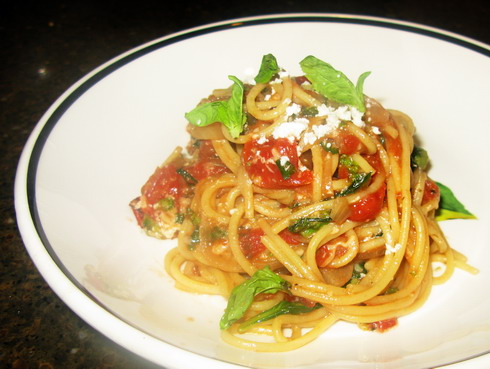
Okay, I didn’t make up this recipe.
It is Morganna’s friend, Brittney’s recipe and even though she says it is just something she makes for quick dinner, I think it is delicious, and wanted to share it with you.
Now, the truth is, the rapini, also known as broccoli rabe, which is in it, was my idea–she usually uses spinach. But then, we had rapini and no spinach, so there you go. And as she says, the ingredients change depending on what is in the pantry and fridge, but this time around, the fresh shiitake and rapini really made it taste really wonderful–even more wonderful than the first time she made it for me, when it featured baby spinach.
What is rapini? Well, it is a brassica, just like cabbage, broccoli, gai lan, cauliflower, kale, collards, turnips and the like, which means it is chock-full of vitamins and minerals, and is tasty, too. Even though it is often known as broccoli rabe, and it has little flowerlets that look like broccoli, it isn’t really very closely related to broccoli–instead, its closest brassica relative is the turnip. Which explains why it doesn’t really taste broccoli-like–the leaves, stalks and flowerheads taste like slightly less bitter and more sweet turnip greens, with a more robust texture.
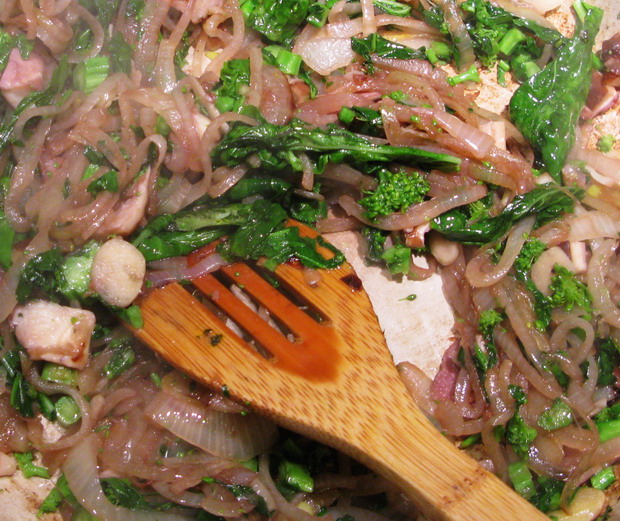
I like rapini a lot, most often just finely chopped and sauteed with olive oil, garlic, salt and pepper with maybe a sprinkling of balsamic vinegar and a dash of chili flakes. I had bought some to try cooked with panch phoron, but when Brittney said she would like to make her skillet spaghetti, I thought that the rapini would go beautifully with the fresh, locally grown shiitake mushrooms and greenhouse basil she planned to put in it.
I was happy to be right.
Now, the reason that this is called skillet spaghetti, is that the sauce, which is fairly chunky, is made in a deep skillet, and when the spaghetti is cooked al-dente, it is added to the skillet, along with a quantity of cheese, and the whole lot is tossed carefully together with tongs until the spaghetti is liberally coated with sauce and melty cheese, and can be twirled into a shapely mound on a plate or in a bowl. The liquid in the sauce is sparse and thick, and when the cheese is thoroughly combined, it acts rather like a glue to hold the sauce and pasta together, without being sticky or goopy in any way.
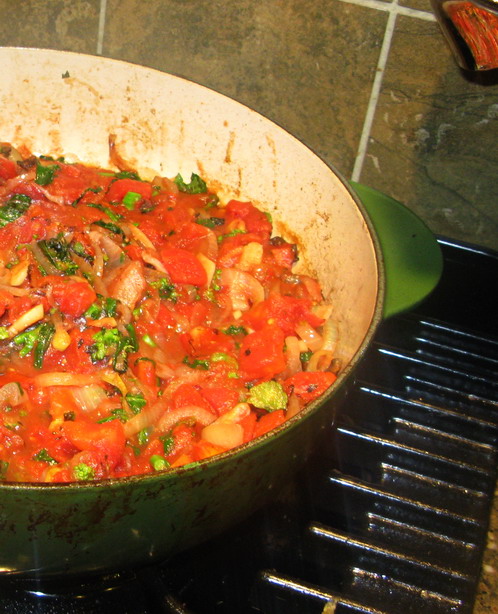
The cheeses Brittney usually puts in the pasta are freshly shredded Parmesan or Romano, but this time around, because I had just bought some locally made goat milk feta, she used that in combination with the Parmesan, and the salty-sharp flavor of the feta melded perfectly with the nuttiness Parmesan and mellowed the lightly bitter flavor of the greens while complementing the earthy mushrooms.
As good as the feta was, though, Brittney says you can use just about any good cheese you want in it, depending on what else is in the sauce.
As for what other vegetables could be used in this sauce, you are only limited by your pantry, your refrigerator or your garden. In the summer, fresh summer squashes would be delightful, and in the spring or fall, chard would be great. A mixture of fresh mushrooms would be delicious, and if you have nothing fresh, some olives and frozen or jarred artichoke hearts would be lovely. Eggplant in the late summer and early fall would rule, and in the summer, replacing the canned tomatoes with fresh ones would be perfect. About any herbs you have could go in this instead of, or with the basil, but I particularly think that oregano, thyme, rosemary or marjoram would be lovely. Pine nuts would be great if you have them, too, now that I think on it.
Brittney also told me that she has put thinly sliced chicken in this sauce, or crumbled Italian sausage (remove the casing first) or ground beef and every version is really good, but this time around, we are talking about vegetables and cheese.
I figure that if you are vegan, you could leave out the cheese, and maybe replace it with ground up pine nuts or something, but I love cheese, so I am not advocating leaving it out unless you must. For me, I think the cheese in this is essential, because it contributes so much to the texture and flavor of the sauce.
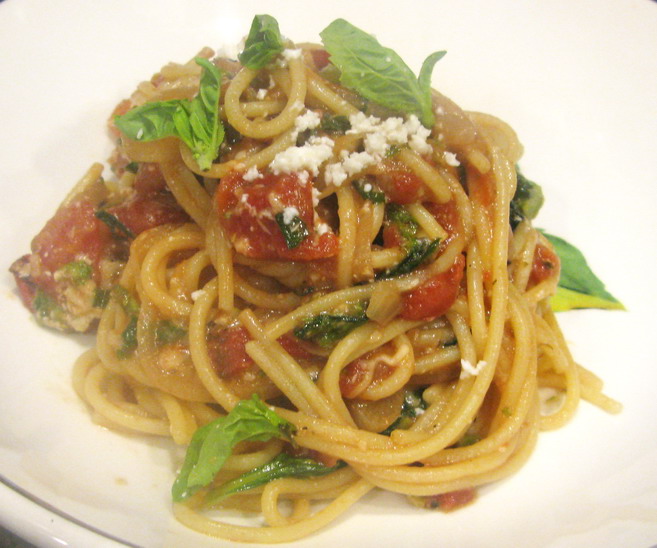
Brittney’s Skillet Spaghetti With Shiitake and Rapini
Ingredients:
3 tablespoons olive oil
2 cups thinly sliced yellow onions
7 large cloves garlic peeled and thinly sliced
1 teaspoon salt
10 large fresh shiitake mushrooms, stems removed and cut into quarters
1/3 cup red table wine
1 cup finely chopped rapini
1 28 ounce can diced tomatoes (we used Muir Glen Organic)
1 cup packed fresh basil leaves, roughly chopped
1 pound spaghetti, cooked al dente, rinsed and drained
1/4 cup crumbled goat or sheep’s milk feta
1/3 cup shredded Parmesan cheese
salt and freshly ground pepper to taste
extra basil leaves and feta for garnish
Method:
In a large deep skillet, heat olive oil over medium heat. Add onions and sprinkle with salt. Cook, stirring, until the onions turn golden. Add the garlic and cook until it turns golden and the onions brown slightly. Add the mushrooms when the garlic is halfway to golden. Cook stirring, until the mushrooms soften, and pour in wine.
Cook off most of the alcohol, then add the rapini, and cook stirring, until the rapini wilts and the color deepens to a rich dark green.
Add the tomatoes and all their juice, and turn the heat down to medium low and cook until the tomatoes release their juices and the liquid begins to reduce. Add the basil, and cook until the tomatoes are softened and the juice is lightly thickened.
Add the spaghetti and the cheeses to the skillet and turn off the heat. Using tongs, toss the pasta, cheese and sauce together, until well combined and the cheeses have melted. Be patient and be ready for a forearm workout–this takes a while. Taste for salt and pepper, and add as needed, then toss again to mix thoroughly.
Twirl into heated bowls or onto heated plates, and sprinkle with basil leaves and feta.
Serves four really hungry adults and one sort-of hungry toddler. (Adults who forgot to eat all day, like we did. Yeah, that was dumb–but fear not, we fed Kat. Just not ourselves.)
Weekend Cat Blogging: The King Lives (In Memory, At Least)

I had to post about this, because it is so cute.
In the photo to the left, you see two of our beloved departed cats, Ozy, the big grey King of Cats, and Tristan, his best friend. They died within months of each other last year, both at ripe old ages.
Kat, even though she was just a tiny girl, remembers them.
I know this, because she has a book about cat breeds that has two photos in it that look just like Ozy and one that looks just like Tristan. When she gets the book out, for months, I would say, “Which kitty is Ozy,” and she would point to those two pictures of Russian Blues who looked just like the old Oz. And if I asked which one looked like Tristan, she’d point to the one Siamese cat in the book who looked like old Sir Triz.
The other night, when we went out so Zak could play open mike night, as we were leaving, she apparently brought the book over to Brittany and opened it to the Ozy picture and said quite clearly, “Ozy.”
And then didn’t say it again for two days.
Then, yesterday, she got it out and looked at the picture again, then ran over and started pulling on my sleeve, saying, over and over, “Ozy, Ozy, Ozy, Ozy.” She did this until I came over to where she had left the book and looked down to see it laying open to the picture of our old, departed, beloved King of Cats.
It almost made me cry to know that our little baby, even though she was so small, remembers Ozy.
I think that the King would be pleased.
Now, she just needs to learn to say “Tristan.”

Categories:
- Admin (rss) (55)
- Blogs and Blogging (rss) (81)
- Book Reviews: Cookbooks (rss) (43)
- Book Reviews: Non-Cookbook Food Books (rss) (38)
- Cats and Cat Blogging (rss) (47)
- Chinese Cooking Lessons (rss) (32)
- Culinary School Stories (rss) (18)
- Dairy Pruducts: Cultured and Barbaric (rss) (4)
- Documentary Filmmaking (rss) (1)
- Essays, Rants and Reflections (rss) (260)
- Fighting Hunger (rss) (12)
- Food and Kids (rss) (45)
- Food in the News (rss) (126)
- Food Media (rss) (98)
- Food Preservation (rss) (18)
- Food Safety (rss) (45)
- Gardening (rss) (30)
- Herbs and Herb Blogging (rss) (20)
- Holidays (rss) (50)
- Kat Blogging (rss) (22)
- Kitchen Science (rss) (36)
- Leftover Makeover (rss) (8)
- Life, the Universe and Everything (rss) (131)
- Local and Sustainable (rss) (227)
- Local Athens Food and Foodies (rss) (42)
- Meatless Mondays (rss) (32)
- Menu For Hope (rss) (5)
- Nutrition, Diet and Health (rss) (84)
- On The Farm (rss) (8)
- Recipes: Almost Vegetarian, Vegetarian and Vegan (rss) (294)
- Recipes: American Regional (rss) (37)
- Recipes: Appalachian Hillbilly (rss) (33)
- Recipes: Bread, Pasta, Grains (rss) (95)
- Recipes: Canning and Preserving (rss) (8)
- Recipes: Chinese (rss) (123)
- Recipes: Comfort Food (rss) (120)
- Recipes: Cookies (rss) (16)
- Recipes: Desserts (rss) (48)
- Recipes: French (rss) (25)
- Recipes: Fruits and Vegetables (rss) (302)
- Recipes: Greek, North African and Middle Eastern (rss) (31)
- Recipes: Indian (rss) (137)
- Recipes: Italian (rss) (42)
- Recipes: Japanese (rss) (7)
- Recipes: Jewish (rss) (4)
- Recipes: Korean (rss) (6)
- Recipes: Meat, Poultry and Fish (rss) (220)
- Recipes: Mexican/Native American/ Latin American/Caribb (rss) (27)
- Recipes: Original (rss) (108)
- Recipes: Thai (rss) (27)
- Recipes: Tofu (rss) (17)
- Recipes: US Regional (rss) (16)
- Recipes: Vietnamese (rss) (8)
- Restaurant Stories (rss) (28)
- Sewing, Quilting, Arts and Crafts (rss) (16)
- Simple Chinese Recipes (rss) (30)
- Slow Food and Heritage Foods (rss) (10)
- Spice Blogging (rss) (44)
- The Chinese Cookbook Project (rss) (14)
- The Chinese Pantry (rss) (39)
- The Documentary (rss) (2)
- The Kitchen Saga (rss) (17)
- The Locavore's Bookshelf (rss) (15)
- The Unsung Adventures of The Culinary Nerd (rss) (6)
- Tools and Toys (rss) (35)
- Uncategorized (rss) (10)
- With a Side of Politics (rss) (48)
Archives:
- August 2012 (9)
- July 2012 (12)
- September 2011 (3)
- August 2011 (7)
- July 2011 (8)
- June 2011 (16)
- May 2011 (17)
- April 2011 (11)
- December 2010 (9)
- November 2010 (5)
- February 2010 (1)
- December 2009 (5)
- November 2009 (7)
- October 2009 (10)
- September 2009 (16)
- August 2009 (14)
- July 2009 (14)
- June 2009 (7)
- May 2009 (17)
- April 2009 (10)
- March 2009 (25)
- February 2009 (13)
- January 2009 (10)
- December 2008 (5)
- November 2008 (5)
- October 2008 (6)
- September 2008 (13)
- August 2008 (8)
- July 2008 (11)
- June 2008 (18)
- May 2008 (13)
- April 2008 (14)
- March 2008 (16)
- February 2008 (17)
- January 2008 (19)
- December 2007 (25)
- November 2007 (18)
- October 2007 (24)
- September 2007 (16)
- August 2007 (15)
- July 2007 (15)
- June 2007 (10)
- May 2007 (14)
- April 2007 (16)
- March 2007 (17)
- February 2007 (20)
- January 2007 (13)
- November 2006 (1)
- October 2006 (8)
- September 2006 (14)
- August 2006 (25)
- July 2006 (30)
- June 2006 (28)
- May 2006 (34)
- April 2006 (29)
- March 2006 (24)
- February 2006 (30)
- January 2006 (38)
- December 2005 (40)
- November 2005 (37)
- October 2005 (32)
- September 2005 (25)
- August 2005 (30)
- July 2005 (28)
- June 2005 (21)
- May 2005 (8)
- April 2005 (22)
- March 2005 (17)
- February 2005 (29)
- January 2005 (10)
Search Site:
Links:
- Lily’s Wai Sek Hong
- 101 Cookbooks
- A cat in the kitchen
- A Veggie Venture
- Accidental Hedonist
- Cha Xiu Bao
- chez pim
- Chocolate & Zucchini
- Chopstick Cinema
- Chowhound.com
- Chubby Hubby
- Cook sister!
- Cooking with Amy
- da*xiang
- Eat Local Challenge
- Eating Liberally
- Ecocentric
- Eggbeater
- Epicurious
- Farmgirl Fare
- Fatfree Vegan
- Foodgoat
- ForkandBottle.com
- Green Olive Tree
- Hooked on Heat
- Jaden’s Steamy Kitchen
- Kalyn’s Kitchen
- Lucullian delights
- Mahanandi
- Matt Bites
- MeatHenge
- mmm-yoso!!!
- New York Times – Dining & Wine
- Pizza Goon
- Rasa Malaysia
- Ruhlman
- Sailu's Kitchen
- Serious Eats
- SF Gate: Food & Dining
- Simply Recipes
- Soul Fusion Kitchen
- Tastespotting
- The Amateur Gourmet
- The Cleaner Plate Club
- The Food Section
- The Grub Report
- thecookscottage
- U.S. Food Policy
- Wandering Chopsticks
- Washington Post Food and Dining
- Wasted Food
Meta:


Powered by WordPress. Graphics by Zak Kramer.
Design update by Daniel Trout.
Entries and comments feeds.