
Cook Local, Eat Global
What Is A Chef?
“Chef” is a word much overused these days.
It seems that anyone who can cook competently, whether at home or under the scrutiny of television cameras, is now called a chef, either by himself or by others.
I think it is time to stop indiscriminately using the word and return to its original context: that of a professional kitchen.
Chef is actually the shortened form of the French term, “chef de cuisine,” which is defined quite simply as the “head of the kitchen,” and refers precisely to a professional cook who manages all facets of a professional kitchen. Whether that kitchen is large or small and in a restaurant, a hotel, a cruise ship, The White House, an in-house catering facility or Disneyland doesn’t matter. What matters is that it is a professional kitchen, and as such is one that is run, in the best of cases, like the military.
A home cook should never be referred to seriously as a chef.
Nor should a cooking instructor.
Or a food writer.
Or a food blogger.
Or a line cook.
Or a television personality–unless of course, the home cook, cooking instructor, food writer, food blogger, line cook, or television personality have actually done time as the head of a professional kitchen somewhere.
OK–I will cut some slack here. If an individual has worked as a sous chef, that is, as an under-chef who does the job of the chef or executive chef, when the exec is out of the kitchen, then they can be called chef.
But otherwise, no. Sorry. Nope. Nada. Zip.
If you have not run a professional kitchen, you are not a chef.
Period.
End. Of. Story.
So what do I mean by “run” a professional kitchen? What is it that a chef does that home cooks, cooking instructors, food writers, food bloggers, line cooks and television personalities do not do?
They don’t create menus, cost out each menu item so that accurate prices can be assigned to them, set up pantries, understand and effectively run and repair arcane kitchen equipment, much of which is dangerous to life and limb, deal with multiple purveyors, keep track of inventory, order foodstuffs, hire and train staff, create plate presentation, devise and cook off-menu specials, expedite during service, deal with cranky dining room staff, cook and act as both den mother and field marshal at the same time.
In short, these folks, who all may be wonderful cooks and great people, don’t run professional kitchens.
Which is why they shouldn’t be called chefs.
They should be called home cooks, cooking instructors, food writers, food bloggers, line cooks and television personalities. (And yes, Rachael Ray is a television personality, but no, she is not a chef. You will notice that she does not call herself a chef. Neither does Nigella Lawson, another food writer and television personality.)
And there is nothing wrong with that. Home cooks, cooking instructors, food writers, food bloggers, line cooks and television personalities are all fine in their own rights and have their own unique sets of skills and experiences which are just as interesting and fascinating as the skill sets of a chef.
The problem is, there is a new aura of prestige that surrounds the idea of a chef these days, that is probably the result of too much exposure to The Food Network. Although, frankly, Anthony Bourdain, as much as he would hate to admit it, probably has to carry a tiny bit of the blame for this recent fascination with the people food-obsessed enough to want to spend twelve hours or more a day in a cramped, crowded inferno, producing delicious food for throngs of diners.
As much as Bourdain has tried his best to paint the life of a chef as lonely, gritty, dirty, grueling, physically and emotionally dangerous and usually not particularly monetarily rewarding, the fact is, lots of folks find his descriptions of chefs as tough, mean, hard-drinking, substance-using, womanizing he-men alluring.
And when I say folks, I mean, both men and women are fascinated by the ideal of a chef as a pirate captain, a bad boy, a rock star,and an iron-fisted gunslinger all rolled into one.
And it seems that everyone wants to be a chef these days.
So, how do you get to be a chef?
You run a professional kitchen.
OK, so how do you get to run a professional kitchen? I mean, you go to culinary school, right?
Sometimes. That is how Bourdain did it. And Emeril Lagasse. And Cat Cora. And Dean Fearing. And David Chang. And Eric Ripert. And Mary Sue Milliken and Susan Feniger.
But, you know, going to culinary school does not make you a chef, as any of the folks I just listed above will tell you. And, as a culinary school graduate, I can tell you the same thing–just because you graduated from culinary school, doesn’t mean you emerge from your student chrysalis, toque unfurling and whisk in hand as a chef. It just means that you graduated from culinary school with a degree that may or may not help you get a job in a professional kitchen at a level slightly above that of dishwasher, prep cook or commis. (And then again, in some kitchens, a culinary school grad may well start down at the bottom anyway. It depends on the chef running the kitchen.)
Look at it this way. Michael Ruhlman graduated from the Culinary Institute of America, but he doesn’t call himself a chef.
He calls himself a food writer, which is what he is–and a damned fine one at that, one who has collaborated with chefs such as Thomas Keller on cookbooks.
And yes, Ruhlman can throw down and cook up a magnificent feast, but as he and I both know, and as everyone else should know, that doesn’t make him a chef.
Ruhlman knows he isn’t a chef–because he sees what chefs like Keller do and while he understands the language that Keller speaks, and he can explicate Keller’s techniques and recipes in prose that is both evocative and practically accessible, he isn’t like Keller.
Keller does things that are beyond Ruhlman’s ken and that is fine, because the world needs both its Thomas Kellers and its Michael Ruhlmans.
Let’s look at another example: Julia Child.
A graduate of Le Cordon Bleu in Paris, Child became a fine cook under the tutelage of Master Chef Max Bugnard and other master chefs. She went on to become one of the best cookbook writers and cooking instructors in the world and probably the most iconic television cooking personality ever.
But she never ran a professional kitchen.
And so, even though her first television series was entitled “The French Chef,” (the title wasn’t her idea, by the way) she never considered herself to be a chef, because she knew and respected what that title truly meant.
So, culinary school alone does not a chef make.
It is culinary school plus practical experience that makes a chef.
Or, if you want to kick it old-school and do it the way it was in the old days, you can just skip school and go straight for the practical experience by starting at the bottom of the kitchen hierarchy (as a dishwasher, prep cook or commis) and clawing your way up to the top.
That’s how Marco Pierre White, Thomas Keller, Cristeta Comerford, Jeremiah Tower, Jean-Georges Vongerichten, Judy Rodgers and Lidia Bastianich all became chefs.
Or, you could grow up in a family of great professional cooks and spend your childhood in the kitchen of family-owned restaurants, working as a dishwasher and prep cook at an early age while culinary expertise is absorbed directly in your brain as you live, breathe, eat and drink the heady atmosphere of a professional kitchen.
And then, when you grow up, you can decide to open your own restaurant, and continue the family tradition anew.
Which is how Paul Prudhomme became a chef.
Or, you can be like Alice Waters and just up and one day decide to open a restaurant which will become world famous and inspire a cooking style and food movement without much in the way of culinary experience, but she is unique.
The key to becoming a chef–the one commonality in all of these chef’s disparate backgrounds–is experience. Years and years of it. Whether some of it is in the form of culinary school or not, the bulk of this experience takes place in professional kitchens where a cook learns to become a chef by working hands-on, under the supervision of other cooks and chefs.
These experiences do not come instantly. They do not come overnight.
One just does not wake up and become a chef. One does not just decide that one is a chef and start calling oneself a chef.
It is a long, gradual process, one that should be respected by those both within and without the food service industry.
And one way to show that respect is to stop calling every Tom, Dick and Mary who can cook competently on and off camera a chef, and reserve that title for the ones who have put in the time and effort to really become culinary professionals.
Note: The inspiration for this rant came from a commenter on a story last month at The Huffington Post about how Michelle Obama was going to keep the current White House Chef, Cristeta Comerford, as the executive chef.
The commenter in question said that Comerford wasn’t a real chef like Emeril Lagasse, Bobby Flay and Gordon Ramsay, I suppose because she didn’t have a television show.
I got all up in the guy’s face, because it was obvious that he had no idea what being a chef meant, and what a real chef was. To his mind, one was only a real chef if one was famous and had multiple restaurants and television shows and lots of adoring fans out there in TV land. Right. I then decided to write this post, but never got around to it until last night, so here it is.
A Bad Weekend
I haven’t written for a while because of a really awful experience our family had this weekend.
We had taken Kat to the indoor play place at the mall, and we had met our friend, Kendra, her college-aged niece and Kendra’s daughter, who is six months younger than Kat, there. There was also a dad and his three year old son there, and the kids were playing and all was well.
And then this creepy guy came up–he stayed away from the entrance to the play place, but hovered near the barricade that keeps the kids in.
And he was staring at the kids.
At Kat in particular.
All of us adults felt the bad vibe coming from this creep immediately, and we were staring at him, and my mind started working furiously, because he looked familiar. I had seen his face before.
He followed Kat’s movements, like a dog stalking a rabbit, and the look on his face–oh, my God–anyone who can look at a baby like that should not be allowed out around anyone.
He finally noticed that we were all staring at him and looked up and then turned and went into a store nearby. Mind you, this mall is nearly always deserted–it is struggling to stay in business–so he really had no chance to steal a kid away. Nor did he approach the entrance to the play place–if he had one of us, or more likely, all of us, would have confronted him directly.
But as he walked away, I finally remembered where I had seen his face–on the cover of The OU Post–the student newspaper. They had run a story just that Thursday on how a number of registered sex offenders in the county were living too close to elementary schools and the county prosecutor was forcing them to move.
He was one of them.
I told everyone who he was and that we had to leave.
So, we went home, and I picked up the paper–it was still on my desk, and there he was. I showed the lineup of photos to every other adult and they all picked the same guy as the creep.
So, I called the police, and made a report–and the officer who answered the phone promised to send a car right away, and to look up the man’s terms of parole, which he may have just violated by approaching a playground.
So, I felt better, but not by much.
You see, I am a survivor of sexual abuse, and this just triggered so many bad feelings, that I haven’t wanted to write. If you add this to the fact that someone else in town is being obsessed with me in a–well, let’s face it–mentally ill way, and I just have had a hard several days.
That’s why I haven’t written. I can barely eat, much less think about food.
Practically speaking, though, we are going to get some new doors for our home, and have a security system put in. And, we are going to put in security lights–we live in a wooded area back from the street which is a dark street anyway.
And, we are finally going to get another dog. I just know I will sleep better with a dog in the house, and I think it is important for Kat to grow up a dog–kids and dogs go together. And this one will be trained by the best trainers we have in the county, one of whom used to be the head of the local police’s K-9 division.
So that is where my head is right now. Not in a good place.
Thanks for being so understanding.
Easy Everyday After-Work Chicken Curry That Anyone Can Make
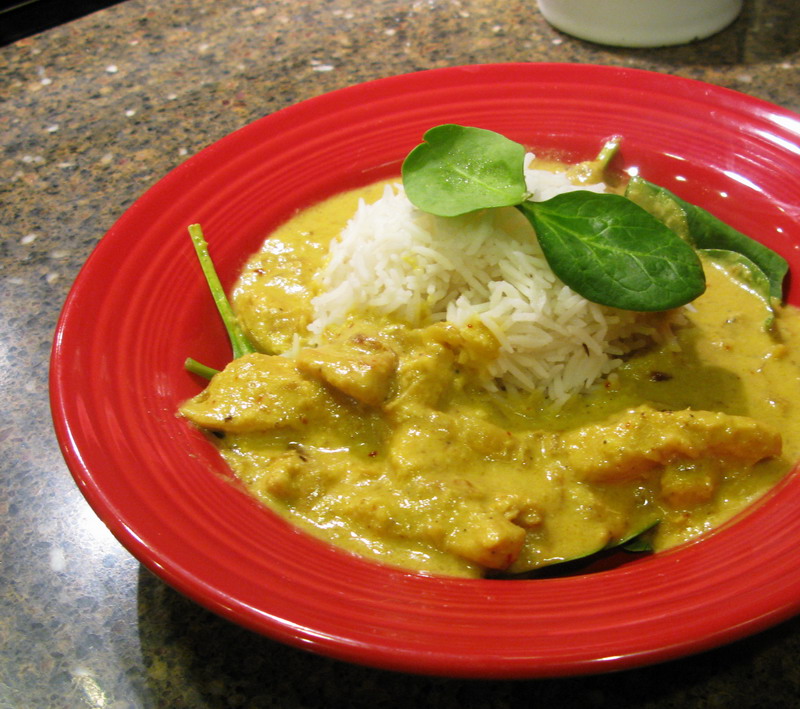
This is a super-simple version of chicken curry that anyone, and I mean anyone, can make. Not only can anyone make it, anyone can make it quickly.
And you can make it even more quickly if you want to brown your onions and grind your curry paste ingredients ahead of time and freeze them in individual portions.
All you need are some basic items in your pantry: a handful of Indian spices (cumin, coriander, cloves, fennel, fenugreek seeds, cardamom pods, chile flakes and turmeric), onions, garlic and ginger, one lemon or lime, coconut milk and the optional frozen grated unsweetened coconut that you can find in most well-stocked Indian markets these days.
To these ingredients, you add chicken, and any of a plethora of vegetables, fruits, herbs and greens to make a unique curry that will taste delicious every time, even if you never make it exactly the same way twice.
The key to making this curry is to relax, and let loose. Add what you like, leave out what you don’t. You don’t have to follow my spicing instructions exactly, but the masala I use makes a very nice, mild coconut milk curry that pleases everyone and offends no one.
And once again, you can speed the process up considerably by preparing ahead of time. Brown your onions in batches for a single curry, and put them in ziplock bags and stick them in the freezer. Then, grind up your ginger, garlic, spices and frozen grated unsweetened coconut (if you use it–it is optional, but I love it) in single batches and put the resultant spice paste into little ziplock bags and put them in the freezer.
Then, when you are on your way out of the door for work, pull your chicken, your onions and masala paste out of the freezer to thaw in the fridge while you are away, and voila! When you come back, you have all the fixings for instant curry. At that point all you need is a fourteen ounce can of coconut milk and some vegetables, herbs or fruits if you want. If you have a rice cooker, you can set it to make basmati rice and have it ready when you get home, too.
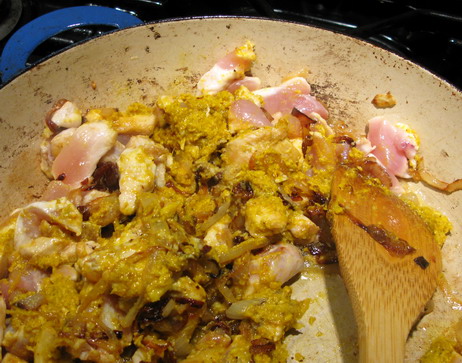
To put it all together, just put a bit of canola or coconut oil in a pan, and add the onions. Heat everything on medium high and when it is hot, add the chicken and cook, stirring until half of the pink has turned brown and white. Add the masala paste and keep cooking and stirring until the spices smell deliciously toasty and divine and the chicken shows almost no pink at all. Then, add the coconut milk, and stir well to combine everything, turn the heat down to low and simmer.
At this point add any vegetables or fruits you like–I will give you a list of ideas at the end of the recipe–and cook until the vegetables are done. If you want to add greens, add them near the end, or in the case of baby spinach, at the very end. If you want to use herbs, stir them in at nearly the end of cooking–unless you choose to use curry leaves, in which case, they go into the pan with the masala paste, and get cooked directly in the hot oil so their flavor and fragrance permeates the dish completely.
And then it is done.
If you take the shortcuts, this recipe can be done in about fifteen minutes, start to finish, depending on what fruits or vegetables you choose to add to the curry. If you cook it all from scratch, it can be ready in about forty-five minutes, which coincidentally is how long it takes my rice cooker to make me up a batch of basmati, so it is all just perfect.
It’s like fast food, only homemade, tasty and good for you.
Oh, one more thing–the frozen unsweetened shredded coconut.
It isn’t necessary, but it makes the curry oh so much richer, nicer and thicker. I use Swad brand, and I have never had trouble finding it in any of the well-stocked Indian or Asian markets around Ohio, so if I can get it, I figure most other folks can. You can also use dried unsweetened flaked coconut for this purpose–which you can definitely find at Indian or Asian grocery stores, but if you use it, add some water to your masala paste to moisten it a bit. You can also soak the dried coconut in water for a few minutes to rehydrate it slightly before grinding everything together.
Whatever you do, don’t use the sweetened flaked stuff you can get in the grocery store baking aisle. Not only will it make your curry sweet, which is the last thing you want to do, it also contains propylene glycol, which is a humectant, meaning it keeps the coconut moist by attracting water molecules from the air. Which is all fine and good, but when heated, as it would be when it is toasted or when it is put into a hot pan to be cooked, it releases the propylene glycol in a cloud of bitter, acrid fumes which not only smell awful and are probably not good for you to be breathing, but it leaves a bitter aftertaste in the coconut.
So, just don’t go there.
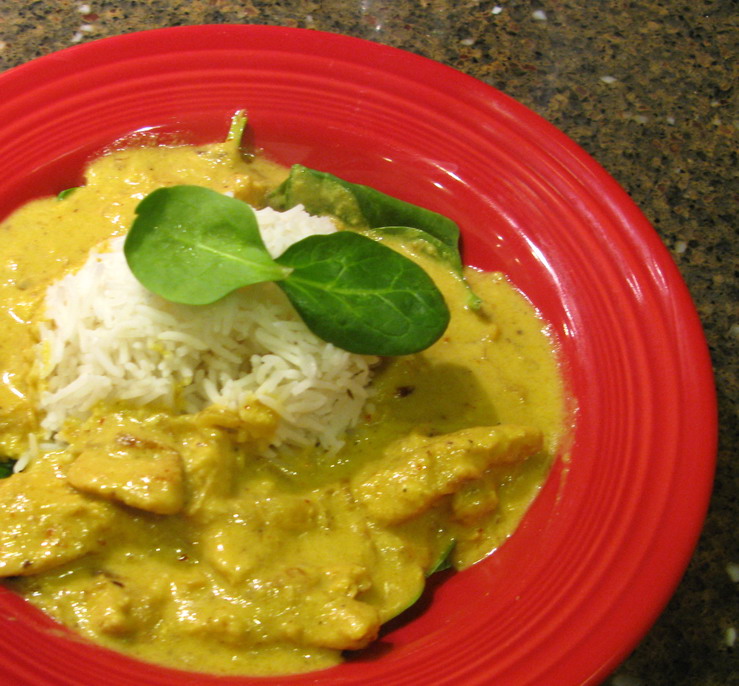
Everyday Chicken Curry
Ingredients:
21/2″ cube fresh ginger, peeled
5-7 large cloves garlic
1 1/2 teaspoons cumin seeds
2 1/2 teaspoons coriander seeds
1 teaspoon fennel seeds
3 whole cloves
5 green cardamom pods
Kashmiri or other mild chili flakes such as Aleppo, to taste–I use about a tablespoon of them
1/2 cup frozen shredded unsweetened coconut, lightly thawed
1 1/2 teaspoons turmeric
water as needed to make a proper masala paste
2 tablespoons canola or coconut oil
2 cups thinly sliced onions
1 teaspoon salt
2 whole boneless skinless chicken breasts–about two pounds–cut into slices ! 1/2″ X1/2″X1/2″
14 ounce can coconut milk
1/4 cup water
salt to taste
juice of 1 lime or lime juice to taste
Method:
In a blender or spice grinder, grind the first 10 ingredients into a paste, using however much water you need to get the paste to become thick and smooth. Set aside.
Heat oil over medium heat in a heavy-bottomed skillet or braising pan–cast iron, either enameled or plain, is perfect for this–and then add onions, and spread them into a single layer. Sprinkle them with salt and cook, stirring, until the onions turn a dark golden brown color that is edging onto reddish brown.
Add the chicken to the pan, and continue cooking and stirring until half of the pink in the flesh has turned to brown and white. Add the spice mixture and stir to combine well, and continue cooking until the spices smell wonderful and the chicken shows almost no pink at all.
Add the coconut milk and 1/4 cup of water and simmer for about fifteen minutes, or until the chicken is done. Add salt as needed to taste and add lime juice to balance the natural sweetness of the coconut milk with a little top note of sour.
Serve over steamed plain basmati rice.
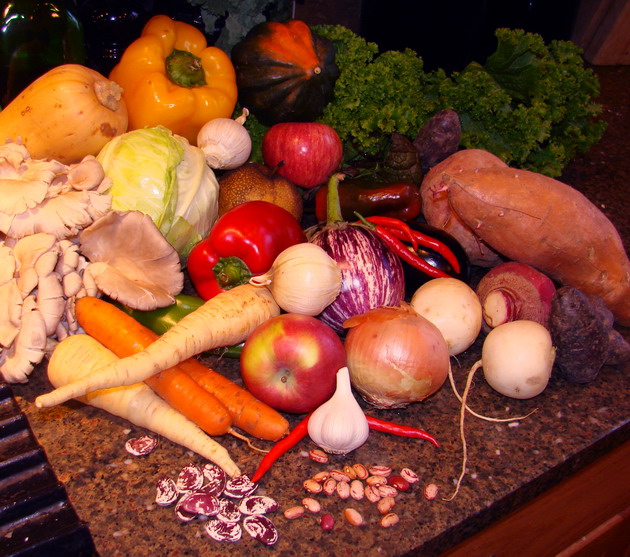
Optional Additional Ingredients:
Vegetables and Greens:
Baby or fingerling potatoes, white red or blue, scrubbed and halved or kept whole. You can either parboil them until they are nearly done in a separate pot of water and then add them to the curry after the coconut milk, or you could add more water to the curry and let the potatoes cook in the curry sauce, but you may have to let the sauce simmer the excess water away after everything is cooked.
Peeled and cubed sweet potatoes
Sliced summer squash
Whole tiny baby carrots
Frozen peas
Pearl onions
Blanched fresh green beans or frozen green beans
Blanched or parboiled cauliflower–purple would look neat
Mushrooms–but if you use them add them with the chicken and saute them first
Baby turnips, peeled and halved
Baby spinach–add at the very end, just before serving so it just wilts and stays a nice velvety fresh green
Kale, stemmed and cut into thin ribbons–blanch first or add in the last ten minutes of cooking
Tomatoes, canned or cherry tomatoes, fresh–add canned in the last ten minutes of cooking, add cherry tomatoes, halved, at the end of cooking
Fruits:
Mango, fresh or frozen. Add at the end, in the last five minutes of cooking
Pineapple, canned, fresh or frozen–add in the last ten minutes of cooking Don’t use syrup packed pineapple–it is too sweet
Pomegranate seeds–just sprinkle them over the top right before serving
Ripe Plantain, peeled and cut into 1″ chunks–add in the last ten minutes of cooking
Golden raisins–add right after the coconut milk
Herbs:
Fresh cilantro, added right before serving in copious amounts
Fresh mint, added just before serving in a moderate amount
Fresh or frozen fenugreek greens, added in the last ten minutes of cooking
For Vegetarians and Vegans: You could easily make this vegetarian by using pan-fried or deep fried paneer in place of the chicken, or if you want to make it vegan, then use pan-fried or deep fried tofu instead. You just have to remember you won’t need to simmer the cheese or tofu as long as you do the chicken, though the longer it simmers, the more flavor it will pick up from the sauce.
Leftovers of this curry freeze very nicely, and like all curries, it benefits by being made a day ahead, or if not, the leftovers will taste amazing the next day.
Can You Do The Heimlich?
I know you all know I am not talking about a dance, but that is what it sounds like a little.
But I am asking a serious question–how many of us know, really know, how to do the life-saving Heimlich maneuver?
Have you had training?
Have you ever done it, if not on a person, on a practice dummy?
Have you ever, god forbid, ever had to use that knowledge, or had that knowledge used upon yourself?
I am asking, because Zak sent me this NY Times Op-Ed piece about how few restaurant professionals know how to do the Heimlich Maneuver, and it made me think.
I was certified in it, back when I was certified in CPR, when I was a Girl Scout, but my certification has lapsed long ago. (Duh–I am a bit old to be a Girl Scout these days!) And while I watched a video the night before we took Kat home from the NICU on the subject of infant and toddler Heimlich and CPR, I don’t know that I would be able to perform it on a kid without practice, much less on an adult.
Which leads me to say I am going to be calling the Red Cross to see if they do training courses here in Heimlich and CPR both for adults and kids. It is just something that I think parents, food professionals, and hell–everyone–should know.
Now that I think on it, maybe I should call up Johnson & Wales, my old culinary school, and see if they currently include the Heimlich in their curriculum (they didn’t when I was there), and if not, see if I can convince them to do so.
I know how crucial CPR can be–back when I was a Girl Scout, my Mom and I actually had to use our CPR skills on a street person who had a heart attack in Charleston, West Virginia. Other folks passed him by, but we stopped and the EMTs who came after the guy at the paint store–my Sunday school teacher–called, said we made a difference.
So–these things are important–for everyone.
So, I ask again, how many of us know these life-saving techniques?
Two Greens Are Better Than One: Chicken with Baby Gai Lan and Bok Choy

Nothing will cure the wintertime blues for me better than greens.
Don’t get me wrong, I love me some greens all through the year, but in the deep, dark, cold months of winter, greens help pull me through the sunless days and long, shivery nights. (No, I don’t live in Alaska, but I do live in Ohio, and in the winter here, the sun is but a rumor, and we Ohioans exist in a grey twilight world of cold and shadow. It gets depressing after a while–particularly in February.)
And while I adore a fine mess of Southern style long-cooked collards and kale, I can’t help but also truly appreciate a plate full of Chinese-style stir-fried greens, with or without meat, tofu or any other vegetables. They are just so good–brilliantly colored, tender-crisp to the teeth and meltingly velvety on the tongue. A big bowl of steamed rice with greens can banish just about any kind of bad mood winter can throw at me, and make me smile. In fact, since my depression tends to be much worse in the dark months of the year, greens are like medicine to me, and I treat them as such. I make sure to eat greens at least twice a week in the winter, usually more like three or four times.

And they do help. The taste makes me smile, the color makes me think of spring which makes me smile again and the vitamins and minerals help bolster my immune system against all the viruses that are endemic to the season.
Tonight, I did something I had not done before, and now I am wondering exactly why that is. (Kind of like I have no idea why I never cooked chicken with bacon and bok choy together before.)
I combined two Chinese greens in one dish, and discovered something: if one green is good, then two are better.
I had about a half pound of baby gai lan left from Sunday dinner, and I had a bundle of three small Shanghai bok choy.
Baby gai lan is a delicacy among a lot of Chinese folks–there in the photograph above you can see what it looks like–it is essentially what it says it is–gai lan that has not matured yet. Interestingly, this fall, when my gai lan came in on my deck garden, this is how I harvested it, because I wasn’t patient enough to let it get big. And when I did it I felt kind of guilty for not waiting, but it tasted so good-sweet, and crisp, with only a tinge of the native bitterness to the leaves. And it was pretty too–the stalks had little flushes of violet along their creamy jade sides, and the leaves were a brilliant emerald color.
Then I saw it at the Columbus Asian Market (CAM to city residents) and was informed as I picked it up, by the Chinese Grandma next to me that it was a delicacy, and it was her favorite way to eat the vegetable. Of course, I had to get it.
And I didn’t use all of it for Sunday dinner, since I got about a pound and a half, so there was some in the crisper drawer, looking lonely next to those Shanghai bok choy bundles, so I decided tonight that they needed to become friends.
I decided to cook them with chicken because Kat loves chicken and is in a growth spurt, but one day, I really want to do this with spiced dry tofu or black mushrooms. I think that both variations would be fantastic.
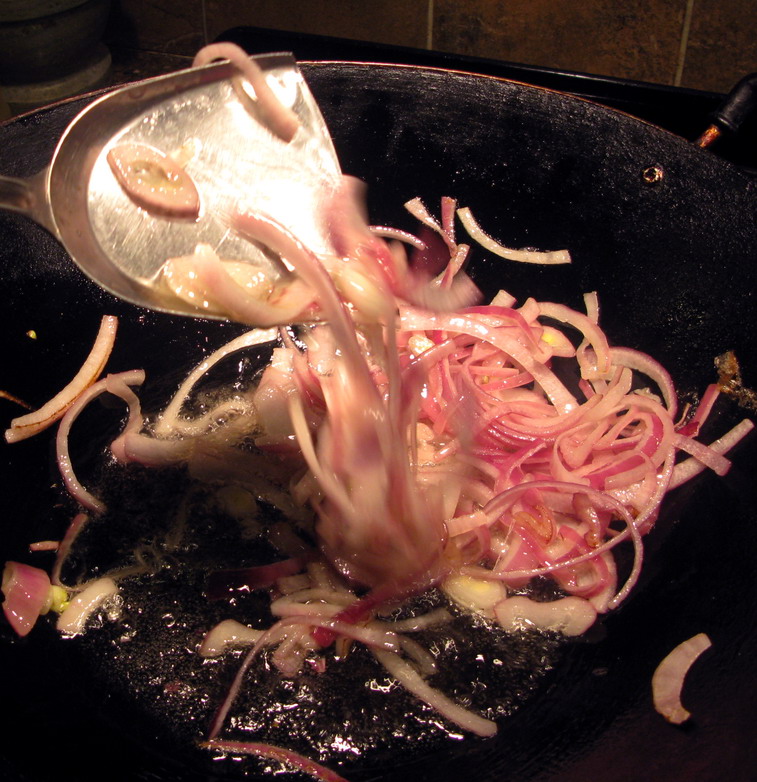
I decided to make the seasonings pretty simple: an onion, some garlic and lots of ginger, with light soy sauce, sugar, a bit of Shao Hsing wine, a dab of chile garlic paste, a teaspoon of vinegar and some chicken broth and sesame oil to finish it.
When I went to the pantry, I had a choice of red or yellow onions, and for a change, I picked up a red one. I wanted to see how much of the pretty violet color would be left after stir-frying, hopeful that at least some of it would remain, because I love to combine greens and purples, whether it is on a plate or in a quilt.
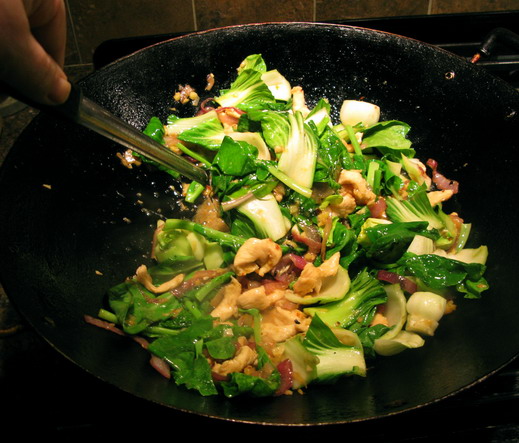
It turned out that a reasonable amount of color was left, so I got my wish of having a supper that had colors of a beautiful plum-violet and varying shades of brilliant green with pale pinkish-white and brown chicken. It looked really, really, pretty.
But looks aren’t everything–how did it taste?
I thought it was perfect. The stems of the baby gai lan were crisp, and the leaves were velvety, while the bok choy stems were juicy and crunchy in a totally different way, with leaves that were soft and yielding to the teeth. The bok choy was sweet the way it always is, but the gai lan was sweeter, with just a little bit of the bitter edge that makes it interesting. And the chicken and slices of red onion just tied everything together nicely.
I will definitely be making this one again–though I might have to try slipping in a third green like Napa cabbage or Chinese mustard, just to see what happens.
Chicken with Baby Gai Lan and Bok Choy
Ingredients:
1 whole boneless skinless chicken breast, thinly sliced into pieces 1″X1/2″X1/4″
1 tablespoon raw or brown sugar
1 tablespoon Shao Hsing wine or dry sherry
1 teaspoon light soy sauce
1 1/2 tablespoons cornstarch
3 tablespoons canola or peanut oil
1 red onion, peeled and sliced thinly
1 2″ cube ginger, peeled and minced
5 cloves garlic, peeled and minced
1/2 teaspoon chili garlic paste
1/2 teaspoon sugar
2 tablespoons light soy sauce
1/2 pound baby gai lan, bottoms trimmed and stalks separated, washed and dried
3 medium Shanghai bok choy, bottom trimmed, washed and dried and cut into 1″ pieces
1/2 cup chicken broth
1/2 teaspoon toasted sesame oil
Method:
In a bowl, toss together the chicken with the first measure of sugar, the wine, the first measure of soy sauce and the cornstarch and allow to sit for at least twenty minutes.
Heat a wok over high heat until a thin ribbon of smoke spirals up from the bottom. Pour in oil, swirl to coat the bottom and allow to heat for about thirty seconds. Add the onion and cook, stirring, for two minutes or so, until the onion is soft and is starting to brown and turn golden on the edges.
Add the chicken and its marinade and push into a single layer on the bottom of the wok. Sprinkle the ginger and garlic over the chicken and put the chili garlic paste in the middle on top of the chicken. Sprinkle with the second measure of sugar.
Allow to sit, undisturbed on the bottom of the wok for about a minute or so, until the chicken begins to brown. Then, start stirring, and cook, stirring, until most of the pink is gone from the meat and it is mostly white with some brown bits.
Add the soy sauce and baby gai lan, and cook, stirring, until the gai lan’s color brightens and the leaves begin to wilt. add the bok choy and the broth and keep cooking and stirring until the leaves of the bok choy wilts slightly. Remove from heat, drizzle in the sesame oil, stir and toss to mix it in thoroughly and transfer to a heated platter and serve immediately with steamed rice.

Categories:
- Admin (rss) (55)
- Blogs and Blogging (rss) (81)
- Book Reviews: Cookbooks (rss) (43)
- Book Reviews: Non-Cookbook Food Books (rss) (38)
- Cats and Cat Blogging (rss) (47)
- Chinese Cooking Lessons (rss) (32)
- Culinary School Stories (rss) (18)
- Dairy Pruducts: Cultured and Barbaric (rss) (4)
- Documentary Filmmaking (rss) (1)
- Essays, Rants and Reflections (rss) (260)
- Fighting Hunger (rss) (12)
- Food and Kids (rss) (45)
- Food in the News (rss) (126)
- Food Media (rss) (98)
- Food Preservation (rss) (18)
- Food Safety (rss) (45)
- Gardening (rss) (30)
- Herbs and Herb Blogging (rss) (20)
- Holidays (rss) (50)
- Kat Blogging (rss) (22)
- Kitchen Science (rss) (36)
- Leftover Makeover (rss) (8)
- Life, the Universe and Everything (rss) (131)
- Local and Sustainable (rss) (227)
- Local Athens Food and Foodies (rss) (42)
- Meatless Mondays (rss) (32)
- Menu For Hope (rss) (5)
- Nutrition, Diet and Health (rss) (84)
- On The Farm (rss) (8)
- Recipes: Almost Vegetarian, Vegetarian and Vegan (rss) (294)
- Recipes: American Regional (rss) (37)
- Recipes: Appalachian Hillbilly (rss) (33)
- Recipes: Bread, Pasta, Grains (rss) (95)
- Recipes: Canning and Preserving (rss) (8)
- Recipes: Chinese (rss) (123)
- Recipes: Comfort Food (rss) (120)
- Recipes: Cookies (rss) (16)
- Recipes: Desserts (rss) (48)
- Recipes: French (rss) (25)
- Recipes: Fruits and Vegetables (rss) (302)
- Recipes: Greek, North African and Middle Eastern (rss) (31)
- Recipes: Indian (rss) (137)
- Recipes: Italian (rss) (42)
- Recipes: Japanese (rss) (7)
- Recipes: Jewish (rss) (4)
- Recipes: Korean (rss) (6)
- Recipes: Meat, Poultry and Fish (rss) (220)
- Recipes: Mexican/Native American/ Latin American/Caribb (rss) (27)
- Recipes: Original (rss) (108)
- Recipes: Thai (rss) (27)
- Recipes: Tofu (rss) (17)
- Recipes: US Regional (rss) (16)
- Recipes: Vietnamese (rss) (8)
- Restaurant Stories (rss) (28)
- Sewing, Quilting, Arts and Crafts (rss) (16)
- Simple Chinese Recipes (rss) (30)
- Slow Food and Heritage Foods (rss) (10)
- Spice Blogging (rss) (44)
- The Chinese Cookbook Project (rss) (14)
- The Chinese Pantry (rss) (39)
- The Documentary (rss) (2)
- The Kitchen Saga (rss) (17)
- The Locavore's Bookshelf (rss) (15)
- The Unsung Adventures of The Culinary Nerd (rss) (6)
- Tools and Toys (rss) (35)
- Uncategorized (rss) (10)
- With a Side of Politics (rss) (48)
Archives:
- August 2012 (9)
- July 2012 (12)
- September 2011 (3)
- August 2011 (7)
- July 2011 (8)
- June 2011 (16)
- May 2011 (17)
- April 2011 (11)
- December 2010 (9)
- November 2010 (5)
- February 2010 (1)
- December 2009 (5)
- November 2009 (7)
- October 2009 (10)
- September 2009 (16)
- August 2009 (14)
- July 2009 (14)
- June 2009 (7)
- May 2009 (17)
- April 2009 (10)
- March 2009 (25)
- February 2009 (13)
- January 2009 (10)
- December 2008 (5)
- November 2008 (5)
- October 2008 (6)
- September 2008 (13)
- August 2008 (8)
- July 2008 (11)
- June 2008 (18)
- May 2008 (13)
- April 2008 (14)
- March 2008 (16)
- February 2008 (17)
- January 2008 (19)
- December 2007 (25)
- November 2007 (18)
- October 2007 (24)
- September 2007 (16)
- August 2007 (15)
- July 2007 (15)
- June 2007 (10)
- May 2007 (14)
- April 2007 (16)
- March 2007 (17)
- February 2007 (20)
- January 2007 (13)
- November 2006 (1)
- October 2006 (8)
- September 2006 (14)
- August 2006 (25)
- July 2006 (30)
- June 2006 (28)
- May 2006 (34)
- April 2006 (29)
- March 2006 (24)
- February 2006 (30)
- January 2006 (38)
- December 2005 (40)
- November 2005 (37)
- October 2005 (32)
- September 2005 (25)
- August 2005 (30)
- July 2005 (28)
- June 2005 (21)
- May 2005 (8)
- April 2005 (22)
- March 2005 (17)
- February 2005 (29)
- January 2005 (10)
Search Site:
Links:
- Lily’s Wai Sek Hong
- 101 Cookbooks
- A cat in the kitchen
- A Veggie Venture
- Accidental Hedonist
- Cha Xiu Bao
- chez pim
- Chocolate & Zucchini
- Chopstick Cinema
- Chowhound.com
- Chubby Hubby
- Cook sister!
- Cooking with Amy
- da*xiang
- Eat Local Challenge
- Eating Liberally
- Ecocentric
- Eggbeater
- Epicurious
- Farmgirl Fare
- Fatfree Vegan
- Foodgoat
- ForkandBottle.com
- Green Olive Tree
- Hooked on Heat
- Jaden’s Steamy Kitchen
- Kalyn’s Kitchen
- Lucullian delights
- Mahanandi
- Matt Bites
- MeatHenge
- mmm-yoso!!!
- New York Times – Dining & Wine
- Pizza Goon
- Rasa Malaysia
- Ruhlman
- Sailu's Kitchen
- Serious Eats
- SF Gate: Food & Dining
- Simply Recipes
- Soul Fusion Kitchen
- Tastespotting
- The Amateur Gourmet
- The Cleaner Plate Club
- The Food Section
- The Grub Report
- thecookscottage
- U.S. Food Policy
- Wandering Chopsticks
- Washington Post Food and Dining
- Wasted Food
Meta:


Powered by WordPress. Graphics by Zak Kramer.
Design update by Daniel Trout.
Entries and comments feeds.