
Cook Local, Eat Global
Cilantro Chicken with Fresh Water Chestnuts and Baby Bok Choy
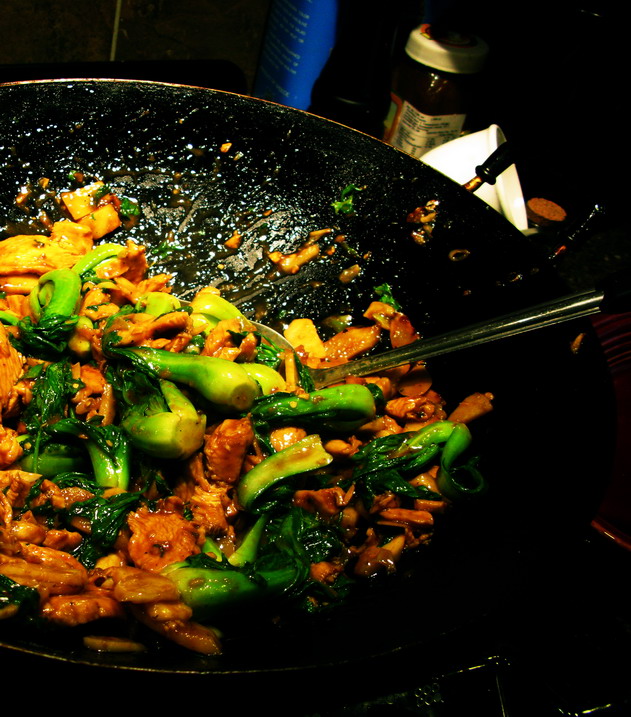
Water chestnuts are not locally grown here in Ohio, at least, not that I know of.
But, when they are fresh, they are truly divine, and I will buy them even if they were grown in California or Florida. Not only will I buy them, but I will buy several pounds of them, and use them in stir fries for a week, and the truth is, they are so delectably crisp and nutty-sweet that none of us ever tire of them. They are just that delicious.
I like coming up with new recipes to use them in, because that is more fun than just making the same several recipes–as good as they are–over and over again.
With super fresh local chicken, cilantro, green garlic and scallions all from the farmer’s market, as well as some really fresh baby bok choy, I decided to put together a new twist on the Cilantro Chicken I posted about a few weeks ago.
Here, I substituted fresh water chestnuts for the carrots, and added the baby bok choy along with about a half teaspoon of freshly toasted, ground Sichuan peppercorns. I love the combination of the nutty-sweet water chestnuts and the shimmery, flowery fragrance and tongue-tingling taste of the Sichuan peppercorns. They are amazing together, and I have used them in both Five Fires Beef and Sichuan Chicken with Garlic Sauce. And while these recipes are delicious, and I love making them, there is always room for another stir-fry recipe in my kitchen!
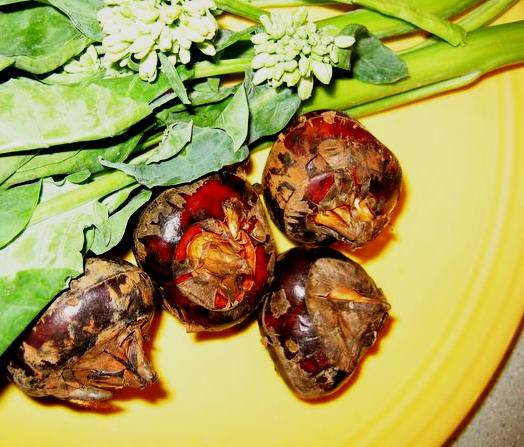
Let’s talk a little bit about how to handle fresh water chestnuts before we go on to the recipe. They should look like the ones in the picture here–there should be no sign of mold–no blue green spots, nor fuzzy white spots. They should be plump and firm. Some of them are sold cleaned and shiny, and others have a thin or sometimes thick layer of mud on them–I have found that the mud actually helps keep mold from attacking them. The shiny ones can have mold on the inside that you cannot detect until you start peeling them. The mud seems to seal any cracks in the skin that allow mold entry to the sweet interior flesh.
Store them loosely wrapped in the fridge for only a few days–five at the most–before using them. When you are ready to peel them, rinse them well, then cut off the top and bottom, and with a sharp paring knife, carve off the peel along the diameter of the chestnut. If you see any spots with blue mold or bright yellow flesh inside, cut those portions away, or if it is a big amount, toss that chestnut. The flesh should be bright white with the texture of fresh coconut–it should be quite firm. When you bite into them raw–and I suggest it–they are super crisp and VERY sweet, like the best candy in the world.
After they are peeled, rinse them again to get any flecks of peel off, and then slice them however you like. I tend to cut them into squarish slices, not rounds, just because it is easier to set them on the flat bottom or top and slice through that way than to set them on the round edge and cut round slices.
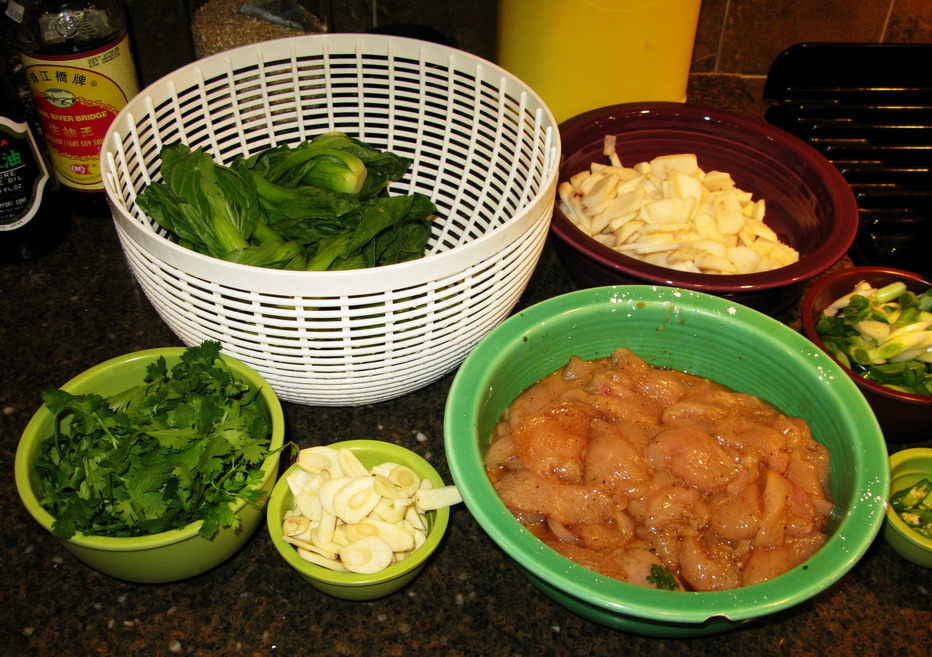
One other note on this recipe–I use fresh Thai chilies in it, but you don’t have to use chilies at all, or you can use dry Chinese or Thai chilies instead. You can add more chilies, or less, to your taste–I like a little bit of them, just to add zing that balances the sweetness of the water chestnuts. I like more garlic than ginger in this recipe, but if you want, you could make it the other way around. I will put my foot down and insist on scallions instead of onions for this stir-fry, though. Scallions have a green sharpness that goes perfectly with the cilantro and bok choy and really boosts the fresh flavor of the dish. Onions would be too strong.
Okay, enough stalling. Here is the recipe for you, which I hope you try and enjoy.
And remember, if you cannot get fresh water chestnuts, try using jicama instead. It has the same texture and a similar, if not quite as sweet flavor. Canned water chestnuts just won’t do for this recipe, so just pass on them this time around.
Oh, and one more thing–if you want to do a vegetarian version of this recipe, wheat gluten, also known as seitan, makes a great substitute for the chicken.
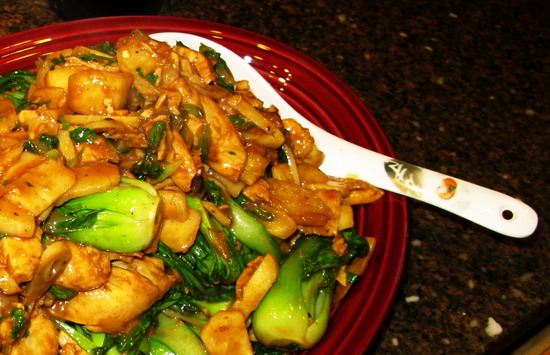
Cilantro Chicken with Fresh Water Chestnuts and Baby Bok Choy
Ingredients:
1 pound boneless skinless chicken breast or thigh, cut into 1 1/2″ X 1/2″ X 1/4″ strips
2 tablespoons Shao Hsing wine or dry sherry
1 tablespoon dark soy sauce
1/2 teaspoon freshly ground, toasted Sichuan peppercorns
2 tablespoons cornstarch
3 tablespoons peanut or canola oil
2″ cube fresh ginger, peeled and cut into thin slices
2-4 fresh Thai chilies, sliced thinly on the diagonal
8 cloves garlic, peeled and thinly sliced
5 large scallions, thinly sliced on the bias, light green and white parts only (reserve the dark green slices for garnish)
1 teaspoon sugar
1/4 teaspoon salt
1/8 cup Shao Hsing wine or dry sherry
2 cups fresh water chestnuts, peeled and thinly sliced into rectangles
1 tablespoon dark soy sauce
12 baby bok choy, bottoms trimmed, rinsed and dried (I use a salad spinner)
1/3 cup chicken broth
3 cups roughly chopped cilantro leaves (about two big bunches from the store)
reserved thinly sliced dark green scallions
1/4 teaspoon toasted sesame oil
Method:
Toss together the chicken, wine, soy sauce, Sichuan peppercorns and cornstarch and allow to marinate for at least twenty minutes, but no more than an hour and a half.
Heat wok on the highest heat your stove can produce until a thin wisp of smoke rises from the bottom. Drizzle oil into the wok, and allow to heat for about thirty seconds or so, or just until the oil shimmers in the bottom of the wok.
Add ginger and stir fry for about a minute. Add chilies, garlic and scallions and stir fry for thirty seconds.
Spread chicken in a single layer over the bottom of the wok, and allow to sit undisturbed for about a minute. While chicken is browning on the bottom, sprinkle with the sugar and salt. When chicken has browned a bit, stir fry until almost all of the pink is gone from the chicken. You will see that browned bits of marinade have begun to stick to the sides of the wok.
Drizzle the wine around the sides of the wok, and deglaze, scraping up the browned bits.
Continue stir frying until all of the pink is gone from the chicken, then toss in the water chestnuts.
Add soy sauce, bok choy, and chicken broth, and stir fry until bok choy leaves go limp and the stalks are still tender-crisp.
Throw in the cilantro and scallion tops, and stir fry for about one minute more.
Remove from heat and drizzle with sesame oil.
Serve immediately with steamed rice.
In Memory of Ozy: The King Has Left The Building
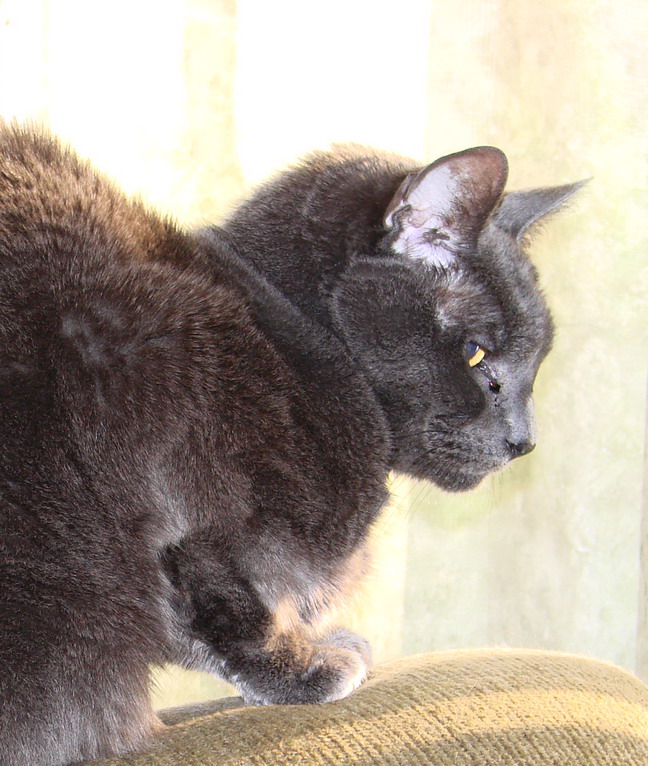
Yesterday morning was the end of an era. It was the end of the benevolent reign of the King of Cats in our house.
The day dawned sunny and warm as Zak sought out Ozy and put him into the dreaded cat carrier.
It was a measure of how tired, old and sick the King was that he didn’t complain, struggle, nor attempt escape. He despised confinement, and every time Zak and I took one of our “across the countryside” moves–from Ohio to Rhode Island, from Rhode Island to Maryland, and from Maryland, finally back to Ohio–we had to tranquilize Ozy and crate him with his best pal Tristain, the ever-flighty Siamese, so as to avoid the His Big Grey Highness ripping out his teeth or claws as he tried to dismantle his carrier from the inside.
But, this one time, he didn’t struggle, or fuss. I think he probably knew it was time.
It is hard to conceive of our household without Ozymandias, King of Cats. He came into our lives by showing up on my doorstep as a scrawny, underfed street kitten in Huntington, West Virginia. Zak had just said that he wanted a grey cat, for they were superior to all other cats two days before, so I called him and said, “Your cat is here on my porch. Come get him.”
So, he did. He put the then nameless kitten in an unused ferret cage to transport him and was horrified at the crazed attempts the little thing waged to gain his freedom.
Ozy then got sick and Zak feared losing him, as he had his other beloved grey kitten, Mojo, to some dread disease like feline leukemia.
So, it was then that he bestowed upon the kitten a mighty name, a strong name, a name fit for a great king, which he hoped the little scrapper would grow up to be.
Ozymandias.
It turned out that the little critter was just constipated. After a mighty stench-filled series of rocks was released from his gut, he was fine, and went on to grow into a lanky, insane adolescent cat whose destructive potential was limitless.
He always had the propensity to show his displeasure by urinating on something–one time right after we flea-dipped him when he was a half-grown cat, he bounced off every bathroom wall (we locked him in there for the procedure), dashed out the newly opened door, and before Zak could close off the bedroom, he dashed in there, leaped on the bed, then squatted and soaked Zak’s pillow, while staring balefully at him.
Luckily we laughed, although there were times when we would threaten to put him back out on the street for his antics.
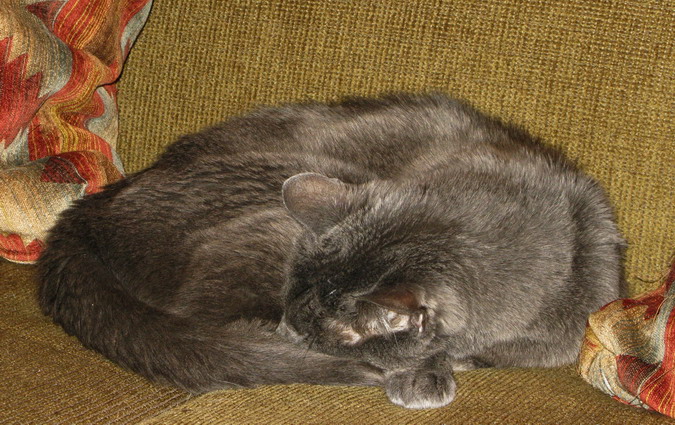
We never did throw him out, at least not permanently–we loved him too much.
And he finally grew to be a large cat in his maturity–twelve pounds, all of it lean, sinuous muscle. He was a very manly cat, although he was silly when he was younger, and could never hold his ears erect and centered–one was always cocked off-kilter, giving him a comical expression. He also was endowed with a low criminal forehead and somewhat beady eyes, which when he was younger made him look untrustworthy, but as he aged, it only gave his face character.
After about five years of life and many adventures, he finally attained some measure of gravitas, and was able to look calm, collected and dignified. (Except when the ferrets were loose–he never lost his absolute terror of those critters, and would flee instantly upon their approach.) He became a tremendous mouser, and ruled all the other cats of our household with an iron paw–well, not really. He was the King, however, and while he seldom had to cuff any of his subjects, he still would throw down and wrestle one or another of them to floor if they became too uppity.
Morganna cannot remember a time without Ozy, but sadly, Kat will never remember him at all. (Nor will she know Liriel or Nan, or dogs, nor any of the other wonderful cats who went before she arrived on the scene.)
Ozy slowed down over the years, of course, but all the other cats, even the ones younger and stronger, respected him, and bowed to his superior feline nature. Our friends imagined that he spoke with either Elvis Presley’s or Johnny Cash’s voice, and elaborate monologues were devised on his behalf. Many songs were sung in his honor and many fond names were given to him over the years, as he only grew in stateliness and stature.
But, over the past few years, he had begun to shrink and wither before our eyes. Old age was finally taking its toll, and he began to slow down, his eyes dimming with cataracts, his once silvery-sheened fur dulling and thinning. His purr still rumbled like thunder and rain, however, and whenever any of us cried, whether it was Morganna, myself, Zak or Kat, he would come running, and butt his head against us, purring his mighty purr in consolation.
In recent weeks that purr had quieted to a pale whisper of its former glory.
And now, it is gone forever.

It is hard to cry now, knowing that the rumble purr won’t be there to sooth my tears.
But then, I look at this picture of the King and Kat, from just a few months ago, and I cannot help but smile. He isn’t here in body, but his spirit remains in my memory, just as his fur is still sticking to the back of the loveseat that he claimed as his throne. He’ll always be the King to me, the greatest cat who was with Zak and I through the best of times and the worst of times, and brought us much joy and laughter over the years.
And so, in memory of our beloved King of Cats, I paraphrase Shelly:
Hail Ozymandias, king of cats: Look upon his works, ye Mighty, and despair!
Toddler Tastes
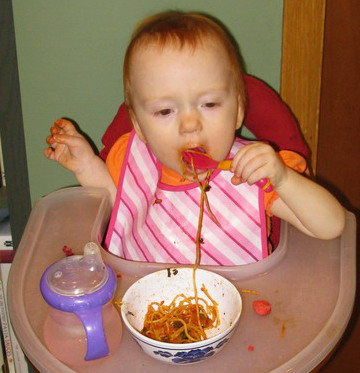
A few months ago on his blog, Anthony Bourdain was musing with horrified dread on the subject of what he would feed his infant daughter when she started eating solid food.
A lot of foodie moms (myself included) posted with the hopefully helpful advice that babies and toddlers will eat what you feed them. That is to say, if they never get a taste of Chicken McNuggets in the the first place, they won’t insist on a diet that consists only of questionable chicken parts nuggetized and breaded with unknown substances and deep fried in half-degraded oil.
Watching Kat eat her own little bowl of Kiss Kiss Bang Bang Spaghetti the other day made me realize that I hadn’t really talked about how toddler’s tastes change and how to guide those tastes toward healthy, delicious food choices.
So far, Kat still tends to prefer flavorful, healthy foods, although she does love her ice cream, chocolate preferably. She doesn’t get much in the way of cookies or cake or candy, simply because we generally don’t keep such foods around our house. She still most often shares our meals with us, although there are some foods she doesn’t seem to like much. Cow milk, except in the form of cheese, preferably sharp cheddar, cream, ice cream or yogurt lassi, is on her “I don’t consume it” list. Meat is a sometimes food as well: some days she will refuse it, while at other meals, she cannot get enough of it. I have noticed that she tends to prefer chicken and pork to beef, but what she seems to prefer above all meat is eggs. (Kat really digs Cilantro Chicken Stir Fry–she eats that chicken so fast I can barely keep up with shredding it into little bites for her.)
She likes scrambled eggs so much that Zak has taken to calling her “The Oviraptor.” She can power through one to two extra large farm fresh eggs from pastured hens in record time, gobbling them up using both a spoon and a hand, if the spoon method is too slow. She likes the way I cook them best–well beaten with a tiny bit of cream, a sprinkle of herbs and slowly cooked with a bit of butter–all local. At the end, I add a sprinkle of shredded sharp cheddar and serve it forth to her great appreciation.
Fruits and vegetables are a seesaw ride. One day she cannot get enough of oranges and tangerines, then two days later, they are the untouchables of the citrus world. Apples are beyond great one minute, and the next, she is tossing them to the cats as outcast unclean. Asparagus is viewed with suspicion when sauteed in butter, but let it be cut up in a creamy pasta dish and it is better than good and is pounced upon and gobbled up. Tomatoes are almost always the best beloved, although now and again they are given a fierce toddler glare that eloquently says, “I don’t think so.”
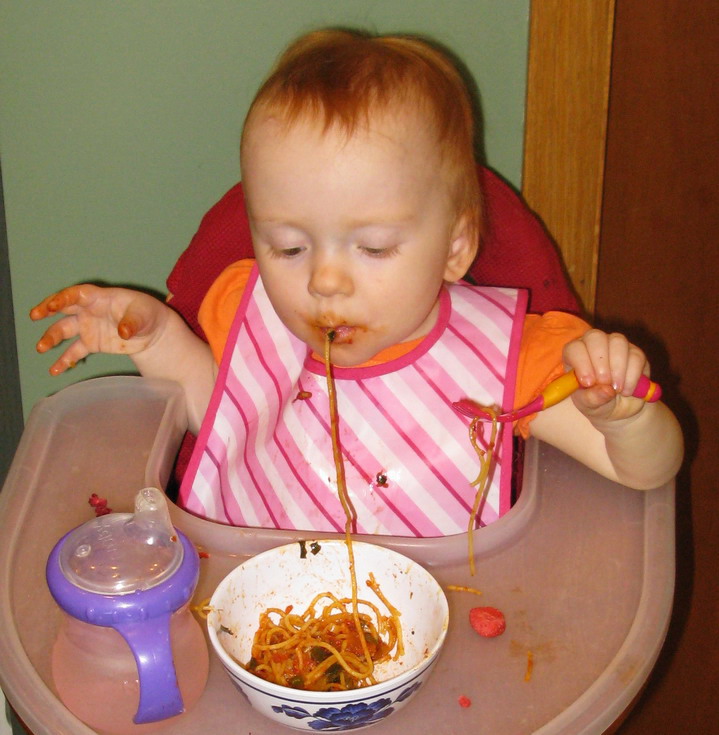
Noodles of all types, both Western and Asian, are a great hit, as is anything over or in rice. Pasta, especially long thin noodles, have the extra bonus of providing dinner time entertainment to Mommy, Daddy, Big Sister and any of the assorted dinner guests who happen to sit down with us. Tomato based sauces made with my home-canned tomatoes are greatly favored, but she also likes vegetable pastas with creamy cheese sauces too. Asparagus and spinach are great in her book if noodles are involved, and peas taste better when mixed into macaroni and cheese, a dish which we have renamed “Cheez n’ Peaz.” Kat loves her Cheez ‘n’ Peaz, although in typical toddler fashion, while she may eat peas with gusto one day, she may pick them out of her bowl and set them aside the next day.
That toddler tendency to eat a food one moment and refuse it the next is probably one of the must frustrating aspects to feeding a child of Kat’s age. Some kids grow out of it by three, others continue in this irritating and confounding behavior until they are eight or nine years old. I think that the best way to deal with it is to not make a fuss about it, and if a kid doesn’t eat one thing, offer something else–within reason–and then offer the once offensive food again in a day or so. Be laid back about it, though, because in my experience, the more attention paid to the behavior by a parent, whether positive, in the form of offering a dizzying array of food choices all of which the child may refuse just for the pleasure of feeling their own personal power, or negative, in the form of berating, cajoling, coercing or otherwise making a divisive issue of food, the more likely the child is to continue in the behavior, because they are rewarded by this attention.
When Kat refuses to eat something, I just shrug and offer something else. If she doesn’t eat that, I figure she probably isn’t really hungry. Most kids will not starve themselves, so I don’t worry–I just keep an eye on what she eats over a period of days, instead of looking at what she is eating or not eating this minute. When I look at it that way, I find that she does eat a varied, nutritive diet, it just may not seem so at every meal when she pulls the bizzaro toddler trick of only eating one specific food for a meal or two.

That is my best advice to parents–take the long view when it comes to what your kids eat. Pay attention to the big trends, not the momentary whims. I find that Kat’s appetite fluctuates depending on her growth patterns, her physical activity levels and her, uh, digestive status. (In other words, if she hasn’t had a bowel movement in several days, it stands to reason that she might not eat much. Little bellies can only hold so much, and sometimes room needs to be made before a meal can go down.)
And when the momentary whims get you down, try and shrug your shoulders and ignore them. Feed them a varied diet in as calm and matter-of-fact way possible, and while you are at it, let them taste what you are eating, even if you think it is too spicy and they won’t like it. (Within reason–no steak tartare or raw fish for babies, please!) They may surprise you and love it–Kat still adores all sorts of curries, and as you can see the allium-laden Kiss Kiss Bang Bang really was a big hit with my little highchair dweller.
Let toddlers see you and other adults and kids enjoying food, making appreciative noises and sounds. Let them experience laughter and conversation at the table, maybe even a tiny drop of wine from your fingertip, and offer a lick of garlic butter from your spoon. Start them on the sensual pleasures of food early and you will eventually have a life-long food lover on your hands.
In other words, make food fun, not a fight, not just for your kids’ sake, but for your own as well.
Can Urban Farming Help Alleviate A Looming Food Crisis?

Americans need to go back to the land.
I don’t mean this in a 1960’s, leaving the city for a commune in the country, complete with goat milk, wheat grass and sprouted lentil loaves, kind of way.
I think we all need to get back to the land wherever we are.
We need to touch whatever bit of earth we have at our disposal, whether that means a planter on the deck, a grassy front yard, or an empty lot at the end of the block. We need to do more than touch that earth–we need to till it, plant seeds, tend them and watch them grow into food for ourselves, our families and our neighbors.
America used to be a nation of farmers, and we need to remember that and return to our roots.
Why?
Because of rising food prices, and looming threats of food shortages.
Because of lack of availability of fresh vegetables and fruits among the urban poor.
Because of soaring obesity rates, and lowered nutrition among the country’s poor.
Because eating locally is good for us and the environment, and our local economy.
And because we need to remember who we are, as a nation.
Gandhi once said, “To forget how to dig the earth and to tend the soil is to forget ourselves,” and he is right. As Americans have turned away from the land, as we have allowed farms to be turned into strip malls and condominiums, as we have turned away from self-reliance and embraced consumerism as a lifestyle, we have forgotten the soul of our nation. We have forgotten what once made us strong, and that was a deep connection to the earth, to our homes, to our neighbors.
We need to rebuild that connection, and in doing so, we will be better able to weather the coming economic recession, high food prices and possible food shortages which loom over our future lives.
And the thing is–gardening and growing at least some of our vegetables and fruits–can be accomplished anywhere. You don’t have to have forty acres and a mule, or even one acre and a rototiller. A small urban yard will do, or a series of containers on a rooftop or balcony or a vacant lot.
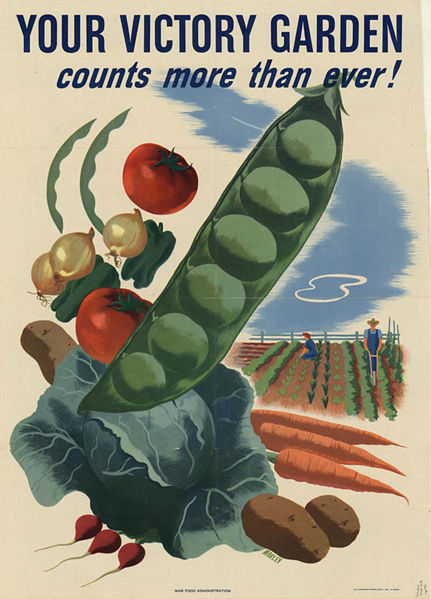
Urban agriculture is finally coming back into its own in the US, after last being seen as a real movement during WWII with the “Victory Garden” campaign when rooftops and backyards were planted in cities and larger gardens were dug in the country by people from all walks of life.
The New York Times features an article on the growing trend of urban farming in the US where individuals not only grow food for their families on vacant lots, but also grow enough vegetables to sell to their neighbors. Not only does this bring in extra cash for people in poor neighborhoods, it also brings much appreciated fresh food to people who have little choice in where to shop.
The Times reports that co-ops have been formed, CSA;s have gone urban and restaurants have taken to buying produce grown within their own cities.
Of course, none of this is new–there have always been urban farmers. What is new is the idea that urban farming in the US could help to substantially feed citizens while also boosting local income and microeconomic systems. (Cities in the UK and other countries are also embracing urban agriculture as well, but I am primarily talking about the US for now.)
For proof that city-based agricultural ventures, from backyard gardens to community gardens to full-fledged urban market farms, can produce a significant amount of food in modern times, we need to look beyond the US, however. We need to examine the current urban agricultural system of Cuba.
Cuba’s successful experiment in urban agriculture started as a means to feed Cuba without relying on food imports after trade embargoes caused food shortages. Currently, urban farms occupy around 86,000 acres, and in the past few years, these farms have produced 3.4 million tons of food annually. Urban farms grow 90 percent of the fresh vegetables for the city of Havana alone.
Considering that these government-led and supported urban agriculture programs only started a few decades ago, their success is astonishing, and to me, enticing.
Just think of what Americans could do with our abundance of land, in comparison to the smaller acreage available to Cuba.
Why don’t we do it then? Why don’t we all start planting our own “Victory Gardens” again, and take the time to learn how to grow our own food, and take back a measure of self-reliance once more? Why don’t we claim our own victories–against poverty, against processed foods, against corporate control, against our own complacency–and relearn what we have forgotten: how to dig the earth and tend the soil.
Let’s join other Americans and do it, in big ways and small ways.
Let’s remember ourselves.
Author’s Note: Our backyard is finally being terraced this year, and the first things we will plant in it will be asparagus crowns, strawberries and a bunch of annual vegetables. The ornamentals–the flowers and shrubs, and hopefully fruit trees–will wait for next year. The food comes first.
Kiss, Kiss, Bang, Bang: Spaghetti with Ramps, Green Garlic and Goat Feta
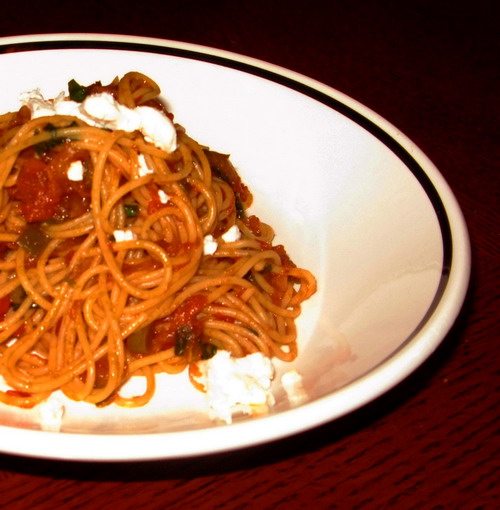
I bet you are wondering why I called this recipe “Kiss, Kiss, Bang Bang,” right?
Well, it has nothing to do with either James Bond, the movie with Robert Downey Jr. or the Torchwood episode of the same name.
It has to do with the nature of the recipe I am presenting.
This pasta sauce is such an explosion of strong flavors, that if you were to kiss someone after eating it, you would make a big bang of an impression upon them.
And probably not in a good way.
So, this title is a warning of sorts. If you are in a kissing mood after you eat this spaghetti, I suggest that you choose your target kissee wisely. The best strategy would be to feed your intended recipient of the kiss some of the pasta first, so that the two of you are equally armed when it comes to the strong flavors and aromas left in the mouth. The combination of caramelized onions, ramps, green garlic and goat feta is powerful–delicious, sensual and delightful, really, but you don’t really want to share it second hand. (Well, unless you know someone like me who thinks the aroma and flavor of garlic is just about the sexiest ever….) And the combination is strong enough, thanks to the ramps, that it will defeat the liberal application of Listerine, Altoids and Crest. (On the other hand, personally, I’d sooner kiss someone who has just eaten a raw garlic clove than someone who has washed his or her mouth out with Listerine. Listerine tastes like someone has been licking a hospital floor. Ick.)
So, the title is a warning, but it is also an advertisement for those who love big bangin’ flavors–if you love the sweetness of caramelized onions, the tang of garlic, the heady aroma of ramps, and the sword-sharp bite of goat feta, then this recipe is for you. Take all of those flavors, add the sweetness of tomatoes and the heat of a little bit of chilies, and you have a great, quick sauce for spaghetti that will not only chase the blues and blahs away, but will chase away anyone else you might want to be rid of as well.
The truth is–you can leave out the ramps if you must–especially if you have no way of getting them. Just add more green garlic or add some regular garlic to the sauce. Or just plain old leave it out. You can also forgo the butter in the recipe and just use olive oil instead, but I find that a bit of butter in addition to the olive oil softens the flavor of all of the alliums, and adds a certain richness to the sauce, making it cling deliciously to the spaghetti. You can also leave out the optional teaspoon of anchovy paste in order to make this dish vegetarian–the anchovy paste adds a great deal of umami flavor, but it isn’t necessary. I just think it perfectly rounds out the sauce and ties the different allium tastes together into a cohesive whole.
As for the goat feta, I was lucky enough to get some of the first batch of Chris Schmiel’s (of Integration Acres) home made feta from his goats. You may not be so lucky, so if you can’t get goat feta, use whatever feta you can get–the creamiest, tangiest, most sharp feta you can find.
One more thing–I used home-canned tomatoes and marinara sauce from last summer’s abundant tomato crop, but you can just as easily use store-bought canned tomatoes and jarred marinara. In fact, this would be a quick way to jazz up jarred sauce–just use the highest quality sauce you can buy, one without high fructose corn syrup, so that you get the truest, strongest tomato flavor possible.
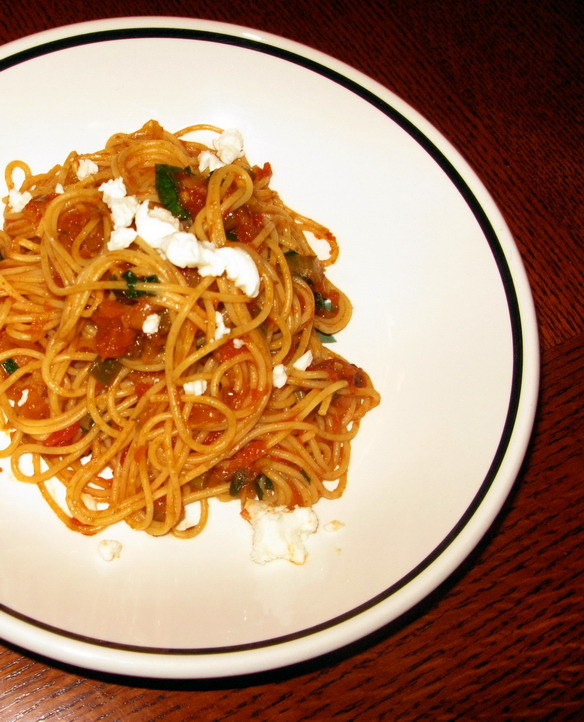
Kiss Kiss Bang Bang Spaghetti
Ingredients:
2 tablespoons olive oil
1 tablespoon butter (optional–you could use another tablespoon of olive oil instead)
2 cups thinly sliced yellow onions
1 teaspoon salt
1/4 cup fresh green garlic, white and light green parts only, thinly sliced
1 teaspoon Aleppo pepper flakes
1 teaspoon anchovy paste (optional)
1 teaspoon or to taste chili garlic paste–I used my homemade paste (or use freshly chopped chilies or a few drops of hot sauce)
1/4 cup dry sherry or dry red wine
1 pint canned tomatoes
1 quart marinara sauce
1 cup thinly sliced green garlic–dark green tops only
1 cup thinly sliced ramp leaves
salt and freshly ground black pepper to taste
1 pound thin spaghetti, cooked al dente
1/4 cup crumbled feta cheese
Method:
Heat olive oil and butter in a heavy-bottomed skillet until the butter foams. Add the onions and sprinkle with the salt. Cook, stirring, until the onions turn a deep golden brown. Add the garlic and continue stirring and cooking until the garlic turns golden and the onions are a deep reddish brown. add the pepper flakes, anchovy paste, and chili garlic paste, and cook, stirring for another minute. Add the sherry or red wine, and cook, stirring, until the alcohol boils off.
Add the tomatoes, and cook, stirring, until the juice is boiled off and the tomatoes begin to break down. Chop at the tomatoes with a spoon until they break down, and add the marinara sauce and keep cooking until the sauce thickens slightly. Toss in the green garlic tops and ramp leaves, and season to taste with salt and pepper. Cook until the leaves wilt slightly, then add drained spaghetti to the pot and toss until the pasta is well coated.
Swirl pasta onto serving bowls and top with crumbled feta cheese and serve immediately. (Serves six as a main course with salad.)

Categories:
- Admin (rss) (55)
- Blogs and Blogging (rss) (81)
- Book Reviews: Cookbooks (rss) (43)
- Book Reviews: Non-Cookbook Food Books (rss) (38)
- Cats and Cat Blogging (rss) (47)
- Chinese Cooking Lessons (rss) (32)
- Culinary School Stories (rss) (18)
- Dairy Pruducts: Cultured and Barbaric (rss) (4)
- Documentary Filmmaking (rss) (1)
- Essays, Rants and Reflections (rss) (260)
- Fighting Hunger (rss) (12)
- Food and Kids (rss) (45)
- Food in the News (rss) (126)
- Food Media (rss) (98)
- Food Preservation (rss) (18)
- Food Safety (rss) (45)
- Gardening (rss) (30)
- Herbs and Herb Blogging (rss) (20)
- Holidays (rss) (50)
- Kat Blogging (rss) (22)
- Kitchen Science (rss) (36)
- Leftover Makeover (rss) (8)
- Life, the Universe and Everything (rss) (131)
- Local and Sustainable (rss) (227)
- Local Athens Food and Foodies (rss) (42)
- Meatless Mondays (rss) (32)
- Menu For Hope (rss) (5)
- Nutrition, Diet and Health (rss) (84)
- On The Farm (rss) (8)
- Recipes: Almost Vegetarian, Vegetarian and Vegan (rss) (294)
- Recipes: American Regional (rss) (37)
- Recipes: Appalachian Hillbilly (rss) (33)
- Recipes: Bread, Pasta, Grains (rss) (95)
- Recipes: Canning and Preserving (rss) (8)
- Recipes: Chinese (rss) (123)
- Recipes: Comfort Food (rss) (120)
- Recipes: Cookies (rss) (16)
- Recipes: Desserts (rss) (48)
- Recipes: French (rss) (25)
- Recipes: Fruits and Vegetables (rss) (302)
- Recipes: Greek, North African and Middle Eastern (rss) (31)
- Recipes: Indian (rss) (137)
- Recipes: Italian (rss) (42)
- Recipes: Japanese (rss) (7)
- Recipes: Jewish (rss) (4)
- Recipes: Korean (rss) (6)
- Recipes: Meat, Poultry and Fish (rss) (220)
- Recipes: Mexican/Native American/ Latin American/Caribb (rss) (27)
- Recipes: Original (rss) (108)
- Recipes: Thai (rss) (27)
- Recipes: Tofu (rss) (17)
- Recipes: US Regional (rss) (16)
- Recipes: Vietnamese (rss) (8)
- Restaurant Stories (rss) (28)
- Sewing, Quilting, Arts and Crafts (rss) (16)
- Simple Chinese Recipes (rss) (30)
- Slow Food and Heritage Foods (rss) (10)
- Spice Blogging (rss) (44)
- The Chinese Cookbook Project (rss) (14)
- The Chinese Pantry (rss) (39)
- The Documentary (rss) (2)
- The Kitchen Saga (rss) (17)
- The Locavore's Bookshelf (rss) (15)
- The Unsung Adventures of The Culinary Nerd (rss) (6)
- Tools and Toys (rss) (35)
- Uncategorized (rss) (10)
- With a Side of Politics (rss) (48)
Archives:
- August 2012 (9)
- July 2012 (12)
- September 2011 (3)
- August 2011 (7)
- July 2011 (8)
- June 2011 (16)
- May 2011 (17)
- April 2011 (11)
- December 2010 (9)
- November 2010 (5)
- February 2010 (1)
- December 2009 (5)
- November 2009 (7)
- October 2009 (10)
- September 2009 (16)
- August 2009 (14)
- July 2009 (14)
- June 2009 (7)
- May 2009 (17)
- April 2009 (10)
- March 2009 (25)
- February 2009 (13)
- January 2009 (10)
- December 2008 (5)
- November 2008 (5)
- October 2008 (6)
- September 2008 (13)
- August 2008 (8)
- July 2008 (11)
- June 2008 (18)
- May 2008 (13)
- April 2008 (14)
- March 2008 (16)
- February 2008 (17)
- January 2008 (19)
- December 2007 (25)
- November 2007 (18)
- October 2007 (24)
- September 2007 (16)
- August 2007 (15)
- July 2007 (15)
- June 2007 (10)
- May 2007 (14)
- April 2007 (16)
- March 2007 (17)
- February 2007 (20)
- January 2007 (13)
- November 2006 (1)
- October 2006 (8)
- September 2006 (14)
- August 2006 (25)
- July 2006 (30)
- June 2006 (28)
- May 2006 (34)
- April 2006 (29)
- March 2006 (24)
- February 2006 (30)
- January 2006 (38)
- December 2005 (40)
- November 2005 (37)
- October 2005 (32)
- September 2005 (25)
- August 2005 (30)
- July 2005 (28)
- June 2005 (21)
- May 2005 (8)
- April 2005 (22)
- March 2005 (17)
- February 2005 (29)
- January 2005 (10)
Search Site:
Links:
- Lily’s Wai Sek Hong
- 101 Cookbooks
- A cat in the kitchen
- A Veggie Venture
- Accidental Hedonist
- Cha Xiu Bao
- chez pim
- Chocolate & Zucchini
- Chopstick Cinema
- Chowhound.com
- Chubby Hubby
- Cook sister!
- Cooking with Amy
- da*xiang
- Eat Local Challenge
- Eating Liberally
- Ecocentric
- Eggbeater
- Epicurious
- Farmgirl Fare
- Fatfree Vegan
- Foodgoat
- ForkandBottle.com
- Green Olive Tree
- Hooked on Heat
- Jaden’s Steamy Kitchen
- Kalyn’s Kitchen
- Lucullian delights
- Mahanandi
- Matt Bites
- MeatHenge
- mmm-yoso!!!
- New York Times – Dining & Wine
- Pizza Goon
- Rasa Malaysia
- Ruhlman
- Sailu's Kitchen
- Serious Eats
- SF Gate: Food & Dining
- Simply Recipes
- Soul Fusion Kitchen
- Tastespotting
- The Amateur Gourmet
- The Cleaner Plate Club
- The Food Section
- The Grub Report
- thecookscottage
- U.S. Food Policy
- Wandering Chopsticks
- Washington Post Food and Dining
- Wasted Food
Meta:


Powered by WordPress. Graphics by Zak Kramer.
Design update by Daniel Trout.
Entries and comments feeds.