
Cook Local, Eat Global
Hunkar Begendi: A Turkish Classic Fit For An Empress
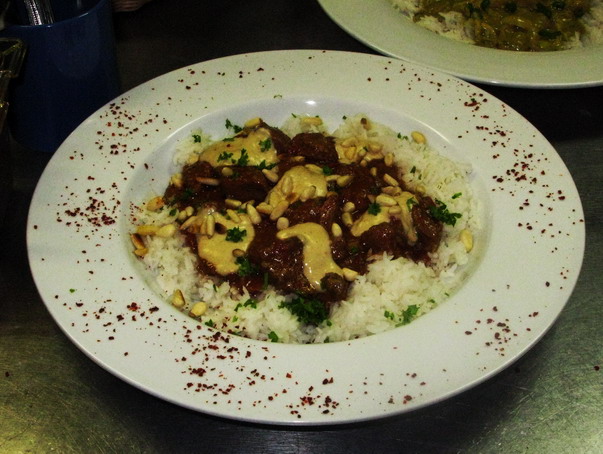
Most people consider stews to be humble affairs, meant for homey dinners wit family, but this Turkish dish of lamb stewed with garlic, onions, tomatoes and herbs, then topped with a roasted eggplant and cheese-enriched bechamel sauce is special enough to be served in at state dinners of the Ottoman Empire.
In fact, it is told that this dish was served to the visiting Empress Eugenie, wife of Napoleon III when she visited the Sultan Abdul Aziz, and some say that its name, which means either “Her Majesty’s Delight,” or “The Sultan’s Delight” came about to commemorate her compliments to the royal chef. When she asked that he give the recipe to her own royal cook, the chef is said to have humbly refused saying that it was not written down, because he “cooked with his eyes and his nose.”
Well, as far as I am concerned, any dish that is good enough for an empress and a sulta is good enough for anyone. I had gotten a taste of a version of the sauce made in a wonderful Turkish restaurant in Columbus (Cafe Shish Kebab, on Bethel Road), and it was amazingly delicious: smoky, rich, smooth and perfectly balanced. It was presented over roasted lamb, but I wanted to make it with the lamb stew, because I loved the idea of a stew fancy enough to be presented to royalty.
The original recipe I worked with is from Claudia Roden’s book, Arabesque, but as is usual for me, I changed it around a good deal, adding herbs, garlic and herbs to the tomato-based stewing liquid, and adding mild and spicy chil peppers to the béchamel. I also topped the dish with toasted pine nuts, which added another level of complexity to the flavor as well giving it a hint of crunch.
While I made this dish for a dinner special, and will be doing so again, I have to admit that it was a bit of work. But it is perfect for a special dinner party where you can tell your guests the story of this seemingly plain dish’s royal lineage.
Hunkar Begendi
Ingredients:
3 tablespoons olive oil
2 pounds mixed boned shoulder and leg of lamb
1 large onion, thinly sliced
6 cloves garlic, minced
1/8 teaspoon ground cinnamon
1 teaspoon dried or fresh thyme
2 bay leaves
1/8 teaspoon freshly ground black pepper
3 whole cloves
Pinch freshly ground cardamom
14 ounce can diced tomatoes
Water as needed
Salt to taste
3 pounds eggplant
6 tablespoons butter
4 tablespoons flour
1 teaspoon minced garlic
2 ¼ cups half and half or milk, warmed in a microwave
Salt and freshly ground pepper to taste
1 teaspoon Aleppo pepper flakes
½ teaspoon paprika
Pinch cayenne pepper
½ cup grated Parmesan cheese
1 cup toasted pine nuts and a generous amount of minced fresh parsley for garnish
Method:
Heat the olive oil in a heavy-bottomed pot until it is nearly smoking. Add the meat in batches and cook, stirring, until it browns. Remove from pan and set aside, then add onions, and cook, stirring, until they turn golden brown. Add the garlic, herbs and spices, and cook until the onions are a deep reddish brown. Add the lamb back to the pot, and add the tomatoes and if necessary to cover the meat, a bit of water.
Turn heat to low, and cook until the meat is tender, about an hour.
Roast the eggplant: Preheat oven to 475 degrees F. Prick eggplants all over with a fork, then lightly oil the skins. Lay on a foil lined baking sheet and put into preheated oven and cook, turning now and again, until the eggplant is soft and smoky-scented. This will take about forty-five to fifty minutes.
When cool enough to handle, peel off the skin and cut off the blossom end, then drop the flesh in chunks into a fine-meshed strainer, and chop roughly in the strainer, allowing the biter juice escape through the strainer. Mash into a puree with the back of a spoon, allowing the rest of the juice to drip out of the strainer.
Make the béchamel by melting the butter in a saucepan, and then adding the flour. Cook, stirring, for about three minutes, to get the raw flavor of the flour out. Add the garlic and keep cooking for another two minutes. Add the warmed milk and whisk thoroughly to smooth out any lumps that may form. Season to taste with the salt, pepper and spices.
Whisk in the eggplant, and cook over low heat to warm the sauce through, then whisk in the cheese, and whisk until it is melted and incorporated into the sauce.
Serve the stew ladled into warmed bowls (over rice, if you wish), with the béchamel sauce drizzled over the top. Sprinkle generously with the pine nuts and parsley. Serves 6-8 depending on if you serve it with rice or on its own.
Why Does So Much Food Waste Happen in Restaurants?
In this, my final post in the series on the topic of reducing food waste in restaurant kitchens, I want to examine why there is so much waste of food in American restaurants today, and ways that consumers can help reduce this waste.
There are a lot of reasons behind the colossal waste of food that goes on in the restaurant industry, but I would say that one of the largest causes has to do
with corporate restaurant policy regarding the treatment of leftovers.
When I say leftovers, I am not talking about what comes back on diner’s plates at the end of the meal–that is a separate issue which I will discuss in a little bit. I am talking about corporate chain restaurant policy regarding the disposal of food that is left on the steam table, in the display rack or in
the warming oven at the end of the night shift. The food that can be reheated one more time without bacterial contamination risk or loss of food quality is always saved, cooled properly and refrigerated to be rewarmed the next day, but what about the rest of the food that is quite often still good to eat, but will suffer in looks or taste if it is warmed over the next day. (Most corporate restaurants lack the flexibility in menu that independent restaurants have, so it is not often that you will see a leftover from one day transformed into something else as a dinner special the next day. Consistency is one of the watchwords of the corporate food world, and in the name of the “C-word,” a lot of edible food is thrown away.)
You would think that restaurants would give this food to their employees, or better yet, donate it to a local food bank, food pantry or church soup kitchen to be served to the homeless and impoverished people for whom hunger is a daily reality.
But, alas, that is most often not the case.
Most corporate chain restaurants, coffee shops, bakeries and the like have a very strict policy of dumping this perfectly good food out into the dumpster, which is often locked and behind enclosures in order to keep enterprising individuals from “harvesting” or saving this food. (If these enclosed or locked bins tampered with, even by a hungry person, they can then be arrested and charged not with just vandalism for breaking the locks, but for breaking and entering and theft. Imagine being charged with stealing garbage–the whole point of garbage is that the former owner of it no longer wants it, so why is it illegal for someone else to take it before it is heaped into a landfill?) Employees who are caught taking food of this kind home or eating it, or donating it are treated as thieves and are often fired.
Why are such draconian and ridiculously wasteful policies the norm in the corporate food industry?
There are two reasons. One has to do with the fear of food loss through employee theft. Yes, that is right–corporations are so afraid of losing money through employee theft that they waste just as much, if not more, money throwing away imperfect, but still edible food. The reasoning behind this somewhat obtuse concept is that if you have day old muffins that must go out, and fresh muffins, and if you give the employees the day old–still palatable, but not quite the best–to employees to eat or take home, then you would have no way of knowing if they were taking the day old muffins which you were going to throw away or the fresh ones.
The reason why food is not donated to hunger relief organizations has to do with the fear of being legally liable if, due to improper storage or reheating after the food is released into the hands of whatever individuals or organizations to which it is donated, someone or a group of persons fall ill from food borne disease.
That sounds like a reasonable fear, unless one knows about the federal law which protects organizations, corporations and individuals who donate food in good faith to non-profit organizations for the relief of hunger, from legal liability in the unlikely case of illness related to the food donation.
This law, called The Federal Bill Emerson Good Samaritan Food Donation Act, came into effect in 1996, so there is really no excuse for corporate restaurant chains to -not- donate their food to the needy through non-profit organizations.
It is possible that many corporate policy makers do not know about the law, which is where employees and consumers can step up to the plate and attempt to make a change in the rules that allow so much edible food to be thrown away from corporate kitchens. Ask managers of individual restaurants what their policy is for donating leftovers, and if they cite liability, inform them of this law, and then call a corporate hotline, email the headquarters, or even better, write them a letter, telling them about the law and asking them to change their policies regarding food donation. Whichever course of action you take, get your friends on board, and if you work in a corporate chain restaurant, talk to your managers and see if you can get them to talk to their managers. Send letters to the board of directors or the president of the company. You may be surprised at how effective such communication can be–corporations will not change their policies if there is no complaints, but a volley of complaints, especially those in writing, tend to get the attention of those who are high enough in the hierarchy to do something about it.
You can also work with America’s Second Harvest on these issues, and try and get your local restaurants, both independent and corporate chains, to try and cut down rampant food waste by donating unused food to food pantries, soup kitchens and homeless shelters.
In contrast, most independent restaurants do not have such unreasonable policies regarding the disposal of unused, unsellable, but still edible food. Every independent restaurant where I have worked has either given such food to employees, or sold it to them at a very low cost, in the interest of both feeding their employees and not wasting food. Many of the independents where I have worked also donated food to homeless shelters and food banks quite generously, even before the Good Samaritan law was in effect. Many other independent restaurants will donate food to various groups for free–for example, at Salaam, we donated lots of uneaten dinner and lunch specials which were still great that day, but wouldn’t be good the next day to the Obama campaign workers who had come to town during the Ohio primary. These folks appreciated the hot food and salads, and we appreciated being able to offer support that wasn’t monetary, but was still necessary and meaningful.
One other reason there is so much food waste in American restaurants, especially in chain restaurants, is the gargantuan portion sizes that have become the norm. Some chain restaurants, like The Cheesecake Factory, have portion sizes so ridiculously large, they don’t serve their entrees on plates, they serve them on oval platters, or as Zak quipped the one time we ate there as his dinner was set before him, “Here comes the trough!” Apparently, frequent diners at such restaurants take their uneaten food home, but when we were there, our table only sent back what we couldn’t eat on our dirty plates, and we saw many diners do the same. Some tables sent away so much food that another three or four people could have been fed on what was wasted. (This is one of the reasons I try to give only sensible portions at Salaam–I hate to see unusable food returned to the kitchen–although in small, independent restaurants, you will often see workers setting aside unusable food as compost or in rural areas as animal fodder. To my mind, that certainly beats sending it to the landfill.)
Of course, when you have restaurants sending food home with individuals who may or may not follow safe storage and reheating procedures, it begs the question as to why they will not donate edible but unsellable food because of liability issues.
I think that in the coming months and years as food prices rise precipitously due to the sharp rise in oil prices, we may see this wasteful attitude toward food in corporate restaurants start to change. We may see a more frugal philosophy of food once more arise in the restaurant industry.
Let us just hope that it is also a more ethical and compassionate philosophy as well. The amount of food that is wasted in American restaurants could easily go towards relieving a significant portion of the hunger problem in our country, and I would like to see more restaurants get behind efforts to feed the needy by participating in programs such as America’s Second Harvest and Share Our Strength. Ask the servers and managers at your favorite restaurants if they participate in food reclamation projects, and see what you can do to foster such efforts in your neighborhood. Everyone who joins in the effort to end food waste and hunger in America and does their own small share is building the momentum of a movement that is not only ecologically sound, but compassionate as well.
Author’s Note: I would like to thank Jonathan Bloom, author of the blog, Wasted Food, for putting the idea for this series of posts in my head.
Sauerkraut Braised in Beer: An Early Spring Delight
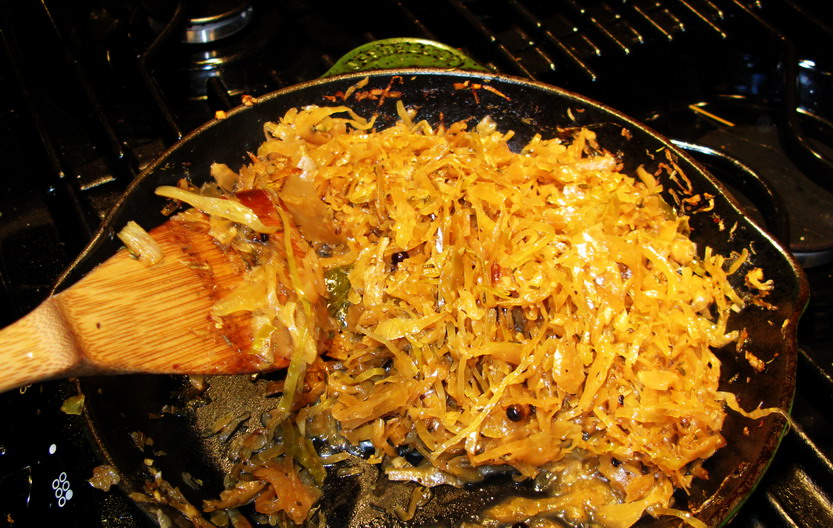
Yes, sauerkraut is a spring vegetable.
Yes, it is made in the autumn, and eaten all winter, but the last of it is also eaten in the early spring, before the emergence of the first spring greens, asparagus and peas.
Well, it is eaten in the spring if you made enough of it to get you that far.
Anyway, here is my recipe for beer braised sauerkraut.
First you need some kraut–and make it good kraut while you are at it. The best is what you or a trusted friend makes themselves, but failing that, you can buy it in a jar or in a vacuum sealed plastic bag. But, please, not a can–the canned stuff tastes like metal to me, which is not a stellar recommendation for it as a palate-pleaser.
Then, you need to deeply caramelize some onions. Yes, here is yet another recipe that is improved by the technique of deeply browning onions; the sweetness of the onions perfectly compliments the tang of the sauerkraut, with the beer balancing everything.
For extra flavor, I also add minced garlic, a few juniper berries or a sprig of rosemary and some dried thyme and lots of freshly ground pepper.
It is simple to make and goes great with any type of sausage, with sauteed mushrooms and mashed potatoes. I particularly like it this way–a mound of garlic mashed potatoes with a well with some butter, topped with the braised sauerkraut, then the whole thing is finished with the sauteed mushrooms.
That right there is vegetarian heaven for me.

Beer Braised Sauerkraut
Ingredients:
1 1/2 tablespoons olive oil or bacon drippings
1 cup thinly sliced onions
1/2 teaspoon salt
3 cloves garlic, minced
1 teaspoon juniper berries, lightly crushed or 1″ sprig fresh rosemary, leaves removed and lightly crushed, stem discarded
1/2 teaspoon dried thyme leaves
freshly ground black pepper to taste
1 pound sauerkraut
12 ounces lager or ale
Method:
Heat oil or drippings in a heavy-bottomed skillet over medium heat. Add in onions, sprinkle with salt and cook, stirring, until deep golden brown. Add garlic, juniper or rosemary, thyme and black pepper, and cook, stirring, until the onions are deep brown and sweet-smelling. Add beer, and sauerkraut, lower heat, simmering until most of the liquid is boiled away, and everything is fragrant and good. Stir now and then during the simmering, and serve with sausage, or with mushrooms and mashed potatoes.
Another Step for Reducing Waste in Restaurants: Cross-Utilization and Repurposing of Food
Cross-utilization and repurposing are two words that get used by chefs and cooks, but not so much anyone else, so let me first define them for you.
Cross-utilization means using an ingredient, sauce, or condiment that is usually used for one or two specific dishes for another dish or two where, perhaps, they are not expected, or are not usually used. The way my grandmothers, both of whom lived through the Great Depression, referred to it was “making do.”
“Making do,” basically means using what you have on hand, rather than running out and buying something new. Whether this refers to what is in your closet, or what is in your pantry, it is the frugal person’s way of creatively making something new out of something old. And, as I have mentioned before, chefs, as a group, are nothing if not frugal.
For a chef, cross-utilization generally refers to using basic pantry items to make up new menu items or daily specials, which not only avoids having to buy new and different ingredients and uses up what is in the pantry, but it also stimulates creativity. Being limited by a set number of materials and ingredients forces anyone, but certainly a chef, to think outside the box, to work around a problem, to, essentially, turn a limitation into a positive attribute.
I don’t know how many times I have come up with appetizer and dinner specials that use only pantry items, and pretty much every time I have done so, the response from diners has been overwhelmingly positive. It is really cool to be able to make something that blows people away, seemingly out of nothing, and it makes For more on the philosophy of cross-utilization, see my recent post all about it here.
Cross-utilization, or making do is something that every home cook probably has done in the past, especially in times of financial stress, but it is good to try and do it as often as possible anyway. It is a good habit to get into. Not only does it cut food loss and waste, it helps keep a cook creative when it comes to thinking of ways to cook different ingredients and differing presentations of everyday dishes.
For example, a while back, my parents planned to come visit us for the day, which would be their first big driving expedition after Dad’s surgery. Morganna and I wanted to make Indian food, so when we went shopping, we kept that in mind. We ended up picking out some purple cauliflower which we intended to make into aloo gobi–curried potatoes and cauliflower. However, my Mom caught a nasty cold which turned into bronchitis, so we never got around to that planned feast.
Instead, a week later, when I came home from work late Saturday night, and found extra folks around at dinner time (I forgot that it was Torchwood and Dr. Who night–silly me!), even though I was planning to have keema mattar, which is minced lamb with peas, I saw the cauliflower and decided it would work perfectly well in the dish in addition to the canonical ingredients. And it did. It worked so well, in fact, and looked so pretty (I love how fresh green and purple look together!) and tasted so nice that it was remarked upon by everyone who ate it, and so I will be making my keema mattar gobi again. And the truth is, I would never have thought of it in the first place if I had not had cauliflower sitting around needing to be used and a mind open to culinary possibilities.
Repurposing food is a similar process to cross-utilization, but instead of pertaining to using ingredients in more ways than you had originally intended, it has to do with creative use already cooked food. You know–leftovers.
Yes, leftovers. Even restaurants have them and, if they want to keep their food cost down, chefs have to figure out how to use them.
Sometimes, leftovers are made on purpose in restaurants. If one is going to make a stew or soup that will freeze well, and you have space for it in your freezer, why not make twice as much (which takes not much more time than a single batch) and cool some down and freeze it, properly dated and marked, for a later date? Every chef needs a quick lunch or dinner special now and then; sometimes, in the middle of a shift, a soup runs out and you need another one very quickly. It is nice to be able to heat up something which you know is good, in a matter of minutes, when unforeseen circumstances strike–the special runs out, the cook who was supposed to make the soup is deathly ill with pneumonia and had to be sent home, or the gas line is leaking and you can’t use your stove, but you still have people to feed.
But even if you didn’t mean to have leftovers, sometimes they can be frozen and used later. There are a few guidelines about doing this–the leftover food should only have been cooled and reheated once, and it should be cooled to below forty degrees F. before being put into the freezer. This is for food safety concerns–the more times food is cooled and reheated, the more chances there are for harmful bacteria to proliferate. In addition, food that has been cooled and reheated more than once or twice suffers greatly in quality–food textures go awry, the colors can fade or oxidize and turn brown and the flavor balance can be upset beyond repair.
In some cases, you can make one dish, and turn it into something completely different. A classic example is where cooks diners and similar restaurants will save leftover baked potatoes and make baked potato soup the next day. Leftover keema sookh–a dry curry made from minced lamb, beef or chicken, can be mixed with rice, vegetables and spices and then be used to stuff roasted vegetables the next day. Taco meat can become chili, leftover rice can become rice stuffing or fried rice and leftover bechamel sauce can be turned into mornay sauce with the addition of grated cheese, which can then be used in any number of other dishes. Leftover vegetables can be saved and made into soups, either as mixed vegetable soups, or as pureed cream soups. Leftover bread can be fried into croûtons which can then garnish salads and soups, or it can be made into one of my favorite desserts of all time–bread pudding. Leftover tortillas can become the garnish for sopa de lima–a tangy chicken and lime soup with a garnish of fried tortilla strips–and leftover roast meat can become the basis of a soup, a salad, a casserole, or a sandwich or dumpling filling.
For an example of how I took an unpopular dinner special made one night and turned it into a completely new dish that sold out the next night, read this post which also is a rumination upon the art of cooking and even more importantly, naming and marketing dinner specials.
There are so many ways to use leftovers in both a restaurant and home kitchen that there isn’t really a great excuse for a lot of the food waste that goes on in the United States. But even though there are ways to re-use or repurpose food, you have to follow strict sanitation procedures and food safety guidelines in order to ensure that the leftovers are handled properly so that no diners get sick. Only foods which have been handled properly should be repurposed, which means that if a food has stayed between the temperatures of 40 and 140 degrees F. for more than four hours, they should not be used. (That range of temperatures, known in restaurants as “the temperature danger zone” or “TDZ” for short, is the perfect temperatures at which most harmful bacteria thrive and grow.) When in doubt about the safety or the quality of a food, it is best, if regrettable, to throw it out. (Another industry catchphrase–“When in doubt, throw it out!” is a good principle for home cooks to live by as well.)
Now that I have discussed the biggest techniques that help restaurant cooks and chefs decrease food waste and thus keep food costs low, all of which can be modified for home use, my next post will be about -why- there is so much food waste in American restaurants, and what can be done about it.
The Next Step to Avoiding Food Waste in Restaurants: Utilizing Surplus
Sometimes, even though proper inventory and ordering procedures are followed, a restaurant will have a surplus of perishable ingredients. In these cases, there are a few things that a resourceful cook or chef can do to alleviate the problem before it becomes a case of unnecessary food waste. (Sometimes, it isn’t an accidental overstock that happens–in the summer and early autumn, when produce is cheap and plentiful, chefs will often end up with a windfall of vegetables and fruit and will need to do something with it before it goes bad–in cases such as this, all of these techniques are just as useful.)
Some fresh foods can simply be converted to frozen foods without much work or trouble, and then, can be used from the freezer over the course of months, instead of days. Sweet and hot peppers can both be simply chopped or sliced, packed in plastic bags and frozen. The same can be done with onions and garlic. Spinach can also be frozen with minimal processing–if the leaves are mature, remove the thick veins and stems and either leave the leaves whole or tear into smaller pieces and then pack into bags and freeze. If you have baby spinach, you just pack the whole leaves into bags and freeze them. Frozen spinach leaves can then be added directly to simmering soups, stews or sauces without pre-cooking.
Fresh herbs can also be frozen with minimal preparation. Most of them can just be chopped finely and frozen in bags, although some people put tablespoon amounts into individual compartments in an ice cube tray, and add a little bit of water to hold them together, then freeze the cubes. After they are frozen, the cubes can be packed in plastic bags and stored for future use. Some herbs, like cilantro and basil, can be pureed and then frozen in ice cube trays without the addition of water, and can be used like the chopped frozen herb cubes.
Alternately, batches of green cilantro chutney or pesto can be made and frozen, either in small bags or containers, or in cubes, to be thawed and used later or to be added to curries, soups and sauces as they cook.
Fresh fruits such as strawberries, blueberries, raspberries, blackberries and mangoes can all be frozen simply as well: for the berries, you just wash and dry them, then layer them onto sheet pans, put them in the fridge until they are frozen, then pack them into bags, label and date them and store them in freezer. Strawberries can either be frozen whole or sliced. All of these fruits can be used to make pies, dessert sauces, ice creams, sorbets and smoothies in the future.
For mangoes, simply peel and pit them, and cut into slices. Treat with a bit of lemon juice to prevent discoloration, and freeze on sheet pans and then pack into bags. I like to use frozen mango to make lassi, chutneys, salsas and to add to curries.
Tomatoes can be frozen whole, but they are better, and they take up less space, if you make them into a nice marinara sauce or plain tomato sauce, pack these sauces into quart bags and freeze them flat, so they stack easily in the freezer for storage. (Speaking of tomatoes, you can also use the freezer to store excess tomato paste. Restaurant pack tomato paste is often sold in huge units of several quarts or pounds. If you don’t need that much in whatever recipe you are using, the rest can be stored in smaller portions from a cup to a tablespoon in freezer bags. For the smaller amounts, you can squeeze the paste into ice cube trays or freeze tablespoon-sized plops on a sheet pan lined with waxed paper. Once they are frozen, the cubes can be popped into a bag, or the plops can be peeled up and popped into a bag which then lives happily in the freezer until it is needed. You don’t even have to thaw the paste before using it, although I always do.)
Speaking of sauces, we come to the issue of stocks, soups, sauces and stews.
These types of recipes are the secret weapon of cooks and chefs when it comes to using up excess ingredients.
If you have some potatoes on hand that have gone a bit soft, or some carrots that are a little rubbery, or some celery that is no longer crisp, then don’t throw them out–use them in a soup or stew or a sauce. Daily soup or dinner specials are not just a way to vary a menu, they also help a chef or cook deal with surplus perishable ingredients in a delicious and constructive fashion.
I don’t feel in the least bit bad about using slighly older produce in soups or stews, because it isn’t like I am using rotted food. Far from it–slightly older vegetables which would be nasty in a stir fry or salad are perfectly fine to be boiled in a soup or stew where the liquid is meant to be eaten along with the vegetables. With vegetables that are a bit too old, often the only characteristic that suffers is texture, and with a soup , stew or sauce, that doesn’t matter. The boiling water extracts all of the water soluble vitamins left in the vegetable, and then they are eaten in the broth, along with the solids. The flavors are all extracted and present in the finished dish, and frankly, there is nothing more homey and comforting than a stew or soup.
Stocks are a special case. Stocks are made, in large part, from parts of animals and plants which are frankly, otherwise inedible to people. Bones are not a big part of the human diet when they are whole, but when they have had all of their goodness extracted by a long simmer in a stockpot, they create the basis for every great soup, sauce and stew–stock.
Every chef I have ever known has extolled the virtues of the stockpot, not only for creating kitchen gold, but also because it fits perfectly with their frugal natures. Bones cannot be eaten by people, but there is no need to throw them away without first extracting every ounce of goodness from them. Carrot ends, celery leaves and ends, leek tops and onion skins also are not palatable to humans, but they add flavor, fragrance and color to stock. (Onion skins give a golden color to chicken stock which makes it more appealing to the eyes.) Bones from every animal, along with fish heads and tails, shrimp, crab and lobster shells, and crustacean heads, are all saved by chefs and used to make stocks which results in every scrap of food being used to make a food product that only enhances every other dish to which it is added. Stocks can be frozen, too, in whatever increments one likes, so they can have a very long shelf life, although in larger restaurants, a stockpot or two are always going on a back burner of the stove and what it makes is used up as it is made.
Stocks are simple, and make goodness out of what many people would see as garbage, using bones, vegetable scraps, herbs (and yes, you can use some herbs that are not pretty enough to put on a plate as garnish, but are still good to cook with in a stock, and unlikely bits of carcass like chicken or pig’s feet. (For illustrated instructions on how to make chicken stock, click here. For Chinese style pork and chicken stock, click here.)
Running a restaurant does not have to be a wasteful enterprise. In fact, if the chef is clever, it can be the exact opposite–it can be a model of how best to use every scrap of edible foodstuff inherent to any given ingredient, but it does take a little extra work to avoid just throwing away raw materials.
The next post will talk about what happens to food that is already cooked in a restaurant, and how to avoid throwing it away.

Categories:
- Admin (rss) (55)
- Blogs and Blogging (rss) (81)
- Book Reviews: Cookbooks (rss) (43)
- Book Reviews: Non-Cookbook Food Books (rss) (38)
- Cats and Cat Blogging (rss) (47)
- Chinese Cooking Lessons (rss) (32)
- Culinary School Stories (rss) (18)
- Dairy Pruducts: Cultured and Barbaric (rss) (4)
- Documentary Filmmaking (rss) (1)
- Essays, Rants and Reflections (rss) (260)
- Fighting Hunger (rss) (12)
- Food and Kids (rss) (45)
- Food in the News (rss) (126)
- Food Media (rss) (98)
- Food Preservation (rss) (18)
- Food Safety (rss) (45)
- Gardening (rss) (30)
- Herbs and Herb Blogging (rss) (20)
- Holidays (rss) (50)
- Kat Blogging (rss) (22)
- Kitchen Science (rss) (36)
- Leftover Makeover (rss) (8)
- Life, the Universe and Everything (rss) (131)
- Local and Sustainable (rss) (227)
- Local Athens Food and Foodies (rss) (42)
- Meatless Mondays (rss) (32)
- Menu For Hope (rss) (5)
- Nutrition, Diet and Health (rss) (84)
- On The Farm (rss) (8)
- Recipes: Almost Vegetarian, Vegetarian and Vegan (rss) (294)
- Recipes: American Regional (rss) (37)
- Recipes: Appalachian Hillbilly (rss) (33)
- Recipes: Bread, Pasta, Grains (rss) (95)
- Recipes: Canning and Preserving (rss) (8)
- Recipes: Chinese (rss) (123)
- Recipes: Comfort Food (rss) (120)
- Recipes: Cookies (rss) (16)
- Recipes: Desserts (rss) (48)
- Recipes: French (rss) (25)
- Recipes: Fruits and Vegetables (rss) (302)
- Recipes: Greek, North African and Middle Eastern (rss) (31)
- Recipes: Indian (rss) (137)
- Recipes: Italian (rss) (42)
- Recipes: Japanese (rss) (7)
- Recipes: Jewish (rss) (4)
- Recipes: Korean (rss) (6)
- Recipes: Meat, Poultry and Fish (rss) (220)
- Recipes: Mexican/Native American/ Latin American/Caribb (rss) (27)
- Recipes: Original (rss) (108)
- Recipes: Thai (rss) (27)
- Recipes: Tofu (rss) (17)
- Recipes: US Regional (rss) (16)
- Recipes: Vietnamese (rss) (8)
- Restaurant Stories (rss) (28)
- Sewing, Quilting, Arts and Crafts (rss) (16)
- Simple Chinese Recipes (rss) (30)
- Slow Food and Heritage Foods (rss) (10)
- Spice Blogging (rss) (44)
- The Chinese Cookbook Project (rss) (14)
- The Chinese Pantry (rss) (39)
- The Documentary (rss) (2)
- The Kitchen Saga (rss) (17)
- The Locavore's Bookshelf (rss) (15)
- The Unsung Adventures of The Culinary Nerd (rss) (6)
- Tools and Toys (rss) (35)
- Uncategorized (rss) (10)
- With a Side of Politics (rss) (48)
Archives:
- August 2012 (9)
- July 2012 (12)
- September 2011 (3)
- August 2011 (7)
- July 2011 (8)
- June 2011 (16)
- May 2011 (17)
- April 2011 (11)
- December 2010 (9)
- November 2010 (5)
- February 2010 (1)
- December 2009 (5)
- November 2009 (7)
- October 2009 (10)
- September 2009 (16)
- August 2009 (14)
- July 2009 (14)
- June 2009 (7)
- May 2009 (17)
- April 2009 (10)
- March 2009 (25)
- February 2009 (13)
- January 2009 (10)
- December 2008 (5)
- November 2008 (5)
- October 2008 (6)
- September 2008 (13)
- August 2008 (8)
- July 2008 (11)
- June 2008 (18)
- May 2008 (13)
- April 2008 (14)
- March 2008 (16)
- February 2008 (17)
- January 2008 (19)
- December 2007 (25)
- November 2007 (18)
- October 2007 (24)
- September 2007 (16)
- August 2007 (15)
- July 2007 (15)
- June 2007 (10)
- May 2007 (14)
- April 2007 (16)
- March 2007 (17)
- February 2007 (20)
- January 2007 (13)
- November 2006 (1)
- October 2006 (8)
- September 2006 (14)
- August 2006 (25)
- July 2006 (30)
- June 2006 (28)
- May 2006 (34)
- April 2006 (29)
- March 2006 (24)
- February 2006 (30)
- January 2006 (38)
- December 2005 (40)
- November 2005 (37)
- October 2005 (32)
- September 2005 (25)
- August 2005 (30)
- July 2005 (28)
- June 2005 (21)
- May 2005 (8)
- April 2005 (22)
- March 2005 (17)
- February 2005 (29)
- January 2005 (10)
Search Site:
Links:
- Lily’s Wai Sek Hong
- 101 Cookbooks
- A cat in the kitchen
- A Veggie Venture
- Accidental Hedonist
- Cha Xiu Bao
- chez pim
- Chocolate & Zucchini
- Chopstick Cinema
- Chowhound.com
- Chubby Hubby
- Cook sister!
- Cooking with Amy
- da*xiang
- Eat Local Challenge
- Eating Liberally
- Ecocentric
- Eggbeater
- Epicurious
- Farmgirl Fare
- Fatfree Vegan
- Foodgoat
- ForkandBottle.com
- Green Olive Tree
- Hooked on Heat
- Jaden’s Steamy Kitchen
- Kalyn’s Kitchen
- Lucullian delights
- Mahanandi
- Matt Bites
- MeatHenge
- mmm-yoso!!!
- New York Times – Dining & Wine
- Pizza Goon
- Rasa Malaysia
- Ruhlman
- Sailu's Kitchen
- Serious Eats
- SF Gate: Food & Dining
- Simply Recipes
- Soul Fusion Kitchen
- Tastespotting
- The Amateur Gourmet
- The Cleaner Plate Club
- The Food Section
- The Grub Report
- thecookscottage
- U.S. Food Policy
- Wandering Chopsticks
- Washington Post Food and Dining
- Wasted Food
Meta:


Powered by WordPress. Graphics by Zak Kramer.
Design update by Daniel Trout.
Entries and comments feeds.