
Cook Local, Eat Global
A Beautiful Vegan Curry: Kashmiri Dhingri Chole
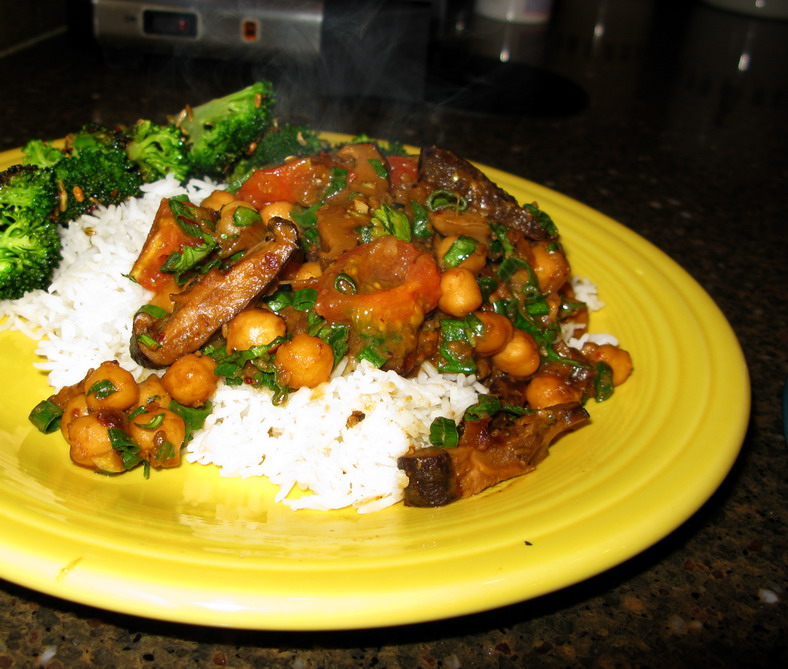
This is one of those recipes you want to make for your non-vegan friends in order to prove to them that vegan food can be delicious. Consider this curry to be an “ambassador recipe” to the world of non-vegetarians. I have quite a few such recipes, and they nearly always work. This one is great because it includes dried shiitake mushrooms, also called “Chinese black mushrooms,” which you can get at nearly any Asian grocery store. These umami-filled fungi have a wonderful earthy aroma, meaty texture and rich flavor which pair perfectly with chickpeas, also known as chole.
I came across this recipe in Geeta Samtani’s excellent cookbook, A Taste of Kashmir while I was gleaning ideas for lunch and dinner specials at Salaam. I like to do at least two or three vegetarian or vegan specials a week, and I really like to find unusual recipes that no one else in town would ever make.
As soon as I saw this one, I had to make it.
And we sold out of it. People loved it.
And, it is simple to make.

The one “tricky” part of the recipe is soaking and cooking the mushrooms. I have found that the best method is to boil water, and pour it over the mushrooms, and let them soak until you can stand to stick your fingers into the water. When they are cool enough to touch, they are completely rehydrated.
Just squeeze the excess water out, cut off the stem and discard it because it will be too tough, and slice the mushroom cap into thin pieces. Then let the pieces dry slightly on a paper towel before you saute them with the onions, garlic, ginger and spices–this removed the last of the excess water so that the mushrooms will get just a little bit crispy and absolutely delicious as they cook.
The other hint I have for making this recipe is that if you happen to have a bit of hummus in your fridge, instead of mashing some of the chickpeas to thicken the curry, you could add a heaping tablespoon of hummus. I have discovered that you cannot taste the tahini in a curry if you use it as a thickener and the lemon juice, garlic and cumin in it are already part of this recipe to begin with, so it all works out perfectly. This is just a little shortcut if you don’t want to take the time to mash chickpeas, although, in reality, that doesn’t take very long, either, even if you just use a manual potato masher.
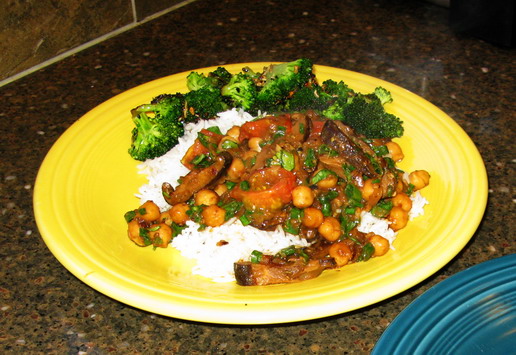
Kashmiri Dhingri Chole–Mushroom and Chickpea Curry
Ingredients:
10-20 Chinese black mushrooms
boiling water as needed to rehydrate mushrooms
3 tablespoons canola or peanut oil
2 cups thinly sliced onions
1 teaspoon salt
1 1/2″ cube ginger, peeled and minced finely
1 teaspoon cumin seeds
1/4 teaspoon black peppercorns
1 teaspoon fennel seeds
1/2 teaspoon coriander seeds
1 cardamom pod, seeds removed and pod discarded
1 clove
1 pinch ground cinnamon
8 cloves garlic, peeled and minced finely
2 14 ounce cans of chickpeas, drained
handful fresh cherry tomatoes, quartered
lemon juice and salt to taste
1/2 cup scallion tops, thinly sliced
1 cup cilantro leaves, roughly chopped
Method:
Put mushrooms in a bowl, and cover with boiling water. Allow to sit while you prep the rest of the ingredients. When the water is cool enough to touch, squeeze out excess water, cut off the stems off, and slice the caps thinly. Sit slices on paper towels to drain while you prepare everything else. KEEP THE MUSHROOM SOAKING WATER!!!
Heat oil in a heavy-bottomed skillet, and add onions, Sprinkle with salt, and cook, stirring, until medium golden brown. Add ginger, and cook.
While ginger is cooking with the onions, grind spices to a powder, and add to the skillet. Add mushroom slices, and cook, stirring until onions are deep reddish brown, and the mushrooms are lightly crispy on the edges and brown. Add garlic, cook for one more minute, stirring, and add to the pot the chickpeas and all but the last tiny bit of the mushroom soaking water. (That last bit contains the little bits of grit that come off the mushrooms that is not tasty–throw that bit away.)
Turn down the heat and simmer for about twenty minutes. Take out about 1/4 of the chickpeas, and mash them to a near puree, and add them back to the pan. Add the tomatoes, and cook until they just begin to wilt. Add the lemon juice and salt to taste, and stir in scallion tops and cilantro leaves.
Serve over steamed basmati rice.
This Is Why I Have Not Posted Since Monday: Buddha Crazy Quilt Wallhanging

I feel bad for not having posted in a few days, although I am happy to see a mostly positive discussion coming about because of my last post.
But there is a reason, and it is a good one.
I have been working on my latest piece of fabric art, which you can see pictured to the right.
It is a gift for Zak, and when it is finished, it will be a quilted wall-hanging. No, I am not working with a pattern–I am just cutting fabric and piecing as I go. The centerpiece of it is a screenprinted Buddha from India; the rest of the fabrics are cotton Balinese batiks. It will hang at the end of our long upstairs hallway, which is painted a brilliant sky blue over the altar where the carved wooden Buddha I gave Zak for his birthday a couple of years ago sits.
I’ve only been working on it for a couple of days, but I am making very fast progress.
I’ll post updates now and again, and when Kat’s quilt comes back from the lady who is machine quilting it, I will post pictures of it, too.
Now, back to your regularly scheduled food blog!
How Can Vegetarians, Vegans and Omnivores Learn To Talk With Each Other?
Last Monday, when I wrote the post Largest Beef Recall in US History a Natural Consequence of Industrial Agricultural Practices, I figured that there would be a fair amount of comments, but I never really thought about what kind of comments I would get. I did expect some kneejerk vegan responses which are always an exhortation to go vegan across the board, and those were in evidence. However, I never expected this thoughtful reply to my assertion that not everyone in the world -wants- to be a vegan, and should not be exhorted to become one at every given opportunity.
A reader named Sgt. Pepper replied to my statement that while I may, in the future, become vegetarian, I would never become a vegan, because I love dairy products and eggs a great deal, and I saw no real reason to give them up, since there are plenty of local farmers producing eggs ethically, and there are ethical dairies in existence. (One of which is even local!)
This is what Sgt. Pepper had to say:
This is a good example of how the subjectivity of experience causes omnis and vegos to clash and why it’s so hard for us to understand the other’s perspective. For me, I liked milk, cheese and eggs an awful lot when I ate them, but I don’t think I would have listed any of them in the top 100 pleasures of my life. Obviously, Barbara would. None of us can live completely cruelty free lives so we all draw our lines in different places. How can we get along?
It never occurred to me that it would must be inevitably impossible for vegans, vegetarians an omnivores to get along.
While some vegetarians and vegans may not recognize it, there are plenty of ethical omnivores in the world, and we are working toward some of the same goals they are: which is the treatment of domesticated animals with dignity, care and compassion. This statement is sometimes scoffed at by some vegetarians and vegans, because their definition of compassion means that animals must never be killed my humans for any reason, most certainly not to be eaten, but that does not render my statement false. Just because vegetarians and vegans may disagree with us, does not suddenly make ethical omnivores nonexistent–it merely makes our opinions marginalized in the discussions of ethical eating, animal welfare and environmental issues when there are militant vegetarians and vegans involved in the conversation.
This saddens me, because the truth is, in order to make the changes necessary in our society to secure the decent treatment of domesticated animals, and to lower the consumption of meat for collective human and environmental health, all people who believe in these goals, no matter what their personal philosophy, should work together to attain these goals.
In other words, instead of wasting time arguing with each other over who is more right than whom, and over which method of eating is more ethical than the other, we should be working together against the corporations and governmental lobbyists which favor industrialized agricultural practices which are dangerous to human, animal and environmental health.
How do we learn to shut the hell up and actually make alliances which will help attain our goals?
I think that if vegetarians, vegans and ethical omnivores of all dietary persuasions would try and adhere to a few simple “rules of engagement” when they talk with each other over the potentially heated subject of what we eat, we may make some headway in learning to come together, rather than driving ourselves apart.
I think that the first big step, which for some, may be a hurdle to surmount, is that we need to learn to view each other’s opinions with respect, even if we do not agree. In fact, I think it is essential to try to approach these conversations about what we eat and why with the honest and respectful understanding that each of us as ethical individuals who are trying to do the best we can for ourselves, our families, our environment, and other living beings.
In order to approach each other with this sort of honest respect, it means that we will all have to work hard to ditch our own ego-boosting feelings of self-righteousness. When we are certain that we are absolutely right, it often blinds us to the possibilities that while our decisions may be right for ourselves, they may not be right for everyone. Human beings are not all cookie-cutter-clones of each other. Our bodies are all unique and the diet that is healthful and beneficial to one person may be deadly to another. I am pretty certain that if I ate a diet mainly composed of blood, milk and meat, like a traditional Masai or fish, whale meat and blubber like a traditional Inuit, I’d probably not be very healthy, while these tribespeople thrive on their diets. And, nutritional studies have shown that when the Inuit, for example, eat a typical American style diet, they, too, become quite sick.
So, I think that in order to talk successfully with each other, rather than past each other, we need to loosen our grips on our deeply held, but divisive ideologies and focus instead on what we agree upon: that industrial agriculture is harmful to humans, animals and the environment, and then turn the conversation towards various strategies to combat the prevalence of corporate industrial farming practices.
We might also benefit from looking at each other as individuals, and not as stereotypes, and learning to let go of the bad experiences we may have had with individuals of various groups in the past.
In other words, let’s try and stop saying things like, “Meat-eaters are murderers!” or, “Vegans are a bunch of self-righteous freaks who abuse their kids!”
Neither statement is completely true. Yes, some meat-eaters are murderers–the cannibalistic Jeffrey Dahmer certainly counts as both a meat-eater and a murderer–a serial murderer, in fact. On the other hand, Adolf Hitler was a vegetarian, and while he may not have murdered anyone with his own hands, he did sign the orders for the extermination of millions of Jews, Gypsies, Slavs, Poles, homosexuals, political dissidents and religious dissidents. Since it was his idea to kill all of these folks, Hitler counts as a mass-murderer–and he was a vegetarian. (And he was an ardent animal-lover–he adored his canine companions, in particular, and hated hunting, saying he could never shoot a hare.)
So, clearly, one need neither be a meat-eater, nor a consumer of vegetables to be considered a murderer. Murderers eat any number of foods, as any rational or thoughtful person could tell you, and truly, eating any one thing or another is no pre-requisite for the sorts of mental instability that lead to murderous rampages. If the case that all meat eaters were murderers was truly based upon fact, I believe we would be up to our armpits in murderers.
But what about the assertion that vegans are self-righteous child-abusers? This one gets trotted out fairly often after the unfortunate case of the couple who starved their baby to death and use their vegan lifestyle as an excuse. After this couple’s case came to light in the media, Nina Planck wrote a shrill, fear-mongering screed in the New York Times bashing all vegan parents as child-abusers at worst and neglectful at best, which I countered here. Even Planck herself backed off a bit from her rather–ahem–ignorant–assertions in her later response to the vegans who responded to her essay.
Vegan parents are no more likely to abuse their children than any other parent. In fact, if you look at the sorts of parents who abuse and neglect their kids, you will see that they run across a cross-section of society as a whole, and there is no one connection between them, certainly not a dietary connection. (Actually, statistically speaking, since vegans are such a small percentage of the population in comparison to omnivores, it is more likely that there are more omnivores abusing their kids than vegans. That is just how math works, folks. Even I know that.)
So, let’s just drop those particular stereotypes, shall we? Meat eaters can be murders, but so can vegetable eaters. Vegan parents can be abusive parents, but then, so can omnivorous parents.
And while it is likely true that vegans have run across obnoxious omnivores, and omnivores have run across vexatious vegans, and vegetarians have probably gotten the sharp edge of both vegan and omnivore’s tongues over the years, we need to drop those experiences and move on, realizing that there are assholes all over the place, and we need not make blanket statements limiting their appearance to the camps of whichever dietary group we choose to vilify at any particular moment. The truth is, omnivores, vegetarians and vegans can all be insufferable at times, and have all made nasty, untrue, unhelpful and just plain uncivilized comments to and about those who chose to eat differently than they do. This is not only childish, it is also stupid, because it distracts us from the real issues concerning the health and safety of our food supply.
This has to stop, because it does nothing but alienate each other when we could instead be working together toward a common goal: a food supply that is tasty, safe to eat, healthy for humans, animals and our environment, and which is fair to consumers and farmers alike.
Look at it this way: every time a vegan snipes at an omnivore for being a meat-eating murderer or an omnivore points a finger at a vegan and calls her a child abuser, or a vegan and an omnivore both spit at a vegetarian for doing “not enough” and “going too far” at the same time, the board of directors at Cargill or Tyson grins with satisfaction as they make another million dollars, and another thousand feedlot cows goes to their death in a place like Westland-Hallmark.
So, which is more important to you? Feeling self-righteous, or banding together to do something positive about our food supply?
Salon Article On The Making Of The Humane Society Slaughterhouse Video
This is going to be short, since I have a ton of stuff to do today before I go to work.
Salon has a good article up today about the man who went undercover and worked at the Westland/Hallmark Meat Company slaughterhouse for six weeks where he continually witnessed acts of extreme animal cruelty. He also witnessed plenty of “downer” cows–cows too injured or sick to walk– enter the US food supply, most of them going to the Federal School Lunch Program.
The article is short, but to the point, and worth reading, if nothing else for the Humane Society’s reply to the frequent assertions by the National Cattlemen’s Beef Association and the Beef Industry Food Safety Council, that the sorts of cruelty and flagrant violation of food safety and animal protection laws shown in the video are just an isolated incident in one slaughterhouse, among “a few bad apples” among the workers. (Hey, isn’t that what the US military said was going on at Abu Ghraib? Isolated incidences of torture, perpetrated by a “few bad apples?” Upper management always tries to weasel out of getting blamed.)
When asked what he thought of these assertions, Wayne Pacelle, the president of the Humane Society was unconvinced:
The Humane Society, he attests, had not been tipped off to abuses at the plant. “This plant was selected at random,” he says. “There are 6,200 facilities across the country that USDA inspects. We chose this one and found egregious abuses. There is no way that these groups can say that everything is safe.”
I have to come down on the side of Wayne Pacelle and the unnamed undercover videographer on this one.
If the slaughterhouse was chosen at random, then there is absolutely no shred of evidence to support the industry’s official party line that this was an isolated incident. Americans should meet any such assertion with the skepticism it deserves, and should demand accountability.
And, while we are at it, let’s stop eating so damned much cheap beef. It just isn’t worth it.
Let This Post Be A Virtual Candle: Inspirational Indian Cook, Pedatha, Passes Away

It is with sadness that I give the news that came to me by email tonight from Jigyasa Giri and Pratibha Jain, the authors of the beautiful and lyrically written southern Indian vegetarian cookbook, Cooking At Home With Pedatha.
Their email was simple and poignant: “Barbara, our world is empty…”
Down below this simple statement of grief was the image of Pedatha’s lovely face you see above.
Tears came instantly to my eyes, because even though I never met Pedatha, through reading Jigyasa and Pratibha’s book, I felt as if I knew Pedatha as well as any of my beloved elder Aunties. I felt the keen pang of loss, because not only had I never met this remarkable woman and inspirational cook, I never would.
I will only say now, what I wrote back to Jigyasa and Pratibha: “You two, and Pedatha herself, gave a piece of her heart and soul to the world through your book, and for that I am very, very grateful.”
Through their book, Pedatha’s images, words, admonitions, kitchen philosophy and recipes will live on forever, not to be lost by the hands of time. For as long as one copy of this book exists and there is a human being to touch it, hold it, open it, read it, and I hope, cook from it, the spirit of Pedatha will live on. So long as we can taste the flavors of Pedatha’s dishes, her spirit will be with us, a part of us.
Because, the truth is, even in death, there is no parting. Separation is an illusion–we are all, each of us, part of the unity that is the Universe.
Thank you both Jigyasa and Pratibha for giving part of Pedatha to the world. We are grateful, and will not forget her, even as we sorrow with you.

Categories:
- Admin (rss) (55)
- Blogs and Blogging (rss) (81)
- Book Reviews: Cookbooks (rss) (43)
- Book Reviews: Non-Cookbook Food Books (rss) (38)
- Cats and Cat Blogging (rss) (47)
- Chinese Cooking Lessons (rss) (32)
- Culinary School Stories (rss) (18)
- Dairy Pruducts: Cultured and Barbaric (rss) (4)
- Documentary Filmmaking (rss) (1)
- Essays, Rants and Reflections (rss) (260)
- Fighting Hunger (rss) (12)
- Food and Kids (rss) (45)
- Food in the News (rss) (126)
- Food Media (rss) (98)
- Food Preservation (rss) (18)
- Food Safety (rss) (45)
- Gardening (rss) (30)
- Herbs and Herb Blogging (rss) (20)
- Holidays (rss) (50)
- Kat Blogging (rss) (22)
- Kitchen Science (rss) (36)
- Leftover Makeover (rss) (8)
- Life, the Universe and Everything (rss) (131)
- Local and Sustainable (rss) (227)
- Local Athens Food and Foodies (rss) (42)
- Meatless Mondays (rss) (32)
- Menu For Hope (rss) (5)
- Nutrition, Diet and Health (rss) (84)
- On The Farm (rss) (8)
- Recipes: Almost Vegetarian, Vegetarian and Vegan (rss) (294)
- Recipes: American Regional (rss) (37)
- Recipes: Appalachian Hillbilly (rss) (33)
- Recipes: Bread, Pasta, Grains (rss) (95)
- Recipes: Canning and Preserving (rss) (8)
- Recipes: Chinese (rss) (123)
- Recipes: Comfort Food (rss) (120)
- Recipes: Cookies (rss) (16)
- Recipes: Desserts (rss) (48)
- Recipes: French (rss) (25)
- Recipes: Fruits and Vegetables (rss) (302)
- Recipes: Greek, North African and Middle Eastern (rss) (31)
- Recipes: Indian (rss) (137)
- Recipes: Italian (rss) (42)
- Recipes: Japanese (rss) (7)
- Recipes: Jewish (rss) (4)
- Recipes: Korean (rss) (6)
- Recipes: Meat, Poultry and Fish (rss) (220)
- Recipes: Mexican/Native American/ Latin American/Caribb (rss) (27)
- Recipes: Original (rss) (108)
- Recipes: Thai (rss) (27)
- Recipes: Tofu (rss) (17)
- Recipes: US Regional (rss) (16)
- Recipes: Vietnamese (rss) (8)
- Restaurant Stories (rss) (28)
- Sewing, Quilting, Arts and Crafts (rss) (16)
- Simple Chinese Recipes (rss) (30)
- Slow Food and Heritage Foods (rss) (10)
- Spice Blogging (rss) (44)
- The Chinese Cookbook Project (rss) (14)
- The Chinese Pantry (rss) (39)
- The Documentary (rss) (2)
- The Kitchen Saga (rss) (17)
- The Locavore's Bookshelf (rss) (15)
- The Unsung Adventures of The Culinary Nerd (rss) (6)
- Tools and Toys (rss) (35)
- Uncategorized (rss) (10)
- With a Side of Politics (rss) (48)
Archives:
- August 2012 (9)
- July 2012 (12)
- September 2011 (3)
- August 2011 (7)
- July 2011 (8)
- June 2011 (16)
- May 2011 (17)
- April 2011 (11)
- December 2010 (9)
- November 2010 (5)
- February 2010 (1)
- December 2009 (5)
- November 2009 (7)
- October 2009 (10)
- September 2009 (16)
- August 2009 (14)
- July 2009 (14)
- June 2009 (7)
- May 2009 (17)
- April 2009 (10)
- March 2009 (25)
- February 2009 (13)
- January 2009 (10)
- December 2008 (5)
- November 2008 (5)
- October 2008 (6)
- September 2008 (13)
- August 2008 (8)
- July 2008 (11)
- June 2008 (18)
- May 2008 (13)
- April 2008 (14)
- March 2008 (16)
- February 2008 (17)
- January 2008 (19)
- December 2007 (25)
- November 2007 (18)
- October 2007 (24)
- September 2007 (16)
- August 2007 (15)
- July 2007 (15)
- June 2007 (10)
- May 2007 (14)
- April 2007 (16)
- March 2007 (17)
- February 2007 (20)
- January 2007 (13)
- November 2006 (1)
- October 2006 (8)
- September 2006 (14)
- August 2006 (25)
- July 2006 (30)
- June 2006 (28)
- May 2006 (34)
- April 2006 (29)
- March 2006 (24)
- February 2006 (30)
- January 2006 (38)
- December 2005 (40)
- November 2005 (37)
- October 2005 (32)
- September 2005 (25)
- August 2005 (30)
- July 2005 (28)
- June 2005 (21)
- May 2005 (8)
- April 2005 (22)
- March 2005 (17)
- February 2005 (29)
- January 2005 (10)
Search Site:
Links:
- Lily’s Wai Sek Hong
- 101 Cookbooks
- A cat in the kitchen
- A Veggie Venture
- Accidental Hedonist
- Cha Xiu Bao
- chez pim
- Chocolate & Zucchini
- Chopstick Cinema
- Chowhound.com
- Chubby Hubby
- Cook sister!
- Cooking with Amy
- da*xiang
- Eat Local Challenge
- Eating Liberally
- Ecocentric
- Eggbeater
- Epicurious
- Farmgirl Fare
- Fatfree Vegan
- Foodgoat
- ForkandBottle.com
- Green Olive Tree
- Hooked on Heat
- Jaden’s Steamy Kitchen
- Kalyn’s Kitchen
- Lucullian delights
- Mahanandi
- Matt Bites
- MeatHenge
- mmm-yoso!!!
- New York Times – Dining & Wine
- Pizza Goon
- Rasa Malaysia
- Ruhlman
- Sailu's Kitchen
- Serious Eats
- SF Gate: Food & Dining
- Simply Recipes
- Soul Fusion Kitchen
- Tastespotting
- The Amateur Gourmet
- The Cleaner Plate Club
- The Food Section
- The Grub Report
- thecookscottage
- U.S. Food Policy
- Wandering Chopsticks
- Washington Post Food and Dining
- Wasted Food
Meta:


Powered by WordPress. Graphics by Zak Kramer.
Design update by Daniel Trout.
Entries and comments feeds.