
Cook Local, Eat Global
Red-Cooked Pork With Taro and Sweet Potato
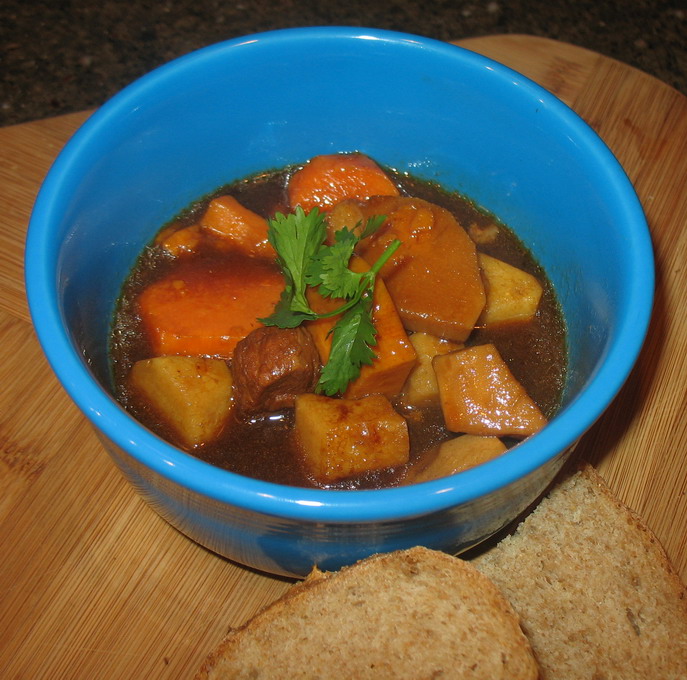
When most Americans think of Chinese food, stir-fried dishes come to mind; however, this is hardly representative of the entire range of culinary expression in China. While stir-frying is a good example of the ingenuity of the Chinese kitchen in dealing with the necessity of conserving fuel, and turning that necessity into culinary genius, stir-fried dishes are only a small part of the full expression of Chinese cookery.
There are many other techniques employed in the Chinese kitchen, as well as cooking styles that use techniques much more familiar to the Western kitchen, such as braising, stewing, roasting and simmering.
One such cooking style is called, “red-cooking.” Red cooking is the practice of braising or stewing meats and vegetables in a sauce which includes dark soy sauce, rice wine or sherry, star anise and other spices, and rock sugar to create a hearty deep reddish-brown sauced dish which is commonly eaten in the wintertime. Regional variations on the technique abound; in Sichuan province, for example, red-cooked dishes are given further color and flavor by the addition of chile-bean paste, a mixture of fermented soy and broad beans, chile and spices. Red Cooked Beef With Turnips is a perfect example of a typical Sichuan variation on the red-cooking technique.
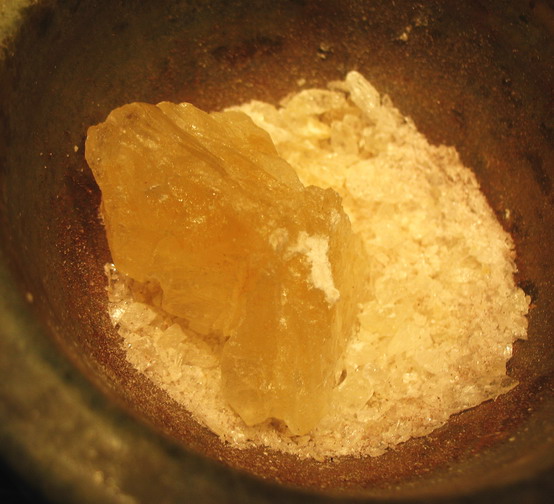
A more typical Cantonese preparation is one that uses fewer flavoring ingredients in order to subtly enhance the natural flavors of the meats and vegetables cooked in the sauce. Rock sugar, which is not used in the Sichuan versions of the dish, is a necessary ingredient for the Cantonese version. Rock sugar, also known as lump sugar, yellow rock sugar or rock candy, is a crystallized mixture of refined and unrefined cane sugar and honey. It not only gives sweetness to red-cooked dishes, but also gives the sauce a unique glossiness and body which is difficult to replicate by using any other sort of sugar. Easily found in Asian markets, rock sugar is sold in plastic bags, and comes in medium to large glassy-looking yellow lumps. Many authors suggest putting lumps into a plastic bag and using a hammer to pulverize them into small chips; however, I just use my marble mortar and pestle to grind it. One good whack with the pestle reduces a lump to smaller lumps. Then, each smaller lump can be ground down into powdery shards separately with ease and no mess.
Good dark soy sauce is another essential ingredient to Cantonese red-cooking. (For a description of the differences between dark and light soy sauces, take a look at a former post on the subject here.) Get a premium brand like Pearl River Bridge or Kimlan; using Kikkoman will not give a good flavor to the dish, nor will it give the requisite reddish-brown tint to the sauce.
In adapting this recipe from Irene Kuo’s version in her classic cookbook, The Key to Chinese Cooking, I decided that instead of just using bamboo shoots in the stew, I would also add a favorite Pacific rim ingredient–taro roots.
Taro roots are actually starchy rhizomes, and they are a staple ingredient in many southeast Asian and Pacific island cuisines. It grows in tropical climates, so it cannot be said to be local to Ohio, however, I am so fond of the texture of it and the way it picks up the flavors of what it is cooked with, that when I saw some at the Asian market here in town, I had to get them.
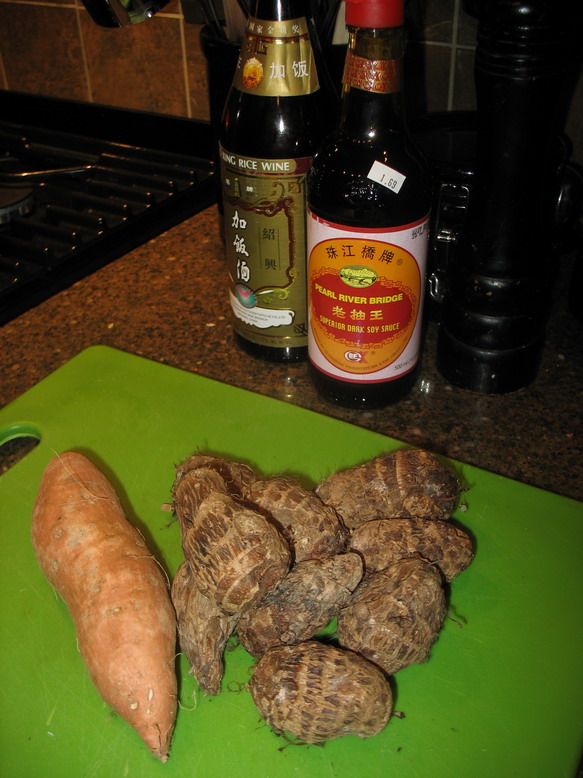
Taro itself has very little flavor; it has a bland, vaguely sweet flavor with a texture reminiscent of large dried lima beans. I first tasted them in a red-cooked dish that Huy, the chef of the China Garden Restaurant in Huntington, West Virginia, made for his employees for supper one night. I instantly fell in love with them–they had that rich, buttery texture that was instantly appealing, and the chunks of rhizome picked up the delicious flavor of the sauce to perfection. I remember Mei, his wife, explaining to me what they were and showing me the hairy-looking unpeeled rhizomes, and saying, “These are like potatoes for people in southern China. They are good in winter stews, and sometimes they are boiled and mashed into a dough and used to make dumplings that are fried crisp and frizzy outside and are soft and melting inside.”
Huy pointed out to me also that large raw taro roots are carved into elaborate decorations that look like ivory, but that one cannot eat raw taro for it is poisonous. In fact, even when peeling and cutting the roots up, one should wear gloves for the juice is irritating to the skin. The roots have to boiled for at least an hour (unless you are using a pressure cooker, in which case, ten minutes under 15 psi will suffice), in order to denature the crystals of calcium oxalate, which is one of the main irritating constituents in the rhizome.
So–let it be known, that if you want to use taro root, you should wear gloves in peeling it, and you should also cook it thoroughly–at least forty-five minutes to an hour so that the rhizomes come to complete tenderness, lest you have severe irritation in your hands, your lips, tongue, and throat.
If you do not want to play with taro and its irritants, or, if you cannot find it, then use new potatoes instead. It won’t be quite so authentically Chinese, but the stew will still taste delicious.
As for the sweet potatoes and the leeks–well, they are not traditional. I used the leeks instead of scallions, and I used the sweet potatoes just because I knew that they would taste wonderful with the sauce.
I don’t feel in the least bit bad about using untraditional ingredients, either, because, frankly, most Chinese Americans have been adapting Chinese recipe and techniques to western ingredients and kitchens ever since they have come to these shores–ever since the Gold Rush days. It is the way that diaspora cuisines develop, grow and diversify over the years.
In another burst of East meets West diversity, instead of serving this with steamed rice or plain steamed buns, I served it with fresh whole wheat bread from the bakery down the hill. The bread mopped the sauce up beautifully. I think that the only thing that would have made the meal better would have been a big arugula and pear salad with black walnuts and a pomegranate vinaigrette! (But I was fresh out of arugula and pomegranates, so we did without.)
Red Cooked Pork With Taro and Sweet Potato
Ingredients:
2 tablespoons peanut or canola oil
3 pounds boneless pork sirloin roast, cut into 1 1/2″ cubes
2″ cube fresh ginger, peeled and cut into thin slices
1 whole leek, trimmed and washed, white and light green parts only sliced into 1/4″ thick slices
4 tablespoons dark soy sauce
1/4 cup Shao Hsing wine
2 1/2 tablespoons crushed rock sugar or 1 tablespoon raw or brown sugar and 1 1/2 tablespoons honey
1/2 teaspoon salt
2 whole star anise
1 stick cinnamon
3 cups boiling chicken stock or broth
3 halved canned bamboo shoots, rinsed and cut into 1/4″ thick slices
1/2 pound taro roots, peeled and cut into 1″ chunks
2 small sweet potatoes, peeled and cut in half lengthwise and cut into 1/2″ chunks
2 tablespoons cornstarch dissolved in 2 tablespoons cold water
salt to taste
1/2 cup cilantro leaves, lightly chopped
Method:
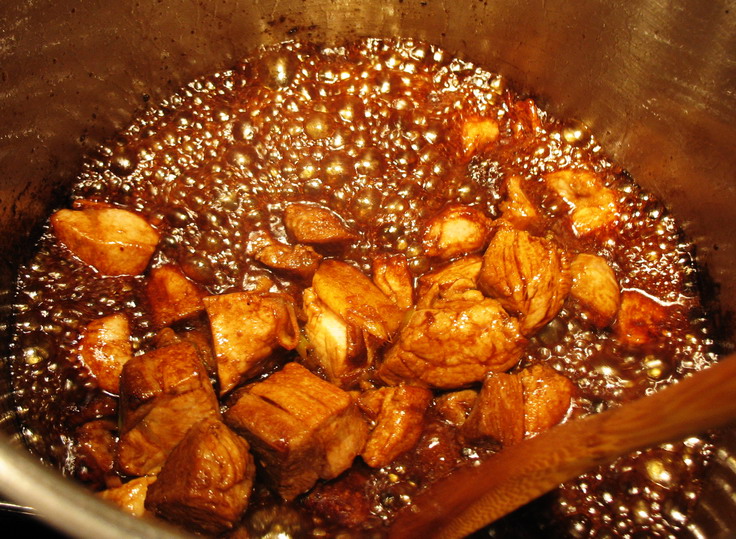
Heat oil in a Dutch oven over medium heat. Add pork cubes, ginger and leeks and allow meat to brown thoroughly.
Deglaze with soy sauce and wine, scraping up any browned bits. Add seasonings, bamboo shoots and boiling chicken stock or broth, and bring to a boil.

Turn down heat so that the liquid simmers, cover and cook for about forty five minutes.
Add taro roots and cook for another forty-five minutes, until meat and taro are fork tender.
Add sweet potatoes and remove lid. Simmer until sweet potatoes are fork tender. Bring liquid back to a boil, and reduce sauce until it thickens slightly. Add cornstarch mixture and allow to thicken.
Season to taste with salt, and garnish with cilantro.
Crazy Days
This is just a quick note to let folks know that all is basically well here, and I have a post that I have been working on for more than twenty-four hours.
Not that it is that large or complex a piece of writing, but that it is crazy around here.

Kat is fine. As you can see. (Zak has really gotten into the idea of babywearing and has started collecting slings and carriers so he can keep Kat close and still do stuff all day.) She now weighs seven pounds six ounces; she has gained three ounces in the past three days. She is sleeping less at night, but we are working on that issue with diligence and care.
The kitties are all fine, as are Zak and I.
It is just that the house seems to be falling apart. First, the washing machine broke. Then, it soaked through the carpet in the utility room, rotting it. Then, while I was clearing all of the stuff from the utility room in order to allow the workmen to clear out the dead washer, the carpet and the ugly cabinetry in preparation for the new laminate flooring, wire shelving and new washing machine that will be happening next week, I heard one of the housecleaning ladies yell for me with a note of panic in her voice. (God bless my Mom-in-Law, Tessa, who gave us the gift of housecleaning for Kat’s first year of life.)
I ran to the bathroom, which is the main one, and the one Morganna uses, and saw the lady backed into a corner of shower, surrounded with shattered glass from the shower door. It was absolutely horrifying.It was safety glass, but she was in there in her sock feet. She started to take a step toward me while abjectly apologizing–and I firmly told her to stay put. She thought I was mad at her. I wasn’t. I was terrified that she had been hurt or that she would cut open her foot if she moved.
So, one of her cleaning crew came up behind me and I told her to run and get her shoes, only to be met with a blank stare and a “huh?”
“Go get her shoes, now!”
Luckily, the shoes were fetched, and put on with no cutting or bleeding.
I am just glad that Morganna wasn’t in there when it happened, showering.
So, we need to replace the shower door.
Along with the washer.
I hope that nothing else breaks anytime soon, is all.
And yes, someday soon, I will finally post the roundup to the Spice is Right IV: Back to School that I was going to post on the day I went into labor and delivered Kat.
Book Review: Climbing The Mango Trees
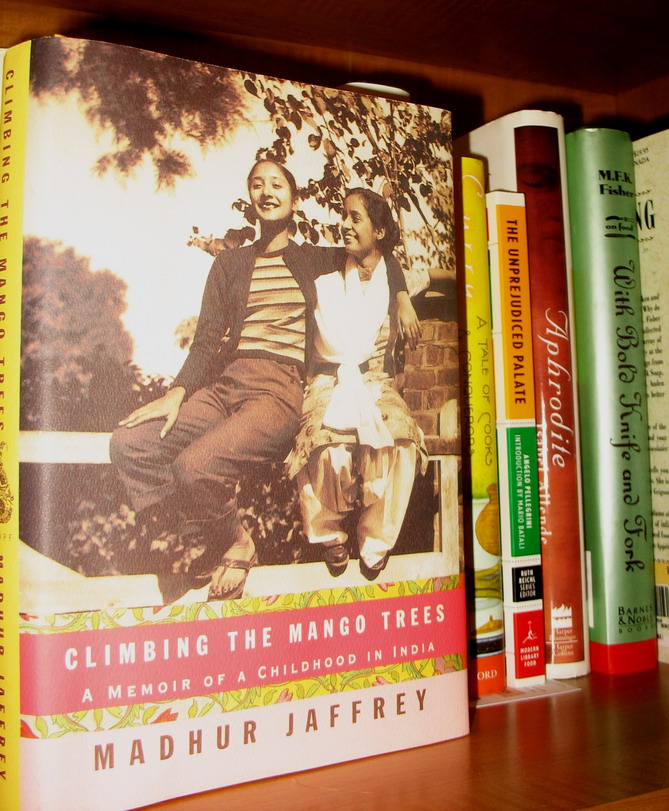
As I mentioned long ago, Madhur Jaffrey is the reason I first tasted Indian food. I had checked her cookbook, An Invitation to Indian Cooking out of the library, and enchanted by her descriptions of Indian food, got up the nerve to cook rogan josht. That one dish from that book started me on the road to seriously studying Indian cookery, and I owe it all to Ms. Jaffrey.
So, when I saw on Amazon that she had a memoir out, I of course had to nab myself a copy. I considered Climbing The Mango Trees a birthday gift to myself, and splurged on the fast shipping just so I could get my greedy hands on it sooner.
When it arrived, I devoured it as quickly as a new mother possibly can, which means I read it while breastfeeding Kat, while rocking her to sleep and while holding her while she slept. It took me about a day to read that way, because I kept getting interrupted by stuff like diaper changes, baby laundry and cooking dinner.
But, needless to say, I tore through it like a hot summer wind, and was sad to see it end.
How was it?
Well, it started slowly, with Jaffrey giving us a bit of a tour of northern Indian history, and placing her ancestors into that history. Luckily, I find such things fascinating, but I could see other readers going to sleep on it. Once she started talking about her own lifetime, the narrative picked up, and I was treated to Jaffrey’s own voice as she recalled incidents from her past that were of both personal and national importance.
Jaffrey’s childhood took place during very significant chunks of Indian history, and her perspective both as the child she was and the adult she is were valuable and very emotionally gripping. Of particular interest was her remembrances of Partition and the assassination of Ghandi. I found myself weeping with Jaffrey when she recounted the assassination and the resulting violence, riots and massacres. Her family, while Hindu, also had ties to the Muslim culture of northern India, and Jaffrey tells of her great sorrow during the tumult of the partition, at losing many Muslim friends and aquaintances, many of whom she never heard from or saw again.
All of the narrative is not sorrowful, of course. She does recount her food experiences, and here is where foodies will be most enthralled, because Jaffrey is endowed with a powerful taste memory, and has used this ability to recreate dishes from her childhood that might have gone lost to the world had she not written them down. The last chapter includes a number of recipes for particular dishes mentioned in the book, including many that have never been published before.
A delicious book, full of wit and wisdom, love, laughter and tears, Climbing the Mango Trees is well worth reading, especially for those who are interested not only in the food and culture of India, but also the modern history of the world’s largest democracy.
Lazy Sunday Brunch: Kitchen Sink Eggs
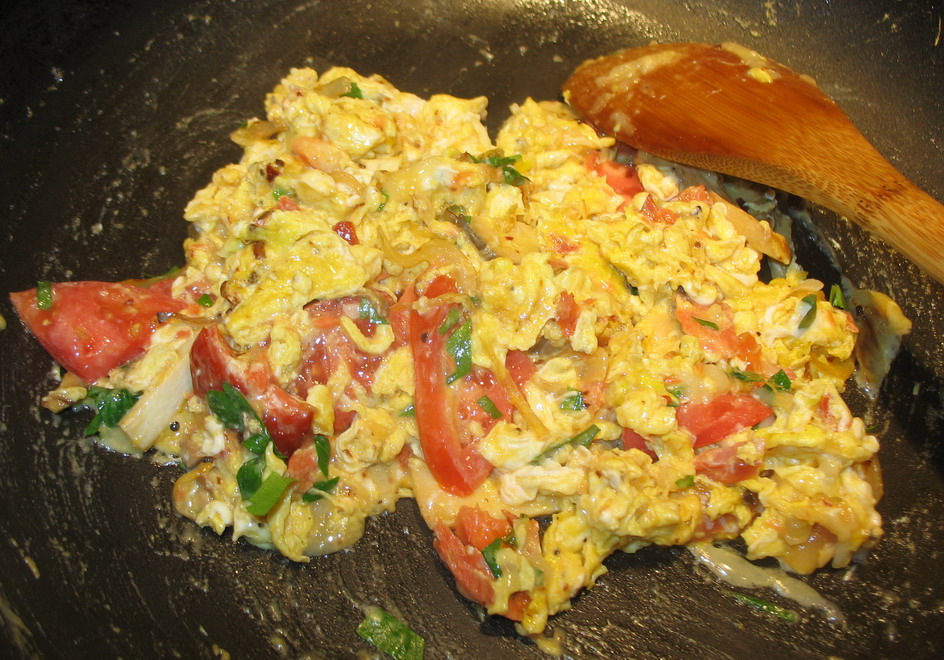
No, I don’t cook eggs in the kitchen sink.
The name comes from the colorful saying, “Everything but the kitchen sink,” which is meant to refer to a concatenation of stuff that is jumbled together, seemingly without rhyme or reason. In reference to this recipe, one could and might well say, “These eggs have everything but the kitchen sink in them,” and be essentially correct–no kitchen sink is harmed in the creation of this dish.
What is the essential ingredients to Kitchen Sink Eggs besides eggs and lots of other stuff?
A strong appetite and laziness.
These scrambled eggs into which I habitually stir all sorts of other things came about one Sunday morning when I was too damned tired, clumsy and lazy (allright, and hung-over–these eggs first came about when I was a college student, way back in the day) to bother with an omelette, but I really wanted something that tasted like one anyway. I also had lots of leftover vegetables in the fridge, along with some bits of pieces of various sorts of cheese, some shreds of ham and a mushroom or two. And, a full dozen of eggs.
So, I decided to make myself an anti-omelette.
And I did.
And it was good.
When my next door neighbor smelled what was cooking, she came over and stuck her head in the door. (We were friends–she was a medical student while I was a journalism student, and we were always in and out at odd hours of the day and night.) She blinked muzzily and rubbed her hung-over face, (we had been over to friends’ house watching movies and drinking beer, then ended up acting as midwives for his cat who went into labor on his lap until all hours) and said, “Smells good. Whazzit?”
From nowhere, the phrase “Kitchen Sink Eggs” popped out of my mouth, and a dish was born. I scraped half the pan into a plate for her and half for me, and we fell to with great glee and gusto. With a side of whole wheat toast and black coffee, the eggs helped clear our heads and fill our rebellious bellies, making us fit for human company.
Ever since that morning, I have made Kitchen Sink Eggs (henceforth to be known as KSE) for those times when I want something filling, but I don’t really want to work at it. The recipe, such as it is, is infinitely malleable. It consists of whatever one has hanging around in the kitchen that would taste good mixed into scrambled eggs. Fresh mushrooms, caramelized onions, fresh or dried herbs, spices (curry powder or garam masala is particularly nice), leftover steamed or sauteed vegetables such as asparagus, potatoes or broccoli, bits of ham or crumbled bacon or cooked sausage, shreds of leftover chicken, sliced olives, and fresh vegetables such as tomatoes or chard, mixed with a bit of shredded cheese, have all graced a batch or two of KSE over the years.
Today’s version included shreds of Alaskan wild-caught smoked salmon, a sliced fresh trumpet mushroom from my CSA, caramelized onion, raw-milk gruyere cheese, Aleppo pepper, fresh parsley, and the last of my CSA’s fresh tomatoes. (They said there may be some more next week, but I doubt it. We’ve already had one frost and while the tomato plants survived that one, I am not sure they will make it through another one.)
I have served them for breakfast, brunch and dinner to myself, family and very close friends, because they are the epitome of homey comforting food that while it looks rather ugly, is very satisfying. Unlike omelettes, which can be dressed up to become elegant and presented on dainty plates for the most refined of guests, KSE are not really meant to be anything but rough-edged, down and dirty, quick, hearty sustainance.
There is nothing wrong with that, of course. Lazy Sundays are not the time for culinary flash, but instead are the perfect moment for something filling and flavorful, which these eggs most certainly are. Try them the next time you think you might want an omelette, but don’t much feel like making one. The recipe I am giving today is the way I made it today, using what I had on hand. Just remember that the recipe is infitely mutable, and use what you have in your fridge in order to make your own unique version of KSE.
Kitchen Sink Eggs
Ingredients:
3 fresh eggs, well-beaten
1 tablespoon whole milk
2 tablespoons butter
1 teaspoon Aleppo pepper flakes or red chile flakes to taste (or black pepper to taste)
1 small onion, peeled and thinly sliced
1 medium trumpet mushroom, cleaned and thinly sliced
1 ounce Alaskan wild-caught smoked salmon, shredded
3 heaping tablespoons shredded gruyere cheese
1 very small tomato, sliced thinly, each slice cut into quarters
1 tablespoon minced fresh parsley
salt to taste–optional (with the cheese and the smoked salmon, I needed no salt in this batch of KSE)
Method:
Beat eggs well, then beat in milk until combined. Set aside.
Melt butter in a cast iron or non-stick skillet or wok over medium heat. Add Aleppo pepper, red chile flakes or black pepper, and onions. Cook until the onions are well light golden and transluescent. Add mushroom, and cook until the mushroom is golden and softened and the onion is well-caramelized and fully brown.
Add salmon, and continue cooking for one minute.
Add egg and milk mixture and reduce heat to low. Cook, stirring until the egg is nearly solid.
Sprinkle egg with cheese, and add tomato, continue cooking, stirring constantly until eggs are as set as you like and the cheese is melted and fully incorporated.
Sprinkle with parsley, and give one final stir before serving with well-buttered whole grain toast.
My Pet Peeve: Picky People
So, I had a few extra moments to myself today–a rare commodity these days–and decided to try and catch up on what’s happening in foodblogland. I only got to look at a couple of my favorite blogs, but one entry at one blog jumped out at me and made me want to jump up and testify.
Amy, of Cooking With Amy ranted a wee bit about how she cannot abide picky eaters.
Her post brought forth an amen and a hallelujah from my “amen corner” here, because if there is a human behavior that works my very last nerve, it is food controlling behavior that impinges on the ability for other people to enjoy their own dinners, or otherwise interact socially with the food-controlling individual.
And the thing is–I try really hard to be tolerant of people. I really do. If I know that someone really hates a particular food, I will refrain from cooking it for them. I have already written about how, as a host, I do take into account people’s real food allergies and religious proscriptions against certain foods. I am respectful of health restrictions, because they involve keeping the diners alive (food allergies are not to be trifled with), and my own personal honor is such that I must respect people’s food restrictions that are based on their religious beliefs, because to not do so is for me to put myself between them and their view of God. And that is not my place, nor, really, anyone else’s place. So, that is all good.
But what about people who just have a list of foods they don’t like because they are “icky?” What about people who refuse to eat large categories of foods for no real reason except that they had some traumatic food incident in childhood that has left them permanently scarred? Or, they just don’t like the taste of most foods? Or, they are food controlling because it makes them the center of attention?
I, like Amy, just don’t have patience with these folks. Though, I must make a caveat here–when I say I don’t have patience with picky eaters, please understand I am talking about ADULTS, not kids. I cut kids slack because they go through developmental phases where they are picky, and nearly every kid goes through a stage where they don’t like this or that sort of food. (And that which they like and dislike often changes from day to day, much to the eternal frustration of their parents and caregivers.)
What I object to are adults who act like kids.
And my attitude toward such adults is this–grow up and get over yourself. Or, shut up when we are at the table. Or, get therapy, because you really need it. Or, I just don’t interact with them, because the rise in my blood pressure as I watch them harry waitstaff or when they whimper about this or that food and how they won’t eat it while I am trying to cook is just not worth it.
What is funny about this is that I am married to a man who used to hardly eat anything. Zak used to eat meat, potatoes, a handful of vegetables, pasta, rice, bread and the holy of holies–cold breakfast cereal. I am told by his parents that he used to live on sugar cereal virtually alone, and that there were years when he would eat it for two out of three meals a day.
Well, when I met him, he had just come back from Italy where he had his first culinary epiphany when he tasted pesto for the first time. (This was back before pesto had come to the US and taken over the culinary scene to the point where it became ubiquitous. At this point, in the early 90’s, he was astonished that I even knew what it was.) So, he had tasted truly great food in Italy and in the rest of Europe, and had started loosening up his own food neuroses.
But he credits moving in with me as being a turning point in his life as an eater. Apparently, my indomitable will in the kitchen broke him of being a picky eater, because I flatly refused to cater to his whims and limit my cooking to what I knew he liked. I just flat out refused, and cooked and ate whatever I had a mind to. If he didn’t like it, he could always eat cereal, and there were times when he did. But, over the years, his tastes changed to the point where he is quite the epicure now, and actually can discuss things culinary with me without either his eyes glazing over or saying, “huh?” at my every sentence.
Not only has his palate developed, so has his culinary vocabulary.
I do that with a lot of people. I cook stuff that they supposedly don’t like–often unknowingly, but sometimes on purpose, and damned if they don’t love it when I make it! I have had many a friend tell me, “I hate tofu, but the way you cooked it was awesome.” Or, “I always thought eggplant was nasty until you made that miso-glazed grilled stuff. That was so good.”
But some people defeat my kitchen super-powers, and are simply too whiney or neurotic to even try whatever it is I make for them, and it is these folks who bug the crap out of me. I guess because they aren’t even willing to meet me halfway and try something new. They just want to complain.
Strangely enough, quite a few culinary arts students are that way. I met more picky people in culinary school than anywhere else I have been. It seemed as if young food-controlling people flocked to culinary college, though, why, I have no idea, since most of the chefs delighted in torturing them by insisting that they try all of these scary new foods.Personally, I cannot get why someone would aspire to be a chef and yet refuse to eat vegetables. It seems rather–well, like an aspiring race car driver who won’t drive to work or something. It is just weird.
Folks like that try my patience, and tend to make me cranky, leading to rants like this one.
I guess it bugs me because extremly picky eaters tend to be narcissistic–they are so self-absorbed in their food controlling behaviors, they are either unaware of how annoying they are to those around them, or they just flat out don’t care. (Remember, I am talking about really picky eaters here, not just someone who doesn’t like okra because it is slimy and canned peas because they are olive green and mushy. I am talking about people who will not eat whole categories of food for no logical or sensible reason, and who make a big deal about it.)
That kind of self-centered behavior is extremely immature and childish, and I think that is the crux of the issue for me–I am not good at dealing with adults who act like spoiled little kids.
So, Amy–know this–you are not the only one out there who dislikes picky people. I’m the same exact way.

Categories:
- Admin (rss) (55)
- Blogs and Blogging (rss) (81)
- Book Reviews: Cookbooks (rss) (43)
- Book Reviews: Non-Cookbook Food Books (rss) (38)
- Cats and Cat Blogging (rss) (47)
- Chinese Cooking Lessons (rss) (32)
- Culinary School Stories (rss) (18)
- Dairy Pruducts: Cultured and Barbaric (rss) (4)
- Documentary Filmmaking (rss) (1)
- Essays, Rants and Reflections (rss) (260)
- Fighting Hunger (rss) (12)
- Food and Kids (rss) (45)
- Food in the News (rss) (126)
- Food Media (rss) (98)
- Food Preservation (rss) (18)
- Food Safety (rss) (45)
- Gardening (rss) (30)
- Herbs and Herb Blogging (rss) (20)
- Holidays (rss) (50)
- Kat Blogging (rss) (22)
- Kitchen Science (rss) (36)
- Leftover Makeover (rss) (8)
- Life, the Universe and Everything (rss) (131)
- Local and Sustainable (rss) (227)
- Local Athens Food and Foodies (rss) (42)
- Meatless Mondays (rss) (32)
- Menu For Hope (rss) (5)
- Nutrition, Diet and Health (rss) (84)
- On The Farm (rss) (8)
- Recipes: Almost Vegetarian, Vegetarian and Vegan (rss) (294)
- Recipes: American Regional (rss) (37)
- Recipes: Appalachian Hillbilly (rss) (33)
- Recipes: Bread, Pasta, Grains (rss) (95)
- Recipes: Canning and Preserving (rss) (8)
- Recipes: Chinese (rss) (123)
- Recipes: Comfort Food (rss) (120)
- Recipes: Cookies (rss) (16)
- Recipes: Desserts (rss) (48)
- Recipes: French (rss) (25)
- Recipes: Fruits and Vegetables (rss) (302)
- Recipes: Greek, North African and Middle Eastern (rss) (31)
- Recipes: Indian (rss) (137)
- Recipes: Italian (rss) (42)
- Recipes: Japanese (rss) (7)
- Recipes: Jewish (rss) (4)
- Recipes: Korean (rss) (6)
- Recipes: Meat, Poultry and Fish (rss) (220)
- Recipes: Mexican/Native American/ Latin American/Caribb (rss) (27)
- Recipes: Original (rss) (108)
- Recipes: Thai (rss) (27)
- Recipes: Tofu (rss) (17)
- Recipes: US Regional (rss) (16)
- Recipes: Vietnamese (rss) (8)
- Restaurant Stories (rss) (28)
- Sewing, Quilting, Arts and Crafts (rss) (16)
- Simple Chinese Recipes (rss) (30)
- Slow Food and Heritage Foods (rss) (10)
- Spice Blogging (rss) (44)
- The Chinese Cookbook Project (rss) (14)
- The Chinese Pantry (rss) (39)
- The Documentary (rss) (2)
- The Kitchen Saga (rss) (17)
- The Locavore's Bookshelf (rss) (15)
- The Unsung Adventures of The Culinary Nerd (rss) (6)
- Tools and Toys (rss) (35)
- Uncategorized (rss) (10)
- With a Side of Politics (rss) (48)
Archives:
- August 2012 (9)
- July 2012 (12)
- September 2011 (3)
- August 2011 (7)
- July 2011 (8)
- June 2011 (16)
- May 2011 (17)
- April 2011 (11)
- December 2010 (9)
- November 2010 (5)
- February 2010 (1)
- December 2009 (5)
- November 2009 (7)
- October 2009 (10)
- September 2009 (16)
- August 2009 (14)
- July 2009 (14)
- June 2009 (7)
- May 2009 (17)
- April 2009 (10)
- March 2009 (25)
- February 2009 (13)
- January 2009 (10)
- December 2008 (5)
- November 2008 (5)
- October 2008 (6)
- September 2008 (13)
- August 2008 (8)
- July 2008 (11)
- June 2008 (18)
- May 2008 (13)
- April 2008 (14)
- March 2008 (16)
- February 2008 (17)
- January 2008 (19)
- December 2007 (25)
- November 2007 (18)
- October 2007 (24)
- September 2007 (16)
- August 2007 (15)
- July 2007 (15)
- June 2007 (10)
- May 2007 (14)
- April 2007 (16)
- March 2007 (17)
- February 2007 (20)
- January 2007 (13)
- November 2006 (1)
- October 2006 (8)
- September 2006 (14)
- August 2006 (25)
- July 2006 (30)
- June 2006 (28)
- May 2006 (34)
- April 2006 (29)
- March 2006 (24)
- February 2006 (30)
- January 2006 (38)
- December 2005 (40)
- November 2005 (37)
- October 2005 (32)
- September 2005 (25)
- August 2005 (30)
- July 2005 (28)
- June 2005 (21)
- May 2005 (8)
- April 2005 (22)
- March 2005 (17)
- February 2005 (29)
- January 2005 (10)
Search Site:
Links:
- Lily’s Wai Sek Hong
- 101 Cookbooks
- A cat in the kitchen
- A Veggie Venture
- Accidental Hedonist
- Cha Xiu Bao
- chez pim
- Chocolate & Zucchini
- Chopstick Cinema
- Chowhound.com
- Chubby Hubby
- Cook sister!
- Cooking with Amy
- da*xiang
- Eat Local Challenge
- Eating Liberally
- Ecocentric
- Eggbeater
- Epicurious
- Farmgirl Fare
- Fatfree Vegan
- Foodgoat
- ForkandBottle.com
- Green Olive Tree
- Hooked on Heat
- Jaden’s Steamy Kitchen
- Kalyn’s Kitchen
- Lucullian delights
- Mahanandi
- Matt Bites
- MeatHenge
- mmm-yoso!!!
- New York Times – Dining & Wine
- Pizza Goon
- Rasa Malaysia
- Ruhlman
- Sailu's Kitchen
- Serious Eats
- SF Gate: Food & Dining
- Simply Recipes
- Soul Fusion Kitchen
- Tastespotting
- The Amateur Gourmet
- The Cleaner Plate Club
- The Food Section
- The Grub Report
- thecookscottage
- U.S. Food Policy
- Wandering Chopsticks
- Washington Post Food and Dining
- Wasted Food
Meta:


Powered by WordPress. Graphics by Zak Kramer.
Design update by Daniel Trout.
Entries and comments feeds.