
Cook Local, Eat Global
Women, Food and Feminism
So, I am late.
Yesterday, March 8, was International Women’s Day, and folks were supposed to be blogging against sexism.
Oops.
I was abed, asleep and sickly all day.
So, here I am, all late and wrong, not to write about sexism, because, while I could talk about rampant sexist behavior in professional kitchens (a tradition that is fading as more women enter professional kitchens, educated and great cooks in their own right, and as more students graduate from culinary school where the chefs have beaten sexist tendencies out of them), I don’t so much feel like writing an angry essay. And it would be an angry one, because sexist behavior is infuriating.
So, instead, because I was inspired by Raspberry Sour’s post on the topic yesterday, I want to take up the gauntlet she threw down and talk about women, food and feminism.
She quite correctly correlates the rise of feminism, and the entry of large numbers of women into the workforce with the accelerated growth of the use of processed convenience foods and the overwhelming popularity of fast food restaurants and take out as replacements for home-cooked meals.
When women go to work, they step out of the kitchen, and that seems to be that.
Or is it?
When we talk about two-income households, there is often discussion of “equal sharing” in the household chores between the spouses. However, the reality of the situation is that while many of today’s men are doing more of the childcare chores than was the case in the past, most of the housecleaning/shopping/food preparation falls to women, or at least, that is the case if one believes the statistics quoted by Linda Hirshman in her recent article, “Homeward Bound” for the American Prospect Online.
She postulates that while the glass ceiling in education and the workplace has effectively been shattered by the concerted efforts of feminists in the US, there has been very little change in the actual structure of our families and society. This stands to reason: it is easier to attack gender inequality on campus and in the marketplace because of the possiblity of governmental and judicial intervention; however, when it comes to private lives, none of us wants Big Brother or Big Sister telling us how to live and relate to each other. (And rightly so.) Without the assistance of the courts and the legislatures, it is a very slippery operation for feminists to plunge into the depths of the American psyche and monkey around with the way in which men and women relate to each other in a household setting. Furthermore, I would say that such sweeping changes cannot be accomplished quickly and easily, simply because that is now how human societies evolve naturally.
Social evolution is by nature a slow process because we are dealing with a complex set of interactions on both small and grand scales. Without resorting to violence, experiments in totalitarian government, sweeping economic or educational programs, the possibility of quickly reshaping social systems is doomed to failure. This is both frustrating and comforting. It is frustrating, because there are inequalities that very much need to be addressed on personal and societal levels. It is comforting, because it attests to the strength and stability of human institutions–that it takes huge messy things like wars and rumors of war to disrupt them.
But I have moved far afield from the kitchen.
When women leave the home for the workplace, they often leave behind the kitchen, and in doing so, we see intense growth in the “home meal replacement” industry which includes take-out businesses, huge prepared-food departments in grocery stores, aisles of frozen and boxed convenience foods, fast food restaurants lining our city streets, and scads of “personal chefs” starting their own businesses. Along with this growth, we see the growth in girth of ourselves and our children, with record numbers of obese kids developing type II diabetes, a life-threatening disease with serious consequences with is entirely preventable.
What is a woman to do in this environment? If she is a working mother, should she eschew the convenience of fast food and make sure to cook at least four or five meals a week for her kids? (Or, should Dad do it? There is some statistical evidence to suggest that more and more men are taking up in the kitchen in the US where women have left off, which is a good thing, in my book.)
If she does cook for her kids, how can she make the time to do so, when she is also carting them to their sports practice, piano lessons, play dates and doing housework on top of it all?
And then, there is the question of what if she doesn’t know how to cook for the kids?
A good question.
I am certain that no one is going to be surprised at my answer. I say–women should go back to the kitchen, taking husbands and kids with her, and everyone can learn to cook together.
Record numbers of young adults in our country have no clue how to cook even the simplest things, like say, scrambled eggs, pancakes, or even grilled cheese sandwitches without having a minor kitchen disaster. This is because many people grew up without Moms or Dads who cooked. We used to learn at Mom’s side, and just in case Mom was a wretched cook, there was always that Home Economics class to take up the slack. Except, very few schools offer Home Ec anymore, certainly not as a requirement, and seldom as an elective.
How do these people feed themselves? They heat frozen stuff up in the microwave, they eat at McDonald’s and they gobble up Pop-Tarts. We know that this is not good.
Hie thee hence to the kitchen, Moms, I say. Make dinner time QT–quality time–with the family. If Mom doesn’t know how to cook, maybe Dad does. If Dad doesn’t maybe Mom does, and if neither do, then there is always Food TV to help.
Rachel Ray and Alton Brown will hold their hands and help them out–Ray is popular for a reason, you know, and it isn’t just because she is perky and cute. She’s popular because she is a klutz in the kitchen, but she proves to overworked parents that by darned, even clumsy people can throw down and cook a meal in thirty minutes that is tasty and filling and comes from mostly real ingredients.
Am I then, an anti-feminist?
Uh, no. Actually, I see nothing anti-feminist about cooking with the family.
Notice I said, “cooking with,” not “cooking for” the family.
It seems like a small distinction, but it isn’t. The implications of my change in one small word are huge.
If a woman cooks for her family, even if she chooses to, she is stepping into a traditional female role. I have done this many times, and I don’t mind it, because to me, cooking is as personally satisfying as sitting down and creating a piece of art, or writing an essay. It is an expression of my own creative spark, my self, and is a gift that I give to those I love. That is fine for me, but for a lot of women, cooking for others is their own personal version of hell. They don’t like it, they resent it and the chore chafes on them like an invisible yoke. For these women, I do not advocate that they step into that traditional female role, unless they bring the entire family into the kitchen with them.
Why?
Because I believe that every individual should know the basics of cookery so that they can, when they grow up, feed themselves and others a basically healthy diet without resorting to the use of processed ingredients which are of dubious economic and nutritive value.Parents, meaning both Moms and Dads, are responsible for feeding our offspring food upon which they can thrive and grow into healthy adults, and research has found that healthy eating habits are most likely to last throughout life when they are formed at home and modelled by both parents. Eating together as a family has proven health and educational benefits for children; I would argue that it has social benefits for the entire family, in that it strengthens relationship bonds and fosters familial closeness.
Besides, I think that in our zeal to drive our kids around to playdates, soccer practice, drama club, and debate team, all of which are meant to foster the emotional and educational growth of our kids, we have forgotten that the physical health of our kids is just as important. Good nutrition is a basis for physical health, and who is better at teaching good eating (and cooking) habits to our kids but parents? In my world, I see nothing wrong with forgoing a night or two of outside activities so that kids can stay home, and cook and eat with the family.
That is my prescription for the ills of society. Women, men and children should come back to the kitchen and learn to cook together. It won’t fix everything, of course. It won’t change who does the laundry, the fact that South Dakota has outlawed most forms of abortion and the fact that lots of folks are still homeless in Louisiana while our federal government dithers and points fingers and places blame. It won’t address the fact that women, on average still make a fraction of what men make in the marketplace.
But, it might make a dent in the number of kids who are obese, who have developed type II diabetes, and who have no clue how to cook beyond putting a box of lasagne in the microwave and pushing a button.
It might make us value our families a little more. It might make us look for family fun in a place that had previously only been the home of drudgery and food fights. It might make us laugh with each other (and at each other, too) as we struggle to gain useful life skills together.
Cooking and eating together is a family value, and is one that should not be considered conservative or liberal, traditional or progressive, sexist or feminist.
It should just plain old be valued.
Cookbook Review: From Curries to Kebabs: Recipes from the Indian Spice Trail
Madhur Jaffrey is a Devi of the kitchen.

Even if she came to cookery later in her life (as did Julia Child, for that matter), she found her calling.
And all started when she was a college student abroad, alone, and homesick for her mother’s cooking. She learned to cook originally to feed herself, but soon found that she had the ability to transmit her knowledge to others who are either not familiar or only passingly familiar with Indian cuisines. And when she began writing cookbooks to introduce Americans and the British to Indian cookery, she has indirectly fed millions of very happy people.
It was Jaffrey’s evocative descriptions of the glories of Indian food that induced me, over twenty years ago, to throw caution to the wind and attempt cooking rogan gosht, even though I had never in my life tasted a real curry.
And it was her unfailing instruction that ensured that the result was voluptuously delicious, which ensnared me further, as I fell deeply in love with a cuisine more complex than I could ever dream or imagine.
Every book of hers I have taken up since, has taught me something new, and with each new title, I learn at least three recipes that quickly become classics which are requested again and again by my family and friends.
From Curries to Kebabs: Recipes from the Indian Spice Trail is no exception.
The first thirty-two pages are a historical treatise that follows curry from its birthplace in the Indian subcontinent, across the world. In tracing this development, Jaffrey takes special note of the places where Indian immigrants have settled across the globe, and how their cookery has changed once it is transplanted in its new home. She shows how Indian cookery has fused with the native cookery of such diverse places as Britain, Malaysia, Japan, Africa and Trinidad, and as a result, the dish called “curry” has come to mean nearly innumerable things to innumerable people–all of whom love it passionately.
Yes, the story of this book is much the same as Lizzie Collingham’s Curry: A Tale of Cooks and Conquerers, but instead of being a long history, with a few recipes sprinkled throughout, Jaffrey’s book lets the curry do the talking. The majority of Jaffrey’s book is taken up by a unique and comprehensive selection of curry recipes from around the world, all of them with extensive historical and personal notes, as well as key information on technique and ingredients.
Jaffrey’s scholarship is impeccable, and her recipes, are as always, a pleasure to use.
Thus far, I have cooked four recipes from the book, and have loved each of them, and can confidently report that they work as written, and are yet amenable to the tinkering that some of us adventurous cooks must indulge ourselves in.
My one quibble with a recipe thus far, comes from her use of a microwave in the making of Saada roti–a Guyanese bread. I think that the bread would have turned out better if I had used an open gas flame to puff it up instead of using the microwave. While the bread was hot and fresh, it was good. However, as is the case with all microwaved breads, when it cooled, it toughened and took on a rubbery texture that was less than appealing.
The book itself is beautiful, printed on heavy glossy paper that one worries about getting messy in the kitchen. The photography is beautiful without the food looking overly styled, though if a careful cook reads the descriptions and then looks at the photographs, it is obvious that some of the foods have been left undercooked for aesthetic value, instead of being cooked as per the instructions in the recipe.
But that is a minor flaw. In truth, this cookbook is nearly perfect. Since I picked it up about a month ago, I have turned to it again and again for inspiration, and it has not failed me yet.
I don’t think it ever will, for I have yet to have a Madhur Jaffrey recipe disapoint me after over twenty years.
There are very few other cookbook authors to whom I can give such high praise.
Soybean Pastes: A Primer
Since I wrote the primer on soy sauces, I thought I should probably talk a little about the different kinds of fermented soybean pastes there are in Asian cookery, too. They are nearly as important as flavor enhancers as soy sauce, and the variation in flavor, color and texture in these sauces and pastes is amazing.
And, as I have come to learn, you cannot really substitute different kinds of soybean paste in recipes.
Once again, my bias is toward Chinese cookery, though I also have some knowledge of the giant of the Japanese kitchen: miso. I know that there are many more different varieties of soybean pastes in Asia than the ones I am listing here, but this is just a quick and dirty guide meant to get readers started on knowing the difference between the varieties, what they are used for and how to use them.
As with soy sauces, if you are doing primarily Chinese cooking, buy Chinese fermented soybean pastes; do not try to substitute miso. Miso has a completely different flavor and character, probably owing to the fact that rice or barley are also ingredients of miso. Wheat is most often an ingredient in Chinese soy pastes, and this, I think makes a great difference, though it will also mean that people with gluten sensitivities will have to either avoid the ingredient entirely or go against my general dictum and use miso. My feeling on that issue is simple: you have to do what you have to do for your health. Use the miso and tamari and don’t worry about it.
But for everyone else, please, don’t use miso in place of Chinese soybean sauces and pastes. I have been there, done that, and brought back t-shirts for everyone; it just won’t taste right. Not only are the grains used in them different, my suspicion is that the organisms that are used to ferment the bean and grain mixture are totally different. As any homebrewer or sourdough baker will know, this will make a large difference in overall flavor.
Now that we have that dictum out of the way, let’s talk about the different varieties of fermented soybean pastes in the Asian market.
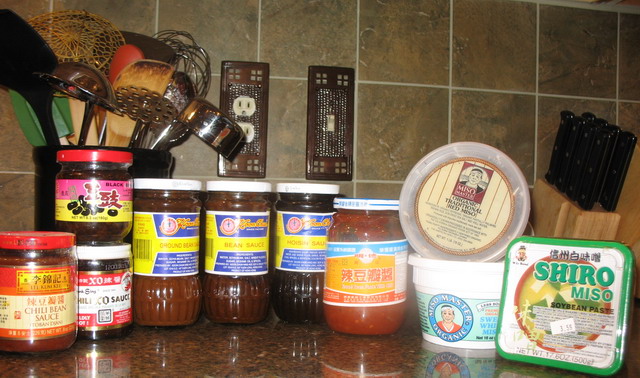
Let’s start with miso. Made of soybeans, rice and/or barley, and salt that has been inoculated with Aspergillus oryzae, a mold, miso becomes a protein-rich paste that varies widely in color and flavor depending upon the ingredients used, the length of fermentation, how finely the ingredients are ground before fermentation, and how the paste is treated after fermentation. The most commonly found miso pastes in the United States are the pale, mild and slightly sweet shiro miso (shiro means “white”), and the darker, saltier, more robust aka miso. (Aka means “red”.) Hatcho miso, which originated in the town of Hatcho, is also becoming more common in the United States–it is aged for three years and has a very complex, smoky flavor. There are even lower-sodium versions of miso now available; Miso Master, a company in California that makes organic, hand-made misos, has a very delicious lower sodium shiro miso that I like a great deal.
Miso is most often encountered by Americans in miso soup at sushi bars, and, in truth, much of it is consumed that way in Japan as well. However, it is also used as an ingredient in pickle-making, in marinades for grilled and broiled fish, meats and vegetables, and in stews. It is a very versatile condiment, and is highly nutritious, being filled with protein and B vitamins.
Miso-making, however, did not originate in Japan. Historians believe that the method of making fermented soybean paste came from China in the seventh century. In China, fermented soybean paste, called chiang, had been made for thousands of years. Once chiang came to Japan, however, the methods and materials for producing it diverged and miso developed into a distinct, differently-flavored condiment.
The Chinese are said to have learned how to make chiang from the Koreans who called it “jang.” I know very little about Korean foods, however (it is one of my next realms of study), so I will move on to the various different types of fermented soybean pastes used in the Chinese kitchen.
Hoisin sauce, sometimes also called “sweet bean paste,” is probably the most familiar variety of fermented soybean paste to Americans. Heavily sweetened with sugar and seasoned with vinegar and garlic, hoisin sauce is a thick, nearly black paste that is sweet, tangy and savory all at once. It is used both as an ingredient, and as a table condiment; it is used to moisten and sweeten the pancakes served with Peking Duck and mu shu. It is featured in many familiar dishes, including some versions of Kung Pao, and the marinade for char sui. The brand I have used for years is Koon Chun from Taiwan, which comes in a shapely jar with a yellow, blue, white and red label that is printed in Chinese on one side, and English on the other.
Bean sauce or ground bean sauce are my favorite of the Chinese fermented soybean pastes, and I think they are the most versatile. A medium brown in color, the only difference is that the ground bean sauce is pureed into a thick, smooth paste, while the plain bean sauce is chunkier; they both contain the same ingredients: soy beans, salt, wheat, sugar, sesame oil and unidentified spices. Salty and robust, these sauces are similar in flavor to aka miso, but are not as sharp or as obviously saline in nature. They are used as the main flavoring ingredient in many dishes, including ja ziang mein and bean sauce chicken. Just a teaspoon or so added to a marinade or a sauce adds a great boost in flavor that is delicious, yet mysterious, particularly if you are unfamiliar with it as an ingredient. Once again, I prefer the Koon Chun brand.
Broad bean paste with chile is a Sichuanese ingredient that is a necessity in my kitchen. It is what gives Sichuan Red Cooked Beef with Turnips and Ma Po Tofu their distinctive brick red color, strong tangy flavor and chile heat. Made from a mixture of fermented soybeans, broad beans and wheat, then seasoned with salt, sesame oil and chiles, the scent and flavor of this paste is very unique. It has a pleasant alcoholic mustiness that is difficult to decribe otherwise. But it is what gives many Sichuanese dishes their very strong flavor, and using chile garlic paste as a substitute does not work. The brand that I favor comes from Taiwan and is made by the Ming Teh Food Industry Company. It has a yellow, red and blue label with a globe on it and very little English lettering. It is often hard to find, so I can also recommend the more readily available Lee Kum Kee brand.
There are many other brands and types of Chinese fermented soy bean pastes out there. I just highlighted the three most useful and versatile of them, which are nearly always present in my kitchen, along with some recipes where they are necessary to create a distinctive flavor.
And now, I will give you a recipe that uses all three Chinese fermented soybean pastes in one dish; it is a variation on Ja Jiang Mein, but is sweeter, and utilizes more vegetables and tofu than the original recipe did. I also spiced it up considerably by adding five Thai bird chiles to the ginger, garlic and onions that traditionally flavor the noodles of Beijing.
I call the dish, “King Du Noodles,” after a similar dish made at the Hometown Deli and Carryout restaurant in Columbus, Ohio, which is one of the two places we always stop for Chinese food when we visit.
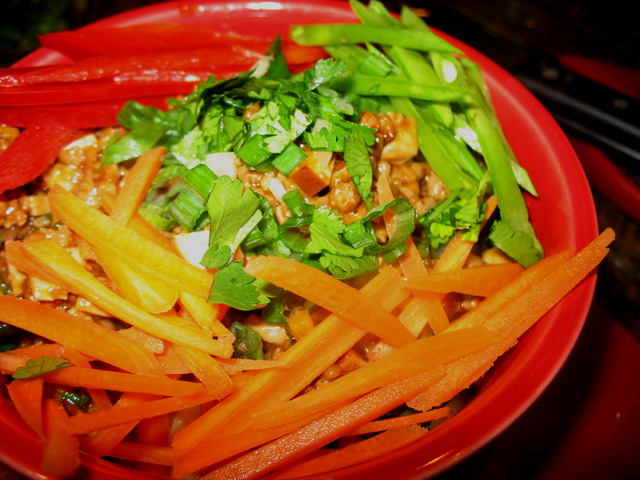
King Du Noodles
Ingredients:
2 tablespoons peanut oil
1 medium onion, diced finely
2″ cube fresh ginger, minced
5 garlic cloves, minced
3-6 Thai bird chiles sliced thinly
2 fresh or dried rehydrated shiitake mushrooms, diced
8 ounces pressed spiced tofu, diced finely
3/4 pound ground or minced pork
1 tablespoon hoisin sauce
1 tablespoon Sichuan hot bean sauce (broad bean paste with chiles)
1 tablespoon soy bean sauce
1 teaspoon sugar
1 teaspoon freshly ground Sichuan peppercorns
1 teaspoon freshly ground pepper
3 tablespoons Shao Hsing wine
1/2 cup chicken broth
1 1/2 tablespoons cornstarch dissolved in 1 tablespoon chicken broth
1/2 cup sliced scallion tops
1 cup loosely packed cilantro leaves, roughly chopped
1 teaspoon sesame oil
1 cup shredded carrot
1 cup shredded snow peas
1 red sweet bell pepper, shredded
1 pound fresh egg noodles, cooked al dente and drained
Method:
Heat wok until a thin wisp of white smoke coils up from it. Add oil and heat until it shimmers. When it is ready, add onions and cook and stir until they are just beginning to take on color. Add ginger, garlic, chiles, and mushrooms and stir fry until fragrant–about forty-five seconds or so. Add pressed tofu and continue stir frying another minute.
Add pork, soy bean pastes/sauces, Sichuan pepper, pepper and sugar, and stir fry, chopping at the meat to separate it with your wok shovel. Cook until most of the pink is gone from the meat.
Add wine, cook off alcohol. Add chicken broth and cornstarch mixture, cook, stirring, until thickened. Add sliced scallion tops and cilantro, stir to combine.
Remove from heat, drizzle with sesame oil.
Divide noodles into bowls, and top with meat sauce and vegetable shreds.
Announcing The Spice is Right #1:
Yes, I have finally cogitated upon the matter of the recurring spice-blogging event enough and thus come to a few conclusions.
It will occur monthly.

The deadline for entries will be on the 15th day of every month, meaning that for the first challenge, which will be in April, you will have extra time to think about it. I will announce the next month’s theme on the 15th of every month, here, as well as on the Food Blog Skool calendar and at IMBB, so you have several places to go to find out what is next in the queue of challenges.
The deadline is for you to send your entry to me by email–not a specific day you must post about your entry. I like the way Meena has arranged her “From My Rasoi” event, where sometime during the month, when you get around it and it fits your dinner schedule, you post your theme-perfect entry, and then by, on or before the deadline, you send her your emailed entry. This sort of flexibility I think is admirable and will help a maximum number of people join in the fun.
This is for fun, but I may choose winners and offer silly prizes now and again, and have guest judges so it isn’t just me and my own biases at play (or at work).
The Rules:
Every game has to have rules and food blog events are no exception, so here we go:
1. Email me your entry with your name as you want it to appear on the round-up, the url to the entry and a photograph, if you want me to use one, on or before the 15th of every month so I can do an efficient round-up post. Your post can occur wherever you like in the month–I don’t care when, just send it to me on, by or before the 15th at helgardeATgmailDOTcom. Include a link back in your entry to this post announcing “The Spice is Right” so that if other folks read it and want to play, they know where to go to find the rules. One entry per blogger, please. If you have no blog–email me a photo and a description and I will include you in the roundup anyway. (Or, be like the rest of us food-obsessed geeks and start a blog!)
2. The photo should be scaled to the following size: 1 inch width by .75 inch height and 72 dpi (pixels/inch) so that I don’t have to play around with sizes and whatnot. (Thank you Amy of Cooking With Amy for this idea!)
3. Your entry should include some background about the spice you have chosen to highlight. Whether this is something you learned from books, or that was passed down from your grandma or is from your own experience, tell us about it. Tell us why you chose this particular spice to highlight on this particular month. Describe how it tastes, and why you like it.
4. The recipe does not have to contain only the one spice you are posting about, however, the flavor of that spice should predominate. Say, you have chosen cardamom, and want to post an Indian dish featuring it. You could choose kheer–Indian rice pudding–which is predominately flavored with cardamom, which is fine, but you could also choose sindi elaichi murgh— a dish which has other spices in the masala, but the cardamom flavor soars above the other flavors, supported by their presence.
5. Finally, the definition of a spice that we will be using for the purpose of this event is as follows: “Any aromatic substance, fresh or dried, that is derived from the root, rhizome, bulb, bark, woody stem, flower, fruit or seed of a plant that is used to flavor foods.” You will notice that I left yout soft stems and leaves–that is because those are herbs. I didn’t want to step on Kalyn’s toes with her Weekly Herb Blogging event at Kalyn’s Kitchen. I am also not counting minerals, such as salt, as spices, though we may have a special “salty” edition of the “Spice is Right” challenge someday in the future.
So, I think that is enough in the way of rules–maybe I should announce the theme for April’s “The Spice is Right” Challenge:
The theme will be (drumroll, please) “Ancient Spices.”
You can take that to mean anything you want it to mean. It can mean spices that were used in the ancient world, that aren’t used so much anymore. You can interpret it to mean the can of curry powder you have in your cupboard from 1962. You can take it to mean a spice that has a very long history of use. You can use an old recipe that is written in Middle English that features your chosen spice. The field is wide open.
I look forward to hearing from you all!
Soy Sauce: A Primer on the Types, Functions and Flavors of the Quintessential Condiment
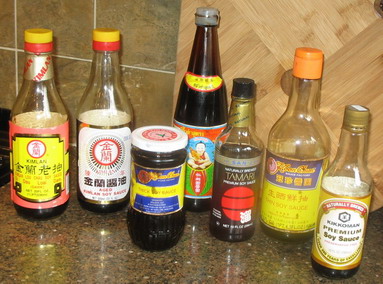 One thing that tends to shock newcomers to Asian cooking is the seemingly endless array of soy sauces on the shelves of the local Asian market. Which ones to buy? What are they all used for? Are they all different, or the same, or what?
And most often: Why are there so many?
And then, when a novice cook takes up, say, Chinese, cuisine, they are perplexed to find that they can’t just pick out one brand or one type of soy sauce and use it in every dish. This is not how Chinese cooks operate, and that is the first glimpse many Westerners get of the fact that yes, indeed, each of those soy sauces in the store are different, and they are used for different purposes in the kitchen.
This doesn’t end the confusion many feel upon looking at the soy sauce aisle: if anything, this realization often deepens the angst.
So, here I am, to try and ease the difficulty a bit for those who want to cook good Asian food, but aren’t sure what soy sauce or sauces to buy for what purpose.
Before I begin, let me tell you a bit about my own personal bias–I tend to cook primarily Chinese foods, so the soy sauces in my collection are weighted toward being Chinese in style and origin. I do have a couple of Japanese soy sauces for when I make Japanese or Korean foods, and I have one bottle of Thai black soy sauce, but the rest of the soy sauces in my kitchen are Chinese in origin. Since I know the most about Chinese foods, that is the perspective I am bringing to this discussion.
Which is fine, because it is the Chinese recipes which seem to be the most apt to require the cook to have multiple types of soy sauce on hand, and it has invariably been Chinese recipes that require more than one kind of soy sauce that has caused readers to ask, “Do I really have to have two different kinds of soy sauce for this?”
My answer has almost always been a qualified yes, because over the years and in my experimentation in cooking Chinese foods, I have found that the tradition of having multiple kinds of soy sauces for different flavor and color effects really does lead to more versatility in the kitchen.
Chinese Soy Sauces can generally be categorized into three types. Light or thin soy sauce, dark or thick soy sauce and thick soy sauce, or soy jam.
Light or thin soy sauce is most like the soy sauce that Americans think of when they think of soy sauce: Kikkoman’s. It is made by the fermentation of wheat and soybeans, and is salty, but not intensely so. It is dark brown, but when you swirl the liquid in the bottle, you can see that it is very thin–it has no “legs” meaning that it doesn’t cling to the side of the bottle when it swishes. It runs right back down. It is a good, general purpose sauce that is used to cook light-colored and flavored foods such as seafoods, chicken, some pork dishes and vegetables. It is used when a paler colored sauce is desired for a stir-fried or braised dish or to make a pale broth in a soup. It has a clean, salty with a slight tang,
Dark or thick soy sauce is made the same way that light soy sauce is made–as a fermentation of soybeans and wheat, but some caramel or molasses is added to the sauce when it is finished brewing. This results in a darker, more reddish color, and a sweeter, more complex flavor. The sugar in the mixture also gives dark soy sauce a lot of body–if you swirl it in its glass bottle, you will see it clings a great deal more to the sides than thin soy sauce, dripping down slowly and leaving “legs.” It is used primarily in stronger flavored preparations, sometimes on its own, and sometimes in combination with light soy sauce. It is part of what gives “red braised” dishes their deep brick-colored sauces, and is used to flavor beef, pork, duck and some chicken dishes.
Thick soy sauce, or soy jam is not the same thing as dark soy sauce. In my kitchen and when I teach classes, I call it “thick soy sauce” and the other “dark soy sauce” to differentiate between them, but many authors call them interchangably by the same name. Thick soy sauce has much more molasses in it than dark soy sauce, and is used primarily as a coloring agent in restaurants for fried rice. A scant half-teaspoon is all that is needed to color a full wok of fried rice a toasty brown color; to try and use liquid soy sauce to get the same effect would require so much that the rice would become so salty as to be inedible. Also, because of the high molasses content of thick soy sauce, it can be used to sweeten various dishes, especially ones that are braised. Thick soy sauce is always sold in jars; it is too thick to easily flow from a bottle.
Of course, there are Japanese soy sauces; Americans are most familiar with the Japanese style soy sauce, Kikkoman’s. To my taste, Japanese soy sauces, also known as shoyu, are cleaner in flavor than Chinese soy sauces. The Chinese versions all seem to have very complex fore- and aftertastes, while the Japanese shoyu is a much more pure flavor that to me tastes saltier. There are many different grades and kinds of Japanese shoyu; some are so fine that they are only used uncooked as dipping sauces, while others are quite rustic.
Tamari is a specialized Japanese shoyu that is made completely from fermented soybeans without the addition of wheat. It has an even purer flavor than shoyu with wheat, but doesn’t taste as salty to me. I always recommend that people who have gluten sensitivities or celiac disease use this for all soy sauce applications, though I myself use it very infrequently.
Thai black soy sauce is a very thick, dark sauce filled with additional molasses. It is somewhere in between Chinese dark soy sauce and thick soy sauce in texture, flavor and color, though to my taste it is sweeter than either of them. It is used in place of fish sauce by many Thai vegetarians, though I myself tend to prefer the flavor of fish sauce.
There are many other different kinds of soy sauces available to cooks. There are specialty flavored sauces such as “mushroom soy,” which is flavored with extracts from dried shiitake mushrooms, and “spice sauce” which is a dark soy sauce which has garlic and various spices such as star anise and pepper steeped in it. Then there are also the soy-sauce based condiments and sauces of Japan, like teriyaki, which is a mixture of shoyu, mirin (a sweet rice wine) and sugar, or ponzu, which is a mixture of shoyu, citrus juice (often lemon), rice vinegar and bonito flakes or stock. Though one can buy them in the market, I prefer to make these derivatives of shoyu on my own to my own taste.
My advice for buying soy sauces is this: buy the best you can afford and make certain that it is naturally brewed. The naturally brewed ones will say so prominently on their labels, and they have superior flavors, which translates to better cooking in your kitchen. If you are cooking Chinese food, go ahead and buy both thin and dark soy sauces, and thick soy sauce only if you intend to make fried rice and want it to look like the versions made in restaurants. (Homestyle fried rice is pale; few Chinese home cooks use the thick soy sauce as a coloring agent for their fried rice.) The different types of soy sauces don’t cost much and they really go far in bringing an authentic flavor to your cooking.
My last bit of advice is this: if you are cooking Chinese foods, use Chinese soy sauces, and if you are cooking Japanese foods, use Japanese soy sauces. I don’t mix the two; the flavors never come out right when I do. In fact, I can usually tell when I go to a pan-Asian restaurant, if the cook is Chinese or Japanese by the way their stir-fried foods taste. Japanese versions of Chinese dishes always taste distinctly Japanese, often, I believe, because of the use of Japanese soy sauce. It may just be me, but I can taste the difference between the two styles of soy sauce, though I have had enough Chinese-Americans agree with me on this that I think I am not the only “soy sauce geek” in the world!

Categories:
- Admin (rss) (55)
- Blogs and Blogging (rss) (81)
- Book Reviews: Cookbooks (rss) (43)
- Book Reviews: Non-Cookbook Food Books (rss) (38)
- Cats and Cat Blogging (rss) (47)
- Chinese Cooking Lessons (rss) (32)
- Culinary School Stories (rss) (18)
- Dairy Pruducts: Cultured and Barbaric (rss) (4)
- Documentary Filmmaking (rss) (1)
- Essays, Rants and Reflections (rss) (260)
- Fighting Hunger (rss) (12)
- Food and Kids (rss) (45)
- Food in the News (rss) (126)
- Food Media (rss) (98)
- Food Preservation (rss) (18)
- Food Safety (rss) (45)
- Gardening (rss) (30)
- Herbs and Herb Blogging (rss) (20)
- Holidays (rss) (50)
- Kat Blogging (rss) (22)
- Kitchen Science (rss) (36)
- Leftover Makeover (rss) (8)
- Life, the Universe and Everything (rss) (131)
- Local and Sustainable (rss) (227)
- Local Athens Food and Foodies (rss) (42)
- Meatless Mondays (rss) (32)
- Menu For Hope (rss) (5)
- Nutrition, Diet and Health (rss) (84)
- On The Farm (rss) (8)
- Recipes: Almost Vegetarian, Vegetarian and Vegan (rss) (294)
- Recipes: American Regional (rss) (37)
- Recipes: Appalachian Hillbilly (rss) (33)
- Recipes: Bread, Pasta, Grains (rss) (95)
- Recipes: Canning and Preserving (rss) (8)
- Recipes: Chinese (rss) (123)
- Recipes: Comfort Food (rss) (120)
- Recipes: Cookies (rss) (16)
- Recipes: Desserts (rss) (48)
- Recipes: French (rss) (25)
- Recipes: Fruits and Vegetables (rss) (302)
- Recipes: Greek, North African and Middle Eastern (rss) (31)
- Recipes: Indian (rss) (137)
- Recipes: Italian (rss) (42)
- Recipes: Japanese (rss) (7)
- Recipes: Jewish (rss) (4)
- Recipes: Korean (rss) (6)
- Recipes: Meat, Poultry and Fish (rss) (220)
- Recipes: Mexican/Native American/ Latin American/Caribb (rss) (27)
- Recipes: Original (rss) (108)
- Recipes: Thai (rss) (27)
- Recipes: Tofu (rss) (17)
- Recipes: US Regional (rss) (16)
- Recipes: Vietnamese (rss) (8)
- Restaurant Stories (rss) (28)
- Sewing, Quilting, Arts and Crafts (rss) (16)
- Simple Chinese Recipes (rss) (30)
- Slow Food and Heritage Foods (rss) (10)
- Spice Blogging (rss) (44)
- The Chinese Cookbook Project (rss) (14)
- The Chinese Pantry (rss) (39)
- The Documentary (rss) (2)
- The Kitchen Saga (rss) (17)
- The Locavore's Bookshelf (rss) (15)
- The Unsung Adventures of The Culinary Nerd (rss) (6)
- Tools and Toys (rss) (35)
- Uncategorized (rss) (10)
- With a Side of Politics (rss) (48)
Archives:
- August 2012 (9)
- July 2012 (12)
- September 2011 (3)
- August 2011 (7)
- July 2011 (8)
- June 2011 (16)
- May 2011 (17)
- April 2011 (11)
- December 2010 (9)
- November 2010 (5)
- February 2010 (1)
- December 2009 (5)
- November 2009 (7)
- October 2009 (10)
- September 2009 (16)
- August 2009 (14)
- July 2009 (14)
- June 2009 (7)
- May 2009 (17)
- April 2009 (10)
- March 2009 (25)
- February 2009 (13)
- January 2009 (10)
- December 2008 (5)
- November 2008 (5)
- October 2008 (6)
- September 2008 (13)
- August 2008 (8)
- July 2008 (11)
- June 2008 (18)
- May 2008 (13)
- April 2008 (14)
- March 2008 (16)
- February 2008 (17)
- January 2008 (19)
- December 2007 (25)
- November 2007 (18)
- October 2007 (24)
- September 2007 (16)
- August 2007 (15)
- July 2007 (15)
- June 2007 (10)
- May 2007 (14)
- April 2007 (16)
- March 2007 (17)
- February 2007 (20)
- January 2007 (13)
- November 2006 (1)
- October 2006 (8)
- September 2006 (14)
- August 2006 (25)
- July 2006 (30)
- June 2006 (28)
- May 2006 (34)
- April 2006 (29)
- March 2006 (24)
- February 2006 (30)
- January 2006 (38)
- December 2005 (40)
- November 2005 (37)
- October 2005 (32)
- September 2005 (25)
- August 2005 (30)
- July 2005 (28)
- June 2005 (21)
- May 2005 (8)
- April 2005 (22)
- March 2005 (17)
- February 2005 (29)
- January 2005 (10)
Search Site:
Links:
- Lily’s Wai Sek Hong
- 101 Cookbooks
- A cat in the kitchen
- A Veggie Venture
- Accidental Hedonist
- Cha Xiu Bao
- chez pim
- Chocolate & Zucchini
- Chopstick Cinema
- Chowhound.com
- Chubby Hubby
- Cook sister!
- Cooking with Amy
- da*xiang
- Eat Local Challenge
- Eating Liberally
- Ecocentric
- Eggbeater
- Epicurious
- Farmgirl Fare
- Fatfree Vegan
- Foodgoat
- ForkandBottle.com
- Green Olive Tree
- Hooked on Heat
- Jaden’s Steamy Kitchen
- Kalyn’s Kitchen
- Lucullian delights
- Mahanandi
- Matt Bites
- MeatHenge
- mmm-yoso!!!
- New York Times – Dining & Wine
- Pizza Goon
- Rasa Malaysia
- Ruhlman
- Sailu's Kitchen
- Serious Eats
- SF Gate: Food & Dining
- Simply Recipes
- Soul Fusion Kitchen
- Tastespotting
- The Amateur Gourmet
- The Cleaner Plate Club
- The Food Section
- The Grub Report
- thecookscottage
- U.S. Food Policy
- Wandering Chopsticks
- Washington Post Food and Dining
- Wasted Food
Meta:


Powered by WordPress. Graphics by Zak Kramer.
Design update by Daniel Trout.
Entries and comments feeds.