
Cook Local, Eat Global
Local Tomatoes Stuffed With Mediterranean Rice Salad: Recycle, Reduce, Reuse
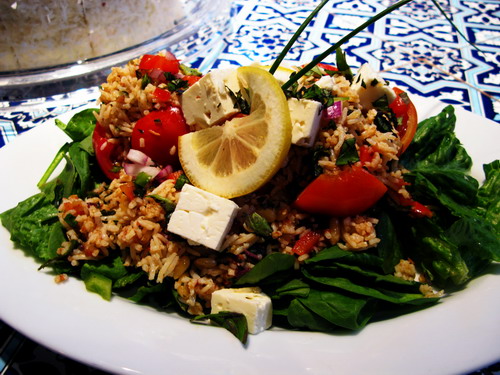
At Restaurant Salaam, we use a lot of basmati rice; it is the main starch which accompanies our curries, our kofta and dals. Twice, sometimes three times a day, we fill up our large electric rice cooker with basmati and water and in about twenty-five minutes we have perfectly fluffy, steaming hot rice.
Which is wonderful, because cooking it is a no-brainer for all of us; the rice cooker does all of the work.
But sometimes, particularly during the summer months, business is unpredictable, and we will have a large amount of cooked rice left over at the end of a shift.
Even if we were not dealing with rising food prices and food shortages around the world, I am loathe to waste any perfectly edible food, so I am constantly working to come up with new and different ways to use cooked rice.
My new favorite is to make a salad from it, and use it to stuff ripe, juicy local tomatoes.
The version pictured here has feta cheese on top, but the truth is, you could leave that out and have a wonderful vegan entree. Even so, as a vegetarian entree, the rice and tomato salad sold out last Friday night when I ran it as a special–it tasted so good you would never know that I put it together to use up leftover cooked rice.
To make it, I broke up the clumps of rice so that it all fell apart into individual grains, and then seasoned it with chopped raw red bell pepper, scallions, chopped Kalamata olives, Aleppo pepper flakes, finely diced red onion, toasted pine nuts, finely chopped parsley and lots of fresh basil. I also mixed into the dish leftover cold squash and eggplant simmered with onions, garlic, sweet peppers and tomatoes which I chopped roughly in the food processor. (You could use leftover ratatouille for this purpose, or just saute lots of onions and garlic, then add sliced green and red bell peppers. Finally add chunks of eggplants and squash and cook for a few more minutes before adding fresh or canned tomatoes and salt and pepper to taste.)
Then, I seasoned the rice salad with a simple lemon and olive oil vinaigrette, and let it chill.
The tomatoes were large fresh ones that I cored and then cut into quarters by cutting in a cross shape from the top almost all the way to the bottom. That way, the tomatoes fell open in a flower-shape, and that is where I stuffed the rice salad.
To assemble the salad, I used a mixture of baby spinach and romaine lettuce as the base of greens. Over that, I put a generous scoop of the rice salad, which makes a nest for the tomato to rest in–it keeps it from rolling around on the plate. Then, I put the tomato on top, stuffed it with another couple of scoops of rice salad, sprinkled it with feta cheese and then garnished it with a mixture of finely diced green and red bell peppers and red onion, a lemon twist and some chopped basil. I put a little bit of the same lemon olive oil vinagrette that I used in the rice in a cup on the side, and the dish was done.
I was clever and made up a salad to keep on the bar for the servers to carry to each table as a visual example of what the special looked like. The beauty of it is what sold it, and people loved it. It was light, yet still satisfying and was perfect for a hot, humid late-July night. It was also easy to make and a great way to use up rice that might otherwise have gone to waste–something which I hate to see happen.
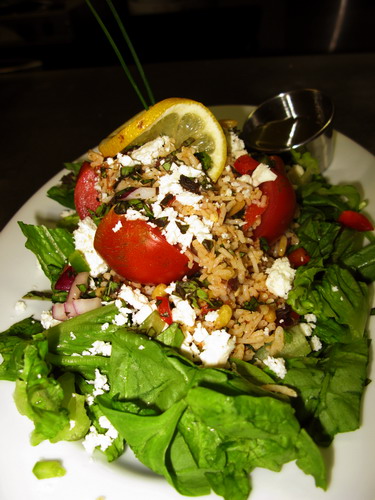
Local Tomatoes Stuffed With Mediterranean Rice Salad
Ingredients:
5 cups cooked cold basmati or other rice
1/2 cup finely diced red bell pepper
1/2 cup finely diced red onion
1/2 cup thinly sliced scallion
1/2 cup minced fresh parsley
2 cups packed basil leaves, minced
1 cup kalamata olives, roughly chopped
1/2 cup toasted pine nuts
1/2 cup ratatouille or just eggplant and squash cooked with tomatoes, chilled and half-pureed in food processor (optional)
1/2 cup lemon juice
1 1/2 cups olive oil
1/2 teaspoon salt
1 tablespoon Aleppo pepper
1 teaspoon minced fresh mint
black pepper to taste
5 or 6 large tomatoes, cored and cut into quarters almost to the bottom of the tomato into a flower shape as explained above
1 pound mixed salad greens
5 ounces feta cheese, crumbled
1 cup mixed finely diced red and green bell pepper and red onion
thinly sliced lemon
finely minced fresh basil
Method:
Break apart any clumps in the rice and put it into a very large mixing bowl.
Add bell pepper, onions, scallions, parsley, basil, olives, pine nuts, and ratatouille, and using your hands, mix together until everything is evenly distributed.
In a separate bowl, whisk together lemon juice, olive oil, salt, Aleppo pepper, mint and black pepper, and when it is emulsified, pour 2/3 of the vinaigrette over the rice salad. Mix with your hands to combine again, then cover and chill in the refrigerator.
Let tomatoes come to room temperature.
On each serving plate, place a mound of greens, then a mound of rice salad. Put one of the cut tomatoes on top of the rice salad and then fill the hollow of the tomato with more rice salad, mounding it up. Sprinkle with feta cheese, and then garnish with sprinklings of the pepper and onion mixture and the basil, and top the rice mound with a lemon twist.
Assemble all five salads the same way, and pass remaining vinaigrette for each diner to drizzle over the salad as they choose.
Adventures in Restaurant Life (Or, Why Some Chefs Go Postal)
This is a post that The Food Whore could have written, and which I have avoided writing for a while because she has the “funny stories about weird restaurant patrons and catering clients” genre down to an art.
But people seem to have an endless appetite for tales on the myriad sorts of weirdness that restaurant workers are exposed to every day. I guess that Anthony Bourdain’s Kitchen Confidential whetted everyone’s appetites for true stories of what happens behind the kitchen door in America’s restaurants, and people never seem to grow wearing with hearing of the antics that occur in and around restaurants. Many of the stories are about customers, to be certain, but the genre is not limited to the (rightfully) cranky vent-fests like you find on Waiter Rant, where we learn about the disgusting dining habits and obnoxious entitlement issues that a certain segment of the restaurant-going public feel the need to exhibit every time they sit down in a dining room.
Nor are all of the stories about the after-hours fun and frolic that kitchen staff and front-of-the-house folks get into when the cleaning is done, the lights are off and the doors are locked. As entertaining as those stories are, you don’t need to read my blog to get those–Bourdain’s writing on the subject is the standard–and my own experiences of the sort are not quite so fascinating that you need to hear them. (Yeah, when I was a young waitress, I drank a lot, and like the rest of the employees much of my inebriation was courtesy of alcohol filched from the restaurant’s bar. And yeah, I watched a lot of folks take a lot of drugs, but I was a boring little girl and stayed clean of that. As for the sex–I do not kiss and tell, nor do I tell other people’s sexual exploits. Those stories are for them to tell, and none of the stories from my wild and wicked youth are that interesting anyway.)
So, what the hell am I writing about if I am not talking about how awful some diners can be, or the freakishness of the restaurant lifestyle and how it affects the social deviants who live it. (Unlike Bourdain, I don’t think that everyone who works in restaurants is terminally messed up, although I have to say he is right–a large number of us are just a little bit on the, uh, how shall I say it, odd side. Most chefs are control freaks, a lot of line cooks are line cooks because they just cannot make it in a regular 9 to 5 job for whatever reason, savory or unsavory, and a lot of bartenders, servers and front of the house folks do drink a lot–but then, if you had to put up with people snapping their fingers at you to get your attention, and verbally harassing you because the food is just not perfect, or sexually harassing you or laying their hands upon your person because they get the idea that because you serve them food, you are there to cater to their every need–if you had to deal with that, you might well drink a hell of a lot, too.)
(OK. Maybe Bourdain is right. Maybe restaurant people are all bonkers. We’d have to be to put up with the weird shit that happens to us daily.)
So, what am I talking about?
I am talking about The Pantsless Douchebag, from here on out to be known by the initials TPD.
I can hear the “What?” from here. Let me elaborate.
Here’s the deal: Restaurant Salaam is located off of the main street of Athens, down a little brick alley, and you have to step down a set of stairs when you enter the door. We are literally, underground, and when you come in the door, it is like entering another world. There is the aura of some hybrid of a 1920’s speakeasy and a harem straight out of the tales of Scheherazade. And since we serve primarily Middle Eastern, Moroccan and Indian food, it is only natural that in this little place that is filled with beaded curtains, gurgling fountains, jeweled pillows, mirrors and flickering candle lanterns, which is scented with the fragrance of spices from all over the world, we have a belly dancer in on Saturday nights, and sometimes, a live drummer.
Two dancers perform on alternate weeks, and both Anoushka and Leah are gorgeous and graceful, and our customers love them, as do all of the rest of the Salaam family. And I have never seen anyone in our restaurant behave in any way which could be construed as disrespectful to either of them, which is pretty remarkable, because Middle Eastern dance still has a somewhat tawdry reputation among people who do not understand that there is a big difference between it and pole dancing.
In case any readers don’t know this, I am going to state it up front: belly dancers are not sex workers. They are not exotic dancers. They do not take off their clothes as a regular part of their performances. As sexy as Middle Eastern dance is, and as gorgeous as the dancers are, it did not originate as a dance to titillate or excite male viewers. It began as a dance imitating the throes that women go through in childbirth, and originally, it was done by women for other women. And yes, it is a dance that embraces women’s sexual nature, but that doesn’t mean that it is also not art, nor does it mean that there is anything shameful about the dancers who master it.
So, now that I have given you more background on belly dance than you ever thought you’d need, let me tell you about Mr. TPD–remember him?
This past Saturday, it was quiet. Very quiet. Apparently, everyone who was going to eat out that weekend had gone out the night before, and the kitchen staff at Salaam were dying of boredom, and eating bits and pieces of everything in order to pass the time. The dining room staff was equally sad, and when Leah, and my friend Dan, who has been drumming for our dancers off and on for a few weeks, showed up, they were confronted by a nearly empty dining room.
And when Leah danced, even with Dan drumming, she was greeted by a vast round of indifference. (And for a group of people to be indifferent to Leah is amazing to me–she generally has no trouble getting people to pay attention to her.) There was a dance professor from OU who was nice to Leah, and who watched attentively and tipped her well (we put out a tip jar for the dancers on our counter and most of the time they do very well with tips from our customers), but other than that, it was just deadly dull.
I was back in the kitchen when this happened, but apparently, Leah said she used to dance out on the sidewalk at the end of the alley in order to bring in customers, so she and Dan went out to see if they could literally drum up business.
And it seemed to work–two small parties (a two top and a three top) came in, and all was well.
But even as we sent out the appetizers for these tables, I had a bad feeling. A disturbance in the force, I guess you could say. So, I walked out and asked where Leah and Dan were, and was told by Kim that they were outside.
And I just knew I had to go out and check on them.
Just as I walked outside, I saw the door to the bar across the street open, and an entire gaggle of drunk young men staggered out and commenced to goggle and catcall at Leah.
One came across the street as I stepped out of the shadows of the alley and stood at Dan’s shoulder, waiting. This guy danced with Leah, but stayed well out of her personal space. He lifted his shirt and did belly rolls in imitation of her, and even managed a hip roll or two. Sure, he had to show off his nipples, but he was basically just having fun, and didn’t worry Leah or anyone else in the slightest.
But, then, another one started wriggling his way across the street. I noticed instantly that he was barefoot, and glanced down at my Dansko clogs, and filed away that information for possible future use in the back of my brain while I watched him warily.
Unlike the first guy, this one was all up in Leah’s stuff. He, too, raised his shirt, and writhed rather incompetently, while saying such sweet nothings as, “Get wild, baby, get wild, yeah!” Leah kept darting away, while still dancing, and I kept my eye on the other seven guys who were still across the street, watching and calling out encouragement to TPD who kept circling Leah, getting closer and closer. Dan kept playing, although, as he said later, he was ready to whack the guy with his aluminum doumbek if need be.
I stepped closer, just as TPD dropped his pants, and shimmied his hips right up against Leah, all but humping her. Lucky for him, he was both wearing boxers and he did not even brush up against Leah (but that is because she moves fast), because if either of these conditions had not been met, he would have learned to his detriment how fast the Chef in Black can move, and how nasty she can be to drunken assholes who think it is their right to put their hands on a woman without her permission.
At that point, Leah stopped dancing and Dan stopped drumming, and she turned on her heel and walked quickly back to the restaurant, Dan right behind her. As he passed me, I muttered to him, “Get Leah out, I’ll deal with these guys.”
TPD and his more sober friend tried to follow Leah and Dan, but I was between them. He kept calling after Leah, “What do I need to do, baby, what did I do wrong, hey, what happened, I thought you were getting wild!” His friend, the first dancer, the one who had a sense of personal space and decency, said, “Man, I can’t believe you dropped your drawers,” as he picked up said drawers and stalked after him, shaking his head.
I stayed between the two of them and the door, and would not let TPD in the restaurant, even as he tried to follow Leah.
“Can I go in?” he pleaded, “What do I have to do to see more–buy some french fries? Pizza?”
“We have neither,” I answered, as I sized up my possible opponent. I decided quickly that a bare foot crushed under my Dansko clog was my first move, in the case TPD tried to move past me and go into the restaurant. If that did not stop him, I figured an elbow to the undefended gut would make him bend over, putting his chin in line with my knee. (Yes, I have had martial arts training, along with lessons in the quick and dirty art of street fighting.)
TPD did try to get past me to open the door, but I was too fast and kept getting in his way, and I kept him talking. “What do I need to do? I want tog et wild.”
“What you need to do is put on your pants and leave,” I answered calmly, never letting on that his foot was in danger of being broken if he so much as laid one finger on me or that door.
“But I want to see more–do you guys get crazy in there?”
I sighed. “She isn’t a stripper. She is a dancer, but she doesn’t take off her clothes. Not now, not ever, and not in my restaurant. Now, please, put on your pants and go about your business somewhere else.”
He looked crestfallen, and then I realized that he was likely not going to be touching me or the door anytime soon, so I relaxed a notch. His friend kept telling him, “Would you just put your damned pants on–the lady doesn’t want to see your drawers, now take them and put them on, dumbass.”
TPD looked at me pitifully and said, “Can I step in so I can put on my pants?”
I gave him a glare and said, “You took them off on the street, and so as far as I am concerned, you should be able to put them back on in the street, but I will be nice this once.”
I backed into the restaurant, let him duck in, and blocked the stairway. (Leah saw him come in, and got a bit freaked that he was coming after her. My quick thinking daughter/line cook, Morganna, grabbed Leah and hustled her to the back, and said, “You disappear–let Mom deal with him. She won’t let him touch you–trust me.)
He struggled to put on his pants–apparently they come off easier than they go on, and said, “I thought she was getting wild, I’m sorry, I didn’t oh, I, uh, can I come in for dinner?”
I looked down at his bare feet and still pantsless self and said drily, “Not without pants or shoes, you cannot come in and eat dinner. We have standards here.”
He finally got his pants up and before he could step forward, I did, and essentially, got him to back right back out the door into the alley. “Can I please come in?” he asked. “No,” I said. “You don’t have any shoes, and you don’t even know where your shoes are, so why don’t you just run along now and find something else to do with yourself.”
He did finally shuffle off, finally, but his friend stayed behind and apologized for TPD.
It turns out that his friend is a hotel and hospitality major, and had heard how good our food was and had been meaning to come in and eat, but hadn;t yet. When he found out that I made Thai food, particularly on weekends, he asked if he could bring in his buddies with some Thai beer and eat, and I said, “So long as they keep their pants on and their hands to themselves, you are all welcome. But if they lose any clothes or touch one our dancers or servers or are verbally abusive, I and my kitchen crew will come out and ask you to leave, and if you don’t leave for us, the police will come and take you out. Do you understand?”
He smiled, and said, “Yes, Chef. I promise that if I bring my boys in they’ll act like they’ve got manners.”
We shook hands, and I said, “I’ll hold you to that promise.”
He nodded, smiled and went on his way, hopefully to catch up to TPD and teach him a little lesson in how to act.
So, see–these are the kinds of things that make chefs want to go postal.
Now, I can laugh about it–OK, I could laugh about it right afterwards. We all could. Galen, one of my line cooks, shook his head upon hearing the tale and said, “He must have thought it was a strip club. But, shit, he must never have been in a strip club, because if you drop your pants in one, the bouncers are on you so fast you’re on the curb before you can even think of touching your underwear.”
Leah was glad I had come out so if there needed to be a forceful demonstration that TPD wasn’t allowed to touch her, that it didn’t have to be her who landed the blow–she glanced down at her sparkly halter top, bangly belt and swirly skirt and said, “It would really suck to have to get in a brawl dressed like this–and then be in the front page of the newspaper with some drunk guy knocked out at my feet.”
Yeah. And you don’t want to get arrested in a belly dance outfit, either.
So, I told her to leave the forceful explanations of proper behavior to Chef Vader. (That is one of my nicknames in the kitchen, bestowed because I wear all black and sometimes have a rather–forceful tone when I am working. Chefs are control freaks. Remember that.) And it comes from my uncanny intuition of knowing when something is awry, too, as illustrated in this experience.
There are other stories to tell, but I will leave them for another time–I guess I could write a series and call it “The Misadventures of Chef Vader,” or something.
That is, if you want to hear them…
Thai-Vietnamese Summer Salad Rolls
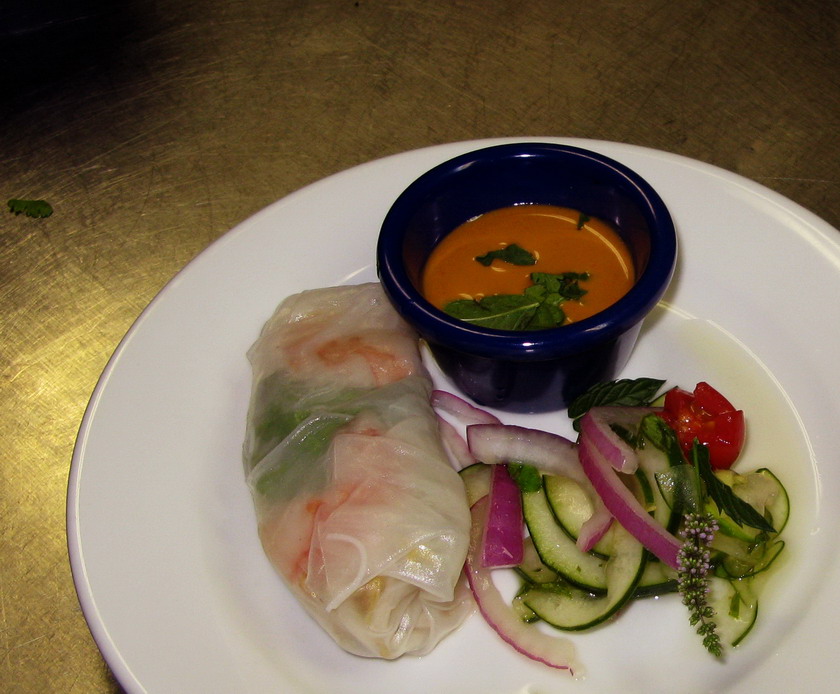
When it is so hot and humid and sticky that you cannot bear to turn on the stove, and the thought of eating something warm makes you vaguely queasy, salads are the traditional cold food solution in the West.
But, you know, I really like one of the Eastern takes on the matter, because not only is it cooling, fresh, light and crisp like a salad, you also get the kid-like pleasure of eating with your fingers!
Salad rolls, also called garden rolls, summer rolls and uncooked spring rolls, originated in Vietnam, but their popularity has spread them to Thailand and beyond. The classic recipe is made with chilled boiled shrimp and cold roast pork, combined with bean sprouts, herbs (Thai basil is a classic), lettuce, and cooled, chilled thin rice noodles, all rolled up together in a rice paper wrapper and served ice cold with some kind of dipping sauce.
But that is the classic, and as excellent as it is, I have never tasted a recipe that I couldn’t adapt happily.
I’ve made vegan versions with avocado instead of the shrimp and pork, and those are awfully tasty. I’ve taken out the pork and used fresh mango slices instead, which tastes amazing with the crisp-tender sweet boiled shrimp and the bright flavors of the emerald green herbs. (The truth is, as much as I adore pork, and love Vietnamese style roast pork, in the summer, I prefer salad rolls without it, because it is heavier than I would like.)
The one necessary component to this recipe which cannot be substituted is the rice paper wrapper. These round, translucent, paper-thin creations are easily found in most Asian markets and even some supermarkets in the international food section. They are sold in clear plastic disc-shaped packets, and come about thirty to a package.
When you open the package, you will notice that these fragile little see-through circles made of rice flour and water, rolled thinly and set to dry in the sun on a basket (you can see the texture of the basket imprinted in them, which is pretty cool) are quite crisp. How in the world can you wrap anything in these, you might think to yourself.
Easily–the trick is to dip them into hot (not boiling, just hot like bathwater) water, and push them down so they sink and are completely covered. (You can gently massage the rice paper with your fingertips to get them to soften faster, but you don’t need to, at least not if your water is hot enough.) Leave the rice paper in the water, swishing it about perhaps, until it completely softens, and takes on the texture of wet silk habutai (The kind of light silk fabric commonly used in clothing in the US) and is completely pliable.
Then, you gently take the wrapper out, lay it on a work surface (I use a clean plastic cutting board) smooth it out, and place your filling in the lower third of the wrapper. Contain your fillings into a vaguely cylindrical shape, which is challenging with the bean sprouts, but endeavor to persevere, and they will eventually be tamed. Fold the lower bit of the wrapper up over the fillings, then fold in the two sides, tightly–but not so tightly that you tear the rice paper.
Then, roll up the salad roll, as tightly as you can, and place it on a plate, seam side down, and there you have it! The rolling tightly part takes some practice, but I promise you that after your fifth or seventh roll, your salad rolls will begin to look prettier and prettier. And even if they are not pretty, your first efforts will taste delightful.
These salad rolls are best made fresh, right before you eat them, but you can make them a few hours ahead of time if you put them into a pan that has been lined with damp paper towels, and then cover the rolls with more damp towels. If you stack them on top of each other, make sure that you place damp paper towels between the layers so that the rice paper wrappers don’t have a chance to stick together.
Then you need to make a dipping sauce.
My favorite is also the easiest to make–it consists of equal parts of natural peanut butter (the kind that is made only of peanuts and salt) and hoisin sauce, a sweet soybean paste-like sauce, with a little bit of rice vinegar or lime juice for tang and enough sriracha sauce to add a sparkle of chili heat. I make it in a food processor, and add enough water through the feed tube to make a moderately thick but still fluid sauce that will easily stick to the rolls without either being sticky on the tongue nor dripping off the rice wrapper and making a mess of your clothes.
That is all there is to these delectable little cold bites–they are a great summer appetizer, salad course or if it really is that hot and miserable outside, entree. I’ll give you a list of possible ingredients below, and some general instructions as well as a recipe for the sauce, but really, this is not a recipe you need to follow to the letter. Unlike some people, I don’t want you to copy my every culinary adventure perfectly–I want you to strike out on your own, using my recipes as a map to possibly unfamiliar territory, and make your own taste discoveries.
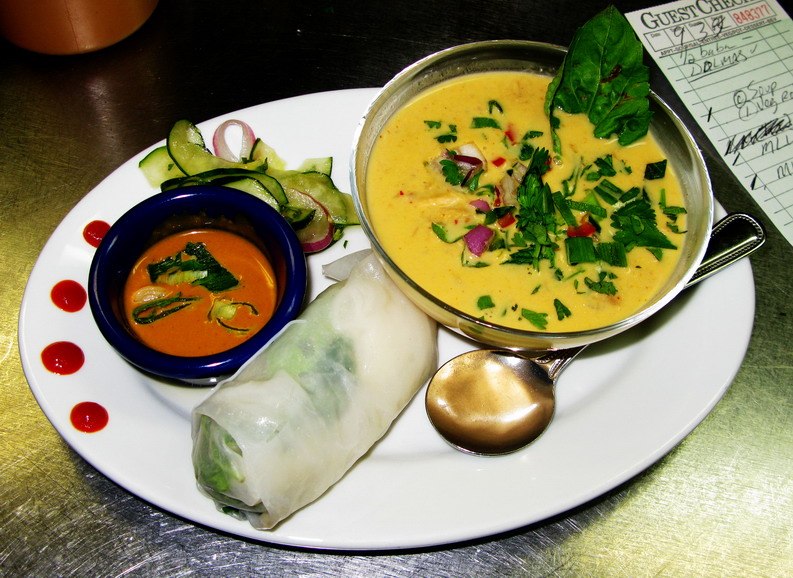
Thai-Vietnamese Salad Rolls
Possibly Ingredients:
rice paper wrappers (these are not an option!)
shelled boiled shrimp, cut in half longways
spiced pressed tofu, cut into thin slices
finely shredded or chiffonade-cut leaf lettuce, butterhead or romaine
mizuna (a lightly spicy, herbal-scented leafy green from Japan) leaves
whole basil leaves, stems removed
whole mint leaves, stems removed
sprigs of cilantro
long chive leaves, cut to lengths about 2 1/2″ long
mung bean sprouts (traditional) or radish sprouts (not traditional, but very tasty)
thin shreds of carrot
thin slices of fresh avocado–lightly firm fruits are best
thin slices of lightly firm mango
thin slices of seeded cucumber
thin rice vermicelli boiled for five minutes, drained and rinsed in cold water, then chilled with ice
1 cup natural peanut butter
1 cup hoisin sauce
2 tablespoons lime juice or rice vinegar
sriracha or other Asian chili sauce to taste
lightly crushed roasted peanuts for garnish
Method:
Soak a rice paper wrapper in hot (nice hot bathwater temperature) water until it becomes fully pliable and has the texture of wet light fabric like silk or cotton. Remove from water and allow excess water to drip back into pan. Lay wrapper onto a work surface, and smooth out with fingers.
At this point, while you are filling and rolling the first wrapper, you can put a second wrapper into the water to soften while you are working.
Put your chosen fillings neatly in layers on the lower third of the wrapper, shaping them gently to a cylindrical mound. If you use shrimp, place two pieces, cut side up on the bottom of your pile of filling ingredients. (This allows the pretty side of the shrimp to show through the translucent wrapper–if you are using avocado or mango in place of the shrimp, use them now. If you are using tofu–put the herbs first, because they are prettier, then the tofu. If you are using mango or avocado with shrimp, place them on top of the shrimp.) Place your basil leaves or other herbs on top of the shrimp so a dark green color shows through the wrapper underneath the pink of the shrimp, then add lettuce if you use it, and bean sprouts, then noodles, last. (Just grab a few noodles in your fingertips and pull them out from the mass, and kind of wind them up into a little wad. Use very few noodles–too many will give your roll a too chewy mouthfeel.)
Fold up the bottom third of the wrapper on top of the fillings, and then fold both sides in tightly. (But not so tightly that the bean sprouts poke through the fragile wrapper–this takes practice. Do not despair–you will get better at this, and even after hundreds of these rolls, I still lose a wrapper now and again to a vicious, wild bean sprout trying to make its escape.)
Roll up the fillings inside the wrapper, using your fingers to both roll and contain the fillings, keeping the wrapper as tight on the sides as possible. This is tricky, and you will feel like you could use about five extra fingers to accomplish this feat. Again, do not despair–you will get better at this.
When the roll is done, set it on a serving plate or, if you are making them ahead, in a pan lined with damp paper towels, as outlined above.
Repeat steps until you run out of wrappers, filling or both.
Make the sauce–put all sauce ingredients except peanuts in blender or food processor. Blend together, and then add just enough water while blender or processor is running to thin the sauce to a thick but not gloppy consistency–a little thicker than heavy cream is just right. (Make sure it coats the back of a spoon without running off quickly–it should drip, but slowly.)
The next step is the most important–eat and enjoy!
From the New York Times: Farmer Banned From Greenmarkets
One of the big reasons people shop at farmer’s markets across the country is because they want to eat fresher foods that were grown locally. They want to support local farmers and food producers and support their local economy, all while eating delicious food.
What they don’t want to do is fall victim to the old bait and switch tactics that you expect out of corporations. They expect foods at farmer’s markets to be what they are advertised to be. In other words, if they are paying top dollar for pasture-raised, organic grain fed chickens, they want their chickens to be pastured and fed only organic grain. And if a farmer signs an agreement with an individual market to follow the rules which state that they personally raise or produce the food that they sell, then, that farmer should only be selling what he has personally raised or produced.
The managers of New York City’s Greenmarkets has taken the unusual step of suspending a local farmer from selling at their markets because he was found to be selling more meat than he could possibly be producing on his upstate farm, leading to questions over where he might be getting the balance of the meat, and how it was raised.
This is a serious issue, because one of the biggest boons that farmer’s markets have brought to consumers has been creating a sense of trust in the growers and producers who sell at the market to be selling what they say they are selling, and to be producing food exactly the way they say they do. When one farmer violates that trust, it can lead to credibility issues for other farmers who sell at the market.
I haven’t heard of a similar issue here in Athens, but I do remember that when the farmer’s market in Charleston, West Virginia, started when I was a kid, there was no rules about the seller having to have produced, grown or made the foods that they sold at the market, which resulted in legitimate farmers competing with vendors who bought fruits and vegetables from wholesalers and sold their wares alongside the farmers. (A big tip-off that this was going on was the fact that no matter how warm the summer was, pineapples, bananas and citrus fruits quite simply do not grow in West Virginia.)
The Charleston farmer’s market now has the same basic rules in place that the Greenmarkets in New York and our market here in Athens has–everything has to be grown, produced or made by the farmer/vendor in question. I think that such rules are necessary, and need to be upheld, and although I, like most everyone else, doesn’t much care for someone who breaks trust, I cannot but feel somewhat sorry for the farmer in the Times article–his pool of buyers has dried up and it sounds like he is suffering from physical injuries which make it hard for him to work.
On the other hand, his situation shows what happens when one lies to consumers and they find out about it. Loyalty only lasts so long as the trust that feeds it is not found to be misplaced.
Yet Another Reason to Dislike The Cook’s Illustrated Family of Publications
Long time readers of my blog should know by now how much I dislike the magazine Cook’s Illustrated. If you are new here, read one of my last rants on the subject, specifically, about how repugnant I find their tone when they write about Asian recipes, just before they “perfect” them by sucking every last bit of flavor, soul and everything that makes the recipe unique, Asian and interesting from it.
It isn’t just how the Cook’s Illustrated stable of writers and recipe “testers” destroy Asian recipes that annoys me–I cannot abide the way that their recipes are all trumpeted as “the best,” because, frankly, they are not exceptional in any way. They are just bland and often dumbed down to the lowest common denominator. And, I really hate the way in which they do taste tests and equipment ratings, where low price trumps quality every time. Essentially, what I think is that the staff of Cook’s Illustrated, Cook’s Country and America’s Test Kitchen has set themselves up as authorities on food and cooking without actually having much in the way of credentials to back up their claims.
And that is enough for me to have little patience with their overbearing, arrogant “we are always right” writing style, and to actively dislike their publications and television shows.
Unfortunately, that active dislike has, overnight, morphed into utter loathing, because of the actions of one of their public relations minions in the case of a blogger who used a recipe from Cook’s Country as inspiration for a potato salad and then blogged about it.
She was contacted by this misinformed public relations person by email, and was told in a very unprofessional manner that she was violating Cook’s Country’s copyright on that recipe and she was told that she must remove it from her blog.
That was not all–not only was she in violation of their copyright (which she was not–more on that in a moment), if she wanted to use a Cook’s Country recipe on her blog, she had to write to this PR person to ask permission, and then, once granted, she was not allowed to modify the recipe in any way.
Why?
Because the recipe has been rigorously tested and as it is published, it is perfected, and does not need to be modified.
That was what really torqued my gizzard right there. I mean, it was bad enough that the PR flunky had no idea what the laws on copyright covering recipes are in the first place (or if she did know, she was engaging in harassment by emailing this blogger out of the blue in order to misquote copyright law), but to have the gall to say that the publishers of Cook’s Country do not allow their recipes to be modified because they are already perfect is just beyond overbearing. That kind of arrogance and ignorance is something I do not expect to find among those of us who live in the reality based community.
The deal about copyright as it applies to recipes is this–and I know this because I have done some pretty extensive research on the subject so I could write about it at The Paper Palate and here on Tigers & Strawberries-according to US copyright law, you cannot ever copyright a list of ingredients. The only part of a recipe that is protected by copyright is the method, and then only if it is written in a unique and literary fashion. There are only so many ways to express the following sentence, “preheat oven to 350 degrees,” for example, so that phrase or sentence cannot be copyrighted.
If, however, you were to follow up that phrase with something along the lines of, “Then, dust off your grandmother’s cast iron frying pan–your grandmother did pass down a cast iron frying pan to you, didn’t she–well, if she didn’t any cast iron frying pan will do, and grease it up well with bacon drippings…” that series or phrases would fall under copyright.
In other words, if your recipe is written in a unique voice, with a recognizable style, it falls under copyright. If it is “just the facts ma’am,” then it doesn’t fall under copyright. All prose leading up to a recipe, describing the process of creating the recipe, does fall under copyright, as it is most certainly a literary expression.
Most food bloggers deal with the issue of using recipes from other sources by citing the source, and then changing either the ingredients, or the wording of the method enough to make it uniquely their own. However, even if they heavily modify the recipe, most food bloggers cite the source, because it is considered to be ethical to do so.
And most folks, both published cookbook authors and other bloggers, don’t seem to mind.
When I review cookbooks here, I always cook at least a handful of recipes from the book after I review the book and present them here, with pictures and commentaries. I have never had a cookbook author complain about this–quite the contrary, several authors have not only gone out of their way to thank me for presenting reviews for their books on my blog, but have often linked to this blog on their own sites, or have thanked me in print in subsequent editions of their cookbooks.
That is because these authors understand the power of word-of-mouth, or word-of-blog advertising. They understand that I am giving them free publicity by featuring their books and recipes in my blog and they understand what blogger and researcher Leena Trivedi-Grenier discovered in the course of her US Food Blog Survey–that people who read about a magazine or cookbook on a blog and see successful recipes presented from them tend to go out and BUY those publications. Duh.
Apparently, the publishers of Cook’s Illustrated, Cook’s Country and America’s Test Kitchen don’t grok that. They are so worried that they might lose money because someone presented one of their recipes for free, that they will risk the ire of a large number of potential readers by being utterly obnoxious to a blogger by telling her incorrectly that not only is she in violation of their copyright, but she isn’t allowed to change the recipe in the first place.
This is so hypocritical of these guys, since the woman who decided to adapt Sichuan Green Beans in their February 2007 tried to use dill pickles as a substitute for Sichuan preserved vegetables, because, I don’t know, a pickle is a pickle. Right? (Um, no. Dill pickles are made in brine from cucumbers, and Sichuan preserved vegetable is made from a type of mustard plant and is salted and rubbed with chilies and is allowed to ferment.) I mean–they change recipes all the time, including perfectly good traditional Asian ones, often in heinous ways, but they are so godlike and perfect that they can do that, while we mere mortals dare not? Puleez! They have a lot of nerve.
That is the last straw for me. I haven’t even looked at one of their publications in over a year, but now I never will again. Nor will I ever suggest any of their publications to any or my readers, friends or family. Nor will I ever purchase one of their books as a gift for new cooks, nor will I ever watch their television show.
I will say that I am tempted to take one of their lame-assed Asian recipes, and present it on my blog, deliberately changing what I need to in order to make it edible, then email their PR department, not to ask permission, but to inform them that I had done so on the chance that they would like to send me an obnoxious and ignorant email like the one sent to the blogger at Alosha’s Kitchen. If they did that, it would give me the excuse to open up a can of ugly legal whupass in a barrage of verbiage that is just this side of Lewis Black. (Here is a clue–stupid people merely annoy me, but condescending and supercilious stupid people will make me lose my cool. Most of the time, I can keep myself civil, but not always. In the case of these Culinary Inquisitors, there is no way I could maintain my usual poised and gracious online communication style.)
I probably won’t though, for several reasons. One, I would want to illustrate the post with my middle finger displayed prominently over the results of the recipe, and that is really, really juvenile. (I think I have been watching and reading a little too much Anthony Bourdain recently.) Two, I have other stuff to do, like present my own recipes, which are often original and which I don’t care if people change up when they cook them, because, dammit, that is what cooks do–they put their own individual fillip on their food, and I will be damned if I stop anyone from engaging in culinary creativity. And I have a restaurant to help run and a baby to raise and a girl getting ready for college, on top of it all.
And three, because, well, I just don’t like being that angry, and a post like that would necessitate a state of focused rage in order to present it with the proper satiric style. And while it would be fun to write the post as a complete send-up of the usual way they write their articles, with all of their bombast and bluster intact, I don’t think I have the energy to sit down and do that right now. I can either go to the gym and get back into physical shape or I can sharpen my wits on these addled morons, but I can’t do both. And right now, being more physically in shape is more important.
So there we have it–the final straw in the saga of the publishers of Cook’s Illustrated, Cook’s Country, and America’s Test Kitchen and my relationship with their magazines. It is over, done, finished.
Oh, well, except for this one thing–I am finally going to say something I have thought for years, but not said in a public forum–I cannot stand Christopher Kimball, his arrogant attitude which I believe has polluted every one of his publications, his faux-folksy, sexist-assed, uptight Yankee editorials, and his god-damned dweeb haircut and bow tie. He’s a self-important git who sucks the joy and life out of cooking every time he picks up his pen.
There.
I said it.
And the devil in me feels just a little bit better for it.
And yeah, I -have- been watching a little too much Lewis Black and Anthony Bourdain these days.
Maybe I should take up Zen meditation again.
It might help.

Categories:
- Admin (rss) (55)
- Blogs and Blogging (rss) (81)
- Book Reviews: Cookbooks (rss) (43)
- Book Reviews: Non-Cookbook Food Books (rss) (38)
- Cats and Cat Blogging (rss) (47)
- Chinese Cooking Lessons (rss) (32)
- Culinary School Stories (rss) (18)
- Dairy Pruducts: Cultured and Barbaric (rss) (4)
- Documentary Filmmaking (rss) (1)
- Essays, Rants and Reflections (rss) (260)
- Fighting Hunger (rss) (12)
- Food and Kids (rss) (45)
- Food in the News (rss) (126)
- Food Media (rss) (98)
- Food Preservation (rss) (18)
- Food Safety (rss) (45)
- Gardening (rss) (30)
- Herbs and Herb Blogging (rss) (20)
- Holidays (rss) (50)
- Kat Blogging (rss) (22)
- Kitchen Science (rss) (36)
- Leftover Makeover (rss) (8)
- Life, the Universe and Everything (rss) (131)
- Local and Sustainable (rss) (227)
- Local Athens Food and Foodies (rss) (42)
- Meatless Mondays (rss) (32)
- Menu For Hope (rss) (5)
- Nutrition, Diet and Health (rss) (84)
- On The Farm (rss) (8)
- Recipes: Almost Vegetarian, Vegetarian and Vegan (rss) (294)
- Recipes: American Regional (rss) (37)
- Recipes: Appalachian Hillbilly (rss) (33)
- Recipes: Bread, Pasta, Grains (rss) (95)
- Recipes: Canning and Preserving (rss) (8)
- Recipes: Chinese (rss) (123)
- Recipes: Comfort Food (rss) (120)
- Recipes: Cookies (rss) (16)
- Recipes: Desserts (rss) (48)
- Recipes: French (rss) (25)
- Recipes: Fruits and Vegetables (rss) (302)
- Recipes: Greek, North African and Middle Eastern (rss) (31)
- Recipes: Indian (rss) (137)
- Recipes: Italian (rss) (42)
- Recipes: Japanese (rss) (7)
- Recipes: Jewish (rss) (4)
- Recipes: Korean (rss) (6)
- Recipes: Meat, Poultry and Fish (rss) (220)
- Recipes: Mexican/Native American/ Latin American/Caribb (rss) (27)
- Recipes: Original (rss) (108)
- Recipes: Thai (rss) (27)
- Recipes: Tofu (rss) (17)
- Recipes: US Regional (rss) (16)
- Recipes: Vietnamese (rss) (8)
- Restaurant Stories (rss) (28)
- Sewing, Quilting, Arts and Crafts (rss) (16)
- Simple Chinese Recipes (rss) (30)
- Slow Food and Heritage Foods (rss) (10)
- Spice Blogging (rss) (44)
- The Chinese Cookbook Project (rss) (14)
- The Chinese Pantry (rss) (39)
- The Documentary (rss) (2)
- The Kitchen Saga (rss) (17)
- The Locavore's Bookshelf (rss) (15)
- The Unsung Adventures of The Culinary Nerd (rss) (6)
- Tools and Toys (rss) (35)
- Uncategorized (rss) (10)
- With a Side of Politics (rss) (48)
Archives:
- August 2012 (9)
- July 2012 (12)
- September 2011 (3)
- August 2011 (7)
- July 2011 (8)
- June 2011 (16)
- May 2011 (17)
- April 2011 (11)
- December 2010 (9)
- November 2010 (5)
- February 2010 (1)
- December 2009 (5)
- November 2009 (7)
- October 2009 (10)
- September 2009 (16)
- August 2009 (14)
- July 2009 (14)
- June 2009 (7)
- May 2009 (17)
- April 2009 (10)
- March 2009 (25)
- February 2009 (13)
- January 2009 (10)
- December 2008 (5)
- November 2008 (5)
- October 2008 (6)
- September 2008 (13)
- August 2008 (8)
- July 2008 (11)
- June 2008 (18)
- May 2008 (13)
- April 2008 (14)
- March 2008 (16)
- February 2008 (17)
- January 2008 (19)
- December 2007 (25)
- November 2007 (18)
- October 2007 (24)
- September 2007 (16)
- August 2007 (15)
- July 2007 (15)
- June 2007 (10)
- May 2007 (14)
- April 2007 (16)
- March 2007 (17)
- February 2007 (20)
- January 2007 (13)
- November 2006 (1)
- October 2006 (8)
- September 2006 (14)
- August 2006 (25)
- July 2006 (30)
- June 2006 (28)
- May 2006 (34)
- April 2006 (29)
- March 2006 (24)
- February 2006 (30)
- January 2006 (38)
- December 2005 (40)
- November 2005 (37)
- October 2005 (32)
- September 2005 (25)
- August 2005 (30)
- July 2005 (28)
- June 2005 (21)
- May 2005 (8)
- April 2005 (22)
- March 2005 (17)
- February 2005 (29)
- January 2005 (10)
Search Site:
Links:
- Lily’s Wai Sek Hong
- 101 Cookbooks
- A cat in the kitchen
- A Veggie Venture
- Accidental Hedonist
- Cha Xiu Bao
- chez pim
- Chocolate & Zucchini
- Chopstick Cinema
- Chowhound.com
- Chubby Hubby
- Cook sister!
- Cooking with Amy
- da*xiang
- Eat Local Challenge
- Eating Liberally
- Ecocentric
- Eggbeater
- Epicurious
- Farmgirl Fare
- Fatfree Vegan
- Foodgoat
- ForkandBottle.com
- Green Olive Tree
- Hooked on Heat
- Jaden’s Steamy Kitchen
- Kalyn’s Kitchen
- Lucullian delights
- Mahanandi
- Matt Bites
- MeatHenge
- mmm-yoso!!!
- New York Times – Dining & Wine
- Pizza Goon
- Rasa Malaysia
- Ruhlman
- Sailu's Kitchen
- Serious Eats
- SF Gate: Food & Dining
- Simply Recipes
- Soul Fusion Kitchen
- Tastespotting
- The Amateur Gourmet
- The Cleaner Plate Club
- The Food Section
- The Grub Report
- thecookscottage
- U.S. Food Policy
- Wandering Chopsticks
- Washington Post Food and Dining
- Wasted Food
Meta:


Powered by WordPress. Graphics by Zak Kramer.
Design update by Daniel Trout.
Entries and comments feeds.