
Cook Local, Eat Global
Weekend Whale Blogging: “. . . from hell’s heart I stab at thee; for hate’s sake I spit my last breath at thee.”
Okay, really, I cannot imagine the cheerful plastic Ahab who is sitting on Schmoo’s back saying that, but still.
It is a great quote.
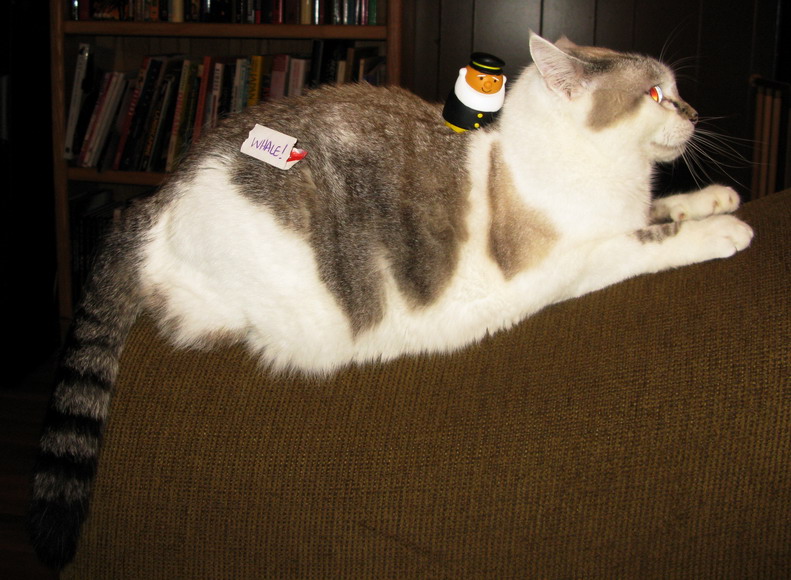
And a tagline for a great photograph, courtesy of Brittany and Morganna.
I would say poor Schmoo, but really, he didn’t care that he was having stuff placed upon his person for embarrassing photographs.
He’s just too laid back for that.
Adapted From 660 Curries: Methi Gosht–Lamb With Fenugreek Greens

I absolutely love the flavor of methi greens. They are lightly bitter, but with the sweet fragrance of newly-mown hay which I find to be irresistible. It is a delectable combination, and I discovered when I made this recipe that methi greens make a perfect foil for the rich sweetness of braised cubes of lamb shoulder.
The recipe is adapted from Raghavan Iyer’s excellent cookbook 660 Curries; I changed a few of the particulars in order to make a prettier curry, especially for service at Salaam. Along with adding fragrant spices, I added paprika in order to give the meat an appealing reddish brown color. I also didn’t make the deep-fried onion garnish, as we don’t have the capability to do deep frying at the restaurant; instead, I used finely diced red onion and bell pepper to add color and fresh flavor to the dish.
To add height and texture to the plate, I placed pieces of shallow fried pappad–thin wafers made of lentil flour and spices that are easily found in Indian markets. When put into hot oil, these discs bubble, puff and spread out into thin, crisp cracker-like wafers. Broken into irregularly-shaped pieces, the pappad made very pretty garnishes for the curry, which perhaps made up for a lack of deep-fried onions. (And, they were fun to eat, too!)
This curry is not saucy–the meat is basically cooked in its own juices, and the fenugreek greens, which are added at the end so that they retain their dark green color–add their own liquid to the dish. I didn’t thicken the juices at all; I simply simmered them in order to concentrate their flavors. We served methi gosht with raita and cilantro chutney so that the dish wasn’t too dry, being as it was served on top of basmati rice, which is not exactly juicy.
Methi, also known as fenugreek greens, is available dried, in boxes labeled as quasoori methi or kasoori methi, frozen in resealable bags, and sometimes fresh at Indian markets. I like combining either the fresh or frozen greens with a bit of the dried greens; the fragrance in the dried methi is stronger and more concentrated, but the flavor, color and texture of the fresh or frozen greens are superior. If you use a bit of the dried greens along with the fresh or frozen, you get the best of both worlds.
I also like to add a bit of fenugreek seeds to any masala I grind for a dish that uses methi greens. Its vanilla/fresh-cut hay/musky aroma enhances the flavor and scent of the greens. This makes sense, as they are both from the same plant! In addition to fenugreek seeds, I ground up cumin, coriander, black cardamom and black pepper together to make the spice blend for this curry; my choices were a serious departure from the original recipe, but the results were very fragrant and enhanced the meaty flavor of the lamb perfectly.
I cooked my curry in the pressure cooker, which results in a very tender, moist texture with a great deal of flavor, but it can be cooked on the stovetop normally, too. Just note that it will take a good bit longer to cook without a pressure cooker, and plan your meal accordingly.
A good sauteed vegetable dish, like Broccoli with Panch Phoron, would go perfectly with this dish. A potato dish, like Tiny New Potatoes With Garlic Scapes and Panch Phoron would also go nicely here, as would Aloo Gobi.
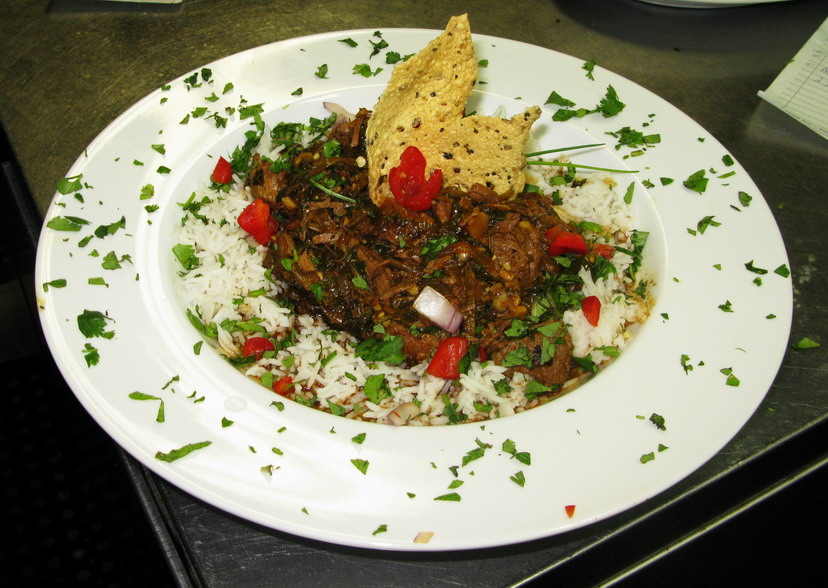
Methi Gosht
Ingredients:
1 tablespoon cumin seeds
1 teaspoons black peppercorns
1 tablespoon coriander seeds
2 black cumin pods
1/2 teaspoon fenugreek seeds
2 tablespoons fresh ginger ground into a paste (measured after grinding)
2 tablespoons fresh garlic ground into a paste (measured after grinding)
1 1/2 teaspoons kosher salt
1 teaspoon ground cayenne pepper
1/2 teaspoon turmeric
2 tablespoons sweet paprika
2 pounds boneless leg of lamb, fat trimmed and cut into 1″ cubes
2 tablespoons ghee or canola oil
2 tablespoons dried methi greens
1 1/2 cups water
1 1/2 cups frozen or fresh methi greens, large stems removed
salt and garam masala to taste
Method:
Grind whole spices into a fine powder. Mix together with the ginger and garlic pastes, the salt, cayenne pepper, turmeric and paprika, and rub all over the lamb pieces. Cover and refrigerate for at least 1 hour.
Heat oil in the bottom of a pressure cooker or braising pot over medium high heat. Brown the meat cubes well, and allow meat juices to emerge. Add dried methi and water, lock down the lid to the pressure cooker and bring to full pressure. Turn heat down to low and cook on high pressure for fifteen minutes. Allow pressure to reduce naturally off the heat. When pressure is reduced, remove lid, add fresh or frozen methi, and cook at a fast simmer until meat is completely done, the greens are wilted and tender, and the liquid in the pot as reduced by 2/3.
Add salt and garam masala to taste and serve over steamed rice.
If you don’t have a pressure cooker, add only a little bit of water–about 1/2 to 1 cup and simmer, covered, over medium heat until the meat is mostly tender–about twenty-five to thirty-five minutes, then continue recipe as written.
Fried Catfish Japanese Style

I am never going to pan fry cat fish in the Southern manner again.
As much as I love the cornmeal-dredged classic recipe I grew up with, I have discovered that I prefer the Japanese way of pan-frying better.
This is the method used to make tonkatsu–pan fried thin boneless pork cutlets with the most light, ethereal, crispy crust imaginable–adapted to catfish fillets.
What is so special about tonkatsu?
It is breading.
It is made from panko–a special Japanese breadcrumb that makes a light, crisp coating that is not just texturally fascinating, but also utterly delicious. Panko is made with crustless white bread and the bits are very crisp and irregularly shaped, making the the bits quite interesting in texture. My favorite type includes honey, making for a lightly sweet crust on whatever it coats.

Panko makes tonkatsu a wonderful dining experience, but it turns a farmed catfish–one of the most safest, most sustainable fish choices available–fillets into a divine treat.
And panko coated fried catfish is simple to make–just as easy as the cornmeal crusted variety.
But it tastes so much better. It takes a food that is fairly stereotypical to the Southern palate and makes it truly special.
With just a squeeze of lemon juice, the catfish katsu is a perfect summer supper–especially when paired with the first local corn of the season, and garlic-sauteed new potatoes and green beans. (The corn is from Wittens, in Lowell, Ohio, where they grow it under plastic in order to get it to mature sooner than the rest of the corn in Southeastern Ohio.)
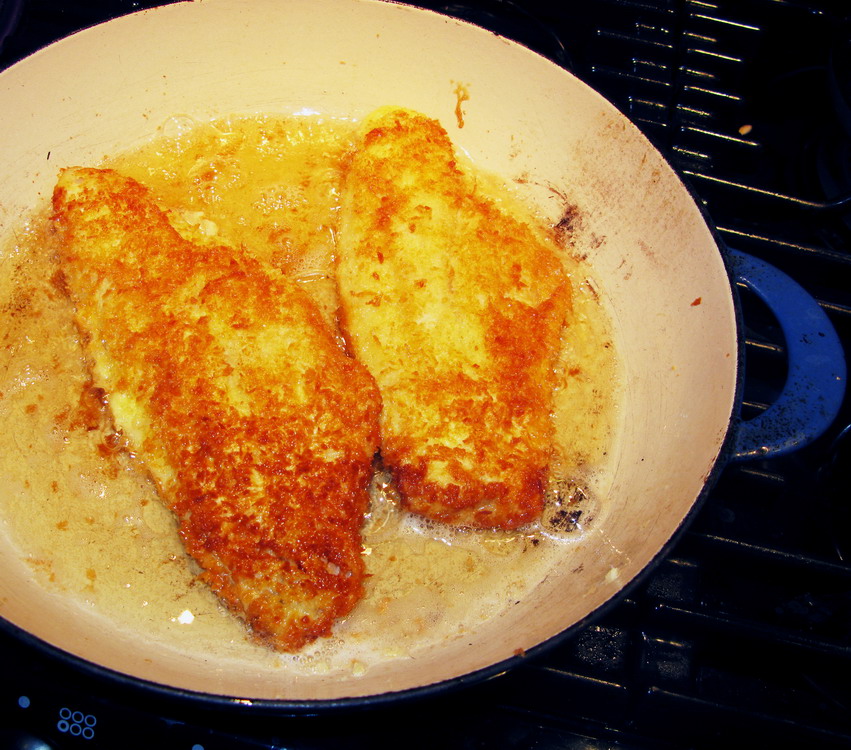
Panko-Crusted Fried Catfish
Ingredients:
4 large catfish fillets
salt and freshly ground pepper to taste
3/4 cup all purpose flour on a shallow plate
2 eggs well beaten
1 cup honey panko on a shallow plate
canola or peanut oil as needed for pan frying
Method
Salt and pepper both sides of catfish fillets well.
Dredge 2 fillets in flour on both sides, shaking to remove excess.
Pour oil into wide, heavy-bottomed skillet to depth of 1/2 inch. Heat on medium heat.
Dip in egg, coating well on both sides, then lay on panko on plate, scooping crumbs and patting onto egg-coated fish to coat well.
Lay fillets side by side in the pan, and cook without turning until you see the breadcrumbs on the edges of the fish begin to turn golden. Then, with a wide, long spatula, turn each fillet. The formerly bottom side should be golden brown and quite crisp. When fish is crisp on the other side, remove from pan, drain on paper towels and keep warm.
Repeat with other two fillets, and serve immediately.
Catering A Vegetarian Wedding With Local Food
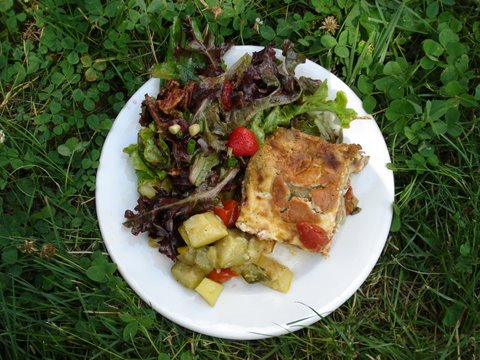
When Sonia Marcus, the chair of the Communication Committee of the Ohio University Eco House, started planning her wedding, she decided that she wanted all of the food to not only be beautiful and delicious, but locally grown and produced as well.
This choice fits perfectly with her own life philosophy of living as green as possible, including eating as much local food as she can. As the person in charge of all public relations for the Eco House, a project where Ohio University Students live together in a ecologically sustainable fashion in order to show everyone else not only what is possible theoretically, but practically, Sonia has committed herself to living as “green” as she herself can, even though she doesn’t reside in the Eco House.
And so, I was not at all surprised to hear from Hilarie, the owner and executive chef at Salaam, that Sonia wanted us to do the catering for the event, and that she wanted a menu that reflected the local early-summer bounty available to those of us lucky enough to live in Southeastern Ohio. In this way, she could expose all 150 of her wedding guests to the fact that not only is local food available, it is so delicious that one could never feel deprived while eating it, at least, not in the summer. (It is also quite economical, especially when we are talking about fresh fruits, vegetables and herbs in the height of the growing season.)
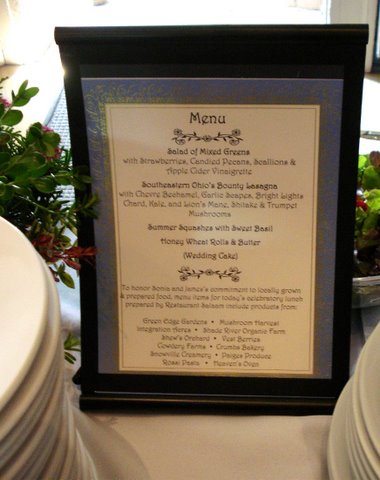
Hilarie asked me to help her devise a menu for the vegetarian (but not vegan) luncheon, which would include appetizers, salad, a side dish and an entree as well as rolls and butter.
We came up with a delectable menu that reflected the best of Appalachian Ohio, and that included locally baked bread, locally made pasta, local dairy products including milk, butter, cream and chevre.
The appetizers were fresh, locally grown sugar snap peas which are at their height right now, with a dip that included soy sauce and sesame oil, feta and pesto filled cherry tomatoes, and dates stuffed with chevre and pomegranate molasses which are then rolled in sugared pecans and dried chili flakes. (The last appetizer is a departure from the local food theme–although the chevre was local–but Sonia really wanted them. She had them at the restaurant and fell in love–which is fine. I don’t think that it serves any purpose to be a fundamentalist about local eating.)
The salad featured locally grown lettuces, strawberries, and scallions with sugared pecans and a vinaigrette featuring local honey and cider vinegar.
The side dish was locally grown summer squashes sauteed in olive oil with onions and cherry tomatoes, then finished with fresh, local basil.
The entree, which was my favorite part of the menu was an absolutely delectable vegetarian lasagne featuring Rossi Pasta’s celadon-green spinach-basil-garlic no-boil lasagne noodles, locally grown fresh shiitake, trumpet and lion’s mane mushrooms, local bright lights chard and kale, a fresh tomato and basil sauce, and a bechamel sauce enriched by local chevre.
It was awesome. I am so glad that Hil and I came up with the lasagne recipe–we did it together–because we will probably be doing it in the restaurant now and again from now on.
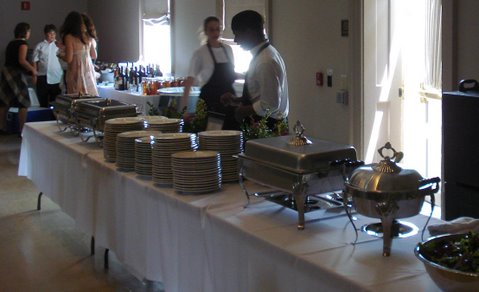
All of the guests loved the food, and it was great to know that they got to taste something new and interesting, that they might otherwise have never known about. Hilarie made menu signs that listed all of our suppliers so that guests could find these great food producers and growers at the farmer’s market next weeked.
Thank you, Sonia, for choosing to do something different with your wedding reception lunch, which gave us a chance to feature the delicious foods that are produced and grown all over Southeastern Ohio.
Seduction on a Plate: Fraises a l’Aziz
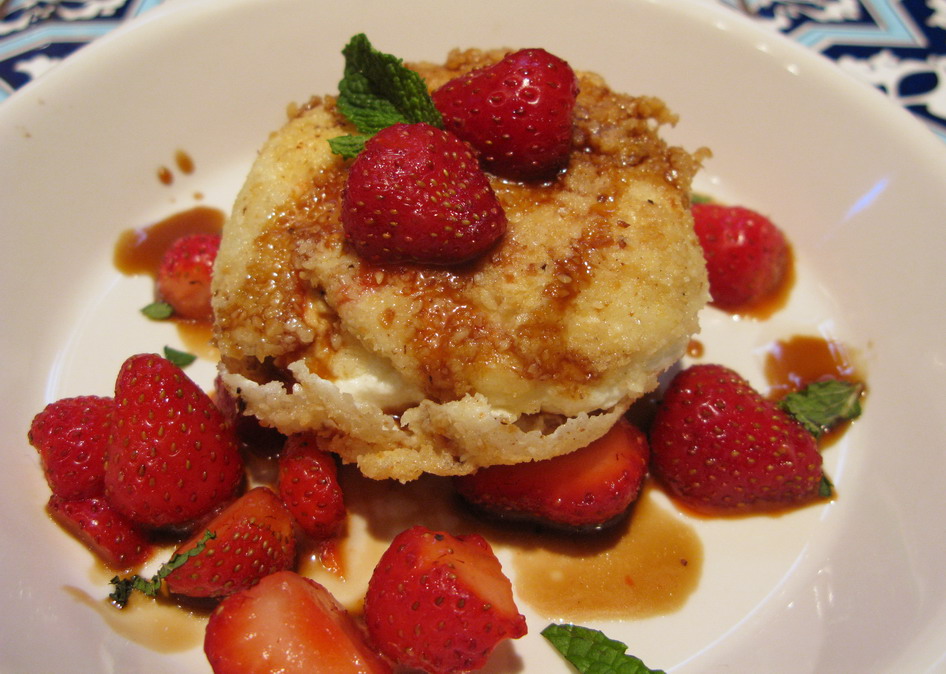
Inspiration for a new dish often strikes me in odd moments.
Some flavor combinations come to me in dreams, if you can believe that.
Others lay in wait in my subconscious mind and pop out in the midst of a conversation about an unrelated topic.
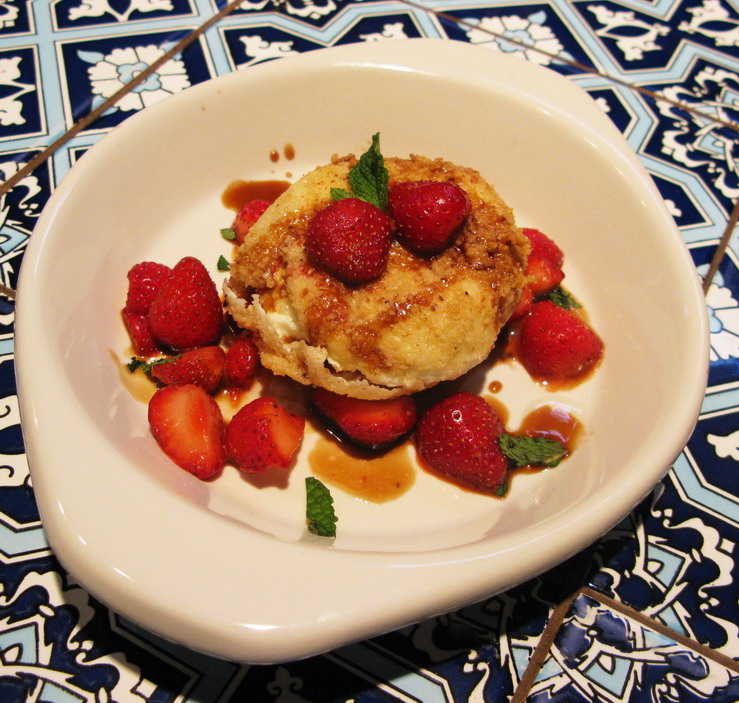
The kernel of the idea for this appetizer, which consists of strawberries macerated in a bit of sugar, black pepper and rosewater, topped with chevre which has been breaded with matzo meal and lightly fried, and dressed with pomegranate vinaigrette, came circuitously into my consciousness by way of seeing batik fabric that called to mind the exact shade of strawberries, combined with flecks of gold and swirls of deep, rich reddish brown.
These colors danced into my mind, and as I stared at the fabric, I had a taste memory of some strawberries I had once eaten at a fine Italian restaurant in Boston which had been lightly sugared, then seasoned with balsamic vinegar and black pepper. The unlikely combination popped on my palate, flooding my senses with wild imaginings of satyrs playing flutes for golden nymphs dancing on meadows perfumed by the wild strawberries they crushed underfoot and fed each other with rosy-stained fingers.
But as the fabric’s colors danced to the satyrs’ reedy melody in my imaginal memory, balsamic vinegar was replaced with pomegranate molasses–for years, every summer at least once or twice, I had been serving a leafy green salad with strawberries, almonds and pomegranate vinaigrette to great effect. And, of course, as I pondered salad, I remembered how well-loved a bit of fried chevre is when presented with greens and a tart dressing.
And so, as it traveled through my imagination, the dish evolved from a dessert I had tasted over a decade ago, to a combination of two of my favorite salads, finally coming together as an appetizer that combines bits of each of these dishes into a cohesive whole.
And it all came about while I was shopping for quilt fabric.
Such is the way in which my mind works–ideas bubble up from my subconscious, stirred by the most unlikely of utensils.
I am certain that you will want a recipe for this dish, but the truth is that I cannot give you one.
Not an exact one, anyway.
Why?
Well, so much of the dish is contingent upon the flavors and textures of each component. The thickness of the chevre patty depends on the texture of the cheese–if it is firmer, then it can be cut more thinly–if it is very soft, it should be shaped to be more thick. The seasoning of the strawberries requires an understanding of how sweet your berries are–if they are very ripe, they will need a minimal amount of sugar–only enough to bring out the juice and soften the berries to a velvety finish. If they are more tart, not only will they take more sugar, but also a tiny bit more rosewater, to bring out the floral quality in their fragrance. And if they are too sweet, the tiniest of pinches extra of the freshly ground black pepper will not only counterbalance the sugar, but it will also bring out a haunting fragrance that the berries possess which can often be overpowered by a too heavy hand with the sugar spoon.
The amount of sugar and oil you add to the pomegranate molasses to make the vinaigrette also depends upon the acidity of the molasses itself. Each brand differs in flavor, thickness and color, so I suggest that cooks make salad dressings with whatever molasses they have on hand, doing it all by taste and feel. I will say that the basic ratio of oil to molasses is about 3:1–as is the case with the strawberries, it is the amount of sugar which is variable, depending on the intrinsic flavor of the boiled down pomegranate juice. (Which is, of course, all that pomegranate molasses is–pomegranate juice boiled down to a thick, dark, sour-sweet syrup.)
Just use a judicious hand in making a dish like this. The beauty in it comes from the interplay between the fragrant, sensuous berries, kissed by two floral aromas–rosewater and black pepper–, the chevre, with its golden crisped exterior and melty, tangy interior, and the sweet and sour notes from the vinaigrette, which ties everything together. Do not add too much sugar, use a light hand with the rosewater and black pepper, and drizzle the vinaigrette onto the plate and the cheese with a squeeze bottle for perfect control.
And please don’t forget to take out your chevre patties to let them warm up slightly before dipping them in lightly beaten egg whites and then coating them in matzo meal. If they are completely cold from the fridge, the center will not become melted enough to be interesting. And fry them in a neutral flavored oil like canola, over medium heat. You want the oil to only be a scant 1/2 inch deep in the pan and you want it to be hot enough that the patties will start to bubble immediately upon entering the pan, but not so hot that the coating immediately begins to burn.
You want it to cook quickly enough to not soak up too much oil, but not so quickly that the matzo scorches, leaving a nasty, acrid taste in the back of the diner’s palate after they take a bite.
I hope that my instructions and admonitions are not too vague to be of use–but I really haven’t developed this into a full-fledged, tested recipe.
I only just ran it as an appetizer special this Friday, when it sold out two thirds of the way through the evening, so in essence, I was cooking by the seat of my pants.
And, judging by the blissful expressions and soft moans coming from the tables, I believe that my navigation was unerring as I brought dish inspired by a piece of fabric, a dessert I ate once long ago and the sweet song from a satyr’s flute from the liminal world of my imagination into the realm of consensual reality.

Categories:
- Admin (rss) (55)
- Blogs and Blogging (rss) (81)
- Book Reviews: Cookbooks (rss) (43)
- Book Reviews: Non-Cookbook Food Books (rss) (38)
- Cats and Cat Blogging (rss) (47)
- Chinese Cooking Lessons (rss) (32)
- Culinary School Stories (rss) (18)
- Dairy Pruducts: Cultured and Barbaric (rss) (4)
- Documentary Filmmaking (rss) (1)
- Essays, Rants and Reflections (rss) (260)
- Fighting Hunger (rss) (12)
- Food and Kids (rss) (45)
- Food in the News (rss) (126)
- Food Media (rss) (98)
- Food Preservation (rss) (18)
- Food Safety (rss) (45)
- Gardening (rss) (30)
- Herbs and Herb Blogging (rss) (20)
- Holidays (rss) (50)
- Kat Blogging (rss) (22)
- Kitchen Science (rss) (36)
- Leftover Makeover (rss) (8)
- Life, the Universe and Everything (rss) (131)
- Local and Sustainable (rss) (227)
- Local Athens Food and Foodies (rss) (42)
- Meatless Mondays (rss) (32)
- Menu For Hope (rss) (5)
- Nutrition, Diet and Health (rss) (84)
- On The Farm (rss) (8)
- Recipes: Almost Vegetarian, Vegetarian and Vegan (rss) (294)
- Recipes: American Regional (rss) (37)
- Recipes: Appalachian Hillbilly (rss) (33)
- Recipes: Bread, Pasta, Grains (rss) (95)
- Recipes: Canning and Preserving (rss) (8)
- Recipes: Chinese (rss) (123)
- Recipes: Comfort Food (rss) (120)
- Recipes: Cookies (rss) (16)
- Recipes: Desserts (rss) (48)
- Recipes: French (rss) (25)
- Recipes: Fruits and Vegetables (rss) (302)
- Recipes: Greek, North African and Middle Eastern (rss) (31)
- Recipes: Indian (rss) (137)
- Recipes: Italian (rss) (42)
- Recipes: Japanese (rss) (7)
- Recipes: Jewish (rss) (4)
- Recipes: Korean (rss) (6)
- Recipes: Meat, Poultry and Fish (rss) (220)
- Recipes: Mexican/Native American/ Latin American/Caribb (rss) (27)
- Recipes: Original (rss) (108)
- Recipes: Thai (rss) (27)
- Recipes: Tofu (rss) (17)
- Recipes: US Regional (rss) (16)
- Recipes: Vietnamese (rss) (8)
- Restaurant Stories (rss) (28)
- Sewing, Quilting, Arts and Crafts (rss) (16)
- Simple Chinese Recipes (rss) (30)
- Slow Food and Heritage Foods (rss) (10)
- Spice Blogging (rss) (44)
- The Chinese Cookbook Project (rss) (14)
- The Chinese Pantry (rss) (39)
- The Documentary (rss) (2)
- The Kitchen Saga (rss) (17)
- The Locavore's Bookshelf (rss) (15)
- The Unsung Adventures of The Culinary Nerd (rss) (6)
- Tools and Toys (rss) (35)
- Uncategorized (rss) (10)
- With a Side of Politics (rss) (48)
Archives:
- August 2012 (9)
- July 2012 (12)
- September 2011 (3)
- August 2011 (7)
- July 2011 (8)
- June 2011 (16)
- May 2011 (17)
- April 2011 (11)
- December 2010 (9)
- November 2010 (5)
- February 2010 (1)
- December 2009 (5)
- November 2009 (7)
- October 2009 (10)
- September 2009 (16)
- August 2009 (14)
- July 2009 (14)
- June 2009 (7)
- May 2009 (17)
- April 2009 (10)
- March 2009 (25)
- February 2009 (13)
- January 2009 (10)
- December 2008 (5)
- November 2008 (5)
- October 2008 (6)
- September 2008 (13)
- August 2008 (8)
- July 2008 (11)
- June 2008 (18)
- May 2008 (13)
- April 2008 (14)
- March 2008 (16)
- February 2008 (17)
- January 2008 (19)
- December 2007 (25)
- November 2007 (18)
- October 2007 (24)
- September 2007 (16)
- August 2007 (15)
- July 2007 (15)
- June 2007 (10)
- May 2007 (14)
- April 2007 (16)
- March 2007 (17)
- February 2007 (20)
- January 2007 (13)
- November 2006 (1)
- October 2006 (8)
- September 2006 (14)
- August 2006 (25)
- July 2006 (30)
- June 2006 (28)
- May 2006 (34)
- April 2006 (29)
- March 2006 (24)
- February 2006 (30)
- January 2006 (38)
- December 2005 (40)
- November 2005 (37)
- October 2005 (32)
- September 2005 (25)
- August 2005 (30)
- July 2005 (28)
- June 2005 (21)
- May 2005 (8)
- April 2005 (22)
- March 2005 (17)
- February 2005 (29)
- January 2005 (10)
Search Site:
Links:
- Lily’s Wai Sek Hong
- 101 Cookbooks
- A cat in the kitchen
- A Veggie Venture
- Accidental Hedonist
- Cha Xiu Bao
- chez pim
- Chocolate & Zucchini
- Chopstick Cinema
- Chowhound.com
- Chubby Hubby
- Cook sister!
- Cooking with Amy
- da*xiang
- Eat Local Challenge
- Eating Liberally
- Ecocentric
- Eggbeater
- Epicurious
- Farmgirl Fare
- Fatfree Vegan
- Foodgoat
- ForkandBottle.com
- Green Olive Tree
- Hooked on Heat
- Jaden’s Steamy Kitchen
- Kalyn’s Kitchen
- Lucullian delights
- Mahanandi
- Matt Bites
- MeatHenge
- mmm-yoso!!!
- New York Times – Dining & Wine
- Pizza Goon
- Rasa Malaysia
- Ruhlman
- Sailu's Kitchen
- Serious Eats
- SF Gate: Food & Dining
- Simply Recipes
- Soul Fusion Kitchen
- Tastespotting
- The Amateur Gourmet
- The Cleaner Plate Club
- The Food Section
- The Grub Report
- thecookscottage
- U.S. Food Policy
- Wandering Chopsticks
- Washington Post Food and Dining
- Wasted Food
Meta:


Powered by WordPress. Graphics by Zak Kramer.
Design update by Daniel Trout.
Entries and comments feeds.