
Cook Local, Eat Global
A Thai Stir Fry Full of Flavor: Pork and Gai Lan with Shallots, Garlic and Chilies
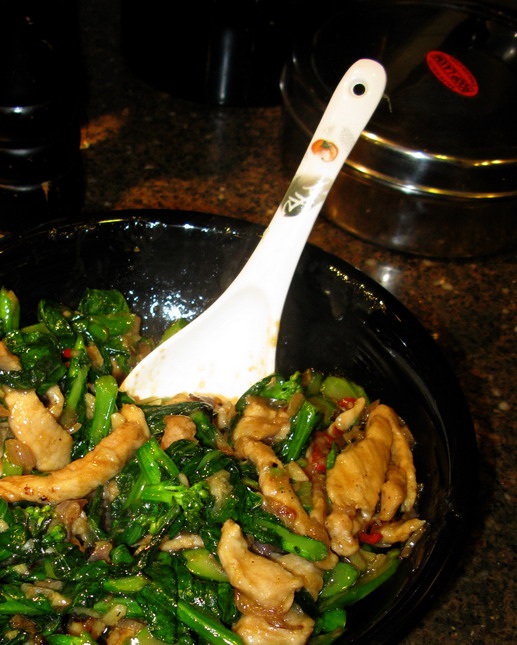
I have been craving gai lan something fierce for two weeks, but sadly, our local Asian market hasn’t had any.
So, while we were in Columbus buying supplies for Morganna’s better late than never 18th birthday party, I picked up gai lan. I am glad I bought extra, because I want to make this recipe again for the party. (We are doing Thai food for the party, the dishes will include tom kha gai, spicy basil chicken and massamun beef curry–and now this pork with gai lan dish.)
I doubt that this is traditional in any sense, although I know that both pork and gai lan are eaten in Thailand, and I used all traditional Thai ingredients: Thai sweet soy, fish sauce, shallots, bird chilies, garlic, lime juice a touch of palm sugar and oyster sauce, so maybe this dish really is something like a stir fry one would eat in Thailand. (I had Thai basil, too, but resisted the urge to use it, as I think that the flavor would not meld with the gai lan. I don’t think that they would get along in a dish–I think that the two greens, both possessing strong flavors, would duke it out on the plate and every bite would be a cage match. So, I just didn’t go there.) As an improvisation made without consulting any food blogs or cookbooks, this dish turned out to taste quite good–it was a balance between sweet, sour, salty and spicy with a great fragrance from the garlic and the browned shallots.
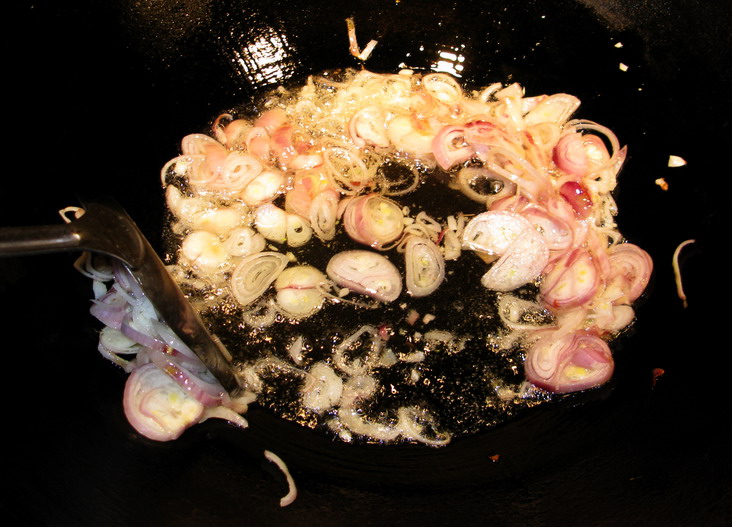
Let me give a word about shallots: they are an often overlooked ingredient in Thai food, and I find them to be indispensable when I am cooking Thai. They give a delicious sweetness to Thai stir-fries and roasted, they are often incorporated into curry pastes. I have tried onions and scallions both in the same capacity and they just don’t taste right. It has to be shallots. And you will notice that I used quite a bit of them in this stir-fry–they are a main component of the overall flavor of the dish, not to mention that they give a little subtle hint of pale violet color–at least in the parts of the slices that aren’t browned.
One more word of advice before I give the recipe–the number of bird chilies you use depends on how spicy you like the dish, and how hot your particular batch of chilies is. I bought some at a local store last week which were not at all that hot, but the ones I bought from the Thai grocery store in Columbus were smokin’! I tasted one while I was prepping, and boy was it hot! It brought tears to my eyes. For less spicy chilies, I might have used around eight of them, but for these wicked little red fellows, I used five.
This would be really tasty with spiced pressed tofu and mushrooms in place of the pork, too. I love both of them with gai lan and they would go beautifully in this sauce.
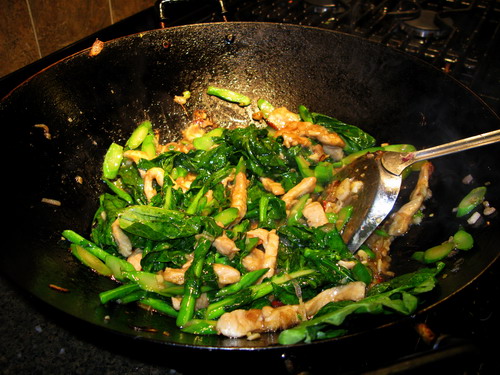
Thai Pork and Gai Lan with Shallots, Garlic and Chilies
Ingredients:
3/4 pound lean pork loin, trimmed of excess fat and thinly sliced in pieces 1 1/2″ X1/4″X1/8″
1 1/2 tablespoons cornstarch
2 teaspoons Thai Sweet Soy
1 tablespoon dry sherry
2 tablespoons fish sauce
3 tablespoons canola or peanut oil
1 cup thinly sliced fresh shallots
8 cloves fresh garlic, peeled and minced
5-8 Thai bird chilies, to taste, thinly sliced on the diagonal
1 tablespoon palm sugar
2 teaspoons Thai sweet soy sauce
2 tablespoons fish sauce
1 pound gai lan, washed and dried, stems cut thinly on the bias, and leaves cut into large pieces
2 tablespoons chicken broth or stock
1 tablespoon oyster sauce
juice of one lime
Method:
Mix pork slices with the next four ingredients, and allow to marinate for at least twenty minutes, but no longer than about a half hour while you prepare the other ingredients.
Heat wok until it smokes, and add oil. Allow to heat for another thirty seconds. Add shallots to the wok and stir fry until they turn golden brown and fragrant. At this point, add pork, spread it into a single layer on the bottom of the wok and sprinkle garlic. chilies and palm sugar over it. Leave the pork undisturbed until the pork browns lightly on the bottom, and then stir fry until most of the pink is gone. Add sweet soy and fish sauce, then the gai lan and continue cooking. Sprinkle the gai lan with the chicken broth or stock, and stir fry until all the pink is gone from the pork, and the gai lan leaves are wilted and the stems are have brightened to a nice emerald green. Add the oyster sauce and lime juice, and toss over heat for a few seconds to combine, then remove from heat and scrape into a warmed serving plate.
Served with steamed jasmine rice.
Affordable Luxury: Cream of Asparagus Soup With Cardamom and Chives
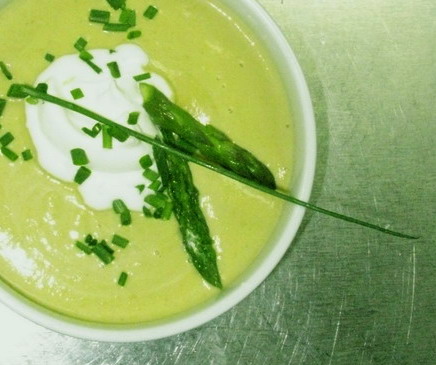
There are few foods more luxurious than a velvety cream soup. The cream not only gives the soup its incredible mouthfeel, which is decadently intense bordering upon sinful, but it also boosts the flavors of the main ingredients because, as we should all know by now, fat carries flavor.
When your soup is based upon a vegetable, cream really strengthens the flavor and fragrance because the flavors and scents of many vegetables, herbs, aromatics, and spices, are fat-soluble, which means that if they are bathed in warm fat, more of the molecules that carry their scent and flavor will be extracted from the vegetable matter. Adding to this flavor-boosting effect is the fact that cream soups are always pureed–this process also releases more flavoring agents into the dish, because of course, the more surface area of a substance that is exposed to heat, the more flavor can be extracted.
So, I guess you can tell from the above two paragraphs that I am personally in favor of cream soups.
And it is true, I am, although it was not always thus.
I grew up with hearty vegetable soups that were based on tomato and meat broth and which contained chunks of vegetables. The only creamy soup I really liked was cream of broccoli or cheddar broccoli soup, which I ate rarely because few people I knew made them, and the canned versions were, well, they left a lot to be desired. (The truth is that I also loved Campbell’s Cream of Tomato Soup, too, but as it is not made with real cream, I don’t really count it as a cream soup. It may have been good, smooth and silky, but it was made with milk, so it didn’t count.)
But when I first had a sip of a real cream-based soup, which I believe was lobster bisque, it was love at first taste.
Not surprisingly, when Hilarie asked me to come up with a soup course for the Valentine’s Day menu, and I saw that asparagus was currently cheap at the wholesaler, I jumped on the idea of a cream of asparagus soup with Indian spices. Besides, it would offer a beautiful, cooling, spring-like color scheme of shades of green and white, which is soothing, while the flavor would be at once subtle and seductive.
As I was thinking of how to serve the soup–in what way I would present it for the greatest visual impact, I had the inspiration to put a dollop of unsweetened whipped cream in the center of the soup, and garnishing it with a pair of emerald colored steamed asparagus tips, some thinly sliced chives and a gracefully curved long chive leaf.
I could have used creme fraiche or sour cream, but I liked the idea of unsweetened whipped cream better. I didn’t really want to change the flavor profile of the soup in the way that either creme fraiche or sour cream would, but I loved the idea of a cloud-like island of billowy soft cream in the center, framed by darker green vegetation, floating in the sea of pale jade soup.
So, that is what I did, and it made people very, very happy.
One more note before I give the recipe: you can make these completely vegetarian by using vegetable broth instead of the chicken stock in this dish. I did, in fact, make a small pot of a vegetarian version of this for the vegetarian guests whom we knew to be coming, and it was quite good. It was not quite as luxurious and richly golden in flavor, but it was still very, very good.
I wouldn’t make it vegan, however–unless you are really allergic to dairy products. And even then–well, I would hesitate to make this recipe without real cream or at least half and half. In my experience vegan alternatives to dairy products do not always taste as good in cream soup recipes as the real McCoy, so keep that in mind. If you do decide to substitute and it turns out odd or weird tasting–don’t complain to me–I warned you, but do indeed experiment, try again and let me know if you manage to come up with a vegan version that is really, really tasty and doesn’t suffer from the lack of real dairy products.
One more note–you really need a good immersion blender to make this soup successfully. If you have a good one like we do at Salaam, you don’t have to strain the soup after it is pureed–it will be velvety enough on its own. If you only have a conventional blender, you can still make this soup, but be prepared to strain the resulting puree through a fine-meshed sieve. I say go for the immersion blender–once you have one, you will never know how you did without one for so long.
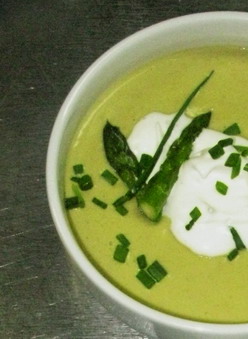
Cream of Asparagus Soup With Cardamom and Chives
Ingredients:
3 tablespoons olive or canola oil
1 cup thinly sliced yellow onions
1 teaspoon salt
1/4 cup dry sherry
6 cloves garlic, minced
1/4 teaspoon freshly ground cardamom seeds
1/4 teaspoon freshly ground white peppercorns
2 teaspoons finely grated lemon zest
4 quarts chicken stock or broth or vegetable broth that was made without tomato
3-4 pounds fresh asparagus
1 really large potato peeled and cut into thin slices
1-2 cups heavy cream–use at your discretion
salt and white pepper to taste
fresh lemon juice to taste
1/2 cup heavy cream whipped to soft peaks
thinly sliced fresh chives and uncut long fronds of fresh chive for garnish (In season, chive blossoms would look amazing as a garnish with this soup–the pale lavender would look stunning with the light jade color of the soup, the white cream and the deep green chive leaves and asparagus tips)
Method:
Heat oil in the bottom of a heavy-bottomed soup or stockpot over medium heat. Add onions and sprinkle with salt. Cook, stirring as needed, until the onions turn a medium gold color. Then deglaze the pot with the sherry, add the garlic, spices and lemon zest. Allow the alcohol to boil away, then add the stock or broth, and bring to a boil.
Remove the lowest quarter of the asparagus stalks–the toughest parts, and choose about twenty of the prettiest tips, and cut them off on the diagonal from the stalk. Put them in a bowl, add a few tablespoons of water, cover loosely with plastic wrap and microwave for about forty five seconds to a full minute–just until the tips become tender and deepen to a vibrant emerald green color.
Slice the rest of the asparagus stalks and tips into slices about 1/2″ in length, and add to the boiling stock or broth. Add the thinly sliced potato, and cook until the potato is completely tender and the asparagus has just turned tender. Do NOT overcook the asparagus–you want it to retain as much of the fresh green color as possible. If you cook the stalks until they are completely mushy, the color will become a dull olive drab and the resulting soup will not look fresh and inviting, but instead will look rather vile and unappetizing. So take my advice and watch the asparagus like a hawk.
When it is done, strain out the solids, by pouring the soup through a sieve set over another soup or stockpot. This way you can reserve the cooking liquid, because you are going to need some, but probably not all of it.
Then, put the vegetables back into the soup pot, add about a cup of the cooking liquid and then puree with an immersion blender, adding liquid as needed to help the vegetables form a velvety smooth pureed texture.
After you have the vegetables completely pureed, warm the cream you are going to add to the soup in the microwave. Add as much cream and the reserved stock to make the soup as thick and creamy as you like. When it is done, adjust the seasoning to taste with the salt, pepper and most importantly, the lemon juice, and hold above 141 degrees F. until service.
To serve, ladle into small bowls, add a little dollup of the whipped cream to the center of the bowl, sprinkle sliced chives around the little whipped cream island, place two asparagus tips next to it at close to 45 degreet angles to each other, with the cut ends sunk into the cream, and place a long curved frond of chive with the cut end in the cream between the asparagus tips, arcing over the soup gracefully. (Use the photos above as reference for plating.)
I guarantee that this soup will not only taste amazing, it will also look gorgeous on the table. It is perfect for an evening of romance and seduction.
Largest Beef Recall in US History a Natural Consequence of Industrial Agricultural Practices
My regular readers by now should know what I think of confined animal feeding operations (CAFO’s), which are the backbone of the meat industry in the United States: they create unsafe environments for humans and animals, cause untold amounts of animal and human suffering, they lead to unsafe, dirty meat supplies, and they are just plain old, downright bloody evil. (Yes, I said it–evil.)
When the story broke last month about a videotape taken undercover by members of the Humane Society of the United States which showed slaughterhouse workers beating, kicking, and using forklifts to force “downer cows”–cows so ill they were unable to walk–to stand and walk so they could legally be slaughtered and used for human consumption, a quiet trickle of controversy began. That trickle became a flood as more and more Americans got a first-hand glimpse of the hideous cost, both human and animal, of cheap beef, and people began talking, both in the media and in homes across the country. Voices were raised in outrage, not only because of the vicious cruelty shown to the already hurting cows by the slaughterhouse workers, but because US government regulations disallow such cows from being declared fit for human consumption because of the dangers posed by eating meat from animals who could have bovine spongiform encephalopathy , known popularly as “mad cow disease.”
The loudest exclamations came about, however, when it was made clear that the meat from this particular slaughterhouse supplied ground beef to the federal school lunch program which serves hot lunches to schoolchildren across the United States.
The idea that innocent, unknowing children might have been fed beef contaminated with BSE among other diseases sent chills up the spines of parents everywhere.
As well it should; this story is a case of corporate greed taking precedence over the health and well-being of not just human beings, but the most vulnerable humans–children.
As if the brutal treatment of sick, defenseless cows wasn’t bad enough, it was done in the name profit, with not only the cows suffering the consequences of this senseless worship of money, but schoolchildren were also the target of uncaring, faceless corporate drones and their minions on the killing floor.
In an unprecedented move, the generally toothless, spineless and utterly worthless USDA, requested the largest beef recall in US history yesterday, imploring the corporation fingered in the Humane Society video, Westland/Hallmark Meat Packing Company in Chino, California, to voluntarily recall 143 million pounds of beef from circulation.
Please note my use of the words “requested,” “implored” and “voluntarily,” in that last sentence.
Many media outlets, including CNN are saying that the USDA “ordered” this recall, even though that is not the case. The USDA, even though it is in part a regulatory agency charged with overseeing the safety of the US food supply, does not have the legal authority to order recalls of diseased, tainted or otherwise unsafe food products.
The best that the USDA can do is ask food producers to voluntarily remove unsafe products from the human food chain, hopefully before too many people get sick and die.
In this case, which the USDA says involves a very low risk of the beef being contaminated with disease-causing organisms, it turns out that the recall is utterly worthless since most of the 143 million pounds of meat in question (apparently that is enough ground beef to make two hamburgers for every man, woman and child in the US–what a treat!) has probably already been consumed. A good amount of it presumably by kids eating school lunches.
Most of this beef was slaughtered and ground up over the span of two years, so of course, most of it has already been bought, paid for, and eaten, meat being a perishable item and all. And I guess that the USDA figures that there is a minimal risk of illness because this meat, having already been eaten, hasn’t seemed to cause anyone to get sick, now has it?
On the other hand, if some of those downer cows were infected with BSE, and meat from them contaminated with the prions which cause the disease were eaten by American citizens, we wouldn’t know about it yet anyway, since the incubation period for new variant Creutzfeldt-Jakob disease, which is what people get when they eat prions in meat from BSE infected cows, is anywhere from 16-50 years. (I have read a bunch of different estimations on the incubation period for CJD–it seems that no one really knows for certain.)
By which time, the owners of the Westland/Hallmark Meat Packing Company may have made billions of dollars selling possibly tainted meat to the US government to be fed to school children–a captive audience if ever there was one–and to restaurants and individual consumers. The fact that those who eat this meat may well die in sixty years or so with brains that look like hunks of grey swiss cheese is immaterial. The money will have been made, and our government, ever in the service of corporate greed, will have done nothing to stop it.
When I read letters and posts the other day on the NY Times blogs about the Humane Society video, I wasn’t really surprised to see people expressing shock and disbelief at what they were seeing, not to mention the implications of the information presented in therein. People acted as if it was a great surprise to learn what the true costs of the flood of CAFO-produced cheap meat are in this country.
Of course, the truth is that when you industrialize any process, and treat any living creature involved in that process as a product or commodity, the natural consequence of this action is that -all living creatures- involved in the process also become seen only as cogs in the profit-making machine. What I mean is that when animals, in this case, cows, are treated not as living creatures, but instead as objects or products, the humans who are involved in the process, whether they are slaughterhouse workers or consumers, are also disregarded as objects. When monetary gain is the highest goal set by a corporation, and greed becomes the ruling law of the day, and animals and humans alike are commodified and their suffering or potential safety is disregarded as immaterial to the goal of making as much cash as possible by cutting every possible corner, then it should come as no surprise to learn that animals are made to suffer heinously, workers are put into unsafe working conditions which not only threaten their lives, but also their humanity, and consumers, including children, are endangered by the consumption of unsafe food.
What should also come as no surprise is that our government is not only not doing anything to stop this sort of criminal activity, but is also complicit in it. For decades, our government has been less “by the people and for the people,” as it has been “by the corporations and for the corporations.” Laws that were once enacted in order to keep workers and consumers safe have been gutted in favor of helping large businesses make more money at the expense of human wellbeing.
And what is really amazing is that people act as if this sort of horror has not happened before. Does no one read The Jungle anymore, or do people believe that just because it Upton Sinclair’s novel inspired the passage of the Pure Food and Drug Act and The Meat Inspection Act into federal law that animals, consumers and workers are protected from the hellish brutality depicted therein?
I guess that what has happened is that consumers have assumed that because of these laws enacted early in the twentieth century, that the meat industry has changed its ways and the US government food inspectors are a well-funded, powerful group who are able to keep us all safe from corporate wrongdoing when it comes to our food supply. What consumers do not know or think about is how those laws have been weakened over decades of successful industry lobbying, and as a consequence of this how the USDA’s inspection process has been hampered by lack of adequate funding and lack of congressional and consumer oversight.
Of course, it isn’t as if there has not been public outcry on the subject of food safety over the hears. I remember a few reports on 60 Minutes in the seventies, and more recently, Eric Schlosser’s Fast Food Nation and Michael Pollan’s The Omnivore’s Dilemma have both pointed out the precarious situation our food supply is in, all because Americans insist upon cheap widely available meat and the industry which provides it insists upon as little regulation and oversight as possible.
Neither of these works has resulted in the kind of outcry we are seeing over the Humane Society video, however.
And that is fine–I don’t care if it is a book, a video or somebody’s grandmother which get Americans off their duffs and springing into action over the issue of CAFO’s and food safety. I just want them to stop slumbering on the issue and start acting.
Whether they act by boycotting beef, becoming vegetarians, calling their congresspersons and demanding legislative action, by switching to locally produced grass-fed meat or by demanding better food in schools–I don’t care.
The silver lining to this ugly stormcloud is that finally, Americans are moved to demand action.
I just hope that people see through the sham of this “recall” and keep making a fuss. Loudly. And that they start hitting the beef industry in the wallet, so that there is financial impact. Because frankly, that is all that the meat industry in this country will understand–if their bottom line is hurt, and only if they lose money, will they change.
Upton Sinclair would be sad to see the current way that meat is produced in this country, but I believe he would be heartened by the fact that Americans are once again awakening from their complacent consumer slumber, and are realizing that the ugly face of meat is not just a historical curiosity.
It is alive and well, and stalking our children even today.
Images From The Valentine’s Day Menu

It is true when people say that for restaurant people, working Valentine’s Day and Mother’s Day is like the entire pre-Christmas retail season rolled into one long shift or so. Those are the two days in a restaurant’s calendar that are destined for wild and crazy amounts of business.
This year, Hilarie had the idea to put together a special prix fixe five-course menu which would include a small selection of appetizers (we ended up with three), a soup, a salad, a main course (we had three options), and a dessert. Of course, a prix fixe menu is all-inclusive, with one price for the menu which includes no substitutions. (Although, the truth is, we made substitutions from our regular menu for some customers, ones who are lactose-intolerant, for example. We just are not good at being true hard-asses as some restaurant folks are.)
Of course, the problem with the prix fixe menu, is that we also offered our regular menu items; this isn’t necessarily problematic, except that it tended to confuse the flow of food out of our kitchen.
Basically, what happened is that the kitchen crew had to learn how to cook, plate and garnish totally new menu items, in addition to the usual items we can all do with our eyes closed. It was a little confusing at times, but the truth is, the staff did beautifully, and everything went out smoothly. There were some little mix-ups, but nothing horrible happened during service. No courses were lost, no patrons were run over by errant food runners (I count myself in that number), nor did any of us trip and fall up on the stage where the band was playing great gypsy jazz and torch songs.
It was really a lot of fun, if tiring. I spent most of the first part of this week prepping the food for this one meal, but it was all worth it.
For an example, take a look at the appetizers up above. The muhammara was made yesterday, and it is really simple and delicious. The lebni–which is on the left hand side, is a delectable drained yogurt cheese blended with fresh dill, a bit of salt, and walnuts, with a few other seasonings. Both of these were served with pita triangles.
Between those two spreads is the troublesome menu item: green Spanish olives stuffed with feta cheese and marinated in lemon juice, preserved lemon bits, chili pepper, black pepper, olive oil and garlic.
Everyone loved these, which was great. They should love them, because stuffing feta cheese into olives is a bloody annoying task which I would wish on no one. I declared to all and sundry that I was never going to make them again, and in fact, cursed myself for having such a daft and maniacally obsessive-compulsive idea the entire time I stuffed these critters, but really, they are good. You’d think that the olives and feta would be too salty together, but they really weren’t. The marinade, which was tangy and lemony and garlicky, helped with that.
After all of the compliments on those olives, I resolved that if asked nicely, I would probably do them again, even if they were tedious to put together.
But they still stand as a testimony to the streak of compulsive behavior that most chefs have in the makeup of their personalities.
The next course, of course, was soup.

As you can see, this is cream of asparagus soup spiced gently with cardamom and other Indian spices.
There are all sorts of tasty ingredients in the soup: chicken stock, fresh asparagus, lemon zest, lightly caramelized onions, fresh garlic, cream, half-and-half, potatoes and chives. I also made a vegetarian version that did not include the chicken stock–I made it with water, but finished the soup with a bechamel sauce enriched with egg yolk.
It turned out beautifully. The compliments for the soup came fast and furious, and I was thrilled with the response.
I especially liked the elegant presentation: I put a dollop of unsweetened whipped cream in the center of the bowl of soup: it floated like a fluffy island of dairy goodness. Next to the whipped cream are two steamed asparagus tips, with a long spear of chive between them, with tiny flecks of chopped chives surrounding everything. The deep green of the chives and the emerald of the asparagus tips contrasted with the pale jade of the soup and the pure white of the whipped cream. It looked just like spring, the spring that we all hope is going to be wending our way soon.
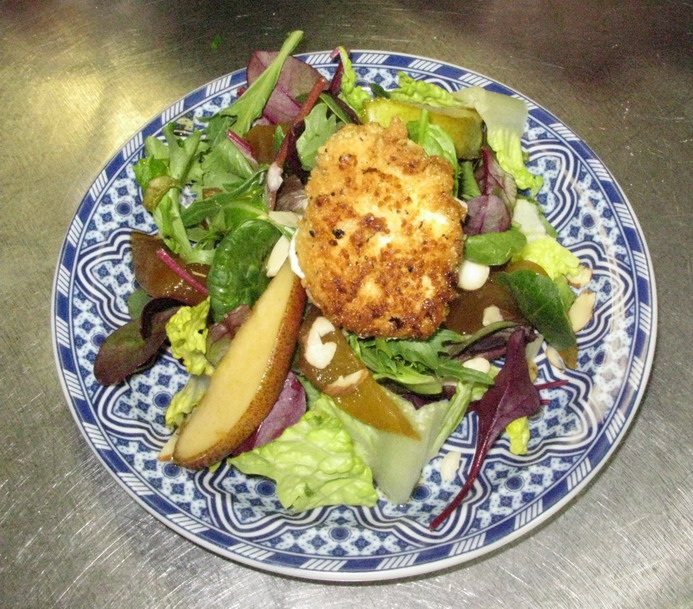
Here is the salad: caramelized pears over mixed greens with sliced almonds and pan-fried goat cheese with a pomegranate dressing.
I was surprised that no one had tasted pan-fried chevre; I thought that it was a rather over-done appetizer and salad topping. Then, I had to remember that I was chided for loving that when I was in culinary school, among chefs from New York, Paris, Alsace, Italy, and all over Europe. These folks had seen and done everything, so pan-fried cheese was passe to them.
But not to the folks of Athens.
I have to say, they took to it naturally–folks raved about it. We fried the little patties of cheese a la minute, which means, at the last minute, so the were sizzling hot on top of the cold greens and chilled caramelized pears.
I promise to put up a recipe for this one–caramelizing the pears was fun, and making the cheese is even more fun. I think that it would make a great salad for a dinner party.

Now we come to the main courses.
Here is Hilarie’s Moroccan roasted lamb and vegetables. This is one of my favorites of her dinner specials, leg of lamb marinated with garlic, olive oil, spices and herbs then roasted with sweet potatoes, onions and carrots, all marinated in the same tasty goodness. She makes a cracking-good gravy to go with it, and tonight, we had it with rice, though it goes perfectly with couscous, too.
Do you like the cute little red heart cut from bell pepper? Those are fun to make with little heart-shaped cutters, and they are fast, too.
I can still smell that lamb.
I probably should have had some to eat myself. Duh!

That is one of the stuffed peppers I made for a vegetarian entree.
It is a blanched sweet red bell pepper, with the top cut off, and then cut partway in half from top to bottom, and spread apart.
The stuffing is a mixture of rice, chickpeas, tomatoes, lentils, onions, garlic, spices and almonds. I put a scoop of the stuffing under the pepper, then a generous mound of it in the pepper. I topped it with some more of that egg enriched bechamel sauce, and topped that with crumbled feta cheese, and then baked it. When the sauce was bubbly and the feta was browned, I sprinkled some chives and parsley over it and added another little pepper heart.
As for the salmon with green chutney–it looked pretty much like the fish I posted about last week, except it had another red pepper heart tucked in the lemon twist.
Now we come to the dessert: Chai Creme Brulee.
I was a goof and forgot to take a photograph of it plated and pretty, but here is an action shot of the sugar topping being caramelized with a propane torch by Becky. It was a huge, HUGE, and I mean HUGE hit for everyone, such that it is going to become a signature Salaam dessert which we will have on our dessert tray most of the time.

The guests, of whom there were many, loved the dinner, especially the creme brulee. When I was taking various courses to the tables, I was thrilled to be thanked by all and sundry, many of whom were effusive in their praise of the entire dinner. When asked what my next project would be, I answered, “Ice cream and sorbet!” and was met with many anticipatory smiles.
I finally left near the end of dinner, after the third seating came in and their dinners were going out. Hilarie introduced me to many of her old friends, and then gave me a hug. I looked at her and said, “Whose stupid idea was this anyway?”
She snorted and retorted, “Hey, you went along with it!”
What could I say except, “I’m crazy enough to think that stuffing hundreds of olives with feta cheese by hand is a good idea, so what do you expect?”
It was fun, even if it was a lot of work.
The payoff was great–we were surrounded by people with happy bellies, the scent of great food in our noses, and the sound of lovely music in our ears.
I can’t wait until next Valentine’s Day.
Devising a Special Valentine’s Day Prix Fixe Menu

It is very fun working in a small, local restaurant, especially around holidays.
For something new and different this coming Valentine’s Day at Salaam, Hilarie came up with the idea of offering a prix fixe menu that included special appetizers, soup, salad, a choice of two main courses, and a dessert. The Django Reinhardt tribute band, the Coolville Hotclub will be playing gypsy jazz with guest singer Emily Burhans, whose whisky-smooth voice slithers sensually through love songs like a silk dress over a woman’s hip.
Considering the intimate, cozy dining room, the ambiance created by the band, and the general Silk-Road theme of Salaam, I had a great time coming up with a series of courses to beguile and entice our guests.
The appetizers will be lebni, which is a cheese spread made from strained yogurt, walnuts, dill and spices, muhammara which is just the sexiest dip ever conceived by humanity, and feta stuffed Spanish olives marinated in preserved lemons, herbs, olive oil and Aleppo pepper, all served with a side of toasted pita triangles.
Then, we will have a cream of Asparagus soup with chives and Indian spices, garnished with asparagus spears.
Next is a salad of caramelized pears over mixed greens with fried chevre and almonds, dressed with pomegranate salad dressing.
The entree choices are Moroccan roasted leg of lamb with roasted vegetables or salmon steaks baked over rice and tomatoes with green chutney. (We are also doing a vegetarian option of a sweet pepper stuffed with rice, lentils, golden raisins and almonds with bechamel sauce and feta cheese on top for vegetarians who call ahead.)
The dessert is the show-stopper–chai creme brulee. I developed the recipe using Anthony Bourdain’s basic creme brulee recipe from his Les Halles Cookbook which I fiddled with to give the the rich custard the delicate flavor of spiced tea, without making it taste–well, like some very nasty cremes brulees I have had in the past at other restaurants.
The menu will be a bit of a challenge to serve considering how tiny our kitchen is, but the staff we have to work with is amazing, so I am confident that all will go well. I spent most of today prepping appetizers (remind me never to suggest stuffing olives with feta cheese again–yeah, it tastes great, especially after they are marinated, but geez, Louise, is it a royal pain in the hind end), and making on the chutney for the fish, the caramelized pears, and the creme brulee. Well, I made the custard today, after letting the flavorings steep in the cream overnight. The burnt sugar topping won’t get made until service tomorrow–I don’t like burning the sugar and sticking it in the fridge–I like the contrast between the cold custard and a crisp, warm sugar crust.
Tomorrow, I need to go in early and make the soup, prep the garnishes and the cheese, which will be fried at service.
It should be fun.
I promise to post pictures either tomorrow night or Friday morning!

Categories:
- Admin (rss) (55)
- Blogs and Blogging (rss) (81)
- Book Reviews: Cookbooks (rss) (43)
- Book Reviews: Non-Cookbook Food Books (rss) (38)
- Cats and Cat Blogging (rss) (47)
- Chinese Cooking Lessons (rss) (32)
- Culinary School Stories (rss) (18)
- Dairy Pruducts: Cultured and Barbaric (rss) (4)
- Documentary Filmmaking (rss) (1)
- Essays, Rants and Reflections (rss) (260)
- Fighting Hunger (rss) (12)
- Food and Kids (rss) (45)
- Food in the News (rss) (126)
- Food Media (rss) (98)
- Food Preservation (rss) (18)
- Food Safety (rss) (45)
- Gardening (rss) (30)
- Herbs and Herb Blogging (rss) (20)
- Holidays (rss) (50)
- Kat Blogging (rss) (22)
- Kitchen Science (rss) (36)
- Leftover Makeover (rss) (8)
- Life, the Universe and Everything (rss) (131)
- Local and Sustainable (rss) (227)
- Local Athens Food and Foodies (rss) (42)
- Meatless Mondays (rss) (32)
- Menu For Hope (rss) (5)
- Nutrition, Diet and Health (rss) (84)
- On The Farm (rss) (8)
- Recipes: Almost Vegetarian, Vegetarian and Vegan (rss) (294)
- Recipes: American Regional (rss) (37)
- Recipes: Appalachian Hillbilly (rss) (33)
- Recipes: Bread, Pasta, Grains (rss) (95)
- Recipes: Canning and Preserving (rss) (8)
- Recipes: Chinese (rss) (123)
- Recipes: Comfort Food (rss) (120)
- Recipes: Cookies (rss) (16)
- Recipes: Desserts (rss) (48)
- Recipes: French (rss) (25)
- Recipes: Fruits and Vegetables (rss) (302)
- Recipes: Greek, North African and Middle Eastern (rss) (31)
- Recipes: Indian (rss) (137)
- Recipes: Italian (rss) (42)
- Recipes: Japanese (rss) (7)
- Recipes: Jewish (rss) (4)
- Recipes: Korean (rss) (6)
- Recipes: Meat, Poultry and Fish (rss) (220)
- Recipes: Mexican/Native American/ Latin American/Caribb (rss) (27)
- Recipes: Original (rss) (108)
- Recipes: Thai (rss) (27)
- Recipes: Tofu (rss) (17)
- Recipes: US Regional (rss) (16)
- Recipes: Vietnamese (rss) (8)
- Restaurant Stories (rss) (28)
- Sewing, Quilting, Arts and Crafts (rss) (16)
- Simple Chinese Recipes (rss) (30)
- Slow Food and Heritage Foods (rss) (10)
- Spice Blogging (rss) (44)
- The Chinese Cookbook Project (rss) (14)
- The Chinese Pantry (rss) (39)
- The Documentary (rss) (2)
- The Kitchen Saga (rss) (17)
- The Locavore's Bookshelf (rss) (15)
- The Unsung Adventures of The Culinary Nerd (rss) (6)
- Tools and Toys (rss) (35)
- Uncategorized (rss) (10)
- With a Side of Politics (rss) (48)
Archives:
- August 2012 (9)
- July 2012 (12)
- September 2011 (3)
- August 2011 (7)
- July 2011 (8)
- June 2011 (16)
- May 2011 (17)
- April 2011 (11)
- December 2010 (9)
- November 2010 (5)
- February 2010 (1)
- December 2009 (5)
- November 2009 (7)
- October 2009 (10)
- September 2009 (16)
- August 2009 (14)
- July 2009 (14)
- June 2009 (7)
- May 2009 (17)
- April 2009 (10)
- March 2009 (25)
- February 2009 (13)
- January 2009 (10)
- December 2008 (5)
- November 2008 (5)
- October 2008 (6)
- September 2008 (13)
- August 2008 (8)
- July 2008 (11)
- June 2008 (18)
- May 2008 (13)
- April 2008 (14)
- March 2008 (16)
- February 2008 (17)
- January 2008 (19)
- December 2007 (25)
- November 2007 (18)
- October 2007 (24)
- September 2007 (16)
- August 2007 (15)
- July 2007 (15)
- June 2007 (10)
- May 2007 (14)
- April 2007 (16)
- March 2007 (17)
- February 2007 (20)
- January 2007 (13)
- November 2006 (1)
- October 2006 (8)
- September 2006 (14)
- August 2006 (25)
- July 2006 (30)
- June 2006 (28)
- May 2006 (34)
- April 2006 (29)
- March 2006 (24)
- February 2006 (30)
- January 2006 (38)
- December 2005 (40)
- November 2005 (37)
- October 2005 (32)
- September 2005 (25)
- August 2005 (30)
- July 2005 (28)
- June 2005 (21)
- May 2005 (8)
- April 2005 (22)
- March 2005 (17)
- February 2005 (29)
- January 2005 (10)
Search Site:
Links:
- Lily’s Wai Sek Hong
- 101 Cookbooks
- A cat in the kitchen
- A Veggie Venture
- Accidental Hedonist
- Cha Xiu Bao
- chez pim
- Chocolate & Zucchini
- Chopstick Cinema
- Chowhound.com
- Chubby Hubby
- Cook sister!
- Cooking with Amy
- da*xiang
- Eat Local Challenge
- Eating Liberally
- Ecocentric
- Eggbeater
- Epicurious
- Farmgirl Fare
- Fatfree Vegan
- Foodgoat
- ForkandBottle.com
- Green Olive Tree
- Hooked on Heat
- Jaden’s Steamy Kitchen
- Kalyn’s Kitchen
- Lucullian delights
- Mahanandi
- Matt Bites
- MeatHenge
- mmm-yoso!!!
- New York Times – Dining & Wine
- Pizza Goon
- Rasa Malaysia
- Ruhlman
- Sailu's Kitchen
- Serious Eats
- SF Gate: Food & Dining
- Simply Recipes
- Soul Fusion Kitchen
- Tastespotting
- The Amateur Gourmet
- The Cleaner Plate Club
- The Food Section
- The Grub Report
- thecookscottage
- U.S. Food Policy
- Wandering Chopsticks
- Washington Post Food and Dining
- Wasted Food
Meta:


Powered by WordPress. Graphics by Zak Kramer.
Design update by Daniel Trout.
Entries and comments feeds.