
Cook Local, Eat Global
Dal of the Day: Rajma Dal
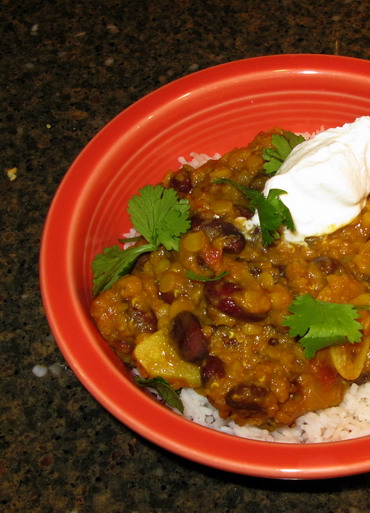
This recipe is my own, and does not reflect any “authentic” tradition from any part of India, even though the ingredients, techniques and execution are quite Indian, and results in a very authentic and delicious flavor.
I started making dals at Salaam almost from the first day I worked there, not only because I love them and they are easy to make, but because I wanted there to not only be more vegetarian options available, I specifically wanted there to be many more vegan options. Our menu is not a bad one for vegetarians, or vegans, for that matter–hummus, baba ganoush, tabouli, pita bread, harira and our curried couscous salad and Ann’s Salad–greens with candied pecans, oranges and green onions dressed in a cider-vinegar vinaigrette–are all vegan and quite delicious. (In fact, the cuisines which form the basis of our menu–those of the Middle East–are quite friendly to vegan dietary needs–there are many purely plant based foods in heavy use from this part of the world.)
There are also vegetarian items which make use of cheese: our house salad with feta cheese, walnuts, mixed greens with spinach, sweet peppers, cucumbers and tomatoes with feta cheese and pomegranate vinaigrette, and spanakopita–a Greek phyllo pastry filled with feta cheese, spinach, garlic and onions–come to mind.
But no matter how many vegan or vegetarian menu items there are, I always think we can always offer more. Athens is home to lots of vegans, vegetarians and flexitarians–those folks like me who will eat more vegetable-based foods, but who do not completely eschew meat–and we all tend to like out food fresh, delicious and good for you.
Dal fits the bill on all counts: it can contain a variety of fresh, seasonal vegetables in addition to the dried beans and lentils which are its main ingredient, when made properly it is filled with flavor and it is generally low in fat (unless we are talking about dal makhani, a Punjabi dish filled with butter and cream), high in fiber, protein and vitamins and phytochemicals from the vegetables and spices. I, like many Indians, believe it has curative powers, and think it is a perfect food for those who are not feeling well, and furthermore, I find that it can cure, if not a broken heart, then heart that is seriously down in the dumps.
My dals have been rising in popularity over the past months, to the point that customers will ask for them especially. One customer, who wanted a special takeout order of vegan for six people–she was having a dinner party–that contained chickpeas, or channa, told Hilarie when she put in her order that she had brought a friend from India to eat at Salaam and he had taken one bite of one of our curries–she couldn’t remember which, but was pretty sure it was a dal–and he actually teared up, because he said that after living in the US for nine years, this was the first time he had eaten Indian food in any restaurant that tasted like home. That same week another Indian man had come in for lunch two days in a row just to eat my dal.
Salaam’s employees have become converts to the way of dal–when I come in on Tuesday or Wednesday mornings to make lunch specials and I start boiling the lentils or beans, Keri, who swears she never ate vegan food that she loved before I introduced her to dal, will dash back, drawn by the earthy aroma of the legumes and will stick her face in the steam and grin. “You’re making dal, aren’t you?” she says, excitedly. Dennis, the day cook and my partner in crime when it comes to finding good recipes to try, has appointed himself my taste tester, and will not let a serving of dal go out to a customer without his own seal of approval.
And Mark and Hilarie–our owners and arguably two of the coolest folks in Athens–have declared that they could eat dal every day for breakfast for the rest of their lives and be happy.
So, that is the tale of my “dals of the day” which sometimes are traditional recipes, and sometimes are made from a mixture of the lentils and beans in our pantry cooked with any combination of spices, vegetables and herbs I can imagine.
This rajma dal is one of my own creation–it is a mixture of dried masoor and toor dal cooked until they are softened, to which canned, rinsed kidney beans–rajma, canned tomatoes, and frozen fenugreek greens–methi–are added. While this, the dal’s base simmers to reduce the liquid, I put together a grand tarka containing a bunch of thinly sliced onions, lots of minced ginger and garlic, fresh chili peppers, lots of whole cumin and mustard seeds, and at the very last, a sprinkling of freshly ground fenugreek seeds, cooked in perfect succession in canola oil. This tarka, once the dal is cooked down to a thick, but still liquid, rich yellow puree dotted with kidney beans and tomato pieces, is tipped into the pot and stirred madly to meld all of the ingredients into a fragrant, extremely delicious whole. (At home, I like to use the garlic just thinly sliced, but at work, in deference to those who may not like to bite into a hunk of garlic, I mince it.)
At Salaam, we always serve dal over basmati rice, with sides of green chutney and cucumber raita. At home, I am perfectly happy with just basmati rice and strained yogurt with some lime pickles. Either way, this rajma dal is a hearty vegetarian meal, easily made vegan by leaving off the dairy-based accompaniments. It is a great way to introduce vegetarian meals to non-vegetarians, especially if you add some greens cooked in a tasty Indian fashion, as well as some spicy aloo gobi to the plate. These vegetable dishes not only add color, textural variety, vitamins and other nutrients to the meal, their flavors go beautifully with this dal. (I have found over the years that meat-eaters will miss meat less if they are presented with a plate of vegetarian food that is not only hearty and delicious, but which also features a variety of textures, colors and flavors. They get so into trying everything alone and in combination that they forget about the meat.)

Rajma Dal
Ingredients:
1 1/2 cups masoor dal, picked over carefully for stones and debris and rinsed and drained
1/2 cup toor dal, picked over carefully for stones and debris and rinsed and drained
water as needed
1 1/2 teaspoons ground turmeric
pinch asafoetida (optional)
3 14 ounce cans dark red kidney beans, drained and rinsed thoroughly
1 14 ounce can diced tomatoes
3 cubes frozen fenugreek greens (you don’t have to thaw them) or 1/4 cup fresh fenugreek greens, or 2 tablespoons dried fenugreek greens, soaked in warm water until softened then drained with the excess water squeezed out and discarded
4 tablespoons canola oil
3 cups thinly sliced onions
1 tablespoon Aleppo pepper flakes
1 teaspoon salt
2-4 red and green Thai chilies, thinly sliced on the diagonal (optional)
8 garlic cloves, either minced or cut into very thin slices
1 tablespoon finely grated fresh ginger
1 tablespoon whole mustard seeds
1 1/2 tablespoons whole cumin seeds
1 teaspoon fenugreek seeds, finely ground
salt to taste
chopped cilantro for garnish
Method:
Put masoor and toor dals in a heavy-bottomed wide, deep Dutch oven. Cast iron is great. Add turmeric and if you are using it, asafoetida. Cover with cold water by one inch and bring to a boil over medium heat. Turn heat down to low and cook, stirring and adding water as needed to keep the lentils from sticking, until the masoor cooks down to a puree and the toor dall is tender, but still holding its shape.
Add the kideny beans, tomatoes and fenugreek greens. (They are available frozen, already portioned into cubes and in resealable bags, in most Indian markets.) Turn heat down as low as you can and cook, stirring now and then until the added liquid from the frozen greens and tomatoes is cooked away.
While the dal is cooking, start the tarka–heat the oil in a heavy-bottomed, deep skillet or frying pan. When the oil is hot, add the onions and sprinkle with salt and cook, stirring, over medium heat, until they turn a golden color. Add Aleppo pepper flakes, and f using chilies, add them here, and keep cooking until the onions are a deep golden brown and the oil has turned reddish from the pepper flakes. Add garlic and ginger, and stirring constantly, cook until the garlic takes on a yellowish tinge and all is fragrant. Add the whole spices, and cook until the onions are dark reddish brown, the garlic is golden, and the mustard seeds pop. Sprinkle in the fenugreek seeds, and stir for thirty more seconds, then pour the whole fragrant mess into the dal, and stir it in well.
Taste and add salt as needed for flavor, then serve with chopped cilantro leaves as a garnish. This makes enough for about six to eight people for a main dish, more for a side dish.
Doin’ The Dal Thang
I have always loved lentils and dried beans.
I think that it is because when I was growing up and we were on the lower end of the lower-middle class spectrum, we ate a lot of meals where dried beans and lentils were the centerpiece. Navy bean soup with a hambone, carrots, celery and onions, lentil soup with a little bit of beef, some potatoes, carrots and celery, pinto beans with cornbread, and my favorite, dried baby limas, found themselves on our table, and the tables of most of my friends, neighbors and relatives several times a week. Beans were a great way to stretch a tiny bit of meat, or to replace meat altogether, they were nutritious, hearty and filling, and frankly, they made us all very happy.
Beans and lentils were poor people’s food, but even after our family climbed up the social ladder towards middle-middle class, we still relished our beans, and ate them with the same frequency as before.
They were just too damned good to ignore.
So, knowing as we now do that I grew up eating lots of beans, it should come as absolutely no surprise whatsoever that my number one favorite type of Indian food is dal.
Dal is a word that is used to denote either a spiced bean or lentil dish, or it can also refer to the split or split and skinned beans and lentils that are used to make the dish. I have read that there are over fifty different types of beans and lentils cooked and eaten all over the Indian subcontinent, which not only is amazingly cool, it also makes me hungry just to think about it!
Dal is the soul food of India, and I feel safe to say that it is eaten in nearly every household there, from the most humble to the most opulent, and I would be surprised to find a person of Indian extraction who is not comforted by a nice warm bowl of aromatic, delectably spiced dal. I’m not Indian myself, but I know that no matter how stressed I am at a given moment, no matter how down or blue, my mood can always be lifted by dishing up a bowl of dal, and sitting down to let it wrap my senses in the comfort of its fragrant, delicious embrace.
Dal is the culinary equivalent of an old,soft, warm blanket and fuzzy bunny slippers–and even though, like a threadbare quilt, it seldom looks like much, it is filled with the very essence of comfort.
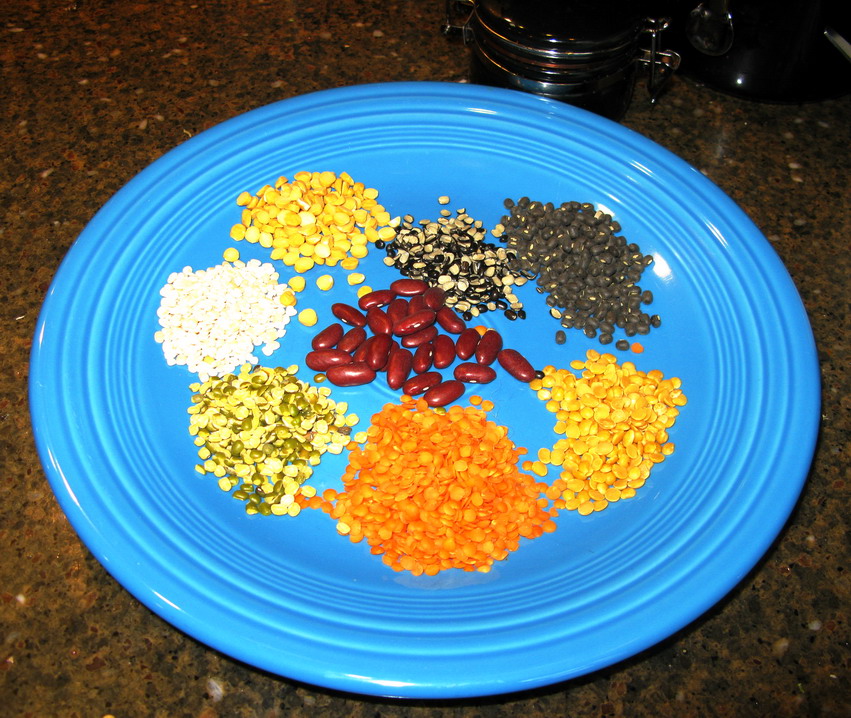
In the photograph above, you see a selection of some of the different dals I have sitting in my pantry. If you look at the plate like a clock, at the noon position, you see split urad–which cooks up to a nice creamy consistency, and has a very nutty flavor. Going clockwise, next is whole urad–these take a while to cook–about three hours, or about forty-five minutes in a pressure cooker–but they are worth the wait. Whole urad become velvety when they are done and their dark color is strikingly lovely. Next is toor dal, which I think has a very sweet flavor, and which cooks up very quickly, but with a bit more texture than the next dal–the brilliant salmon-orange colored one: masoor dal. This is my favorite basic dal–the one I often will use as the basis of mixed dals. It cooks into a yellow puree that has a delectable aroma, and it mixes very well with other lentils and beans.
The green and white dal is split moong dal with the skin left on. Skinned, mung dal is very nutty and sweet, but leaving the skin on not only gives more dietary fiber to the finished dish, it gives color, texture and a vegetal, herbal aroma. The white dal is skinned, split urad–splitting any bean or lentil makes it cook faster, and skinning them makes them more digestible.
Channa dal is next–these are split, skinned channa–chickpeas. They cook up beautifully, retaining their shape and nutlike flavor and aroma. I like to mix channa dal with split skinned moong, split moong and masoor dal for a wonderfully thick, fragrant and well-textured dish.
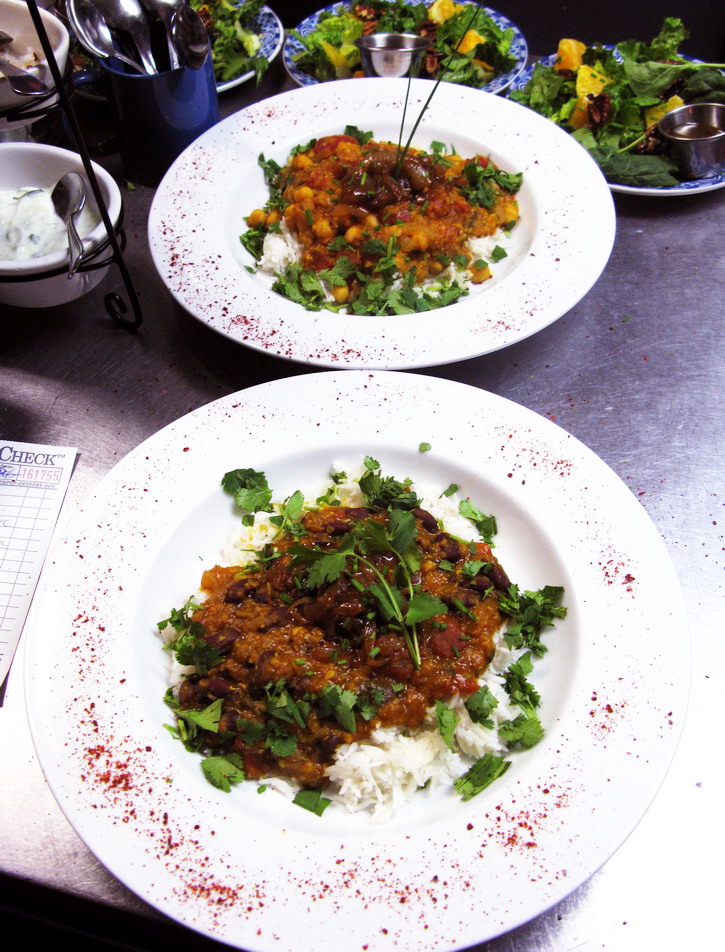
In the center, you will see kidney beans, also known as rajma. These are my new favorite–they have a very meaty, rich flavor and when they are cooked properly, their strong, chewy skins encase velvety soft flesh. I just made a dal with rajma for a dinner special this weekend past, and it was extremely popular.
Dal is easy to cook–but I think that it is a mistake to take its simplicity for granted. The secret to making a great dal isn’t in how you cook the lentils or beans–so long as they are cooked fully, it doesn’t matter if you boil them in a regular pot or use the pressure cooker. And while adding various vegetables to dal–like mushrooms, tomatoes, spinach, squash, or potatoes, or even meat or poultry–will give the finished dish a great amount of flavor, texture and color, they are not crucial to a good bowl of dal.
The secret to a great dal is this: make a good tarka.
As I explained in a previous post–a tarka is created by heating oil or ghee (Indian clarified butter), and toasting whole spices, such as mustard seeds and cumin seeds, herbs such as curry leaves or bay leaves, as well as thinly sliced onions, garlic, ginger and chilies until everything is deeply browned and extremely fragrant. This amazing melange is then poured into the dal, and stirred in thoroughly. The tarka is what makes the dal–so it behooves the cook to learn how to cook every ingredient until it is browned perfectly.
I generally cook the onions first in my usual fashion. As outlined in the post, Teaching Tarka, I let the onions cook until they are golden colored, then add the chilies, ginger and garlic, and after these are fragrant and take on color, I add the whole spices and curry or bay leaves if I am using them. Then, I continue cooking until the onions are deep reddish brown, the garlic is golden, the mustard seeds have popped and the curry leaves have wilted and crisped.
At this point, the tarka is ready, and is stirred into the dal, where it imparts the most amazing fragrance and flavor to the dish imaginable.
It is my tarka that makes my dals so good–so good that many a meat-eater has told me that they had no idea that vegan food could be so good before they had eaten my dal. It is because of my tarka that many Indian folks have said that my dal is like a little taste of home when they have eaten at my table.
So, by all means–do that dal thang, folks–but do it right.
Make a bangin’ tarka and treat yourselves and your friends and family to a bowl of healthy, delicious Indian soul food that is not only good for you, the environment and your pocketbook, but it also tastes so good it is nearly sinful.
Weekend Cat Blogging: What Are The Feline Citizens Up To?
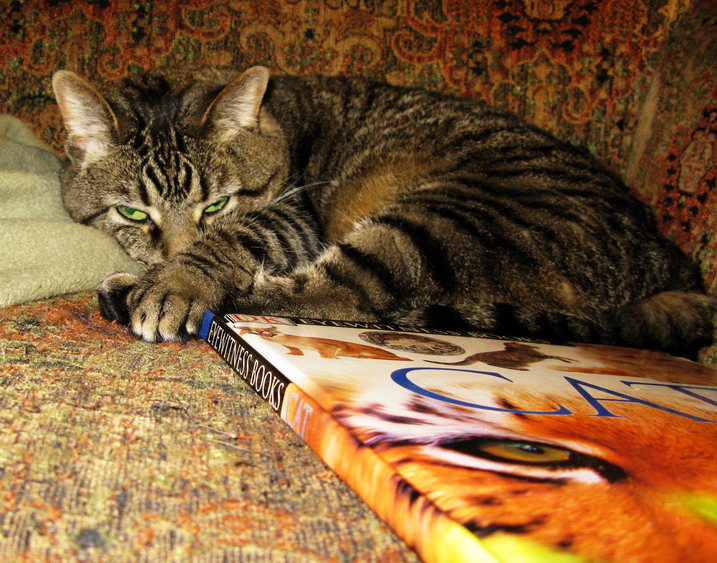
What are the feline citizens of our home up to these days, now that the King of Cats has gone to his castle in the sky.
Well, if these photographs are any kind of evidence, they are napping.
As you can see, Grimalkin has a very strong sense of irony by the book she chooses to curl up with for her afternoon nap.
That is one of Kat’s favorite books, by the way, and we look at it together quite often. She can now point out the leopards, jaguars (and yes, she can tell them apart), cougars, tigers, lions, bobcats and black panthers, as well as the various house cats. She even can point out the pictures of the Russian Blue cats if you ask her to show you “the cats that look like Ozy.” Maybe she will remember him, at least in a small way, after all.

This is the sight that greeted me one morning when I got up: three amigos on the top of our cat tree in the living room.
Tatterdemalion, also known as Tatter, is the fluffy black girl cat in the back of the grouping. The stripy cat in front is Gummitch, my baby boy cat who is the sweetest kitty I have ever known. He is cuddled up with Jack, the other stripy boy cat who has gotten very aggressive with the other cats now that Ozy is gone. We are currently trying to work with his behavior problems. After a cat dies, there is a shifting of power in the feline community, and that is the turmoil we are dealing with now.
But this photo is of a gentle moment between three friends.
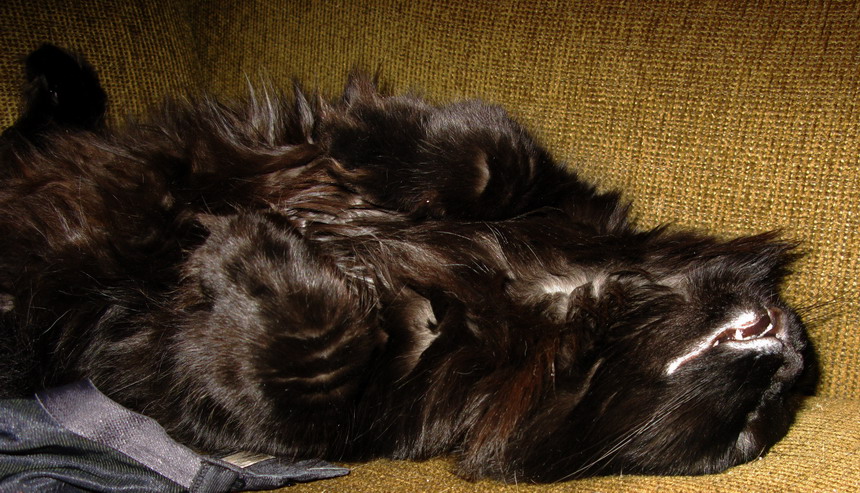
Here is another picture of Tatter so relaxed that she is asleep on her back with her belly exposed. Cats won’t sleep that way unless they are very calm, chilled out and relaxed and happy.
So far, the cats are shifting their pecking order, but between the outbursts of foul temper, there are moments of relaxation, quiet and peace.
It is all quite interesting to watch and be a part of.
Book Review: The Fortune Cookie Chronicles
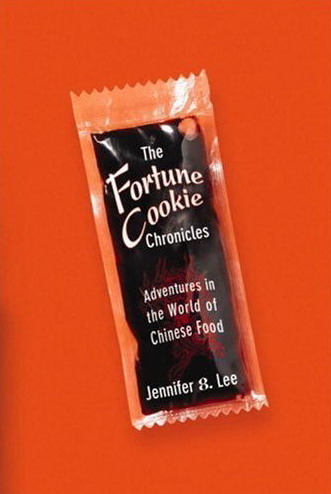
If you are at all a fan of Chinese American restaurant food, and if you have ever wondered about the fact that no matter how small a town you visit in the US, you are likely to find at least one Chinese restaurant there, you should pick up a copy of Jennifer 8. Lee’s book, The Fortune Cookie Chronicles: Adventures in the World of Chinese Food.
The book opens with the statistical anomaly of the 110 second-place Powerball winners from the drawing of March 30, 2005. Even though only 3.5 second place winners were likely, the lottery officials were stunned to see 110 winners listed the next day–so stunned that they wondered if somehow lottery security had been breached.
It turned out that all 110 winners had played numbers they had gotten from fortune cookies–fortune cookies that had all been made in one factory and then shipped across the nation.
It was a strange case of cross-cultural luck in action, and it makes the perfect opening for a book on the cultural ubiquity of Chinese restaurants in the United States, which outnumber all of the McDonalds, Buger Kings and KFCs combined.
Filled with fun facts, fascinating stories, mysterious tales (such as the much-disputed origin of fortune cookies) and written in a light, conversational tone, The Fortune Cookie Chronicles is a really easy, illuminating read.
But all is not sweetness and fluff.
Lee shines a light into the dark truths surrounding the difficulties, dangers and struggles of Chinese immigrants to the US, bringing into focus the harsh realities of how others make profit on the backs of other human beings who come to the United States in search of a better life. She moves from the cold facts of the statistics on how many Chinese restaurant deliverymen, many of whom can barely speak English are murdered in New York City for paltry sums of cash and a takeout meal, to focus on the intensely personal and painful problems encountered by a Chinese immigrant family who leave New York to buy a tiny restaurant in rural Georgia. The racism and discrimination faced by Chinese immigrants is highlighted, pointing to a sad reality of life in the US, where often times Asians are invisible and are treated as if they are interchangeable.
What I found most interesting about the book was that Lee explains how Chinese restaurants arise even in the smallest areas of the United States, and how workers are supplied for these restaurants through a national network of employment agencies. This is an ingenious way to both supply workers for specialized restaurants which cannot always get workers through an existing population of Chinese immigrants (how many Chinese immigrants live in rural Georgia, for example?), as well as giving opportunities for workers to settle in places they may never have otherwise known about.
Years ago, when I was a waitress in a Chinese restaurant in Huntington, West Virginia, I got to see this system in action. The China Garden was unusual in that the owners hired American servers, dishwashers and prep cooks, but the cooks were all Chinese immigrants, many of them quite recent. I knew that the owners kept an apartment or two upstairs from the restaurant for the cooks, all of whom lived together, and I remember asking once how they found them. I was told that they called an employment agency in New York City and that they would get the names of several possible cooks and they would choose one or two as needed, and then the cooks would hop on a bus and appear a day or so later. This wasn’t the only way that cooks were hired–family members were brought from China at times, and now and again, a Chinese student from the nearby University was hired, (a medical student and nursing student were among them) but many of the workers came through the exact agency Lee writes about in this book.
The Fortune Cookie Chronicles is a fascinating read, giving a well-balanced view of the history and current reality of Chinese restaurants in America. It is well worth reading, and if you want to know more about the book, or the author, you can visit the book’s official website where Lee has a blog.
It’s That Time of Year Again: Dan’s Birthday Cheesecake 2008
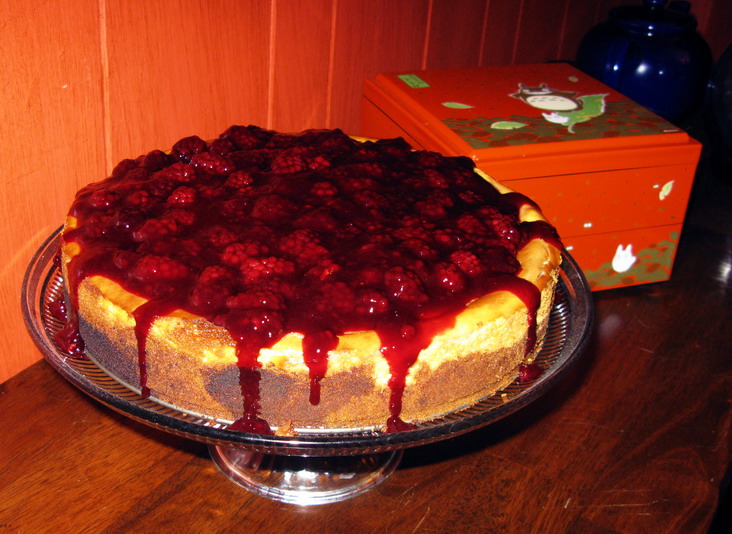
Long time readers know that I have been baking cheesecakes for my dear friend and brother, Dan, for his birthday for quite some time. And I have posted the Universal Cheesecake Recipe which I use as a basis for every variant I have made and recorded on this blog. The different flavors I have posted about include Pomegranate Cheesecake, Strawberry Cheesecake, Chocolate Raspberry Cheesecake, and Irish Mocha Cheesecake.
This year, I had a couple of ideas for what kind of cheesecake to make for Dan.
One was a Turkish Coffee Cheesecake, which would use chocolate, espresso powder and cardamom in the batter, chocolate wafers and almonds with cardamom in the crust, and would be garnished with chocolate shavings, almond slices and espresso beans. That sounded good, but too similar to the chocolate raspberry cheesecake I made for him last year. I wanted something a little lighter.
I also thought of doing a rhubarb cheesecake, since the tart tourmaline-colored stalks have just come into season, but I wasn’t certain that Dan liked rhubarb.
What I knew he liked was blackberries, and since I had some in the freezer, I thought that would be a good choice.
I chose cinnamon graham cracker crumbs for the crust, and flavored the batter simply with vanilla bean paste, lemon zest and lemon juice. To one third of the batter I added some “Simply Fruit” blackberry jam, beating it in thoroughly until the batter turned pink. This was spooned into the plain batter after it was added to the crust in the pan, and swirled around for a pink and cream-colored marble effect.
For a topping, I thawed out frozen blackberries, added a dash of rosewater, some raw sugar, and a bit of lemon juice. I put this in a saucepan with the remainder of the jar of jam and added a little bit of cornstarch dissolved in cold water. I cooked this mixture until the juice thickened to a syrupy consistency. I cooled it in the fridge, and after the cake was baked and cooled (I cooled it in a nearly empty freezer), I spooned the blackberries and juice over the cake.
How did it turn out?
Well, Dan liked it, because it tasted light and fresh, and he was better able to be gluttonous and eat a ton of it at a sitting than a richer, chocolatey cake.
I loved it because the texture was fluffy and it was tangy and not too sweet. It was amazing. I think I liked it better than just about any of my other cheesecake creations, except perhaps the Pomegranate Cheesecake.
Without further ado, here is the recipe:
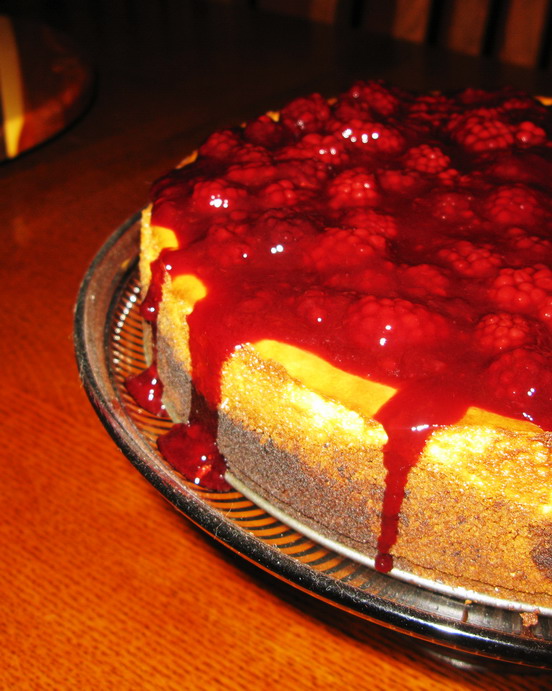
Dan’s Blackberry Cheesecake
Ingredients:
2 cups cinnamon graham cracker crumbs
8 tablespoons butter, melted
3 pounds cream cheese, softened
1 1/2 cups raw sugar
1 tablespoon vanilla paste
2 tablespoons lemon zest, finely grated
2 tablespoons lemon juice
3 whole large eggs
2 egg yolks
3 tablespoons Simply Fruit Blackberry jam
1 pound frozen or fresh blackberries
1 tablespoon rosewater
1 teaspoon raw sugar
1 tablespoon lemon juice
1/4 cup Simply Fruit Blackberry Jam
1 tablespoon cornstarch dissolved in two tablespoons cold water
Method:
Preheat oven to 375 degrees F.
Place crumbs into the bowl of a food processor. (I also use the processor to make the crumbs, by the way, so they are usually already in the bowl.) Start the processor and as it is running, drizzle the melted butter through the feed tube. Allow machine to mix thoroughly until the texture of damp sand is accomplished.
Dump crust ingredients from processor bowl into the center of a non-stick 10 inch springform pan. Pat the crumbs in an even layer on the bottom of the pan and about a third of the way up the sides of the pan. Don’t worry if the top edge is a little ragged. It won’t matter.
Bake in the preheated oven for fifteen minutes (ten if you have a convection oven), then remove from the oven and allow to cool thoroughly. Turn the oven temperature down to 300 degrees and put a pan of water in the bottom of the oven. This creates a moist, steamy environment for the cheesecake to bake in, without having to bake it -in- a water bath.
Beat together the cream cheese and sugar in a heavy-duty mixer until they are thoroughly combined and are fluffy. Add vanilla bean paste, lemon zest and juice, and beat until the batter is smooth.
Whisk together the eggs and egg yolks until they are thoroughly combined and lighten in color somewhat. Add to cheese batter and beat well to combine. (This also incorporates some air into the batter.)
Take out one third of the batter and stir the smaller amount of jam, until the batter is pale pink.
Scrape the white cheesecake batter into the prepared, cooled pan over the crust, and smooth the top so it is even. Drop spoonsful of the blackberry flavored batter into the pan, and swirl with a table knife until a marble effect is achieved. Smooth the top of the batter again, and place the cake into the center rack of the 300 degree preheated oven and bake for one hour and fifteen minutes. (Bake for fifty minutes to an hour if you have a convection oven.)
Remove from oven when done–the cake will be set around the edges, and will be somewhat jiggly in the middle. Do not worry–as it cools on a wire rack on the counter, the residual heat of the cake will continue to bake the middle. By the time it is at room temperature, it will be completely set.
Allow to cool to room temperature, then cover tightly with foil, and still in the pan, refrigerate for at least ten hours or until completely cold. (Or stick it into the freezer until it is completely cold–a few hours.)
Meanwhile, take the thawed frozen blackberries, or fresh berry, and toss with rosewater and sugar. Put into a saucepan, add the jam, and cook on low heat until the jam melts and the berries soften lightly. Bring to a boil and add the cornstarch and water, and stirring constantly, allow the mixture to thicken slightly. Cool completely and when ready to serve, unmold the springform cake, spoon berries over the top of the cake, allowing some of the juice to drizzle artfully over the edge of the cake. (To remove from the pan and serve, run a thin icing spatula or knife gently around the outside of the springform pan to loosen the cake from the pan. Unlock the spring, and loosen the sides of the pan away from the cake, and lift away.)
It serves at least sixteen people, up to twenty or so, depending on how thinly you slice the cake.
It also serves one Dan, and a few of his friends, if he feels generous enough to share.

Categories:
- Admin (rss) (55)
- Blogs and Blogging (rss) (81)
- Book Reviews: Cookbooks (rss) (43)
- Book Reviews: Non-Cookbook Food Books (rss) (38)
- Cats and Cat Blogging (rss) (47)
- Chinese Cooking Lessons (rss) (32)
- Culinary School Stories (rss) (18)
- Dairy Pruducts: Cultured and Barbaric (rss) (4)
- Documentary Filmmaking (rss) (1)
- Essays, Rants and Reflections (rss) (260)
- Fighting Hunger (rss) (12)
- Food and Kids (rss) (45)
- Food in the News (rss) (126)
- Food Media (rss) (98)
- Food Preservation (rss) (18)
- Food Safety (rss) (45)
- Gardening (rss) (30)
- Herbs and Herb Blogging (rss) (20)
- Holidays (rss) (50)
- Kat Blogging (rss) (22)
- Kitchen Science (rss) (36)
- Leftover Makeover (rss) (8)
- Life, the Universe and Everything (rss) (131)
- Local and Sustainable (rss) (227)
- Local Athens Food and Foodies (rss) (42)
- Meatless Mondays (rss) (32)
- Menu For Hope (rss) (5)
- Nutrition, Diet and Health (rss) (84)
- On The Farm (rss) (8)
- Recipes: Almost Vegetarian, Vegetarian and Vegan (rss) (294)
- Recipes: American Regional (rss) (37)
- Recipes: Appalachian Hillbilly (rss) (33)
- Recipes: Bread, Pasta, Grains (rss) (95)
- Recipes: Canning and Preserving (rss) (8)
- Recipes: Chinese (rss) (123)
- Recipes: Comfort Food (rss) (120)
- Recipes: Cookies (rss) (16)
- Recipes: Desserts (rss) (48)
- Recipes: French (rss) (25)
- Recipes: Fruits and Vegetables (rss) (302)
- Recipes: Greek, North African and Middle Eastern (rss) (31)
- Recipes: Indian (rss) (137)
- Recipes: Italian (rss) (42)
- Recipes: Japanese (rss) (7)
- Recipes: Jewish (rss) (4)
- Recipes: Korean (rss) (6)
- Recipes: Meat, Poultry and Fish (rss) (220)
- Recipes: Mexican/Native American/ Latin American/Caribb (rss) (27)
- Recipes: Original (rss) (108)
- Recipes: Thai (rss) (27)
- Recipes: Tofu (rss) (17)
- Recipes: US Regional (rss) (16)
- Recipes: Vietnamese (rss) (8)
- Restaurant Stories (rss) (28)
- Sewing, Quilting, Arts and Crafts (rss) (16)
- Simple Chinese Recipes (rss) (30)
- Slow Food and Heritage Foods (rss) (10)
- Spice Blogging (rss) (44)
- The Chinese Cookbook Project (rss) (14)
- The Chinese Pantry (rss) (39)
- The Documentary (rss) (2)
- The Kitchen Saga (rss) (17)
- The Locavore's Bookshelf (rss) (15)
- The Unsung Adventures of The Culinary Nerd (rss) (6)
- Tools and Toys (rss) (35)
- Uncategorized (rss) (10)
- With a Side of Politics (rss) (48)
Archives:
- August 2012 (9)
- July 2012 (12)
- September 2011 (3)
- August 2011 (7)
- July 2011 (8)
- June 2011 (16)
- May 2011 (17)
- April 2011 (11)
- December 2010 (9)
- November 2010 (5)
- February 2010 (1)
- December 2009 (5)
- November 2009 (7)
- October 2009 (10)
- September 2009 (16)
- August 2009 (14)
- July 2009 (14)
- June 2009 (7)
- May 2009 (17)
- April 2009 (10)
- March 2009 (25)
- February 2009 (13)
- January 2009 (10)
- December 2008 (5)
- November 2008 (5)
- October 2008 (6)
- September 2008 (13)
- August 2008 (8)
- July 2008 (11)
- June 2008 (18)
- May 2008 (13)
- April 2008 (14)
- March 2008 (16)
- February 2008 (17)
- January 2008 (19)
- December 2007 (25)
- November 2007 (18)
- October 2007 (24)
- September 2007 (16)
- August 2007 (15)
- July 2007 (15)
- June 2007 (10)
- May 2007 (14)
- April 2007 (16)
- March 2007 (17)
- February 2007 (20)
- January 2007 (13)
- November 2006 (1)
- October 2006 (8)
- September 2006 (14)
- August 2006 (25)
- July 2006 (30)
- June 2006 (28)
- May 2006 (34)
- April 2006 (29)
- March 2006 (24)
- February 2006 (30)
- January 2006 (38)
- December 2005 (40)
- November 2005 (37)
- October 2005 (32)
- September 2005 (25)
- August 2005 (30)
- July 2005 (28)
- June 2005 (21)
- May 2005 (8)
- April 2005 (22)
- March 2005 (17)
- February 2005 (29)
- January 2005 (10)
Search Site:
Links:
- Lily’s Wai Sek Hong
- 101 Cookbooks
- A cat in the kitchen
- A Veggie Venture
- Accidental Hedonist
- Cha Xiu Bao
- chez pim
- Chocolate & Zucchini
- Chopstick Cinema
- Chowhound.com
- Chubby Hubby
- Cook sister!
- Cooking with Amy
- da*xiang
- Eat Local Challenge
- Eating Liberally
- Ecocentric
- Eggbeater
- Epicurious
- Farmgirl Fare
- Fatfree Vegan
- Foodgoat
- ForkandBottle.com
- Green Olive Tree
- Hooked on Heat
- Jaden’s Steamy Kitchen
- Kalyn’s Kitchen
- Lucullian delights
- Mahanandi
- Matt Bites
- MeatHenge
- mmm-yoso!!!
- New York Times – Dining & Wine
- Pizza Goon
- Rasa Malaysia
- Ruhlman
- Sailu's Kitchen
- Serious Eats
- SF Gate: Food & Dining
- Simply Recipes
- Soul Fusion Kitchen
- Tastespotting
- The Amateur Gourmet
- The Cleaner Plate Club
- The Food Section
- The Grub Report
- thecookscottage
- U.S. Food Policy
- Wandering Chopsticks
- Washington Post Food and Dining
- Wasted Food
Meta:


Powered by WordPress. Graphics by Zak Kramer.
Design update by Daniel Trout.
Entries and comments feeds.