
Cook Local, Eat Global
Cardamom Waffles With Cherries and Almonds
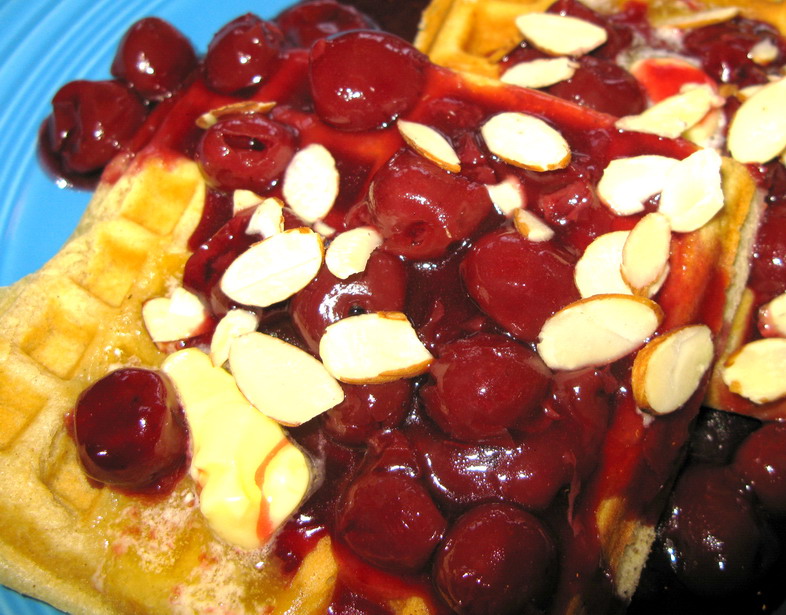
I was shocked when my father-in-law admitted to us a few years ago that he had never, in his life, had a waffle. (When we asked why, he said he wasn’t sure why he hadn’t eaten a waffle, except that he figured they just couldn’t be that exciting.)
We therefore, took him to eat at our favorite Waffle House in Columbus, forthwith, and ordered for him a waffle with a side of sausage.
He took a bite, and declared quite distinctly, “I like waffles. I should eat more of them.”
So, we went to the Waffle House again the next morning.
He had a lot of waffles to catch up on.
Now that we live in Athens, there is not a Waffle House close by.
So, when we get a hankerin’ for a hunk of waffle, I must hie myself off to the kitchen and whip some up.
Which is what I did this morning, although I didn’t feel like making my usual recipe which involves buttermilk (which I don’t have on hand) and beaten egg whites. I was too lazy for egg-white beating, and having a dearth of buttermilk, I decided to try a different recipe.
The following recipe, which is much easier to throw together in the morning pre-coffee, I adapted considerably from Marion Cunningham’s Classic Waffle recipe from The Breakfast Book. I left out the vegetable shortening, and used half whole wheat flour, added vanilla extract, cardamom and cinnamon, and some cream to her already excellent recipe.
I decided that I wanted some fruit to go with my waffles, and as any longtime reader should know, I am of the firm belief that cherries make nearly everything better. So, I dug out a jar of sour cherries in light syrup, and plopped them in a saucepan with a dab of butter, some almond extract a bit of sugar and some cardamom, and cooked them down while I made the waffles. When most of the liquid was gone, I thickened the rest of it with a cornstarch and cold water slurry, then put it all in a sauceboat and served it warm with some sliced almonds on the side.
Not only did the waffles with cherry sauce and almonds turn out to look pretty, they smelled divine and tasted golden and buttery, tart and sweet and crunchy. They were awesome.
While we ate these for a special Sunday breakfast, I think that you could serve these with a scoop of homemade vanilla ice cream for a great homey, comfort-food dessert. And think of the possibilities for a breakfast in bed on Valentine’s Day, especially if you have one of those fancy machines which makes heart-shaped waffles. It would make a very pretty presentation with the golden waffles, crimson cherries and maybe some white whipped cream.
Very pretty indeed. And quite romantically tasty as well.
If you want to try a vegan version of this recipe, I suggest exchanging the milk and cream with 1 1/2 cups almond milk, and using canola oil in place of the melted butter. For the eggs, use vegan egg substitutes–they should work fine. I suspect that waffles made with these ingredients will be crisper in texture than those made with dairy products, so adjust cooking time to account for this. Just leave the butter out of the cherry sauce.

Cardamom Waffles With Cherries and Almonds
Ingredients for the Waffles:
1 cup all-purpose flour
1 cup whole wheat flour
4 teaspoons baking powder
1 teaspoon salt
2 tablespoons raw sugar
1/2 teaspoon ground cardamom
1/4 teaspoon cinnamon
2 eggs, well beaten
1 teaspoon vanilla extract
1 cup milk
1/2 cup heavy or light cream
1/3 cup butter, melted
Method:
Whisk together all dry ingredients until well blended.
Beat vanilla into eggs, then stir this mixture into the milk. Stir in cream.
Mix the wet ingredients well into the dry ingredients until very blended, then whisk in the melted butter.
Following your waffle-maker’s instructions, bake your waffles until crisp and golden.
Makes about eight small waffles.
Ingredients For Cherry Sauce:
1 16 ounce jar sour cherries in light syrup (or one pound of frozen sour cherries, thawed)
1/2 tablespoon butter
1/4 teaspoon ground cardamom
1 teaspoon almond extract
1-2 tablespoons raw sugar
1 1/2 tablespoons cornstarch dissolved in 2 tablespoons cold water
sliced almonds
Method:
Pour contents of jar into saucepan and add all other ingredients except cornstarch and almonds. Simmer over medium heat, stirring now and then, until liquid is reduced by half.
Bring cherries to a boil, then add cornstarch and cook, stirring, until thickened.
Remove from heat, and keep warm until you serve.
Garnish with sliced almonds.
The Locavore’s Bookshelf: In Defense of Food

In Defense of Food: An Eater’s Manifesto is Michael Pollan’s follow-up to his immensely popular and influential book,The Omnivore’s Dilemma, which documented his own personal journey as he discovered the ins and outs of various food systems in the United States, including corporate agriculture, confined animal feeding operations, small pasture-based livestock farms, foraging and hunting.
I have to be up front and say that I, like nearly everyone else in the known universe, loved The Omnivore’s Dilemma. Not only did I think that the points Pollan makes throughout the book are valid and useful, and I am thrilled to see it as widely read as it has been and continues to be, but I was also vastly entertained by his personal ruminations on his research, as well as the way in which he related his experiences in various settings. As a former farm girl and all-around country mouse, I was particularly amused by his thoughts and feelings as he did some of the nastier work involved in food-raising and gathering such as butchering chickens and field dressing a wild hog. I couldn’t help but chuckle at the city feller’s antics, but even as I snickered, I was cheering him on in his discoveries as he pushed his personal limits and stretched the boundaries of his life farther and farther in the search for a more authentic and honest relationship with food.
That said, I have to very sadly admit that I didn’t think much of In Defense of Food.
I appreciate that it is meant to be a more practical book that deals with the question raised by many readers after they finished The Omnivore’s Dilemma: “What, then, do we eat?” Pollan answers this question in seven simple words. “Eat food, not too much, mostly plants,” right at the beginning of the book, and then goes on to expand upon that statement for the next two hundred pages or so.
And that is fine and good. I agree with Pollan on that point. We should eat food, which he defines as whole foods which would be recognizable to our grandmothers, and we should eat less than we do, and we should eat less meat than we currently eat, though it is not necessary to give up all of it if we do not want to.
He advocates eating local, sustainably grown and produced foods, preferably organic, and I can’t say that I disagree with any of that.
In fact, the reason why I didn’t love this book has nothing to do with whether I think Pollan is right or wrong; I happen to agree with him on most of his major points.
It has to do with the fact that the book is not cohesive and reads like two separate smaller books melded together into one longer book.
Or, more accurately, it reads like two long, investigative magazine articles (which is where his seven-word thesis statement first appeared–in an article published a year ago for the New York Times Magazine, which I read when it came out) somewhat clumsily edited together. The truth is, the other theme of the book, that America’s dietary issues are part and parcel of the ever-changing nutritional advice we are given by scientists, a practice which he calls, “nutritionism,” is also from the same article in the New York Times Magazine. (In fact, for the first couple of chapters, I kept thinking, “I’ve read this before. Where?” By the third chapter, I figured it out. and looked it up online and found the article in question.)
However, in the article, these two themes were more elegantly woven together into a cohesive whole.
When the ideas were expanded into this small book, however, the weaving began to unravel, and what could have been a deftly written, fascinating look at why American’s obsession with health and nutrition may not in fact be healthy, and what to do about it, becomes instead a clumsy, rushed attempt to get a sequel to The Omnivore’s Dilemma out to the reading public as fast as possible.
I can understand the appeal of this approach. When Pollan wrote his New York Times Magazine article, entitled, “Unhappy Meals,” he made a concise, cogent argument that we should stop listening to the nutritional advice of the experts who use reductive science to study foods, which result in a plethora of theories which seem to be adopted and then discarded with dizzying speed, leading to great confusion on the part of consumers. He said we were better off ignoring any processed food which had health claims on its packaging and should instead go back to eating whole foods, which we cook for ourselves. He advocated ignoring the center aisles of the grocery store as much as possible, and only shopping on the edges, where the produce, dairy, meat and eggs are displayed, and we should reject any food which our grandparents would not recognize. (Of course, the problem with that advice is that all of the very traditional Chinese food I eat would have been a mystery to my grandmothers–but I am sure that a Chinese peer of my grandparents would recognize my Cantonese and Sichuan foods readily. Thus, I figure I can “grandfather” those foods into my diet and still follow the spirit, if not the actual words of Pollan’s dictum.) (And yes, that pun was intentional.)
That was a great article, and I can understand why Pollan would want to get those words out to as many people as possible, not just the folks who read the New York Times.
The problem is that he had to expand on that article to make a whole book, and that is where he got into trouble.
I don’t think that the expansion was very well done. I think it was rushed, and he ended up putting too much emphasis on the evils of nutrition science and its ties to the food processing industry, and wrote too little about what it is we should be eating instead, with practical advice on how to change the typical American’s lifestyle, shopping and cooking habits. The fact is, he could have made his point about “nutritionism” in one chapter, and then spent the rest of the book formulating answers for the difficult question of exactly how one is to change everyone’s relationship to food when not everyone has access to farmer’s markets and inner city folk don’t even always have access to real grocery stores.
To me, these are more pressing issues, although I will admit that I may be a special case in that I have been reading critically about nutrition science for quite some time, and have always been somewhat cynical about such spurious claims like margarine being more healthy than butter. (Which, of course, it isn’t: artificially hydrogenating liquid vegetable fat to make is solid introduces trans-fats which are more unhealthy than naturally solid animal fats.)
In other words, all through the majority of the book, where Pollan reiterates his indictment of “nutritionism,” I was bored to tears.
Also, I noticed that while he tells us to eat less, he makes little to no mention of exercising more. Much like Nina Planck in her book, Real Food, Pollan mentions that humans can exist on any number of diets: all meat, mostly meat, some meat, all plants, mostly plants, no plants. However, like Planck, he tends to downplay the fact that in human societies where people eat these rather extreme sounding diets, they always are more physically active than we modern Americans are.
I am of the firm belief that it is as much our couch-potato/desk-jockey lifestyle which contributes to our expanding waistlines and declining health as it is the typical processed crap food American diet.
To have both Planck and Pollan downplay this rather large elephant in the room is curious.
The other thing I missed while reading In Defense of Food was Pollan’s personal touch. This is a much less personal work, and so there are no engaging stories and anecdotes about Pollan’s discoveries and adventures. Those are my favorite parts of all of his books, and in this one, they were completely lacking.
But it need not have been that way. If he had spent longer researching this book, rather than rushing it to press, he could have done more exploration on the question of how to get more fresh, whole food to more people in this country, and I think that the book could only have benefited from that treatment.
That said, while I don’t really like the book–I think it has many good solid points.
However, all of those points are available online in the better written, more concise, “Unhappy Meals,” which is free, instead of being $21.95.
And then, you can dash off to the grocery store or farmer’s market and spend that cash you saved on some good food that someone’s grandma somewhere would recognize as wholesome and tasty.
The Food Of Angels: Pasta With Prosciutto, Peas And Parmigiano
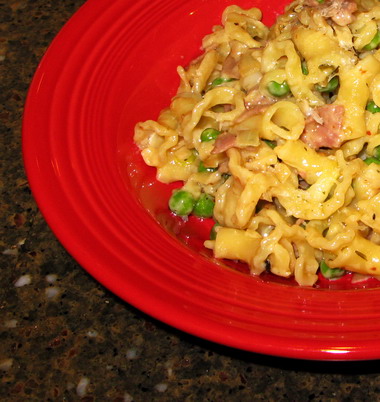
This is one of my all-time favorite dishes from Northern Italy, but I have never cooked it before now.
Which is sort of weird, but when I first had it, back when I lived in Providence, Rhode Island, I didn’t have to make it. I could just walk into any number of little restaurants up on Federal Hill and order it, and it was always good. Some versions were better than others, yes, but all of them were good, and some of them were great. But good, better or great, this lovely dish was so common and so moderately priced–I just never got around to making it.
Until Zak reminded me of it, today.
And then, I had to have it.
This lovely to look at pink, green and cream dish is just the sort of heavenly food that I like to think that the angels painted by Raphael and Donatello eat when they are not posing for portraits. It is just that heavenly–it somehow manages to taste both rich and light at the same time. It is the kitchen magician’s art which makes it so, I suspect.
I didn’t bother consulting a recipe or anything. It is pretty much a cream-based pasta sauce that has onions, a bit of garlic, prosciutto, and peas cooked in butter, with or without some wine. The cream is reduced until it coats the back of a spoon, and then some delicious Parmigiano-Reggiano is grated into it, and that is it. Oh, some herbs might go in it, some black pepper, or a few chili flakes, but really, this is all there is to it.
It is beyond simple, which is good, but it also means that you have to use the best ingredients you can find and afford to make it.
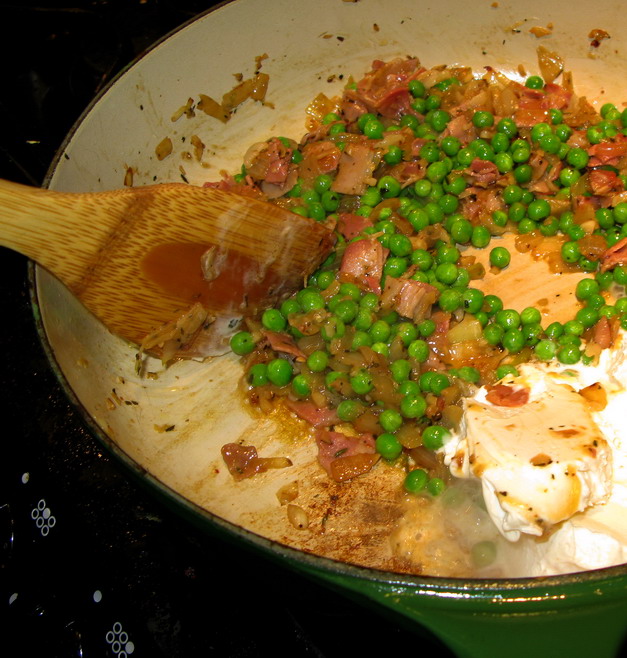
Now, a true purist would say that if I am going to use the real Parma prosciutto and Parmigiano-Reggiano, I should only use fresh, just picked baby peas in season, too.
Well, I have had some rather crappy fresh peas, and many really good frozen ones, and frankly, I know for a fact that those restaurants in Providence used frozen peas, so that is what I used, too. So long as you choose the smallest, youngest frozen peas you can, and don’t overcook them, the dish will be delicious.
The only other ingredient of note for this dish is the cream.
I was privileged to be able to use fresh, raw cream this time around, although it was in a form which I have never seen before, and likely won’t see again.
It was essentially cream which had most of the water removed from it; Victoria, one of the owners and operators of Snowville Creamery, had called us last Saturday to ask if we were going to be at the farmer’s market–which we weren’t, as Kat was sick with the croup. When Zak told her why not, she said she would come by and bring us something–apparently the cream separator had gotten a bit fractious and had over-spun the milk, producing cream that was somewhere between fluid cream and butter.
She left it on our porch in a cooler.
When I got up and tasted it–it had the flavor of liquid cream, but had the texture of whipped butter. It was rich and delicious–so good that we spread some on toast made from fresh bread from the Village Bakery down the hill and topped it with strawberry preserves for an amazing breakfast.
I ended up using a good amount of it in this pasta sauce, and was thrilled to discover that it is basically pre-reduced cream. I could just plop a couple scoops of it into the pan with the other ingredients, stir it until it melts and then add the cheese and the pasta and it was done. No simmering to reduce.
I’m of the opinion that if I could have a small tub of that in the fridge at all times, it would certainly make saucemaking simpler. Maybe they have a future with the product, if not for home use, for the restaurant industry.
In the end, this pasta is an easy, delicious dish for a quick supper, especially if paired with a simple green salad. The sugar of the peas brings out the inherent sweetness in the prosciutto, while the dry cured ham’s saltiness seasons the dish perfectly. Caramelized onions deepen the flavors, a bit of sherry or dry white wine adds a bit of complexity, and the cheese gives a hint of hazel and pine nut flavor to the finished dish. The cream binds everything together in a smooth finish, while the herbs and pepper add tiny aromatic sparks to the whole.
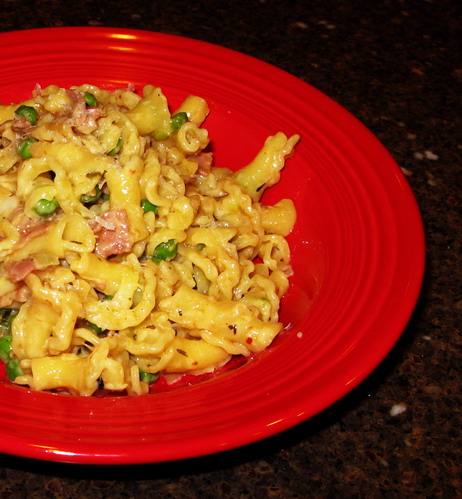
And it looks pretty, too–the green peas contrast perfectly with the pink prosciutto; giving the dish a spring-like freshness that is hard to resist.
While fettuccine is traditional, I like to use campanelle–the bellflower shaped pasta for two reasons. One, I like the way that the fluted, floriferous tubes look in the bowl and two, those pretty ruffles catch the rich sauce and trap the peas and bits of prosciutto perfectly, making the sauce much easier to eat than it is when made with fettuccine.
Besides, campanelle is fun to say, and the romantic flowered shape keeps it well within my imagining of it being the perfect angelic meal.
If you wanted to make a vegetarian version of this, I suggest substituting some flavorful mushrooms for the prosciutto, like dried rehydrated porcini or shiitake. Soak the mushrooms in the wine you want to use to deglaze the pan, and then when you go to cut them up, squeeze the excess liquid back into the bowl and cut the mushrooms into thin slices. The reserved soaking liquid you can either filter through a coffee filter to remove any dirt or sediment or you can just pour right from the bowl it is in, being certain to leave the last bits of the liquid, with the bits of grit and grunge, in the bowl.
Pasta With Prosciutto, Peas And Parmigiano
Ingredients:
1 tablespoon butter
1 cup finely diced onion
freshly grated black pepper to taste
1/2 teaspoon Aleppo pepper (optional)
1/4 pound thinly sliced prosciutto, cut into 1/2″ squares
3 cloves garlic, minced
1 teaspoon fresh thyme leaves, plus extra for garnish
1/2 cup dry sherry or dry white wine
1 1/2 cups frozen peas, at least halfway thawed
1 1/4 cup heavy cream
1 cup freshly grated Parmigiano-reggiano, plus extra for garnish if you desire
salt to taste
1 pound cooked pasta of your choice, though in my opinion, campanelle is best
Method:
Heat butter in a heavy bottomed, deep skillet or pan on medium heat until it melts and foams. Add onions, and cook, stirring, until they turn translucent gold. add black and Aleppo pepper and prosciutto, and cook, stirring for two minutes, until prosciutto loses its raw look, and onions darken to a deeper shade of gold. Add garlic and thyme leaves and cook for two minutes more.
Deglaze the pan with the wine, and after the alcohol boils off, add the peas. Cook for another minute, then add cream, and stirring, reduce the cream until the sauce coats the back of a spoon. Add half the cheese, stir in and taste for salt. Correct seasoning, then add hot, drained pasta to pan, along with the remaining cheese and stir to combine.
Garnish each serving with a sprinkling of grated cheese and some thyme leaves.
Serves four to six people, depending on appetites.
A New and Interesting Food Blog: World Foodie Guide
I just became aware of a new (only three or four months old) food blog from London which I think is a fun and interesting read.
World Foodie Guide, written by Helen Yuet Ling Pang, a British Chinese woman who is the child of a restaurant owner, is in part a guide to the restaurants she likes to frequent, and in part, the story of how she is learning to cook the Chinese foods of her youth.
She has a lot of fascinating posts already, including highly useful posts on Chopstick Etiquette, and How to Eat Xiao Long Bao or Shanghai Dumplings (those delectable steamed morsels of thin dough wrapped around delicious soup.)
The chopstick post is a great introduction of the ins and outs of Chinese table manners–something which I have not written about because I have not learned my manners from childhood, only willy-nilly from close observation of friends and fellow eaters and films where food is central, such as Ang Lee’s Eat, Drink, Man, Woman. (I’ve even learned useful table manners from wuxia films such as Yuen Wo Ping’s Iron Monkey, believe it or not.)
However, even though I have managed to eat many Chinese meals without embarrassing myself, or worse, my hosts, I still do not know enough of the particulars to write cogently about it. That is okay, because Helen wrote a beautiful and extremely informative post for everyone’s enjoyment, and more importantly, edification.
And as for the soup dumplings–any time you are dealing with a thin shell of noodle encasing boiling hot soup, you need all the help you can get to eat it gracefully and safely.
Anyway–enough from me. Frolic off forthwith to World Foodie Guide and dig in!
Chinese Wheat Noodles With Mushroom-Tofu Sauce
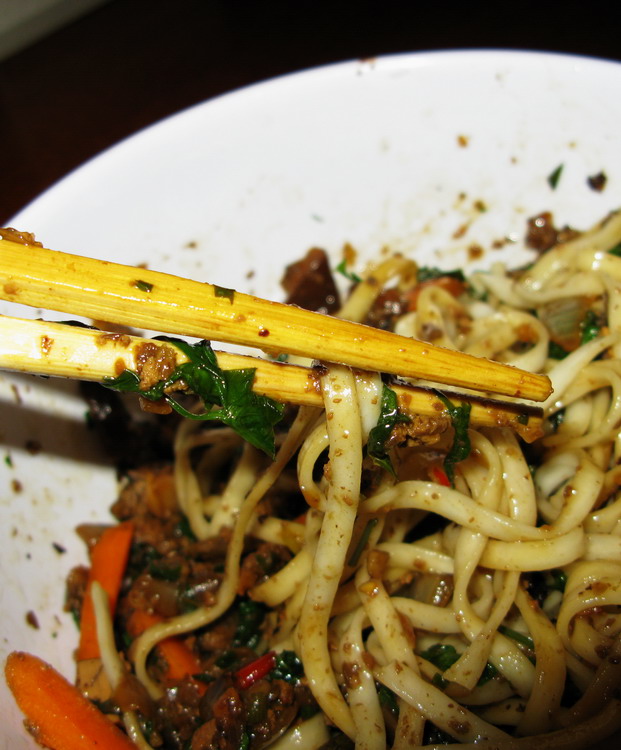
On a cold winter night, when the weather is blustery and damp, there is nothing that warms myself and my family up more than a bowl of za jiang mein–Chinese wheat noodles tossed with a hearty, spicy-sweet meat and tofu sauce and topped with crisp raw or blanched vegetables.
And since last night, our weather changed from springlike back to winter, I promised everyone that I would make a big batch of what some folks call “Chinese Spaghetti,” and had my proposal greeted with much applause and acclaim.
There was only one problem.
I wasn’t in the mood for meat.
I wanted mushrooms.
So, I thought to myself, “Is there any reason I couldn’t make a thick, somewhat chunky sauce like the za jiang meat sauce, but instead of meat, use mushrooms?”
I decided that there was absolutely no reason in the world I couldn’t or shouldn’t do that, so I did, although I also still made a batch of the meaty version for everyone else. I -had- promised, and besides, not everyone in this house loves mushrooms as much as I do.
Now, I have to admit that while this sauce was inspired by the soybean-paste based za jiang sauce, I detoured considerably from the usual recipe while I was in the process of creation. I wanted something spicier than the usual, so I added both fresh and Hunan salted chilies, and there was some kale and collards in the fridge that looked ever so tasty, so I chopped them finely and added them. And then, after those additions, I found that at the end of cooking, I needed to add a slosh of Chianking black vinegar (you can use balsamic if you don’t have the Chianking); the sour note balanced the spicy-hot chilies and slightly bitter greens to perfection.
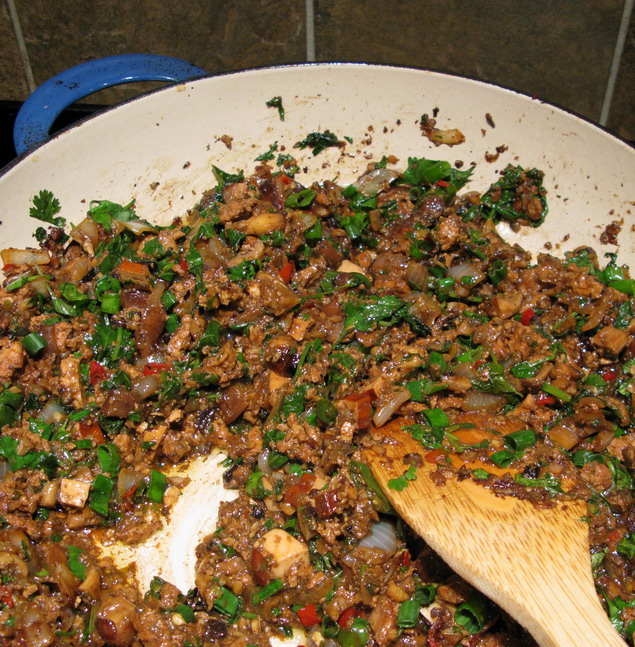
The original sauce often includes tiny cubes of pressed tofu which are probably there to add a textural interest as well as to stretch the meat and make it go farther without lightening up the recipe considerably. (It is supposed to be warming, stick-to-your-ribs fare–after all, it is a dish common around Beijing which is not in the least bit balmy in the wintertime.) I kept these little cubes because I love them, but I also added about three ounces of crumbled, unpressed extra firm tofu that I marinated in dark soy sauce. This served two purposes: it boosted the protein level of the dish, and it helped mimic the texture of the meat sauce, without being as heavy.
I used two types of mushrooms in the sauce as well–if I had more varieties, I would have used them. For the bulk of the sauce, I used regular fresh button mushrooms, which I minced up finely, as if I was making duxelles, and fresh shiitake mushrooms, which I diced into 1/4″ pieces, to add textural variety. I could also have used rehydrated dried shiitake, but I had fresh ones on hand, so that is what went into the pot. These mushrooms were cooked together after I had thoroughly browned an onion with the chilies and some fermented black beans. With the mushrooms went finely minced garlic, ginger and scallion, and as the liquid cooked down and the mushrooms began to brown and stick to the pan, I deglazed with a good splash of Shao Hsing wine, although dry sherry would have worked just as well. After that, in went the two types of tofu to cook for a minute or two before the chopped greens went in.
As soon as the collards and kale turned from dull pine green to emerald, I tossed some soy sauce, a dab of ground bean sauce and hoisin sauce, and a sprinkle of sugar into the pan with a scant 1/4 cup of vegetable broth. A bare teaspoon of cornstarch and water slurry thickened the sauce after it cooked for a minute or so, and at the very end, two big handfuls of cilantro were stirred in along with a few drops of sesame oil and the tablespoon of vinegar.
How did it taste?
It ended up rich, redolent with the dark mystery of mushrooms, and sparkling with chile heat and the bittersweet kiss of winter greens. The vinegar gave it just the last fillip of tang it needed to enter the realm of deliciousness, while the cilantro added a fresh liveliness that is hard to resist.
It was just as good as the usual za jiang mein with meat, although, after I was done with it, it tasted considerably different, being as I used less soybean pastes and sugar and more chilies. It was lovely, though, and satisfied that mushroom longing I had, without being heavy and overly filling.
It was good stuff. I will be making it again–although since I was the only one eating this batch, I can either freeze the leftovers or use them in a Chinese rice noodle stir fry for lunch, or toss them with ramen or rice. We’ll see. Any of those options would taste wonderful.
One more thing–if I had thought of it, I would have used mushroom soy sauce for this dish–it has the essence of dried shiitake mushrooms in it. That would have ruled!
There is always the next time, though….
Chinese Wheat Noodles With Mushroom-Tofu Sauce
Ingredients:
3 ounces extra firm tofu, crumbled
1 1/2 teaspoons dark soy sauce
3-4 tablespoons canola or peanut oil
1 cup finely diced onion
1 tablespoon fermented black beans
1 teaspoon thinly sliced fresh Thai chile
1 teaspoon Hunan salted chile (optional)
8 ounces fresh button mushrooms, stems trimmed, minced finely
4-8 ounces fresh shiitake mushrooms, stems removed and caps diced
4 cloves fresh garlic, finely minced
2″ piece fresh ginger, peeled and finely minced
3 scallions, light green and white parts only, finely minced (save the tops–slice them for garnish)
2 tablespoons Shao Hsing wine or dry sherry
1 tablespoon dark soy sauce
3 ounces pressed spiced dry tofu, diced finely
1 1/2 cups finely chopped kale and collards or any green you prefer
1 tablespoon ground bean sauce
1 teaspoon hoisin sauce
1 teaspoon raw sugar
1/4 cup vegetable broth
1 teaspoon cornstarch dissolved in 2 teaspoons cold water
1 cup roughly chopped cilantro and the sliced scallion tops
1 tablespoon Chianking black vinegar or balsamic vinegar
1/4 teaspoon toasted sesame oil
Method:
Toss crumbled extra firm tofu with the soy sauce until it is stained dark brown. Allow to marinate while you prepare other ingredients.
Heat oil in a cast iron pan until it is quite hot. Turn heat down to medium. Saute onion, fermented beans and chile, stirring constantly until the onion is golden brown. Add mushrooms, garlic, ginger and scallions, and keep cooking, stirring constantly until the ground mushrooms give up their liquid and begin to dry out, and some of the stuff sticks to the bottom of the pan.
Add Shao Hsing wine and soy sauce, and scrape up browned bits. Add both types tofu, and cook, stirring, about a minute or two more.
Add greens, and stir. When greens brighten in color and wilt, add ground bean sauce, hoisin sauce, sugar and vegetable broth. Cook for one more minute, add the cornstarch mixture and cook for another thirty seconds.
Stir in cilantro, scallion tops, vinegar and sesame oil.
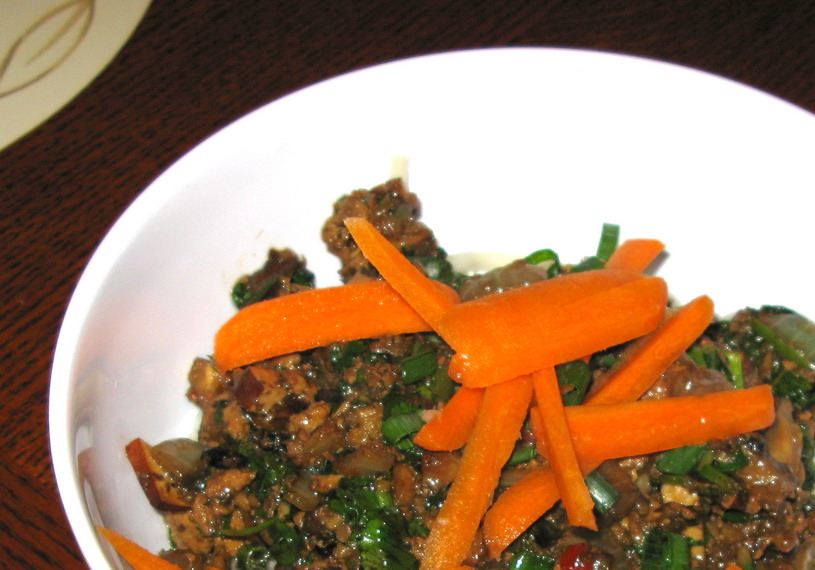
Toss immediately with freshly boiled, well drained, steaming hot Chinese wheat noodles (I used dried–fresh would be great, too), and add any jullienned raw or blanched vegetable garnish you would like–I used carrots, but you could use sweet red, green or any color you like bell pepper, seeded cucumber, radish, daikon, kohlrabi. It is all good.

Categories:
- Admin (rss) (55)
- Blogs and Blogging (rss) (81)
- Book Reviews: Cookbooks (rss) (43)
- Book Reviews: Non-Cookbook Food Books (rss) (38)
- Cats and Cat Blogging (rss) (47)
- Chinese Cooking Lessons (rss) (32)
- Culinary School Stories (rss) (18)
- Dairy Pruducts: Cultured and Barbaric (rss) (4)
- Documentary Filmmaking (rss) (1)
- Essays, Rants and Reflections (rss) (260)
- Fighting Hunger (rss) (12)
- Food and Kids (rss) (45)
- Food in the News (rss) (126)
- Food Media (rss) (98)
- Food Preservation (rss) (18)
- Food Safety (rss) (45)
- Gardening (rss) (30)
- Herbs and Herb Blogging (rss) (20)
- Holidays (rss) (50)
- Kat Blogging (rss) (22)
- Kitchen Science (rss) (36)
- Leftover Makeover (rss) (8)
- Life, the Universe and Everything (rss) (131)
- Local and Sustainable (rss) (227)
- Local Athens Food and Foodies (rss) (42)
- Meatless Mondays (rss) (32)
- Menu For Hope (rss) (5)
- Nutrition, Diet and Health (rss) (84)
- On The Farm (rss) (8)
- Recipes: Almost Vegetarian, Vegetarian and Vegan (rss) (294)
- Recipes: American Regional (rss) (37)
- Recipes: Appalachian Hillbilly (rss) (33)
- Recipes: Bread, Pasta, Grains (rss) (95)
- Recipes: Canning and Preserving (rss) (8)
- Recipes: Chinese (rss) (123)
- Recipes: Comfort Food (rss) (120)
- Recipes: Cookies (rss) (16)
- Recipes: Desserts (rss) (48)
- Recipes: French (rss) (25)
- Recipes: Fruits and Vegetables (rss) (302)
- Recipes: Greek, North African and Middle Eastern (rss) (31)
- Recipes: Indian (rss) (137)
- Recipes: Italian (rss) (42)
- Recipes: Japanese (rss) (7)
- Recipes: Jewish (rss) (4)
- Recipes: Korean (rss) (6)
- Recipes: Meat, Poultry and Fish (rss) (220)
- Recipes: Mexican/Native American/ Latin American/Caribb (rss) (27)
- Recipes: Original (rss) (108)
- Recipes: Thai (rss) (27)
- Recipes: Tofu (rss) (17)
- Recipes: US Regional (rss) (16)
- Recipes: Vietnamese (rss) (8)
- Restaurant Stories (rss) (28)
- Sewing, Quilting, Arts and Crafts (rss) (16)
- Simple Chinese Recipes (rss) (30)
- Slow Food and Heritage Foods (rss) (10)
- Spice Blogging (rss) (44)
- The Chinese Cookbook Project (rss) (14)
- The Chinese Pantry (rss) (39)
- The Documentary (rss) (2)
- The Kitchen Saga (rss) (17)
- The Locavore's Bookshelf (rss) (15)
- The Unsung Adventures of The Culinary Nerd (rss) (6)
- Tools and Toys (rss) (35)
- Uncategorized (rss) (10)
- With a Side of Politics (rss) (48)
Archives:
- August 2012 (9)
- July 2012 (12)
- September 2011 (3)
- August 2011 (7)
- July 2011 (8)
- June 2011 (16)
- May 2011 (17)
- April 2011 (11)
- December 2010 (9)
- November 2010 (5)
- February 2010 (1)
- December 2009 (5)
- November 2009 (7)
- October 2009 (10)
- September 2009 (16)
- August 2009 (14)
- July 2009 (14)
- June 2009 (7)
- May 2009 (17)
- April 2009 (10)
- March 2009 (25)
- February 2009 (13)
- January 2009 (10)
- December 2008 (5)
- November 2008 (5)
- October 2008 (6)
- September 2008 (13)
- August 2008 (8)
- July 2008 (11)
- June 2008 (18)
- May 2008 (13)
- April 2008 (14)
- March 2008 (16)
- February 2008 (17)
- January 2008 (19)
- December 2007 (25)
- November 2007 (18)
- October 2007 (24)
- September 2007 (16)
- August 2007 (15)
- July 2007 (15)
- June 2007 (10)
- May 2007 (14)
- April 2007 (16)
- March 2007 (17)
- February 2007 (20)
- January 2007 (13)
- November 2006 (1)
- October 2006 (8)
- September 2006 (14)
- August 2006 (25)
- July 2006 (30)
- June 2006 (28)
- May 2006 (34)
- April 2006 (29)
- March 2006 (24)
- February 2006 (30)
- January 2006 (38)
- December 2005 (40)
- November 2005 (37)
- October 2005 (32)
- September 2005 (25)
- August 2005 (30)
- July 2005 (28)
- June 2005 (21)
- May 2005 (8)
- April 2005 (22)
- March 2005 (17)
- February 2005 (29)
- January 2005 (10)
Search Site:
Links:
- Lily’s Wai Sek Hong
- 101 Cookbooks
- A cat in the kitchen
- A Veggie Venture
- Accidental Hedonist
- Cha Xiu Bao
- chez pim
- Chocolate & Zucchini
- Chopstick Cinema
- Chowhound.com
- Chubby Hubby
- Cook sister!
- Cooking with Amy
- da*xiang
- Eat Local Challenge
- Eating Liberally
- Ecocentric
- Eggbeater
- Epicurious
- Farmgirl Fare
- Fatfree Vegan
- Foodgoat
- ForkandBottle.com
- Green Olive Tree
- Hooked on Heat
- Jaden’s Steamy Kitchen
- Kalyn’s Kitchen
- Lucullian delights
- Mahanandi
- Matt Bites
- MeatHenge
- mmm-yoso!!!
- New York Times – Dining & Wine
- Pizza Goon
- Rasa Malaysia
- Ruhlman
- Sailu's Kitchen
- Serious Eats
- SF Gate: Food & Dining
- Simply Recipes
- Soul Fusion Kitchen
- Tastespotting
- The Amateur Gourmet
- The Cleaner Plate Club
- The Food Section
- The Grub Report
- thecookscottage
- U.S. Food Policy
- Wandering Chopsticks
- Washington Post Food and Dining
- Wasted Food
Meta:


Powered by WordPress. Graphics by Zak Kramer.
Design update by Daniel Trout.
Entries and comments feeds.