
Cook Local, Eat Global
Brussels Sprouts: A Much Maligned Vegetable Finally Comes Home
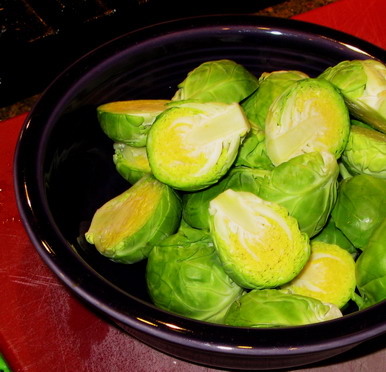
I admit it.
I used to be a hater.
I used to hate brussels sprouts, and could never understand why in the world anyone in possession of their senses would ever want to eat one, much less more than one of these mutant, alien miniature cabbage heads. They were mushy, watery, bitter, and smelled like–well, like a dirty toilet, as far as I could tell.
They were the devil.
And I have to tell you, that the salad at a meal I ate last night at the best fine dining restaurant here in Athens, Zoe, converted me from a hater of all things brussels sprouts, to a lover of that bonny wee brassica.
It turns out that everyone in my childhood days just overcooked brussels sprouts. And apparently, the longer you cook them, especially if you are boiling them, the more bitter they become–probably because the sugar is leached out into the cooking water, leaving only the smelly and nasty sulphur compounds behind.
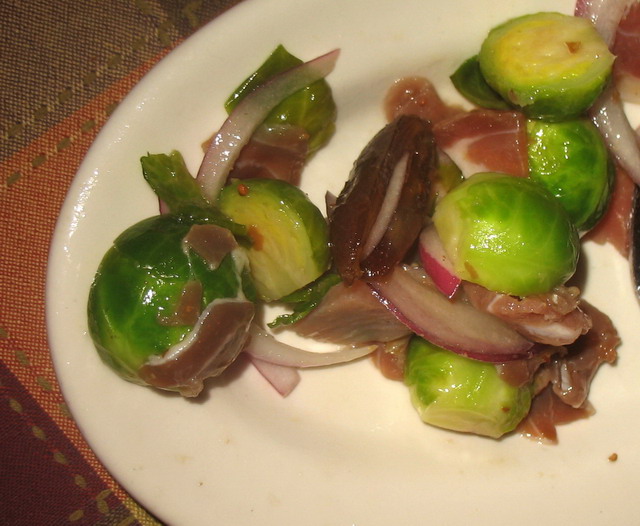
But about that salad, pictured above.
The chef/owner of Zoe, Scott Bradley, is a genius. His salads are always delicious, but the above combination of steamed brussels sprouts, prosciutto, dates and thinly sliced red onions tossed with a traditional, garlicky Caesar salad dressing was amazing. The textures were perfect counterpoints with the tender-crisp sprouts, the crunchy onions, the slightly chewy prosciutto and the sticky dates–and the flavors were just perfect. From salt to honey sweet to sharp–this salad had it all, and I gobbled down a good half of it before I remembered I had a camera with me and snapped a quick picture of what remained on my plate.
I ordered the salad, because I was out with my in-laws, and my father-in-law, Karl, has been telling me for years that there was absolutely no reason in the world why I should dislike brussels sprouts. So, I was determined to try them in his presence–not to prove him wrong, but to prove him right. I wanted him to be there to see me lose my last culinary prejudice against an innocent vegetable. (My other childhood vegetable foes have long become my pals: peas and I made our peace when I learned how to cook them with Indian spices, and beets became my buddies when I was pregnant with Morganna, and out of the blue, I started craving them.)
And so, I tried it, and liked it. And I told our waitress about how good it was, and told her that Scott had made me a brussels sprouts convert. She admitted that she never much cared for them herself, but on my recommendation, she would try the salad. I sure hope she liked it as much as I did.
The sprouts didn’t taste bitter and awful. They were like a combination of collard greens and bok choy with a little bit of hazelnut thrown in for good measure. They were nutty and sweet and lightly crunchy and tender at the same time.
Amazed, I had Morganna try them, and she pronounced them delicious. And Zak–he liked them too.
Oh, frabjous day, calloo callay!
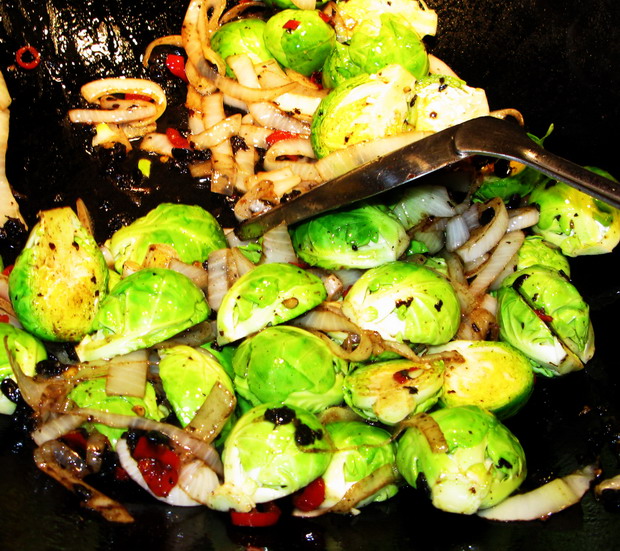
So, of course, tonight, I had to figure out how to cook my very own brussels sprouts. I decided to try a stir fry with onions, garlic, Hunan salted chilies, fermented black beans, tofu and carrots.
It turned out to be mighty tasty.
I did cook this recipe a bit topsy-turvy from the way I usually do a stir-fry: I put the brussels sprouts in the wok right after the aromatics were cooked, so that they would soak up plenty of of the onion, garlic, black bean and chile flavor, and could sear and brown against the hot surface of the wok without any other major ingredients in the way. After the sprouts where half-tender, I removed them, and added the tofu to the wok, and continued cooking as normal, adding the carrots next, and then returning the brussels sprouts to the wok, before deglazing, so that the quickly reducing wine would steam them to perfection, and they would get thoroughly coated in the glaze it produced.
As fine and tasty as this recipe is, I cannot wait to roast them in the oven and season them with ghee, panch phoron and lemon.
And of course, when I do make that, I will present it here and show you all how.
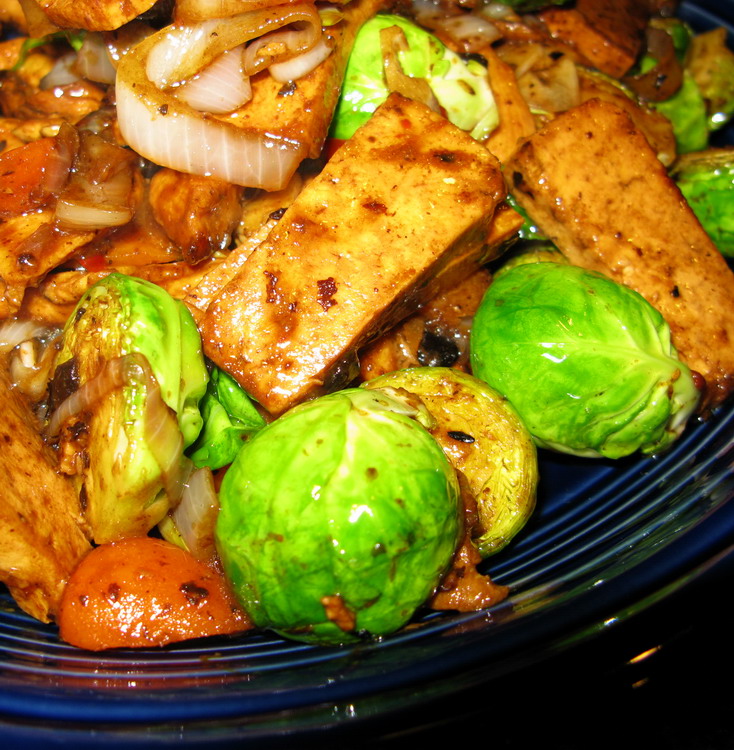
Stir Fried Tofu with Brussels Sprouts and Carrots
Ingredients:
1 pound extra firm tofu, (with the liquid pressed out if necessary), cut into thin slices about 2″X1/2″X1/8″
1 1/2 tablespoon dark soy sauce
1 tablespoon cornstarch
3 tablespoons canola or peanut oil
1 large onion, peeled and thinly sliced
2 tablespoons fermented black beans
2 teaspoons Hunan salted chilies or thinly sliced fresh chile to taste
1 pound brussels sprouts, bottom and outer leaves trimmed away–then cut each sprout in half
4 large cloves garlic, peeled and cut into thin slices
1/2 pound baby carrots, cut into thin slices diagonally
1/8 cup Shao Hsing wine or dry sherry
2 tablespoons dark soy sauce
1 1/2 tablespoon ground bean sauce
1/4 teaspoon toasted sesame oil
handful cilantro leaves, roughly chopped as garnish–optional
Method:
Gently toss the tofu with the soy sauce and cornstarch until the tofu is coated. Allow to marinate while preparing the other vegetables.
Heat wok on high heat until a thin thread of smoke arises from the surface of the pan; add oil, and heat for another forty-five seconds or so. Add onions, black beans, and chilies, and stir fry until onions are golden brown–about two to three minutes. Add brussels sprouts, and allow them to sit, cut side down on the bottom of the wok until they are beginning to brown–about a minute, then stir fry for about two more minutes.
Remove sprouts from wok, and set aside. Add tofu to wok, laying it in a single layer against the bottom and lower sides of the wok, and allow to brown well undisturbed–about a minute. While tofu browns, sprinkle garlic slices over it. Stir fry tofu and garlic for about a minute after tofu browns, then add carrots and brussel sprouts into the wok. Stir fry for another minute, then deglaze wok with Shao Hsing wine or sherry. As thick sauce forms, add the soy sauce and ground bean sauce, and continue stir frying for another minute until all is glazed with the deep brown sauce.
Remove from heat and add sesme oil and cilantro and serve with steamed rice.
Note: Sweet red peppers would be great added to this. Only, I didn’t have any. But you could have some, and try it out. I bet fresh or dried shiitake would be great with this, too.
Muhammara: It’s Vegan, It’s Good For You and It’s Damned Sexy
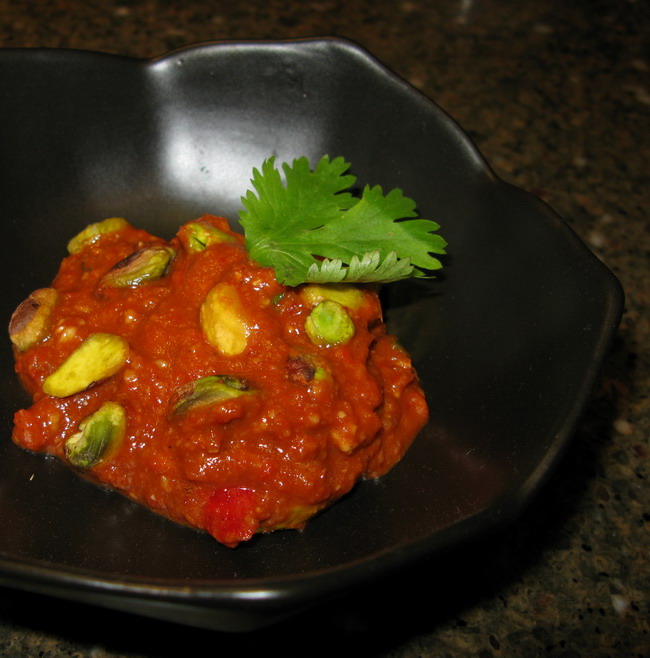
Muhammara is a dip, spread, sauce, condiment or salad that is said to have originated in Aleppo, Syria, although, it is served and eaten all over the Middle East.
It is also sexy: red, a little spicy, smooth, and oh so slippery on the tongue and tingly on the lips. It’s like a long kiss that you don’t want to end: and the best part is this–it’s good for you.
It is made from ingredients that are full of anti-oxidants, vitamins and minerals, and it is just plain good. Low in calories, high in nutrients, and it tastes naughty, like you are blowing your diet just by looking at its come-hither-scarlet self.
Muhammara. Say it with me, slowly, sensually: “Muhammara.” Mmmm. Yeah.
This delectable dish is scarlet from the roasted and fresh red sweet and hot peppers that are its main constituents, fragrant from the cumin, onion and garlic, rich from the olive oil and ground walnuts, and tangy from the pomegranate molasses. It is very pretty, especially the way I make it, which is slightly chunky from the addition of fresh red and green bell pepper, and flecked with fresh bits of fresh cilantro.
You will also note that like hummus and baba ganoush, muhammara is vegan. Not just vegan, but vegiliciously vegan. Tasty enough that everyone, vegan or not, loves it. It is just that good.
I have only had it as a dip with pita bread and used as a condiment with lamb and chicken kebab, but the muhammara was so delicious in those contexts, I couldn’t help but try and think of some other ways to use it. I think it would make a great sauce for baked fish or seafood, and a lovely marinade for grilled chicken. My mind is still working out these possibilities, but I promise to have a recipe for a dinner special I am planning for Friday that will include muhammara as a component.
But, before you go cooking with it, you have to learn how to make muhammara. There are lots of recipes on the ‘net, no doubt, many of them more authentic than mine, but the truth is, mine is pretty tasty, so I think you should give it a shot. It is easy to make, especially if you start out with already roasted peppers–at home, I roast them when they are in season, and peel and seed them then seal them up in ziplock bags, push out the air and stick them in the freezer. You could also use canned or jarred roasted red peppers for this, too–just drain and rinse them well. Or, you can start with fresh red peppers and roast them yourself. (That link takes you to a post that includes a recipe with instructions–and a picture on how to roast your own bell peppers.)
You can use either a fresh chile pepper in this dish, or you could use hot sauce or a spoonful of Chinese chili garlic paste. Any of these will work, though I am fond of the first and last options, myself. In either case, be sure and use some of Aleppo pepper flakes when you saute the onions–they not only add great flavor, but also give the muhammara a great fragrance.
As for the breadcrumbs–I used a freshly toasted pita to make them–I just cut it up and tossed it in the food processor with the roasted pepper. Then, I processed everything together with about a tablespoon of olive oil. I think that using fresh bread to make the crumbs gives a better texture and flavor to the dip, but if you want, you can use packaged breadcrumbs. Or, use whatever good bread you have around–the amount of breadcrumbs I give is approximate, since I didn’t really measure as I made it, but I suspect that one piece of pita bread would make about a cup of breadcrumbs.
You will notice that I don’t puree everything into a paste–I like my muhammara to have texture. I not only add some fresh green and red bell pepper, chopped finely, but I also only roughly chop some of the walnuts. This just makes the dip that much more interesting to eat.
Finally, if you want, you can use either fresh mint or parsley instead of the cilantro in your muhammara. I just happen to really like the way the cilantro sets off the sweetness of the peppers.
Remember: this dip is good for you. Antioxidants, cholesterol lowering ingredients and vitamins.
And it’s sexy. Say it one more time: “Muhammara.”
Now, get in your kitchen and make yourself a batch of it, and seduce yourself, your family and your friends.

Muhammara
Ingredients:
1 1/2 pounds roasted red peppers, divided
1 toasted round of pita bread
4 cloves garlic, chopped
1 cup toasted walnut pieces
1 1/2 teaspoons (or to taste) chili garlic paste or Sriracha
4 tablespoons olive oil, divided
1 medium onion, finely diced
1 tablespoon Aleppo pepper flakes
1/4 cup tomato paste
1 teaspoon cumin seeds, toasted and ground or 1/2 teaspoon ground cumin
1 medium fresh red bell pepper, seeded, cored and diced finely
2 tablespoons fresh green bell pepper, diced finely
2 tablespoons roughly chopped toasted walnuts
3 tablespoons roughly chopped fresh cilantro, mint or parsley
salt to taste
2 tablespoons pomegranate molasses, or to taste
chopped cilantro leaves and whole pistachios for garnish
Method:
Cut roasted peppers into strips and put two-thirds of them in a food processor. Cut or tear pita into roughly 1″ squares and put into the food processor along with the peppers, garlic and two tablespoons of olive oil. Puree, then pour into a medium sized mixing bowl.
Heat remaining olive oil on medium heat, and add onions and Aleppo pepper flakes. Cook until onions are a dark golden brown and fragrant. Add to bowl, along with the rest of the ingredients, except the salt and pomegranate molasses. Stir well to combine. Taste for salt, add what is needed, then add at least 2 tablespoons of pomegranate molasses.
Chill, but bring to room temperature before serving. Garnish with cilantro leaves and pistachios, and serve with toasty warm pita wedges. (Or with lamb and chicken kebabs, but when you do that, you lose vegan points. I’m just saying. On the other hand, I bet it would make a great sauce/marinade for grilled portabello mushrooms. I bet that would rule, and still be vegan.)
Taste vs. Flavor, Or, In Praise of Our Noses
I was reading somewhere on the net, a thread of conversation about food, foodies, and what makes a foodie a foodie. In the middle of this wide-ranging discussion, one commenter postulated that most foodies were supertasters who have tongues which can discriminate between the most subtle nuances of flavor between different foods.
Except, as another poster pointed out, supertasters, which are people who have a much higher than average number of taste buds on their tongues, don’t tend to like highly flavored foods, because what they taste is so intense that they are nauseated or disgusted by it.
It is more likely for a supertaster to become an extremely fussy or picky eater than it is for them to become a foodie.
Most food lovers probably only have an average number of tastebuds on their tongues. Which may make some folks sad, because everyone wants to be above-average in something, and having a very sensitive tongue–well, it sounds kind of sexy, doesn’t it?
But I don’t think what our tongues are up to in our mouths that make us food-lovers–it is what goes on in our noses that matters.
Why do I say this?
Because there are only five tastes which are registered on the tongue: sweet, sour, bitter, salty and umami--which is that meaty, savory taste that makes myriad foods such as mushrooms, meat and fermented soy products so darned, well, tasty. (Hot as in chile heat is not a taste–it is a sensation. It is the feeling of our mouths receiving a slight chemical burn–which doesn’t sound appetizing, but for myself and others like me, it is.)
If we could only discern those five tastes, then our food would only be made of a combination between those five tastes. And we would not have most spices, wine would either be bitter, sweet or sour, or some combination of the three, and our cuisines would be much more boring.
Instead, humans experience a myriad of flavors, all built from a combination of tastes and fragrances. We have hundreds, if not thousands of herbs and spices which build complex flavor patterns in our cuisines, and we talk about the “nose” of wine, or its “bouquet” in terms referring to its floral, fruity, woody or spicy qualities. We are thus able to proclaim not only the difference in flavor between a cherry and an apple, but also discern distinct differences in flavor between the hundreds of varieties of apples.
But the truth is–we do not only experience taste, we also experience flavor, and because of that, gastronomy is endlessly diverse, fascinating and fun.
What is the difference between taste and flavor?
Taste is discerned by the taste buds on the tongue.
Flavor is sensed in combination between our taste buds and our noses–with our noses, frankly, doing most of the work. It is the fragrance and aroma of food that make it most interesting, and I am firmly of the belief that most foodies boast sensitive noses, not sensitive tongues. (If you don’t believe me, think back to the last time you had a cold and had a nose so stopped up that you had to breathe through your mouth. Remember how weird food tasted–or rather, didn’t taste? That is because your blocked-up nose was unable to deliver its part of the sense of taste to your brain, and so every flavor was dulled down or erased completely.)
In my case, I have found over the years that I can smell the different individual spices of the melange used in an Indian dish, before I even taste it. Now, this ability to disentangle the rich spice mixtures of India by smell is not something I was born with; I learned to do it.
Well, not quite–I mean, I always had a good sense of smell. I could detect the difference of a single bay leaf between my Aunt Nancy’s lentil soup and my mother’s–otherwise, the recipe was exactly the same. But, to me–that bay leaf aroma was very present, and it made the two soups as different as night and day.
But sniffing out a bay leaf in a cauldron of soup at twenty paces is one thing; parsing out the identity of the spices dancing together in a curry is quite a different beastie altogether.
I had to train my nose, and my palate to do that.
How did I do this?
I will tell you. I used to, as I collected my Indian spices over time, take a small bit of each one and sniff it, then write down my impressions of it. Then, I would taste a bit of it on its own–and write down my further impressions. Finally, I would toast a bit of it in a dry skillet, and in a second skillet, would cook another bit of it in oil. Once again, I would write down what I thought of the flavor of the spice in cooked form.
When I taught Indian and Chinese cooking in Maryland, I used to put my students through their paces and urged them to keep a spice notebook to keep track of what all the spices, aromatics, herbs and condiments used in these cuisines tasted like, so they could refer back to their notes if they ever got stumped on the origin of a particular scent, flavor or taste. It seems that the act of writing down your impressions helps to burn the association of the flavor with the spice or herb in the mind; it essentially helps create what is called a “taste memory,” which is the ability to recall the specific flavor or taste of any given ingredient, mixture or dish.
Most chefs, myself included, have excellent taste memories. Some of them were born with an exquisitely sensitive palate, while others develop theirs through study and training over time. Most of us, I think, started out with good senses of taste and smell, and the ability to recall foods from memory, but then, this memory is strengthened by regular practice in using these senses critically and intentionally, by articulating what it is we are tasting.
The ability to recognize and parse out different tastes and flavors is a great skill for anyone to have, whether one is a chef, a serious home cook or just a serious eater, because not only does it allow us to understand and enjoy food to its fullest extent, it also allows a chef or cook to recreate dishes which we may have only tasted once, perhaps twice, without having to rely on a recipe.
Having a good nose and a memory for flavors is fun, I must say, because I enjoy being able to go out to most restaurants, eat something great and then be able to skip off home and after the passage of weeks or months, or sometimes, even years, hie myself into the kitchen to recreate the recipe on my own.
(I call that particular activity “food hacking,” and no, I do not do “Top Secret Restaurant Recipes.” I mean, why would anyone want to make a Big Mac at home? But, food hacking is a fun hobby.)
Just remember, that without our sense of smell, food would be much more boring than it is. We’d be lacking the very green, somewhat pine-resin flavor of rosemary, and the sweet, somewhat citrus, floral delight that is cardamom. We’d be bereft of the tingling warmth and spiny spark of black pepper and the delectable red burst of the first strawberry of the season.
Without our noses, our meals would be poorer indeed.
So what is the upshot of all of this blather?
It is this–if you want to be a better cook, a more discerning eater or just learn more about food, don’t worry about how many tastebuds are sitting on the surface of your tongue.
Instead, follow your nose.
Inspiration For A Light Supper: Moroccan Chicken Salad

In creating dinner specials for Restaurant Salaam, I have found inspiration in sometimes surprising places.
Of course, I am inspired by recipes I have found in the many dozens of cookbooks covering the regions of North Africa, the Eastern Mediterranean, the Middle East, India and Western China which I have in my collection. This goes without saying; when I am creating a set of dinner specials for a given week, and I become stuck, all I need to do to help the thoughts flow is reach for the overflowing bookshelves in my kitchen.
Sometimes, after I have read enough cookbooks, recipes will come to me in dreams; I will literally awaken in the middle of the night with a dish in my mind. I can often literally smell and nearly taste it, and I have a strong picture of it in my mind’s eye.
Such divine culinary visions cannot be counted upon. More often, inspiration will come to me when I think about an existing dish or recipe from another cuisine which I will then adapt to another, only tangentially related cuisine, or one which is completely different.
The salad pictured above, which we ran as a dinner special Saturday night, is an example of a recipe which came about as a reinterpretation of a classic recipe from another culture, and how it came to my mind in the first place is a good illustration of how the mind of a chef can work in roundabout ways.
There is no such thing in Morocco that I know of as a Moroccan Chicken Salad. At least, not like this one. The flavors, which include preserved lemon, roasted red pepper, harissa, garlic, olive oil, cinnamon and cumin, are certainly Moroccan; however, they are put together in a way which is from the South of France, in the classic dish, Salade Nicoise.
Now, I am not a huge fan of Salade Nicoise, which is a composed salad made of tunafish canned in oil, hard-boiled egg, blanched green beans, and black olives, arranged artfully (hence the term, “composed”–a composed salad is put together in a very aesthetic way) on a bed of crisp greens and dressed with olive oil, anchovies and lemon juice. To me, it always sounds better and looks better than it tastes, though that may be that I have just never had an excellent one. I have only eaten it a few times, and have only prepared it once, back when I was in culinary school, and while each version was good–it never made me want to jump up and sing or dance around in gustatory bliss. (A salad which does that to me is Yum Woon Sen–a Thai combination of cellophane noodles, vegetables, shrimp, pork and a very spicy, sour dressing with garlic, chile and lime juice.)
So, needless to say, Salade Nicoise is just not a dish which lives in the higher reaches of my personal taste memory banks.
This leads to the question: what exactly made me think of a salad I don’t even love in the first place in order to make a riff of of it that I absolutely love?
I have to point the finger at Julia Child and Jacques Pepin and lay the “blame” for my inspiration upon their shoulders.

See, it all came about last week when Morganna and I started watching one of the gifts I gave her for Christmas: the entire series of Julia and Jacques: Cooking at Home on DVD.
This series was Julia Child’s last television cooking show and I have to say that while her stamina was obviously lessened with her age, and her formerly tall, broad-shouldered leonine physicality was stooped and diminished, her intelligence, culinary instinct, ability to teach technique and witty comic streak were not only intact, but very apparent. She was a charming and funny woman to the end, and her partnership with Jacque Pepin, a great chef and teacher in his own right, brought out the best in her. The two culinarians complimented each other perfectly, and it was great fun to watch them agree and disagree in their unscripted forays in Julia’s kitchen.
With each recipe, they taught two ways of completing it, sometimes using complimentary techniques, and sometimes openly disagreeing, in a friendly way, on how to proceed. Jacques, for example, was always using copious amounts of garlic (ah, how I love that man!) while Julia declared that she never much cared for so much garlic in her own food.
The recipes showcased in this series are mostly French, of course, but they also show some American classics, like hamburgers. But each recipe, no matter what the inspiration or root cuisine, is presented in such a way that they look delectable, doable, and very, very appetizing. When they did two version of Salad Nicoise–Julia’s the traditional one with canned oil-packed tuna, and Jacques” with seared fresh tuna steak, suddenly, I found myself hungry for the idea of that salad. Hungry enough that I dreamed of it the night after watching the show, and I woke up hungry for a salad–not exactly like it–but in the same vein.
So, that is how I dreamed up this Moroccan Chicken Salad.
With the help of two culinary Muses.
How did I decide to change it around:?
Well, I like poached chicken better than I like tuna–especially since I am still avoiding tuna because of the mercury content of it while I am nursing Kat. And while boiled baby potatoes are classic, I thought that, especially after the holiday feasting and binging on heavy foods, I would replace them with something lighter. Artichoke hearts appealed to me, so I chose them, but–I kept the green beans intact. They were, after all, my favorite vegetable when I was growing up, and I love them in salads, composed or otherwise.
Olives had to stay, but I let go of the boiled eggs. They would be too rich. I used a tiny bit of feta cheese, instead, in part, because I liked the texture and the intense salty, milky flavor. I thought it would go well with the chicken. Then, I decided to add cherry tomatoes for tang and color and some pine nuts for crunch.
As for the dressing–it is a combination of typical Moroccan flavors, though I still kept with the olive oil and lemon base of Salad Nicoise. In this case, I used preserved lemons which I made myself, and their salty juice. (I highly suggest that you make your own preserved lemons if you want to make this salad–the flavors of homemade ones are much superior, much fresher than the commercially available preserved lemons.) I have to admit that I put this dressing together experimentally, and so this recipe is not a final one, nor is it probably particularly accurate. In fact, for the dressing, you will note that I say, “to taste” a lot–this is because if I keep developing this salad, I will probably change the dressing slightly, if nothing else, to simplify it a bit.
But, the salad came out so beautifully, and made such an impression on everyone who tasted it, I couldn’t resist sharing it, even in its unfinished state, with my readers.
One more thing: the garnishes you see on the top–the scallion brush and cherry tomato lotus. I am not going to describe how to make these in this post, as I had no time while I was making them at work to photograph the process. Verbal description alone is fairly useless in teaching how to make vegetable or fruit garnishes. Even these, which are so simple that I can turn out dozens of them in minutes, are hard to teach without illustration.
So, here is the recipe, though the dressing instructions are probably not as exact as I would like. However, I suspect that if you follow them, you will be able to come up with a reasonable approximation of the salad I made this past Saturday night.

Moroccan Chicken Salad
Ingredients:
2 whole bone in chicken breasts (about two pounds)
2 cups chicken stock, broth or water
1/2 pound grean beans, trimmed and stringed
1/2 pound frozen artichoke hearts, cooked according to package directsions, and cut into halves
handful cherry tomatoes
4 ounces feta cheese, drained and cut into very small cubes
1/2 cup pine nuts
1/2 cup pitted black olives–I used Kalamata
12 ounces fresh, crisp salad greens, washed, dried and cut into bite sized pieces
Ingrdients for Dressing:
1 preserved lemon, seeds removed
3 fresh garlic cloves, peeled
1 teaspoon harissa or chili garlic paste
1/2 cup fresh lemon juice
3/4 cup preserved lemon juice
2 tablespoons jarred roasted red pepper, pureed
fresh dill to taste
ground cinnamon to taste
ground cumin to taste
2 cups olive oil
sugar or honey to taste
Method:
Start recipe one day before serving.
Remove skin from chicken breasts, and poach in the stock, broth or water until meat is just done–do not overcook. Remove from the cooking liquid–reserve the liquid for another purpose. When meat is cool enough to handle, remove from the bones, and reserve bones to make stock. Shred the meat into bite sized pieces and set aside into a storage container.
Bring a pot of water to a rolling boil. Add prepared string beans, and cook until they just brighten in color and barely soften. Drain, and rinse with cold water until they are cool. Drain well and set aside into a storage container.
Cook artichoke hearts according to package directions and drain well. Rinse with cold water and set aside into storage container.
Rinse olives for a few minutes to remove some of the salt. Set aside in a storage container.
Heat a heavy-bottomed skillet on medium heat until it is quite warm. Add pine nuts and shaking pan, toast nuts until just golden and fragrant. Pour onto a plate, allow to cool, and set aside in a sealed container.
Rinse the preserved lemon under cold running water for five minutes, rubbing to rid it of excess salt. Cut it up into small pieces, and put into a food processor along with all other solid ingredients. Process until pureed.
Put pureed ingredients, along with juices, into a bowl, and whisk together. Taste. Add olive oil and whisk well to combine. Add seasonings and sugar or honey to taste–the dressing should be a balance between sweet, sour and salty flavors with a bit of the spice and herb flavors to add zip.
Use just enough dressing to moisten the chicken–toss it together well, seal it up and refrigerate overnight. Repeat process with the green beans and artichoke hearts.
The next day, put the salad together just before serving.
Lay a generous bed of mixed greens on the serving plate, and top with a mound of chicken on the top. Along the sides, add green beans, and on both ends, add artichoke heart halves. Fill each half with a cherry tomato, then in the corners between the artichokes and the green beans, add a small pile of olives. Sprinkle pine nuts over everything, and top the chicken with a small amount of feta cubes.
Garnish however you like, and serve remaining dressing on the side.
Serves 6
Culinary New Year’s Resolutions v.3.0
For the past two years, early in January, I wrote posts describing my culinary resolutions for the coming year, and since they were so much fun the first two times, here I am again. As before, these resolutions deal not just with the kitchen, but also with this blog, my writing, and life in general.
The first year I wrote my resolutions, one of my biggest ones was to cook more Thai food and blog about it, which I did accomplish. Last year, I resolved to work on my book proposal, which I utterly failed at, because I discovered that postpartum depression is more pernicious than at first it seems, and it can trigger a latent genetic tendency to depression. This is not fun, but I refuse to let depression sap me of my will to create and write. So, this year, I am back to the drawing board on the book proposals. (Yes, in the plural. I have another idea for a book–a cookbook this time….finally!)
So, what are my culinary resolutions for the coming year?
To continue to be creative at coming up with dinner specials that fit the theme of Restaurant Salaam, which not only keep food costs down and work within the limitations of our kitchen, but which beguile the senses of our guests, enliven their imaginations, and keep them coming back for more. I also want to keep writing about my experiences in the restaurant kitchen; I think that readers are interested in what goes on behind the scenes, and what it takes to make food come to life in a restaurant setting. It is certainly different than working in a home kitchen, but not entirely. To do well in a professional kitchen, not only does one have to be skilled–and that is something that ever cook or chef works to improve constantly–everyone wants to absorb new techniques and ideas–but you also have to have love and passion. Food cooked without love or passion lacks soul no matter if you are cooking at home or in a restaurant. It may be technically beautiful, its presentation may be divinely inspired, and its flavors may be interesting and complex, but without love, something is always missing.
One of my goals is to get that feeling of cooking with love across to my readers this year.
Another resolution is to continue writing about the glories of the local food scene here in Athens. Recently, after the story about Tigers & Strawberries appeared in the local newspaper, expatriates of Athens have written emails to me telling me that they are thrilled to find out about my blog and want to hear more about what is going on in Athens in regards to food. That is great–because exciting things are happening, and I have quite a few good posts lined up to highlight these new developments. And while looking at the new in Athens, I want to write about the old, as well–here in Appalachia, traditions change slowly, if at all, and I like to share our foodways with my readers, from fishing, hunting and gathering food in the wilds, to gardening, to canning and beyond, I will continue to write about the local food traditions that are still extent in my home.
Another resolution is to spend more time and energy on making vegetarian and vegan meals that are not only healthy for my family and sustainable for the earth, but also delicious and satisfying. As I get older, I like to eat less meat, and I find that both Zak and Morganna are becoming more apt to be happy with meatless meals, so I hope to showcase more of them in the future, particularly those based on recipes from Asia.
Speaking of Asia, I also want to keep writing more informative pieces on individual ingredients or classes of ingredients as well as reviewing cookbooks for the many cuisines of Asia. This has been the focus of my blog from the beginning and I want to continue to offer my personal explorations in the foods of China, India, Thailand, Vietnam and Korea to the delectation of my readers.
I also want to do more informative posts on individual ingredients and spices–just to help along some of my readers who are just dipping their toes into the realm of highly-flavored cookery. Spices, in particular, can be daunting to a new cook, and I want to do anything in my power to make a neophyte as comfortable with spice cookery as possible.
Finally–I will continue to write essays on subjects relating to food, health, cooking, cookbooks, agriculture and culture as my will to write them arises.
Now–it is everyone else’s turn: first, what else would you like to see me cover in Tigers & Strawberries in the coming months, and secondly–what are -your- culinary New Year’s resolutions? What are you going to do to stretch your food horizons in the coming twelve months?

Categories:
- Admin (rss) (55)
- Blogs and Blogging (rss) (81)
- Book Reviews: Cookbooks (rss) (43)
- Book Reviews: Non-Cookbook Food Books (rss) (38)
- Cats and Cat Blogging (rss) (47)
- Chinese Cooking Lessons (rss) (32)
- Culinary School Stories (rss) (18)
- Dairy Pruducts: Cultured and Barbaric (rss) (4)
- Documentary Filmmaking (rss) (1)
- Essays, Rants and Reflections (rss) (260)
- Fighting Hunger (rss) (12)
- Food and Kids (rss) (45)
- Food in the News (rss) (126)
- Food Media (rss) (98)
- Food Preservation (rss) (18)
- Food Safety (rss) (45)
- Gardening (rss) (30)
- Herbs and Herb Blogging (rss) (20)
- Holidays (rss) (50)
- Kat Blogging (rss) (22)
- Kitchen Science (rss) (36)
- Leftover Makeover (rss) (8)
- Life, the Universe and Everything (rss) (131)
- Local and Sustainable (rss) (227)
- Local Athens Food and Foodies (rss) (42)
- Meatless Mondays (rss) (32)
- Menu For Hope (rss) (5)
- Nutrition, Diet and Health (rss) (84)
- On The Farm (rss) (8)
- Recipes: Almost Vegetarian, Vegetarian and Vegan (rss) (294)
- Recipes: American Regional (rss) (37)
- Recipes: Appalachian Hillbilly (rss) (33)
- Recipes: Bread, Pasta, Grains (rss) (95)
- Recipes: Canning and Preserving (rss) (8)
- Recipes: Chinese (rss) (123)
- Recipes: Comfort Food (rss) (120)
- Recipes: Cookies (rss) (16)
- Recipes: Desserts (rss) (48)
- Recipes: French (rss) (25)
- Recipes: Fruits and Vegetables (rss) (302)
- Recipes: Greek, North African and Middle Eastern (rss) (31)
- Recipes: Indian (rss) (137)
- Recipes: Italian (rss) (42)
- Recipes: Japanese (rss) (7)
- Recipes: Jewish (rss) (4)
- Recipes: Korean (rss) (6)
- Recipes: Meat, Poultry and Fish (rss) (220)
- Recipes: Mexican/Native American/ Latin American/Caribb (rss) (27)
- Recipes: Original (rss) (108)
- Recipes: Thai (rss) (27)
- Recipes: Tofu (rss) (17)
- Recipes: US Regional (rss) (16)
- Recipes: Vietnamese (rss) (8)
- Restaurant Stories (rss) (28)
- Sewing, Quilting, Arts and Crafts (rss) (16)
- Simple Chinese Recipes (rss) (30)
- Slow Food and Heritage Foods (rss) (10)
- Spice Blogging (rss) (44)
- The Chinese Cookbook Project (rss) (14)
- The Chinese Pantry (rss) (39)
- The Documentary (rss) (2)
- The Kitchen Saga (rss) (17)
- The Locavore's Bookshelf (rss) (15)
- The Unsung Adventures of The Culinary Nerd (rss) (6)
- Tools and Toys (rss) (35)
- Uncategorized (rss) (10)
- With a Side of Politics (rss) (48)
Archives:
- August 2012 (9)
- July 2012 (12)
- September 2011 (3)
- August 2011 (7)
- July 2011 (8)
- June 2011 (16)
- May 2011 (17)
- April 2011 (11)
- December 2010 (9)
- November 2010 (5)
- February 2010 (1)
- December 2009 (5)
- November 2009 (7)
- October 2009 (10)
- September 2009 (16)
- August 2009 (14)
- July 2009 (14)
- June 2009 (7)
- May 2009 (17)
- April 2009 (10)
- March 2009 (25)
- February 2009 (13)
- January 2009 (10)
- December 2008 (5)
- November 2008 (5)
- October 2008 (6)
- September 2008 (13)
- August 2008 (8)
- July 2008 (11)
- June 2008 (18)
- May 2008 (13)
- April 2008 (14)
- March 2008 (16)
- February 2008 (17)
- January 2008 (19)
- December 2007 (25)
- November 2007 (18)
- October 2007 (24)
- September 2007 (16)
- August 2007 (15)
- July 2007 (15)
- June 2007 (10)
- May 2007 (14)
- April 2007 (16)
- March 2007 (17)
- February 2007 (20)
- January 2007 (13)
- November 2006 (1)
- October 2006 (8)
- September 2006 (14)
- August 2006 (25)
- July 2006 (30)
- June 2006 (28)
- May 2006 (34)
- April 2006 (29)
- March 2006 (24)
- February 2006 (30)
- January 2006 (38)
- December 2005 (40)
- November 2005 (37)
- October 2005 (32)
- September 2005 (25)
- August 2005 (30)
- July 2005 (28)
- June 2005 (21)
- May 2005 (8)
- April 2005 (22)
- March 2005 (17)
- February 2005 (29)
- January 2005 (10)
Search Site:
Links:
- Lily’s Wai Sek Hong
- 101 Cookbooks
- A cat in the kitchen
- A Veggie Venture
- Accidental Hedonist
- Cha Xiu Bao
- chez pim
- Chocolate & Zucchini
- Chopstick Cinema
- Chowhound.com
- Chubby Hubby
- Cook sister!
- Cooking with Amy
- da*xiang
- Eat Local Challenge
- Eating Liberally
- Ecocentric
- Eggbeater
- Epicurious
- Farmgirl Fare
- Fatfree Vegan
- Foodgoat
- ForkandBottle.com
- Green Olive Tree
- Hooked on Heat
- Jaden’s Steamy Kitchen
- Kalyn’s Kitchen
- Lucullian delights
- Mahanandi
- Matt Bites
- MeatHenge
- mmm-yoso!!!
- New York Times – Dining & Wine
- Pizza Goon
- Rasa Malaysia
- Ruhlman
- Sailu's Kitchen
- Serious Eats
- SF Gate: Food & Dining
- Simply Recipes
- Soul Fusion Kitchen
- Tastespotting
- The Amateur Gourmet
- The Cleaner Plate Club
- The Food Section
- The Grub Report
- thecookscottage
- U.S. Food Policy
- Wandering Chopsticks
- Washington Post Food and Dining
- Wasted Food
Meta:


Powered by WordPress. Graphics by Zak Kramer.
Design update by Daniel Trout.
Entries and comments feeds.