
Cook Local, Eat Global
Not Live Radio: Live TV….
Okay, when I got contacted by WOUB, I assumed that it was WOUB, the NPR affiliate radio station here at Ohio University.
Well, actually, it was WOUB, the PBS affliate television station here at Ohio University.
How did it come about? Because the station manager saw me in Time….He emailed me and asked if I would be interviewed live for a story about locavores. So, I said yes, thinking “Live radio–I’ve done that before, no problem. I can even stick an MP3 of the interview on the site, and it would be cool.”
But, the reality is that there will be no MP3, though I might be able to get a CDR of the clip and put streaming video up here.
I first got the clue that I wasn’t going to be doing a live radio interview when I stepped into the newsroom, and the young man who was going to interview me stepped up to shake my hand.
On the lower half of his body, he was wearing khaki shorts and flipflops. On the upper half, he had an oxford cloth shirt, a tie and a suit jacket.
I’ve done radio. Folks who do radio never dress nicely on the top. Or, the bottom, for that matter.
Suddenly, I was very grateful that I had the inspiration to put the new, less brightly colored shirt on to go to the station. I had been wearing a cotton Indian block print skirt in shades of melon, orange, magenta and cream, with a dip-dyed melon to orange kurta shirt with silvery embroidery around the neckline. This would have, under the television lights, blinded any viewer who happened to tune in, not to mention the interviewer/anchorperson.
I am also glad that I thought I was going to a radio interview, even if it meant I looked like myself, in a nice t-shirt and jeans, with understated jewelry, sans makeup and overly styled hair.
Why? Wouldn’t I have rather put on some make up and done up my hair?
Well, yes. And, no.
Because, if I had to worry over being on television all weekend, my nerves would have been shot, and I likely would have stammered through the entire interview like a fool.
This way, having it sprung upon me at the last minute, was much better, because I didn’t have time to get scared.
I just went in, got a mic wired to me, and waited to be interviewed. No worries about how I looked, what to say or anything.
Hopefully, I sounded intelligent!
But, at least, I got some points across to the local media about eating locally, which is worth any amount of nervousness on my part.
Oh, and another cool thing that came out of the Time story–a friend I have not heard from in years tracked me down and emailed me. We had lost touch years ago and I had no clue about how to get in touch with her. But, it looks like she found me.
That is just as cool as getting the word out about the local food movement!
On Edible Flowers
Edible flowers were and are all the rage in some culinary circles, but I find many people hesitant either to try and cook with flowers, or to eat them if they are served. This hesitancy probably stems from unfamiliarity with the long-standing custom of eating flowers and using them as flavorings in food. It probably also is the result of childhood warnings given by well-meaning and rightfully fearful parents; some flowers, for all that they look and smell delicious to small person’s senses, are indeed, quite poisonous.
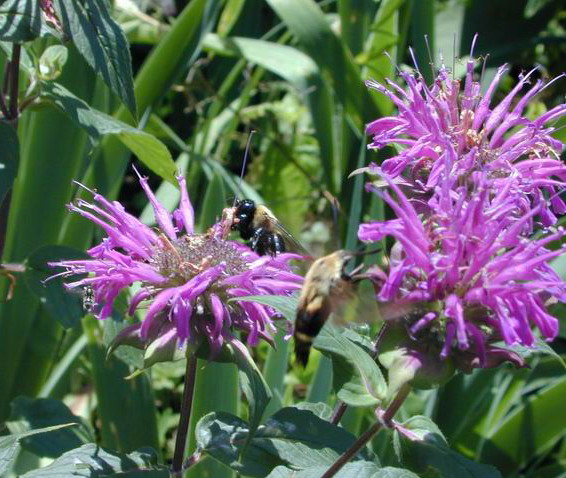
The bright colors and exquisite shapes and scents of flowers are both alluring and in some cases, dangerous, (oleander, for example is deadly poisonous, for all that it is gorgeous), and so we are made wary when it comes to tasting them.
So, the first rule when it comes to eating flowers is to not eat any of them, until you are certain that they are not poisonous. In order to find out which are edible and not, one can consult a knowlegeable friend, a reputable website, or a good book.
The second rule of edible flowers is not to eat any from a florist shop, nursery center or from the roadside. Florist shops and garden centers use pesticides on their plants that are not safe for plants which are to be eaten. Unless you like a side of poison with your salad, then, it is best to avoid plants from those sources. In the case of roadside gathering, car exhaust, and the use of herbicides by state road crews to control weeds make the prospect of eating these plants questionable at best, dangerous at worst. (This also goes for gathering berries by the roadside–it is generally a bad idea.)
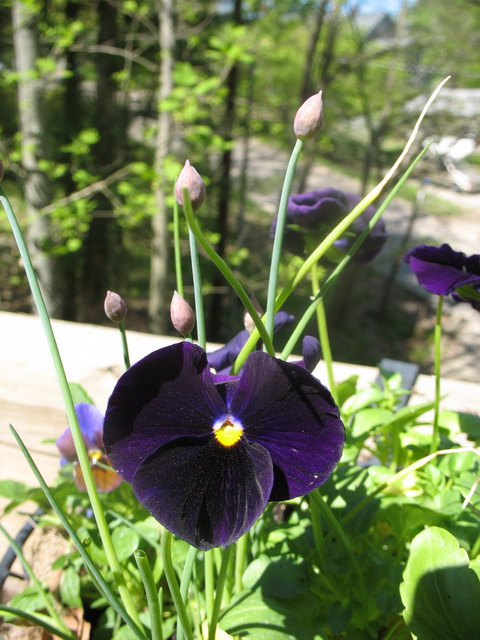
Where, then, does one get edible flowers? Well, the best way to go about getting safely edible flowers is to grow them yourself. If you have a small amount of garden space, or even just a sunny deck or porch, you can grow some edible blossoms for yourself and your family. Nasturtiums, pansies and violas thrive in pots; and the flowers of most culinary herbs, which also do well in container gardens, are not only lovely, but edible. For a couple of good books on growing your own edible plants, check out Rosiland Creasey’s The Edible Flower Garden, and Taylor’s 50 Best Herbs and Edible Flowers : Easy Plants for More Beautiful Gardens.
But even if you don’t have room to grow your own edible flowers, they can usually be bought at local farmers markets from growers who do not use pesticides or herbicides, because they know people will be eating them. Upscale grocery stores such as Whole Foods, Wild Oats and many independant natural foods stores also sell edible flowers grown without any poisons.
One does not have to use only fresh flowers in order to cook with the flavors and essences of them. Dried lavender buds are available from Penzey’s, for use in cooking, and rosewater, lavender water, orange flower water and pure essential oils can all be used in cookery as well. Just be certain that what you buy is meant to be used in foods, and is from a non-poisonous source.
Following are a few of my own very favorite edible flowers, with notes on how to use them and how easily they are grown.
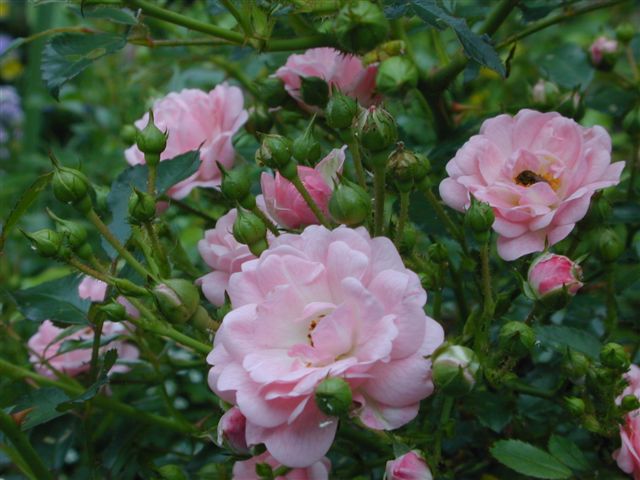
Roses are my number one favorite all time edible flower. While I don’t often use the flowers themselves, except as garnishes, I do make use of a product made from the flowers: rosewater. (I prefer Cortas brand from Lebanon for its superior aroma and flavor.) However, one can also use the flowers to make candies, the petals or whole blossoms can be coated in lightly whipped eggwhites and sprinkled with super-fine granulated sugar to candy them, and can be used to make jams, preserves and jellies. Gulkand is a type of rose petal jam made in India; I have used this product to make a filling for a cake I named Gateau de Mumtaz Mahal. One of my most famous recipes made with rosewater are the ever-popular Aphrodite Cakes, but I have also made Strawberry Rosewater Ice Cream, and I use rosewater in nearly any recipe that includes berries, such as Strawberry Shortcake. Blackberries and raspberries are also enhanced by the use of rosewater, as evidenced in the recipe for Blackberry Pie.
Lavender comes in a close second when it comes to my favorite edible flower. The rich medicinal tang of lavender is probably one of my favorite scents in all the world, even more beloved than the heady musk of roses. Unlike roses, which I tend to use only in sweets, I do use lavender in both sweet and savory preparations. It is a component of the classic herb mixture, “Herbes de Provence,” which includes some or all of the following, depending on who is doing the mixing: cracked fennel seed, rosemary, thyme, savory, marjoram, chervil, tarragon, basil and lavender. This mixture is used on poultry, fish, roasted meats and in stews. I also have used lavender to great effect in shortbread, as shown in the recipe for Lavender Crescents, and mixed with ginger in an ice cream called Creme Glace Chinoise.

Violas and pansies are often used candied to decorate cookies and cakes, but they can also be used in salads to good effect. They are colorful, beautiful, and simple to grow. They do tend to like cooler weather, however, so they are kind of hard to keep looking pretty all summer long, once the dog days start in. I like to use them in salads, particularly in ones like my Fried Chevre Salad. Some people say they cannot detect a scent or flavor in these little flowers, but when you grow a lot of them together like I do, you can catch a whiff of a very delicate, sweet floral scent that is as endearing as their little “faces” are. I like to use them to garnish all sorts of savory dishes, too, however, where they can bring a dash of brilliant color to an otherwise monochromatic dish, like Kashmiri Kofta.
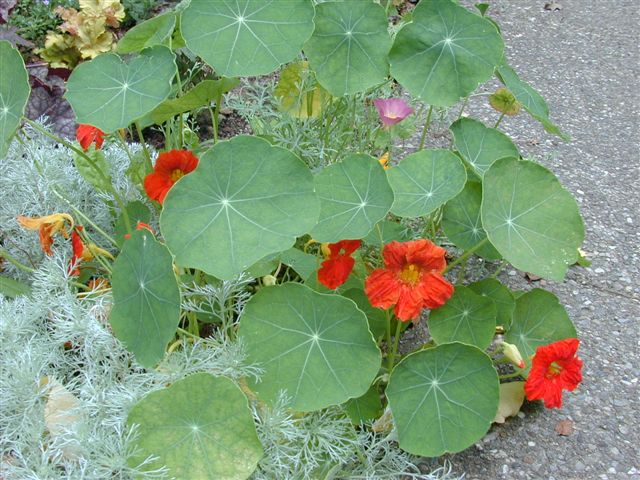
Nasturtiums are the edible flowers most often found in upscale grocery stores, and with good reason. They are brilliant in color, and are filled with bright, peppery flavor that is akin to watercress or radish sprouts. When we lived in Pataskala, I used nasturtiums to border all of the walkways of the garden, and then would use the leaves and flowers to garnish salads, soups, and any other dish that would sit still for them. I also liked to minced up the flowers and leaves with basil, thyme and rosemary and make a delicious compound butter that was great stuffed under the skin of a roasted chicken, or used to butter freshly baked breads. Unfortunately, most of the front of our new house is shady, so I have to wait to grow more nasturtiums until we get the back yard terraced next spring, but until then, I will buy them at the farmer’s market for when I want to use them as garnishes, like I did last summer when I made Nam Sod.
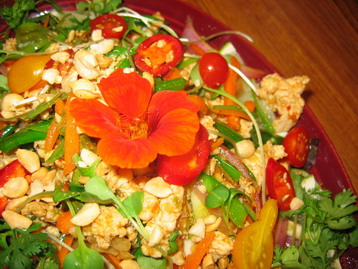
These are just a few of the possible edible flowers you can use, whether you want to make an entry to this month’s The Spice is Right–The Perfumed Garden event, or just because you want to give cooking with flowers a try. There are quite a few good resources online to start whetting your appetite on the subject, and whether you get your flowers from the local farmers market, or grow your own, it is very fun and rewarding to explore the myriad scents, colors and flavors afforded by the many different edible flowers of the world.
The “Making Of” the Time Magazine Article
I’ve had a number of people ask me what it is like to “be in Time Magazine,” and what the photo-shoot experience was like.
Rather than answer everyone individually, I decided to just write a quick “the making of” post here, so that the curious can be satisfied.
What is it like to be interviewed?
Well, in truth, I am used to being the one doing the interviewing, so it isn’t that odd. I know what sorts of questions reporters are apt to ask, and how they are likely to ask them. Besides, I have been interviewed via email and over the phone more than once already, so it wasn’t anything that unusual. (Now, the live radio interview I am doing on Monday for the local NPR station–that is another matter….live stuff always gives me the quiggly stomach!)
Margot Roosevelt, the reporter, contacted me via email. She found a comment I had made on the Locavores website, and she asked the webmistress, Sage Van Wing for my email address. Sage, who has already interviewed me for a book she is working on, gave her the email address and so Margot contacted me. I consented to an email interview, Margot sent a list of fifteen excellent questions, which I sat down the evening after my amniocentesis (those hurt, btw), and answered as fully as possible, which means I wrote poor Margot a novel-length email back.
She wrote right back and thanked me, and said she was going to write the article over the weekend, and that she might contact me with more questons.
The next Tuesday, she emailed me again and told me that the photo editor for the article was going to be contacting me the next day, because she wanted to assign a photographer to come out and shoot a portrait of me for the story.
This is where surreality crept into the experience.
I hate to have my photograph taken.
And I needed a haircut.
And I was just beginning to show I was pregnant.
And I had a zit on my chin.
So, what did I do?
I said, “Sure, give the photo editor my phone number and she can call me tomorrow.”
And then, I panicked.
Morganna and Zak, however, were thrilled.
Morganna, in fact, did not stop bouncing up and down the entire evening. But, even in her excitement, she managed to slow down enough to help me pick out something good to wear that conveyed a laid-back image. She even picked out nice, tasteful jewelry for me to wear.
The next day, I got up, had a leisurely breakfast and waited for the photo editor to call back. I made a haircut appointment for the afternoon, and hung out in my jammies until noon, figuring that editor people are morning people. Finally, I jumped into the bathtub, whereupon the photo editor called me. So, I talked to her while I was in the bathtub. Thank goodness for cordless phones.
She asked what city in Ohio I was closest to, I told her Columbus. She said she had freelancers she worked with in both Columbus and Dayton, and I told her it would be a much easier drive for the one in Columbus to come to Athens, so she said she would call me right back.
I got out of the bath, got dressed, waited around, and then went to get my haircut. After the haircut, I went out and bought make-up so I could cover the zit issues. (Whatever happened to that pregnancy glow? Has it passed me by?)
While I was gone, she called back and had gotten in touch with the photographer, who was to call me. He was going to be in Athens the next day.
There was also a message on the machine from the photographer, Ted.
So, I called Ted back, and he said he would be dropping his kids off at school and then heading out to Athens right afterwards, and that he would be at the house around eleven in the morning.
That was great, except I had a prenatal checkup at that time, but I figured I’d reschedule. (No, I didn’t tell the receptionist that I couldn’t come in because a photographer from Time Magazine was going to be at my house. I didn’t think that much information was necessary.)
So, we got off the phone, and a bunch of thunderstorms swept through our area of Ohio (this becomes important later) and I finally decided to tell my family and friends about the Time Magazine article and photograph thing.
Everyone was thrilled to death.
Which was fine–they weren’t being photographed.
The day dawned, cool and sunny. I got up, bathed, got dressed in the clothes and jewelry Morganna had picked out, pressed and polished for me.
I put on make-up and did my hair, and sat down to wait.
Ted and his assistant arrived on time, and we went up on the deck to scout the location. Ted and Mark moved around my container garden, and set up a corner of the deck as the “studio.” They arranged the herb and tomato plants so that everything looked lovely, moved the table and chair over and then took a good look at me. Ted declared the shirt Morganna had chosen as too dark and too patterened. (It was a denim shirt with a pattern of suede-like brown swirls over it. Very pretty and casual.) “Something lighter, and with less of a pattern,” Ted said definatively, and sent me on my way to dig through the closet.
Zak had suggested green as a good choice, since it goes with my hair, eyes and complexion, so we dug out three different blouses and two t-shirts in varying shades of pale green. Ted’s eyes lit up when he saw the lace blouse and said, “That’s beautiful. That one.”
So, in I went and changed, and switched out the turquoise jewelry for the silver and green amber jewelry.
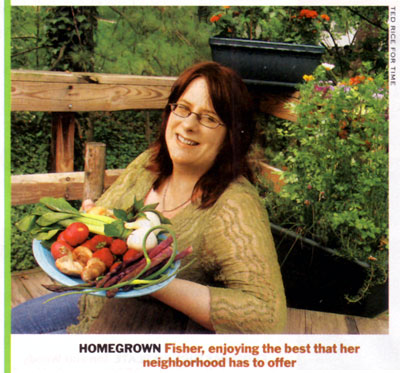
Then, it was time for me to make up the platter of local fruits and vegetables you see in the picture with me. I used my Gram’s vintage Fiestaware platter, and set up an arrangement of fresh shiitake mushrooms, purple asparagus, tatsoi, garlic scapes, garlic, onions, new potatoes, strawberries and Thai basil. We had unfortunately already eaten the rainbow chard and Japanese turnips, but the combination of colors, shapes and textures was good as it was.
I went back up on the deck and it turned out that there was a technical difficulty.
Remember that thunderstorm I mentioned? Well, Ted’s main camera had gotten a bit damp during the storm, and was misbehaving. So, he switched to his backup camera, a smaller digital SLR (I was drooling over both of the cameras–as I told Ted, I am used to being on the other side of the camera.) He had the lights set up and everything ready, so down I sat, and we started working.
Let me tell you, while Ted made it fun by being really funny and personable and witty–I am so glad that I am not a model or an actor or something. It would work my nerves to have to be photographed all the time. Or maybe, as one gets used to it, one relaxes and smiling becomes more natural. Maybe that is how it works. But I know one thing–I admire the patience of public figures much more than I did before. Their patience and stamina.
Ted teased me about my “Clint Eastwood squint,” and did all he could to get me to open my eyes wider. I told him about how Chef Lipa, in culinary school, a Filipino chef of Spanish and Chinese ancestry, used to tease me about how little my eyes were and how I needed, “a Jackie Chan operation” to deal with the slight epicanthic folds in the corner of my eyes. Retelling Chef Lipa’s antics got us all to laugh.
Those epicanthic folds are the legacy of my mother’s mother–it is the Cherokee genetics showing on me. I didn’t get the pretty skin,or the black hair, but I got the cheekbones and the eyelids. As you can see in the photograph, Ted did his best and finally got me relaxed and smiling, so it all went well.
Then, we went inside and he did some shots in my kitchen, but he was never as happy with those as he was with the outdoor shots.
And that was it. It took about two and a half hours to do the photo-shoot, and even taking into consideration that I am not an easy subject who is happy in front of a camera, and the fact that there were technical difficulties to overcome, Ted made it fun and did a great job.
So, now that I have told you the story, I can tell you what it is like to be in Time Magazine.
It is cool, but not just because my picture is there for the world to see, and I said intelligent things.
What makes me happiest is that I got to talk about the issue of local foods and sustainable agriculture to a wide, mainstream audience. I got to put a face to the local food movement–I got to humanize it for people. I got to talk about an issue that is important to me and a lot of other people in a way, by emphasizing the great gustatory pleasure locally harvested fresh foods bring, that will attract others to the topic.
That is what makes me the happiest about the entire experience. Not that I am in Time, and my parents and in-laws can run about showing off the picture to all and sundry (although that is cool, too and it really makes them happy), but because I got to help bring the message of local eating to a huge audience.
-That- is the best thing about the Time article.
New Organic Foods Forum Up And Running
A friend of mine (thank you, Heather!) sent me email alerting me to a new forum for folks interested in organic foods, issues of sustainability, local foods, organic farming, gardening and the like.
The Forum, called Sustain360, is sponsored by a roster of organizations and and companies that include The Organic Center, Environmental Working Group, FamilyFarmed.org, Farm Aid, Slow Food, Chefs Collaborative, Beyond Pesticides, Organic Valley, Holistic Moms Network, and Children’s Health Environmental Coalition.
Right now the forum is in its infancy, but it looks like a good group of posters are involved and active. To participate, you must register, but really, it is a painless process that does not involve giving up firstborn children or a quart of blood or anything, so go check it out and see if it is to your liking.
I Had To Do It: Bulgogi Burgers
It is all Sarah Gim’s fault.
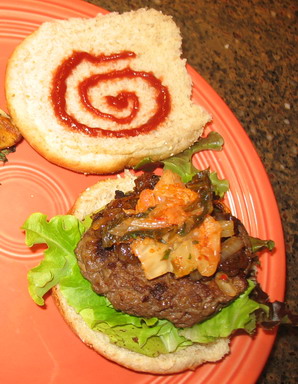
I was perusing Slashfood the other day, and ran smack into her post, “Food Porn: The Bulgogi Burger,” and had an instant craving. (Any woman who has been pregnant knows exactly what I mean when I say, “instant craving.”)
What the heck is a bulgogi burger? Well, Sarah took some ground beef and mixed into it the marinade that goes on bulgogi, the famous Korean grilled beef that is amazingly tasty, especially when served wrapped in leaf lettuce with some herbs and raw onions. Then she cooked the burgers, and topped them with lettuce and onions that had been marinated in that same bulgogi marinade, and instead of ketchup, she moistened the bun with goh-choo-jahng, which is Korean red chile sauce.
She mentioned that if she had kimchee, she probably would have shredded some of it up for a “slaw” to go atop the burger, but as she the fridge was bare of the fermented cabbage, she did without.
By the time I read the post, my mouth was watering. I -had- to have me one of those burgers. I just had to. I became fixated upon them, and I hankered mightily for those burgers with a hunger just this side of Elvis clamoring for another peanut butter ‘n ‘nanner sammich.
(To be fair, at this time, I have to say that this is not all Sarah Gim’s fault–John T. Edge holds some amount of the blame here, too. I had just finished reading his book, Hamburgers & Fries, where I read about all sorts of regional variants on hamburgers that are to be found in this great land, and I was jonesing after every last one of them, all because Edge writes the way Aretha Frankling sings.)
And I had in the pantry all of the fixings for bulgogi marinade and kimchee. I was distinctly short of goh-choo-jahng, but I did have a fine and tasty substitute: sriracha. Sriracha sauce is the wonderful tangy hot sauce with the jaunty rooster on the bottle that one applies to one’s bowl of pho in countless Vietnamese restaurants, or which is used to heat up one’s pad thai in countless Thai places across the US.
In our house, sriracha is ubiquitous, but we never call it by its proper name; we just call it, “The Rooster.”
As in, “Pass me The Rooster, please?”
Or, “I think we are running low on Rooster.”
So, tonight, because there was no chance of rain, I determined to make bulgogi burgers for supper.
About five hours before dinnertime, I minced up some scallion top, ginger and garlic, added some pepper flakes, raw sugar, soy sauce, rice wine, and sesame oil, and kneaded this mixture firmly into a pound and a half of local, grassfed ground beef. Then, I covered it up and let it sit for a while, and get all tasty while I went about my day.
Right before dinner, I made the toppings, and improvised a side dish. Instead of marinating raw onions, I caramelized some, and then added rice wine, soy sauce, sugar and sesame oil to them. I let the liquid reduce to a thick glaze, and the onions cooked down into a rich dark brown “jam” that was heady with scent and flavor. The kimchee slaw was even simpler–I just shredded up half a small jar of kimchee and called it slaw. (No one else in the house had the kimchee on top of the burger, so I ate the rest of it on the side. No sense in letting perfectly good kimchee go to waste.)
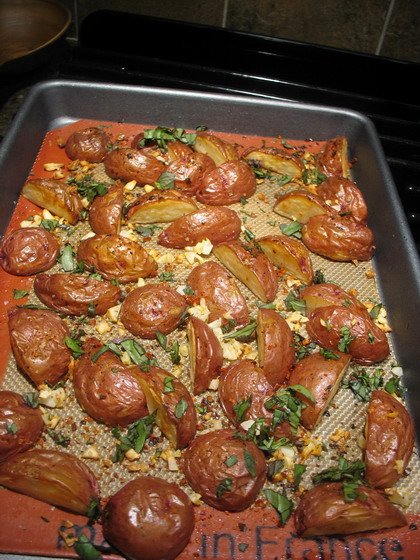
As for the side dish–I roasted the new potatoes I picked up at the farmers market on Saturday in peanut oil, with chile flakes and salt. When they were halfway done, I added minced garlic, and when they were done, I tossed in some minced Thai basil.
How did it all taste?
Fantastic. Just fantastic. Zak cooked the meat so that it was still juicy on the grill, and the potatoes were crisp on the outside and creamy on the inside. Better than french fries, in my opinion, and the Thai basil and garlic combination was a winner. The onion jam, Rooster, kimchee and leaf lettuce added textural contrast and layers of flavor to the already quite tasty burgers, and the whole-wheat buns held it all together.
The onions were rich and smoky, sweet and smooth. The kimchee was crunchy and tangy, with heat and salt to spare, while the burgers had all the richness of bulgogi in patty form. The Rooster added another level of sweetness and tanginess while ramping up the heat another notch, and the lettuce was all crisp, buttery and green.
It was all good.
Will I be making these again?
Oh, yes. Yes, indeed.
Thanks, Sarah–it was a great idea!
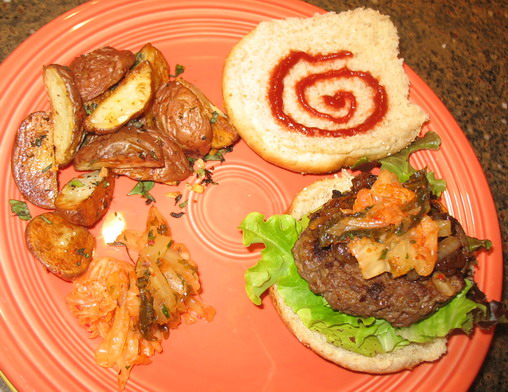
Bulgogi Burgers with Roasted Thai Basil Garlic Potatoes
Ingredients for the Burgers and Toppings:
1 1/2 pounds ground beef
4 garlic cloves, minced
1 dark green scallion top, minced
1/2″ cube ginger, peeled and minced
1/2 teaspoon red chile flakes (optional)
1 teaspoon raw sugar
4 tablespoons soy sauce
1 tablespoon rice wine
1/2 teaspoon sesame oil
1 small onion, sliced thinly
1 tablespoon peanut oil
pinch salt
pinch chile flakes
1/4 teaspoon raw sugar
1 tablespoon rice wine
2 tablespoons soy sauce
1/4 teaspoon sesame oil
kimchee, shredded, as needed
lettuce leaves, as needed
The Rooster
buns of your choice
Method:
Mix together first nine ingredients well, put into a bowl, cover and sit in the fridge to marinate for at least four hours. An hour before you are going to cook it, take it out and allow to come to room temperature, still covered.
While meat is marinating, heat peanut oil in a small skillet and saute onion. Sprinkle with salt early on to bring out the water in the onions faster, and stir constantly. When it is medium golden in color, add sugar and chile flakes, and continue cooking and stirring. When the onions are quite shrunken and are starting to turn deep golden, add wine, and boil off alcohol, still stirring. Add the soy sauce and sesame oil and simmer until the liquid reduces to a shiny brown glaze and the onions have started to fall apart into a “jamlike” consistency.
Grill burgers to desired doneness, and when they are finished cooking, allow them to sit for about three to five minutes to rest. Assemble burgers with some lettuce, onions, and kimchee if desired with The Rooster being the final touch.
Ingredients for the Potatoes:
1 quart small new potatoes, cut into halves or quarters depending on their size
2 tablespoons peanut oil
1/2 teaspoon salt
red chile flakes to taste
3 medium garlic cloves, peeled and minced
1/4 cup Thai basil leaves, stemmed and minced
Method:
Preheat oven to 400 degrees.
Arrange potatoes, cut side down, on a baking sheet that has been lined with a silpat or is non-stick. Pour peanut oil over, toss to coat potatoes. Make sure they go back to being cut side down and all surfaces of the potatoes have been coated with a thin film of oil.
Sprinkle with salt and chile flakes.
Bake in oven 18 minutes. Take out of oven, and sprinkle evenly with the garlic, and return to oven and bake another seven minutes for a total of 25 minutes. With very small potatoes, this should be enough time–test with a fork. If they are not tender, put back in the oven for a few more mintues.
Sprinkle with Thai basil and serve.

Categories:
- Admin (rss) (55)
- Blogs and Blogging (rss) (81)
- Book Reviews: Cookbooks (rss) (43)
- Book Reviews: Non-Cookbook Food Books (rss) (38)
- Cats and Cat Blogging (rss) (47)
- Chinese Cooking Lessons (rss) (32)
- Culinary School Stories (rss) (18)
- Dairy Pruducts: Cultured and Barbaric (rss) (4)
- Documentary Filmmaking (rss) (1)
- Essays, Rants and Reflections (rss) (260)
- Fighting Hunger (rss) (12)
- Food and Kids (rss) (45)
- Food in the News (rss) (126)
- Food Media (rss) (98)
- Food Preservation (rss) (18)
- Food Safety (rss) (45)
- Gardening (rss) (30)
- Herbs and Herb Blogging (rss) (20)
- Holidays (rss) (50)
- Kat Blogging (rss) (22)
- Kitchen Science (rss) (36)
- Leftover Makeover (rss) (8)
- Life, the Universe and Everything (rss) (131)
- Local and Sustainable (rss) (227)
- Local Athens Food and Foodies (rss) (42)
- Meatless Mondays (rss) (32)
- Menu For Hope (rss) (5)
- Nutrition, Diet and Health (rss) (84)
- On The Farm (rss) (8)
- Recipes: Almost Vegetarian, Vegetarian and Vegan (rss) (294)
- Recipes: American Regional (rss) (37)
- Recipes: Appalachian Hillbilly (rss) (33)
- Recipes: Bread, Pasta, Grains (rss) (95)
- Recipes: Canning and Preserving (rss) (8)
- Recipes: Chinese (rss) (123)
- Recipes: Comfort Food (rss) (120)
- Recipes: Cookies (rss) (16)
- Recipes: Desserts (rss) (48)
- Recipes: French (rss) (25)
- Recipes: Fruits and Vegetables (rss) (302)
- Recipes: Greek, North African and Middle Eastern (rss) (31)
- Recipes: Indian (rss) (137)
- Recipes: Italian (rss) (42)
- Recipes: Japanese (rss) (7)
- Recipes: Jewish (rss) (4)
- Recipes: Korean (rss) (6)
- Recipes: Meat, Poultry and Fish (rss) (220)
- Recipes: Mexican/Native American/ Latin American/Caribb (rss) (27)
- Recipes: Original (rss) (108)
- Recipes: Thai (rss) (27)
- Recipes: Tofu (rss) (17)
- Recipes: US Regional (rss) (16)
- Recipes: Vietnamese (rss) (8)
- Restaurant Stories (rss) (28)
- Sewing, Quilting, Arts and Crafts (rss) (16)
- Simple Chinese Recipes (rss) (30)
- Slow Food and Heritage Foods (rss) (10)
- Spice Blogging (rss) (44)
- The Chinese Cookbook Project (rss) (14)
- The Chinese Pantry (rss) (39)
- The Documentary (rss) (2)
- The Kitchen Saga (rss) (17)
- The Locavore's Bookshelf (rss) (15)
- The Unsung Adventures of The Culinary Nerd (rss) (6)
- Tools and Toys (rss) (35)
- Uncategorized (rss) (10)
- With a Side of Politics (rss) (48)
Archives:
- August 2012 (9)
- July 2012 (12)
- September 2011 (3)
- August 2011 (7)
- July 2011 (8)
- June 2011 (16)
- May 2011 (17)
- April 2011 (11)
- December 2010 (9)
- November 2010 (5)
- February 2010 (1)
- December 2009 (5)
- November 2009 (7)
- October 2009 (10)
- September 2009 (16)
- August 2009 (14)
- July 2009 (14)
- June 2009 (7)
- May 2009 (17)
- April 2009 (10)
- March 2009 (25)
- February 2009 (13)
- January 2009 (10)
- December 2008 (5)
- November 2008 (5)
- October 2008 (6)
- September 2008 (13)
- August 2008 (8)
- July 2008 (11)
- June 2008 (18)
- May 2008 (13)
- April 2008 (14)
- March 2008 (16)
- February 2008 (17)
- January 2008 (19)
- December 2007 (25)
- November 2007 (18)
- October 2007 (24)
- September 2007 (16)
- August 2007 (15)
- July 2007 (15)
- June 2007 (10)
- May 2007 (14)
- April 2007 (16)
- March 2007 (17)
- February 2007 (20)
- January 2007 (13)
- November 2006 (1)
- October 2006 (8)
- September 2006 (14)
- August 2006 (25)
- July 2006 (30)
- June 2006 (28)
- May 2006 (34)
- April 2006 (29)
- March 2006 (24)
- February 2006 (30)
- January 2006 (38)
- December 2005 (40)
- November 2005 (37)
- October 2005 (32)
- September 2005 (25)
- August 2005 (30)
- July 2005 (28)
- June 2005 (21)
- May 2005 (8)
- April 2005 (22)
- March 2005 (17)
- February 2005 (29)
- January 2005 (10)
Search Site:
Links:
- Lily’s Wai Sek Hong
- 101 Cookbooks
- A cat in the kitchen
- A Veggie Venture
- Accidental Hedonist
- Cha Xiu Bao
- chez pim
- Chocolate & Zucchini
- Chopstick Cinema
- Chowhound.com
- Chubby Hubby
- Cook sister!
- Cooking with Amy
- da*xiang
- Eat Local Challenge
- Eating Liberally
- Ecocentric
- Eggbeater
- Epicurious
- Farmgirl Fare
- Fatfree Vegan
- Foodgoat
- ForkandBottle.com
- Green Olive Tree
- Hooked on Heat
- Jaden’s Steamy Kitchen
- Kalyn’s Kitchen
- Lucullian delights
- Mahanandi
- Matt Bites
- MeatHenge
- mmm-yoso!!!
- New York Times – Dining & Wine
- Pizza Goon
- Rasa Malaysia
- Ruhlman
- Sailu's Kitchen
- Serious Eats
- SF Gate: Food & Dining
- Simply Recipes
- Soul Fusion Kitchen
- Tastespotting
- The Amateur Gourmet
- The Cleaner Plate Club
- The Food Section
- The Grub Report
- thecookscottage
- U.S. Food Policy
- Wandering Chopsticks
- Washington Post Food and Dining
- Wasted Food
Meta:


Powered by WordPress. Graphics by Zak Kramer.
Design update by Daniel Trout.
Entries and comments feeds.