
Cook Local, Eat Global
Massamun Curry with Chicken
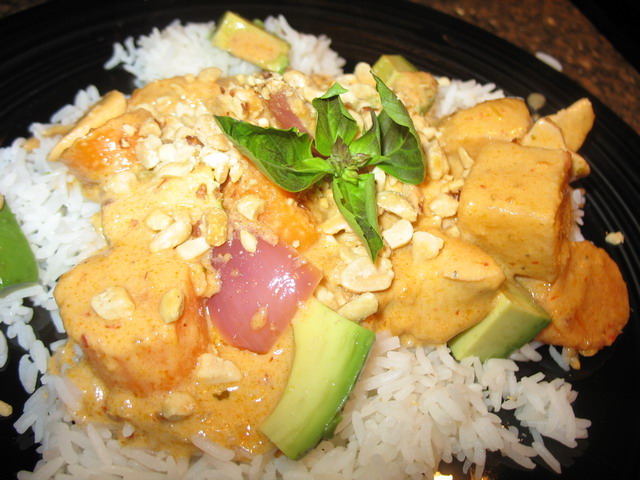
Massamun Curry with Chicken is the very first Thai curry I ever tasted.
The name comes from “Musselman,” an archaic term for a Muslim (Muslimman) or Arab, and it is theorized that the recipe was inspired by the cookery of Arab/Persian Islamic spice merchants and traders who came to Thailand in the 16th century.
However, though the name refers to Muslims or Arabs, the flavor profile is almost completely Thai. The curry has some heat, but mostly, it is filled with great scents and savors that come from the skillful blending of the ingredients in the curry paste, which include a great many Arab-favored spices. The strong fragrances of galangal and lemongrass, both of which are distinctively used in southeastern Asian cooki; Thai cooks, in particular, seem to value both ingredients very highly.
The first time I tasted this dish, Zak and I were out on our first official “date.” He had taken me to dinner at a nice Thai restaurant in Cleveland, and it was the first time I was to ever taste real Thai cooking. I remember tasting Mee Grob–or fried puffy rice noodles seasoned with a spicy-sweet and sour sauce and garnished with shrimp and bean sprouts. Then, I discovered the joy of Tom Kha Gai, which I instantly adopted as my new favorite soup on the spot.
Finally, the Massamun Chicken was set before me, and I remember falling in love with the dish upon the first taste. The smooth coconut milk curry, the tender chicken, the soft and aromatic potatoes and the carrots done just until they were a little al dente–all of this combined beautifully with the garnish of cilantro leaves and lightly crushed peanuts.
It was a beautiful, relevatory dinner, and it was afterwards that I declared my intention to learn to cook such exquisite food.
So, I did.
My Massamun Curry is much the same as the first curry I tasted, with one difference.
I love to garnish it with avocado slices.
Why?
Because the second restaurant where I ordered this deliciously luxurious dish garnished the finished plates with avocado, and the combination of silky green fruit with velvety curry sauce is out of this world!
This is much simpler to make than Green Curry, and you -can- freeze the curry paste without a loss of quality of flavor.
It is well worth trying to make, and is great for a summer supper, or for dinner in October.

Massamun Curry
Ingredients for Massamun Curry Paste:
10 cloves garlic
2 shallots
1″ piece galangal root
5 stalks lemongrass
2 tablespoons unsalted dry roasted peanuts
1 tbs coriander seeds
1/2 teaspoon cumin
1 tsp. cardamom seeds
6 whole cloves
1/2 teaspoon cinnamon
1 teaspoon salt
2 tablespoons cilantro roots and stems
2 red dried New Mexico red chiles, (chiles Colorado) soaked until pliable and seeded
15 red Thai bird chiles
zest 1 lime
2 tsp. shrimp paste
Method:
Grind all ingredients together into a fine paste using a mortar and pestle, a Sumeet grinder or a combination of a food processor and a mortar and pestle as directed in the recipe for Green Curry Paste.
Ingredients for Curry:
2 19 ounce cans coconut milk
1 batch curry paste
½-1 tbsp. peanut butter
1 tsp. palm sugar, raw sugar or brown sugar
4 tbsp. fish sauce, or to taste
2 kaffir lime leaves, the zest of one lime or several drops of lime oil
1 pound new potatoes, scrubbed and cut into quarters
2 large carrots, peeled and cut into 1/2″ thick slices
1 lb. boneless skinless chicken breast, trimmed and cut into 1†chunks
juice of 2 limes
1 small red onion, peeled and cut into 1″X1″ squares
½ cup roasted unsalted peanuts, lightly crushed
handful of whole cilantro leaves to garnish
1 ripe avocado sliced for garnish
Method:
Separate two tablespoons of cream from the top of the coconut milk. Melt in a wok or deep, wide pan, until liquid and bubbling. Add curry paste and stir fry until all is very aromatic.
Add the rest of the coconut milk, stir to combine and bring to a boil.
Add sugar, fish sauce and lime leaves, zest or oil. Taste for flavor balance–it should be somewhat spicy, a bit salty and sweet at the same time. Correct flavor as needed. Add potatoes, and carrots and cover, turning heat to medium. Cook until potatoes are mostly done, and the carrots are half-crisp, then add chicken, cover and cook until done.
When chicken and potatoes are done to a turn, add the onions and allow them to just begin to soften for the last few minutes of cooking.
Add lime juice, and taste for flavor. If necessary, add more fish sauce.
Serve over steamed jasmine rice and garnish each portion with cilantro leaves, a sprinkling of coarsely crushed peanuts and slices of avocado.
The Queen of Thai Curries: Green Curry
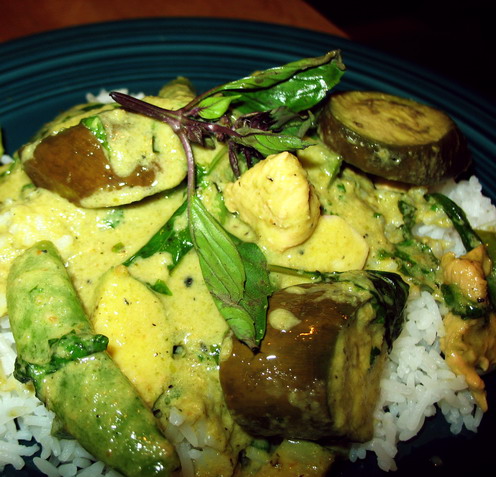
And now we come to it: my favorite Thai curry of all time.
Green curry.
I tend to only make green curry in the summer, when the herbs and seasonings that go into it are fresh and readily available, because I am snobby about the curry paste. There is something about green curry paste that to my palate does not survive storage. Canned pastes, and even the ones packaged in resealable plastic tubs like Mae Ploy, which are generally quite good, lack the brilliant color and sparkling flavor that the freshly made paste brims with. It just plain doesn’t taste as good somehow.
I think it is because the flavor and fragrance of Green Curry relies so much upon fresh herbs and chiles that much of that goodness is lost when the paste is preserved in a can or plastic container.
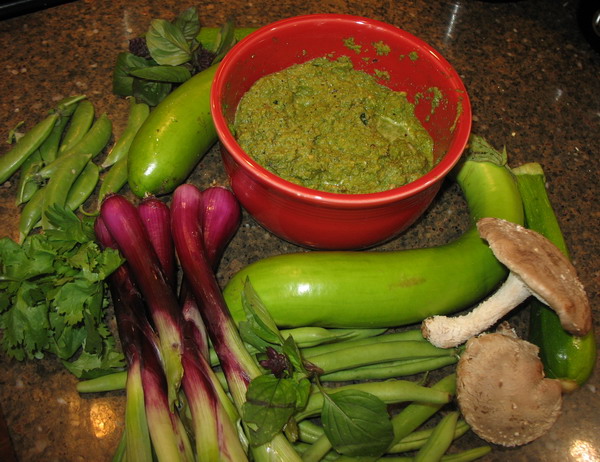
The ingredients to the paste, once found and obtained, are simple to combine into a pungent, fragrant paste, particularly if one has a Sumeet grinder. If one does not have access to such a tool, a food processor combined with a mortar and pestle will make, if not quick work of the paste making, at least, easier work than it would be by doing it the traditional way, which is with a mortar and pestle alone. I used to use either a mortar and pestle alone or in combination with the food processor in order to make green curry paste in my pre-Sumeet days; I only once tried to make it with just the food processor. With only the food processor, the paste was too chunky and lumpy; it refused to smooth out into anything resembling a true paste. But, I found that if I used a food processor to puree the vegetal ingredients into bits, I could then use the mortar and pestle to finish the job and make the curry paste just as velvety smooth as I wanted it to be.
One other note about the curry paste.
You may be tempted to leave out the shrimp paste.
Unless you are allergic to shrimp, or are keeping kosher and do not eat shellfish, please do not leave out the shrimp paste.
I know it smells kind of strong, and doesn’t look good, but it really does give a great boost of umami flavor to the Thai curries. Without it, the curry paste tastes a bit flat, and seems to be missing something. That is because it is.
If you must substitute, you can use red miso–but I urge you that unless you must avoid shrimp for health or religious reasons, that you give the authentic ingredient a try.
What is best cooked in a green curry?
Well, pork is traditional, but as I am not easily eating red meats these days, I opted for chicken.
In truth, my favorite animal-based proteins cooked in green curry are crab and salmon; I like to make a thick curry sauce from the paste and coconut cream and slather it over salmon steaks or filets and then broil them to perfection, and then use the rest of the paste to make a vegetable based curry and serve the salmon on a bed of steamed jasmine rice with a circlet of the curried vegetables around it. THAT is my number one favorite version of that dish, but I don’t think I will be having it for a while–not until Kat is born and weaned from breastmilk, anyway. (I am concerned at the amount of methylmercury that is being found in large predatory fish like salmon and tuna–it is a contaminant that can cause serious nerve and brain damage in fetuses and developing children.)
Another favorite is green curry crab, but lacking crabmeat, that is hard to do.
So, I did a green curry chicken with mixed green vegetables.
You can glimpse the vegetables I used in the curry above; I don’t know why I like to match the colors of the veggies to the curry so much with this dish, but I do. Or, maybe it is because some of my favorite green veggies are in season when the Thai basil is up and happy–in the summer. Anyway, eggplant–green Asian or Thai eggplant if I can get it–is a necessity. The velvety richness of eggplant marries perfectly with the creamy curry sauce and the sharp herbal flavors and chile heat. Zucchini, especially if it is not overcooked, is also wonderful; its blandness is a perfect carrier for all of the flavors of green curry. Green beans add a verdant crunch, especially when not allowed to overcook, and sugar snap peas, again, barely cooked, add sweet sugary zing.
The onions that I use in this dish, however, are always purple.
Why?
Because green and purple look lovely together, that is why! I usually use regular large red onions, but at the farmer’s market last weekend I found these glorious royal purple scallions, and had to use them, and they not only were very pretty, they added a good amount of snappy flavor to the finished dish. I just floated them into the sauce near the end of cooking and then garnished with basil leaves and roughly chopped cilantro, stirring them in at the last moment so that they barely wilted by the time the curry was served.
Owing to the heat of this dish, I served it with plenty of steamed jasmine rice. Paired with a Thai tomato-cucumber marinated salad, this was a wonderful dinner, full of fresh, delightful flavors that really let the vegetables stand out, while still being highly seasoned. It is a dish that I only make a couple of times a year, but I always look forward to it, and it is always worth the extra time and trouble it takes to make it and make it well.
Green Curry Paste
Ingredients:
20 white peppercorns, ground finely (Obviously, I substituted grains of paradise here because of my allergy)
1 tbsp. coriander seeds, toasted to bring out flavor, and ground
½ tsp. cardamom seeds, removed from pods and ground
1 tsp. coarse sea salt
4 green jalapeno or serrano chilis, roughly chopped
1 green poblano or pasilla chili (optional, for color), roughly chopped
15-20 green thai bird chilis, chopped
2 tbsp. chopped lemongrass (about the bottom third of one stalk)
1 tbsp. chopped fresh or frozen galangal
1 tsp. grated lime zest
1 tbsp. finely chopped cilantro roots or stems
2 tbsp. finely chopped basil leaves
3 shallots, chopped
8 cloves garlic chopped
2 tsp. young ginger, chopped
2 tsp. shrimp paste
Hand method:
Grind seeds in a spice or coffee grinder. (If you use a coffee grinder, clean out before and after.)
Put ingredients into mortar and pestle in order of their appearance, grinding the first ones thoroughly first. When you get to the sea salt, use it in sprinkles to help grind the tougher herbs, such as lemongrass, galangal, lime zest, cilantro root and basil stems.
If you run out of room in your mortar and pestle, put paste into a bowl and grind in batches.
Food processor/Sumeet method:
Grind spices into a powder with spice grinder or mortar and pestle.
Put everything else into a food processor and process into a rough paste. (A regular food processor will not make a smooth paste. Before I discovered the Sumeet, I used to use the food processor to break everything down to small bits, then, I would turn it into a paste by working it with the mortar and pestle by hand. This was less time consuming than the hand method, but resulted in a similar texture, color and flavor.)
With the Sumeet, you just grind everything together into a smooth paste by putting ingredients into the jar in batches.
This recipe makes about a cup and a half of curry paste. When I am making curry, I use the entire batch to flavor the curry. You don’t have to use so much. If you want to keep it in the fridge, it keeps pretty well for a few days. For longer storage, put into a zioplock bag, push out all the air and freeze. It will keep, with a small loss of fragrance and fresh flavor, for months in this way.
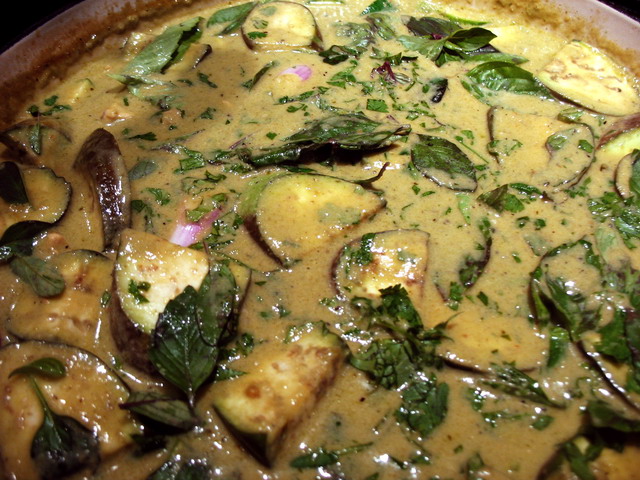
Green Curry Chicken with Asian Eggplants And Green Vegetables
Ingredients:
1 1/2 19 ounce can Mae Ploy brand coconut milk
2-4 tbsp. fresh green curry paste
2 kaffir lime leaves, or the zest of two limes
fish sauce to taste
palm or raw cane sugar to taste (about 1 tbsp.)
1 pound boneless skinless chicken breast, trimmed and cut into 1†chunks
1/2 pound Asian eggplants (round or long Thai green ones, or long purple ones….doesn’t matter) cut into slices on the diagonal about ½†thick
2 small zuchinni, cut in half longways, then cut into half-rounds about 1/2″ thick
1/2 pound green beans, trimmed, topped and tailed and snapped into 1″ pieces
1/4-1/2 pound sugar snap peas, topped and tailed
2 large fresh shiitake, stems removed and discarded, caps cut into 1/4″ slices
1small purple onion, cut into squares, or 4 purple scallions, cleaned and sliced on the diagonal into 1/4″ slices
lime juice to taste (about the juice of ½ to ¾ of a lime)
1 cup fresh Thai basil leaves
½ cup cilantro leaves, roughly chopped
½ cup mint leaves, roughly chopped (optional)
Method:
Take about a two tablespoons of cream off top of the coconut milk, and melt in a pan. Add curry paste in whatever amount you think you will want to use–as I said, I use the whole batch because I like my curry to be very full of flavor. You may think that is too intense. To be on the safe side, maybe you should use 2/3 of the batch to start with.
Fry curry paste in coconut cream until well-scented, then add lime zest (Don’t do this, if you are using lime leaves) and fry a few seconds longer. Add the rest of the coconut milk. If you are using lime leaves, add them to the curry at this point. Bring curry to a simmer on medium low heat.
Add fish sauce and sugar to taste and bring to a simmer. Simmer slowly for about fifteen minutes, stirring now and then.
Add eggplants, and cook until tender. When nearly done, add the rest of the vegetables except the onions, and the chicken. Cook until the chicken is nearly done, then add the onions, so that they cook only about two or three minutes, until just barely softened.
Add lime juice to taste, then add fresh herb leaves, remove from heat and let leaves wilt slightly, then serve with plenty of steamed jasmine rice.
The Culinary Nerd Goes To Mecca (Well, -a- Mecca, Not -the- Mecca)
So, first of all, I am sure you want to know who or what the Culinary Nerd is.
That would be me.
That nickname was given to me in culinary school by a fellow student one day when a visiting chef once asked the crowd of us if anyone knew what huilacoche was.
I was the only one who raised my hand. When he recognized me, I said, “It is a fungus that grows on corn that we in the US call corn smut, but which in Mexico, is eaten.” He asked if I had tasted it, and I said yes, that it had a soft texture rather like oyster mushrooms, but it tasted more like a combination of corn, truffles and wild mushrooms.
He liked my answer.
The student sitting next to me, who had been through all the first year classes with me, and who had seen me get into arguments with chefs over the origin of potatoes (he said Ireland, and I said Peru–and was right) and over whether something was a green tomato or something else (I said it was something else, but I wasn’t sure what–it turned out to be a Thai eggplant) and over the proper method of frying okra (he said to follow the recipe and use a beer batter and fry it whole, I said to do it the way that real southerners have been doing for, like, ever, and cut it up into slices, coat it in seasoned cornmeal and flour and then fry it in either lard or bacon fat. We each cooked up a batch, and guess whose okra got eaten, even by Yankees, and whose didn’t?).
So, Maria looked at me and said, with a fond smile, “You are -such- a Culinary Nerd.”
It stuck. My personal chef business was called, “The Culinary Nerd Personal Chef Company.” I taught workshops as The Culinary Nerd, and in fact, that was almost the name of this blog.
But, even though I named the blog differently, I am still The Culinary Nerd at heart and sometimes I do things that prove it.
Like this:

Willingly getting my photo taken at the American History Museum with one of my great culinary heros, “The Swedish Chef” certainly counts as very nerdish behavior.
Posting it on my blog is further proof.
But, well, when one visits a mecca of sorts–and today’s visit to The American History Museum at the Smithsonian -definately- counts as a culinary mecca, considering that not only the Swedish Chef is there, but a holy of holies is there as well: Julia Child’s Kitchen.

I mean, I have known it has been there for -YEARS- and I kept meaning to go. I thought it was going to be dismantled after a couple of years and tour the country, but I found out today THAT IT WAS STILL THERE!!!!
So, of course, both Morganna and I went and paid homage.

I took a lot of photos, but I am only sharing these that came out–I had to use the flash to get them into focus, so I am sorry for the glare on the glass. But, I think that for those of you who cannot get to DC to see this most sacred of places, you can deal with a little bit of imperfection in my transmission of the goodness to you.
I was excited to see it close up. I mean, I grew up seeing her do her shows in the kitchen, so it is as familiar to me as the kitchens of my mother and grandmothers. But, I was still impressed with seeing it in person–and seeing how no-nonsense it was and how colorful it was without being garish. It was simple without being plain, it was large without being grand, and it was beautiful without being pretentious.

It was like Julia herself.
I loved it. Gazing first hand upon it was like going to a cathedral and seeing relics up close probably is for devout Catholics (I am only slightly kidding when I call her Saint Julia, after all).

Though, I had to laugh, when I overhead Martha Stewart, on the video talking about how it is important, when we eat things like venison steak, that we recognize that what we are eating is a deer, and how Julia was always making that obvious, and how she always emphasized that, without being overt.
The video cut to a clip from Julia’s first series, “The French Chef” where she is talking about roasting a suckling pig. The wee piggy is there, and she strokes it and pats it while she talks about how important it is to get a milk-fed piglet, because without only being fed mother’s milk, its meat isn’t so succulent and tender.
While she is talking, she shows how to prop open the piglet’s mouth with a ball of foil before roasting him so you can present him with an apple.
Several folks watching the video were disturbed, and winced and backed away, saying, “Oooh, that’s gross!”
I walked out laughing. They didn’t get it.
But, I did.
So, that was The Culinary Nerd’s adventure for the day–I got to travel to a holy place, view and photograph sacred relics of a beloved kitchen saint, and had my photograph taken with an icon of culinary goofiness.
And after we came back to Maryland, we all adjourned for a delightful feast at Akbar’s where we dined magnificently upon some of the best North Indian style food in the world. (And we had three Akbar’s virgins with us, so the feast was made doubly divine because we had the pleasure of introducing others to the glory of some of our favorite Indian food.)
And then, we came back here, and I am writing to tell you all about it.
With that, I say, “Goodnight, and good cooking.”
The Fresh Flavors of Thai Food
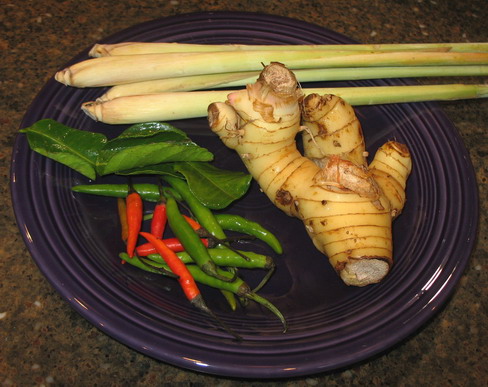
As you can see, my shipment from Thaigrocer.com arrived.
Look at how lovely and fresh the lemongrass and especially the galangal look!
Everything smells wonderful, though I have to admit to being a bit disappointed with the lime leaves–usually when I open a box from Thaigrocer, the first scent that strikes me as I unwrap the packing paper is the flowery, linden-sweet scent of the kaffir lime leaves. They are usually fairly tender and soft; the ones from this shipment however, are leathery and a bit dry. Not as fresh as I would like, however, as soon as I crumpled one between my fringers, the characteristic floral scent wafted up and danced with my nostrils.
I cannot wait to make a green curry, now!
Here is a quick a dirty guide to the fresh Thai seasonings most necessary to recreate the scents and savors of a Thai kitchen:
Lemongrass (Cymbopogon citratus) is a fragrant member of the grass family. Several species of lemongrass have importance in the perfume industry; this one in particular, however, is a queen in the kitchens of Thailand and southeast Asia. In India, this species is most often used as a medicinal herb or in perfumery, but in the rest of southeast Asia, it is an important culinary herb.
The young stalks, I am told, are used sliced thinly as edible garnishes; I have only seen lemongrass so sweet, tender and young in tropical areas like Florida, where it can grow as easily as weed. (A friend of my father-in-law, being culinarily obsessed and a curious gardener, planted a clump of it on a whim, and then watched in dismay as it took over his entire lawn. He has been known to uproot entire swaths of it, and drive around to Thai restaurants, giving clumps of it away at the kitchen door to very happy chefs.)
Since I have never come across young lemongrass, my preferred method of using it is as a component to curry pastes, such as those for Panang Curry and Red Curry, in simmered dishes like Tom Kha Gai and in the flavoring pastes for stir fries and dry curries, such as Mu Pad Prik King.
Lemograss is commonly available at Asian markets, but it is also often found in metropolitan grocery store produce sections. It is also available dried, but I don’t much care for it; it has very little aroma or flavor. I would not suggest using lemon zest as a substitute, in large part because it is much stronger and harsher in flavor and scent than lemongrass–the citrus scent of lemongrass is somehow softer, milder and altogether sweeter than the actual scent of a lemon.
If you are lucky enough to live in a tropical climate, you can grow your own lemongrass–that is, if you don’t mind its invasive ways! If you don’t live in a tropical zone, it can be grown in pots–starts are available from a local Athens area nursery–Companion Plants. They specialize in culinary, medicinal, dyeing and perfumery herbs, and they do mail order.
Kaffir lime leaves , which are the leaves of the Citrus hystrixtree are another Thai ingredient that is irreplacable. Zest from regular Persian limes or Key limes is a barely adequate substitute; both of them, while very fragrant and delicious lack the inherent floral quality of the real article. Kaffir lime leaves when young and fresh are strongly fragrant, and nothing will scent a pot of curry or soup quite as well and as deliciously as a small handful of kaffir lime leaves sprinkled over the pot, with the lid clapped down tightly to capture all of the exquisite perfume.
The etymology of the word “kaffir” is somewhat disturbing to me: in English the word was used in some places as a derogatory term for a native African. The root word is from the Arabic “kafir,” which means “infidel” with the overtone of “barbarian” and so it bothers me every time I say. No one seems to know how the name was pinned to this native southeast Asian tree’s leaves and fruit, but it was.
It is said that kaffir lime trees are easily grown indoors, however, I am not very skilled at keeping purely houseplants alive. If I don’t underwater them, I overwater them, or I leave the windows open and the frost gets them, or the worst of all, the cats eat them to nubs. So, I have always just ordered the lime leaves fresh and left it at that. When I have used as many fresh as I can, I store them in ther freezer, and they keep quite well there for months at a time.
I like it best in curries, especially Green Curry, but I also love it in soups like Tom Kha Gai and slivered up and stir fried into Thai Spicy Basil Chicken. The combination of the anise-scented basil and the floral lime leaves really balances the popping heat from the chiles, shallots and garlic that dominate the flavor palette of this dish.
If you are a better indoor gardener than I am, you can find small kaffir lime trees at Logee’s Greenhouse. Full cultivation instructions are available here.
Galangal, otherwise known as “greater galangal” is a woody, quite tough but spicily aromatic rhizome that is related to the more common ginger. Yet another native to Southeast Asia (do we see a pattern here?) this rhizome has been used medicinally and culinarily for thousands of years throughout the region.
My favorite use for it, however, is in Tom Kha Gai, a dish I have made no less than three times in the past month and a half. When the heat soars and I am sweaty and cranky, I really like nothing better than a bowl of steaming Chicken-Galangal Soup to cool me off. I always insist on using either fresh or frozen galanagal in the soup; the dried rhizome chips, chunks or powders have a musty, overly medicinal flavor and aroma that does not give the unique, luscious savor to the soup that the more herbally-scented, spicy and hot fresh or frozen pieces do. (I also use it in my Chinese Hot and Sour Soup, along with lemongrass, which makes the already delicious soup even more complex and beguiling.)
It is also a mandatory ingredient in most Thai curry pastes; substituting ginger in either the soup or the curry pastes results in a completely different flavor. I highly recommend seeking this fresh spice out and using in your favorite Thai recipes and see what a difference it makes in flavor and aroma. If it is not available fresh in your local Asian market, look for it frozen, in unpeeled chunks, wrapped in plastic. Or, order from Thaigrocer.com.
Thai bird chiles or just plain old Thai chiles, are what put the fire in Thai cookery. The original heat source in Thai cuisine were white peppercorns, which are still used in copious amounts, but as soon as the chiles were introduced after the sixteenth century, they were adopted with great ferver and love by the Thai people.
These little (about 1 1/2″ long) chiles are hot wee devils, with the green ones having an herbal bite and the red ones a smoky, fruity flavor. The ones I just ordered came in with a distinctive, fresh scent that bespoke their heat level–I swear you could smell the chile oil in them!
I use these a lot, not only in Thai cookery, but in Indian and Chinese cooking as well. I find that I can freeze them whole with no real loss of quality, and have done that to save the ones I buy fresh at the farmer’s market in the summer for the winter. They do really well that way, though I have run out of the ones from last summer by now.
They are very commonly sold in Asian markets, and I would say are among the most popular of chiles at the market.
The uses for them are many; obviously, they are used in curry pastes, but also in stir-fries, soups, pickles, sauces and salads. I like them in dry curries like Mu Pad Prik King, and in Pad Thai. But, really, I use them in so many recipes, it is hard to really list them all.
Finally, I adore Thai basil so much that I grow it, and have grown it to have fresh in my garden for the past several years. The year I started plants from seed, I had more than fifty seedlings that survived to become healthy, bushy, mature plants, which meant I had a lot of basil to use in stir fries such as Thai Spicy Chicken. Basil and Asparagus and in noodle dishes and curries.
This year, I am growing about ten plants on my deck in various pots, planters and boxes, plus, I can get it all summer long through my CSA. This means I will have a great many chances to improvise with the spicy anise-scented basil with its violet stems and blossoms contrasting with deep green leaves. I am thinking of putting together a sort of Thai pesto and serving it with stir fried rice noodles. We’ll have to wait until I am back at home in my kitchen again to see what happens with that thought, though.
For home gardeners, you can order Thai basil plants from the afformentioned Companion Plants, or you can get seeds from just about any seed company you can think of. A great cultivar is Siam Queen, which grows up big and bushy, with lots of cinnamon-anise aroma and flavor, and pretty purple stems and violet blossoms contrasting with dark green leaves. It is a lovely plant, and the more you cut it back, the more bushy and vigorous it becomes. It is a plant that truly likes heat and humidty, and which appreciates a nice steamy summer with lots of sun. This year, it is growing like mad up on my deck garden!
So, there we are–a quick guide to the fresh flavors of the Thai kitchen. None of these ingredients taste the same, or in my opinion, with the exception of the chiles, taste even as good as the fresh versions. These fresh ingredients are irreplacable, and I highly recommend that if you cannot find them in a shop near you, nor grow them youself, that you seek out a reputable online supplier like Thaigrocer.com and order some of each of these ingredients for yourself and experiment with them. If you are serious about Thai food and want it to taste as authentically wonderful as possible, I think you owe it to yourself and your tastebuds to give these flavors an honest trial, and see what you think of them.
The Spice Is Right IV: It’s Too Darned Hot Round-Up, Part III
And here we are, in the final phase of It’s Too Darned Hot’s round-up. As always, if I missed an entry you sent along to me–do not fret–just send another email to me, and I will edit you into this post once we get to Maryland and I can sit down with my laptop and go to work.
And, I am sorry that Tigers & Strawberries was down last night–that would be our webhost, Dreamhost, having an outage again. Believe me, it was frustrating, because I was going to have this post done before I went to bed, and instead, had to work on it this morning.
Anyway, enough kvetching! Let’s get down to business and take a look at the last chunk of entries to come in:
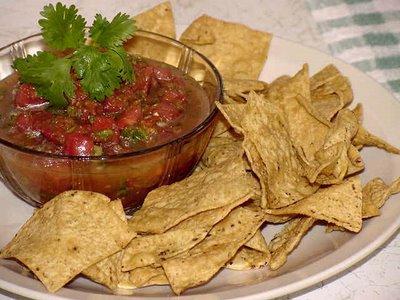
Debbie writes Dejamo’s Distracted in Chicago, but she used to live in Austin, Texas. And when she lived there, she was gifted by her friend Donna with a recipe called Salsa Gigante. And I just want to thank Donna for introducing her to this lovely salsa, which in turn means, I need to thank Debbie for introducing it to us, because it looks like the quintessential Tex-Mex sort of recipe: filled with serrano peppers, cilantro, garlic and goodness. Debbie confesses to not liking spicy foods for years, but this salsa was a revelation to her–she realized that it wasn’t that she didn’t like heat–it was that she didn’t like pickled jalapenos, which were the only bearers of hotness she had come across before! I, for one, am glad that Debbie had that revelation, and so should we all! Thanks for sharing a great memory with us.
Shreyas, the author of Raven Swallows the Sun, makes a discovery in the course of coming up with her entry for this month’s event: fish are friends (and food!) She cooks Tilapia for us that is spices with a glorious-sounding mixture of ancho chile and Herbes de Provence, which she says tastes flowery. (That would be the lavender that is in it–and probably the tarragon, too!) As she describes the dish, it is simple to do: cook the tilapia in parchment packets seasoned liberally with ground ancho chile (which is a dried ripe poblano chile) and the afformentioned Herbes de Provence mixture, until tender and juicy. You cannot go wrong with that, in my opinion–look how scrummy the fish turned out to look! Lovely entry, Shreyas: I am thrilled to see that you, like me, are getting over your fear of cooking fish out of lack of experience. The only way to get that experience is to jump in feet first and learn to swim in the kitchen!
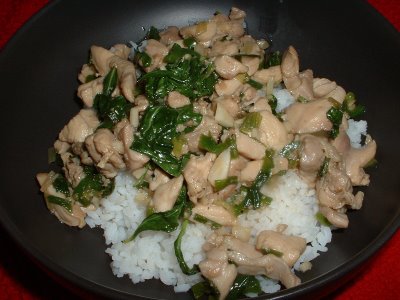
A fellow Ohio blogger, Rosie is Bitchin’ In The Kitchen, and while she is up to that, she is also making some fine and tasty goodies like this Holy Basil Chicken. (Holy Basil, Batman–this chicken is freaking awesome! What do you mean, where’s the Catwoman–I need another bowl of chicken and rice!) I have to admit to a bit of pride to read that I inspired her to haul off and make this wonder with a post I wrote extoling the virtues of the flavor of chiles, Thai basil and lime, in large part because her family cleaned up the whole thing on her first try making it. Not only that, but they extracted promises from her that she would make it again, and SOON! (I am telling you–chile, Thai basil and lime are hard to beat in the heat of summer–we’ve been eating Thai food for about a week now, and the heatwave means nothing to us, because the Thai food keeps us cool and comfy.) Rosie, that’s just it–the next time I am going to be in Columbus, I am just going to have to email you and let you know and see if we can’t meet at the North Market and have an afternoon of shopping and kitchen gossip. I think it would be fun!
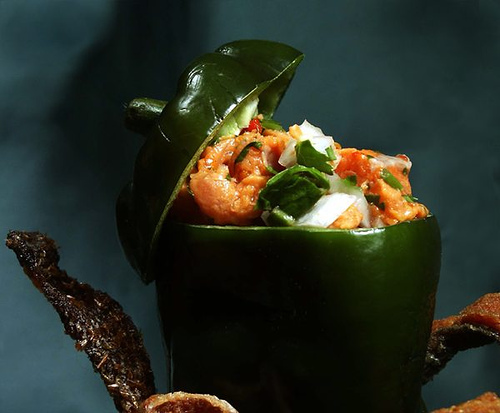
Oh, my. I am nearly struck speechless by Mrs D and Chopper Dave’s contribution to this event. The couple behind the Washington State blog, Belly Timber, have made a dish that has me salivating before the sun is even up, and the wicked thing about it is that I am not currently eating salmon, which is one of my favorite foods, because of the methylmercury issue. (Being pregnant sometimes sucks, you know?) But, enough about me–let’s talk about Salmon Ceviche, which is what you see peeking out of that pretty poblano pepper up there. Ceviche is a great Central to South-American dish that involves chemically “cooking” fish with the citric acid in citrus juice. Usually it is lime or lemon juice, but these folks kicked it up two notches and used both grapefruit and navel orange in addition to the lemon. And they used those lovely poblanos, as well as red jalapenos and it just all sounds glorious. Fabulous. Fantastic. I am still drooling, darnnit. Mrs D. and Chopper Dave–thank you for an outstanding entry, and I really hope to see you come back next month with something equally salivatory.

Limes and Lycopene author, Kathryn from Sydney, Australia, is an herbalist, so she gives us lesson on how chiles are often used to treat patients with sinus troubles. This, in large part, explains my mania for these fiery fruits: I was born and raised in a place with polluted air, and like many who grew up there, my sinus troubles are chronic. However, to back up Kathryn’s assertions with my own experience: since I have started eating large amounts of chiles frequently, I have not had as many sinus infections and problems with congestion as I did before. So there you are. Eat chiles and breathe better. It is a great side effect of enjoying the exciting flavor of one of the world’s most popular spices. And how does our herbalist and cook recommend we eat chiles? She gives us recipes for Harissa and Lablabi: the classic North African hot sauce and chickpea soup combination. Two confort foods in one! Thank you, Kathryn, and I hope to hear more from you soon–that was a great post!

Kitarra is always conjuring up something wicked and writing about it in Cooking Debauchery; this time around she really goes all out and makes for us a versatile sauce: Gingered Mango-Habanero Sauce. It’s got habanero, mango and ginger, with lime and raw sugar in it. How can that possibly be anything other than scrumdillyishous? I mean, really! And not only does she give us the recipe, and the story behind it, she gives us umpteen different possibilites of how to use it, too. As a marinade, it rocks, as a dipping sauce for potstickers, it is heavenly and as a topping for ice cream? Well, then it is positively sexy. How can this be? Let me repeat: habaneros, mango, ginger and lime. A menage a quatre made in Paradise. Thank you, Kitarra for keeping my early-morning drool going until the sun came up.
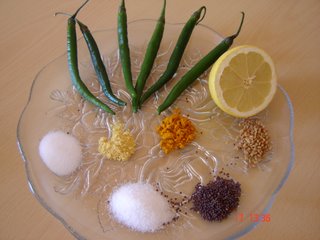
Oh, boy was Anupama, author of the UK blog, Food-n-More telling the truth when she said her entry was “too darned hot!” She gave me a recipe for one of my favorite Indian dishes: Kharachi Mirchi (Pickled Green Chillies). Ooooh. Now, for Debbie, and all the rest of us who don’t like those nasty canned picked jalapenos, I have to tell y’all this: Indian pickles are not like that. Nope, not at all. They are different. They are salty, and sour and spicy and hot and downright lip-smackin’ good, and they are also addictive. My favorite varieties are lime, green chile and green mango pickles, but really, I have run across very few Indian pickles that have not struck my fancy. And I have to say this–they are even better homemade. So run out to the kitchen and get crackin on Anu’s recipe and make yourself some pickled green chiles, because they are bound to be amazing.

Finally, we come to my own entry, the often begged for recipe of my Aztec Gold Brownies. These brownies, in the two years I have been making them, have been one of the most requested recipes ever. So, finally, here it is: dense, fudge-like moist brownies flavored with chipotle chile, espresso, cinnamon and vanilla, and crowned with gold leaf. They are one of my favorite desserts ever, because the flavors are both bold and subtle–they dance across the palate in a parade, with each flavor sliding up slyly behind the first. The chile leaves a final, lingering warmth in the back of the throat, which is powered by the richness of the chocolate. I consider them to be decadance in a very small package.
There we have it–all of the entries into this month’s The Spice is Right event. Once again, I am blown away by the variety and ingenuity shown by the myriad of entries and I am thrilled to see so many participants from all over the world sharing cultures, recipes and wisdom. It is like a bunch of neighbors coming together over a kitchen table and coffee to swap recipes–only here, the neighbors are global, and the kitchen table is virtual.
I want to thank everyone for coming to my virtual table and sharing this feast of recipes old and new, for every course of the meal, from soup to salad, to sauces and condiments, to grain and veggie dishes to entrees from the land and sea to dessert.
And, I hope to see you next month, when the theme will be “Fresh and Local.”

Categories:
- Admin (rss) (55)
- Blogs and Blogging (rss) (81)
- Book Reviews: Cookbooks (rss) (43)
- Book Reviews: Non-Cookbook Food Books (rss) (38)
- Cats and Cat Blogging (rss) (47)
- Chinese Cooking Lessons (rss) (32)
- Culinary School Stories (rss) (18)
- Dairy Pruducts: Cultured and Barbaric (rss) (4)
- Documentary Filmmaking (rss) (1)
- Essays, Rants and Reflections (rss) (260)
- Fighting Hunger (rss) (12)
- Food and Kids (rss) (45)
- Food in the News (rss) (126)
- Food Media (rss) (98)
- Food Preservation (rss) (18)
- Food Safety (rss) (45)
- Gardening (rss) (30)
- Herbs and Herb Blogging (rss) (20)
- Holidays (rss) (50)
- Kat Blogging (rss) (22)
- Kitchen Science (rss) (36)
- Leftover Makeover (rss) (8)
- Life, the Universe and Everything (rss) (131)
- Local and Sustainable (rss) (227)
- Local Athens Food and Foodies (rss) (42)
- Meatless Mondays (rss) (32)
- Menu For Hope (rss) (5)
- Nutrition, Diet and Health (rss) (84)
- On The Farm (rss) (8)
- Recipes: Almost Vegetarian, Vegetarian and Vegan (rss) (294)
- Recipes: American Regional (rss) (37)
- Recipes: Appalachian Hillbilly (rss) (33)
- Recipes: Bread, Pasta, Grains (rss) (95)
- Recipes: Canning and Preserving (rss) (8)
- Recipes: Chinese (rss) (123)
- Recipes: Comfort Food (rss) (120)
- Recipes: Cookies (rss) (16)
- Recipes: Desserts (rss) (48)
- Recipes: French (rss) (25)
- Recipes: Fruits and Vegetables (rss) (302)
- Recipes: Greek, North African and Middle Eastern (rss) (31)
- Recipes: Indian (rss) (137)
- Recipes: Italian (rss) (42)
- Recipes: Japanese (rss) (7)
- Recipes: Jewish (rss) (4)
- Recipes: Korean (rss) (6)
- Recipes: Meat, Poultry and Fish (rss) (220)
- Recipes: Mexican/Native American/ Latin American/Caribb (rss) (27)
- Recipes: Original (rss) (108)
- Recipes: Thai (rss) (27)
- Recipes: Tofu (rss) (17)
- Recipes: US Regional (rss) (16)
- Recipes: Vietnamese (rss) (8)
- Restaurant Stories (rss) (28)
- Sewing, Quilting, Arts and Crafts (rss) (16)
- Simple Chinese Recipes (rss) (30)
- Slow Food and Heritage Foods (rss) (10)
- Spice Blogging (rss) (44)
- The Chinese Cookbook Project (rss) (14)
- The Chinese Pantry (rss) (39)
- The Documentary (rss) (2)
- The Kitchen Saga (rss) (17)
- The Locavore's Bookshelf (rss) (15)
- The Unsung Adventures of The Culinary Nerd (rss) (6)
- Tools and Toys (rss) (35)
- Uncategorized (rss) (10)
- With a Side of Politics (rss) (48)
Archives:
- August 2012 (9)
- July 2012 (12)
- September 2011 (3)
- August 2011 (7)
- July 2011 (8)
- June 2011 (16)
- May 2011 (17)
- April 2011 (11)
- December 2010 (9)
- November 2010 (5)
- February 2010 (1)
- December 2009 (5)
- November 2009 (7)
- October 2009 (10)
- September 2009 (16)
- August 2009 (14)
- July 2009 (14)
- June 2009 (7)
- May 2009 (17)
- April 2009 (10)
- March 2009 (25)
- February 2009 (13)
- January 2009 (10)
- December 2008 (5)
- November 2008 (5)
- October 2008 (6)
- September 2008 (13)
- August 2008 (8)
- July 2008 (11)
- June 2008 (18)
- May 2008 (13)
- April 2008 (14)
- March 2008 (16)
- February 2008 (17)
- January 2008 (19)
- December 2007 (25)
- November 2007 (18)
- October 2007 (24)
- September 2007 (16)
- August 2007 (15)
- July 2007 (15)
- June 2007 (10)
- May 2007 (14)
- April 2007 (16)
- March 2007 (17)
- February 2007 (20)
- January 2007 (13)
- November 2006 (1)
- October 2006 (8)
- September 2006 (14)
- August 2006 (25)
- July 2006 (30)
- June 2006 (28)
- May 2006 (34)
- April 2006 (29)
- March 2006 (24)
- February 2006 (30)
- January 2006 (38)
- December 2005 (40)
- November 2005 (37)
- October 2005 (32)
- September 2005 (25)
- August 2005 (30)
- July 2005 (28)
- June 2005 (21)
- May 2005 (8)
- April 2005 (22)
- March 2005 (17)
- February 2005 (29)
- January 2005 (10)
Search Site:
Links:
- Lily’s Wai Sek Hong
- 101 Cookbooks
- A cat in the kitchen
- A Veggie Venture
- Accidental Hedonist
- Cha Xiu Bao
- chez pim
- Chocolate & Zucchini
- Chopstick Cinema
- Chowhound.com
- Chubby Hubby
- Cook sister!
- Cooking with Amy
- da*xiang
- Eat Local Challenge
- Eating Liberally
- Ecocentric
- Eggbeater
- Epicurious
- Farmgirl Fare
- Fatfree Vegan
- Foodgoat
- ForkandBottle.com
- Green Olive Tree
- Hooked on Heat
- Jaden’s Steamy Kitchen
- Kalyn’s Kitchen
- Lucullian delights
- Mahanandi
- Matt Bites
- MeatHenge
- mmm-yoso!!!
- New York Times – Dining & Wine
- Pizza Goon
- Rasa Malaysia
- Ruhlman
- Sailu's Kitchen
- Serious Eats
- SF Gate: Food & Dining
- Simply Recipes
- Soul Fusion Kitchen
- Tastespotting
- The Amateur Gourmet
- The Cleaner Plate Club
- The Food Section
- The Grub Report
- thecookscottage
- U.S. Food Policy
- Wandering Chopsticks
- Washington Post Food and Dining
- Wasted Food
Meta:


Powered by WordPress. Graphics by Zak Kramer.
Design update by Daniel Trout.
Entries and comments feeds.