
Cook Local, Eat Global
Panch Phoron Makes Green Beans Sparkle
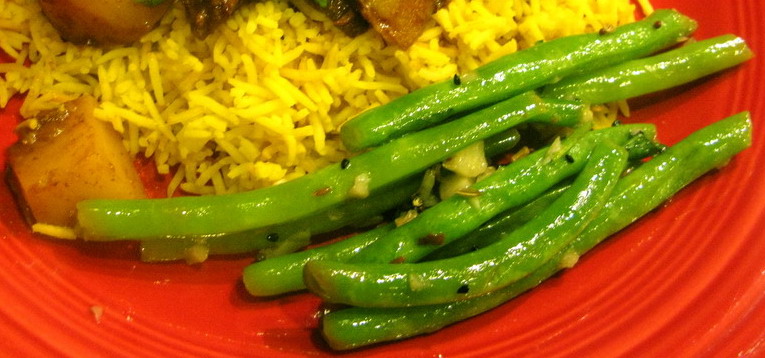
Indian food doesn’t have to be complicated or difficult, nor does it require a lot of ingredients.
Sure, there are lots of curry recipes out there with mile-long ingredient lists; I should know, because I have presented plenty of them. But, the truth is this: once you learn the methods, techniques and the ways in which these many ingredients are combined in Indian cookery, the recipes become much more simple and become second nature.
Even though complicated curries become simpler over time with experience, there is always room in our cooking for very simple recipes that have delicious, nutritive results, and Indian cuisine is no exception to this rule.
That is where panch phoron, a Bengali mixture of five whole spices, comes in.
As far as I am concerned, you can cook any vegetable using a variety of techniques from sauteing to roasting, with panch phoron and have something good.
Kale, chard, asparagus, cauliflower and broccoli, summer squashes, sweet potatoes, baby blue potatoes, and garlic scapes have all been improved by being seasoned with panch phoron, and now, we can add green beans to this august list of vegetables.
This recipe is even more simple than most of the ones listed above; all you need to do is top and tail your beans (snap off the stalk and tail of the beans, removing any strings while you are at it), blanch them briefly in boiling water (just until they turn brilliant green and lightly tenderize–about a minute and a half), then drain them. Then, melt butter, ghee or canola oil in a skillet, add a lot of minced garlic, and cook until the garlic becomes fragrant. Add the panch phoron, and toss, then add the beans and cook, stirring and tossing until the garlic turns lightly golden and the beans are slightly tender. Add a squeeze of lemon juice a liberal sprinkling of salt and some minced cilantro and serve the beans forth.
That is it.
It is fast, easy, fun and delicious, bursting with great flavors.
You could add some chili flakes with the panch phoron if you want your beans to not just be sparkly, but spiky, too. However, since I was serving them with vindaloo, I left out the chili, because I wanted the sweetness of the garlic, spices and beans to dominate the flavor, thus contrasting with the tangy, hot vindaloo.
You don’t have to serve these delicious beans with other Indian foods. They would be just as good with American and European classics such as roast chicken, meatloaf, pan-seared steaks, or grilled salmon.
But I think they would be truly amazing with a butternut squash dal, rice and aloo methi tamatar for an amazing Indian vegetarian meal.
Method:
Top and tail your green beans, removing any strings as you go along. Bring a pot of water to boil over high heat. Drop in your beans all at once, and allow to boil for about a minute and a half, or until the beans brighten in color and become lightly tender.
Drain in a colander, and rinse with cold water. Then, let the beans drip dry before you continue your recipe. (You can do this up to an hour before finishing the recipe. You can just let the beans drain in the colander while you do other stuff in the kitchen.)
When you are ready to serve dinner, melt the ghee, butter or canola oil in a heavy-bottomed skillet on medium heat. Add the garlic and cook for about two minutes, stirring the whole time. Add the panch phoron seeds, and cook, stirring for about another minute. Add the beans, and cook, stirring and tossing, until the garlic is golden and everything is fragrant. Make certain that the beans are totally coated in the flavored oil.
Add the lemon juice and stir well, incorporating it completely into the beans. Salt to taste and toss in cilantro leaves.
Serve immediately, though, really, these are good at room temperature, too.
Luxurious Vegetarian Pasta: Fettucine With Rapini, Walnuts and Gorgonzola
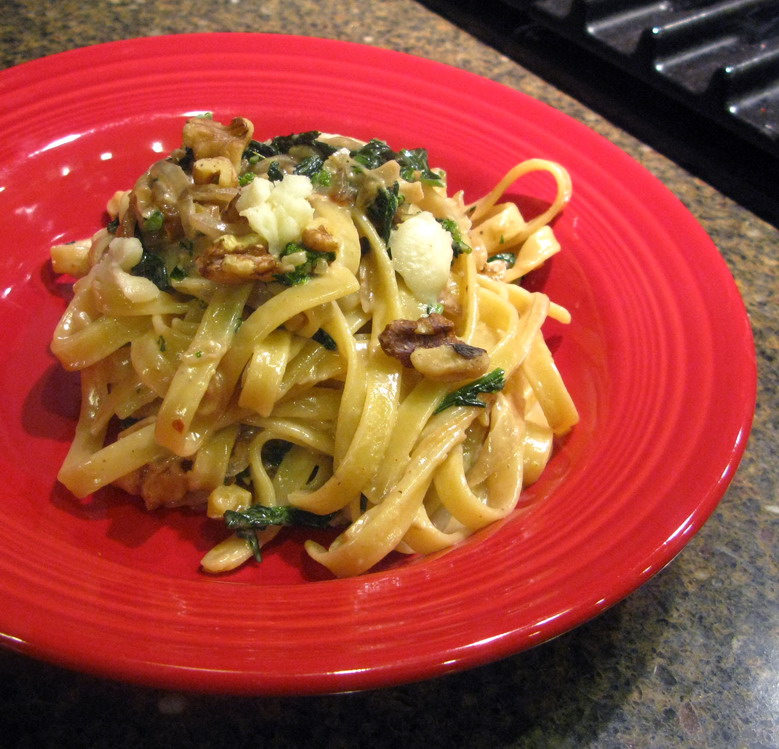
Pasta is one of the best ways to introduce omnivores to vegetarian dishes that, in the immortal words of my friend Kendra, “don’t suck.”
The truth is, there is no reason in the world that vegetarian cuisine should suck any more than non-vegetarian cuisines. Delicious is delicious, and as far as I am concerned, plant-based foods can be just as delectable as meat-based foods.
When you add eggs, honey and dairy products to the plant-based foods, you are heading toward culinary Nirvana.
Now, don’t get me wrong–there are some delicious vegan cuisines in the world. Some of the Indian traditional diets are vegan and most Buddhist Chinese and Japanese cuisines are completely vegan, and every dish I have tasted from those traditions are amazingly splendid and filled with flavor.
But, I have to admit that I love eggs, especially when they come from free-range hens, and cheese in nearly every one of its forms, has been my favorite food since I could toddle along and show a preference. I love me some cheese.
And honey–oh–I like it way better than cane sugar because its flavor is the essence of sunlight.

Okay, enough blathering about my thoughts on vegetarian cuisine, and on to the luxuriously decadent vegetarian pasta which I want you all to try–that is, unless you are allergic to tree nuts. In that case, skip this one.
The inspiration for this recipe came from a dish that another Babara made years and years ago at Seven Sauces, a restaurant that used to be “The” place to eat in Athens. The chef and founder, a dear lady named Barbara, (her son was one of my line cooks at Salaam–and a damned good one, too) used to make a delicious vegetarian pasta dish that included gorgonzola, broccoli, garlic and toasted walnuts, all tossed with fettuccine in a light cream sauce.
That was my favorite dish, and I ate it just about every time I went there, which was a lot back in those years. I just loved it and could never get enough of it–in fact, on the night of my and Zak’s wedding rehearsal dinner, which was held at Seven Sauces, I ordered it, but to my dismay, I was too nervous to do more than pick at it.
So, that dish has been in my memory for years. And now that Seven Sauces is no more, and the dear chef has gone to greener pastures years before, I decided I should just haul off and cook my own version of it.
So that is what I did, but of course, I made a few modifications myself. Which is what I always do, as everyone knows.
First of all, I substituted rapini for the broccoli. It has a similar flavor, but a texture and shape that is much more amenable to getting twirled up on the fork with the fettuccine–no “stabby-stabby, twirly-twirly maneuvers” are necessary to eat it. (You know–stab the broccoli floret, then twirl the pasta, then eat.)
With the rapini, all you have to do is go twirly-twirly with the fork, and voila–a bite of pasta with greens come together in one wonderful mouthful.
I also added caramelized onions and a bit of sherry because to my way of thinking, everything tastes better with caramelized onions and sherry. Well, nearly anything.
And, I put a tiny bit of Aleppo pepper in it, but you could be like the original Barbara and use lots of cracked black peppercorns instead–because frankly, if I could without fear of allergic reaction–I would.
What is crucial to this dish, however, is the cheese. Get the nicest gorgonzola you can afford–or failing that, get whatever good blue cheese you can get. You only need about three ounces of it, and the rest of the ingredients aren’t that expensive, so splurge a little. It is really worth it to use the best ingredients you can in a pasta dish this simple.
Now, if you cannot eat blue-veined cheeses because you are allergic to blue-green molds, well, then–I am sad for you, because I know how you feel. If that is the case, use a ripened cheese, like a brie or Camembert. It won’t taste the same, but it will still be very, very good. Just remove the rind from it–I don’t like the lumps it leaves in the sauce.
One more thing–this is a very rich dish. You don’t need to eat much of it to feel satisfied. Just a small bowl of it is enough to satiate even the greatest of appetites. To cut the richness, you can serve it with a green leafy salad with a light balsamic vinaigrette dressing.
Morganna tasted it and said it would be better with prosciutto, but I disagree. First of all, it would defeat the purpose of eating a vegetarian meal, and secondly, and more importantly, I think it would make it far too rich. She argued that it was already rich and I should just throw down and be like Mario Batali and just own the richness and take it over the top, but no–I think I will leave it as it is. Maybe some wild mushrooms next time, but no prosciutto.
Anyway, here is how to make it–sans prosciutto.

Fettuccine with Rapini, Walnuts and Gorgonzola
Ingredients:
1 cup shelled English walnut pieces
3 tablespoons olive oil
2 cups thinly sliced onions
1 teaspoon salt
4 cloves garlic, peeled and minced
1/2 teaspoon Aleppo pepper flakes or freshly ground black pepper to taste
4 cups rapini, washed well and dried, then thinly cut in ribbons or small chunks, excluding the larger stalks
1/3 cup dry sherry
1/2 cup heavy cream
3 ounces gorgonzola cheese, crumbled
salt to taste
1 pound fettuccine, cooked al dente and drained
Method:
Warm a wide, deep, heavy-bottomed pan over medium flame for a minute or two. Add the walnut pieces and toast, stirring, until the nuts darken slightly and begin to smell brown and good. Remove from the pan and allow to cool. Reserve 1/3 of the nut pieces, and chop the rest until they are fine, but not powdery.
Wipe the pan you used to toast the walnuts out and use to cook the rest of the sauce. Add the olive oil and heat over a medium flame for a minute, then add the onions. Spread them into a near-single layer and sprinkle with salt, then cook, stirring, until they turn medium golden brown.
Sprinkle in the garlic, pepper flakes, or black pepper, and the finely chopped walnut pieces, and cook, stirring, until the garlic is fragrant and golden. Add the rapini, and cook, stirring, until the leaves wilt and give up some of their moisture.
Add the sherry, and stir, allowing the alcohol to boil away. Add the cream, and cook, stirring until the cream boils. Add 2/3 of the cheese, stirring until it is combined with the sauce.
Taste for salt and adjust seasoning as needed. Add the freshly cooked, drained fettuccine to the pan, turn off the heat, and toss to coat the pasta. (Here is an important tip–if you cannot get the timing of having the sauce and the pasta ready at the same moment, cook the sauce first, then turn off the heat or turn it down to way-down-granny-low, while the pasta cooks. The pasta cannot wait for the sauce–it will get all gummy and cold and nasty if it waits, whereas the pasta sauce will be fine. You may lose the fresh green color of the rapini if you cook it too long, but it won’t ruin the texture and overall flavor of the dish.)
Twirl into bowls, and sprinkle with the reserved nuts and crumbled gorgonzola bits.
This makes enough to serve four to six adults, depending on their appetites and whether or not you serve salad with it.
Meat and Potatoes Goan Style: Beef Vindaloo
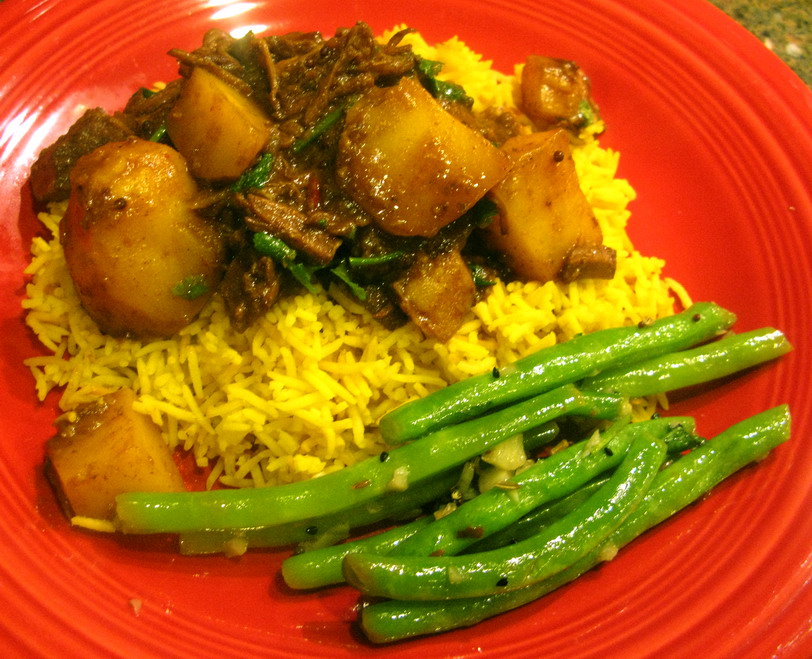
I have posted a couple of different vindaloo recipes here in the past, like my chicken version with mango chunks, and one made with pork, coconut milk and mangoes. As much as I love this fiery curry, I haven’t posted a more classic version, flavored strongly with vinegar and made hearty with potatoes, mostly because I do so love my mango version that I tend to just keep making it that way over and over and eat the traditional potato versions when I am out at a good Indian restaurant.
That is, until I made dinner last night–I had a hankerin’ for a good, stick-to-the-ribs meat and potatoes meal, but one with lots and lots of flavor, and because I was getting over the flu, I wanted one with some heat, to help clear the rest of the gunk that was stuffed up in my sinuses. And, frankly, the intense flavors were perfect for chasing away the bitter cold that the wind had swept into our region the night before.
Vindaloo–the name comes from the Portuguese “Vinha d’Alho,” which translates to “wine with garlic,” was originally a preparation of pork simmered in wine or wine vinegar with a large quantity of garlic. It was brought to the coast of Goa by Portuguese spice merchants, but soon after the dish came into the hands of Indian cooks, it improved immensely with the addition of fresh ginger, pungent mustard seeds, cumin, turmeric, and a generous helping of the newly popular chilies.
Some recipes call for tamarind as the souring agent rather than the more traditional vinegar; in this version with beef, I use both balsamic vinegar (I had no red wine vinegar in the pantry) and tamarind concentrate to give a delicious fruity, tart flavor. I also used a very large quantity of browned onions–more than I use in my chicken version, certainly, which gives the more strongly flavored beef a delectable sweetness.
To be authentic, you really should marinate the meat for at least a few hours, but I have to admit I didn’t, and the dish turned out really flavorful anyway. It could be because I used the pressure cooker–cooking meat this way almost always results in really well-seasoned, tender dish. If you want to marinate yours, mix together the mustard seed, cumin seed, mustard, vinegar, tamarind, turmeric, paprika, cayenne, garlic and ginger, and toss with the beef, then seal it in a container and refrigerate it for at least two hours, or as long as overnight.
Then, after you brown your onions, add the beef with the marinade and brown the beef, and when it is browned, then add the water indicated in the recipe and continue the method as written.
The potatoes that I used were really nice fingerlngs, but you can use any kind of potatoes you have around. Little red baby potatoes would be nice here. If you use new potatoes, scrub them well and don’t bother peeling them, but if you use older, larger russet potatoes, peel them.
Whatever kind of potato you use, don’t pre-boil them, cook them in the curry–that way they soak up all of the flavors of the sauce.
One other thing–you can use whatever fresh chili peppers you want to spice up this curry–and depending on how hot you want the vindaloo to be–you can add the chilies sooner in the cooking process, or later.
If you don’t want to use a pressure cooker, just simmer the beef covered until it is nearly done and add the potatoes. Continue simmering until the potatoes are done, then uncover the curry and simmer uncovered until the sauce thickens to the consistency you want. You will likely have to start with more water than I call for in this recipe, because you will lose more liquid than you would using the pressure cooker.
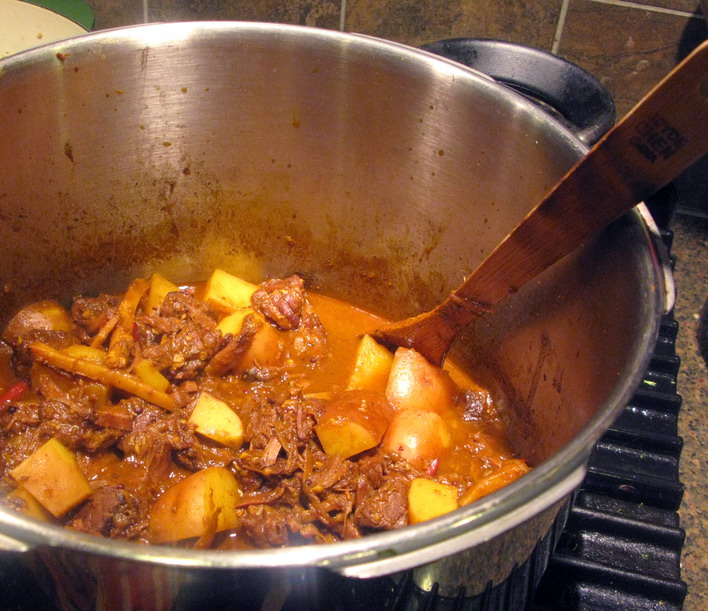
Beef Vindaloo
Ingredients:
4 cups thinly sliced onions
3 tablespoons mustard oil (or canola oil)
1 teaspoon salt
2 tablespoons mustard seeds
2 tablespoons cumin seeds
1/2 teaspoon ground cumin
2″ cube fresh ginger, peeled and cut into jullienne strips
1 head garlic, peeled and minced
2 1/2 pounds stew beef
1 teaspoon turmeric
2 teaspoons sweet paprika
1/2-1 teaspoon ground cayenne
1 tablespoon dijon mustard
2 tablespoons balsamic vinegar
1 tablespoon tamarind concentrate
2 cups water
2 pounds fingerling potatoes, scrubbed and cut into 1″ chunks
4-10 fresh red or green Thai chilies, stems removed, chilies left whole
1/2 teaspoon garam masala
salt to taste
cilantro leaves for garnish
Method:
Heat oil in a heavy-bottomed skillet or pan over medium heat. Add onions, and sprinkle with salt. Cook, stirring, until the onions turn a deep reddish brown.
Add the whole spices, cumin, ginger and garlic, then the beef, and cook, stirring until the beef is half-browned. Add the turmeric, paprika, and cayenne, and cook, stirring until the beef is completely browned.
Put beef mixture into a pressure cooker and add mustard, vinegar, tamarind and water. Bring to a boil, lock the lid in place and bring to full pressure. Turn heat down to low, and cook under full pressure for forty minutes.
Remove pressure cooker from heat and allow the pressure to reduce to normal naturally, by just letting the pot cool. This takes about ten or fifteen minutes. After the pressure is normalized, remove the lid, put back on the heat, and bring to a boil. Add potatoes and chilies, put the lid on, bring to full pressure and cook for five minutes. Remove from heat and allow to sit, covered for three minutes. Release pressure by opening the valve, and when the pressure is normalized, open the lid, put back on the heat and bring back to a boil. Simmer the curry until the sauce is as thick as you want it to be. Season to taste with garam masala and salt.
Garnish with cilantro leaves and serve with turmeric rice.
Update: Emeril Sends A New Set of Pans to the Lady in Elyria

Thanks to Dan, I caught wind of this update to yesterday’s story about the lady who defended herself against would-be robbers with her favorite saucepan.
Her biggest regret about the incident was that the police were forced to take her favorite saucepan away as it was material evidence.
It seems that her sorrow will be assuaged by none other than chef Emeril Lagasse, whose name graces the pan in question. Lagasse is sending an entire set of his signature series All-Clad pans to Ellen Basinski to replace the one which is now sealed in an evidence bag back at the Elyria police station.
It’s a nice ending to this rather unlikely, but happy tale.
I rather think that Lagasse should use the story in marketing his pans. Imagine it: “Not only can you make a mean bolognaise in my pans, but BAM! You can also use them to bash a burglar’s head in!”
In the Hands of a Master, a Saucepan Can Be Deadly…

Yes, it is true–anything can be a weapon, including a saucepan.
And while it is true that the lady pictured here, 70-year-old Ellen Basinski of Elyria, Ohio, did use her favorite anodized aluminum Emeril Lagasse saucepan to defend herself and her home from four would-be burglars yesterday, she did not actually kill any of them with it.
She only injured one of them.
I guess they should be lucky that she didn’t favor Lodge cast iron skillets, or Le Creuset because I can guarantee you, that one of those wielded by even the least stout of Grandmas would certainly put a hurting on someone.
In the hands of a healthy, muscular woman such as myself–a cast iron pan could easily kill.
One good blow to any part of the head could crush a skull or break a neck.
I won’t even go into the lethal possibilities of being on the wrong side of a Chinese cleaver or a long French chef’s knife.
Even a pair of chopsticks, if wielded with precision and malicious intent can be fatal.
I applaud Mrs. Basinski for her resourcefulness, determination and grit in the face of four admittedly incompetent criminals. However, if the foursome had been armed with anything–knives or worse, a handgun, she may well have paid for her temerity with her life.
And a few dollars are never worth that.
Although, I do understand her instinct to not give in to the demands of criminals. While I will give money away to those who need it, either when asked or just by giving when I see a need, I am not so apt to want to acquiesce to the impositions of those who try to bully anyone they perceive as weaker than they are. And that is one of the lessons that is apparent in this story–criminals favor easy targets. When the seemingly helpless old woman turned out to have access to a makeshift weapon and the will and strength to use it, they quit the scene rather than continue to contend with her.
But, she is still lucky they were not armed.
When I read the story to Zak, Morganna, and Brittany, they shook their heads. In addition to applauding the Xena-like prowess of Mrs. Basinski, they all had one thing to say–hopefully no one would have the temerity to attempt a home invasion while Morganna, Brittany and I were in the kitchen. Since all three of us grew up in tough parts of a city (and me half in the city and half in the country where I had access to all sorts of deadly things like guns, knives, woodworking tools, farming implements and chainsaws), our first instinct would be to fight with whatever was handy.
And in my kitchen, that includes lots of cast iron skillets, a steel rolling pin and a Chinese cleaver sharp enough to shave with.
Zak said we would be the culinary equivalent of “The Heroic Trio”, which he dubbed “The Anti-Heroic Trio.”
Note: The photo of our heroine above is from The Cleveland Plain Dealer

Categories:
- Admin (rss) (55)
- Blogs and Blogging (rss) (81)
- Book Reviews: Cookbooks (rss) (43)
- Book Reviews: Non-Cookbook Food Books (rss) (38)
- Cats and Cat Blogging (rss) (47)
- Chinese Cooking Lessons (rss) (32)
- Culinary School Stories (rss) (18)
- Dairy Pruducts: Cultured and Barbaric (rss) (4)
- Documentary Filmmaking (rss) (1)
- Essays, Rants and Reflections (rss) (260)
- Fighting Hunger (rss) (12)
- Food and Kids (rss) (45)
- Food in the News (rss) (126)
- Food Media (rss) (98)
- Food Preservation (rss) (18)
- Food Safety (rss) (45)
- Gardening (rss) (30)
- Herbs and Herb Blogging (rss) (20)
- Holidays (rss) (50)
- Kat Blogging (rss) (22)
- Kitchen Science (rss) (36)
- Leftover Makeover (rss) (8)
- Life, the Universe and Everything (rss) (131)
- Local and Sustainable (rss) (227)
- Local Athens Food and Foodies (rss) (42)
- Meatless Mondays (rss) (32)
- Menu For Hope (rss) (5)
- Nutrition, Diet and Health (rss) (84)
- On The Farm (rss) (8)
- Recipes: Almost Vegetarian, Vegetarian and Vegan (rss) (294)
- Recipes: American Regional (rss) (37)
- Recipes: Appalachian Hillbilly (rss) (33)
- Recipes: Bread, Pasta, Grains (rss) (95)
- Recipes: Canning and Preserving (rss) (8)
- Recipes: Chinese (rss) (123)
- Recipes: Comfort Food (rss) (120)
- Recipes: Cookies (rss) (16)
- Recipes: Desserts (rss) (48)
- Recipes: French (rss) (25)
- Recipes: Fruits and Vegetables (rss) (302)
- Recipes: Greek, North African and Middle Eastern (rss) (31)
- Recipes: Indian (rss) (137)
- Recipes: Italian (rss) (42)
- Recipes: Japanese (rss) (7)
- Recipes: Jewish (rss) (4)
- Recipes: Korean (rss) (6)
- Recipes: Meat, Poultry and Fish (rss) (220)
- Recipes: Mexican/Native American/ Latin American/Caribb (rss) (27)
- Recipes: Original (rss) (108)
- Recipes: Thai (rss) (27)
- Recipes: Tofu (rss) (17)
- Recipes: US Regional (rss) (16)
- Recipes: Vietnamese (rss) (8)
- Restaurant Stories (rss) (28)
- Sewing, Quilting, Arts and Crafts (rss) (16)
- Simple Chinese Recipes (rss) (30)
- Slow Food and Heritage Foods (rss) (10)
- Spice Blogging (rss) (44)
- The Chinese Cookbook Project (rss) (14)
- The Chinese Pantry (rss) (39)
- The Documentary (rss) (2)
- The Kitchen Saga (rss) (17)
- The Locavore's Bookshelf (rss) (15)
- The Unsung Adventures of The Culinary Nerd (rss) (6)
- Tools and Toys (rss) (35)
- Uncategorized (rss) (10)
- With a Side of Politics (rss) (48)
Archives:
- August 2012 (9)
- July 2012 (12)
- September 2011 (3)
- August 2011 (7)
- July 2011 (8)
- June 2011 (16)
- May 2011 (17)
- April 2011 (11)
- December 2010 (9)
- November 2010 (5)
- February 2010 (1)
- December 2009 (5)
- November 2009 (7)
- October 2009 (10)
- September 2009 (16)
- August 2009 (14)
- July 2009 (14)
- June 2009 (7)
- May 2009 (17)
- April 2009 (10)
- March 2009 (25)
- February 2009 (13)
- January 2009 (10)
- December 2008 (5)
- November 2008 (5)
- October 2008 (6)
- September 2008 (13)
- August 2008 (8)
- July 2008 (11)
- June 2008 (18)
- May 2008 (13)
- April 2008 (14)
- March 2008 (16)
- February 2008 (17)
- January 2008 (19)
- December 2007 (25)
- November 2007 (18)
- October 2007 (24)
- September 2007 (16)
- August 2007 (15)
- July 2007 (15)
- June 2007 (10)
- May 2007 (14)
- April 2007 (16)
- March 2007 (17)
- February 2007 (20)
- January 2007 (13)
- November 2006 (1)
- October 2006 (8)
- September 2006 (14)
- August 2006 (25)
- July 2006 (30)
- June 2006 (28)
- May 2006 (34)
- April 2006 (29)
- March 2006 (24)
- February 2006 (30)
- January 2006 (38)
- December 2005 (40)
- November 2005 (37)
- October 2005 (32)
- September 2005 (25)
- August 2005 (30)
- July 2005 (28)
- June 2005 (21)
- May 2005 (8)
- April 2005 (22)
- March 2005 (17)
- February 2005 (29)
- January 2005 (10)
Search Site:
Links:
- Lily’s Wai Sek Hong
- 101 Cookbooks
- A cat in the kitchen
- A Veggie Venture
- Accidental Hedonist
- Cha Xiu Bao
- chez pim
- Chocolate & Zucchini
- Chopstick Cinema
- Chowhound.com
- Chubby Hubby
- Cook sister!
- Cooking with Amy
- da*xiang
- Eat Local Challenge
- Eating Liberally
- Ecocentric
- Eggbeater
- Epicurious
- Farmgirl Fare
- Fatfree Vegan
- Foodgoat
- ForkandBottle.com
- Green Olive Tree
- Hooked on Heat
- Jaden’s Steamy Kitchen
- Kalyn’s Kitchen
- Lucullian delights
- Mahanandi
- Matt Bites
- MeatHenge
- mmm-yoso!!!
- New York Times – Dining & Wine
- Pizza Goon
- Rasa Malaysia
- Ruhlman
- Sailu's Kitchen
- Serious Eats
- SF Gate: Food & Dining
- Simply Recipes
- Soul Fusion Kitchen
- Tastespotting
- The Amateur Gourmet
- The Cleaner Plate Club
- The Food Section
- The Grub Report
- thecookscottage
- U.S. Food Policy
- Wandering Chopsticks
- Washington Post Food and Dining
- Wasted Food
Meta:


Powered by WordPress. Graphics by Zak Kramer.
Design update by Daniel Trout.
Entries and comments feeds.