
Cook Local, Eat Global
Uber-Umami: Chinese Ground Bean Sauce
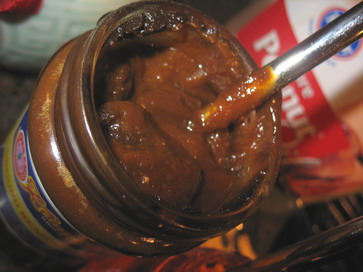
It is thick, salty and looks somewhat like peanut butter.
Everything you cook with it tastes better, but only if you don’t overdo it.
It is made from ground up fermented soybeans, rather like miso, but has a deeper, less salty flavor.
It is Chinese ground bean sauce, and is a “secret ingredient” in many very flavorful stir-fries, because it packs an oomfy wallup of umami flavor in every spoonful.
Remember umami–that “fifth taste,” for which receptors on our tongues have recently been discovered and confirmed? It is that savory, meaty taste that comes about from substances such as glutamate, other amino acids, and nucleotides. These substances, which are found naturally in meats, mushrooms, seaweed, fermented soybean products, fermented fish and some vegetables, enhance the natural flavors of foods, and as such have been utilized for centuries in the kitchens of Asia, long before the synthesis of monosodium glutamate and its overuse in the processed food industry.
Chinese ground bean sauce is produced similarly to Japanese miso, in that it is made from bacterially fermented soy beans, but to my tongue, it has a very different flavor profile. Most miso that I have tasted has a purer, less complex flavor, that has a very strong salty component, whereas the Chinese ground bean sauce has a deeper, more complex flavor profile, with a much more “meaty” taste. I have used miso to substitute it earlier in my experimentations with Chinese cooking, and have never been pleased with the results–the dishes just never tasted right to me, and I didn’t really understand why.
The reason is that one cannot simply exchange out a Chinese ingredient for a Japanese one and expect the dish to come out tasting authentically Chinese. It is just not going to happen. Just as I have learned to taste the difference between Japanese soy sauce and Chinese, so I can taste the difference between miso and Chinese fermented bean pastes.
These ingredients are analogues of each other; they perform similar functions in recipes in their respective cultures, but they do not taste the same, nor do they give the same results.
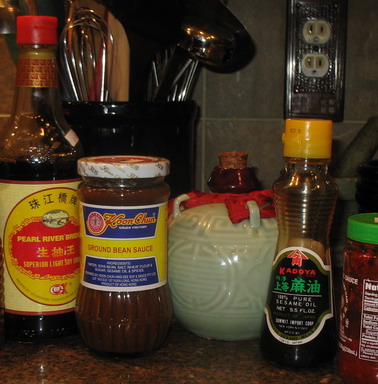
I have found a particularly good combination of ingredients to make a sauce for pork, gai lan and spiced dry tofu: marinate the meat in a bit of raw sugar, light soy sauce, shao hsing rice wine and cornstarch. Then, when cooking the aromatics, add a scant half teaspoon of chile garlic paste, and when you toss in the meat and tofu, add about a teaspoon and a half of the ground bean sauce. Do not add too much, or the dish will become overpoweringly salty. Sprinkle with a quarter teaspoon of the sugar. Add about a tablespoon of the wine and about another teaspoon of soy sauce to the wok after the meat browns on the bottom, and then when you add the gai lan to the wok, toss in a few tablespoons of chicken broth.

At the end, drizzle with a scant eighth teaspoon of toasted sesame oil.
The results are fantastic and subtle. The sauce is scant and glossy and clings to the meat, tofu and greens. The pork is incomparable in flavor–it is both sweet and savory, and salted perfectly. Something about the combination of ingredients makes it taste, if possible, “more porky,” as if the little slices are distillations of essential “porkness.”
If one does not eat pork, one can keep the tofu and substitute chicken. With chicken, I would use slightly less of the ground bean sauce, and a dash more of the wine. If one does not eat meat, keep the tofu and use instead of the meat either soaked dried shiitake mushrooms or fresh ones, marinated as for the pork. If you don’t want to add the chile garlic sauce because you want the flavor to be even more fundamental and simple, leave it out, but I think that the tiny bit I add gives the dish an amazing zing that is wonderful and should not be missed.
Other uses for Chinese ground bean sauce include adding a bit of it to ramen noodles to give them a lift, adding it to other sauces for stir fried or boiled noodle dishes, and using it in marinades for meat and fowl that is to be braised long and slow. The stuff lasts forever sealed up in its jar in the fridge and is inexpensive and well worth the trouble of seeking and and purchasing. I usually buy Koon Chun brand, with the yellow, blue and white label.
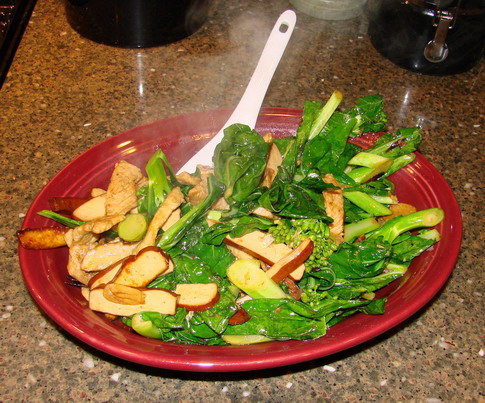
Pork, Tofu and Gai Lan with Ground Bean Sauce
Ingredients:
1/2 pound boneless pork loin, trimmed of most fat and cut into thin 1″X1/4″X1/8″ slices
1 teaspoon light soy sauce (I used Pearl River Bridge Brand)
1 1/2 tablespoons Shao Hsing wine
1/2 teaspoon raw or brown sugar
1 tablespoon cornstarch
3 tablespoons peanut oil
3 garlic cloves, sliced thinly
6 scallions, white and green parts only, sliced thinly on the bias
1 1/2″ cube fresh ginger, peeled and sliced thinly
1/4 teaspoon chile garlic paste
8 ounces spiced dry tofu, cut on the bias into slices similar to the pork slices
1 1/4-1 1/2 teaspoons ground bean sauce
1 tablespoon light soy sauce
2 tablespoons shao hsing wine
1 pound gai lan (Chinese broccoli), thick stems cut on the bias into bite sized pieces, and separated from the leaves
3 tablespoons chicken broth
leaves of the gai lan, cut into rough pieces
scant 1/8 teaspoon toasted sesame oil
Method:
Toss the pork with the next four ingredients and allow to marinate for ten to twenty minutes.
Heat wok on very high heat until it is smoking. Add peanut oil and allow to heat for another thirty seconds. Add garlic, scallion and ginger in a small pile, then put chile garlic paste on top. Allow to cook ten seconds, then stir fry until quite fragrant–about forty-five seconds to a minute.
Add meat in one layer, then put the tofu on top. Put the bean sauce on top of the tofu, and leave the meat to brown on the bottom undisturbed–about a minute or so. When you can see it is browned and smell it, start stir frying. When the pork is showing only 1/3 pink, add the soy sauce and wine and keep stir frying.
Add gai lan stems, and stir fry rapidly until very little pink is seen on the pork.
Add the gai lan leaves, and pour over it the chicken broth. Bring the meat, tofu and stems to the top of the leaves by stir frying, and stir and fry until the leaves wilt and become velvety.
Remove from heat and drizzle with sesame oil. Serve with steamed rice while still extremely hot.
Culinary New Year’s Resolutions, Version 2.0
Last year around this time, I wrote a post entitled Culinary New Year’s Resolutions, and it was such fun, I decided to look back at what I had resolved to do, see how well I managed it and then write up a new batch of resolutions, and invite my readers to add their own culinary resolutions in their comments.
Last year, the first resolution I made was to cook more Thai food and blog about it.
I did rather well with that resolution, and lost no time with getting into it, as I posted about Pad Thai on January second. Later that month, I also posted about Red Curry and Mu Pad Prik King. However, it wasn’t until July, and the heat of summer that I really got the kitchen hopping with Thai cuisine, when I posted about Tom Kha Gai, Panang Nuer, Green Curry, Massamun Curry, Tomato Basil Salad, and Kaeng Kari Gai.
I am pretty pleased with the way that resolution turned out, so I will not repeat it this year. That is not to say that I will not post about Thai food anymore–far from it–but, I won’t feel the need to make a formal declaration of resolve about it.
The resolution to cook more fish, however, fell by the wayside a bit. I was rather waylaid by the fact that I was pregnant and was wary of the issue of mercury in the flesh of many of my favorite fish, most notably salmon and tuna. However, I have been eating wild-caught salmon by Ecofish recently, as their fish are all tested for mercury levels and are certified as being safe, so look for some more fish recipes this year, too.
I also promised to actually cook from some of my many cookbooks last year, and I did, sort of.
As I stated in my post, “No Note-For-Note Cooking Here,” I am just not good at following recipes word for word, so I just don’t. Nearly every time I have done so, I have regretted it, so I just use recipes as starting points. If I do that and I blog about it, I always state that in my post, and state the source of the initial inspiration–I believe in giving credit where credit is due. But, still, I did present recipes from my cookbook collection, including one I adapted from Martin Yan’s recipe (Ghengis Khan Beef, the recipe for which is included in “No Note-For-Note Cooking”), from Grace Young’s excellent book, The Breath of a Wok, and one from the wonderful cookbook, The Fifth Taste, which I called Hillbilly Deluxe Dinner. I also gave an oatmeal cookie recipe which I took from Rosie’s Bakery Chocolate-Packed, Jam Filled Butter-Rich No Holds Barred Cookie Book by Judy Rosenburg’s, and changed completely into “>Oatmeal Fruit and Nut Cookies.
There are other examples of recipes adapted from cookbooks, of course, and they have been such an inspiration to me, I will continue in that vein in the coming year.
Last year, I also promised to cook more from magazines and newspapers.
Oops. I didn’t do so well with that one. I keep meaning to, but I keep not doing it.Oh, well. And this is even though I read lots of cooking magazines, and see lovely photos and good sounding recipes. I just never get around to cooking them. I don’t know why.
So, I should repeat that one this year, and I might try it again.
What I can promise to do is still look at food writing in magazines and newspapers with a critical eye and report on what I find there. THAT part of it, I am good at. Just not so much the cooking part….
In a similar vein, I also resolved to write more book reviews. THAT, I am pleased to say, I kept up with, and it was a lifesaver when I was pregnant and nauseous and didn’t really want to cook or eat. It is hard to write a food blog when food makes you queasy, but the fact that I love to read about food and will curl up with a good cookbook the way normal people do with novels saved me. If you glance over at my archive categories and note the categories “Book Reviews: Cookbooks” and “Book Reviews: Non-Cookbook Food Books,” you will note a total of forty-nine entries.
I think I can safely leave that resolution behind and just keep up the good work when it comes to reading books and writing about them.
I promised more essays last year, and I think I delivered pretty well on that score. I wrote about a myriad of topics, from manners, picky people, Omega 3’s and mercury in fish, blogging ethics, the ethics of meat eating and eating locally, and in doing so, usually fomented vociferous discussion in the comments section.
Have no fear, I will continue writing provocative essays–it is one of strongest abilities as a writer, and I will be darned if I stop doing pushing the envelope of this blog!
I also promised to teach classes and blog about it, but the pregnancy surprise rather nixed that idea and Kat’s presence will likely keep complicating that for a little while yet. However, I still intend to start a small cooking school here in my home, and use the upstairs kitchen to do so. And when I do that, of course I will blog about it here.
The only other resolution I did not keep as well as I could have was my promise to write more about the local Athens food scene, and there is a reason for that.
I am working on a book about that subject.
So, what are my resolutions for this year?
Expect to see more of what you saw last year, though not as often. I am really going to work to post three times a week minimum, but I am not going to push myself harshly on that score. As time goes on and the depression wears down a bit more, I will try and write more and more, but bear with me for a while longer as I get my writing chops back in gear.
I am going to seriously work on my book proposal and start interviewing sources for the book and get on the task of finding an agent. Wish me luck.
As for cooking–look for more Chinese recipes, more in-depth cooking lessons, (including how to stir-fry tofu!) and more Indian recipes. I just met a lovely lady from South India, and she has promised to teach me about South Indian vegetarian cookery, so look for me to share what I learn with everyone here. I’ll still be cooking Thai, of course, but I am thinking of going into some Vietnamese and Korean cookery as well, as there is no place here in town to get any really good Southeast Asian cuisines.
All of that said–what sorts of culinary resolutions have you made? Where do you plan on stretching your foodie-wings this year?
It Had To Be Done: Pomegranate Cheesecake
In the words of my dear friend Dan, “If there are two things that were meant to come together it is pomegranate and cheesecake.”
Thus spake Dan, the man who once or twice in his life has sat down and eaten an entire cheesecake in a sitting, so well does he love those creamy, decadent confections.
In truth, I have to admit that the idea for a pomegranate cheesecake was neither Dan’s nor my own, but instead, it came from the kitchen of a local pan-Arab restaurant, Salaam, which, when it was a hookah cafe, was once known as Shishah. (Avid readers might remember that Zak and I held our baby shower there, where our guests were treated to delectable mezze, baklava and Turkish coffee while being entertained by the henna art and belly dancing of our friend, Eli.)
Anyway, when I saw pomegranate cheesecake on Salaam’s new menu, of course, I had to try it. I -had- to, because the way Dan loves cheesecakes, I love pomegranates. My father introduced them to me in childhood, and they were a great treat for me every winter, when we would buy three or four of them per season and he and I would pick them apart and savor the glinting jewel-like sour seeds with glee. Pomegranates were much more rare to find then, and quite expensive, which is why we only got a few per year. They were so rare, neither of us would have thought of cooking with them–it would have been seen as a waste. So, like Persephone, every winter we ate the seeds as a fruit, as they were, and dreamed about them for the long months we were deprived of them.
Now, of course, I know that in warmer places where pomegranates are grown, they have beguiled cooks with their beauty, scent and flavor for centuries. The kitchens of Persia, Lebanon, Turkey, India and Greece have been the birthplace of many delicacies featuring the flavor and texture of pomegranate, and I was hoping for a cheesecake that lived up to that legacy.
Now–don’t get me wrong. The cheesecake tasted great, but it wasn’t what I would consider a pomegranate cheesecake, it being a traditional sour-cream topped cheesecake with a sprinkling of fresh pomegranate seeds over it. There was no marriage of flavors and textures, and there was nothing to tie the pomegranate to the cheesecake, in order to make it a seamless whole, a dessert worthy of the plate of a Sultan or Mogul Emperor.
So, I took it upon myself to figure out a way to make something royal that involved cheesecake and pomegranates.

In order to tie the flavors together, I knew I would have to use something to get the pomegranate flavor into the cheesecake. I didn’t really want to bury fresh seeds into the batter, because I wanted to use them raw, as garnish atop the baked cake, where they could sparkle like a coating of garnets. I could have used fresh pomegranate juice, but I also despise extracting juice from the fresh fruits–it is a messy and wasteful proposition.
This past year, a plethora of pomegranate-flavored products, primarily juices and drinks, have appeared on the market, in response to the news that the fruit is well gifted in health-giving antioxidants. Because of being trumpeted as a health food and a marketing push by pomegranate growers who have made the once-rare fruit ubiquitous in the produce aisle every winter, pomegranate has become a trendy flavor.
I decided to use two different products–one traditional, and one new, in order to integrate the flavor of pomegranate seamlessly into the body of a cheesecake. The traditional product is very similar to pomegranate molasses, but instead of being used as a cooking ingredient, is used like a jam or a topping. This pomegranate spread is from Turkey, and I have found it under the brand name of Baktat. It is made in a similar fashion to pomegranate molasses, in that it contains simply pomegranate juice and sugar, boiled down to a thick syrup, but it is different in that it is not so concentrated nor is it as sour. It has a very tangy, yet sweet flavor profile, and would complement the richness of cheesecake beautifully. However, its dark brown color is not appetizing, and I wanted something even more tart to go into the cheesecake batter itself.
I found this pomegranate juice concentrate to fit the bill. It is nothing but juice that has been slowly evaporated to remove some of the water, and is meant to be added to water to make a sharply sour drink. It is brilliant ruby in color and extremely sour. I decided to use it in the batter in place of the more usual lemon juice, and then mix it with the Baktat pomegranate spread to make a syrupy fruit topping for the baked cake, which would be covered by sparkling pomegranate seeds.
The recipe I adapted for the cake itself came from Judy Rosenburg’s Rosie’s Bakery All-Butter Fresh Cream Sugar-Packed No-Holds-Barred Baking Book. This fine book, written by the owner of Rosie’s Bakery, which is a Boston institution, has been the inspirational starting point for many a decadent baking project in my own kitchen for over ten years. Almost every recipe I have tried from it has worked as written, though I have to say, that the amounts she gave for the crumb crust for a ten-inch cheesecake were seriously short. I ended up nearly doubling it to make it work correctly. I also changed the batter flavorings accordingly, adding and subtracting and replacing as I went.
How did it turn out?
Well, there is very little of it left.
I forgot to photograph it last night before cutting into it, which was a shame, because it was lovely.
If I were a pastry chef and was working in a professional kitchen, I would only change the presentation slightly–I would add a wreath of golden spun-sugar threads nestled in a waft around the edge of the cake.
However, I am not going to be making spun sugar in my home kitchen anytime soon. It is -way- too messy for me to make as a garnish for one dessert.
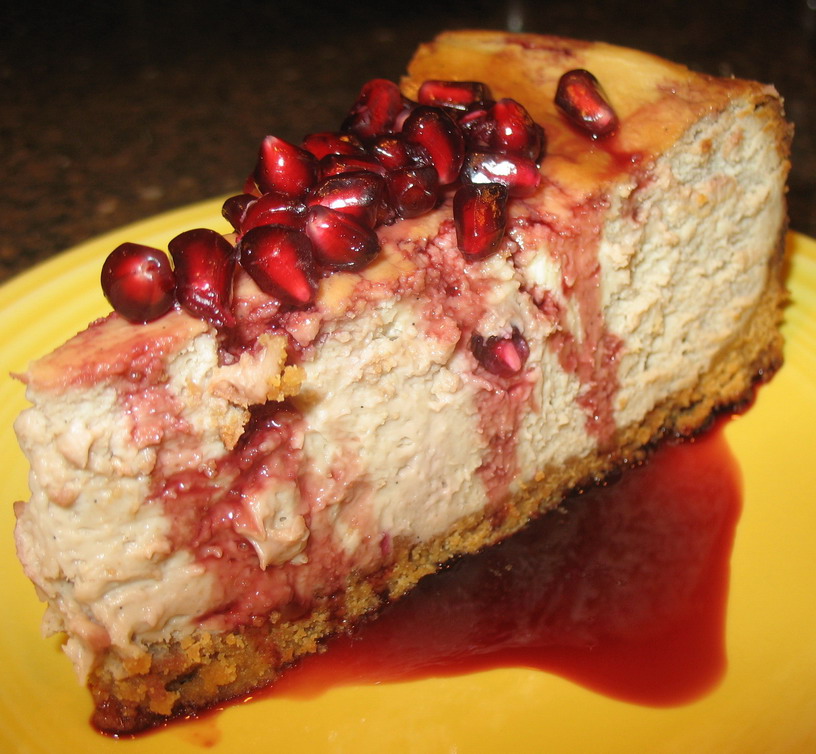
Besides, the cheesecake looked quite pretty without it; the cake itself was a golden circle, with the crimson syrup drizzled over and down it, making a good setting for the gemstone-like pomegranate seeds. (I only wish I had remembered to take a photograph of it whole before cutting into it! That is what happens when one gets out of the habit of blogging.)
At any rate, here is the recipe, which is simplicity itself.
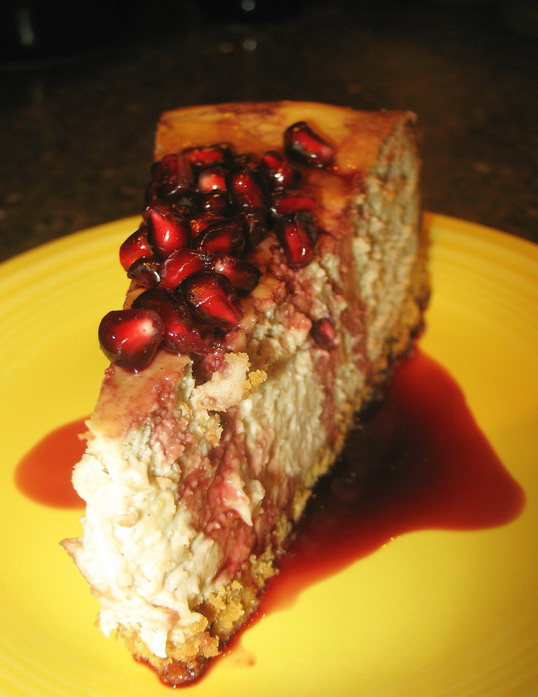
Pomegranate Cheesecake
Ingredients:
2 5.3 ounce (150 gram) packages Walker’s Original Shortbread
1/4 cup sliced almonds
1/2 teaspoon ground cardamom
6 tablespoons butter, melted
3 pounds cream cheese, softened and at room temperature
1 1/2 cups sugar
2 teaspoons vanilla bean paste or extract (I like the paste better)
3 large eggs
2 large egg yolks
3 tablespoons pomegranate juice concentrate (or, you can use 2 tablespoons pomegranate molasses)
Topping Ingredients:
1/3 cup pomegranate juice concentrate
2 tablespoons Baktat pomegranate spread or pomegranate molasses
the seeds from one large pomegranate
Method:
Preheat oven to 375 degrees F.
Using a food processor, grind up the shortbread, almonds and ground cardamom into fine crumbs. Pour into a bowl, drizzle with melted butter and toss together with a fork until they are evenly blended.
Press this mixture firmly into the bottom and partly up the sides of a ten inch springform pan, and bake on the bottom rack of the oven for fifteen minutes. (Bake for ten minutes if you have a convection oven.)
Remove from oven and cool completely.
Turn oven down to 300 degrees, and place a roasting pan or baking pan full of water into the bottom rack. (This creates a moist environment in the oven and helps keep the top of the cheesecake from drying out and cracking or becoming rubbery.)
Beat together the cheese, sugar and vanilla until well blended and light and fluffy on high speed. Beat for two minutes. Scrape down bowl and beat for another thirty seconds.
Whisk together eggs and egg yolks and add to mixture with the pomegranate juice concentrate or pomegranate molasses. Beat on medium speed for about one minute to combine thoroughly. Scrape down bowl and beat for thirty more seconds.
Pour filling into pan, and place on the center oven rack. Bake for one hour and fifteen minutes (50 minutes if you have a convection oven) until the cake appears golden and set. A tester inserted into the center should come out looking dry. Cool the cake in the pan on a wire rack until it comes to room temperature, then cover and refrigerate for eight hours.
To serve, remove from refrigerator and wipe down the outside of the springform pan with a towel dampened with very hot water. Dip a table knife or icing spatula in hot water, wipe it dry and run it around the interior edge of the pan, loosening the sides of the cake. Unlock the spring, and remove the side of the pan.
Blend together the juice concentrate and pomegranate spread with a whisk. Pour over the top of the cake, making certain to drizzle some of it artfully over the sides in decorative rivulets. Sprinkle the top of the cake thickly with pomegranate seeds, until it resembles a geode encrusted with garnet crystals. Serve on plates upon which pools of the pomegranate syrup have been poured, if desired.
A Return to Food Blogging in the New Year
This post will be short, because I really want to go back to blogging about food, and not about myself, and since Kat only sleeps so much in a day, I have to make this quick post very brief.
First of all–to all the loyal readers and new readers who have been checking in this past month and a half or so when I have been AWOL–I give you my hearty thank yous, good wishes and general love. For the outpouring of love and concern from around the world–I have to say that words are not enough to express how helpful all of you have been, even if you never knew it.
You see, the reason I have been away from the ‘net is because after we came home with Kat, and all should have been well, she began to improve and grow by leaps and bounds, and I began to sink into a miasma of post partum depression. It was not the worst case that anyone has seen, but it was bad. Bad enough to sap my will to do anything having to do with food or writing, and bad enough to convince me that I was the worst mother in the world.
Of course, logically, I know that I am not a bad mother at all, but at the time, I was struggling to feel anything other than despair, self-loathing and extreme sorrow. The chemical, hormonal imbalance that is the root cause of PPD was compounded by my memories of traumatic events surrounding Morganna’s birth and early childhood, such that I struggled daily to keep myself together enough to get up in the morning, take care of my daughters, cook dinner, eat enough to lactate properly and care for myself.
I just had no strength left for the ‘net.
For a while I kept up with email, but as my therapy continued and the traumatic memories kept being unburied and the emotions that they evoked in the present began to surface, I gave up even on that.
So, that said–for those who have commented on this blog over the past month or so–I am going through all of the comments and reading them over the next several weeks. If you asked a question here or on email, I will strive to answer it and I apologize profusely for the help coming late. For those who have wished me well, and asked me to return–here I am, with bells on! I am going to strive to post at least three times a week from now on, and if anyone has any requests for recipes or essays they would like to see, leave me a comment on this post and I will see what I can do!
For all of the love sent in my direction over these dark days–I can never thank you all enough. When I did get a glance at the net, and saw the sweetness of readers’ words, it was a tonic for my heart.
Bless you all, and may all the new year bring everyone great joy and wisdom.
It Is a Matter of Manners
I’ve been thinking a great deal since I posted ten days ago on the subject of picky eaters and why they made me peevish.
One thing I have been thinking about is the fact that I had no idea that the topic was going to raise so many people’s blood pressure in so many different directions. I really didn’t think it was that hot of a topic when I took it up. It turns out that I was wrong on that score. Nor did I realize how many folks had opinions on the issue; I had simply been prompted to write because Amy’s post had gotten me thinking. It turns out that if you read responses to Amy’s post, and mine, and to posts inspired by our two posts, you can see that -lots- of people have opinions on the issue of picky eaters. This is obviously a subject that has a lot of people thinking and talking.
The one thing I have been thinking the most about since then was that it isn’t really what people eat or don’t eat that bothers me. Personal food choices are just that–personal, and quite intimately so at that. Each individual has the right to choose what substances to put into their own bodies within reason–no cannibalism, please–and it is not for me to say to someone else that they are wrong for not eating something that I enjoy. In fact, when it comes to dietary choices, in general, I am very easy-going. I have friends who are Muslim, friends who are vegetarians and friends who follow the Atkins diet. I also am friends with people who are lactose intolerant, who have celiac disease, and who have various food allergies.
And I have managed to cook for all of these people, in varying combinations, over the years without making myself or anyone else crazy.
So, why do I state that I disloke picky eaters?
Well, I realized that it wasn’t what people did or did not eat that bothered me, nor was it that they had food preferences that were different than my own. It wasn’t even that some folks had what I consider to be irrational reasons for their food dislikes that bothered me–one could argue that religious prohibitions are irrational in the extreme, yet, I absolute hold religious dietary preferences sacrosanct and will not violate them when I am serving guests for whom they are a chosen expression of spiritual belief and practice.
It isn’t what people eat or don’t eat that gets to me–it is how they go about expressing their choices.
What it comes down to is this: I don’t dislike picky people–I hate rude bastards.
And that is how I realized that the crux of the matter wasn’t food preferences–it was manners.
There are ways to express one’s food preferences in a polite fashion and then there are ways to do it in a rude, obnoxious and childish fashion.
If you express your food preferences politely, you are welcome at my table any time. If you are rude and obnoxious, not only are you not welcome at my table, I will not go out to eat with you, either, because I cannot abide people who treat servers and bartenders as if they were stupid, out to get them or inhuman automatons who are there to bow and scrape and cater to a selfish twit’s every childish whim.
You see, I have worked in food service, and so I have seen how horrible people can be to those in the industry. In fact, if restaurant guests and catering clients were all model citizens with good manners, The Food Whore wouldn’t have as many funny stories, nor would she drink as many lemondrops as she does. (But, one could argue, without her funny stories, the world would be a more boring place–and that is true. In fact, the reason that most rude people I have encountered yet live and breathe is that I learned long ago to laugh at them.)
So, I thought about it and decided that I should write a little primer on manners relating to food, in order to help those confused by the issue get on a little better with the rest of the world. Not that I think that my readers are in any way unmannerly, because they are all so super and wonderful. No, I don’t expect that anyone who comes here regularly will have need of this primer, however, they may know someone who needs enlightened. In such a case, you can email the url to this post to them with no explanation, or print out the primer and leave it on their desk, in their lunchbox or tape it to their foreheads. Whatever works.
This is not a comprehensive list, because I am no Judith Martin, and thus am not really an authority. But this list is just a handful of things that I think are pretty important that might help dinner guests, hosts, servers, customers and family members get along at the table just a little bit better.
Rule Number One of Barbara’s Table Manners is simple–within reason, eat what you are offered, and do so graciously, even if it tastes like ass. This is the big rule that was drummed into my head from early childhood on: if you are offered food in someone else’s home, it is rude to turn it down. It is also rude to explain how you don’t eat whatever it is that is being served to you, unless you have a damned good reason to do so, (like “God will hate me if I eat pork”) and even then, you should try to avoid saying no to your host. If it is something you don’t normally care for, take as small a portion as possible, and eat it, and smile, even if it tastes bad–some might say, especially if it tastes bad.
And after you have eaten it, you praise the cook and thank them vociferously.
Why?
Because when someone cooks something for you, it is an expression of love and fellowship, and such an expression should never be spurned, because that is akin to spitting in someone’s face. Bringing people together at the table to share food is a sacred act, and is meant to create bonds of friendship and community among human beings. To refuse food is tantamount to refusing the friendship of the host and the cook, and in some countries and cultures, this is a dire offense. To accept an invitation to dine, and then refuse to eat what is presented to you as a guest by the host is an even worse offense.
My Grandma always told me that when you serve food to a guest, it is always the best that you can give–and that meant that when you went to someone else’s table, what they served was the best that -they- could offer. Not every person has the means to present a five course meal, but even if they are poor, whatever they put before a guest is the best that their hearth and hands can offer, and it should never be looked down upon, ridiculed or refused. It should be eaten graciously, and many thanks should be given for it.
To be a good guest, one should therefore be humble.
Barbara’s Second Rule is a corollary to the first rule: in order to be a good host, make every effort to know what your guests do and do not like and can and cannot eat; in order to be a good guest, make your dietary needs known to your host ahead of time politely and remember that there is a difference between what you cannot eat and what you will not eat. A good guest should understand that his host is under no obligation to please his palate so long as she does not serve food which will cause her guests bodily harm or death. A good host should do his utmost to provide for the comfort of his guests, while a good guest will do her utmost to not be an undo burden to the host.
For both hosts and guests, this means that discreet inquiries, done privately, on the subject of dietary needs are a must for successful dinner parties.
Guests should also strive not to be an undue burden on the host by not making unreasonable requests. If one is a Muslim on the Atkins diet, and is genuinely allergic to a number of foods such as milk and almonds, one should then also not give the host a list of foods that one simply does not like. Stick with what is a genuine problem, and leave the rest be.
For hosts, I say this: if you have vegetarians dining with you, please do not cook vegetables with meat and call them vegetables. It is not cute, clever or compassionate to do so. It is rude. Do not secretly put pork in the green beans and then “forget” to tell your Muslim guest. And for goodness sake, treat food allergies as serious health problems because they can be deadly. You don’t want to kill anyone do you? I didn’t think so. (Do you really want to have someone come to your door in the middle of a dinner party, and when you open it, you find it is the Grim Reaper? If you think it would be fun, please view Monty Python’s The Meaning of Life and see that while it can be funny, it really puts a damper on the evening’s entertainment.)
Barbara’s Third Rule is a corollary of the First and Second Rules: please do not make ugly faces, icky noises or derisive comments about other people’s food. Whether it is served to you, or is on someone else’s plate, if you don’t care for it, Keep It To Yourself! No one wants to hear you make gagging sounds if they are eating meat and you are a vegetarian, nor do vegarians want to hear you go on about how terrible tofu is. If you don’t like it and you aren’t eating it, leave the person or persons who are eating it alone to eat it in peace for goodness sake. Else you risk never being asked out to eat again.
Rule Number Four is not related necessarily to the other three rules, but it is very important nonetheless. When one is out at a restaurant, please treat your servers as human beings, because that is bloody well what they are. They are not there to be your personal emotional punching bags. They work hard doing a physically, emotionally and mentally demanding job in order to make a living wage, so please don’t make their life worse by acting like an arrogant ass with a sense of entitlement.
And while you are at it, here is a thought: learn the the difference between bad service (an inattentive, surly server who never brings water or remembers what you asked for), a very busy night when the restaurant is filled with loud tables and the waiters are harried, (the service is slow, but the waiter is apologetic, never forgets your requests, and is running around like a chicken with his head cut off, but still getting everything done), and cases where the server is not at fault, but the kitchen is (a steak is medium rare instead of medium well, but the server takes it right back to fix it with an apology and a smile.) Once you have figured out what good service and bad service are, tip accordingly, and never, ever stiff a server unless they are truly out of line with your party.
And never ever say some stupid crap like, “The restaurant should pay the servers a living wage so that I don’t have to tip,” and then use that as an excuse not to leave a tip, because that is a crass bullshit excuse to just be a tightwad. If you go out with me and say such a thing, guess what? I won’t go out with you again. End of story.
There are lots of other little rules that could be added here–and I welcome folks to leave their own musings on manners here in the comments section. Afterwards, perhaps we will collate them into a grand listing of table manners for the twenty-first century. We can keep adding to the big listing as situations arise and warrent inclusion.
Oh, and one more thing–remember this: manners are not just for guests, hosts, company and restaurants. They apply to everyday home meals, too. In fact, I would say it is just as important to treat your family and intimate friends with great courtesy and manners as it is to treat strangers and guests, because manners make life go more smoothly. Families have enough stress heaped upon them from living in close quarters day and in and day out; it never hurts, and in fact helps to alleviate stress if we all just treat each other with a bit of mannerly kindness on a daily basis.
Manners matter, every day, and in every way.
So–now that you know what I care about when it comes to table manners, what do -you- care about most?

Categories:
- Admin (rss) (55)
- Blogs and Blogging (rss) (81)
- Book Reviews: Cookbooks (rss) (43)
- Book Reviews: Non-Cookbook Food Books (rss) (38)
- Cats and Cat Blogging (rss) (47)
- Chinese Cooking Lessons (rss) (32)
- Culinary School Stories (rss) (18)
- Dairy Pruducts: Cultured and Barbaric (rss) (4)
- Documentary Filmmaking (rss) (1)
- Essays, Rants and Reflections (rss) (260)
- Fighting Hunger (rss) (12)
- Food and Kids (rss) (45)
- Food in the News (rss) (126)
- Food Media (rss) (98)
- Food Preservation (rss) (18)
- Food Safety (rss) (45)
- Gardening (rss) (30)
- Herbs and Herb Blogging (rss) (20)
- Holidays (rss) (50)
- Kat Blogging (rss) (22)
- Kitchen Science (rss) (36)
- Leftover Makeover (rss) (8)
- Life, the Universe and Everything (rss) (131)
- Local and Sustainable (rss) (227)
- Local Athens Food and Foodies (rss) (42)
- Meatless Mondays (rss) (32)
- Menu For Hope (rss) (5)
- Nutrition, Diet and Health (rss) (84)
- On The Farm (rss) (8)
- Recipes: Almost Vegetarian, Vegetarian and Vegan (rss) (294)
- Recipes: American Regional (rss) (37)
- Recipes: Appalachian Hillbilly (rss) (33)
- Recipes: Bread, Pasta, Grains (rss) (95)
- Recipes: Canning and Preserving (rss) (8)
- Recipes: Chinese (rss) (123)
- Recipes: Comfort Food (rss) (120)
- Recipes: Cookies (rss) (16)
- Recipes: Desserts (rss) (48)
- Recipes: French (rss) (25)
- Recipes: Fruits and Vegetables (rss) (302)
- Recipes: Greek, North African and Middle Eastern (rss) (31)
- Recipes: Indian (rss) (137)
- Recipes: Italian (rss) (42)
- Recipes: Japanese (rss) (7)
- Recipes: Jewish (rss) (4)
- Recipes: Korean (rss) (6)
- Recipes: Meat, Poultry and Fish (rss) (220)
- Recipes: Mexican/Native American/ Latin American/Caribb (rss) (27)
- Recipes: Original (rss) (108)
- Recipes: Thai (rss) (27)
- Recipes: Tofu (rss) (17)
- Recipes: US Regional (rss) (16)
- Recipes: Vietnamese (rss) (8)
- Restaurant Stories (rss) (28)
- Sewing, Quilting, Arts and Crafts (rss) (16)
- Simple Chinese Recipes (rss) (30)
- Slow Food and Heritage Foods (rss) (10)
- Spice Blogging (rss) (44)
- The Chinese Cookbook Project (rss) (14)
- The Chinese Pantry (rss) (39)
- The Documentary (rss) (2)
- The Kitchen Saga (rss) (17)
- The Locavore's Bookshelf (rss) (15)
- The Unsung Adventures of The Culinary Nerd (rss) (6)
- Tools and Toys (rss) (35)
- Uncategorized (rss) (10)
- With a Side of Politics (rss) (48)
Archives:
- August 2012 (9)
- July 2012 (12)
- September 2011 (3)
- August 2011 (7)
- July 2011 (8)
- June 2011 (16)
- May 2011 (17)
- April 2011 (11)
- December 2010 (9)
- November 2010 (5)
- February 2010 (1)
- December 2009 (5)
- November 2009 (7)
- October 2009 (10)
- September 2009 (16)
- August 2009 (14)
- July 2009 (14)
- June 2009 (7)
- May 2009 (17)
- April 2009 (10)
- March 2009 (25)
- February 2009 (13)
- January 2009 (10)
- December 2008 (5)
- November 2008 (5)
- October 2008 (6)
- September 2008 (13)
- August 2008 (8)
- July 2008 (11)
- June 2008 (18)
- May 2008 (13)
- April 2008 (14)
- March 2008 (16)
- February 2008 (17)
- January 2008 (19)
- December 2007 (25)
- November 2007 (18)
- October 2007 (24)
- September 2007 (16)
- August 2007 (15)
- July 2007 (15)
- June 2007 (10)
- May 2007 (14)
- April 2007 (16)
- March 2007 (17)
- February 2007 (20)
- January 2007 (13)
- November 2006 (1)
- October 2006 (8)
- September 2006 (14)
- August 2006 (25)
- July 2006 (30)
- June 2006 (28)
- May 2006 (34)
- April 2006 (29)
- March 2006 (24)
- February 2006 (30)
- January 2006 (38)
- December 2005 (40)
- November 2005 (37)
- October 2005 (32)
- September 2005 (25)
- August 2005 (30)
- July 2005 (28)
- June 2005 (21)
- May 2005 (8)
- April 2005 (22)
- March 2005 (17)
- February 2005 (29)
- January 2005 (10)
Search Site:
Links:
- Lily’s Wai Sek Hong
- 101 Cookbooks
- A cat in the kitchen
- A Veggie Venture
- Accidental Hedonist
- Cha Xiu Bao
- chez pim
- Chocolate & Zucchini
- Chopstick Cinema
- Chowhound.com
- Chubby Hubby
- Cook sister!
- Cooking with Amy
- da*xiang
- Eat Local Challenge
- Eating Liberally
- Ecocentric
- Eggbeater
- Epicurious
- Farmgirl Fare
- Fatfree Vegan
- Foodgoat
- ForkandBottle.com
- Green Olive Tree
- Hooked on Heat
- Jaden’s Steamy Kitchen
- Kalyn’s Kitchen
- Lucullian delights
- Mahanandi
- Matt Bites
- MeatHenge
- mmm-yoso!!!
- New York Times – Dining & Wine
- Pizza Goon
- Rasa Malaysia
- Ruhlman
- Sailu's Kitchen
- Serious Eats
- SF Gate: Food & Dining
- Simply Recipes
- Soul Fusion Kitchen
- Tastespotting
- The Amateur Gourmet
- The Cleaner Plate Club
- The Food Section
- The Grub Report
- thecookscottage
- U.S. Food Policy
- Wandering Chopsticks
- Washington Post Food and Dining
- Wasted Food
Meta:


Powered by WordPress. Graphics by Zak Kramer.
Design update by Daniel Trout.
Entries and comments feeds.