
Cook Local, Eat Global
A New Way With Sweet Potatoes
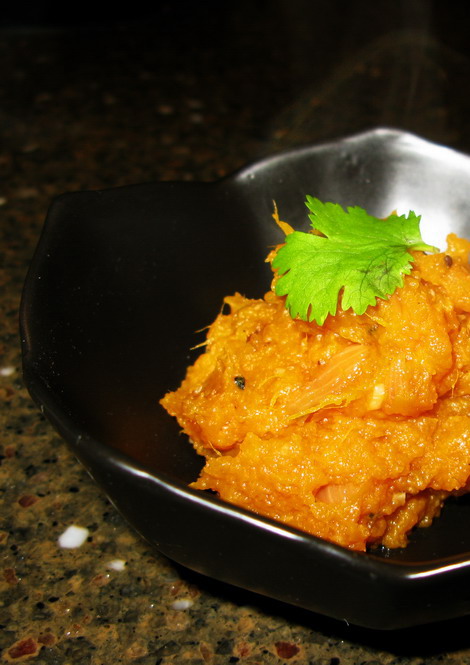
I mentioned a few days ago that I could have called 2007 “The Year of Panch Phoron.” Well, the truth is, I didn’t really start cooking with it until March of 2007, so until March 2008, at my house, it is still “The Year of Panch Phoron.”
Which means I’ll still be experimenting with my belief that any vegetable cooked with this Bengali spice mixture is improved.
So far, I have not been wrong.
I cook broccoli in it, and folks who only eat broccoli out of a sense of duty to their health taste it and ask, “How did you get it to taste so good?”
Potatoes cooked with it become aromatically festive, lentils tempered with it become nutty and full-bodied, and green beans cooked with it sing.
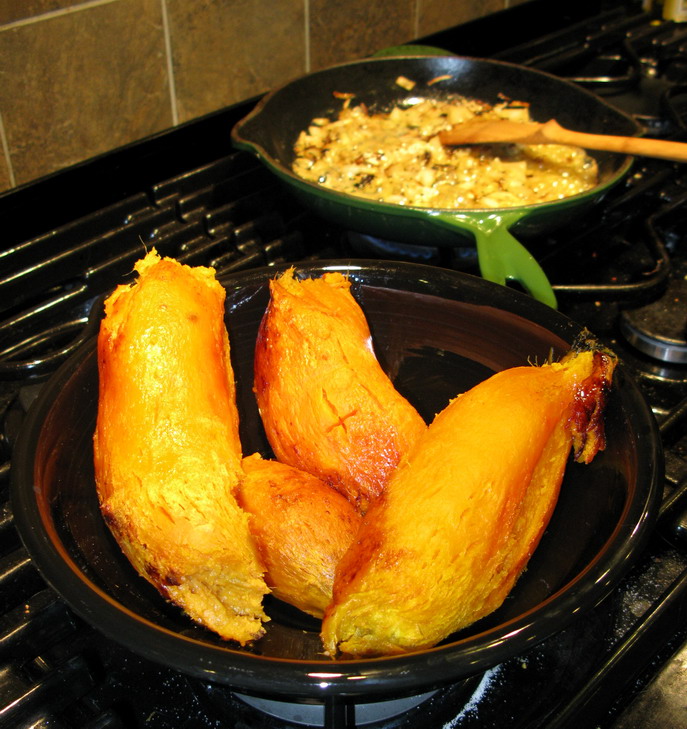
While cooking a small Indian supper for New Year’s Eve, I had an inspiration. ‘
What if I roasted sweet potatoes in the oven, then skinned and mashed them, then made a tarka with onions, garlic and panch phoron browned in ghee, then stirred the tarka into the mashed tubers along with a good sprinkling of salt?
It didn’t sound bad at all.
In fact, it sounded quite good.
And even better–it was completely simple.
Sweet potatoes roast all by themselves in the oven and need absolutely no attention; and the tarka cooks in about ten minutes. Skinning and mashing the potatoes and stirring in the scented, spiced oil and aromatics takes only a minute or two.
It turned out to be a nearly effortless vegetable dish, redolent with the scents and flavors of panch phoron, creamy without being fattening, and delicious enough to convince even sweet potato haters to love it.
(For a vegan version–use canola or another vegetable oil in place of the ghee. Walnut oil would give a great flavor.)
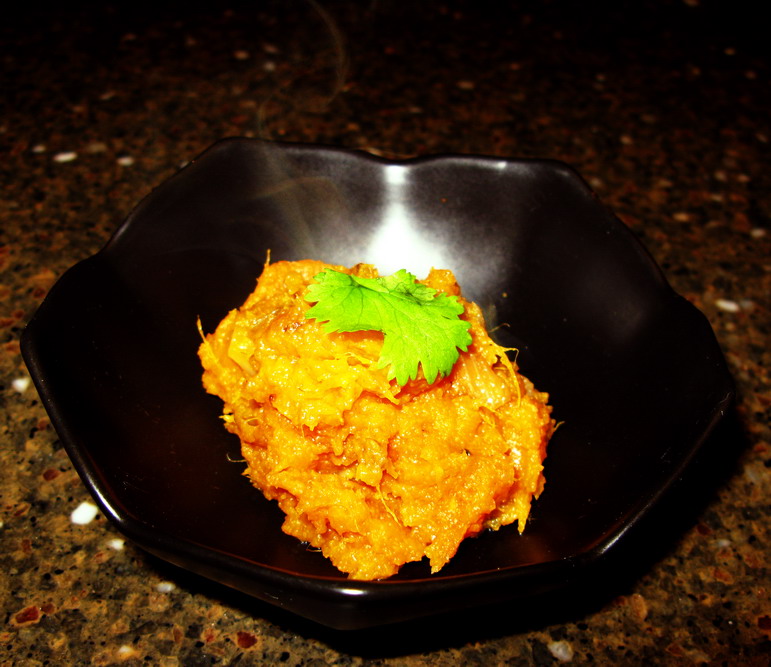
Mashed Sweet Potatoes With Panch Phoron
Ingredients:
2 pounds sweet potatoes, scrubbed clean
2 teaspoons canola oil
2 1/2-3 tablespoons ghee
1 small onion, diced finely
2 large cloves garlic, peeled and minced
2 tablespoons panch phoron
salt to taste
pinch ground cayenne (optional)
lemon juice to taste (optional)
Method:
Heat oven to 375 degrees F. Pierce the potatoes in a few places each with a fork and rub with the two teaspoons oil.
Bake for about forty-five minutes to an hour, or until tender.
When done, skin the potatoes and mash the flesh. Keep flesh warm.
When the potatoes are nearly done roasting, melt ghee in a small skillet, and cook onions in it until they are dark golden. Add garlic and panch phoron and cook until the onions are reddish brown, the seeds are toasted and the garlic is golden.
Stir into the potato mash, adding salt (and if you are using it, cayenne and lemon juice) to taste.
The Final Recipe of 2007: Beef and Vegetables With Sha Cha Sauce

My final recipe for 2007 had to be Chinese, and I wanted it to be something very special, festive and beautiful. And, as you can see above, I was lucky enough to capture an image of the Shao Hsing wine bursting into flame as I deglazed the wok. (Stir frying with one hand and taking photographs with the other is not a really good idea, but so far I have neither set my hair on fire, nor dropped the camera into the wok.)
Since this recipe uses beef tenderloin, I suggest that you reserve it for holidays and special occasions; for lesser meals, you can use a less expensive cut of beef such as sirloin or top round steak. These cuts of beef are quite flavorful, just not quite as meltingly tender as tenderloin. It will not be as rich if you use another cut of beef steak, but it will still be festive.
The main flavoring ingredient in this stir fry, which was cooked as a luxurious dish in restaurants in Hong Kong, is Sha Cha Sauce. Sha cha sauce is a delicious condiment that is based on seafood, specifically brill fish and shrimp, but is also made tangy and spicy by the addition of shallots, garlic and chilies in oil. It is fragrant, redolent of the ocean, and the spice of chili. It is available from Lee Kum Kee, and it makes a delicious addition to grilled meats or stir fries.
This version is similar to the one that I watched chefs Huy and Lo at the now closed China Garden Restaurant in Huntington cook many times. They always served the sizzling hot stir fry over a bed of cold, sliced cucumbers, which provided a delectable contrast in flavor, temperature and texture.
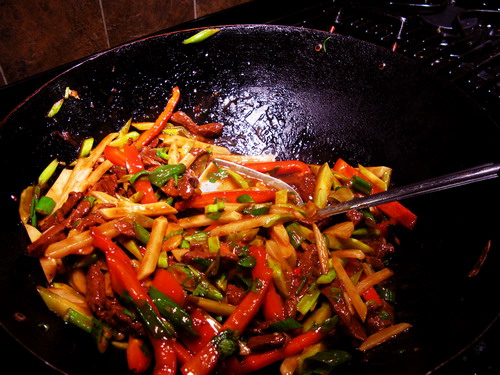
The biggest difference between my version and Huy and Lo’s version is that they never used any vegetables except the aromatics of onion, garlic and ginger. The cucumber was the only vegetable involved in the dish, and then it was garnished by cilantro. I like the crunch and flavor of vegetables in my stir fries, so I added daikon radish, broccoli stems and sweet red pepper. (I also like cooking one dish meals when I can, so vegetable and meat mixed stir fries, while perhaps not as traditional, are simpler and more time effective when one is making a fast supper.)
You can choose whether to cook this with vegetables or not–it is up to you.
As for the flames shown above–you do not have to flambe the meat in your wok. Huy liked to, but he was a chef, you know–and I like to, because it is cool. But, if the idea creeps you out or makes your smoke alarm go postal, don’t bother with it. The flavor is not appreciably changed by not setting it alight. On the other hand, if you want to impress your guests and they are standing in the kitchen and watching, by all means, dip that wok toward the flame and set it alight! (Just make sure to turn off your smoke alarm first!)
Without further ado, here is my recipe to say adieu to 2007 in a flaming, festive bon voyage.
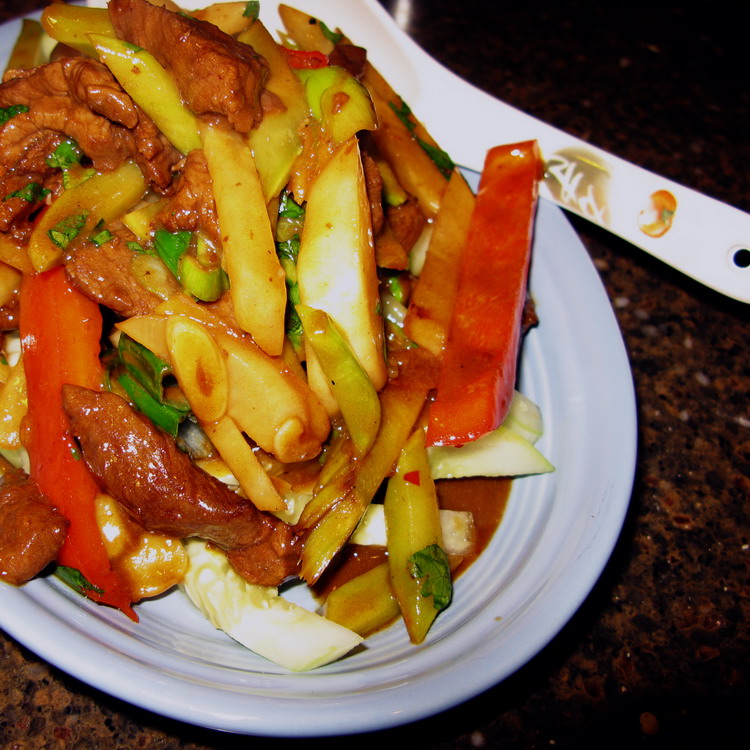
Sha Cha Beef and Vegetables
Ingredients:
1 1/2 pounds beef tenderloin, silverskin trimmed and cut into 1/4″ wide 2″ long, 1/4″ thick sltrips
2 tablespoons dark soy sauce
1 tablespoon Shao Hsing wine (or dry sherry)
1 teaspoon raw sugar
1 teaspoon sha cha sauce
2 tablespoons cornstarch
3 tablespoons peanut or canola oil
5 large scallions, trimmed and cleaned, and cut into diagonal slices about 1″ long–separate whites from dark green parts
2 red or green Thai chilies, cut into thin, diagonal slices
2″ cube fresh ginger, peeled and cut into thin slices
4 cloves garlic, peeled and cut into thin slices
1 cup broccoli stalk, peeled then cut into slices the same size as the beef
2 tablespoons Shao Hsing wine
1 tablespoon dark soy sauce
1 cup peeled diakon, cut into strips like the meat and broccoli stalk
1 cup red sweet bell pepper, cut into strips like the other vegetables
1 1/2 tablespoons sha cha sauce
2 teaspoons black rice vinegar (you can use balsamic if you want)
1/2 teaspoon toasted sesame seed oil
1 cup cilantro leaves
1 peeled cucumber, sliced the same way as the other vegetables
Method:
Toss beef with next five ingredients, and allow to sit while you prepare aromatics and vegetables.
Heat wok over high heat until a wisp of white smoke drifts up. Add oil, and heat for another thirty seconds to a minute. Add scallions and chilies, and stir fry for about a minute, then add ginger, and continue stir frying for one more minute. Scrape the aromatics up on the sides of the wok and add beef in a single layer in the bottom of the wok. Scrape aromatics on top of the beef, and sprinkle in the garlic. Allow beef to sit undisturbed until it browns on the bottom–about a minute or two–you can tell by the smell and the way the edges of the beef darken, when it is time to start stir frying the beef vigorously.
Stir fry beef vigorously, until most of the pink is gone. Add the broccoli stalk to the wok and stir to combine. Deglaze pan with Shao Hsing wine. After you add it, if you want, you can flame it by dipping the edge of the wok toward the burner and setting the alcohol alight. But you don’t need to do this. add dark soy sauce, daikon, bell pepper and sha cha sauce, and keep stir frying.
When meat is done and vegetables are tender-crisp–about a minute, stir in vinegar, sesame oil and cilantro leaves. Scrape contents of wok onto a platter which has been lined completely with the cucumber slices, and serve immediately with steamed rice.
The Year In Review: Posts Which Make Me Proud
I decided, in the last few days of this year, to look back over what I had written and pick out a post or two per month which had a lot of meaning for me.
Well, I tried to keep it to one or two posts per month, but, well–it just didn’t work out that way. I guess I just had too much to say.
In the case of these posts from the past year at Tigers & Strawberries, these are the essays and articles which have meant the most to me, and which I hope have meant something to other folks as well. These are the posts that have stayed with me and made me think, both as I was writing them and as I read and answered the responses to them over the year. I hope that they are as informative and interesting now as they were when I wrote them initially.
January: I kicked off 2007 with a recipe for Pomegranate Cheesecake, but quickly delved into the intricacies of Chinese cookery and culinary culture. Let’s Talk Woks was one of my more informative, useful posts on the subject of woks and Western stoves I have written. It was sparked by the questions a reader sent regarding flat bottomed woks, and I decided to make a post from it because the questions were such sensible, reasonable ones that I was certain that some other readers probably were wondering the same things, but just hadn’t gotten around to asking yet. I was also thrilled to write a review of Fuchsia Dunlop’s cookbook on Hunan cuisine: Revolutionary Chinese Cookbook and present a pair of recipes from the book: Peng’s Home-Style Bean Curd and Beef With Cumin.
February: This generally dreary month roars in with Staple Ingredients of the Chinese Pantry, a [pst which was, once again, inspired by a question from a reader. Again, it is the sort of question that any beginner dipping his or her toe into the culinary arts of China might ask, so I set forth to answer it publicly and thoroughly. I ended up listing fourteen basic ingredients which anyone who is interested in serious study of Chinese cuisine should have in their pantry, along with notes about each ingredient as well as my favorite brands of many of them. I also wrote a post, Let’s Talk About MSG, which caused a bit of a stir, with people discussing this often derided ingredient which is often found in the pantries of Asian cooks. Wok Wonderings continues my quest to answer questions about woks sent in by curious readers.
March: If I were to give 2007 a title, it would be “The Year of Panch Phoron,” because after discovering it in March, I have been using it and loving it ever since. The eponymous post, Panch Phoron, written in an imaginative, emotional style, describes my feelings regarding this essential spice mixture from Bengal. I have since discovered that any vegetable is improved greatly with the addition of panch phoron, even if the vegetable is cooked and presented quite simply. Another good post from March is My Favorite Chinese Cookbooks For Beginners, which is an annotated list of the handful of great cookbooks for beginners to Chinese cuisine. And speaking of Chinese cuisine, I also developed a delectable recipe for Vegan Dry Fried String Beans With Fresh Shiitake Mushrooms that I liked just as well as the pork and dried shrimp-seasoned traditional version.
April: April could have been called “The Month of Stir Fry” because there are a good solid handful of posts on the subject of how to stir fry successfully. Stir Frying Tofu Part I: Choose Your Tofu Wisely gives advice on how to find the best types and styles of tofu to stand up to the rigors of a hot wok and a fast wok shovel, while Ten Steps to Better Tofu From a Wok gets down to the exact techniques needed for making good tofu even greater in the wok. Another useful and important post on stir frying introduces my system which teaches how to invent your own stir fried dishes which taste as delicious as anything you will learn from a cookbook recipe: Creating Your Own Foolproof Chinese Stir Fry: Introducing Barbara’s Rules of Three. And, Morganna, Kat and I showed folks how to make their own kimchi from scratch at home in Up Close and Personal With Kimchi.
May: Anyone who has read my blog for more than oh, say, a week, should know that I am neither a vegetarian or a vegan. But, as an ethical omnivore, I stand beside ethical and responsible vegetarians and vegans when it comes to defending their dietary choices as both nutritious and ethically sound. In May, after I read Nina Planck’s OpEd piece in the New York Times where she states in no uncertain terms that vegan diets are not only nutritionally inadequate for infants, but also implies that parents who feed children vegan diets are neglectful and abusive, I had to return fire. Nina Planck Stirs The Pot; Vegans Get Steamed: Film At Eleven is my heated response to the author’s unqualified nutritional rant. This post got a lot of attention all over the web, and sparked a huge discussion and debate on the issue of vegan parenting which went on for months. I still get cranky when I read Planck’s ill-informed words to the point that I don’t think I can ever look one of her books straight again. I also wrote an essay debunking many of the fear-mongering statements which had been made in the press concerning the die-off of honeybees: Concerning Bees: The Fear Factor, but it was easily overshadowed by the discussion of the ethics of vegans and vegan parenting.
June: June was a month where I was lazy on posting, but I still got to cover a few interesting and fun issues. Harking back to the issue of what to feed infants, I wrote about Cooking for Kat: Breaking the Baby Food Rules. There was much discussion and sharing of baby feeding tips as a lot of readers agreed with me that the American ideal of feeding infants out of boxes and jars was not really ideal at all. I also wrote about my newfound fascination with collecting vintage aprons in Aprons Come Out of the Closet, and I told the story of how I learned my most cherished traditional Chinese recipe in The Secret’s In the Sauce: Sichuan Shredded Chicken with Garlic Sauce.
July: I started posting more regularly again in July, and a lot of informative and opinionated posts came out of the summer flurry of writing and activity. The Intermediate Chinese Pantry lists eleven ingredients I find to be indispensable when added to the basics of the Chinese pantry for cooks who have gone beyond the beginner’s stage of Chinese cookery. Morganna: The Adventures of an Ethical Omnivore in Training told the story of how Morganna and two of her classmates, on their own, slaughtered a young steer on her friend’s farm, and started a discussion which tureswent on for months, and was both enlightening and acrimonious. Most readers understood my point in encouraging Morganna to find out first hand what price is paid for eating meat, but one vegan couldn’t wrap his head around it and became slightly–insulting about it. (Don’t worry–just because one vegan was self-righteous doesn’t mean I think all of them are. I am still proud of my defense of vegan parents.) Another discussion started over my essay, Is Cooking For Your Family Retrograde June Cleaver Nonsense? both here and on various feminist communities over the ‘net.
August: August was the Month of Chinese Noodles here at Tigers and Strawberries; most of my posts were consistent with my desire to cover as many aspects of Chinese noodles as possible. These posts include Chinese Wheat Noodles 101 and Dried Rice Noodles 101 as well as my recipe for a favorite noodle dish: Singapore Rice Noodles. But it wasn’t all noodles all the time in August; I also wrote about a British study which found that children of women who ate a lot of junk food when they were pregnant and breastfeeding tended to prefer junk foods when they were weaned. Weaning Kids From Junk Food: Start Before They’re Born covers my thoughts on the issue which include the fact that modeled parental behavior is at least as important as the mother’s diet in shaping children’s eating habits.
September: Even though for many bloggers September was Eat Local Month, we always eat locally here at Tigers and Strawberries. So while I did write about eating locally in such essays as Eating Locally As A Spiritual Practice,, most of my posts were a continuation of the Chinese noodles theme. In Making Basic Chinese Chicken and Pork Stock and A Noodle Shop Classic: Roast Pork Noodle Soup I taught readers how to make one of the most homey and comforting Chinese dishes one can imagine. Finally, in The Not-So-Secret Ingredient to Roast Pork Noodle Soup, I ‘fessed up to having to use a pinch of MSG to make the broth of the soup taste just like it came from a noodle shop. And then I asked What Is Up With The Cupcake Thing?
October: This was the month when I did a lot of canning and preserving the bounty of Athens county for the cold months of the winter. But that wasn’t all I wrote about, even if I did write about it a lot. I also talked about sucking shrimp heads in A Meditation on Heads-On Shrimp: To Suck or Not To Suck? And, I taught folks how to make a roux in A Basic Saucemaker’s Skill: Making a Roux, as well as how to make a couple of delicious casseroles in Cowboy’s Pie: A Tex-Mex Take On A British Classic and Pork and Apple Enchiladas Verde Casserole. But that’s not all. I also explore the issue of genetic factors in picky food behavior in kids in Where Do Picky Kids Come From? It May Be In The Genes, Or Not and looked at the issue of two cookbook authors hiding good food in bad food for kids and whether or not one of them stole the idea from another in The Cookbook Caper. Both of the latter posts started controversy, but it paled in comparison to the firestorm started when I wrote Is Alice Waters An Elitist Food Snob?
November: I didn’t write much about Thanksgiving in November, probably because I as too busy researching recipes to use at my new job as the chef at Restaurant Salaam here in Athens. But, I did write about my new cranberry sauce recipe: Cranberry Sauce With Pomegranates and Mulled Wine, and I implored readers not to overcook their turkeys in Talking Turkey: Don’t Kill The Bird Twice. I also presented a few recipes I developed as specials for Restaurant Salaam, including the Greek classic Delicious Greek Fish: Psari Plaki. My favorite post, however, has to be What The Heck Is That? where I wrote about the giant puffball mushrooms Peggy found in the woods around Athens, which got turned into a Wild Mushroom Curry with Spinach.
December: In the last month of the year, I found myself asking What’s So Special About Dinner Specials? where I mused on the complexities of predicting the tastes of restaurant patrons and what to do when a dinner special is not as popular as predicted. I also wrote about when dinner specials go right in Moroccan Style Chicken with Oranges, Black Olives and Fennel. A local dairy opened here in the Athens area, and I reported on how the milk was not only local and comparably priced to conventional grocery store brands, but it was The Best Milk I Have Ever Tasted. An OpEd piece in the New York Times gave me the idea to write about Hunters, Locavores and Critics, Oh, My! where I note that I grew up with hunters who went out in the woods not to drink beer and shoot at anything that moves, but rather to provide meat for their families and neighbors. I was surprised to find out how many readers had the same experience with hunters as I did. Then, I gave step by step instructions on how to make ghee from butter in Golly Gee, I mean, Ghee. And, finally, I gave a Christmas present to all caffeine heads among my readership–a new recipe for coffee bars that are like brownies with the chocolate taken out and replaced with espresso and Kahlua: BuzzBarz.
That just about sums up what I feel are the best posts I have written this past year. I hope that Tigers and Strawberries has been a source of inspiration to my readers to get into the kitchen and cook for the past three years and I aspire to continue to bring all of you the best essays, articles, book reviews, and recipes I can in 2008.
Tasty Retro Holiday Spread: Bubbling Hot Artichoke Parmesan
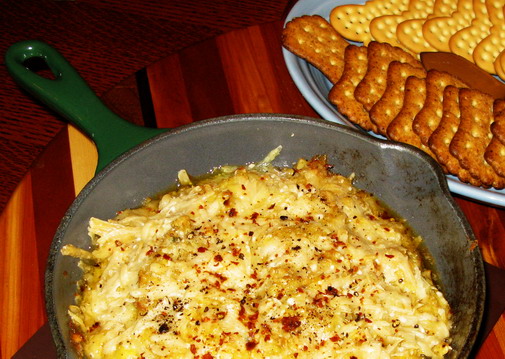
I don’t have any clue the provenance of artichoke parmesan dip/spread. My suspicions are that it came into existence in the United States between the decades of the 1950’s and 1970’s, probably in a woman’s magazine, either as an article, or in an ad promoting the use of canned artichoke hearts to make an “elegant hot appetizer.” Lots of party recipes from that era were touted as being “elegant.” Elegant was in.
I am not certain of how elegant artichoke parmesan is, really. It doesn’t particularly look elegant to me. The color, which ranges from pale celedon to faded celery, isn’t very appetizing, unless one does something to change it up a bit, and the fact that it is baked (some of them are made in crock pots, but I don’t count those–I like the crusty cheese layer you get in the baked versions) in the oven means that the main decorative changes that can be made involve using an attractive ramekin or other vessel in which to bake it.
That all said–it is a very delicious dish, which is why when you look it up on Google, you find a bazillion different recipes, most of them variations on the same ur-recipe from back in the dawn of canned artichoke prehistory. Most recipes have the same handful of ingredients: artichoke hearts, parmesan cheese, mayonnaise, garlic–usually in powdered form–and possibly some herbs. Some recipes include a packet of ranch dressing mix, some include a can of chopped green chilies, or a can of cream of whatever soup, and some include a package of shredded mozzarella cheese, but in general, the ingredient list is short, and regrettably, dependent on canned, dried or dehydrated ingredients for flavor.
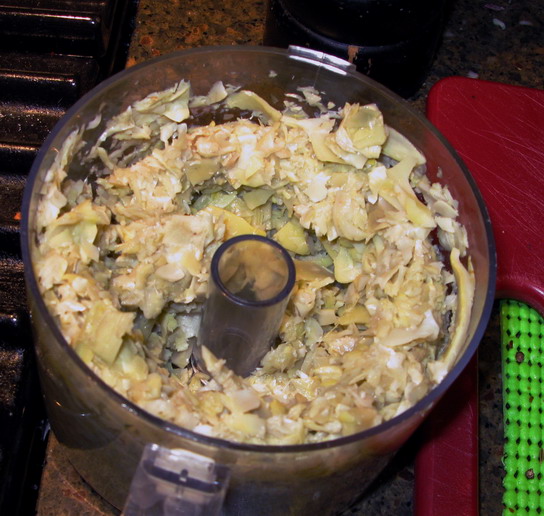
Don’t get me wrong–I have made this recipe many times with water-packed canned artichoke hearts, and it has turned out quite well. I am just of the opinion that if you can find frozen artichoke hearts, and either thaw them and use them uncooked or steam them lightly, the flavor of the artichoke is better, and the color is vastly improved. The color of the finished dip made with frozen artichoke hearts tends more toward the fresh green than the faded, yellowish celery, which I find to be much nicer overall.
If you do use canned artichoke hearts for this recipe, however, rinse them very well in warm water, and drain well before chopping them up.
I have found that since I refuse to use powdered garlic, and thus use minced up fresh garlic in this dish, that pre-cooking the dip mixture before baking it makes for a better flavor and texture.
So, I heat up a cast iron skillet, and add olive oil with a dab of butter to it. Then, I saute the garlic, along with any herbs I am using (fresh tarragon is divine), and the red pepper flakes, until the garlic is softened and golden and the oil/butter combination is well-flavored and scented. Then, I add the artichoke hearts which have been chopped roughly–they are in bits no bigger than my thumbnail–a food processor makes quick work of this step–and cook so that the garlic, herb and chili flavors make their way throughout the artichoke leaf flakes.
After the artichokes have cooked for a few minutes, I add fresh ground pepper, and the mayonnaise, and stir it all together.
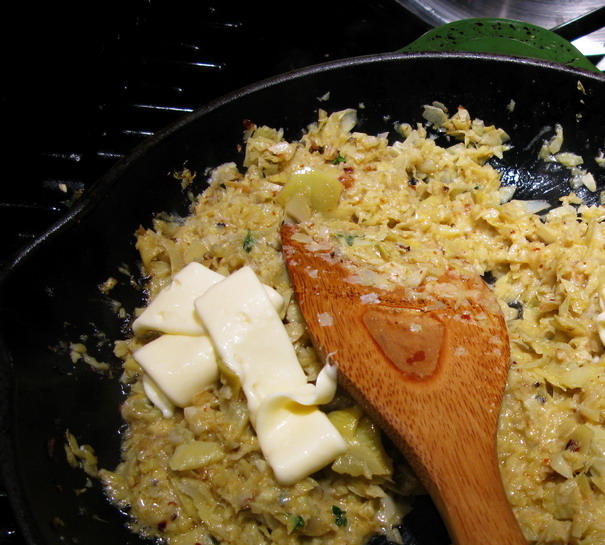
About the mayonnaise.
You don’t need cups and cups of it. Lots of recipes should be called “Mayonnaise and Parmesan Dip with a Hint of Artichoke to Give It Color” because they have so much mayo that it is just ridiculous. I know it is a holiday dish or a party treat, but geez–you don’t need to eat a dip made of nothing much more than fat, fat and more fat in order to celebrate.
In my artichoke parmesan recipe, when it comes to mayonnaise, less is more. I only use enough to bind the artichoke heart bits together. And I add it before I take it off the heat and mix in the cheese, because I have found that warm mayonnaise and artichoke blend together easier than cold. For 14-15 ounces of artichoke heart, I use only about a third of a cup of mayonnaise, and that is enough to make it creamy and spreadable or dippable without either becoming overly creamy and gloppy. And–you can still taste the artichoke hearts–a bonus!
After I mix most of the cheese in, I scrape the dip into a smaller cast iron skillet–my Le Creuset six inch skillet is perfect–and top it with some more cheese and a sprinkle of more chili flakes–I use Aleppo pepper flakes for a mild bite–and a grinding of black pepper, and pop it in the oven for about fifteen minutes, or just until it is bubbly and hot and the cheese on top has browned beautifully.
This is a flexible recipe, you know. You could caramelize onions or shallots and add them. Or, you could add Indian spices, if you so chose. (Oooh–I may have to do this for New Year’s Eve!) Or, add some fresh chilies or chipotles to give it a kicky taste of heat. Some Worcestershire sauce is not amiss, nor is some lemon juice (i prefer lemon juice) and zest. It gives a certain freshness to the dip that helps counteract all of the rich ingredients.
It is good stuff, particularly if you make it with good ingredients.
And it doesn’t have to be a dip or spread. I have used it to top pan pizza before–as the sole topping, or with some onions, fresh tomatoes and grilled chicken on top of it. I have also used it as a pasta sauce, and it is amazingly good. In both of these cases, you skip baking it and make it in the skillet, and then either put it on top of the pizza and bake it or toss it with the pasta and there it is.
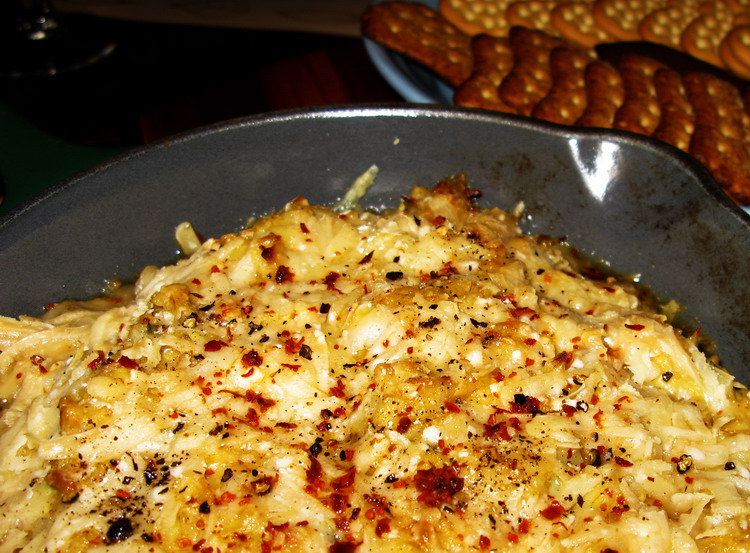
Artichoke Parmesan Dip
Ingredients:
1 15 ounce package frozen artichoke hearts, thawed or steamed according to package directions, or 1 14 ounce can of artichoke hearts packed in water, drained and rinsed in warm water thoroughly, then drained again
2 tablespoons olive oil
1 teaspoon butter (optional)
2 cloves garlic, peeled and minced finely
1 teaspoon Aleppo pepper flakes
1/2 teaspoon fresh thyme leaves or 1 teaspoon fresh tarragon leaves, chopped
zest of one lemon, finely shredded
1/3 cup mayonnaise
freshly ground black pepper to taste
2 teaspoons fresh lemon juice
1 1/4 cups shredded parmesan cheese, divided(the better the cheese you use, the tastier this dip will be)
salt to taste–you may not need any depending on how salty the cheese is
pinch Aleppo pepper, fresh herbs and black pepper for garnish
Method:
Preheat oven to 375 degrees F. Lightly oil your baking dish, ramekin or cast iron skillet that you will bake and present your dip in with a tiny bit of olive oil.
Either using or a food processor, or by hand, roughly chop the artichoke hearts until the leaves are about the size of a thumbnail at the largest, and some are smaller. Do not puree!
Heat olive oil and butter if you are using it, in skillet over medium heat, until butter froths. Add garlic and Aleppo pepper, and cook, stirring, until the garlic is golden and soft–a few minutes. Add fresh herb, lemon zest and the artichoke bits, and stir well. Cook for about two minutes more, just to flavor the artichoke well.
Stir in the mayonnaise, until it is thoroughly combined and the artichoke heart leaves hold together. Add black pepper to taste, and stir in the lemon juice.
Take pan off heat, and stir in the 1 cup of cheese until it is well mixed in. Taste for salt and add some if it is necessary.
Pack into ramekin, baking dish or small skillet, sprinkle with the 1/4 cup cheese and garnish, and bake for ten to fifteen minutes, or until it is hot and bubbly and the top is well-browned.
Serve with crackers, crusty bread, or pita chips of your choice.
Happy Boxing Day: Images From Our Christmas

While technically, last year was Kat’s first Christmas, at that time, being only a few months old, she didn’t really give a damned about it. So long as she was nursing, she was happy.
This year, on the other hand, she helped us decorate the tree, bake cookies and wrap presents.
And, as you can see, while she was technically able to unload her own stocking–she got a little bit of help from a friend.
That’s because two of the presents in her stocking were feather wand kitty toys, and Delia was all about them. I needed to get new ones because between Kat and Delia, the last one we had became completely denuded of feathers.

Eventually, Kat figured out that she didn’t need Delia’s help to get the stocking unstuffed.
I really enjoyed reading her Max’s First Word; the Ruby and Max stories were favorites when Morganna was a kid, and many of the books are out of print, so I was thrilled to find a copy of this one, which is really funny. Ruby and Max are still around, mind you–they, in fact, have their own show on Nickelodeon, but I don’t like the new way they are drawn. The original art was much better. The new Max and Ruby look way too sweet and cutesie for my taste.

Morganna and Kat were both very cute in the morning, as you can see–we awoke to smiling faces and laughter, and it pretty much continued throughout the day. Which is the way Christmas should be. Fun and frolic, and happy kids.

Now, Morganna is still happy here, just dismayed at the hood-hat thing that Kat pulled out of her stocking. While it is certainly cute, the problem with it is that Kat cannot take it off as it is a combination of jester hat and balaclava. It will certainly keep her warm, if irritated, all winter long.
(No, we did not gift Morganna with a similar hood-hat thing, although even if we did, she couldn’t complain much. She has a jester hat with bells and tassels with the word, “Pooka” embroidered on the front, as well as her cosplay bunny-ear hat, both of which she wears quite often, even when it isn’t particularly cold outside.)

Kat enjoyed opening presents, though, in the way of little kids everywhere, she liked the paper and boxes as much or more than the goodies inside. Typical, typical. The cats had fun playing hide and seek with their new catnip mousies among the mountains of paper, and pouncing out at Kat, Morganna, Zak and I.

Kat’s favorite present was this one–her new Radio Flyer riding toy. She had the plastic car, but it was so wide that she couldn’t get her feet on the floor well enough to push it around easily, and the wheels were sticky–they didn’t turn well. And, there was no way to steer the thing. I saw this one on Amazon, and read the reviews and the only bad thing anyone said was that it was very small. Hrm. That made me think it would be perfectly sized for my wee Kat–and it was. She has gotten really good at whizzing around the living room on it, and can even steer it.

Categories:
- Admin (rss) (55)
- Blogs and Blogging (rss) (81)
- Book Reviews: Cookbooks (rss) (43)
- Book Reviews: Non-Cookbook Food Books (rss) (38)
- Cats and Cat Blogging (rss) (47)
- Chinese Cooking Lessons (rss) (32)
- Culinary School Stories (rss) (18)
- Dairy Pruducts: Cultured and Barbaric (rss) (4)
- Documentary Filmmaking (rss) (1)
- Essays, Rants and Reflections (rss) (260)
- Fighting Hunger (rss) (12)
- Food and Kids (rss) (45)
- Food in the News (rss) (126)
- Food Media (rss) (98)
- Food Preservation (rss) (18)
- Food Safety (rss) (45)
- Gardening (rss) (30)
- Herbs and Herb Blogging (rss) (20)
- Holidays (rss) (50)
- Kat Blogging (rss) (22)
- Kitchen Science (rss) (36)
- Leftover Makeover (rss) (8)
- Life, the Universe and Everything (rss) (131)
- Local and Sustainable (rss) (227)
- Local Athens Food and Foodies (rss) (42)
- Meatless Mondays (rss) (32)
- Menu For Hope (rss) (5)
- Nutrition, Diet and Health (rss) (84)
- On The Farm (rss) (8)
- Recipes: Almost Vegetarian, Vegetarian and Vegan (rss) (294)
- Recipes: American Regional (rss) (37)
- Recipes: Appalachian Hillbilly (rss) (33)
- Recipes: Bread, Pasta, Grains (rss) (95)
- Recipes: Canning and Preserving (rss) (8)
- Recipes: Chinese (rss) (123)
- Recipes: Comfort Food (rss) (120)
- Recipes: Cookies (rss) (16)
- Recipes: Desserts (rss) (48)
- Recipes: French (rss) (25)
- Recipes: Fruits and Vegetables (rss) (302)
- Recipes: Greek, North African and Middle Eastern (rss) (31)
- Recipes: Indian (rss) (137)
- Recipes: Italian (rss) (42)
- Recipes: Japanese (rss) (7)
- Recipes: Jewish (rss) (4)
- Recipes: Korean (rss) (6)
- Recipes: Meat, Poultry and Fish (rss) (220)
- Recipes: Mexican/Native American/ Latin American/Caribb (rss) (27)
- Recipes: Original (rss) (108)
- Recipes: Thai (rss) (27)
- Recipes: Tofu (rss) (17)
- Recipes: US Regional (rss) (16)
- Recipes: Vietnamese (rss) (8)
- Restaurant Stories (rss) (28)
- Sewing, Quilting, Arts and Crafts (rss) (16)
- Simple Chinese Recipes (rss) (30)
- Slow Food and Heritage Foods (rss) (10)
- Spice Blogging (rss) (44)
- The Chinese Cookbook Project (rss) (14)
- The Chinese Pantry (rss) (39)
- The Documentary (rss) (2)
- The Kitchen Saga (rss) (17)
- The Locavore's Bookshelf (rss) (15)
- The Unsung Adventures of The Culinary Nerd (rss) (6)
- Tools and Toys (rss) (35)
- Uncategorized (rss) (10)
- With a Side of Politics (rss) (48)
Archives:
- August 2012 (9)
- July 2012 (12)
- September 2011 (3)
- August 2011 (7)
- July 2011 (8)
- June 2011 (16)
- May 2011 (17)
- April 2011 (11)
- December 2010 (9)
- November 2010 (5)
- February 2010 (1)
- December 2009 (5)
- November 2009 (7)
- October 2009 (10)
- September 2009 (16)
- August 2009 (14)
- July 2009 (14)
- June 2009 (7)
- May 2009 (17)
- April 2009 (10)
- March 2009 (25)
- February 2009 (13)
- January 2009 (10)
- December 2008 (5)
- November 2008 (5)
- October 2008 (6)
- September 2008 (13)
- August 2008 (8)
- July 2008 (11)
- June 2008 (18)
- May 2008 (13)
- April 2008 (14)
- March 2008 (16)
- February 2008 (17)
- January 2008 (19)
- December 2007 (25)
- November 2007 (18)
- October 2007 (24)
- September 2007 (16)
- August 2007 (15)
- July 2007 (15)
- June 2007 (10)
- May 2007 (14)
- April 2007 (16)
- March 2007 (17)
- February 2007 (20)
- January 2007 (13)
- November 2006 (1)
- October 2006 (8)
- September 2006 (14)
- August 2006 (25)
- July 2006 (30)
- June 2006 (28)
- May 2006 (34)
- April 2006 (29)
- March 2006 (24)
- February 2006 (30)
- January 2006 (38)
- December 2005 (40)
- November 2005 (37)
- October 2005 (32)
- September 2005 (25)
- August 2005 (30)
- July 2005 (28)
- June 2005 (21)
- May 2005 (8)
- April 2005 (22)
- March 2005 (17)
- February 2005 (29)
- January 2005 (10)
Search Site:
Links:
- Lily’s Wai Sek Hong
- 101 Cookbooks
- A cat in the kitchen
- A Veggie Venture
- Accidental Hedonist
- Cha Xiu Bao
- chez pim
- Chocolate & Zucchini
- Chopstick Cinema
- Chowhound.com
- Chubby Hubby
- Cook sister!
- Cooking with Amy
- da*xiang
- Eat Local Challenge
- Eating Liberally
- Ecocentric
- Eggbeater
- Epicurious
- Farmgirl Fare
- Fatfree Vegan
- Foodgoat
- ForkandBottle.com
- Green Olive Tree
- Hooked on Heat
- Jaden’s Steamy Kitchen
- Kalyn’s Kitchen
- Lucullian delights
- Mahanandi
- Matt Bites
- MeatHenge
- mmm-yoso!!!
- New York Times – Dining & Wine
- Pizza Goon
- Rasa Malaysia
- Ruhlman
- Sailu's Kitchen
- Serious Eats
- SF Gate: Food & Dining
- Simply Recipes
- Soul Fusion Kitchen
- Tastespotting
- The Amateur Gourmet
- The Cleaner Plate Club
- The Food Section
- The Grub Report
- thecookscottage
- U.S. Food Policy
- Wandering Chopsticks
- Washington Post Food and Dining
- Wasted Food
Meta:


Powered by WordPress. Graphics by Zak Kramer.
Design update by Daniel Trout.
Entries and comments feeds.